
Woman Won’t Leave Ex’s House, Goes Away in Cuffs
Woman Refuses to Leave Her Ex’s Home Until Police Put Her in Cuffs
A Relationship Dispute Reaches the Front Door
Police calls involving former partners are often difficult because the legal issue can look deceptively simple from the outside. One person says the relationship is over and wants the other person gone. The other insists there is unfinished business, property to collect, or some reason they should still be allowed to remain. By the time officers arrive, they are stepping into a disagreement that may have been developing long before the first 911 call.
That is the situation captured in this body-camera footage from September 24, 2023. The recording begins in the early afternoon and follows officers as they respond to a residence where a woman is at the home of a former partner. The central problem quickly becomes clear: the resident wants her to leave, while she does not immediately accept that the visit is over.
The encounter does not begin with a dramatic physical confrontation. Instead, officers spend much of the call talking, listening, checking what each person says, and repeatedly trying to resolve the situation without an arrest. That slower beginning is what makes the ending significant. The handcuffs do not appear out of nowhere. They come after a long sequence of warnings, explanations and opportunities to leave.
The footage provides a useful example of how a private relationship dispute can become a police trespass call once the person controlling the property withdraws permission for someone else to remain. It also shows why officers must distinguish emotional claims about a relationship from the immediate question they have been called to resolve: who has the lawful authority to stay at the residence at that moment?
The exact edited video circulates online under the title “Woman Wont Leave Exs House, Goes Away in Cuffs.” The Axon Body 3 timestamp visible in the supplied file places the incident on September 24, 2023. However, an extensive search of accessible local-news archives and public web records did not produce a sufficiently reliable article or official release that identifies the woman, the homeowner, the precise department or the final court disposition. Those details are therefore not invented here.
What follows is based primarily on the body-camera footage itself, with outside material used only to explain the broader legal and policing context where appropriate.
The Body Camera Establishes the Date and Sequence
The recording carries an Axon Body 3 overlay dated September 24, 2023, with the first sampled portion beginning shortly after 1:15 p.m.
That timestamp is important because reposted police footage frequently appears online months or years after the underlying incident. The upload date of a viral clip is not necessarily the date police responded.
Here, the camera metadata gives the encounter a firm chronological anchor.
The video then follows several officers through different stages of the call. At first, they are gathering information. Later, they are standing at the doorway speaking with the people involved. Finally, the woman is escorted to a patrol vehicle in handcuffs.
That progression gives the incident a clear beginning, middle and end even though a public police report has not been located.
Officers Arrive to a Dispute Between Former Partners
The core conflict is personal but the police task is practical.
A former partner is at a residence where the person connected to the home no longer wants her to remain.
The woman appears to believe she has reasons to stay or continue the discussion. Officers, meanwhile, are trying to determine whether she has a current legal right to remain at the property or whether the resident is simply asking that she leave.
This distinction matters.
A former romantic relationship does not automatically create a permanent right to enter or remain in another person’s home. At the same time, officers cannot assume that everyone described as an “ex” is merely a visitor. Questions involving tenancy, shared residence, property ownership and established occupancy can make removal much more complicated.
The footage shows officers taking time to sort through the situation rather than immediately placing anyone under arrest.
The Resident’s Wishes Become the Key Issue
As the conversation develops, the wishes of the person associated with the home become increasingly important.
Police calls of this type often turn on consent.
A guest may initially enter a property with permission. That does not necessarily mean the permission continues indefinitely.
Once the person with authority over the property clearly communicates that the guest must leave, remaining can create a potential trespass issue depending on the facts and local law.
The footage shows officers repeatedly trying to communicate that the woman cannot simply continue the confrontation because she wants to.
The emotional history of the relationship may explain why she is there. It does not automatically resolve the property question in her favor.
Why Officers Do Not Rush the Arrest
One of the most revealing aspects of the video is the amount of time officers spend talking.
They do not appear eager to turn the call into an arrest.
Instead, they ask questions, listen to explanations and give the woman opportunities to separate from the situation.
That is significant because removal calls can be volatile. A sudden arrest can increase tension when a person is already emotionally invested in a breakup or argument.
Voluntary compliance is usually the cleaner outcome.
If the person leaves, the immediate conflict ends without a booking, a criminal allegation or a physical struggle.
The footage suggests officers are trying to reach exactly that result for much of the encounter.
The Woman Remains at the Doorway
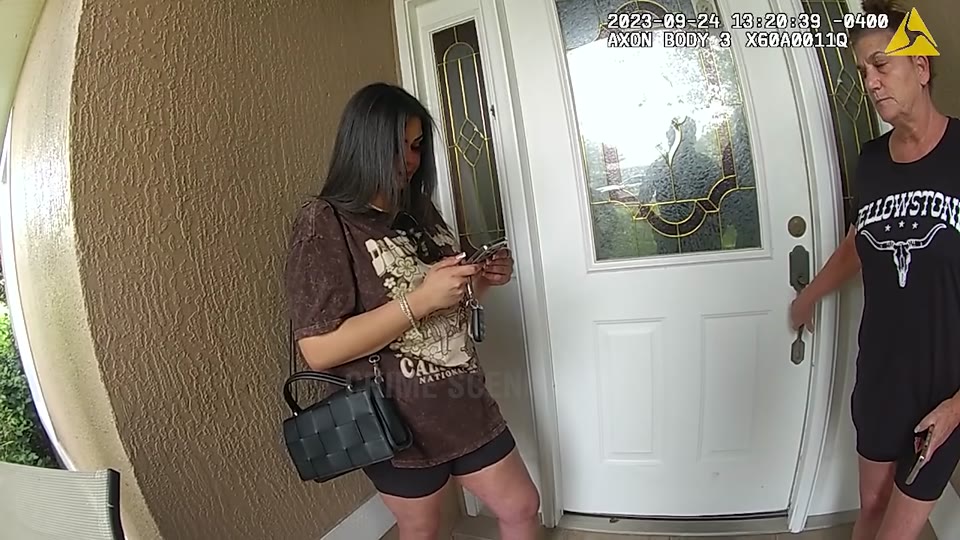
A clear body-camera frame shows the woman standing immediately outside the residence while another woman remains at the doorway.
The scene is visually calm at that moment.
There is no large crowd.
There is no visible weapon.
There is no high-speed pursuit or chaotic street confrontation.
That makes the source of the tension easy to understand: it is about boundaries.
The woman is physically close to the entrance of a home where her continued presence is being disputed.
Officers are positioned between a private relationship disagreement and the need to restore control of the property.
The longer she remains, the less the call resembles a conversation between former partners and the more it becomes a question of compliance with police direction.
Repeated Explanation Becomes Repeated Warning
Police encounters often change character through repetition.
The first request can be conversational.
The second may be firmer.
After several clear explanations, the same instruction can become a warning.
That progression appears in this footage.
The woman is not simply confronted with handcuffs at the first moment of disagreement. Officers continue explaining what they need her to do.
The important point for readers is not the exact number of warnings. It is the overall pattern visible in the recording: police repeatedly attempt to resolve the situation before moving to physical custody.
Property Disputes Can Become Complicated Quickly
A person may have belongings inside a former partner’s home even after permission to remain there has ended.
That can create a practical problem.
Leaving the property does not necessarily mean abandoning every possession forever. Arrangements can sometimes be made for later retrieval, a civil standby, or another controlled exchange depending on local procedures.
What a person generally cannot do is use a dispute over belongings as unlimited permission to remain in a confrontation at someone else’s residence.
The bodycam illustrates why officers often separate the immediate safety issue from later property questions.
First, end the confrontation.
Then determine how any remaining belongings or civil issues should be handled.
The Call Is About Control of the Scene
From the officers’ perspective, the most urgent goal is not to decide who was right throughout the entire relationship.
They are not relationship counselors.
They are responding to a specific present-tense conflict.
Who is allowed to be at the residence?
Does anyone need to leave?
Is anyone refusing a lawful direction?
Is there a risk that the argument will escalate if both sides remain together?
Those questions are narrower than the emotional dispute but far more useful for restoring order.
The video becomes easier to understand when viewed through that lens.
The Ex-Partner Label Can Distract From the Legal Question
Viral titles often emphasize that the people involved used to be in a relationship.
That makes the story instantly relatable, but it can also obscure the legal issue.
An ex-partner can be a lawful tenant.
An ex-partner can also be an invited guest whose permission has been revoked.
Those situations are not interchangeable.
The body-camera footage does not provide enough independently verified documentation for this article to make broad claims about lease status or property title.
What it does show is that the responding officers ultimately treat the woman as someone who must leave rather than someone entitled to remain inside the home.
The Situation Moves Away From Voluntary Resolution
For several minutes, the possibility of a peaceful departure remains open.
The woman has access to a vehicle.
Officers are present.
The confrontation can end simply by creating distance from the residence.
But the discussion continues.
At some point, officers determine that verbal persuasion is no longer resolving the call.
That is the turning point.
The focus changes from convincing the woman to leave to enforcing the decision that she cannot remain.
Once that happens, the consequences become much more immediate.
Handcuffs Change the Entire Encounter
The arrest phase is visibly different from the earlier conversation.
The camera moves closer.
Officers control the woman’s arms and position.
She is escorted away from the residence.
The question of whether she will leave voluntarily is no longer open.
She is now leaving because police are taking her into custody.
This is why the long lead-up matters so much.
A short social-media edit showing only the final minute might make the arrest seem abrupt. The complete footage shows that officers had spent substantial time trying to reach a different outcome.
The Patrol Car Becomes the Final Destination
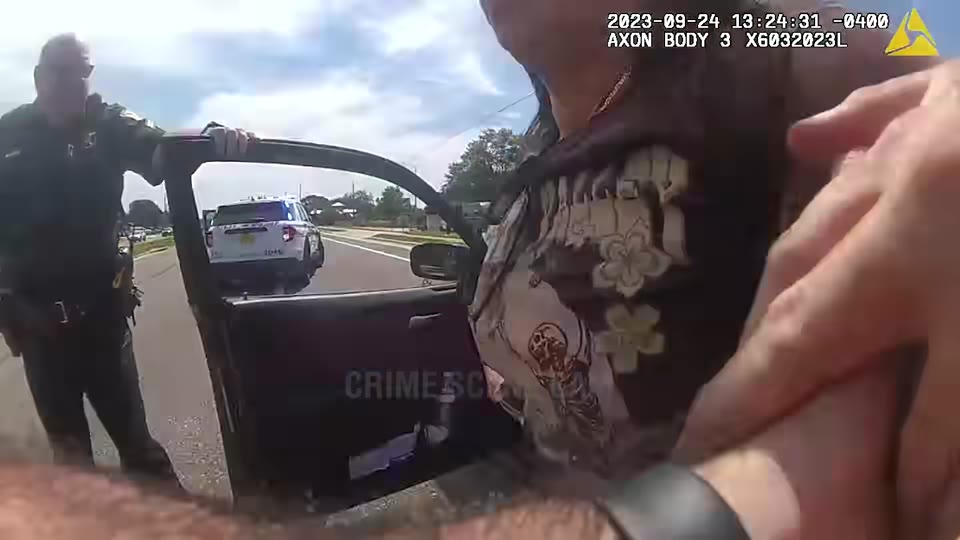
A later frame shows the woman beside a police vehicle while officers complete the arrest process.
The home is no longer the center of the scene.
The physical separation that officers had been trying to create has finally happened, but through custody rather than voluntary departure.
For the resident, the immediate property dispute is effectively over.
For the arrested woman, however, the encounter has moved into a new stage involving booking and whatever allegation officers believed was supported by the circumstances.
Because no verified booking record or court file has been conclusively matched to the footage, this article does not state a specific charge as established fact.
Why We Should Be Careful With the Word Trespass
The circumstances strongly resemble a trespass-removal call, and reposts of the incident describe the dispute in those terms.
But criminal trespass statutes vary by jurisdiction.
The precise elements can depend on notice, property type, prior permission, occupancy rights and other facts.
Without a verified jurisdiction and charging document, it would be irresponsible to quote a specific statute or claim a conviction.
The safest description is that officers responded to a refusal-to-leave dispute and ultimately arrested the woman after efforts to resolve the situation failed.
That wording captures what the camera shows without pretending to know what an unseen court record says.
An Arrest Is Not the Same as a Conviction
Police bodycam channels often end a story at the moment the patrol car drives away.
The legal system does not.
After an arrest, prosecutors may file charges, change charges or decline prosecution.
A defendant may enter a plea.
A court may dismiss a count.
The case may resolve through diversion or another outcome.
None of those possibilities can be determined from handcuffs alone.
That is why this article does not attach an invented sentence or criminal history to the woman.
The video documents police custody. It does not, by itself, document a final judgment.
Why the Footage Is Still Valuable Without a News Article
Not every police call becomes a newspaper story.
Local newsrooms have limited staff and typically prioritize shootings, fatal crashes, major public-safety incidents, public corruption and unusual cases.
A refusal-to-leave arrest at a private residence may never generate a standalone article even if the body-camera footage is later released through a public-record request.
That appears to be the situation here.
The lack of a matching news story does not make the footage meaningless.
It simply means the article must rely more heavily on direct observation and avoid unsupported personal details.
The Viral Reposts Add Very Little Verification
Searches for the exact title find reposts and social-media summaries of the same footage.
Those posts repeat the basic premise that a woman would not leave her former partner’s home and was eventually taken away in handcuffs.
But repetition is not independent confirmation.
If ten accounts copy the same caption from one original video, there are still not ten separate sources for the underlying facts.
For verification, a police report, court docket, booking record or reputable local-news article would be much stronger.
None was located with enough certainty to justify naming the participants.
The Date Is the Strongest External Research Clue
The visible September 24, 2023 timestamp allowed targeted searches of arrest logs and police bulletins.
Those searches produced numerous unrelated trespass and domestic-dispute incidents from the same date, but none matched the footage strongly enough to be treated as this case.
Choosing the closest-looking arrest would create a serious risk of falsely identifying a real person.
That is precisely the kind of mistake a responsible bodycam article should avoid.
When the evidence stops, the identification should stop with it.
Why a Calm Scene Can Still Be Serious
There is a tendency to measure police incidents only by physical intensity.
No chase means it is minor.
No weapon means it is unimportant.
No crash means there is no story.
This footage shows why that assumption is wrong.
A private-property dispute involving former partners can escalate into arrest without any cinematic action.
The tension comes from whether someone will respect a boundary after it has been clearly communicated.
The absence of a violent climax does not make the consequences less real.
The Officers’ Patience Drives the Narrative
For storytelling purposes, the most important element is the repeated effort to avoid the ending viewers know is coming.
Every additional explanation creates the same question: will she finally leave?
That is a natural retention mechanism.
The article does not need fabricated danger or exaggerated language.
The uncertainty already exists in the footage.
The woman can walk away.
She remains.
Officers explain again.
She continues the argument.
The possibility of arrest becomes increasingly obvious.
Then it happens.
Why This Structure Keeps Readers Engaged
A strong incident article should not dump the entire outcome into the opening paragraph and then repeat it for 3,000 words.
Instead, it should reveal the case in stages.
First comes the central conflict.
Then the property issue.
Then the officers’ attempts to mediate.
Then the repeated refusal.
Then the transition to enforcement.
Finally, the article explains what can and cannot be verified about the legal aftermath.
Each section advances the story rather than merely restating the headline.
That is the approach used here.
The Homeowner’s Perspective Matters
A residence is more than a physical structure.
For the person who lives there, it is the place where they expect control over who enters and remains.
When a former partner refuses to leave, the conflict can feel invasive even if no physical violence occurs.
The footage shows why police take these calls seriously.
Leaving both parties to continue an escalating argument at the doorway may simply postpone a larger confrontation.
Creating separation can be the most important immediate goal.
The Woman’s Perspective Also Explains the Resistance
Understanding a person’s perspective is not the same as agreeing with every decision they make.
Breakups can involve confusion, anger, unfinished conversations and disputes over possessions.
Someone may genuinely feel that they deserve another conversation or more time at the property.
Those emotions can explain why leaving feels unacceptable in the moment.
But police arriving at a residence are not there to force a former partner to continue a personal discussion.
Once the resident wants the contact to end, emotional investment does not necessarily create a legal right to remain.
The Bodycam Reduces the Need for Guesswork
Without video, the story might be summarized in a few sentences: officers were called, a woman refused to leave and she was arrested.
The bodycam adds the most important missing element: time.
Viewers can see that the encounter develops gradually.
They can observe the distance between people.
They can hear the ongoing discussion.
They can watch officers move from persuasion to custody.
That sequence allows readers to evaluate the escalation rather than relying entirely on a later description.
But the Camera Still Has Limits
Body cameras do not show everything.
They begin recording at a particular point.
They capture the perspective of the officer wearing them.
They may not show what happened before police arrived.
They do not automatically reveal property records, tenancy agreements or the full history of a relationship.
They also cannot tell viewers what a prosecutor later decided.
The footage is powerful evidence of the encounter, but it is not a complete legal file.
What the Video Establishes
Several facts can be stated confidently.
The encounter occurred on September 24, 2023.
Police responded to a residence.
A woman was involved in a dispute connected to a former partner.
Officers spent significant time speaking with the people involved.
The woman remained near the residence while officers attempted to resolve the situation.
The encounter ultimately ended with officers placing her in handcuffs and escorting her to a police vehicle.
Those facts are visible in the supplied recording.
What the Video Does Not Establish
The footage does not provide a reliably verified full name for the woman.
It does not establish a final court disposition.
It does not prove a criminal history.
It does not justify adding unrelated allegations from similarly dated arrest records.
It does not give this article permission to identify a random police department based on a partially visible vehicle.
Those gaps remain gaps.
Maintaining them is preferable to filling them with speculation.
Why Relationship Calls Require Clear Boundaries
Former-partner disputes can become difficult because the emotional relationship and the legal relationship may end at different times.
Someone can feel that a relationship conversation is unfinished even after permission to enter a home has ended.
Police officers have to work with the immediate facts in front of them.
If a resident wants a visitor gone and the visitor has no established right to remain, the officer’s task may eventually become enforcement rather than mediation.
The footage demonstrates that transition in real time.
A Different Choice Could Have Ended the Call Earlier
The most striking part of the encounter is how avoidable the final scene appears.
There is no indication in the footage that the woman was physically trapped at the property.
She had the opportunity to create distance.
Had she left when officers first made clear that the visit was over, the call could have ended without handcuffs.
That does not answer every legal question, but it explains the practical lesson of the video.
When police are resolving a property dispute, continuing the argument on the property can turn a personal disagreement into an arrest.
The Arrest Ends the Immediate Conflict
Once the woman is placed in the patrol vehicle, the central problem that brought officers to the residence is resolved.
The parties are separated.
The unwanted presence at the home ends.
Officers can complete whatever paperwork or evidence documentation is required.
The resident can return inside.
The woman’s disagreement with the situation can continue through whatever legal process follows, but it no longer continues at the doorway.
That is the practical ending captured by the camera.
Why the Story Works Without Exaggeration
The video does not need a sensational rewrite.
Its tension is straightforward.
A woman wants to remain.
Her former partner wants the contact to end.
Police try to negotiate.
She does not leave.
The officers’ patience narrows.
The possibility of arrest becomes more likely.
Eventually, she is taken away in cuffs.
That sequence is enough to hold attention because every stage contains a choice that could change the ending.
The Most Reliable Timeline
Shortly after 1:15 p.m. on September 24, 2023, officers were involved in a call concerning a woman at a residence connected to a former partner.
The body-camera footage shows officers gathering information and speaking with the parties.
The woman remains near the doorway while the dispute is discussed.
Police repeatedly work toward having her leave the property.
The interaction continues rather than ending through voluntary departure.
Officers ultimately take the woman into custody.
A later portion of the footage shows her beside a patrol vehicle while the arrest is completed.
No sufficiently reliable public source was located that confirms her identity, the precise department or the final court outcome, so those details are intentionally omitted.
The Larger Lesson Is About Boundaries
The most useful takeaway is not that one side “won” a breakup argument.
It is that private boundaries can become legal boundaries once permission to remain on property is withdrawn and police become involved.
At that point, continuing to argue may not preserve anyone’s position.
It may simply create a new problem.
The footage captures that shift with unusual clarity.
The relationship history explains why the woman is reluctant to leave.
The police response explains why reluctance eventually stops mattering to the immediate outcome.
Watch the Full Encounter
The complete body-camera footage shows the long conversation that precedes the arrest, the repeated attempts to resolve the dispute at the residence, and the moment the encounter finally changes from negotiation to custody.
Comments (0)
Loading comments...
May You Like
Officer Stops to Help but the Situation Quickly Escalates

🚨⛽ Man Caught in a Disturbing Incident at a Gas Station | Police Respond US

West Virginia Man Laughs at Police Officer and Ends Up Arrested













