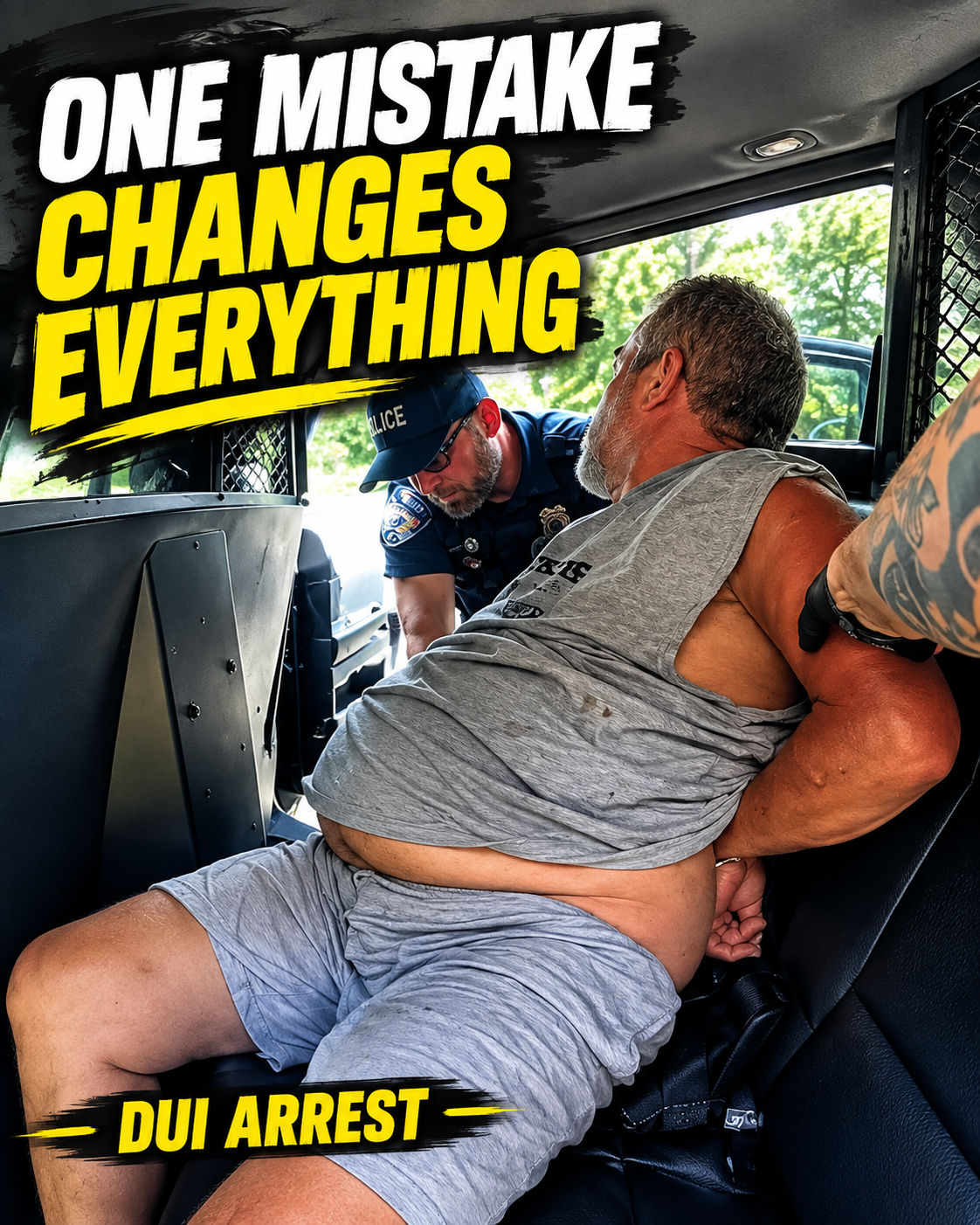
Woman Lectures Police About the Law Until They Arrest Her
Scroll down to watch the full video
She Kept Saying “This Is My Car” — Then She Crossed the 25-Foot Line and a Simple Traffic Stop Turned Into an Arrest
The stop was supposed to be simple. It was May 2nd, 2025, and officers on night patrol noticed a vehicle being driven without its headlights on. That alone was enough reason to make contact, but when I walked toward the driver's window, I had no idea that a few minutes later two people would be in handcuffs. I didn't know the driver would tell me he had no valid license, that his license had been suspended because of a DUI, or that the woman sitting nearby would eventually become part of the investigation herself. At the beginning, there was nothing dramatic about it. I approached the vehicle and asked the driver how he was doing. I told him I'd noticed that he had been driving without his lights on. He immediately gave me an explanation. He said he had turned them on as soon as he got close enough to the other vehicle. I acknowledged what he said and asked for his driver's license, registration, and proof of insurance. The driver started looking for his documents and explained that he had only just realized where his license was. Then the woman came out to help him. She was talking, moving around, trying to get the documents together, and asking what the problem was. I explained that I had pulled him over because he had been driving without his lights. She asked whether that was really a problem. At that moment, it still felt like an ordinary roadside conversation. I wasn't looking for a reason to turn it into something bigger. I was trying to figure out exactly what was happening. Then I asked the driver whether his license was valid. His answer was immediate: no. That single word changed the stop. I asked why he was driving if he knew his license wasn't valid. He explained that the woman was getting ready to go to work and that he had literally just needed to go get her. It was a simple explanation, but it didn't change the fact that he had knowingly gotten behind the wheel without a valid license. I asked how long his license had been invalid. He couldn't give me a clear answer, saying it had been “a while.” I asked what the suspension was for. He eventually told me it was for DUI. Now there was more context to the stop than there had been when I first approached the car. The headlights were only the beginning. The driver knew his license wasn't valid. He knew it had been suspended. And he had chosen to drive anyway because he wanted to pick someone up. Maybe to him, it was a short trip. Maybe he thought nothing would happen. But that was the decision that had put him behind the wheel that night, and now we had to deal with the consequences of that decision.
The driver kept trying to explain himself, and I could tell he wanted me to understand that he wasn't trying to cause trouble. He talked about where he had been earlier. The woman interrupted him at times, correcting things or adding her own version. The conversation was already becoming difficult to follow. At one point, she was talking about having been somewhere earlier that day, and there was mention of an interview that morning. The driver had a Florida ID, and we were trying to sort through the documents connected to him and the vehicle. While I was checking his information, I asked for the registration and proof of insurance. The woman was still moving around the vehicle, trying to locate things. There was nothing unusual about someone wanting to help during a traffic stop. But there is a difference between helping retrieve documents and remaining inside the immediate area of an active investigation after an officer tells you to move away. That distinction became important very quickly. I told her to stand over to the side. She didn't want to. She said it was her car. I explained that I was conducting the traffic stop and asked her again to stand over there. She pushed back. She questioned why she had to move. I told her she was within twenty-five feet of the traffic stop and that I needed her to stay back. She didn't seem to accept that instruction. She continued talking, continued standing close, and continued challenging the reason she was being told to move. I repeated the instruction. She repeated her objection. At one point, she told me that I couldn't arrest her for anything. I told her that if she continued refusing to follow the instruction and remained within the immediate area of the traffic stop, she could be arrested. She seemed almost offended by the idea. From her perspective, this was her car. She wasn't the driver being investigated. She believed she had a right to be there. I understood that she was frustrated, but the traffic stop was already underway. I needed the scene controlled. The driver was still being dealt with, his license was being checked, and now I had another person moving around and arguing with me. I told her again to stand back. She continued. Eventually I told her that she was going to get herself put in jail if she kept behaving this way. That wasn't the outcome I wanted. It was a warning. She still had a choice. She could step away. She could let the traffic stop finish. She could ask questions later. Nothing had happened yet that required the situation to become physical. But the more she challenged the instruction, the more the original reason for the stop seemed to disappear beneath a new conflict. The driver's headlights were no longer the center of the encounter. Neither was his suspended license. The new question was whether the woman would follow the direction to stay away from the traffic stop.
The driver, meanwhile, was still trying to deal with his own problem. I asked him to turn the vehicle off and wait while I checked his license. Then I asked him to step out. He explained that the windows didn't work. I told him that was fine and asked him to step out another way. He eventually came out and turned toward the vehicle. I reminded him that he didn't have a valid license. His response sounded like someone who was already overwhelmed by everything happening around him. He started talking about his life, saying he was just trying to live, trying to get by. The more I listened, the more I realized there was more going on in his life than what I could see from the driver's seat. Later, after he was in custody, he would tell us that he was homeless and living day to day. He had just had a job interview. He said he was trying to be a good citizen. Those details weren't available to me in full when I first approached him, but they helped explain why he seemed so desperate to convince us that he wasn't a bad person. He wanted us to know that he was trying. He wanted us to understand that he wasn't driving because he didn't care about the law. He was trying to pick someone up. He had a job interview. He was trying to survive. But a difficult life doesn't make an invalid license valid. That was the uncomfortable part of the encounter. I could understand his circumstances without being able to ignore the violation. He could be struggling and still be responsible for his decision. Those two things could exist together. But while I was dealing with him, the woman was still nearby, and the situation around us was becoming more unstable. I told her again to move away. She continued to argue. She said it was her car. I told her that didn't change the fact that I was conducting a traffic stop. She told me I couldn't arrest her. I told her again that she needed to listen. Twenty-five feet had become the number repeated over and over because that was the distance I was using to establish where I needed her to be. She seemed to hear the number as a challenge to her ownership of the vehicle. I meant it as a safety boundary around an active traffic stop. Those were two completely different interpretations of the same instruction. And when people hear an instruction differently from the person giving it, a situation can deteriorate before either side realizes how far it has gone.
I remember the moment when the tone changed. Up to that point, the woman had been argumentative, but arguing isn't the same as physical resistance. People can disagree with officers. They can be frustrated. They can complain. They can ask why. None of those things automatically turns a traffic stop into an arrest. But I had already told her multiple times to move away. She remained close. Then she started moving toward us more aggressively. I repeated the instruction. She kept coming. At that point, I had to make a decision about how to control the scene. The driver was nearby. The woman was approaching. The traffic stop was still active. And she was not following the repeated directions to stay back. Then physical contact happened. She put her hands on a deputy. Almost immediately, she began protesting that the deputy had touched her first. She said she had been pushed. From her perspective, that was the defining fact. She believed she had been touched first, and everything she did afterward was a reaction. From the deputy's perspective, the sequence was different. She had been instructed repeatedly to stay away. She had moved aggressively toward the officers. The physical confrontation followed. Those competing versions would become part of the argument afterward, but in that moment there wasn't time to stand on the side of the road and debate whose memory was more accurate. The situation had escalated. The officers moved to secure the people involved. The driver protested. He said he hadn't done anything. He kept saying this was his car. He wanted his phone. He wanted his belongings. He was watching the woman being taken into custody and trying to understand why the situation had become so serious. He was also still dealing with his own license problem. It was as if two separate issues had suddenly collided in the same few seconds. The driver had knowingly been driving without a valid license. The woman had been ordered repeatedly to stay away from the traffic stop. Now both were facing arrest. The driver kept insisting that the officers had problems. An officer told him that he was the one with the problem. The words weren't going to solve anything. At that point, the scene had moved beyond conversation. The camera was still recording, and every movement was being captured. But in the middle of the confrontation, nobody was thinking about how the footage would look later. Everyone was focused on what was happening right then.
Once the driver was secured, he continued trying to explain himself. He asked for his phone and belongings. He kept saying that the vehicle was his. He complained that the officers had put their hands on him first. He wanted someone to listen to his side. Then he told us something that immediately needed attention: there were animals inside the vehicle. He needed someone to know. That detail changed the conversation for a moment. An arrest doesn't erase the responsibilities someone has left behind. If there are animals in a vehicle, somebody has to deal with that. If there are personal belongings, they need to be secured. If someone has a phone, keys, or other property, those things still matter even when the person is being taken into custody. I told him that we would get his belongings. He continued asking for his phone. He was scared and frustrated, but beneath all of that was another concern: what was going to happen to the things he was responsible for? Then he started talking about being homeless and living day to day. He said he had just had a job interview. He said he was trying to be a good citizen. That sentence stayed with me because it was so different from the person we had just been struggling to control. People often imagine that someone who resists an arrest doesn't care about the consequences. But what I saw was more complicated. He cared deeply about the consequences. He was frightened about his belongings. He was worried about the animals. He was worried about his car. He was worried about his future. And he was angry because he believed the entire situation had started with something that shouldn't have mattered. He kept returning to the headlights. He said the sun had still been up. He questioned whether the lights were even necessary. He said he had turned them on as soon as he got close enough. In his mind, the headlights were the original injustice. If the headlights weren't a legitimate reason to stop him, then perhaps everything that followed felt illegitimate too. But from the officers' perspective, the stop had already revealed another violation: he was driving without a valid license. That fact existed independently of the argument over the headlights. The reason someone is initially stopped and the violations discovered afterward are not necessarily the same thing. The driver didn't seem willing to separate those issues. He wanted the entire encounter judged by the first question. We were dealing with the entire sequence.
The woman was still arguing too. She wanted us to acknowledge that she had been touched first. She wanted to know why she should be arrested when she believed she was reacting to the officers. An officer explained that she had been told repeatedly to move away from the traffic stop. He told her that she was within twenty-five feet and that he had warned her multiple times. He explained that she came toward them aggressively and that this forced them to respond. Then he made the key point: when she put her hands on a deputy, the situation became a battery-on-law-enforcement investigation. She still argued that the deputy had pushed her first. The officer repeated that she had been warned not to come close. It was a circular argument. She believed the physical contact justified her actions. The officer believed the repeated instructions and her approach explained why the officers had intervened. Neither side was willing to accept the other's interpretation. At some point, the officer asked her to consider how she would feel if someone ignored her instructions and came toward her. She answered by essentially turning the question around: how would you feel if someone simply put their hands on you? That was the human part of the argument. She wasn't talking about statutes anymore. She was talking about what the encounter felt like from her position. But the officer answered from his own experience. If he were told by an authority figure to stay away from an active traffic stop, he said he would listen. That was his standard. He explained that being an adult meant understanding when an authority figure was telling you to do something. Again, that didn't resolve the disagreement. It only showed how differently both sides were viewing the same moment. The woman saw herself as someone whose space and property were being violated. The officer saw himself as someone trying to maintain control of a traffic stop. The driver saw himself as a man who was already struggling and now watching his night collapse. And the camera saw all of it without understanding any of it. Cameras don't know who is scared. They don't know who feels humiliated. They don't know who thinks they are being disrespected. They simply record.
What made the situation especially difficult was that none of these people appeared to believe they were the villain in their own story. The driver wasn't saying, “I know I shouldn't be here.” He was saying, “I'm just trying to get through the day.” He wasn't describing himself as someone who wanted to break the law. He was describing himself as someone who needed to pick up a person who was going to work. The woman wasn't saying, “I'm trying to interfere with a police investigation.” She was saying, “This is my car.” She didn't appear to believe that standing near her own vehicle should turn into an arrest. The officer wasn't saying, “I want this situation to become physical.” He was repeatedly giving instructions intended to prevent exactly that. Those perspectives can exist simultaneously even when the encounter ends badly. And that is one of the most difficult things for someone watching body-camera footage to understand. When you watch the final few minutes, you see the confrontation. You see people shouting. You see the arrests. You hear accusations from both sides. But you don't always feel the buildup. The escalation isn't one single event. It's a series of small moments that gradually remove the easy exits. The driver chooses to drive without a valid license. The officer stops him. The woman chooses to remain close. The officer tells her to move. She argues. The officer repeats the instruction. She moves closer. Another warning comes. She continues. Physical contact occurs. Then the choices become narrower. The officer has to respond. The woman is taken into custody. The driver is taken into custody because of the license issue. And suddenly everyone is trying to explain what happened after the opportunity to simply walk away has disappeared. That is why the twenty-five-foot boundary matters so much in this story. It wasn't just a measurement. It became the last visible opportunity to de-escalate. Before the woman crossed it again, there was still time to stop. Once the confrontation became physical, there was no easy reset.
The driver's story was particularly painful because he kept talking about the future he was trying to build. He said he was homeless. He said he was living day to day. He had just had a job interview. He was trying to be a good citizen. Imagine having an interview that morning, trying to get yourself back on your feet, and then making the decision to drive despite knowing your license isn't valid. Maybe you tell yourself it is only a short trip. Maybe you tell yourself you're helping someone get to work. Maybe you tell yourself nothing will happen. Then the lights are behind you, and the decision that seemed small suddenly becomes the center of your entire night. That doesn't excuse it. But it shows how ordinary desperation can lead people into decisions that create even bigger problems. He didn't have to drive. He chose to. And once we discovered the license was invalid, there was no way for me to pretend that fact didn't exist simply because I understood why he had done it. That's an uncomfortable truth about accountability. Sometimes the reasons behind a decision are understandable, but the decision is still yours. The driver wanted us to see the difference between being a person who had made a bad choice and being a person who was permanently defined by that choice. He kept saying he was trying to be a good citizen. In his mind, that sentence mattered. He wanted us to know that this wasn't the whole story of his life. And he was right about one thing: an arrest doesn't give anyone a complete biography of another person. We didn't know everything he had been through. We knew what the traffic stop revealed. We knew what he told us. We knew what was recorded. The rest belonged to his life beyond that roadside. The same was true for the woman. We knew what happened during the stop. We knew the instructions she was given. We knew there was physical contact. But we didn't know everything that had brought her to that moment emotionally. That's why I don't think the lesson is simply “listen to the police” or “the police were right.” The deeper lesson is about how quickly two people can become trapped inside a confrontation when neither side is willing to give the situation room to breathe.
Eventually, the legal consequences were clear. The male driver was charged with driving without a driver's license. The woman was charged with obstruction, resisting arrest, and battery on an officer. Those are the charges stated at the end of the source. Whatever happened beyond that is not provided in the footage, so the story ends there. But the emotional ending happened earlier, when the driver was still asking for his phone, his belongings, and help with the animals inside the vehicle. He had started the night trying to pick someone up. He had explained that he had an interview that morning. He said he was homeless. He said he was trying to be a good citizen. And now he was sitting in the middle of an arrest scene, trying to protect whatever pieces of his life were still outside the handcuffs. That is the part people sometimes miss when they watch police footage. Arrests don't happen to characters. They happen to people. And people don't stop having responsibilities simply because they have lost their freedom for the night. The woman still had a car. The driver still had animals to worry about. They both still had lives waiting for them after the footage ended. But they had also made decisions that brought them to that moment. Understanding their circumstances doesn't mean pretending those decisions didn't happen. The driver knew his license wasn't valid. The woman had been told repeatedly to stay away from the traffic stop. The physical confrontation happened after those instructions. Those facts matter just as much as the emotional context. A complete story has room for both. It can acknowledge that someone is struggling without excusing what they did. It can acknowledge that someone felt threatened without automatically deciding that every action afterward was justified. It can recognize that officers are human while still examining what they did. And it can recognize that the people being arrested are human without erasing the reasons they were arrested.
When I think back to that night, I don't think about the headlights first anymore. I think about the distance. Twenty-five feet. That's all it was. A small stretch of pavement between a woman and an active traffic stop. She didn't believe that distance mattered. She believed her connection to the vehicle gave her a reason to stay close. The officer believed the repeated instruction mattered more in that moment. The driver was caught between them, already facing the consequences of driving without a valid license and watching the situation around him deteriorate. In the end, that small distance became the dividing line between arguing and arrest. The most important part of the story isn't that twenty-five feet is some magical number. It isn't. The important part is what the number represented: the moment when a person still had the ability to step away from the conflict. Sometimes stepping back feels like losing. It can feel like admitting that someone else is right. It can feel humiliating to walk away when you believe you have been treated unfairly. But stepping back isn't always surrender. Sometimes it's the decision to protect yourself from making the next mistake. The driver had already made his choice when he decided to drive without a valid license. The woman had another choice when she was told to stay away. Then she had another one when she was warned again. Every warning was another opportunity for the night to end differently. Once physical contact happened, those opportunities disappeared. The handcuffs came out. The explanations became arguments. The arguments became accusations. And the simple traffic stop over headlights became a night that two people would remember for very different reasons. Maybe that's the real lesson hidden inside this footage. We often imagine that life changes because of one enormous decision. Sometimes it doesn't. Sometimes it changes because of a small decision that seems harmless in the moment. A short drive without a valid license. A few steps toward an officer. A refusal to move twenty-five feet away. A decision to keep arguing when there is still time to stop. You don't always know which decision will become the one you wish you had made differently. But once the consequences arrive, the distance between the moment you had a choice and the moment you lose that choice can be frighteningly small.
Comments (0)
Loading comments...
May You Like
🚔⚠️ 911 Call Comes Hours Later After a Troubling Bath Incident | Ohio, USA

💨 High-Speed Police Pursuits Caught on Dashcam | Intense Moments Across the USA 🇺🇸

Woman Refuses Repeated Orders to Exit Her Car Before Officers Move In