
When Being Uncooperative Goes Completely Wrong... 🤦♀️
Routine Traffic Stop Escalates After Driver Refuses to Cooperate With Officers
A Traffic Stop That Refused to Stay Routine
A traffic stop can be over in minutes when the driver and officer move through the familiar sequence: pull over, provide identification, address the alleged violation and follow the officer’s instructions. The encounter captured in this September 20, 2022 body-camera footage follows a very different path.
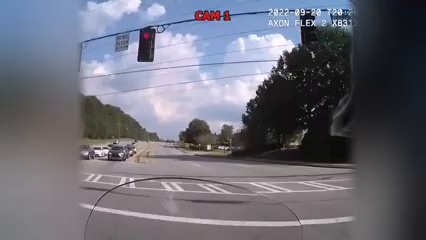
The supplied video begins with an officer observing a vehicle on a public roadway. The Axon Flex 2 overlay places the encounter on September 20, 2022. What initially appears to be an ordinary traffic enforcement contact gradually becomes a prolonged confrontation involving questions about the driver’s license, vehicle documents, registration information and alcohol inside the vehicle.
The driver repeatedly disputes the officers’ authority and the basis for their requests. The conversation grows more confrontational. Additional officers become involved. Eventually, the encounter moves from the roadside conversation to an arrest and a search of the vehicle.
The footage later shows an officer handling a bottle of wine associated with the vehicle. The video’s narration and on-screen case summary describe allegations involving traffic violations, an open container, failure to display a license and resistance or obstruction during the encounter.
There is an important limitation, however. Although the footage itself is clear and the same edited incident has circulated online under the title “Racist Karen Gets a Huge Reality Check,” searches of accessible official releases, court databases and local-news archives did not produce a sufficiently reliable independent record tying the footage to a named defendant, exact police department and final court disposition. For that reason, this article does not invent a name, city, conviction or sentence.
Instead, the account below separates what can be observed directly in the footage from what the edited video itself claims. That approach preserves the most compelling part of the story without turning uncertain internet captions into facts.
The Camera Gives Us a Firm Date
The strongest identifying clue appears directly in the body-camera overlay.
The Axon Flex 2 recording is dated September 20, 2022.
That matters because body-camera metadata is more useful than the date on which a compilation channel later uploaded the clip. The version currently circulating on YouTube appeared years after the original encounter, but the police recording itself clearly comes from 2022.
The footage also shows daylight conditions, a multilane road and an intersection at the beginning of the encounter.
Those details provide a reliable factual foundation even when the exact jurisdiction cannot be independently established from public reporting.
The Stop Begins With Traffic Enforcement
The opening phase looks familiar.
An officer follows the vehicle and initiates contact.
The driver is asked for identification and documentation.
Instead of moving quickly through those requests, the conversation becomes a dispute over why the officer wants the information and what the driver believes she is required to provide.
That distinction is central to the escalation.
The original reason for a traffic stop may be relatively minor, but a roadside encounter can become more complicated when an officer is unable to complete the basic identification and citation process.
A Driver’s License Becomes a Major Point of Conflict
Throughout the footage, officers repeatedly return to the question of the driver’s license.
The driver argues, questions the requests and does not simply hand over the information in the manner officers expect.
The edited video later characterizes failure to display a license as one of the alleged violations.
Because this article could not independently locate the underlying citation or charging document, that allegation is attributed to the video rather than presented as a verified conviction.
What the camera does establish is the prolonged disagreement itself.
The identification issue consumes time and becomes one of the reasons additional officers remain involved.
Vehicle Documentation Adds Another Layer
The encounter also includes discussion about the vehicle’s registration or decal.
Officers examine the vehicle and talk through whether its displayed registration information is current.
Again, a detail that might ordinarily take seconds becomes part of a broader argument.
Traffic stops are procedural by design. Officers typically need to identify the driver, confirm driving status, check registration and insurance information when required, and determine how to resolve the original violation.
When each step becomes contested, the stop grows longer and the opportunity for misunderstanding increases.
The Tone Changes Before the Physical Arrest
One of the most important features of the footage is that the arrest does not appear without warning.
There is a lengthy verbal phase first.
The driver has repeated opportunities to communicate with officers.
Officers repeat instructions.
The driver continues challenging what is happening.
The interaction becomes increasingly tense, but the camera preserves the progression.
For viewers, that context matters. A short clip beginning only at the moment officers take hold of someone can create an entirely different impression from a longer recording that shows the preceding conversation.
Additional Officers Arrive
As the stop continues, more than one officer becomes involved.
The arrival of additional personnel changes the visual dynamic.
What began as a conversation beside a vehicle now involves several uniformed officers, multiple cameras and a driver who remains resistant to the direction the encounter is taking.
Additional officers can serve several purposes during a difficult stop: scene safety, traffic control, witness observation and assistance if an arrest becomes necessary.
Their presence does not by itself establish that the driver has committed a crime. It does, however, show that the original officer no longer considers the encounter a simple one-person traffic contact.
The Body Camera Records Competing Narratives
The driver and officers do not appear to agree about what is happening.
The driver frames the contact as unfair or unnecessary.
Officers frame their actions as routine enforcement and repeated attempts to obtain cooperation.
This is exactly the kind of dispute body cameras are useful for documenting.
The recording does not require viewers to rely entirely on an officer’s later written report or a driver’s recollection. It preserves the actual language, timing and physical movements of the encounter.
That does not mean every legal question can be answered by watching a video. But it gives investigators, courts and the public a much stronger evidentiary record.
The Encounter Moves Toward Arrest
Eventually, the officers stop treating the situation as a conversation that can continue indefinitely.
The driver is physically detained.
The footage becomes tighter and more chaotic as officers work around the vehicle.
At one point, the camera view is partially blocked by bodies and equipment, a common limitation of chest- or head-mounted police cameras during close physical contact.
The edited video describes the later allegation as resisting or obstructing.
Without the original charging record, this article does not state that the driver was convicted of either offense.
The footage does show that the detention required physical involvement from officers rather than a simple voluntary handcuffing.
Why the Camera Angle Matters
Body-camera footage is powerful, but it is not omniscient.
During the arrest phase, an officer’s arm, another person’s body or the vehicle itself can block the lens.
The camera also follows the officer wearing it rather than providing a fixed overhead view.
That means viewers should be cautious about making claims concerning movements that occur outside the frame.
Audio may establish that officers are giving commands even when the exact position of every hand or arm is not visible.
A responsible account describes what the camera captures and avoids filling gaps with assumptions.
The Vehicle Becomes Part of the Investigation
After the driver is under control, officers turn their attention back to the vehicle.
The footage shows them examining the interior and dealing with items associated with the stop.
This is where the encounter moves beyond the original traffic issue.
The edited version of the video references an open-container allegation.
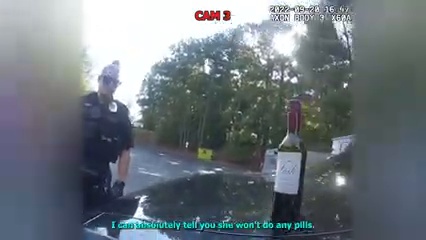
Near the end of the footage, a wine bottle is plainly visible.
That visual evidence supports the narrower statement that alcohol was present and handled by officers. It does not, by itself, answer every legal question about who possessed it, whether it was open while the vehicle was moving or how a court ultimately treated the allegation.
The Wine Bottle Is Clearly Visible
One of the clearest late-stage images shows an officer standing beside the vehicle with a bottle of wine.
The bottle is not an AI recreation or a stock photograph. It is directly visible in the police footage.
The driver can be heard making statements about alcohol and medication during the later interaction.
Those statements are part of the recording, but they should not be transformed into a medical diagnosis or an unsupported claim of intoxication.
The most defensible conclusion is simply that alcohol became relevant to the officers’ investigation and that a wine bottle was documented at the scene.
Open-Container Rules and DUI Are Not the Same Thing
A common mistake in online commentary is to treat the presence of an alcoholic beverage in a vehicle as automatic proof of impaired driving.
Those are different legal questions.
An open-container offense generally concerns possession or location of an opened alcoholic beverage in a vehicle under the applicable state or local law.
A DUI or impaired-driving case requires its own evidence.
The footage provided here does not justify inventing a blood-alcohol concentration, toxicology result or DUI conviction.
The edited video focuses on an open-container allegation rather than supplying verified laboratory evidence of intoxication.
The Video’s Viral Title Is Not a Legal Finding
The clip circulates under a provocative title that uses the words “Racist Karen.”
That phrase is an internet label, not a criminal charge.
It may describe how an editor interprets statements or behavior in the encounter, but it should not replace factual reporting.
For that reason, this article does not use the label as the subject’s identity and does not claim that prejudice itself was the legal basis for the arrest.
The more reliable story is about a traffic stop that escalated through repeated disputes over identification, documentation, officer instructions and the subsequent arrest.
Why Removing the Viral Label Improves the Story
Sensational labels can generate clicks, but they also narrow the reader’s attention.
Once someone is introduced only as a stereotype, every later action is interpreted through that label.
A stronger narrative lets the recorded behavior speak for itself.
Readers can hear the driver’s words.
They can observe the officers’ responses.
They can see how long the encounter continues.
They can decide what they think without the article needing to insult the person involved.
That approach is also safer when the underlying court record has not been independently located.
The Edited Video Adds Claims That Require Caution
The circulating video includes narration and graphics that summarize alleged violations.
Those editorial additions are useful clues for research, but they are not equivalent to an official police report or certified court record.
Compilation channels often obtain public-record footage and then condense hours of material into a shorter narrative.
Editing can improve clarity, but it can also remove context.
For this reason, the article uses the original-looking body-camera portions as primary visual evidence and treats the editor’s legal summary as secondary information unless independently confirmed.
Public Web Searches Confirm the Circulating Video, Not the Entire Case
The exact edited incident can be found online under the same viral title.
The widely circulated version identifies itself as body-camera material obtained for an independent law-enforcement video channel.
However, the public description does not provide the defendant’s name, the department or a docket number.
Other reposts repeat the title and generalized claims, but repetition is not independent verification.
Ten websites copying the same caption do not become ten separate sources.
That is why no personal identity is inserted into this article simply to make the story appear more complete.
The Date Helps, but It Is Not Enough
September 20, 2022 narrows the search considerably.
The officer’s spoken surname, McKinnon, offers another clue.
Yet neither clue produced a sufficiently reliable match in accessible official archives.
There are many law-enforcement officers with that surname and thousands of traffic stops on any given day.
Choosing a similarly named officer from an unrelated agency would be worse than leaving the jurisdiction unidentified.
Accuracy sometimes means acknowledging what cannot be confirmed.
What We Can Say With Confidence
The encounter was recorded on September 20, 2022.
It involved a traffic stop.
The driver repeatedly disputed officers’ requests.
The stop became prolonged.
Multiple officers participated.
The driver was eventually detained and handcuffed.
Officers examined the vehicle.
A wine bottle appears in the footage.
The edited video describes alleged traffic, identification, open-container and resistance-related violations.
Those points are supported either directly by the footage or by clearly attributed editorial material.
What We Should Not Claim
There is no reliable basis in the material reviewed to publish the driver’s full name.
There is no sufficiently verified source establishing the exact city or police department.
There is no court record in hand proving a final conviction or sentence.
There is no verified blood-alcohol concentration.
There is no basis to diagnose the driver with a medical or psychiatric condition.
And there is no reason to turn an internet nickname into a factual identity.
Leaving those details out makes the article more accurate, not less complete.
The Stop Demonstrates How Escalation Accumulates
Most confrontational police encounters do not jump instantly from calm to arrest.
They accumulate friction.
One request is challenged.
The explanation produces another argument.
An officer repeats a direction.
The person questions the direction.
Another officer arrives.
The original issue becomes buried beneath the disagreement over how the stop itself is being handled.
That pattern is visible here.
By the time officers physically detain the driver, the encounter has moved far beyond the traffic issue that started it.
Communication Becomes the Central Problem
The video is useful as a case study in failed communication.
Both sides are speaking, but the conversation rarely produces resolution.
The driver appears focused on disputing the legitimacy of the stop and the officers’ conduct.
The officers remain focused on identification, compliance and completing their investigation.
Because those goals never converge, each exchange increases frustration.
For a reader, that dynamic creates natural narrative tension without any need to exaggerate what happened.
Why Traffic Stops Are Structured
Police traffic-stop procedures can feel repetitive because they are designed to establish basic facts quickly.
Who is driving?
Is the license valid?
Is the vehicle properly registered?
What violation prompted the stop?
Is there an additional safety concern?
When those questions are answered, the officer can usually decide whether to issue a warning, citation, make an arrest or take some other lawful action.
When the information is withheld or disputed, the stop often lasts longer rather than shorter.
An Arrest Does Not Prove Every Allegation
The footage clearly reaches an arrest.
That does not mean every accusation discussed in the edited video was ultimately proven.
An arrest reflects an officer’s decision that probable cause exists for an offense.
A prosecutor may later modify or decline charges.
A defendant may contest them.
A court may dismiss some counts or reach a conviction on others.
Because the final disposition could not be independently verified here, the article stops short of claiming a legal outcome that the available evidence does not establish.
The Bottle Is a Strong Image but a Limited Fact
Visually, the bottle of wine is one of the most memorable images near the end of the footage.
It gives the viewer a tangible object after many minutes of argument.
But evidence should not be asked to prove more than it can.
A bottle can establish that a bottle existed.
Its location and condition may support an open-container investigation.
It does not automatically establish impairment.
It does not tell us when the alcohol was consumed.
It does not replace a chemical test.
The distinction is simple but important.
Body Cameras Preserve the Sequence
Without body-camera footage, the public might encounter this case only as a short arrest entry or a paragraph in a police report.
The recording preserves something different: sequence.
It shows how long the verbal stage lasts.
It shows when additional officers arrive.
It captures repeated requests and responses.
It documents the physical arrest.
It records officers returning to the vehicle.
That chronology is the real value of the footage.
Editing Can Change the Viewer’s Experience
The supplied file is not presented as an untouched evidence export.
It contains editing, subtitles and narration.
That means the viewer is seeing both police footage and a later creator’s storytelling choices.
Subtitles can emphasize particular statements.
Cuts can compress time.
Narration can tell the audience how to interpret behavior.
For research, the safest method is to separate the visible body-camera evidence from the editor’s commentary and verify the latter wherever possible.
Why Independent Reporting Is Hard to Find
Not every traffic arrest becomes a news story.
Local outlets tend to focus on crashes, serious violence, unusual public-safety events or cases involving well-known people.
A contentious traffic stop may exist in police records and court files without ever receiving a dedicated newspaper article.
That appears to be a possibility here.
The lack of a readily discoverable article does not mean the footage is false. It means the external record available through ordinary web search is limited.
The Viral Repost Is Useful Only as a Lead
The current YouTube upload confirms that the same footage has circulated widely.
Its description says the channel obtains law-enforcement footage and edits incidents for educational and commentary purposes.
That helps explain why a 2022 body-camera encounter can become a viral upload years later.
But the upload’s popularity does not make its title an official characterization.
For a blog built around verified police incidents, the footage itself should remain the center of the story.
A Better Way to Hold the Reader
The strongest retention strategy for this case is not to reveal every detail in the first paragraph.
The opening establishes that an ordinary traffic stop will end in arrest.
The next sections show why.
Identification becomes a dispute.
Vehicle documentation adds friction.
Additional officers arrive.
The driver continues challenging the process.
Physical detention follows.
Then the wine bottle introduces another investigative issue.
Each stage answers one question while creating another.
That structure gives the reader a reason to continue without resorting to fabricated cliffhangers.
The Turning Point Is Procedural, Not Cinematic
There is no high-speed crash or dramatic foot chase in this incident.
The turning point is more ordinary and therefore more instructive.
Officers decide the conversation is no longer moving toward voluntary compliance.
From there, the encounter changes from explanation to enforcement.
The driver is detained.
The vehicle is examined.
Evidence is documented.
The emotional intensity rises even though the physical setting barely changes.
That is what makes the footage compelling.
The Ending Is About Consequences, Not a Viral Nickname
By the end of the recording, the driver is no longer debating from behind the wheel.
She is in police custody.
Officers are processing the scene and dealing with the vehicle and its contents.
Whatever viewers think about the argument that preceded the arrest, the encounter has produced concrete consequences.
The safest factual conclusion is not that an internet stereotype received a “reality check.”
It is that a traffic stop escalated because routine investigative steps never reached a cooperative resolution.
The Most Defensible Timeline
On September 20, 2022, an officer initiated a traffic stop captured on an Axon Flex 2 body camera.
The driver and officer disputed identification and vehicle-related issues.
The stop continued for an extended period.
Additional officers became involved.
The driver was ultimately physically detained and handcuffed.
Officers then continued their investigation around the vehicle.
A bottle of wine was documented in the footage.
The edited video later characterized the incident as involving traffic, licensing, open-container and resistance-related allegations.
The exact jurisdiction, defendant identity and final court outcome could not be independently confirmed from sufficiently reliable public sources, so they are intentionally omitted.
Why That Limitation Matters
It can be tempting to fill missing details with whatever appears in a repost, comment section or scraped social-media page.
Doing so would make the article look more specific while making it less trustworthy.
A verified police-content blog benefits from the opposite approach.
Use precise facts when they are available.
Attribute allegations.
Separate footage from commentary.
Acknowledge uncertainty.
Do not invent a court ending simply because the video itself has an entertaining ending.
Readers may come for dramatic footage, but credibility is what gives them a reason to return.
Watch the Full Encounter
The complete footage shows how an apparently routine roadside stop becomes a prolonged dispute, why additional officers become involved, how the arrest unfolds and what officers document afterward.
Comments (0)
Loading comments...
May You Like

One Driver’s Decision to Flee Brings Police Racing After Him

Karen Entitled’ Woman Gets Tased After Allegedly Ramming Police Cars

Police Chase Ends as Driver Hits Stoplight, Crashes Into West Towne Mall












