
When An Entitled Couple Thinks Laws Don't Apply To Them...
How a Milwaukee County Motorcycle Stop Escalated Into Two Arrests
A July 2, 2023 traffic stop that began with questions about eye protection and motorcycle licensing turned into a physical confrontation, two arrests, an impounded motorcycle, and a later criminal case. The footage is a reminder that the most consequential moments in police encounters often begin with ordinary roadside rules.
HOOK
At first, almost nothing about the encounter suggests how far it is about to go. A motorcycle is stopped on a residential street in Milwaukee County, Wisconsin. The rider is standing near the bike. Officers are asking the kind of questions that routinely appear in traffic enforcement: Do you have a license? Do you have the required motorcycle endorsement? Where is your eye protection? Nearby residents begin to watch. A man who identifies himself as connected to the rider and the motorcycle moves closer. Voices rise. Directions that initially sound procedural become repeated commands to step back, move away, and show hands.
Then the character of the scene changes. The dispute is no longer primarily about a motorcycle. It becomes about physical control of the scene, compliance with police commands, and whether the people involved will allow officers to complete the stop. The body-worn footage shows officers and civilians converging on a sidewalk, a struggle breaking out, and additional officers becoming involved. By the end, both the rider and her boyfriend are in custody and the motorcycle is headed for impound.
That escalation is what makes this footage compelling. The beginning is so ordinary that viewers can easily imagine a different ending: a citation, a warning, a tow, perhaps an argument, and everyone eventually walking away. Instead, a sequence of choices turns a traffic matter into a criminal case. The tension comes not from a mystery about what officers first noticed, but from watching a situation repeatedly offer chances to de-escalate and then move in the opposite direction.
OPENING
According to a transcript and summary of the Lens Of Law video, the incident occurred on July 2, 2023 in Milwaukee County. The rider, identified in that source as Yashira, was stopped after officers said she was operating the motorcycle without proper eye protection and without the required motorcycle licensing. During the conversation, she reportedly indicated that she had a regular driver license at home but acknowledged that she did not have a motorcycle endorsement. The footage supplied for this article is consistent with that account: an officer can be heard asking about a motorcycle endorsement while the rider stands beside the bike.
Those details matter because Wisconsin treats motorcycle operation as a distinct licensing category. The Wisconsin Department of Transportation says a Class M motorcycle license can be obtained through an approved rider course or through the permit and road-test process. WisDOT also states that motorcycle operators must use qualifying eye protection unless the motorcycle has a windshield extending at least 15 inches above the handlebars. In other words, the issues raised at the beginning of the stop were not invented after the confrontation; they are ordinary parts of Wisconsin motorcycle regulation.
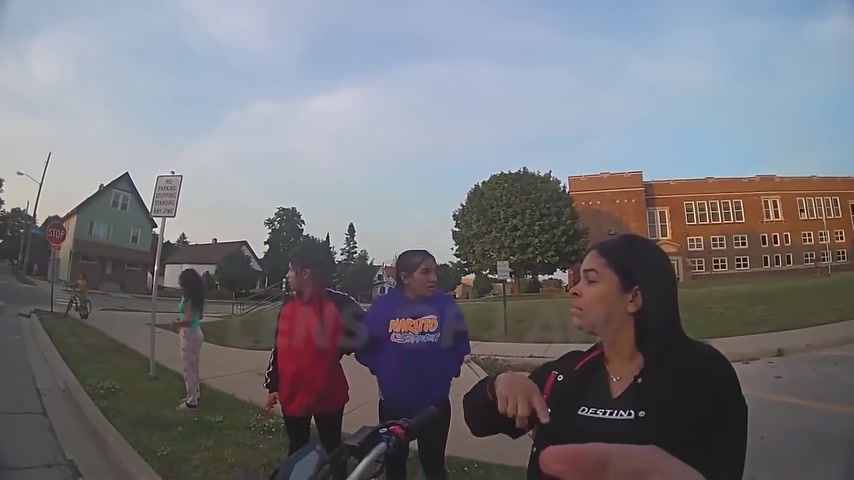
A real frame from the supplied footage, captured during the roadside discussion before the encounter fully escalated.
For a viewer, the important distinction is between the reason for the initial stop and the conduct that follows. Traffic stops often involve disagreements. A driver or rider can believe an officer is mistaken, ask questions, request clarification, or contest a citation later. But once an encounter becomes a physical struggle, the legal stakes can change rapidly. Wisconsin's resisting-or-obstructing statute makes it a Class A misdemeanor to knowingly resist or obstruct an officer who is acting in an official capacity and with lawful authority. The statute is not a blanket rule that every disagreement with police is a crime; Wisconsin legal materials specifically identify knowledge, official capacity, and lawful authority as elements. But physically resisting an arrest or interfering with an officer's actions can create exposure far beyond the original traffic violation.
The video also demonstrates another dynamic common to public police encounters: the arrival or involvement of friends, partners, or bystanders. The rider is not isolated. Several people are visible around the stop, and her boyfriend, identified in the video summary as Charlie, becomes an active participant. Officers repeatedly direct people to move away from the immediate area. The scene therefore becomes harder to manage with each additional person who moves closer, argues, or refuses a direction. What may feel to a friend like support can, from an officer's perspective, become another person whose hands, movements, and intentions must be monitored.
This is one reason the footage holds attention. There are several simultaneous conflicts. The rider disputes what is happening. Her boyfriend focuses on the motorcycle and on her treatment. Officers are trying to maintain distance around the stop. Other people are watching and speaking. The camera is constantly moving between faces, hands, the bike, the sidewalk, and arriving officers. Instead of one dramatic turning point, the escalation happens through accumulation.
DEVELOPMENT
The first phase remains largely verbal. The rider questions the stop and the licensing issue. Officers continue asking for information and directing her around the motorcycle. The conversation is tense but still recognizable as a traffic investigation. The key moment is not simply that the rider is unhappy; it is that officers begin giving increasingly direct instructions while the people around them continue challenging the situation.
The boyfriend's approach intensifies the encounter. In the published transcript summary, officers tell him to back up and warn that he can also be arrested if he refuses to leave the immediate scene. That warning is significant because it establishes a clear boundary before the physical struggle. The footage then shows officers trying to keep space around the rider while multiple people remain nearby. What had been a one-person stop now requires attention in several directions.
As the confrontation becomes physical, the camera view turns chaotic. Bodies fill the frame, officers move quickly, and the calm geometry of the earlier stop disappears. The rider is brought toward the ground as officers attempt to restrain her. Her boyfriend also becomes involved in a struggle with officers. The published video summary says additional assistance was requested and that officers described him as continuing to fight while they attempted to control him. The supplied footage visibly shows officers restraining both individuals at different points and later placing them into police vehicles.
It is worth being precise about what can and cannot be established. The bodycam video is powerful evidence of the encounter, but a short edited video is not the entire investigative record. It does not automatically show every officer's viewpoint, every statement made before the recording segment, every report, or every later court filing. For that reason, this article relies on the video for observable sequence and on published or official sources for the surrounding legal context. Where a final outcome cannot be independently confirmed from a court record available in the sources reviewed, it should not be guessed.
The Lens Of Law transcript summary reports that Yashira was accused of striking an officer and that she was ultimately found guilty of battery and resisting or obstructing an officer. It further reports a sentence of nine months in a house of correction and one year of probation. The same source says Charlie was charged with resisting an officer but does not establish his final disposition. That distinction is important. An arrest or charge is not the same thing as a conviction, and the absence of a verified final result should remain an absence rather than be filled with speculation.
Wisconsin law helps explain why the later allegations are much more serious than the licensing question that began the encounter. Under Wisconsin's general battery statute, intentionally causing bodily harm to another person without consent can constitute misdemeanor battery, while more serious injury levels can carry felony classifications. Wisconsin also separately defines resisting or obstructing an officer. Once a traffic stop becomes a physical confrontation, prosecutors are no longer looking only at whether a rider possessed the correct endorsement or eyewear; they may be evaluating the conduct during the encounter itself.
That is the central narrative lesson of the incident. The original problem appears administratively manageable. A motorcycle can be parked or towed. A rider can be cited. Licensing can be corrected later. A disagreement can be challenged in court. None of those outcomes requires a sidewalk struggle. Yet the footage shows the encounter moving step by step from a regulatory issue to physical force, arrest, jail transport, and criminal allegations.
The boyfriend's concern about the motorcycle becomes another recurring thread. The video summary says the motorcycle was towed and impounded and that, after his arrest, Charlie repeatedly asked what had happened to it, said it belonged to him, and requested translation assistance. In the patrol vehicle footage, the emotional energy has changed. The street confrontation is over; the questions now concern consequences that are already unfolding. That shift is narratively powerful because it shows how quickly control of the situation has moved away from the couple. Minutes earlier, they were arguing beside the motorcycle. Later, they are separated in police vehicles while the motorcycle is no longer in their possession.
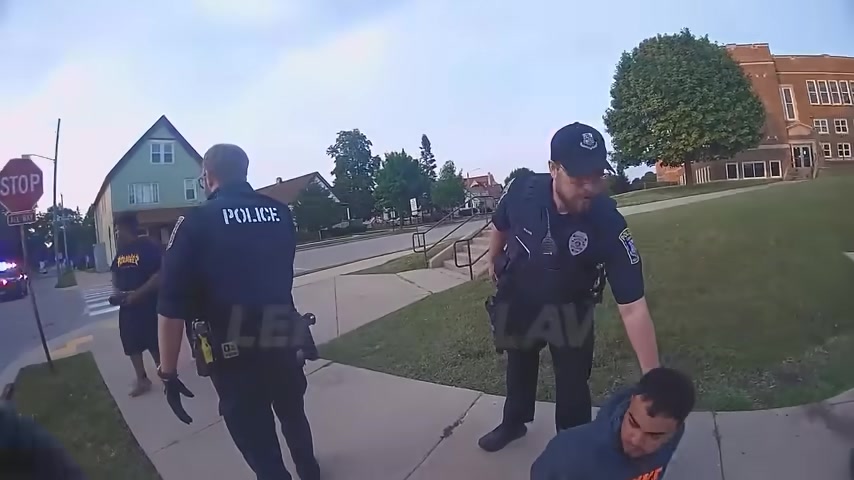
A second real frame from the supplied footage after the confrontation, as officers secure the scene.
There is also a practical lesson in the role of bystanders. Police encounters are public events, and people generally have important rights to observe and record police activity from lawful positions. But observation is different from physically entering an officer's working space or refusing lawful commands tied to scene control. The footage illustrates how quickly officers' attention can shift when someone approaches a tense arrest. Every additional movement has to be interpreted in real time, often before an officer knows whether the person intends to help, argue, pull someone away, or simply get closer.
For readers, this is where the incident becomes more than a viral confrontation. It is a case study in escalation. The most useful question is not which person delivered the sharpest line or appeared most frustrated. It is what decisions increased or decreased the available options. Early in the stop, there are many possible endings. As commands are ignored and physical resistance begins, those options narrow. Once officers and civilians are wrestling on the ground, the encounter has entered a stage where injury, additional charges, and force are much more likely.
That narrowing of options is a strong retention device in storytelling because viewers understand the danger before they know the outcome. Each warning creates a new question: Will the person step back? Will the rider comply? Will the boyfriend disengage? Will the officers regain control without anyone being hurt? A compelling account does not need to exaggerate those questions. The real sequence already contains enough uncertainty.
The location also contributes to the unusual feel of the footage. This is not a high-speed pursuit on an empty highway or a nighttime call in an isolated area. It unfolds in daylight on a neighborhood street, with homes, a large brick building, sidewalks, grass, and onlookers nearby. The normal setting makes the sudden physical struggle more jarring. Everyday surroundings remain unchanged while the stakes for the people in the center of the frame rise dramatically.
The official Wisconsin motorcycle rules provide additional context for the initial stop. WisDOT says all motorcycle operators generally need eye protection unless a qualifying windshield is present, and the state maintains a specific Class M licensing process. These requirements are safety-oriented and routine. That makes the later outcome especially disproportionate to the starting point: a stop over equipment and licensing questions ultimately produces consequences far more significant than the traffic issues themselves.
At the same time, a responsible retelling should avoid turning the people in the video into caricatures. Viral titles often use labels such as “entitled,” but labels are interpretations, not legal findings. The verifiable story is stronger without them: a rider was stopped; she and her boyfriend argued with officers; officers issued repeated commands; the encounter became physical; both were arrested; the motorcycle was impounded; and the available video summary reports a later conviction and sentence for the rider. Those facts create a complete narrative without pretending to know anyone's personality, motives, or private thoughts.
ENDING
By the end of the footage, the street has returned to relative calm, but the consequences are already in motion. The rider and her boyfriend are separated and transported. The motorcycle is removed. What began as a question about lawful motorcycle operation has become a criminal justice matter.
The published Lens Of Law summary states that the rider was later found guilty of battery and resisting or obstructing an officer, with a sentence of nine months in a house of correction and one year of probation. It does not provide a confirmed final court outcome for the boyfriend's resisting charge. Because no independent news report or readily accessible official court record located in this research supplied a fuller verified disposition, this article does not go beyond that source on the final case results.
One useful piece of independent corroboration comes from public Cudahy records. A later Cudahy Common Council packet names Corporal Adam Wege and Officer Rachel Zumstein among department personnel, matching the first names and roles used in the video summary. That document concerns a separate August 2023 incident, so it does not itself prove the details of this July stop, but it supports the identification of the officers as members of the Cudahy Police Department around the same period. The combination of the footage, the published transcript summary, and official Wisconsin rules provides a consistent picture of the encounter's basic framework.
The broader takeaway is simple: roadside encounters can change categories in seconds. A licensing issue can remain a licensing issue, or it can become an arrest for conduct that happens after the stop begins. The law provides processes for disputing citations and challenging police action. A physical confrontation on the street is a very different process, one in which decisions are made under pressure and consequences can accumulate faster than anyone expects.
That is why the final patrol-car scenes are so effective. There is no longer a debate over who can win the argument beside the motorcycle. The immediate outcome has already been decided. The questions have changed from “Why are you stopping me?” to “What happened to the motorcycle?” and “What happens next?” The footage ends with the unmistakable sense that a short series of roadside decisions has created a much longer legal aftermath.
CTA
If you want to understand how an ordinary motorcycle stop turned into two arrests, watch the full encounter from the beginning and pay attention to the sequence of warnings, commands, choices, and turning points. The most revealing part is not a single dramatic moment, but how quickly each decision reduces the chance of a simple ending.
Comments (0)
Loading comments...
May You Like
[DASHCAM] Drunk Driver Leads Trooper on High-Speed Pursuit Through City Streets

Traffic Stop Turns Deadly After Man Steps Out of Stolen Car

Cop thinks sandwich is phone













