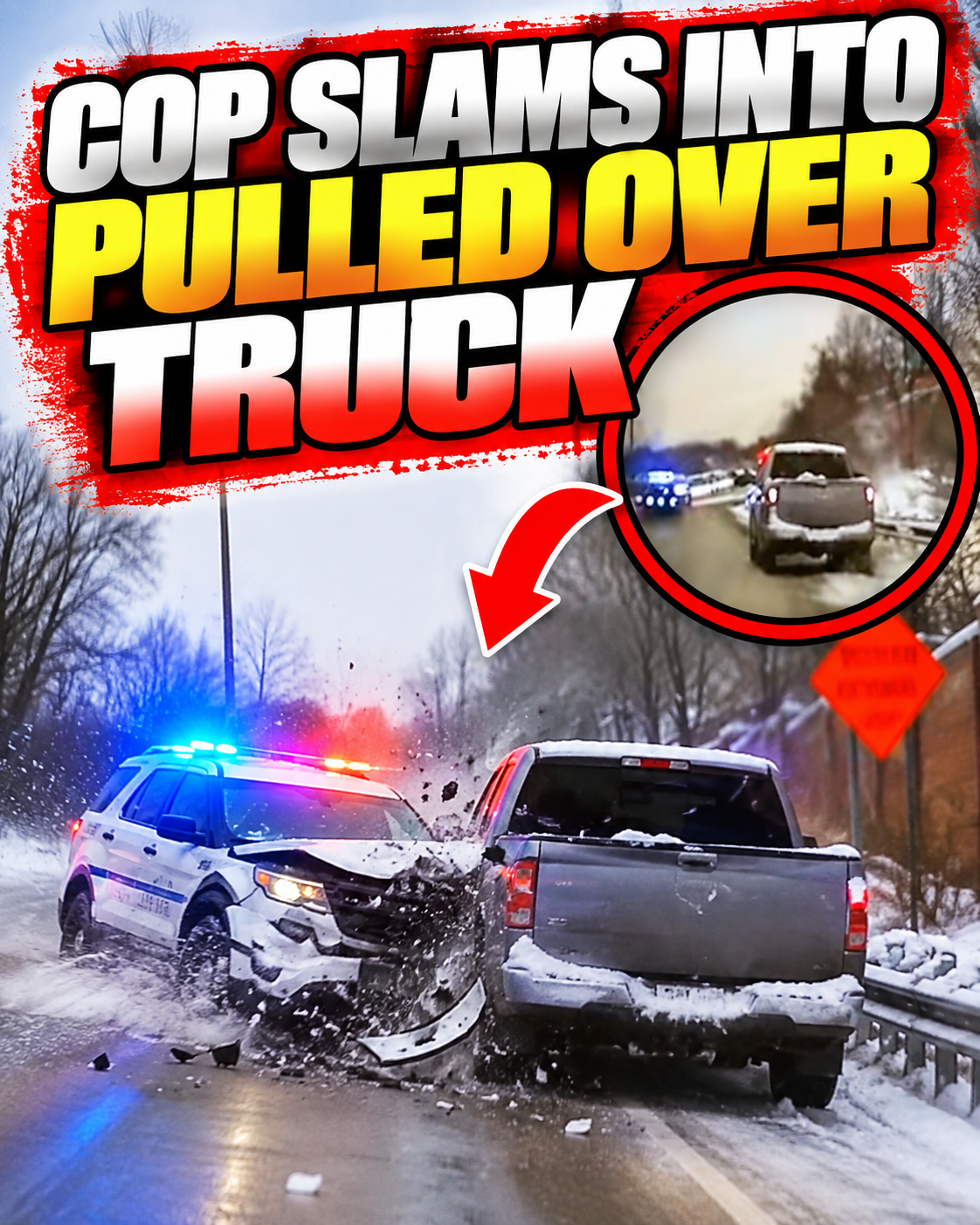
What Starts as a Routine Encounter Quickly Gets Complicated
What Begins as a Routine Encounter Quickly Becomes More Complicated
The highway is packed with evening traffic. Vehicles occupy nearly every available lane, a bus moves along the opposite side of the concrete barrier, and the low sun reflects from windows and body panels. Directly ahead sits a dark Honda SUV, apparently caught in the same congestion as everyone else.
Behind, however, emergency lights are visible.
At first glance, there is nothing particularly dramatic about the scene. Nobody appears to be moving at high speed. Traffic itself makes that nearly impossible. Yet that congestion can make a police encounter more complicated rather than less dangerous. Officers have limited room to maneuver, the driver has few places to stop, and dozens of uninvolved motorists are immediately surrounding both vehicles.
The supplied image does not establish the exact location, police agency, identity of the driver, reason police initiated contact, or the final outcome. Those details cannot responsibly be inferred from a single frame. What the image does show is a heavily congested roadway where a police vehicle has become part of an encounter involving a dark SUV, creating the conditions for a situation that can change with one unexpected decision.
An Ordinary Drive Through Heavy Traffic
Rush-hour congestion is frustrating but predictable.
Drivers move forward a few car lengths.
Brake lights illuminate.
Traffic stops.
Another gap opens.
Everyone moves again.
For the dark SUV ahead, the trip may initially look no different.
But somewhere along the route, police attention becomes focused on the vehicle.
That changes everything.
The surrounding traffic remains ordinary, but the SUV is now part of a police encounter.
Police Have to Work Around the Congestion
Stopping a vehicle on a nearly empty road is relatively straightforward.
Heavy traffic creates a different problem.
There may be no shoulder immediately available.
Cars occupy neighboring lanes.
A concrete barrier restricts one side of the roadway.
Stopping in an active lane could create another hazard.
Police therefore have to consider where the encounter can safely transition from moving traffic to a stationary stop.
The driver faces the same issue.
Emergency Lights Appear Behind the SUV
Once a police vehicle signals for a driver to stop, the next few moments become important.
Normally, the driver should begin looking for a safe place to pull over.
But in this environment, simply moving toward the edge of the road may not be easy.
Another vehicle occupies the next lane.
Traffic ahead is barely moving.
The SUV cannot instantly disappear from the flow.
For police, the question becomes whether the driver is attempting to find a safe stopping point or intentionally continuing.
Traffic Keeps Everyone Close Together
This is where congestion changes the usual dynamics.
A driver cannot easily create distance.
Accelerating is pointless when another vehicle is only a few car lengths ahead.
Changing lanes may be impossible.
Every available opening is temporary.
The police vehicle remains close almost automatically.
In a sense, traffic itself is containing the encounter.
The SUV Moves Forward With Everyone Else
Traffic advances.
The Honda advances too.
Police remain behind.
Another few hundred feet pass.
Still no obvious place to stop.
From inside the SUV, the driver has to process several things simultaneously.
Police lights are behind.
Cars are ahead.
Vehicles occupy neighboring lanes.
The driver needs to decide whether to stop immediately or continue searching for somewhere safer.
That decision may determine how officers interpret the situation.
A Gap Finally Appears
The neighboring lane begins moving.
A small opening develops.
The SUV could potentially move toward it.
But another vehicle quickly occupies the space.
The opportunity disappears.
This is the problem with trying to maneuver through congestion.
Openings exist for seconds.
By the time a driver reacts, they may already be gone.
Police Continue Watching
The officer behind is not simply watching the road.
They are watching the SUV.
Is the driver signaling?
Are they slowing?
Are they attempting to change lanes?
Do they appear to recognize the police presence?
Small details can help officers understand what the driver intends to do.
Predictable behavior lowers uncertainty.
Unexpected behavior raises it.
The Driver Makes a Move
Eventually the SUV changes position.
Perhaps it moves toward another lane or attempts to reach a wider portion of the roadway.
For the driver, the maneuver may appear necessary.
For police, it becomes another piece of information.
The officer follows.
Traffic around them begins reacting to the emergency lights.
Some drivers slow.
Others attempt to move aside.
The encounter now affects far more than the two vehicles directly involved.
Other Motorists Do Not Know What Is Happening
This is one of the most difficult parts of a police response in heavy traffic.
Nearby drivers see emergency lights but may not know what police want them to do.
One person moves right.
Another moves left.
Someone brakes suddenly.
A third driver continues normally.
Each reaction changes the available space.
Police cannot assume traffic will behave uniformly.
Neither can the SUV driver.
A Simple Lane Change Can Become Significant
Under normal conditions, moving one lane over means very little.
During an active police encounter, the same movement can raise questions.
Is the driver preparing to stop?
Are they trying to move around traffic?
Are they attempting to avoid police?
Officers need context before deciding.
One maneuver rarely tells the whole story.
A pattern of movement is much more important.
The Road Begins Opening Ahead
Eventually congestion may begin thinning.
That creates a critical moment.
While traffic was dense, the SUV had limited options.
Now open pavement appears.
If the driver intends to stop, this is an opportunity.
If the driver accelerates instead, the situation may suddenly become much more serious.
Police are watching for exactly that distinction.
Speed Changes the Encounter
The SUV accelerates with traffic.
For a moment, that may mean nothing.
Then the distance begins increasing.
Police accelerate too.
What had been a slow-moving encounter in congestion can transition into something entirely different within seconds.
The officer communicates the vehicle's direction.
The response begins expanding.
The Driver Now Has More Space but More Attention
Open roadway provides mobility.
It also makes the SUV easier to track.
Police can observe lane changes more clearly.
Direction of travel is obvious.
Other officers can be informed.
The driver may feel less confined, but the police response is becoming more coordinated.
Another Unit Can Join From Behind
The lower portion of the supplied image appears to show additional emergency vehicles within the surrounding traffic.
That illustrates an important advantage police have during a moving encounter.
The driver may initially focus on one patrol vehicle.
But additional officers can enter the response.
One unit maintains visual contact.
Another positions farther back.
Others may move toward likely routes ahead.
The situation is no longer limited to one driver and one officer.
The Driver Reaches Another Congested Section
Traffic tightens again.
Brake lights appear.
The SUV has to slow.
Any distance created moments earlier begins disappearing.
Police close the gap.
The driver searches for another opening.
This pattern can repeat several times.
Acceleration creates space.
Traffic takes it away.
The Highway Becomes a Corridor
A highway may appear to offer unlimited forward movement.
In reality, the driver is confined to a relatively narrow corridor.
Concrete barriers restrict one side.
Traffic occupies the others.
Exits occur only at specific locations.
Police know the direction of travel.
The SUV can continue moving, but its realistic choices are limited.
An Exit Offers Another Possibility
An approaching ramp creates a decision.
Continue on the highway or leave it.
Exiting could provide more routes.
But the ramp also forces the vehicle into a narrower lane.
Speed may need to decrease.
Police can anticipate where the ramp leads.
The choice that appears to create freedom can also make the vehicle easier to contain.
The Driver Commits to a Route
Once the SUV enters a ramp, turning back becomes difficult.
Police follow.
The roadway curves.
Speed drops.
The officer begins closing the distance.
Now the driver has to decide what to do at the end of the ramp.
Another highway?
A surface street?
An intersection?
Each option changes the pursuit.
Surface Streets Create New Risks
Leaving the highway introduces pedestrians, traffic lights, driveways, businesses, and cross traffic.
The environment becomes less predictable.
The SUV may have more places to turn, but every turn requires slowing.
Police continue updating the route.
Other units can adjust.
The driver gains choices but loses speed.
Every Turn Provides Police With Information
The SUV turns right.
Police know the new direction.
Another left follows.
Again, officers update the location.
The driver may believe repeated turns create confusion.
But every turn also confirms where the vehicle is.
Radio communication allows that information to reach officers who are nowhere near the original patrol car.
One Red Light Can Eliminate the Advantage
Traffic is stopped ahead.
The SUV approaches.
There is no easy route around the line of vehicles.
The driver has to brake.
Police get closer.
The distance that took several blocks to create disappears.
Now the driver must choose between stopping or attempting another risky maneuver.
The Encounter Becomes Increasingly Difficult to Control
This is how a relatively ordinary police contact can expand.
One continued movement leads to another.
Another officer joins.
Traffic reacts.
The route changes.
The original reason police wanted contact becomes almost secondary to the immediate challenge of safely bringing the moving encounter to an end.
Every additional minute introduces more variables.
Police Have to Think About the Public
Catching the SUV is not the only objective.
Officers also have to consider everyone surrounding it.
A pursuit through dense traffic can expose uninvolved motorists to risk.
That may influence how closely officers follow or how aggressively they attempt to stop the vehicle.
Sometimes maintaining information and coordination is more important than immediately eliminating every foot of distance.
The Driver Eventually Runs Out of Useful Openings
Traffic thickens.
The SUV slows.
Another police unit may be nearby.
An exit does not provide a clear route.
The vehicle is still moving, but movement no longer creates meaningful separation.
At this point, continuing becomes less effective with every second.
The SUV Finally Stops
When the vehicle eventually becomes stationary, police do not immediately assume the incident is finished.
The driver has already continued through a complicated traffic environment.
Officers need to know the SUV will remain stopped.
They position themselves carefully.
Clear instructions become essential.
The encounter shifts from tracking a vehicle to controlling individual movements.
The Driver's Next Actions Matter Most
Once the SUV is stationary, the driver can dramatically lower the tension.
Remain stopped.
Keep hands visible.
Listen to instructions.
Avoid sudden movements.
The exact commands depend on the circumstances, but predictability is the key.
Police have spent the previous portion of the encounter reacting to movement.
Now they want movement to happen only when expected.
Officers Close In
With the vehicle contained, officers can begin approaching or directing the occupants.
Additional units provide more control.
One officer can communicate.
Another can observe.
Traffic may need to be managed around the scene.
What started as one police vehicle following an SUV has become a coordinated roadside response.
The Original Question Returns
Only after the vehicle is under control can officers return to the beginning.
Why did police want to contact this SUV?
The supplied screenshot does not provide that answer.
It would be inappropriate to invent an alleged violation, offense, warrant, or other explanation without verified information.
The reason matters because it provides context for everything that follows.
Footage Can Show the Entire Transition
The value of dashcam footage is that it preserves the development rather than only the conclusion.
Viewers can see the congestion.
The police vehicle behind.
The SUV ahead.
The first movement.
The lane changes.
The changing traffic conditions.
The arrival of additional officers.
Without that sequence, a still image can make the police response appear much more sudden than it actually was.
Heavy Traffic Makes This Encounter Different
Many police pursuit scenes are associated with open roads and high speeds.
This environment creates tension in another way.
There is almost nowhere to go.
Vehicles surround the SUV.
Police are directly behind.
Every lane change depends on another motorist.
The driver cannot control the environment.
Traffic controls much of it.
Movement Does Not Always Mean Progress
This is perhaps the central feature of the encounter.
The SUV can continue forward for miles without meaningfully getting away.
Traffic moves.
The SUV moves.
Police move too.
The driver may be physically traveling farther from the original location while remaining only a short distance from officers.
Continuing therefore creates the appearance of escape without necessarily creating actual separation.
One Decision Can Make a Simple Encounter Much Larger
Had the situation reached a safe stationary point earlier, police might have been able to resolve it more quickly.
Once the vehicle continues, more resources may become necessary.
Additional officers.
More radio communication.
More traffic management.
More uncertainty.
The scale of the response grows because the number of variables grows.
The Police Vehicle Remains in the Mirror
For the driver, this may be the most important visual throughout the encounter.
Emergency lights remain behind.
Traffic may temporarily hide them.
A lane change may increase the gap.
Another vehicle may move between the SUV and police.
But the lights keep returning.
The driver has not escaped the situation.
They have only extended it.
Congestion Eventually Works in Police's Favor
The same traffic that initially makes the stop difficult can eventually prevent the SUV from creating distance.
Cars ahead slow.
Lanes fill.
The vehicle brakes.
Police close in.
The highway effectively becomes a moving containment area.
There may be no roadblock.
No dramatic intervention.
Simply too many vehicles and too little space.
A Routine Encounter Has Become Something Larger
Looking at the first moments, nobody might expect the response to grow.
The SUV is surrounded by ordinary traffic.
The highway is busy.
The police vehicle appears to be another car within the congestion except for its emergency lights.
Then the driver's decisions begin shaping what follows.
One block becomes another.
One lane becomes another.
One officer becomes several.
The encounter expands.
THE MOST STRIKING PART OF THIS SCENE IS NOT SPEED, BUT THE LACK OF SPACE. THE DRIVER MAY KEEP MOVING, YET EVERY CAR AHEAD, EVERY OCCUPIED LANE, AND EVERY POLICE UNIT BEHIND MAKES THE NEXT DECISION MORE DIFFICULT THAN THE LAST.
When the Road Finally Stops Offering Options
Eventually, movement stops providing an advantage.
There is nowhere useful to change lanes.
Traffic blocks the route ahead.
Police remain close.
The driver reaches the same decision that existed near the beginning of the encounter, only now under much greater pressure.
Stop and allow police to make contact.
Or attempt another maneuver that could make an already complicated situation even more serious.
The surrounding motorists continue with their evening once the scene clears. For them, the emergency lights may become nothing more than something briefly seen in the mirror.
For the people directly involved, however, the encounter is defined by a sequence of small decisions made in one of the most difficult environments for a moving police response: a crowded highway where nobody has much room to go anywhere.
Watch the full sequence to see how the encounter develops in heavy traffic, how officers remain with the SUV as the available space changes, and what finally happens when the driver begins running out of room to keep going: PASTE-YOUR-LINK-HERE. https://www.youtube.com/watch?v=EQivN03nIro
Comments (0)
Loading comments...
May You Like

Police vs Chevy Impala High-Speed Pursuit Ends in TVI

Traffic Stop Turns Deadly After Man Steps Out of Stolen Car