
Welfare Check Turns Into a Dangerous Chainsaw Encounter in New Jersey
Welfare Check Turns Into a Dangerous Chainsaw Encounter in New Jersey
A Memorial Day welfare check in Keansburg, New Jersey, changed abruptly when officers encountered Willem Roman inside a home with a running chainsaw and other weapons.
A Worried Mother Makes the Call
Memorial Day afternoon in Keansburg, New Jersey began with a welfare check rather than a criminal investigation. At approximately 1:07 p.m. on May 27, 2024, Keansburg Police Department officers were dispatched to a residence on Seabreeze Way after Willem Roman's mother asked police to check on her 46-year-old son.
The supplied video begins by giving viewers context from the 911 call and then moves into body-worn-camera footage. The camera overlay shows May 27, 2024, and the footage follows uniformed officers as they arrive at the small residential property. Those details match the official account released by the New Jersey Attorney General's Office.
Later reporting on the completed investigation provided additional context from the call. Roman's mother expressed concern about what her son had been saying and about being unable to reach him. That information explains why officers were there, but it did not tell them exactly what they would encounter inside the house.
A welfare check is often one of the least predictable calls an officer can receive. It can end with a brief conversation and reassurance, or it can reveal a medical crisis, a person in emotional distress, an unsafe home, or an immediate threat. The officers approaching this house were therefore working with limited information and had to assess the situation as it developed.
The original online title compares the scene with “The Texas Chainsaw Massacre.” That is attention-grabbing language, but it is a pop-culture comparison rather than a factual description. The real incident was serious enough without that framing: officers conducting a welfare check ultimately encountered Roman inside the home with multiple weapons and a running chainsaw.
The Search Moves From the Yard Into the House
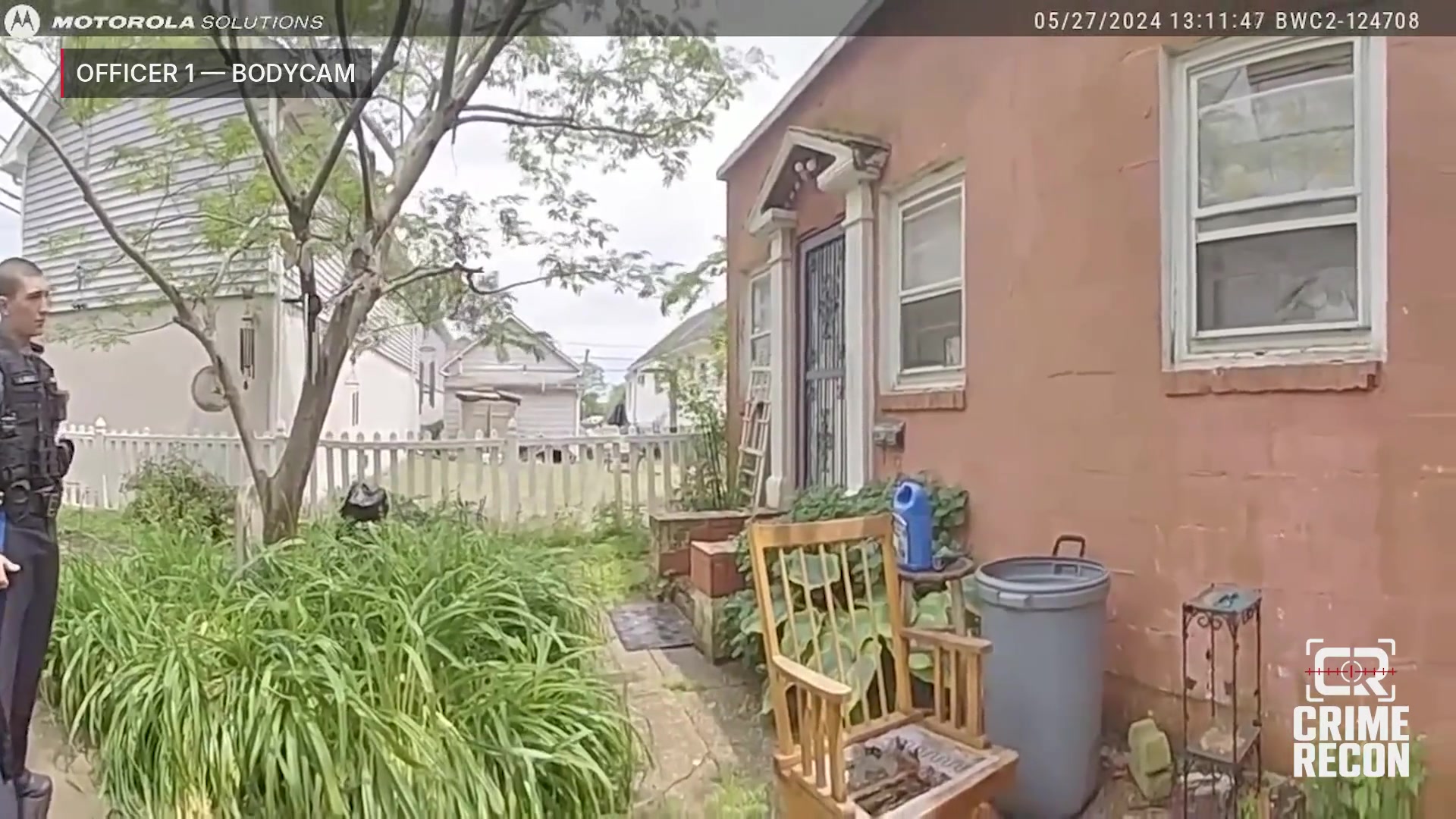
The body-camera footage initially shows officers around the exterior of the residence. They check the property, speak with people at the scene, and gradually move toward entering the home. The surroundings look ordinary: neighboring houses sit close together, a small yard runs alongside the building, and household objects are scattered near the entrance.
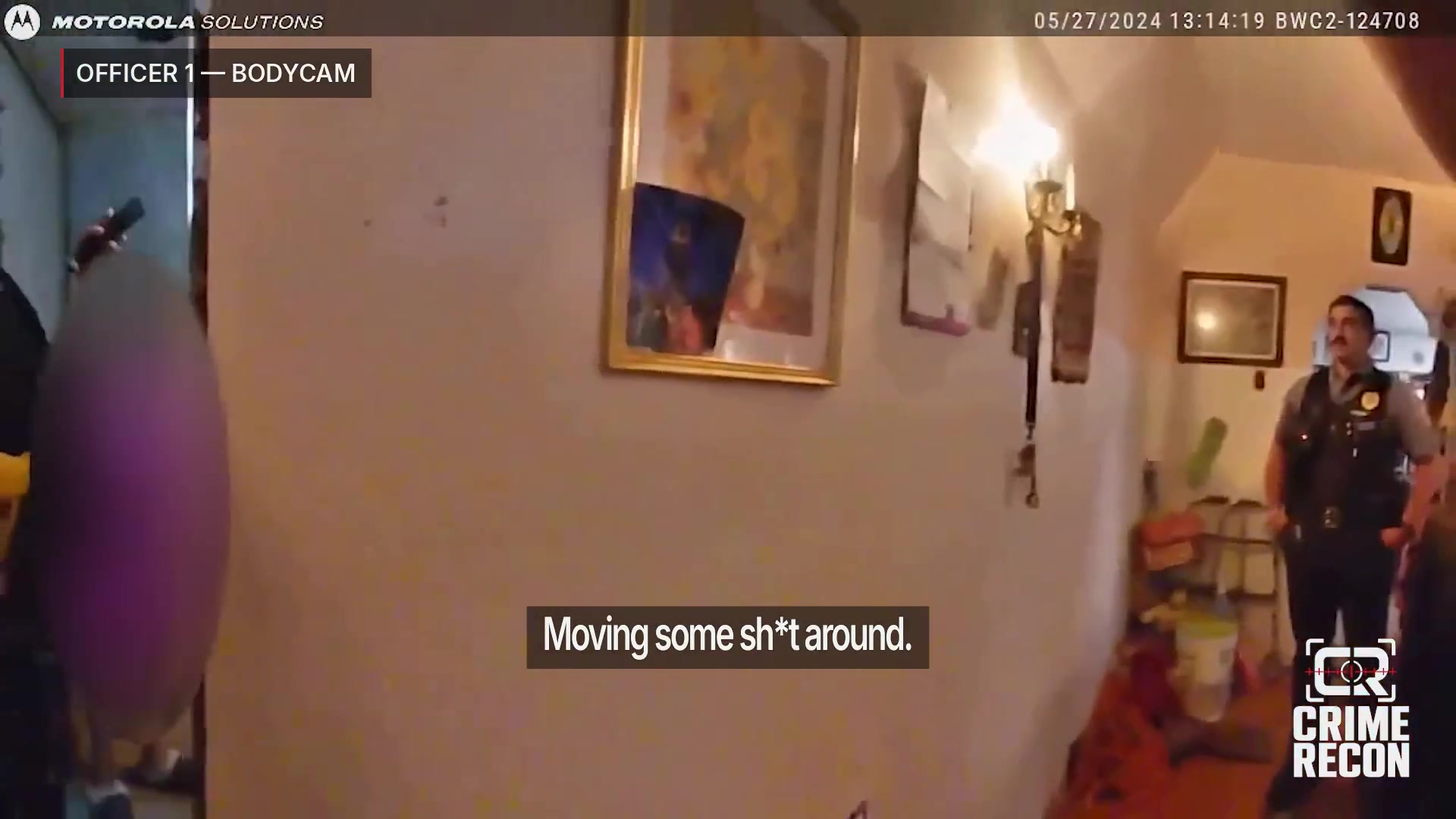
Once officers step inside, the environment changes. The interior is densely furnished and filled with personal belongings. Narrow passages and rooms limit sight lines. Officers cannot see through walls or around corners, and they have to move through the house while continuing to communicate with the family member who is helping them locate Roman.
This matters tactically. Inside a residence, distance disappears quickly. A hallway or doorway can reduce the amount of time an officer has to react to a sudden movement. Furniture can restrict retreat, and officers moving in a group have to avoid blocking one another. What might be manageable in an open parking lot can become far more dangerous inside a cramped home.
The footage also demonstrates why welfare checks can evolve without an obvious dividing line between “routine” and “high risk.” At first, officers are searching and asking questions. Nothing visible outside the house tells them that a running power tool will soon become central to the encounter. Their understanding of the risk changes as they learn more and move deeper into the residence.
According to the Attorney General's later investigation, the officers entered with a family member and located Roman in a second-floor bedroom. They attempted to communicate with him through a closed door, but he was generally not responsive. That lack of response prolonged the uncertainty. Officers knew where he was, but they still did not know precisely what he was doing behind the door.
A Closed Bedroom Door Becomes the Focus
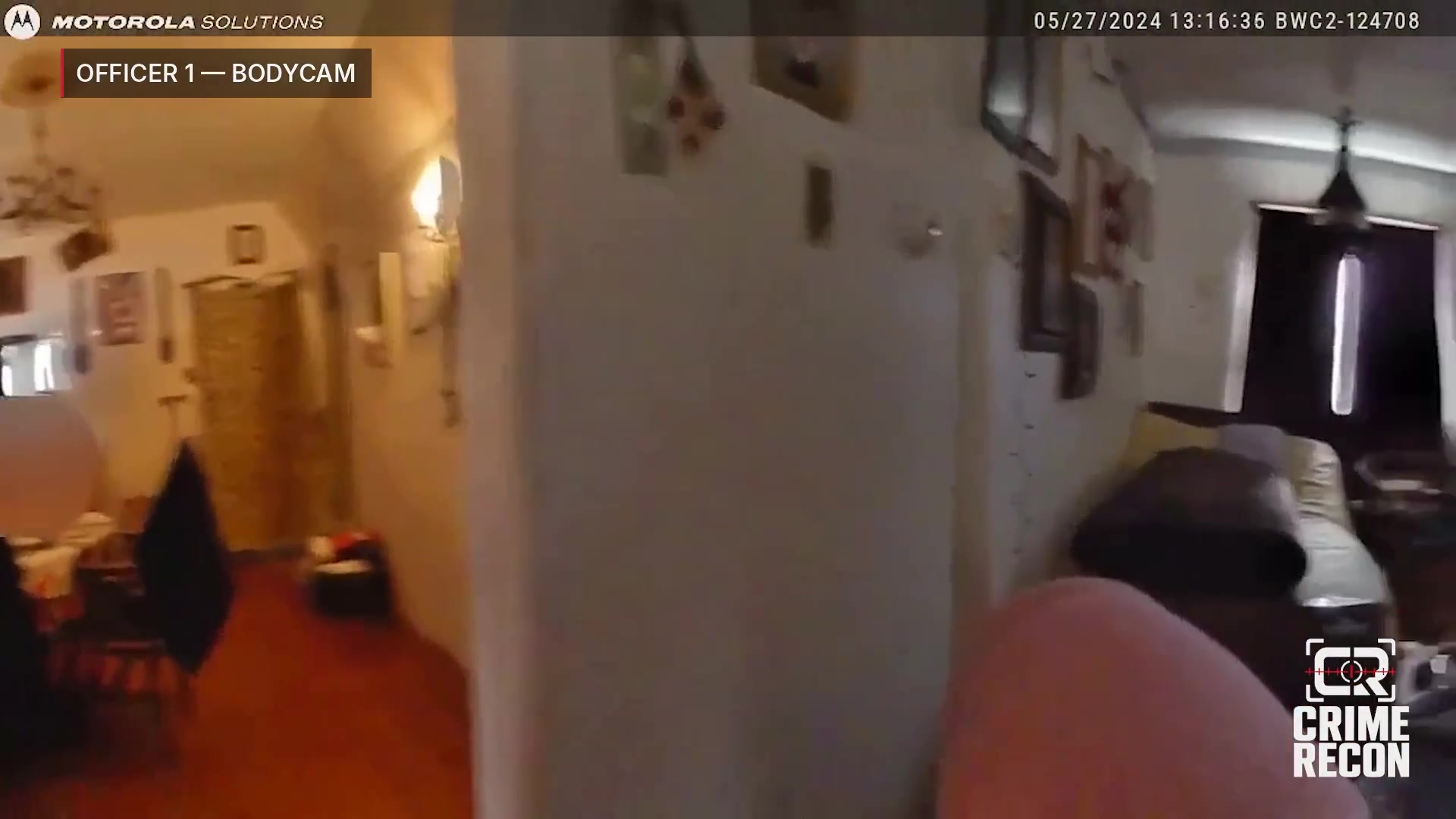
The body-camera sequence inside the home becomes increasingly tense as officers focus on the upstairs room. The video is valuable because it preserves the waiting as well as the eventual confrontation. Much of police work in a situation like this consists of trying to slow events down, communicate and obtain compliance before anyone has to make a split-second decision.
Investigators later determined that Roman had numerous weapons. The Attorney General's preliminary release stated that officers encountered him with multiple weapons and a running chainsaw. The completed investigation added that officers later found a crossbow and multiple knives on his person.
Those facts were not necessarily known to every officer before the bedroom door opened. This distinction is important when evaluating body-camera footage. Information discovered afterward can explain the overall scene, but an officer's decision has to be understood through what was known or reasonably perceived at the time.
The footage shows officers attempting to manage their positions around the interior. In a confined house, officers have few ideal options. Standing too close to a closed door can expose them to a sudden threat. Moving too far away may make it difficult to maintain awareness of a person they were sent to check on. Communication is therefore crucial.
The situation eventually changes abruptly. Roman emerges from the room wearing a dark-colored ski mask, according to the completed state investigation. More importantly, he has a running chainsaw. The sound and movement of the tool immediately transform the officers' problem from an uncertain welfare check into an imminent physical confrontation.
The phrase “chainsaw encounter” can sound sensational when separated from the evidence. Here it is literal. The body-camera footage and the Attorney General's findings both establish that the chainsaw was running as Roman approached the officers.
The Moment the Chainsaw Appears
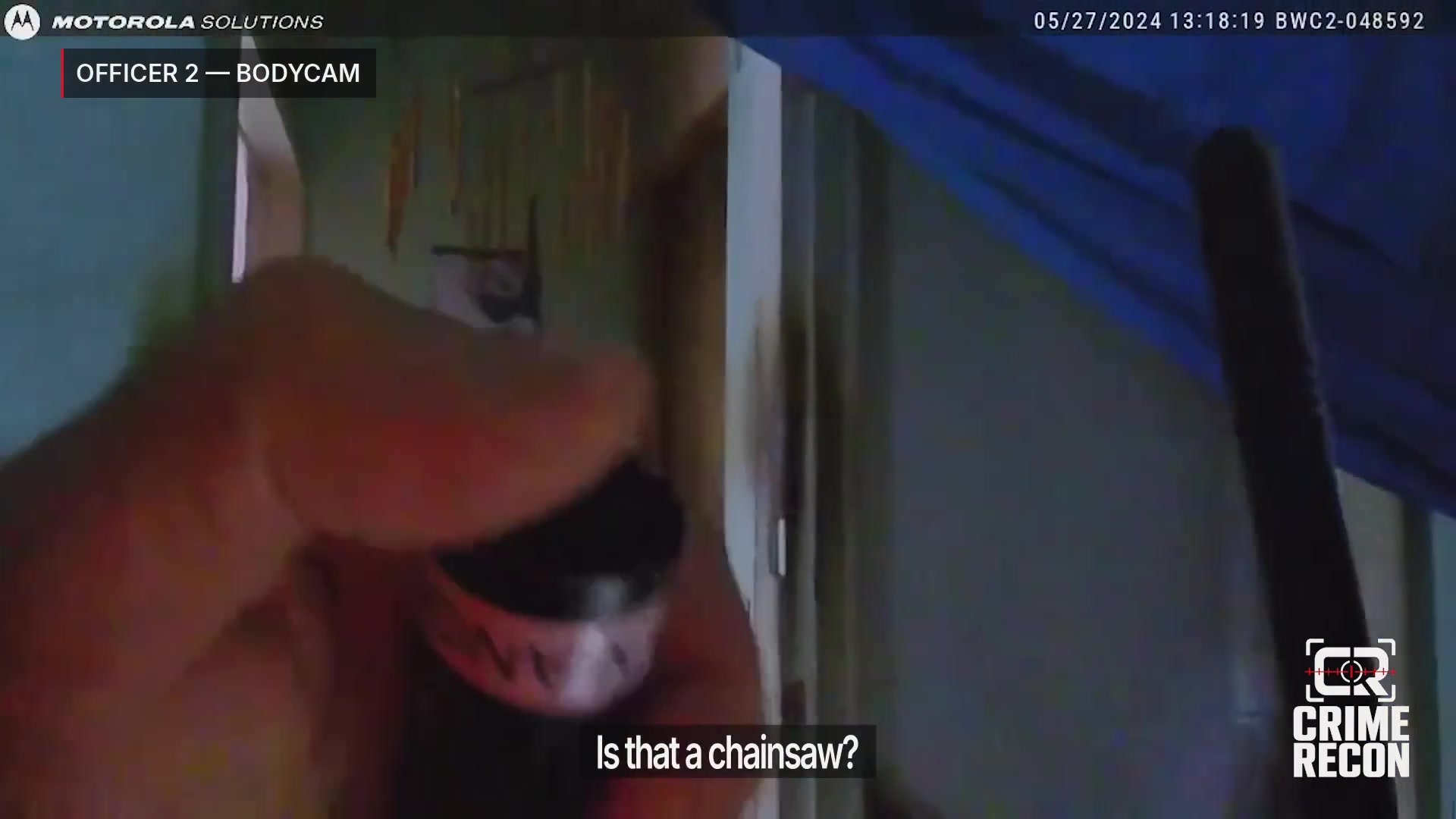
The critical portion of the encounter unfolds extremely quickly. One of the body-camera perspectives captures an officer reacting to the sound and presence of the chainsaw as Roman emerges. The officers are inside a confined residential space with limited room to create distance.
According to the New Jersey Attorney General's investigation, Patrolman John Swartz deployed a conductive energy device, commonly called a Taser, while Patrolman Tyler Manges fired his service weapon. Both struck Roman. He fell to the floor with the chainsaw still running.
The simultaneous use of different force options illustrates how rapidly officers can make individual decisions during the same threat. A conducted-energy device is intended to incapacitate a person without relying on firearm-level force, but its effectiveness is not guaranteed. Probe placement, clothing, movement and other factors can affect whether it produces the intended neuromuscular incapacitation. A firearm, by contrast, is deadly force and is generally associated with a perceived threat of death or serious bodily injury.
It would be misleading to treat the existence of a Taser as proof that a firearm was unnecessary, just as it would be misleading to assume that any weapon automatically justifies a shooting. The legal analysis depends on the circumstances confronting the officers at that moment. That is why the state investigation considered the recordings, Taser data, interviews, ballistics evidence, medical records and autopsy findings rather than relying on a single frozen frame.
The video itself makes the timing clear. The transition from the officers' attempt to locate and communicate with Roman to the appearance of the running chainsaw leaves very little time for deliberation. Viewers have the advantage of knowing the title, replaying the footage and anticipating what is coming. The officers did not have those advantages as they entered the house.
Medical Aid Begins After the Threat Ends
Once Roman is on the floor, the character of the scene changes again. Officers have to secure the dangerous equipment, determine whether additional weapons are present and begin the transition to medical aid.
The Attorney General's Office said officers and emergency medical personnel rendered aid before Roman was transported to Jersey Shore University Medical Center in Neptune. He was initially listed in critical but stable condition. Roman did not die at the residence that afternoon. He remained hospitalized and was pronounced dead on June 14, 2024, more than two weeks after the encounter.
That timeline is important because early reporting described an officer-involved shooting in which the wounded man survived the immediate incident. Only later did the case become a fatal law-enforcement encounter subject to the full process required under New Jersey law.
The state identified Roman publicly on July 1, along with the officers directly involved in the use of force. Swartz was identified as the officer who deployed the conducted-energy device, while Manges was identified as the officer who fired his service weapon.
The discovery of the other weapons added context to the investigation. Authorities said Roman had a crossbow and multiple knives on his person in addition to the chainsaw. Those items do not replace the need to analyze the specific threat officers faced when force was used, but they became part of the physical evidence documenting the encounter.
Body-camera recordings are particularly useful in this phase because they capture what happens after force is used, not merely the instant of the shooting. Investigators can examine officers' movements, commands, efforts to secure weapons, medical response and statements made at the scene. Those details help reconstruct the chronology before memories have been shaped by repeated review of the event.
New Jersey's Independent Review Continues for More Than a Year
Because Roman ultimately died from injuries sustained during an encounter with law enforcement, the case fell under New Jersey's statutory process for investigating such deaths. The Office of Public Integrity and Accountability conducted the investigation independently of the local department's normal chain of command.
The investigation was extensive. According to the later account of the grand-jury presentation, investigators reviewed 911 calls, footage from police body-worn cameras and the conducted-energy device, law-enforcement interviews, photographs, ballistics reports, medical records and the medical examiner's autopsy findings.
This broader record is essential because a body camera is not an all-seeing witness. Its lens points in roughly the same direction as an officer's torso, but not necessarily exactly where the officer's eyes are focused. Objects can block the camera. Rapid movement can blur details. Sound may be clearer than the image, or vice versa. Two officers standing only a few feet apart can therefore record meaningfully different views.
New Jersey's system requires fatal police encounters to be presented to a grand jury. The presentation itself does not mean the involved officer has been accused of a crime. The grand jury reviews the evidence and considers whether criminal charges are supported.
That process concluded in July 2025, more than a year after the incident. The state grand jury voted “no bill,” meaning it declined to file criminal charges against Patrolman Tyler Manges. The completed review therefore ended without a criminal indictment of the officer who fired the shot.
The time between the incident and the grand-jury decision demonstrates why early online descriptions should not be mistaken for final findings. In May and June 2024, the public had only preliminary information. By July 2025, investigators had assembled a much larger evidentiary record and presented it through the process required by state law.
What the Footage Establishes and What It Does Not
The supplied video and official records align on the central chronology. The body-camera overlay shows May 27, 2024. The officers are conducting a welfare check at a residence. They search the property, enter the home, move through the interior, focus on an upstairs room and ultimately confront a man with a running chainsaw. Those visual details correspond closely with the Attorney General's description of the Keansburg incident.
The official record supplies facts the footage cannot establish by itself: Roman's full name and age, the Seabreeze Way location, the identities of Swartz and Manges, Roman's hospitalization and later death, the additional weapons recovered, and the eventual grand-jury outcome.
Other details should remain limited to what the evidence supports. The 911 call reflected Roman's mother's concern about statements involving killing, but a worried caller's report is not a diagnosis and does not prove a specific motive. It would be inappropriate to invent a mental-health condition, drug use or an intention that investigators did not establish publicly.
The same caution applies to the movie comparison in the original title. Nothing about the incident requires a fictional horror reference to make it compelling. The verified circumstances are extraordinary on their own. Two officers entered a home for a welfare check, attempted to communicate with a man behind a bedroom door, and then faced him in a confined space as he approached with a running chainsaw.
Removing the exaggerated comparison also makes the story easier to understand. This was not a mysterious massacre scene. It was a documented police welfare check that escalated into a use-of-force incident, followed by emergency medical care, a death weeks later and a formal independent investigation.
A Routine-Sounding Call With an Unpredictable Ending
The Keansburg case demonstrates how little the label attached to a dispatch can reveal about the risk waiting at the scene. “Welfare check” sounds far removed from an armed confrontation, yet the purpose of the call itself was uncertainty. Roman's mother was worried enough about her son's statements and lack of response to ask police to intervene.
The officers' body cameras preserve the gradual escalation. They arrive in daylight. They check around a modest residential property. They enter a crowded home. They search and communicate. They move upstairs. Only near the end does the danger become unmistakable.
That progression is why the full video provides more context than a short clip of the shooting. Watching only the final seconds removes the uncertainty that shaped everything before them. Watching only the early search, on the other hand, would make the eventual confrontation almost impossible to anticipate.
The later investigation fills in what the cameras could not. Roman was 46. The call occurred at approximately 1:07 p.m. on May 27, 2024. Swartz deployed the conducted-energy device. Manges fired his service weapon. Roman was hospitalized and died on June 14. Investigators recovered additional weapons, and a state grand jury later declined to criminally charge Manges.
Those findings do not erase the tragedy of the outcome. They provide a verified framework for understanding it. A man died, his family experienced the loss that followed, and officers were placed at the center of an encounter that was later examined through an independent legal process.
For viewers interested in police body-camera footage, the most useful lesson may be the simplest: the final moment rarely tells the entire story. Here, the critical encounter makes more sense only after seeing the welfare call, the search through the property, the attempts to communicate and the physical constraints of the house.
The full recording shows that progression in real time and makes clear just how quickly a welfare check can change once officers encounter a threat they could not see from outside.
Comments (0)
Loading comments...
May You Like

High-Speed CHP Chase Ends When Spike Strips Stop Suspect

🚨⛽ Man Caught in a Disturbing Incident at a Gas Station | Police Respond US

West Virginia Man Laughs at Police Officer and Ends Up Arrested













