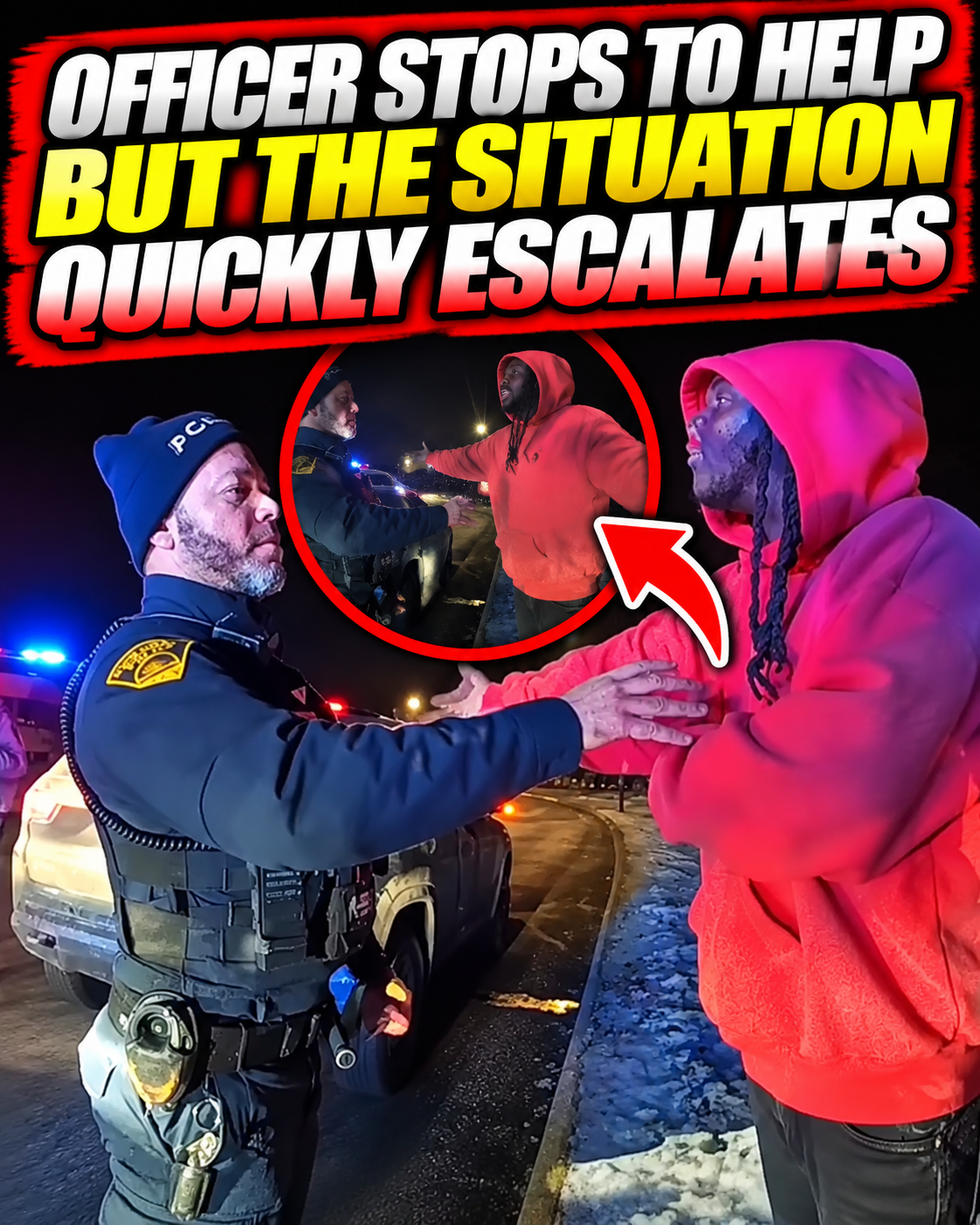
Wanted Suspect Runs Onto the 210 Freeway and Confronts LAPD With a Gun
Wanted Suspect Runs Onto the 210 Freeway and Confronts LAPD With a Gun
A Warrant Search Suddenly Moves Toward the Freeway
On May 5, 2026, Los Angeles Police Department officers in Mission Area were looking for a wanted man when an attempted contact turned into an unusually dangerous foot pursuit. The man was later identified by LAPD as Jason Vega. According to the department's preliminary account, Mission Area Narcotics Enforcement Detail officers had located Vega in the 14000 block of Bledsoe Street and requested additional uniformed officers because he was wanted on outstanding warrants.
The supplied video matches the incident described by LAPD and subsequent Los Angeles reporting. The footage shows officers moving rapidly through a neighborhood and toward the 210 Freeway, followed by a confrontation in active freeway lanes. LAPD's critical-incident index lists the May 5 event as incident NRF023-26 in Mission Division, on the westbound 210 Freeway at Bledsoe Street.
What begins as an attempt to contact a wanted person therefore becomes something much more complicated. Once Vega runs, officers are no longer dealing with a stationary detention. They have to follow a person on foot while continuously assessing where he is going, whether he is armed, and what danger his route may create for members of the public.
The Foot Pursuit Reaches Live Freeway Traffic
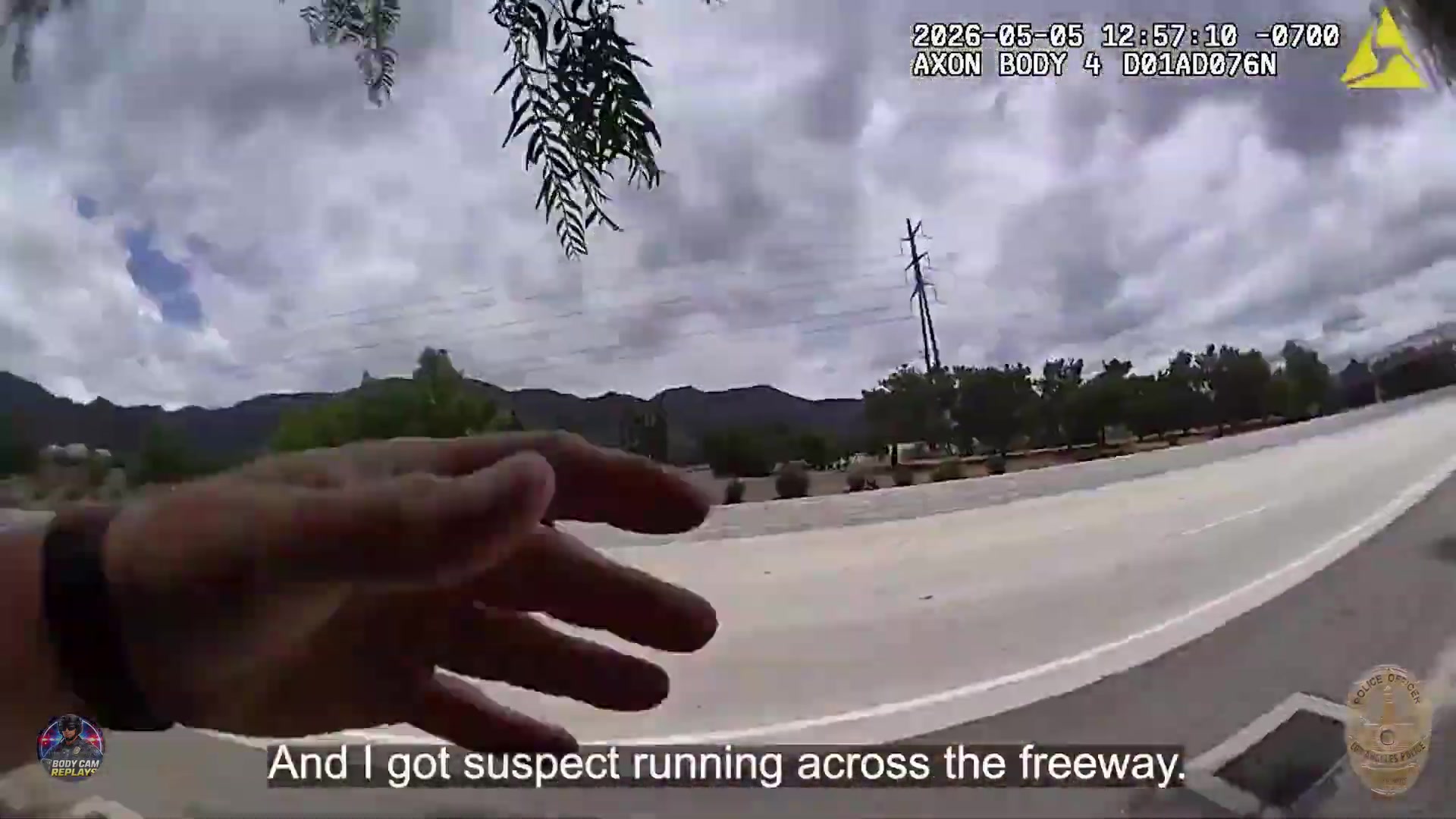
LAPD said Vega fled onto the embankment of the eastbound 210 Freeway. He then crossed the freeway while officers continued the pursuit. The decision to run into freeway traffic dramatically raises the stakes. Vehicles moving at highway speed give officers and the fleeing person very little margin for error, while motorists suddenly find themselves approaching an active police incident with almost no warning.
The footage communicates that danger better than a short written description can. Officers move toward the roadway while traffic remains part of the environment around them. Their focus has to remain divided between Vega, other officers, passing vehicles and the possibility that the suspect may attempt to use one of those vehicles to escape.
This is also where the original title's description of a simple 'foot chase' becomes incomplete. The pursuit is important, but the freeway itself becomes part of the tactical problem. Officers cannot treat an active interstate lane like a sidewalk or a parking lot. Cover is limited, distances can change quickly, and uninvolved motorists can unexpectedly become part of the incident.
Police Say Vega Tries to Take a Pickup Truck
According to LAPD, Vega crossed the freeway and attempted to carjack a pickup truck traveling westbound. The Los Angeles Times and CBS Los Angeles also reported the attempted carjacking while describing the May 5 incident. This is a critical detail because it explains why officers had to react not only to a fleeing suspect but also to an immediate interaction between that suspect and an uninvolved driver.
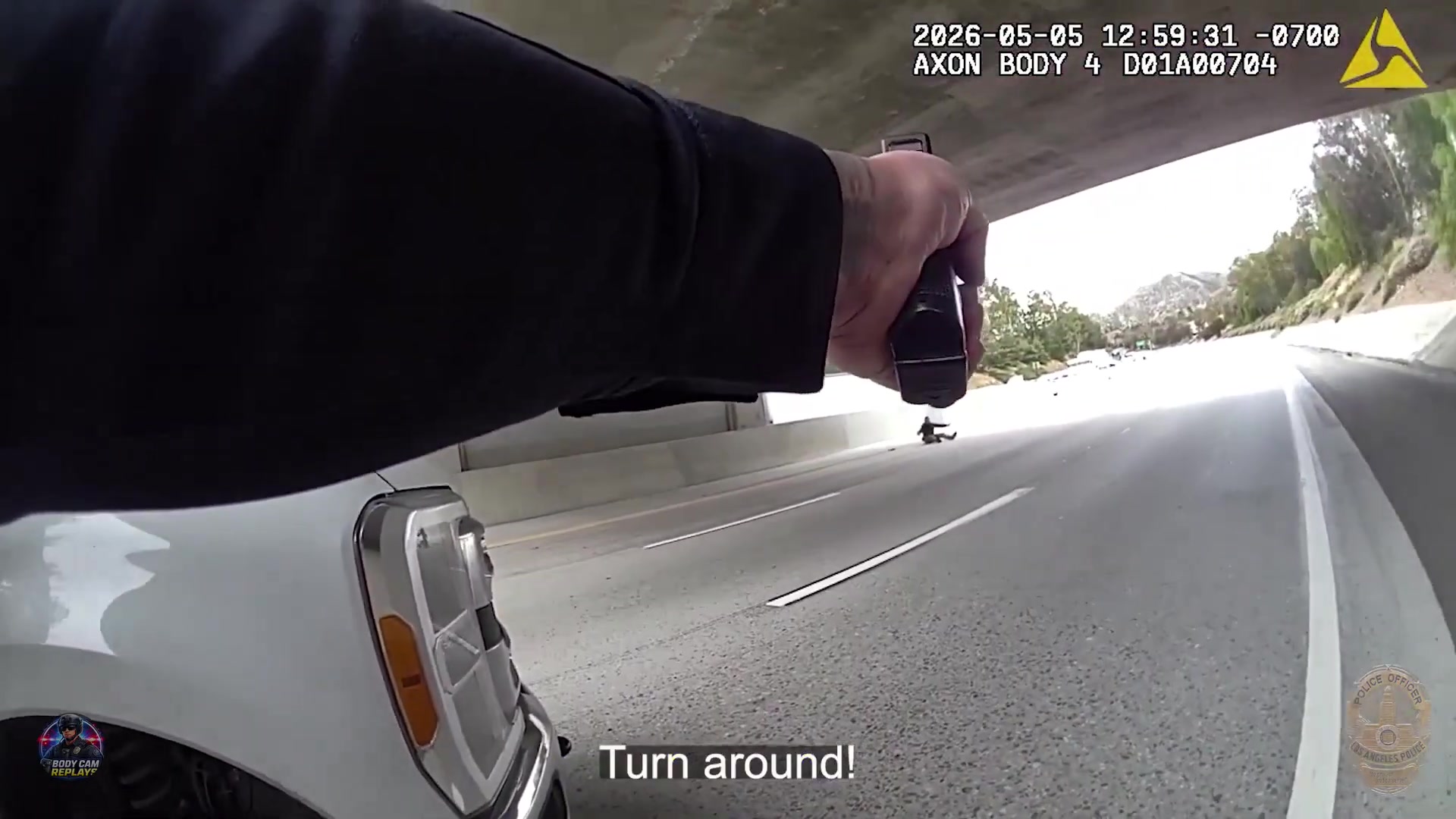
The body-camera footage shows the pursuit reaching the freeway and officers trying to control a situation unfolding among civilian vehicles. In such a setting, an attempted vehicle takeover can create multiple threats at once: danger to the driver, the possibility that the suspect may obtain transportation, and the risk that a stolen vehicle could then be driven through active traffic.
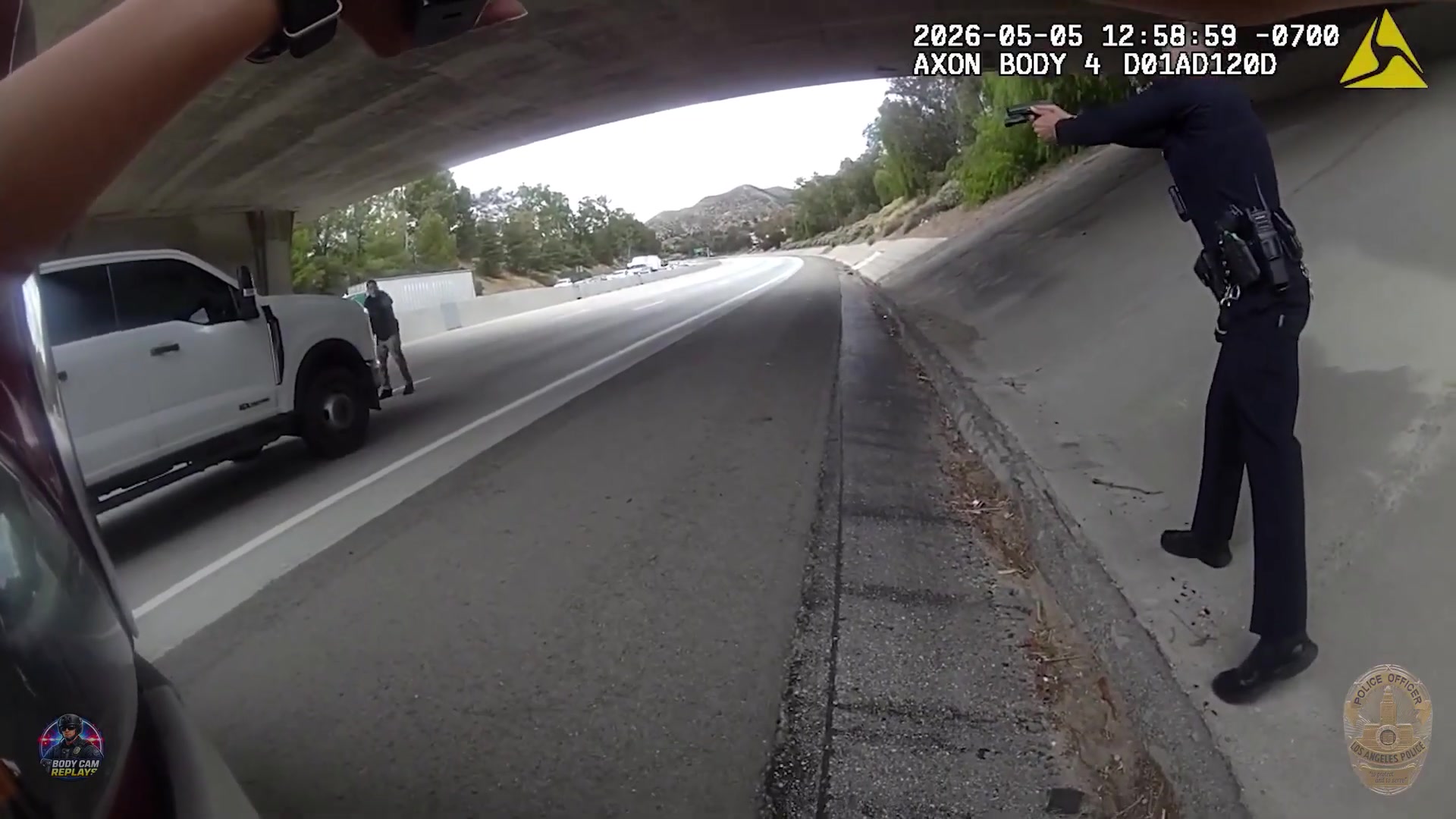
The official LAPD account says officers again contacted Vega and observed that he was armed with a handgun. Officers issued repeated commands for him to drop the firearm. LAPD said Vega refused those commands.
The Handgun Changes the Encounter
Once officers identify a handgun, the encounter changes from a difficult foot pursuit into a potentially lethal confrontation. Distance, available cover, the suspect's movements and the location of nearby civilians become critical. The footage captures officers directing their attention toward Vega while commands are repeatedly given.
LAPD's preliminary investigation states that Vega did not drop the gun, resulting in an officer-involved shooting. The department identified the officers involved in the shooting in its later critical-incident release. As with any officer-involved shooting, the department emphasized that the information released at that stage was preliminary and could change as investigators collected and analyzed additional evidence.
That qualification is important. A body camera provides one officer's moving perspective rather than a complete overhead reconstruction. A camera may be blocked by another officer, swing away during rapid movement, or fail to show exactly where a weapon is pointed at every instant. Investigators therefore combine body-camera footage with other recordings, physical evidence, firearm evidence and witness information when reconstructing the event.
After the Shooting, the Threat Is Not Yet Over
LAPD said Vega fell after the shooting but continued to disregard commands and moved toward his firearm. Officers then used what the department described as an intermediate force option to gain compliance. CBS Los Angeles reported that police used a 40mm less-lethal launcher before Vega surrendered and was taken into custody.
This sequence is significant because the use of gunfire does not automatically end an encounter. Officers must continue assessing what the person is doing and whether a weapon remains accessible. If a firearm is still within reach, approaching immediately can expose officers to another threat. Commands, distance and intermediate force can be used to create an opportunity to take a person into custody while reducing the need for another round of lethal force.
The footage shows the transition from confrontation to arrest. Once officers can safely move forward, multiple personnel converge and take control of Vega on the roadway. The pace changes again: the objective is no longer to pursue or stop an armed movement but to secure the person, locate the firearm and begin the medical and investigative response.
A Glock .40-Caliber Handgun Is Recovered
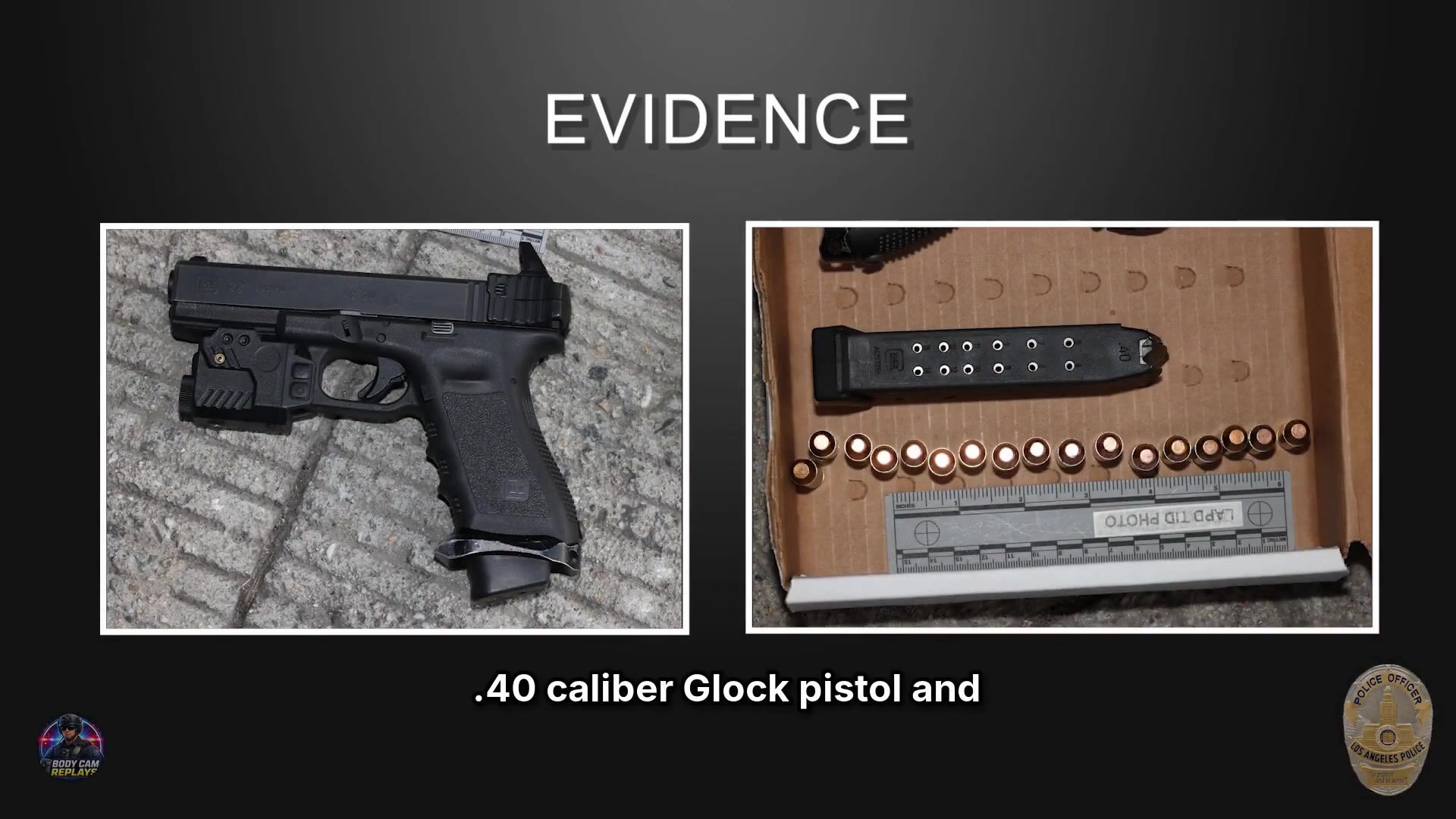
LAPD reported recovering a Glock Model 22 .40-caliber handgun at the scene. The weapon was booked as evidence. Police also said no officers or members of the public were injured during the incident. Vega was transported by ambulance to Olive View Medical Center, treated and medically cleared for booking.
Those details help separate what is visible in the footage from what investigators established afterward. Viewers can see the freeway confrontation and arrest, but the exact model and caliber of a recovered firearm are facts supplied by the department's evidence collection. The same distinction applies to Vega's warrant status and medical disposition.
CBS Los Angeles reported that the incident forced a lengthy closure of westbound 210 lanes and caused major traffic disruption. That is an unsurprising consequence of an officer-involved shooting on a freeway: investigators need to preserve the scene, document evidence, identify the locations of weapons and other items, and reconstruct where officers and the suspect were positioned.
Why the Full Sequence Matters
The most dramatic portion of this video lasts only moments, but focusing exclusively on the shooting removes the events that explain how officers arrived at that point. Police were initially trying to contact a person wanted on warrants. Vega fled. The pursuit moved onto a freeway. Police say he attempted to carjack a pickup truck, was armed with a handgun and repeatedly refused commands to drop it. Only then did the officer-involved shooting occur.
That sequence does not eliminate the need for an independent review of police force. LAPD's Force Investigation Division assumed responsibility for investigating the incident, and the department's published description is explicitly a preliminary account. But chronology is essential to understanding what the body-camera footage depicts.
It is equally important not to add claims that the evidence does not support. The available official release identifies Vega, the outstanding warrants, the attempted carjacking, the handgun, the commands, the shooting, the intermediate-force response and the arrest. It does not justify inventing a motive for Vega's flight or assuming facts about his intentions that investigators have not established.
From a Neighborhood Search to a Freeway Arrest
Few police encounters change environments as dramatically as this one. Officers go from a neighborhood warrant contact to an embankment, active freeway lanes, an alleged attempted carjacking and an armed standoff in traffic. Each transition creates a different problem, and officers have only seconds to adjust.
The incident also demonstrates why body-camera footage is most useful when viewed as a sequence rather than a collection of isolated frames. A single image of officers aiming toward the freeway cannot show the preceding foot pursuit. A clip beginning with gunfire cannot explain the alleged carjacking attempt. And the final arrest does not reveal how difficult it was to safely approach while a firearm remained nearby.
According to LAPD, Vega survived, received medical treatment and was cleared for booking. No officers or uninvolved community members were reported injured. The department recovered the Glock handgun and continued its investigation through Force Investigation Division.
The result is a case where the visual evidence and the official chronology line up unusually well: a wanted suspect runs, crosses the 210 Freeway, becomes involved with a civilian vehicle, is confronted while armed, survives an officer-involved shooting and is ultimately arrested on the roadway.
For viewers, the value of watching the complete recording is not simply seeing the most dramatic moment. It is seeing how quickly an attempted warrant contact develops into a public-safety emergency in one of the most dangerous environments possible for a foot pursuit.
Comments (0)
Loading comments...
May You Like
High-Speed CHP Chase Ends When Spike Strips Stop Suspect
After Dad’s Arrest, One Emotional Moment With an Officer Stands Out

Woman Refuses Repeated Orders to Exit Her Car Before Officers Move In