
Wanted Driver Leads Moore Police on a Dangerous Chase Before TVI Ends It
Wanted Driver Leads Moore Police on a Dangerous Chase Before TVI Ends It
A felony-warrant arrest attempt in Moore, Oklahoma, turned into a fast-moving pursuit on the final afternoon of 2024. Dash-camera footage shows a white pickup weaving through traffic, using opposing lanes and parking lots to keep moving until Moore police finally used a Tactical Vehicle Intervention near Interstate 240 and May Avenue. The maneuver sent the truck onto its side, ending a chase that had repeatedly exposed ordinary motorists to danger.
A Felony Warrant Brings Police to the Pickup
The incident unfolded on December 31, 2024. Moore Police said traffic officers identified a vehicle associated with 35-year-old Kayla Cervantes, who was wanted on felony warrants. Officers attempted to stop the white pickup, but the driver did not yield. Instead, the vehicle accelerated away and the encounter immediately became a pursuit.
The identity, date and reason for the attempted stop are not guesses based on the viral title. They match the description released with the Moore Police dash-camera footage and contemporaneous local reporting. KOCO reported on the day of the pursuit that officers had attempted to stop a driver with a felony warrant near 27th Street and Eastern Avenue before the vehicle fled.
That starting point matters. Officers were not chasing the pickup merely because of a minor traffic disagreement. They were attempting to take a wanted person into custody when the driver chose to continue moving.
The Pickup Moves From Traffic to Oncoming Lanes
The dash-camera footage quickly demonstrates why the pursuit became dangerous. The white pickup travels through normal traffic while the police vehicle follows with emergency equipment activated. At several points the driver changes lanes aggressively and looks for openings between other motorists.
Police said Cervantes drove dangerously and erratically, including through traffic lights, into opposing traffic and through parking lots. The video supports the broad description. The pickup does not remain on a single predictable route. It repeatedly changes the problem officers are trying to solve.
A fleeing driver who uses an opposing lane creates a risk far beyond the police vehicle directly behind them. Oncoming motorists may see a pickup approaching where no vehicle should be and have only seconds to react. Even drivers who hear sirens may not immediately understand where the danger is coming from.
Why Officers Continue the Pursuit
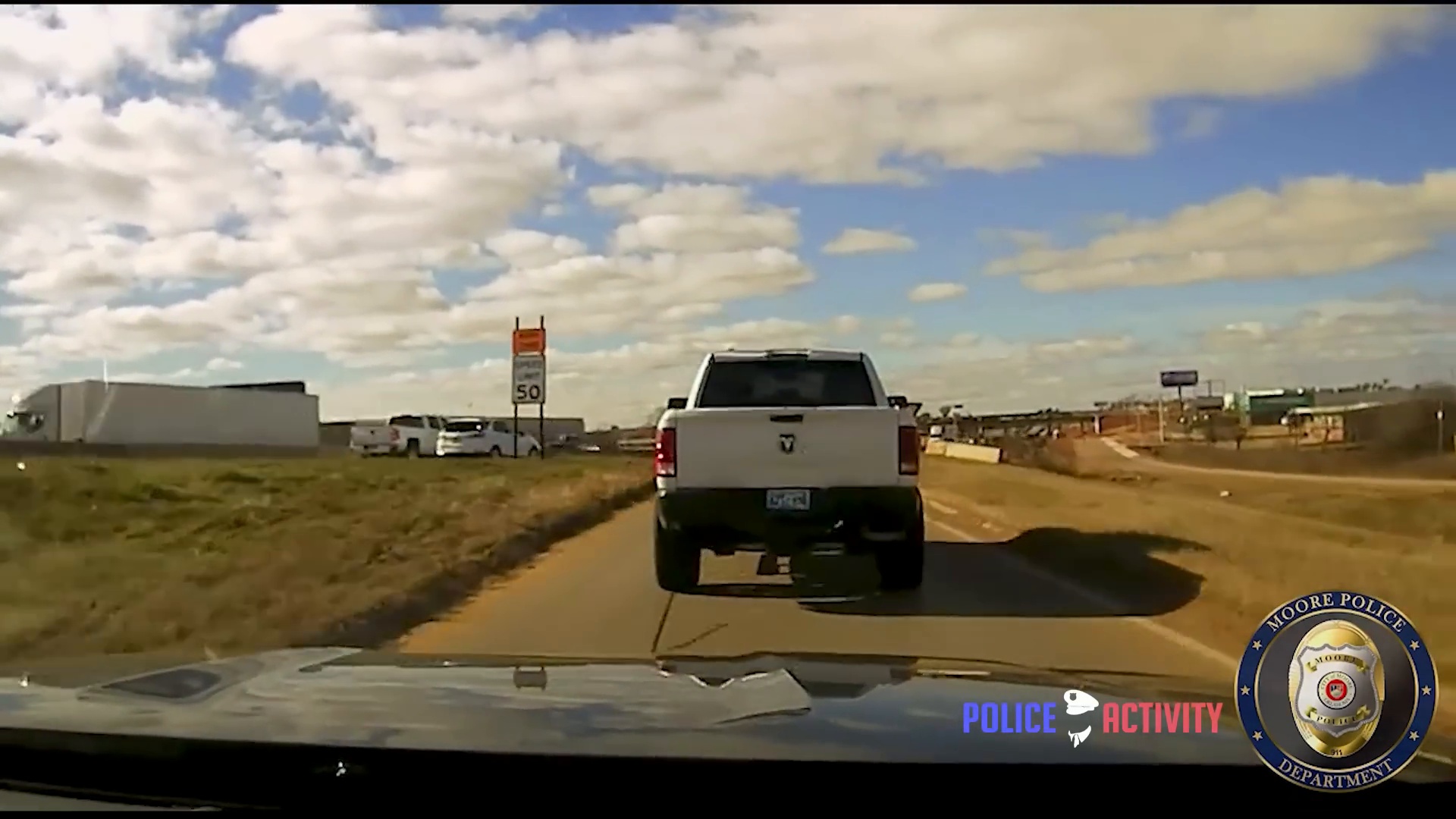
Police pursuits require constant risk assessment. Officers have to consider the reason for the attempted stop, the behavior of the fleeing driver, traffic conditions, speed, road design and whether terminating the chase would reduce or increase the danger.
In this case, the suspect was wanted on felony warrants and the driving behavior itself created additional risk. Once the pickup began moving through traffic in an unpredictable manner, officers were dealing not only with an outstanding warrant but with an active roadway hazard.
That does not mean every pursuit should continue indefinitely. Agencies use policies that guide when officers may pursue and when supervisors may order a chase terminated. The footage does not provide every internal radio discussion or policy decision, so those details should not be invented. What it does show is that Moore officers remained behind the pickup as it moved toward Oklahoma City.
The Chase Reaches Faster Roads
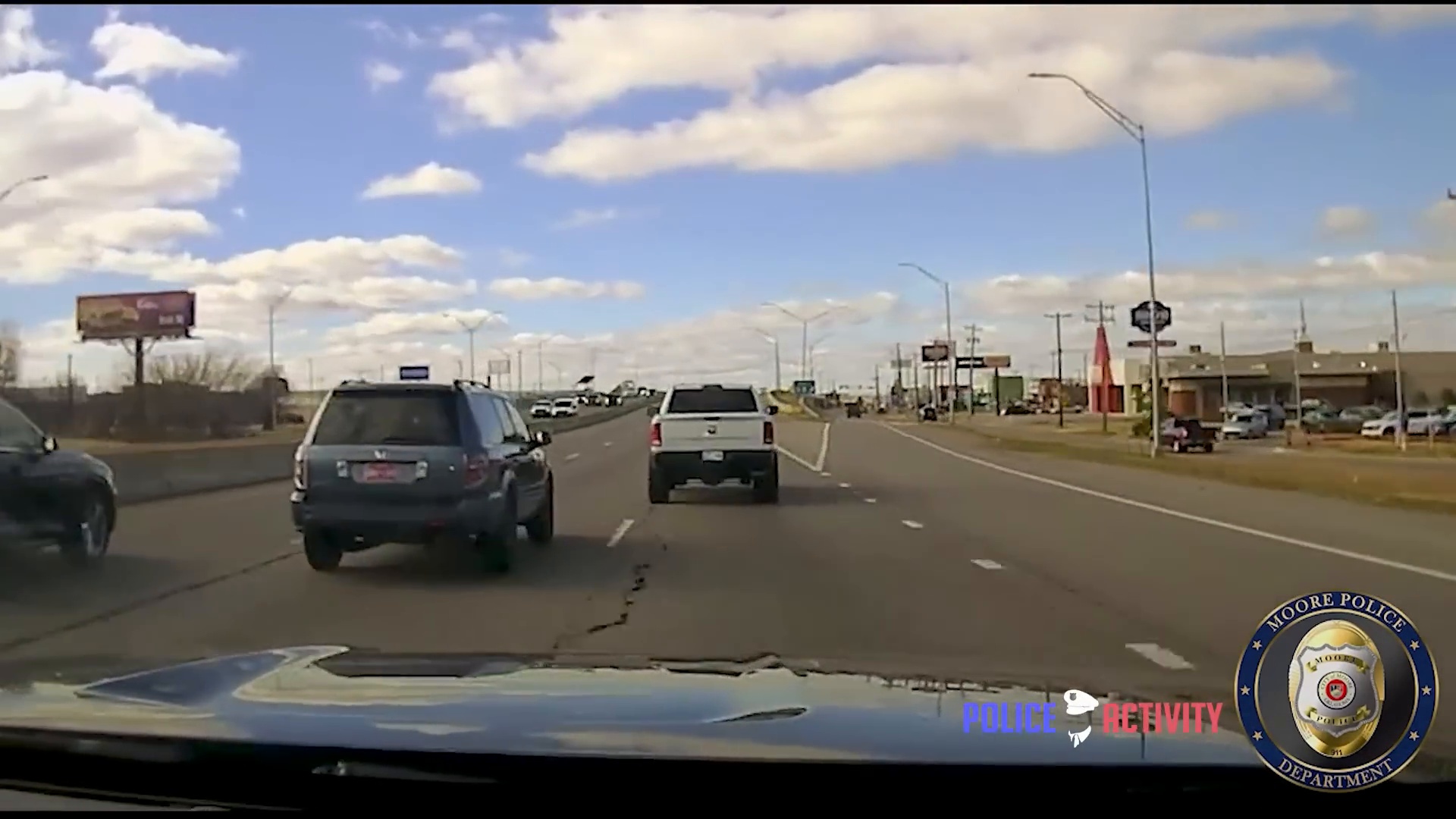
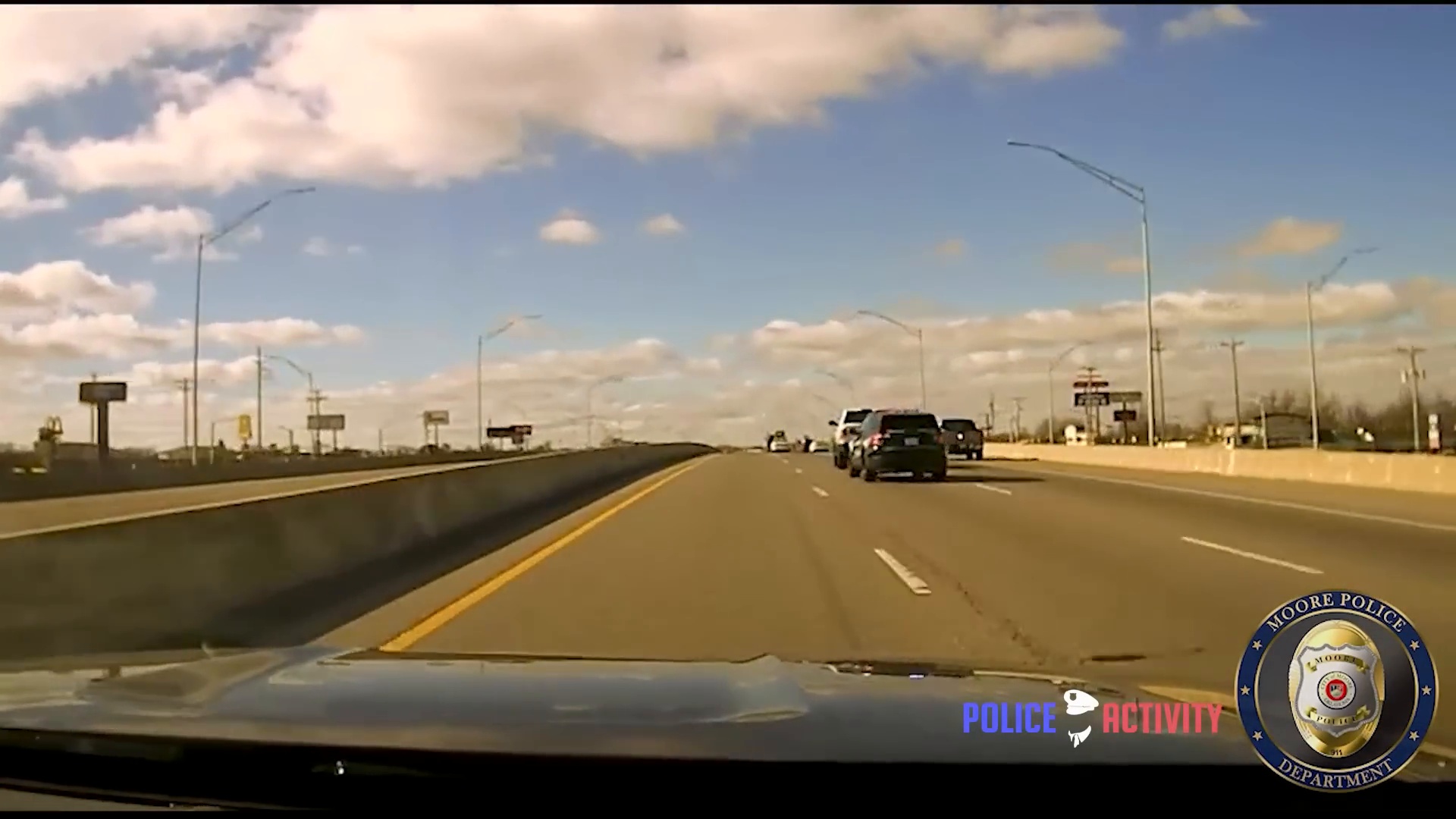
As the pursuit progresses, the environment changes from surface streets and commercial areas to wider, faster roads. The pickup gains space at times, but the pursuing unit continues to keep it in view.
Highway driving can reduce some intersection conflicts while increasing the consequences of a crash. Speeds are higher, traffic can be dense, and a sudden lane change can involve several vehicles at once. The pickup’s size also matters physically. A full-size truck carries substantial mass, so a collision with a smaller passenger vehicle could produce serious consequences.
The video shows officers balancing distance and contact. The pursuing unit does not need to remain inches from the truck to maintain the chase. Instead, the officer tracks its movement while waiting for a location and opportunity where a controlled intervention may become possible.
What a TVI Is Designed to Do
Oklahoma agencies frequently use the term Tactical Vehicle Intervention, or TVI, for a maneuver often called a PIT maneuver elsewhere. The technique involves a police vehicle making controlled contact with the rear quarter of a fleeing vehicle to induce rotation and bring the pursuit to an end.
The objective is not simply to crash into the suspect. Timing, angle, speed, road conditions and surrounding traffic matter. Officers are trained to evaluate whether an intervention can be performed without creating an unreasonable risk to nearby motorists.
In this pursuit, the final TVI occurs near I-240 and May Avenue in southwest Oklahoma City. KOCO reported that Moore police used the maneuver on the interstate and that the white pickup crashed as a result.
The First Contact Does Not Immediately End Everything
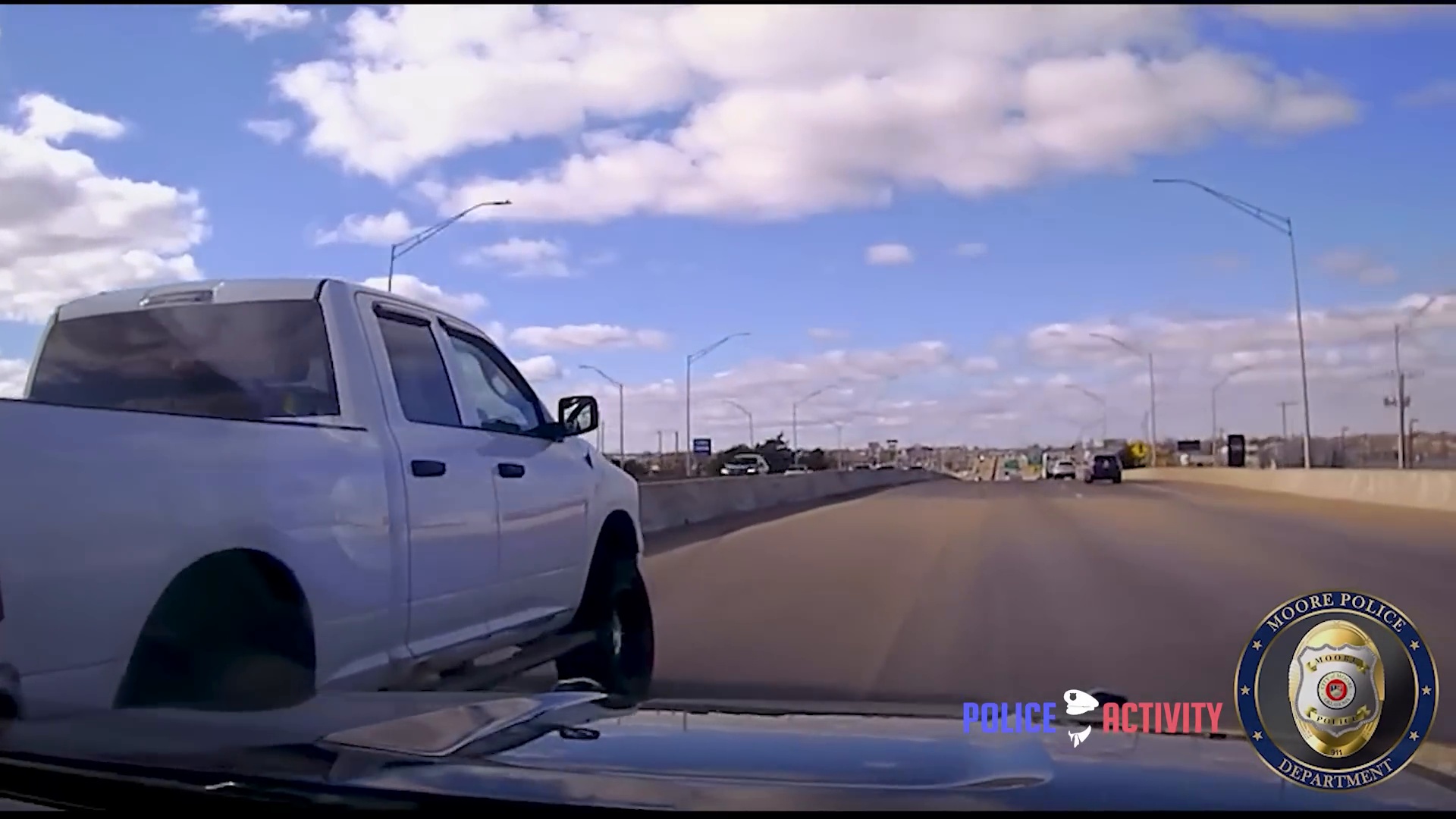
The most dramatic portion of the footage comes as the patrol vehicle closes the distance. The officer positions the cruiser beside the pickup and makes contact. For a moment, the truck continues moving as both vehicles occupy the roadway.
Dash-camera video makes this sequence much easier to understand than a photograph of the wrecked pickup. The maneuver depends on relative position. The police vehicle reaches the truck’s rear quarter, applies lateral force and disrupts the pickup’s ability to continue straight.
The truck begins rotating. At highway speed, that rotation quickly becomes more severe than a simple spin. The pickup leaves its normal orientation and ultimately rolls onto its side before coming to rest.
The Pickup Rolls and the Pursuit Is Over
Once the truck rolls, the chase ends instantly. The pursuing officer stops nearby and the scene changes from pursuit tactics to arrest and medical response.
The aftermath footage shows the damaged white pickup surrounded by law enforcement. The rear and side of the vehicle have sustained significant damage, and debris is visible around the final position. Officers approach knowing that the person inside may be injured but also knowing that a fleeing suspect can remain a threat after a crash.
Police said Cervantes was taken into custody without further incident. That detail is important because the end of a pursuit can sometimes become another confrontation. Here, the public account indicates that officers were able to secure her after the rollover without a separate violent struggle.
Medical Care Comes Before Booking
Cervantes was transported to a nearby hospital after the crash. KOCO reported on December 31 that the suspect was expected to be okay and that no officers were injured. The later police account said she was medically cleared before being booked into the Cleveland County Detention Center.
Medical evaluation after a rollover is a normal and important precaution even when a person appears capable of speaking or walking. Crash forces can cause injuries that are not immediately obvious. Once the immediate threat is controlled, officers and emergency personnel have to shift attention to the physical condition of everyone involved.
No officers or civilians were reported injured during this pursuit. Considering the truck’s movement through traffic and the violence of the final rollover, that is a significant part of the outcome.
What Police Said They Found in the Case
The description released with the footage states that Cervantes had multiple warrants and that the investigation involved M30 fentanyl pills, methamphetamine, heroin and drug paraphernalia that police said she planned to sell. Those allegations provide additional context for the felony-warrant arrest attempt.
It is important to describe these as police allegations rather than a final court judgment. An arrest, booking or allegation does not itself establish guilt on every criminal count. Court records and later proceedings determine how individual charges are ultimately resolved.
The public footage is strongest as evidence of the pursuit itself. It directly shows the driving, the police response and the final TVI. Drug-related allegations come from the law-enforcement description accompanying the release rather than something a viewer could independently determine from the dashcam image.
Why the Date Matters
The pursuit occurred on New Year’s Eve, December 31, 2024. Holiday traffic can add another layer of uncertainty to an already dangerous pursuit. The footage shows ordinary vehicles continuing to use the roads while police attempt to contain the fleeing pickup.
Local reporting appeared the same day, before the longer dash-camera footage was widely circulated. KOCO initially reported the broad facts: a felony-warrant stop, a pursuit beginning near 27th Street and Eastern Avenue, and a TVI near I-240 and May Avenue that ended with a damaged white pickup and the suspect being transported for medical care.
When Moore Police footage later became available, viewers could see how much happened between those two points. The video fills in the driving behavior and the tactical decisions that a short breaking-news report could only summarize.
The Difference Between a Crash Clip and the Full Pursuit
A short social-media clip of the rollover could make the incident look like a police vehicle simply struck a pickup at speed. The complete footage changes that impression by showing the long sequence that precedes the maneuver.
Viewers can see the pickup refusing to stop, moving through traffic and repeatedly seeking ways to continue. They can also see the officer waiting until the chase reaches a location where the cruiser can get into position beside the truck.
That context does not mean viewers must agree with every tactical choice. It does mean the TVI should be evaluated as the final stage of a pursuit rather than as an isolated collision.
Why Dashcam Footage Is So Valuable
Dash cameras preserve sequence. They record how far apart vehicles are, what traffic looks like, when emergency lights are active and how quickly a suspect changes direction. Those details can be difficult to reconstruct from witness descriptions alone.
The camera also has limits. It does not show everything the officer sees through side windows or mirrors. It cannot capture every radio transmission, and it does not explain every decision being made by supervisors or other units.
Still, the footage provides a continuous visual record of the central event. In this case, it shows why the pursuit was dangerous and how the final TVI physically brought it to an end.
A Chase That Could Have Ended Very Differently
The most notable outcome may be what did not happen. Despite the pickup entering dangerous traffic situations and eventually rolling onto its side, police reported no injuries to officers or civilians. Cervantes was evaluated at a hospital and medically cleared.
That does not make the pursuit harmless. Every opposing-lane movement and every high-speed lane change carried the possibility of a collision involving someone who had nothing to do with the warrant. The final maneuver also carried obvious risk, as demonstrated by the condition of the pickup afterward.
The incident illustrates the difficult tradeoff at the heart of police pursuit tactics. Allowing a dangerous driver to continue can expose the public to additional risk, while forcibly ending the pursuit introduces a different set of risks. Officers have to make that decision while events are still unfolding.
The Final Scene Near I-240 and May
The final images are far quieter than the chase. The white pickup sits badly damaged as officers, emergency responders and passing traffic occupy the highway around it. The frantic movement has stopped.
For the suspect, the sequence ends with medical evaluation and booking. For officers, the end of the chase begins another process: securing the scene, documenting the TVI, collecting evidence and preparing reports explaining why the pursuit continued and why the intervention was used.
The wrecked truck becomes a visual summary of the entire encounter. What started as an attempt to arrest a wanted person in Moore traveled through streets, parking areas and highway traffic before ending several miles away in Oklahoma City.
Watch the Full Pursuit From the First Attempted Stop
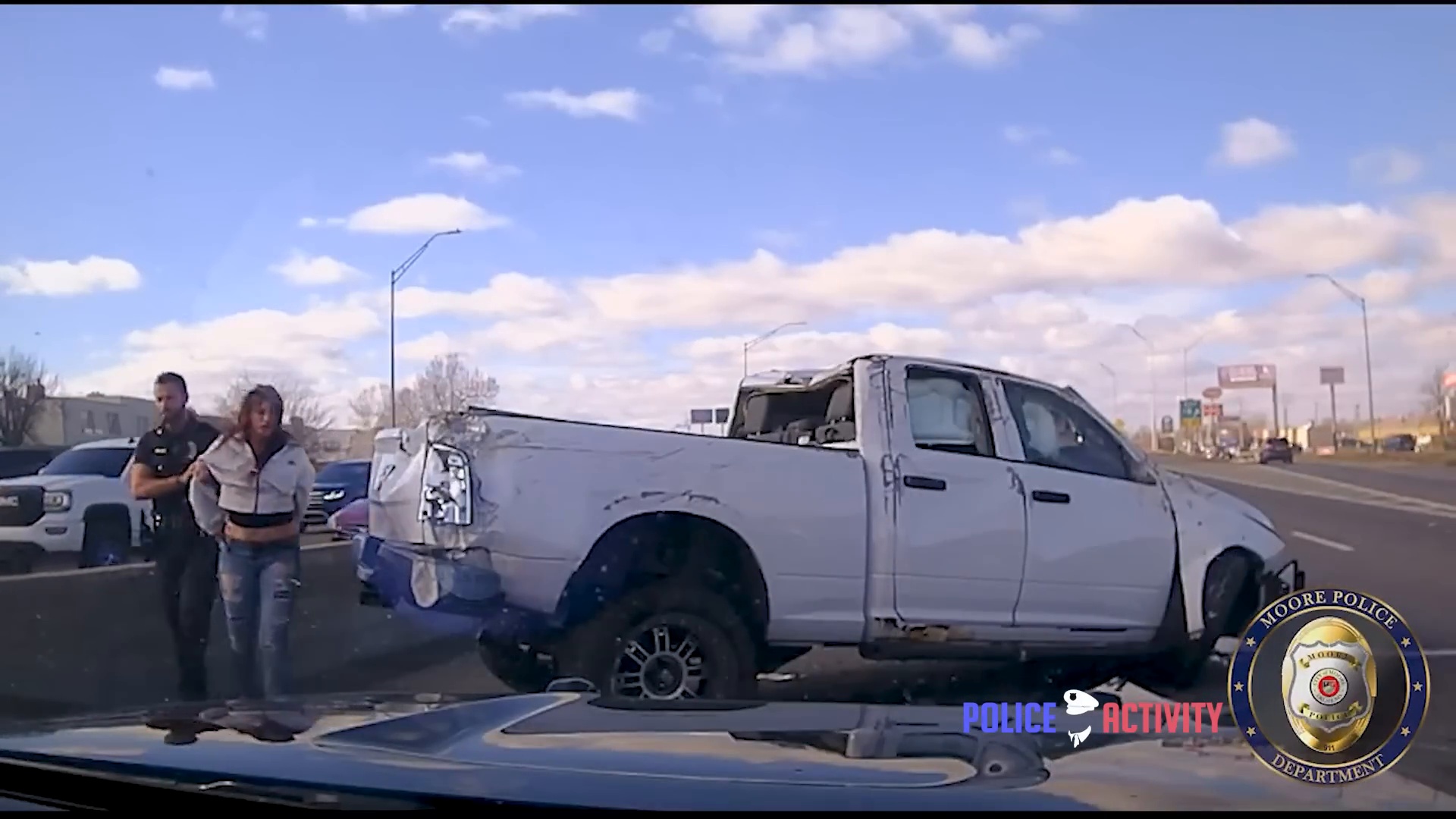
The rollover is the most dramatic moment, but it makes much more sense after seeing the route that led to it. The full dash-camera recording shows the pickup’s driving, the risks to surrounding motorists, the officer’s positioning and the final seconds before the TVI.
Comments (0)
Loading comments...
May You Like

[DASHCAM] Drunk Driver Leads Trooper on High-Speed Pursuit Through City Streets

Couple Arrested for leaving 10 Dogs and Cats in Hot car in Florida

Karen Entitled’ Woman Gets Tased After Allegedly Ramming Police Cars













