Trash-Talking 20-Year-Old Challenges Officer and Gets Humbled Fast
Trash-Talking 20-Year-Old Challenges Officer and Gets Humbled Fast
Verification note: The supplied footage confirms an AXON date of May 4, 2022 and matches the widely circulated video associated with the original title. Public research did not produce an official report or court record that could be tied to the exact incident with sufficient confidence, so no identity, agency, charge or court outcome has been invented.
A Loud Parking-Lot Encounter Turns Serious
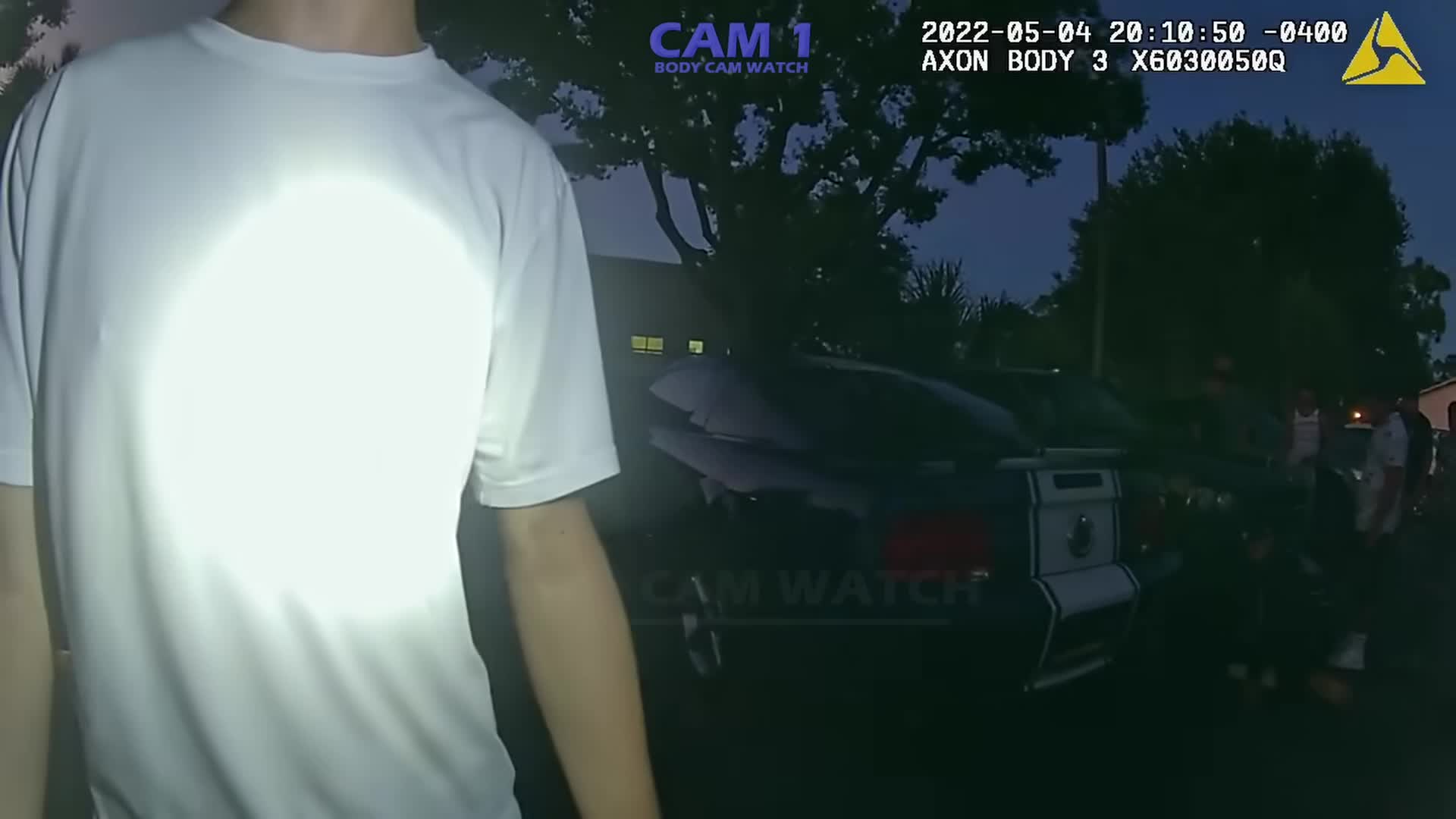
The encounter begins on the evening of May 4, 2022, in a residential parking area as daylight is fading. The AXON Body 3 timestamp visible in the supplied footage shows the first officer interacting with a group of young men shortly after 8:10 p.m. Several vehicles are parked nearby, and what initially appears to be a verbal disturbance quickly becomes focused on one 20-year-old man in a white T-shirt.
The original online title describes him as a trash-talking 20-year-old who is “instantly humbled.” That is unmistakably commentary, but it does reflect the central arc of the video: the young man speaks confrontationally to an officer, continues challenging him at close range, and then finds himself physically detained within moments. The full footage, however, is more useful than the punchline. It shows the warnings, the positioning of the people around the officer, the sudden takedown, the arrival of additional officers and the much longer discussion that follows.
The video circulated widely under the title “When a Trash-Talking 20-Year-Old Gets Instantly Humbled.” Archived online discussions link that title to a YouTube upload and describe the same core sequence: an officer approaches a group in a parking area, one young man challenges him, the officer takes him to the ground, and another young man reacts loudly nearby. Those descriptions match the supplied footage. What public searches did not produce was a police release, arrest affidavit or court docket that could be connected to the exact body-camera recording with enough certainty to name the department, the arrested man or a final criminal disposition.
That limitation is important. The camera gives a precise date and an unusually detailed visual record, but an AXON timestamp and patrol-car number are not enough by themselves to attach a stranger's identity or criminal history. This article therefore stays close to what can be verified from the footage and clearly separates general police procedure from incident-specific facts.
Confidence Meets an Officer Who Is Not Backing Away
The young man's demeanor is central to the first minutes. He stands close to the officer, speaks assertively and appears confident that the verbal exchange will continue on his terms. Other young men remain nearby, creating a scene in which the officer has to watch more than one person while keeping his attention on the individual directly in front of him.
Verbal confrontation with police is not automatically a crime. People can question officers, criticize them and, within broad limits, speak disrespectfully without surrendering constitutional protections. That point matters because online commentary often treats attitude itself as grounds for arrest. It is not. The more significant question is whether speech is accompanied by conduct that interferes with an investigation, threatens safety, constitutes an offense or gives officers some other lawful basis for detention.
The body camera shows the officer monitoring distance closely. That is understandable in a group encounter. A person standing within arm's reach can move from words to physical contact faster than an officer can create space. The presence of other people adds uncertainty because the officer cannot know whether they will remain observers, try to intervene or simply become frightened once physical action begins.
The young man does not appear intimidated by the officer's presence. His posture and continued verbal challenge convey the opposite. That confidence is what gives the later transition its dramatic effect. The scene goes from talking to physical control with almost no cinematic buildup. One moment the two are upright and facing each other; the next the camera drops sharply toward the pavement as the officer takes control.
The Takedown Happens in Seconds
At approximately 8:11 p.m. on the body-camera timestamp, the interaction changes abruptly. The officer moves to restrain the 20-year-old, and the camera perspective plunges toward the pavement. The lens captures legs, arms, clothing and the illuminated ground at extremely close range as the officer works to control the young man's hands and body.
This is the moment that produced the viral “instantly humbled” framing. Online reposts tend to isolate it because the contrast is immediate: a confident verbal challenge is followed almost instantly by a physical detention. But the body camera also demonstrates why takedown footage can be difficult to interpret from a single frozen frame. Once the officer's torso is moving, the camera no longer provides a stable wide shot. Much of what happens is communicated through movement and audio rather than a clean view.
Additional people react immediately. Voices rise around the officer, and the scene becomes louder and more chaotic. That reaction matters tactically. An officer controlling one person on the ground still has to remain aware of everyone standing nearby. Backup becomes valuable not only for restraining the detainee but for separating witnesses, maintaining a safe perimeter and preventing another confrontation.
The footage does not justify inventing a specific offense to explain the takedown. Without the matching arrest report, it would be irresponsible to claim that the young man was arrested for a particular statute simply because viewers can see him being restrained. The video documents the detention. The legal basis and final charge require records that have not been reliably matched to this footage.
Backup Changes the Dynamic
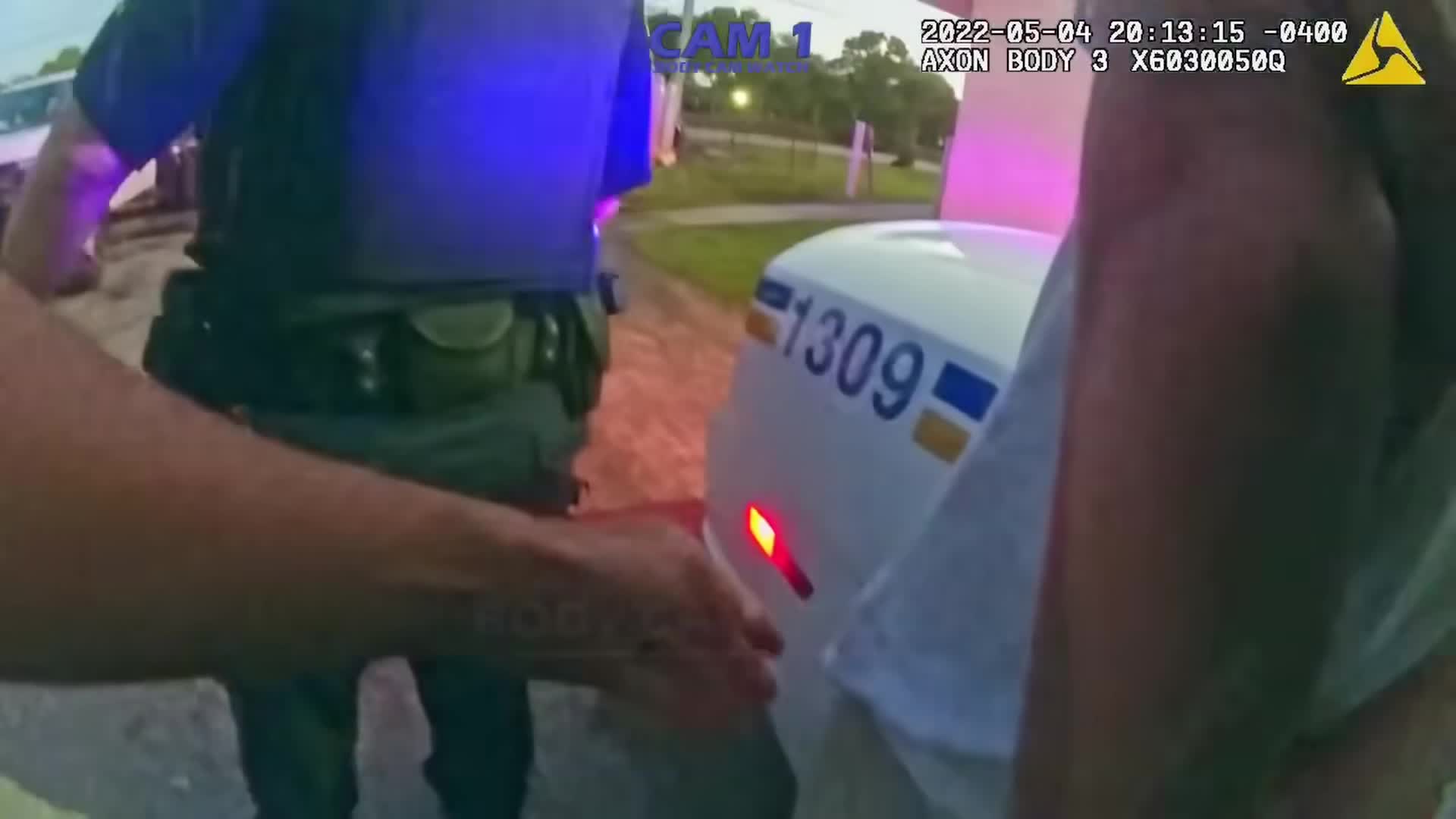
Within minutes, additional officers and marked police vehicles arrive. The parking area fills with emergency lights, and the encounter becomes far more structured. The young man is kept near a patrol vehicle while officers divide their attention among him and the other people who remain at the scene.
A white marked patrol car with unit number 7309 is visible in the footage. The body-camera overlay switches among multiple cameras, confirming that several officers were recording the aftermath. Those are useful verification details, but the visible markings are not sufficiently clear in the supplied frames to identify the agency with confidence. Rather than guess from vehicle styling or a partially obscured patch, the department is left unnamed.
The presence of backup also changes the emotional balance. The first officer no longer has to simultaneously control the detained man and monitor every person around him. Other officers can speak with witnesses, move people apart and determine what happened before they arrived.
This is where the video becomes more than a short takedown clip. The aftermath lasts far longer than the physical struggle. Officers talk with the young men, explain parts of the situation and repeatedly work to keep the scene calm. The detainee's companions remain vocal, and at least one reacts emotionally to what has happened.
For viewers, those minutes provide context that a viral edit can easily remove. Police work after a takedown is often less dramatic but more informative. Officers have to determine identities, establish the sequence of events, decide whether anyone else committed an offense and document why force was used.
The Arrest Is Only the Beginning of the Conversation
Once the immediate struggle is over, the young man remains in police custody while officers continue speaking with him and others at the scene. The camera shows him beside marked vehicles and later in the rear of a patrol car. The shift in his circumstances is obvious. He began the encounter standing freely among friends; he ends it physically separated from them and under police control.
That is the factual core behind the “humbled” language. It does not require speculation about what he felt internally. The observable change is enough: the power dynamic of the encounter changes completely after the officer acts.
The people around him continue challenging aspects of the police response. Their reactions range from argumentative to emotional. Officers repeatedly answer questions while also directing them not to interfere. This is a familiar pattern in group arrests. Friends may feel compelled to defend the person being detained, while officers are concerned that crowding or physically intervening could create another safety problem.
A useful distinction is the difference between observing and interfering. Bystanders generally have broad rights to watch and, subject to reasonable restrictions, record police activity from a safe position. Those rights do not ordinarily include physically obstructing officers, entering an active struggle or refusing lawful directions that are genuinely necessary to secure the scene.
The supplied footage shows officers spending considerable time managing that boundary. The situation does not become a mass arrest. Instead, the primary detainee remains the focus while the others are kept at a distance and spoken to.

Why Trash Talk Is Not the Legal Issue
The online title naturally encourages viewers to see the incident as a lesson about disrespect. That makes for entertaining packaging, but it is not how the legal analysis works.
The First Amendment protects a substantial amount of speech directed at police, including criticism and offensive language. Courts have repeatedly recognized that officers are expected to tolerate verbal challenges that might provoke an ordinary citizen. An arrest therefore cannot be justified merely because an officer dislikes someone's tone.
The critical line is conduct. Threats that fall outside protected speech, physical interference, resisting a lawful detention, assaultive behavior or other independently unlawful acts can change the situation. So can circumstances that give an officer reasonable suspicion or probable cause before the argument even begins.
Because the exact incident report has not been verified here, the article does not pretend to know which legal theory officers ultimately used. The footage shows a confrontational exchange followed by detention. It does not display a charging document.
This is one reason body-camera analysis should resist the temptation to reverse-engineer charges from an arrest. Handcuffs tell viewers that police took control of someone. They do not reveal whether prosecutors later filed a case, reduced a charge, declined prosecution or obtained a conviction.
A 20-Year-Old in a Group Setting
The age in the original title is significant because 20 is legally an adult, even if the social dynamic in the footage resembles a group of young friends testing boundaries. The man is responsible for his own decisions during the encounter, but age alone does not explain why the confrontation escalated.
Group dynamics can amplify confidence. A person who might speak differently to an officer alone may perform for friends, answer more aggressively or resist backing down once others are watching. That is a general behavioral observation, not a diagnosis of this individual. The camera simply shows that he is surrounded by peers when the argument develops.
For the officer, a group setting increases the number of variables. Every person has hands, pockets and freedom of movement. The officer cannot focus exclusively on the loudest speaker without also tracking who is behind him and who is moving closer. Once a physical detention begins, those concerns become more acute.
The later footage shows additional officers maintaining separation and repeatedly communicating with the remaining young men. That response illustrates how quickly one person's arrest can create a broader scene-management problem even when no one else is ultimately taken into custody.
Body Cameras Show the Difference Between a Moment and an Incident
The viral moment lasts seconds. The incident lasts much longer.
The supplied video runs for more than eleven minutes and includes multiple body-camera perspectives. It begins before the takedown and continues through the aftermath, conversations with the group and placement of the detainee in a police vehicle. That length is important because it exposes the editing choices behind social-media versions.
A creator can make the officer appear either impulsive or endlessly patient depending on where a clip begins. Starting one second before the takedown removes everything that preceded it. Ending immediately afterward removes the officers' explanations and the group's reactions. A complete body-camera release allows viewers to examine the sequence rather than only the payoff.
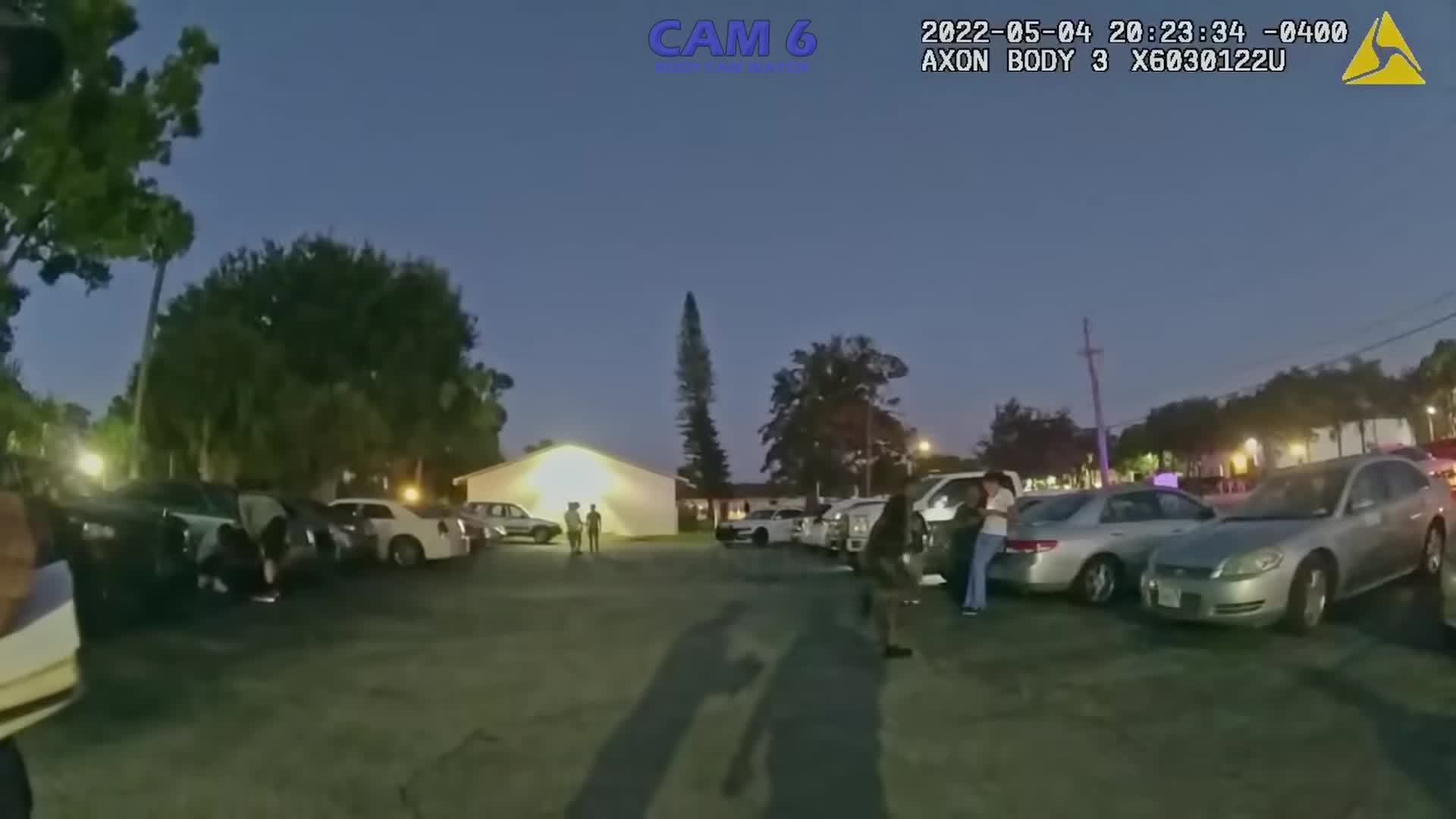
The AXON timestamps also provide a reliable chronology. The first camera shows the encounter shortly after 8:10 p.m. on May 4, 2022. Later footage from another officer continues past 8:30 p.m. The physical confrontation is therefore only a small portion of a scene that police manage for more than twenty minutes across the various recordings incorporated into the edit.
That broader timeline is one of the strongest reasons to use real footage rather than rely solely on a sensational title.
What Could Be Verified Through Public Research
Research confirms that the exact viral title has circulated online with a YouTube link and descriptions of a young man challenging an officer in a parking area before being taken down. An archived 2024 discussion of the video describes the same scene and links to the widely shared upload. This provides useful corroboration that the supplied file is the footage associated with that viral title.
However, searches using the May 4, 2022 AXON date, the subject's reported age, the parking-lot setting, the patrol-car number and descriptions of the takedown did not produce an official police release or local-news article that could be matched beyond reasonable doubt.
Some search results lead to completely unrelated May 4, 2022 cases involving 20-year-olds in Florida. Those cases are not used here. Similarity of age and date is not enough to identify an incident. Likewise, other body-camera videos involving golf carts or driveway disputes have circulated under adjacent recommendation algorithms, but they are different events and should not be blended into this one.
The responsible conclusion is therefore limited: the supplied video is the viral parking-lot encounter associated with the “trash-talking 20-year-old” title, but the man's name, exact department, arrest charges and court outcome remain unverified from reliable public records.
What Remains Unknown
The absence of a verified case file creates clear boundaries for the article. The man's name is not stated. His exact city is not asserted. The department is not guessed from a blurry uniform or patrol-car graphic. No criminal history is attributed to him. No specific charge, bond amount, plea, conviction or sentence is presented as fact.
This may seem unusually cautious for a video that has circulated widely, but viral popularity does not improve the quality of the underlying identification. Reposts often copy one another, and commentary channels frequently omit case numbers or source documents.
The body camera itself remains the strongest evidence available. It establishes the date, approximate time, group setting, verbal confrontation, rapid physical detention, arrival of backup and extended aftermath.
If a matching incident report or court docket later becomes available, those records could add the missing legal context. Until then, inventing that context would make the story less accurate, not more complete.
The Instant Change That Made the Clip Viral
The reason the footage spread is easy to understand. It contains a dramatic reversal compressed into a few seconds.
The young man appears comfortable challenging the officer. His friends are close. The interaction feels verbal. Then the officer moves, the camera drops and the scene changes completely. The contrast is immediate enough that viewers do not need narration to understand why editors built titles around being “humbled.”
But a more careful reading avoids celebrating force simply because it produces a satisfying internet moment. Police force is not supposed to be punishment for arrogance. Its legitimacy depends on the circumstances and lawful objectives facing the officer.
The footage can still be compelling without turning the takedown into a moral sentence. It shows how rapidly a confrontational police encounter can change and how little time remains to reconsider once officers move from verbal commands to physical control.
For anyone watching primarily for the dramatic moment, the longer aftermath is worth attention too. The detainee's companions react, additional officers arrive, and police spend far more time stabilizing the scene than they spent on the takedown itself.

A Viral Lesson With Important Limits
It would be easy to end this story with a simple slogan: do not trash-talk police. That misses the legal and practical complexity.
People retain the right to disagree with officers. They can ask questions and, in many circumstances, criticize police conduct. But a roadside or parking-lot encounter is also a poor place to test physical boundaries or assume that verbal confidence prevents detention. Once an officer has a lawful basis to act, arguing does not create immunity from that action.
For officers, the footage illustrates the opposite responsibility. Authority does not make every insult an offense. Professional policing requires separating irritating speech from conduct that actually justifies detention or force.
The video is memorable because those tensions collide in a compact scene. A 20-year-old speaks as though he controls the interaction. An officer decides otherwise. Seconds later, the young man is on the ground and backup is on the way.
What happened legally after that night cannot be established from the public material located for this article. What happened on camera can. The May 4, 2022 footage documents a confident confrontation, a sudden detention and a long aftermath in which police work to restore order among a group that had just watched the encounter change in an instant.
Comments (0)
Loading comments...
May You Like

Four Suspects Try Killing a Cop After Police Chase

🚨⛽ Man Caught in a Disturbing Incident at a Gas Station | Police Respond US

UCF Student’s Pronoun Dispute With Campus Police Escalates Into an Arrest