
This Stolen U-Haul Survived Every TVI Arkansas State Police Tried!
Stolen U-Haul Refuses to Stop as Arkansas Troopers Try Again and Again to End the Chase
A Stolen Truck Turns Into a Moving Problem
At first glance, it is hardly the kind of vehicle anyone would expect to see at the center of an aggressive police pursuit.
A U-Haul box truck is designed for moving furniture, appliances and cardboard boxes, not outrunning state troopers.
But on the morning of July 30, 2026, a reported stolen U-Haul became the focus of a pursuit through the Little Rock area that repeatedly resisted attempts to bring it to a controlled stop.
The chase was already underway when Arkansas State Police became involved.
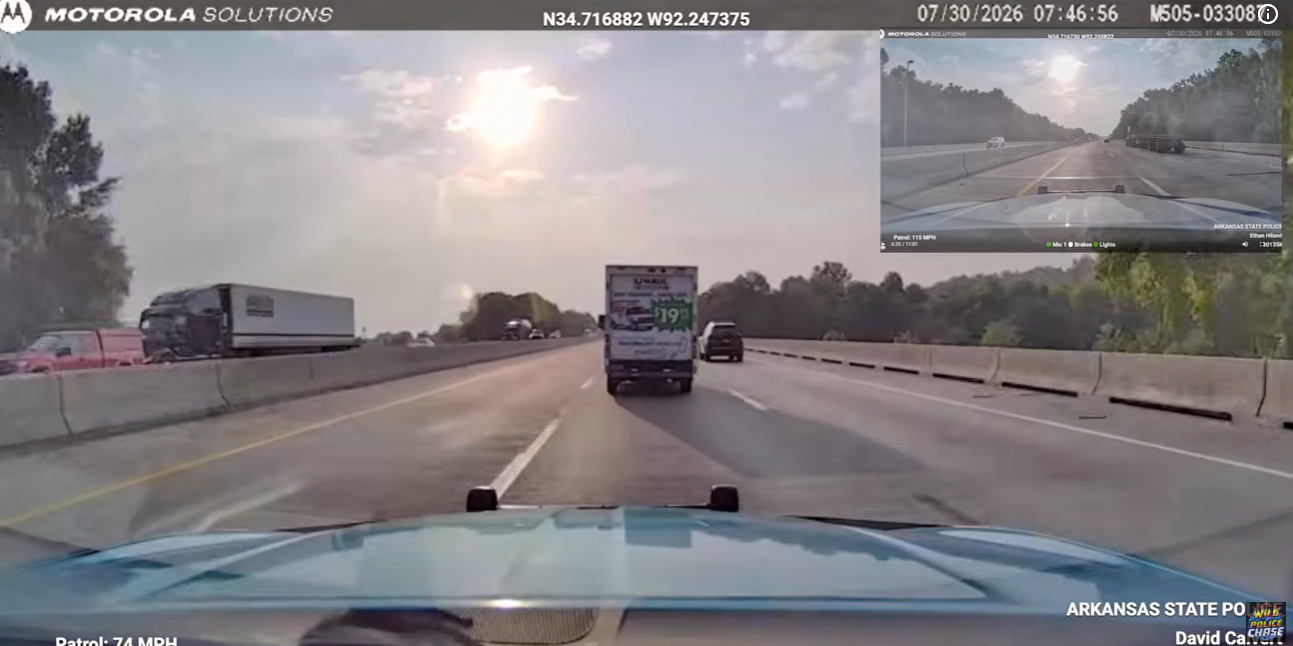
According to the incident account accompanying the released footage, Troop A Dispatch reported at approximately 7:43 a.m. that officers with the Little Rock Police Department were pursuing a stolen 10-foot U-Haul traveling east on Interstate 30 near mile marker 135. Arkansas State Police Trooper David Calvert spotted the pursuit as it continued toward Interstate 440 and joined near the first mile marker.
The footage supplied for this article independently supports those details. The patrol-video overlay identifies Arkansas State Police and David Calvert, while displaying the date July 30, 2026.
Ahead of the patrol car sits the unmistakable rear profile of the U-Haul.
For several moments, the scene almost looks controlled.
The truck moves with traffic.
The trooper follows.
Other vehicles continue traveling nearby.
But what happens over the following minutes illustrates why pursuing a large box truck creates a very different tactical problem from chasing an ordinary passenger car.
Stopping it would require more than simply catching it.
And Arkansas troopers were about to discover just how difficult that could be.
Troopers Join a Chase Already in Progress
Trooper Calvert's report says the U-Haul was traveling at approximately 75 mph in the number two lane when he joined the pursuit.
That speed alone does not tell the entire story.
The bigger problem was visibility.
Because of the height and dimensions of the box truck, Calvert could not see sufficiently far ahead of it to determine whether conditions were safe for a Tactical Vehicle Intervention, commonly referred to by Arkansas State Police as a TVI.
That consideration is immediately apparent in the footage.
A passenger car gives an officer some ability to see traffic beyond it. A large U-Haul blocks much of that view. Attempting to rotate a vehicle without knowing what is directly ahead could turn an already dangerous pursuit into a collision involving innocent motorists.
So the trooper follows and waits.
Trooper Ethan Hiland joins as the secondary unit and begins relaying information to dispatch, according to the published incident narrative.
The pursuit then begins changing rapidly.
Calvert moves toward another lane.
According to his account, the U-Haul cuts him off.
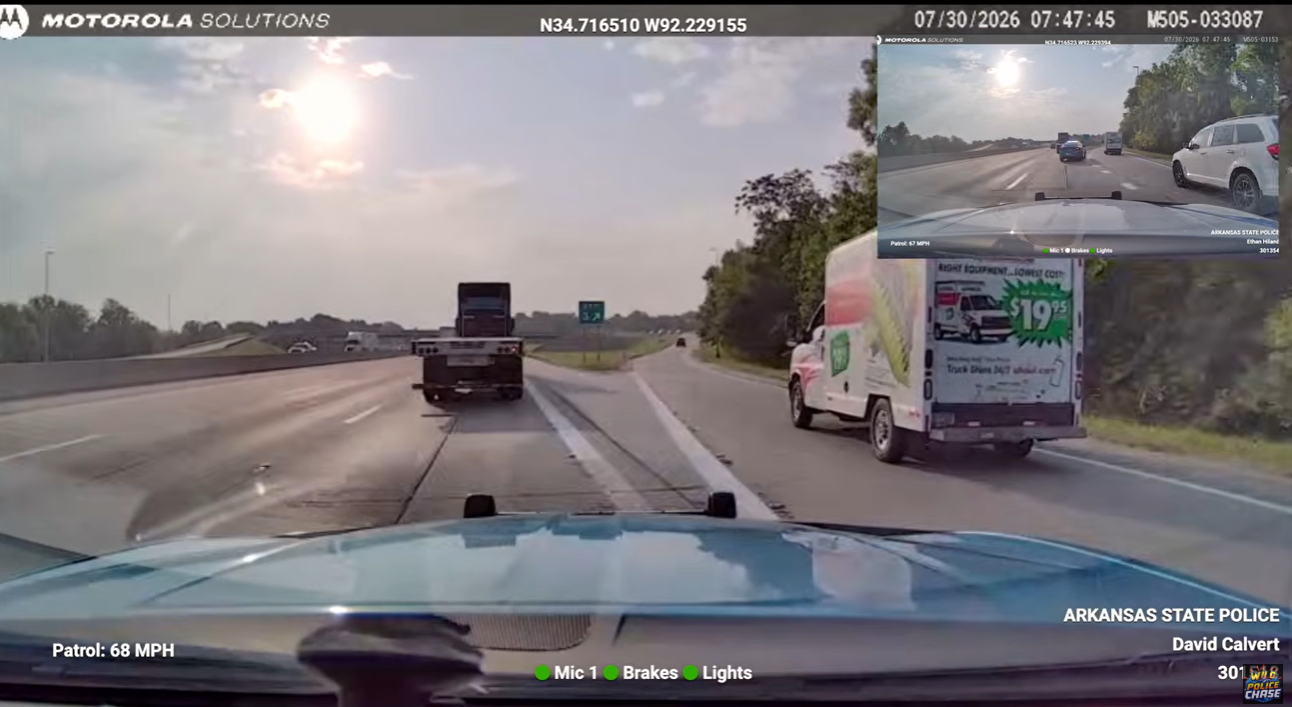
Then the driver suddenly takes the exit near mile marker three.
That maneuver creates an opportunity.
Calvert moves in.
He attempts a driver's-side TVI on the exit ramp.
For an instant, it appears to work.
The U-Haul is pushed into the grass.
With a smaller vehicle, that might have been the end.
But this was not a smaller vehicle.
The size and weight of the truck allow the driver to recover. Instead of remaining disabled in the grass, the U-Haul returns to motion and continues down the exit ramp.
The chase has survived its first major attempt to end it.
Now the environment becomes considerably more dangerous.
The wide interstate gives way to local roads.
The number of possible conflict points increases.
Driveways, intersections, homes and pedestrians become more relevant.
And the truck keeps going.
From Interstate Speeds to Neighborhood Streets
The pursuit continued south on Bankhead Road.
According to Calvert's report, the U-Haul began traveling down the middle of the roadway.
The trooper attempted another tactic, trying to push the vehicle off the road.
Again, it did not work.
The driver maneuvered back in front of the patrol vehicle, preventing the attempted intervention from bringing the chase to an end.
Then came one of the most concerning portions of the pursuit.
The report says the U-Haul reached approximately 60 mph through a residential neighborhood.
That changes the risk equation significantly.
At interstate speeds, vehicles are generally moving in the same direction on a controlled-access roadway. Residential streets introduce far more uncertainty.
A vehicle can emerge from a driveway.
A pedestrian can step into the street.
Someone may be walking a dog.
A child may be crossing the road.
Drivers approaching an intersection may have no idea that a police pursuit is seconds away.
And a loaded or partially loaded box truck requires considerable distance to stop.
The footage communicates that risk in a way numbers alone cannot.
The truck occupies a large portion of the lane as the patrol vehicle follows close behind. The trooper must simultaneously keep contact with the fleeing vehicle, evaluate the road ahead and look for another safe opportunity to end the chase.
That opportunity comes on Frazier Pike.
Calvert reports striking the driver's side toward the rear of the U-Haul's box using the passenger side of his patrol vehicle's push bumper.
The contact develops into something more sustained.
As the U-Haul turns, the truck transitions toward the front of the trooper's bumper while Calvert attempts to push it away from the roadway.
Once again, it looks as though the chase should be over.
Once again, it isn't.
The truck recovers.
Then it leaves the roadway entirely.
The U-Haul Keeps Escaping Every Attempt to Stop It
The pursuit moves through terrain no moving truck should be crossing at speed.
According to the incident narrative, the U-Haul travels through a yard and then through a church parking lot before returning toward the roadway.
By this stage, the pursuit has become a sequence of attempted endings.
The interstate TVI fails to immobilize the truck.
The attempt to push it from the roadway fails.
Another contact on Frazier Pike fails.
The truck continues through grass and property.
Each time officers appear close to stopping it, the driver finds enough traction and momentum to continue.
This is what makes the footage unusually compelling.
There is no need for artificial suspense.
The central question keeps repeating naturally:
Will the next attempt finally stop the U-Haul?
Trooper Hiland now gets his opportunity.
As the U-Haul returns to the roadway, the report states that Hiland successfully performs another TVI.
The truck stops moving.
For the first time in the pursuit, officers appear to have the moment they have been trying to create.
Troopers position themselves for a high-risk takedown.
Commands are issued.
The pursuit should be finished.
But the driver has another idea.
Instead of surrendering, the U-Haul accelerates again.
The truck pulls away from the officers and the pursuit suddenly resumes.
It is a striking moment because the chase essentially restarts after officers have already transitioned into arrest mode.
Police now know that merely getting the vehicle stationary may not be enough.
They need it immobilized.
And moments later, that happens in a way nobody inside the U-Haul can reverse.
A Power Pole Finally Does What the TVIs Could Not
The final escape does not last long.
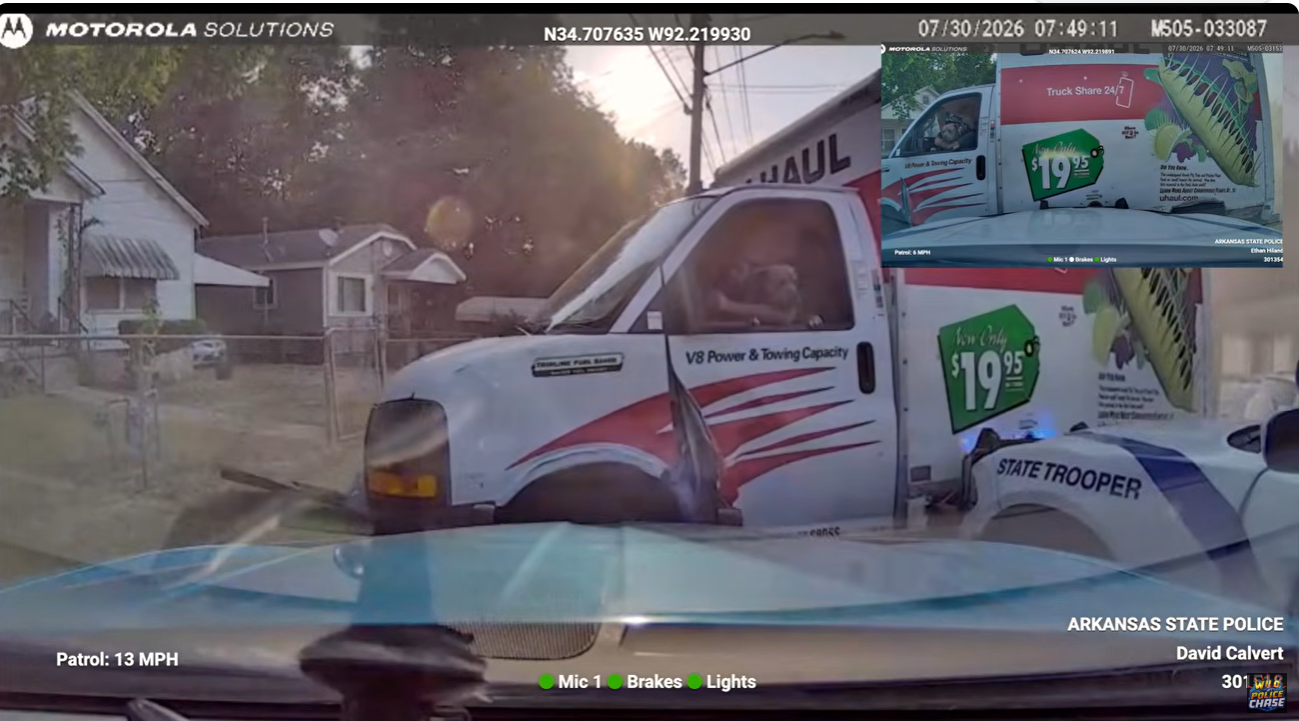
The U-Haul collides rear-first with a power pole.
This time, the truck cannot simply regain traction and continue.
According to Calvert's report, the impact immobilized it.
After multiple police interventions, road departures and recoveries, a fixed object finally brings the pursuit to a definitive end.
But ending the vehicle pursuit does not immediately end the incident.
The driver still has to be taken into custody.
Police identified him in the incident narrative as Jessie Keller.
According to Calvert, Keller refused commands to exit the vehicle. The driver's side of the damaged truck had left him partially pinned near the door, further complicating the extraction.
Troopers and Little Rock officers move in.
The tone is completely different from the opening seconds of the pursuit.
There is no longer distance between police and suspect.
There is no highway separating them.
Officers are now working directly around a crashed box truck while trying to remove the driver.
Calvert reported that Keller continued resisting after officers extracted him and brought him to the ground.
The trooper wrote that he struck Keller once with his right fist on Keller's left side while attempting to gain compliance, then assisted Little Rock police in getting him into handcuffs. Keller was subsequently turned over to the Little Rock Police Department at the scene.
It is important to distinguish those details carefully.
They come from the trooper's incident account accompanying the footage. They describe law enforcement's account of the arrest rather than an independent judicial determination about Keller's conduct.
But when combined with the patrol footage, they provide a detailed chronology of how the chase unfolded.
It began with a stolen-vehicle pursuit already underway.
Arkansas State Police joined.
Several intervention attempts followed.
The truck repeatedly recovered.
The driver escaped even after officers thought they had achieved a stop.
Then the collision with the power pole removed the vehicle from the equation entirely.
Only then could police focus solely on the arrest.
Why This Pursuit Was So Difficult to End
The most unusual feature of this case is the vehicle itself.
TVI and PIT-style maneuvers are intended to disrupt a fleeing vehicle's directional stability and rotate it away from its path of travel.
But vehicles do not all respond identically.
Weight distribution, wheelbase, road surface, speed and the point at which police make contact can dramatically influence the outcome.
A box truck creates additional complications.
Its height and large rear cargo body restrict visibility.
Its mass makes physical contact more consequential.
And even when it leaves pavement, the vehicle may retain enough momentum to continue moving.
Those characteristics can be seen repeatedly throughout this chase.
Calvert explicitly noted that the size of the U-Haul prevented him from seeing far enough ahead to safely attempt a TVI while the pursuit was initially on Interstate 440.
That detail helps explain something viewers might otherwise misunderstand.
Why not simply hit the truck immediately?
Because stopping the suspect is only one consideration.
Police must also consider where the suspect vehicle will go after contact.
A perfectly executed intervention can still create a dangerous situation if the fleeing vehicle rotates into an uninvolved motorist.
The surroundings therefore matter.
So does timing.
Calvert waited until the exit ramp before making the first attempt.
Even then, the U-Haul recovered.
Later attempts occurred as the truck entered areas where continuing the pursuit itself posed growing risks.
The report's description of approximately 60 mph travel through a residential neighborhood is particularly significant.
At that stage, allowing the chase to continue indefinitely was hardly a risk-free alternative.
That creates one of the central dilemmas of vehicle pursuits.
Intervention carries danger.
Continuing the pursuit carries danger.
Breaking off may carry danger if a fleeing driver continues at high speed anyway.
Officers must make decisions within seconds while circumstances constantly change.
The U-Haul pursuit compresses that entire problem into a few intense minutes.
The Footage Later Reaches a National Police Show
The pursuit did not disappear after the original police footage circulated online.
It subsequently reached a much larger audience through On Patrol: Live.
LivePD's episode archive identifies an Arkansas U-Haul segment as the first “Triple Play” feature on its August 28, 2026 episode.
The site's Triple Play archive also lists Arkansas U-Haul Pursuit among its August 2026 selections.
That broader exposure makes sense.
From a television perspective, the pursuit contains an extraordinary series of reversals.
A stolen moving truck is pursued.
A trooper makes contact.
The truck escapes.
Another intervention occurs.
The truck escapes again.
It runs across grass.
It travels through a church parking lot.
Another trooper finally gets it stopped.
Police prepare to make the arrest.
Then the driver takes off yet again.
Only a collision with a utility pole finally prevents another escape.
The story almost seems designed around repeated false endings.
But that is also why the full footage matters more than a short viral clip.
Watching only the final crash removes the tactical decisions preceding it.
Watching only a single TVI attempt makes it appear unsuccessful without showing what happens afterward.
Watching the entire sequence reveals the real challenge: officers were not merely trying to catch the U-Haul.
They were already behind it.
The difficult part was finding a way to stop it without creating an even greater danger.
The Chase Ends, but the Footage Explains Why It Took So Long
By the end of the incident, the U-Haul bears little resemblance to the ordinary rental truck seen when Trooper Calvert first joins the chase.
The vehicle has been struck during multiple intervention attempts.
It has left paved roads.
It has crossed private property.
It has continued through a church parking lot.
It has stopped and escaped again.
Finally, it sits immobilized against a power pole while officers work to take the driver into custody.
That final image is dramatic.
But the most revealing part of the footage comes before it.
The chase demonstrates how quickly a pursuit can move through radically different environments.
Interstate.
Exit ramp.
Local road.
Residential neighborhood.
Grass.
Parking lot.
Roadway again.
Crash scene.
Every transition changes the risks facing officers and everyone nearby.
It also explains why this pursuit cannot be reduced simply to the number of intervention attempts.
Each attempt occurred under different circumstances.
The first could not be made until the trooper had enough visibility.
The U-Haul recovered from subsequent contact because of its size and momentum.
Another successful TVI actually stopped the truck, only for the driver to accelerate away during the attempted takedown.
Ultimately, the power pole created the one thing officers had struggled to achieve throughout the pursuit: an unquestionably immobilized vehicle.
The Arkansas State Police account says Keller was then extracted, restrained and turned over to Little Rock police.
The case is a reminder that the dramatic portion of a pursuit is not always its top speed.
Sometimes the defining question is much simpler:
How do you stop something that refuses to stay stopped?
On July 30, the answer took several troopers, repeated intervention attempts, miles of changing roadway and finally a collision that the U-Haul could not drive away from.
What started as another stolen-vehicle pursuit became an unusually vivid example of the uncertainty officers face when a large fleeing vehicle keeps surviving every attempt to end the chase.
And that is precisely why the footage is so difficult to look away from.
Every time it seems finished, the truck starts moving again.
Until, finally, it doesn't.
Comments (0)
Loading comments...
May You Like

Traffic Stop Turns Deadly After Man Steps Out of Stolen Car

MERIDEN POLICE OFFICER SHOOTS MAN BEATING FATHER WITH A BASEBALL BAT

What Happens when you get Caught Shoplifter Stealing Local Store












