This San Diego Police Encounter Changes in Seconds
POLICE BODYCAM AT THE DOOR: WHEN A SIMPLE KNOCK BECOMES A TENSE INVESTIGATION
A closed apartment door can be one of the most uncertain places for a police officer to stand.
There is almost no information visible from the hallway. Officers may know why someone called police, but they cannot necessarily see who is inside, how many people are present, or what is happening on the other side of the door. The person inside may not even know why officers have arrived.
The supplied image captures exactly that moment. A body-worn camera is positioned directly outside a closed residential-style door with a peephole. The visible overlay indicates police bodycam footage, but the frame alone does not reliably establish the department, location, occupants, or original reason officers responded.
Those details should not be invented.
What the image does show is the beginning of one of the most unpredictable forms of police contact:
BEFORE THE DOOR OPENS, NEITHER THE OFFICER NOR THE PERSON INSIDE KNOWS EXACTLY HOW THE ENCOUNTER WILL DEVELOP.
OFFICERS ARRIVE WITH ONLY PART OF THE STORY
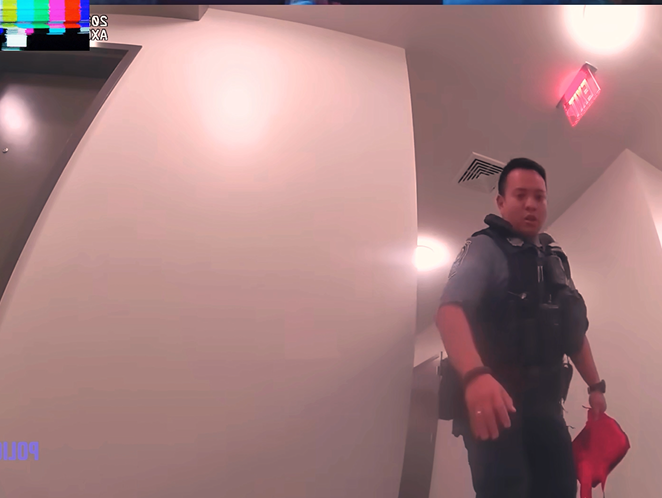
Many residential police encounters begin with a 911 call.
A neighbor reports shouting.
A family member requests a welfare check.
Someone reports suspicious activity.
A property employee asks police to investigate a disturbance.
Whatever the reason, responding officers usually begin with information provided by someone else.
That information can be incomplete.
The caller may not have witnessed everything. Circumstances may change while officers are traveling to the location. Someone initially reported as being inside may already have left.
Officers therefore arrive knowing something caused police to be requested—but not necessarily knowing exactly what they will find.
Apartment buildings make that uncertainty even greater.
Officers may need to locate the correct unit while passing other residents who have nothing to do with the call.
Once they reach the door, the investigation becomes concentrated on a space they cannot see.
THE DOOR CREATES A PHYSICAL BARRIER BETWEEN WHAT POLICE HAVE BEEN TOLD AND WHAT IS ACTUALLY HAPPENING INSIDE.
THE FIRST KNOCK CAN DETERMINE WHAT HAPPENS NEXT
The first police contact may be surprisingly simple.
Knock.
Wait.
Identify themselves.
Wait again.
Someone may answer immediately.
Someone else may speak through the closed door.
There may be no response at all.
Each reaction creates different questions.
If someone answers, officers can begin gathering information directly.
If the occupant refuses to open the door, officers must consider why they are there and what legal authority they have to proceed.
A closed door does not automatically give police unlimited authority to enter a residence. Homes receive particularly strong protection under the Fourth Amendment, and warrantless entry generally requires consent, a warrant, or circumstances recognized by law as an exception.
That distinction is important because viewers sometimes assume that police can simply enter whenever someone refuses to answer.
The reality is more complicated.
POLICE PRESENCE AT A DOOR DOES NOT AUTOMATICALLY ERASE THE LEGAL PROTECTIONS ASSOCIATED WITH A HOME.
At the same time, genuine emergencies can change what officers are legally permitted to do.
WHAT OFFICERS HEAR CAN CHANGE THE SITUATION
When the door remains closed, sound becomes extremely important.
Officers may hear voices.
Movement.
An argument.
Someone asking for help.
Or complete silence.
Those details can influence what happens next.
Consider a welfare check.
Police may have been told that someone inside could be in danger. If the occupant answers normally and demonstrates that no emergency exists, the encounter might end quickly.
But if officers hear indications that someone may require immediate assistance, the circumstances can become much more serious.
This is why an apparently uneventful bodycam sequence of officers standing outside a door can actually represent an active investigation.
They may be listening.
Communicating with dispatch.
Attempting to contact the resident by telephone.
Speaking with neighbors.
Checking information about the address.
SOMETIMES THE MOST IMPORTANT EVIDENCE IS WHAT THE BODYCAM MICROPHONE RECORDS WHILE THE CAMERA SEES NOTHING BUT A CLOSED DOOR.
THE DOOR FINALLY OPENS
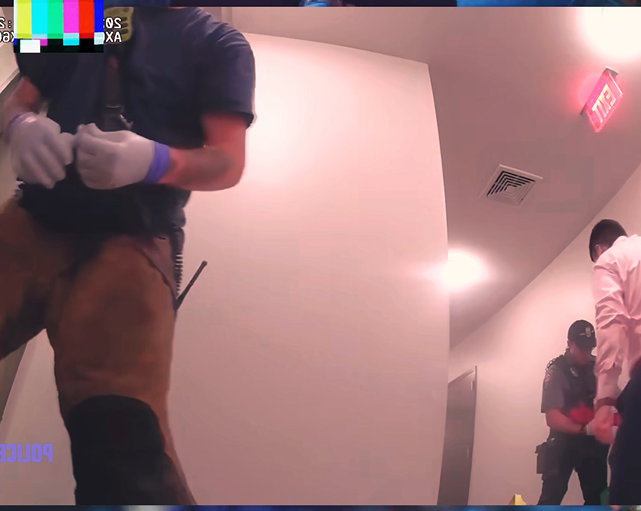
If the occupant eventually opens the door, the dynamics change instantly.
Until that moment, the door created distance.
Now the officer and resident may be only a few feet apart.
Officers can see the person's hands and behavior.
The resident can see how many officers are present.
Questions begin.
“What happened?”
“Who called?”
“Is everyone okay?”
“Is anyone else inside?”
This first conversation can determine whether the encounter ends peacefully or continues.
If officers are investigating a reported disturbance, they may attempt to speak separately with the people involved.
If the call concerns someone's welfare, officers may simply need to confirm that person is safe.
If information obtained at the doorway gives officers reason to investigate further, the encounter can continue.
The key point is that OPENING THE DOOR DOES NOT AUTOMATICALLY MEAN AN ARREST IS ABOUT TO HAPPEN.
Many police calls end after officers determine no additional action is necessary.
But others become significantly more complicated.
WHEN THE CONVERSATION BECOMES A CONFRONTATION
Some encounters change when officers give an instruction that the occupant does not want to follow.
A person may be told to remain where they are.
Someone may attempt to close the door.
Officers may ask another occupant to step outside.
The resident may demand that police leave.
The conversation becomes louder.
Physical distance shrinks.
This is often where bodycam footage becomes particularly important.
The recording can show what officers said before moving forward.
It can capture whether someone attempted to close the door, retreat, leave, or comply.
It can also document the officer's response.
But the legal context remains essential.
Police authority inside a residence involves different considerations from police authority in many public settings. Whether officers can cross a threshold depends heavily on the circumstances.
That is why the minutes before any entry or detention can become crucial if the encounter is later reviewed.
THE THRESHOLD OF A HOME CAN BE BOTH A PHYSICAL LINE AND AN IMPORTANT LEGAL LINE.
WHY OFFICERS MAY WAIT INSTEAD OF FORCING ENTRY
Television often portrays police encounters at doors dramatically.
Officers knock once.
Nobody responds.
Seconds later, the door comes down.
Real situations can look very different.
Unless circumstances justify immediate entry, officers may spend considerable time trying to communicate.
They can knock repeatedly.
Call the occupant.
Speak with property management.
Interview neighbors.
Contact supervisors.
Seek additional information.
Depending on the investigation, officers may need to obtain legal authorization before taking further action.
Waiting can also be tactically useful.
Time allows officers to gather information.
It gives occupants an opportunity to cooperate voluntarily.
And it may prevent an unnecessary confrontation.
NOT EVERY DELAY REPRESENTS INACTION. SOMETIMES WAITING IS THE DELIBERATE POLICE RESPONSE.
WHY APARTMENT HALLWAYS CREATE ADDITIONAL RISKS
The image also highlights another problem: space.
An apartment hallway can be narrow.
If several officers respond, there may be little room to reposition.
Doors belonging to uninvolved residents may be only feet away.
Elevators and stairwells create additional access points.
If someone suddenly runs from the apartment, officers may have only seconds to respond.
If a physical confrontation begins, everyone is operating within a confined area.
This differs significantly from an open parking lot or street where officers can create more distance.
The building itself becomes part of the tactical environment.
Officers have to consider not only the person behind the door but also other residents who could unexpectedly enter the hallway.
IN A CONFINED RESIDENTIAL SPACE, OFFICERS CANNOT CONTROL EVERYTHING BEYOND THE DOOR THEY ARE WATCHING.
BODYCAM FOOTAGE PRESERVES WHAT HAPPENS AT THE THRESHOLD
Body-worn cameras are particularly valuable during residential encounters because many important conversations occur without independent witnesses.
The resident may later describe one version.
Officers may provide another.
The recording can preserve at least part of what occurred.
Did police identify themselves?
What did they ask?
Did the resident consent to something?
Were commands given?
Did someone ask officers to leave?
When did the interaction become confrontational?
Those details can become important during investigations and court proceedings.
Yet bodycam footage is not perfect.
A camera mounted on an officer's chest may point toward a wall while the officer looks sideways.
Another officer can block the view.
The door itself may hide what occupants are doing.
Audio can overlap.
Investigators may therefore need recordings from several officers, dispatch communications, surveillance footage and witness statements.
BODYCAM PROVIDES A POWERFUL RECORD OF THE ENCOUNTER, BUT IT DOES NOT AUTOMATICALLY SHOW EVERYTHING HAPPENING INSIDE THE RESIDENCE.
WHY A SHORT CLIP CAN CREATE THE WRONG IMPRESSION
Imagine a ten-minute encounter outside this door.
For eight minutes, officers talk calmly.
Then something happens.
The door opens.
Voices rise.
A physical confrontation follows.
A social-media clip beginning at minute eight would show only the escalation.
Viewers would have no idea what officers had been told, what had already been discussed, or why the interaction changed.
The opposite can also happen.
An official summary might describe a straightforward encounter, while the complete footage raises questions about how officers handled it.
That is why context should not automatically be used to defend either side.
Context exists to establish sequence.
WHAT HAPPENED BEFORE THE DRAMATIC MOMENT CAN COMPLETELY CHANGE HOW THAT MOMENT IS UNDERSTOOD.
A POLICE DETENTION IS NOT A VERDICT
If the encounter eventually results in an arrest, another distinction becomes essential.
Being handcuffed does not establish guilt.
An arrest represents one stage of a legal process.
Police may believe probable cause exists, but evidence can later be challenged.
Prosecutors review cases.
Defense attorneys examine police conduct.
Judges make legal decisions.
Charges can be amended or dismissed.
If a case reaches trial, guilt must be established according to the applicable legal standard.
For that reason, without verified records connected to this exact footage, it would be inappropriate to assign a specific crime or legal outcome to anyone who might appear later in the video.
THE BODYCAM CAN DOCUMENT THE ARREST. ONLY THE LEGAL PROCESS CAN DETERMINE WHAT ULTIMATELY COMES FROM IT.
EVERYTHING BEGINS WITH A CLOSED DOOR
Look again at the supplied frame.
There is almost nothing happening visually.
A door.
A peephole.
A wall.
An officer waiting immediately outside.
Yet that simplicity creates the tension.
Nobody watching this single moment knows who is behind the door.
We do not know whether it will open calmly.
We do not know whether the occupant will refuse to answer.
We do not know whether officers will leave minutes later or whether the encounter will escalate.
That uncertainty is precisely what the officer experiences.
The difference is that viewers can skip forward.
The officer standing in the hallway cannot.
THE CLOSED DOOR MAY LOOK UNEVENTFUL, BUT IT REPRESENTS THE MOMENT BEFORE EVERY POSSIBILITY BECOMES REAL.
One knock can lead to a brief conversation.
It can lead to an investigation.
It can lead to an arrest.
Or it can lead to officers simply walking away.
The full footage is what reveals which path this encounter ultimately takes.
https://www.youtube.com/watch?v=le1RRl5vRt8
It begins with police standing outside a closed door—but what happens when that door finally opens changes the entire encounter. Click the link below to watch the full bodycam footage and see how the situation ultimately unfolded.
Comments (0)
Loading comments...
May You Like

Entitled Driver Learns Why You Must Obey Lawful Orders During Traffic Stop

Traffic Stop Turns Deadly After Man Steps Out of Stolen Car

Woman Tries to Stop Police From Arresting “Brother” — He Denies Knowing Her