This Could Not Have Ended Better for the Police
Waukesha Police Chase Ends After Driver Runs Across I-94 and Gets Caught in Barbed Wire
What began as a call about a confrontation outside a Waukesha apartment complex quickly turned into a nighttime pursuit through winter conditions, onto Interstate 94, and eventually into a foot chase that ended in one of the most unusual ways imaginable. A 20-year-old Milwaukee man, Deandre Patterson, did not simply drive away from the first responding officer. According to the criminal complaint described by FOX6 Milwaukee, he later reached roughly 110 mph on I-94, abandoned his failing vehicle, crossed interstate traffic on foot, ran into the woods, and ultimately became caught in barbed wire while officers closed in.
The body-camera footage supplied for this article captures the ground-level perspective of that final search. Snowbanks line the streets and parking areas. Flashlights sweep across dark yards and brush. Officers work around fences and vegetation while trying to locate a suspect who had already escaped from a vehicle and crossed a major interstate. The video timestamp places the footage on February 23, 2023, matching the date in the criminal case and contemporary reporting.
The ending is striking precisely because the chase had already created so many opportunities for something much worse to happen. Patterson was accused of driving through traffic at high speed in snowy conditions. He then ran across I-94, exposing himself and motorists to another layer of danger. Yet the pursuit ultimately ended with officers taking him into custody after he became entangled in a fence rather than with a high-speed collision or a violent confrontation.
Contemporary FOX6 reporting, based on the criminal complaint, provides the clearest public account of the incident. It identifies Patterson, describes the original domestic-violence-related call, reconstructs the 4.8-mile pursuit and explains how Waukesha and Brookfield officers converged on him after he fled on foot. Later reporting also documents the resolution of the criminal case.
A Police Call Outside a Waukesha Apartment
According to the criminal complaint summarized by FOX6 Milwaukee, Waukesha police were called to the area of Grand and Sentinel at approximately 8:40 p.m. on February 23, 2023. The first officer arrived and encountered Patterson and a woman fighting outside an apartment complex.
The complaint says the officer attempted to break up the confrontation. Patterson then entered a running vehicle. The officer ordered him not to leave, but Patterson drove away. The officer was able to provide the vehicle's license plate information to dispatch.
That detail became important almost immediately. The first encounter did not end with an arrest, but officers now had a vehicle to look for.
Police located the car again around 8:50 p.m. and attempted a traffic stop near Moreland and Kossow. Instead of yielding, prosecutors alleged, Patterson continued driving.
The Traffic Stop Becomes a Pursuit
The criminal complaint describes the car running a red light and weaving through traffic while refusing to stop. The pursuit eventually reached Interstate 94 at Barker Road.
Once the vehicle entered the interstate, the stakes changed dramatically.
FOX6 reported that prosecutors accused Patterson of driving approximately 110 mph while fleeing eastbound through snow. At that speed, a vehicle covers more than 160 feet every second. Winter conditions reduce the margin for error even further because snow, slush and cold pavement can affect traction and braking.
The supplied video does not show the entire vehicle pursuit from the patrol-car perspective. Instead, it focuses primarily on the later search and arrest. That makes the criminal complaint and contemporaneous reporting essential for understanding what happened before officers entered the snowy terrain with flashlights.
A 4.8-Mile Chase Through Winter Conditions
The pursuit lasted approximately 4.8 miles, according to the complaint cited by FOX6.
That distance may sound short compared with some interstate pursuits, but at highway speeds it can unfold in only a few minutes. During those minutes, officers must monitor the fleeing vehicle, surrounding traffic, changing road conditions and radio communications simultaneously.
Near Moorland, the fleeing car began to slow. The complaint described a cloud of smoke coming from the vehicle, suggesting severe mechanical trouble. Patterson still did not stop immediately.
The vehicle's speed reportedly dropped drastically. As an officer attempted a PIT maneuver near Sunnyslope, Patterson slammed on the brakes, according to prosecutors.
The pursuit by car was nearing its end, but Patterson was not finished fleeing.
The Driver Leaves the Car and Runs Across I-94
Wisconsin Department of Transportation camera footage, referenced by FOX6, showed Patterson getting out of the vehicle after the chase and going over a barrier.
He then ran across interstate traffic.
That decision created an entirely new kind of risk. A person on foot has almost no protection on a freeway. Drivers traveling at highway speed may have only seconds to recognize someone in the roadway, react and change direction.
Police ordered Patterson to stop, according to the complaint, but he continued running and entered a wooded area.
The pursuit had now transformed from vehicle enforcement into a nighttime search on foot.
Bodycam Shows Officers Searching Through Snow and Darkness
The supplied body-camera recording begins to make the conditions clear. Snow is piled along the roadway and around properties. Visibility beyond the reach of officers' flashlights is limited. Fences, trees, brush and uneven terrain create hiding places but also obstacles.
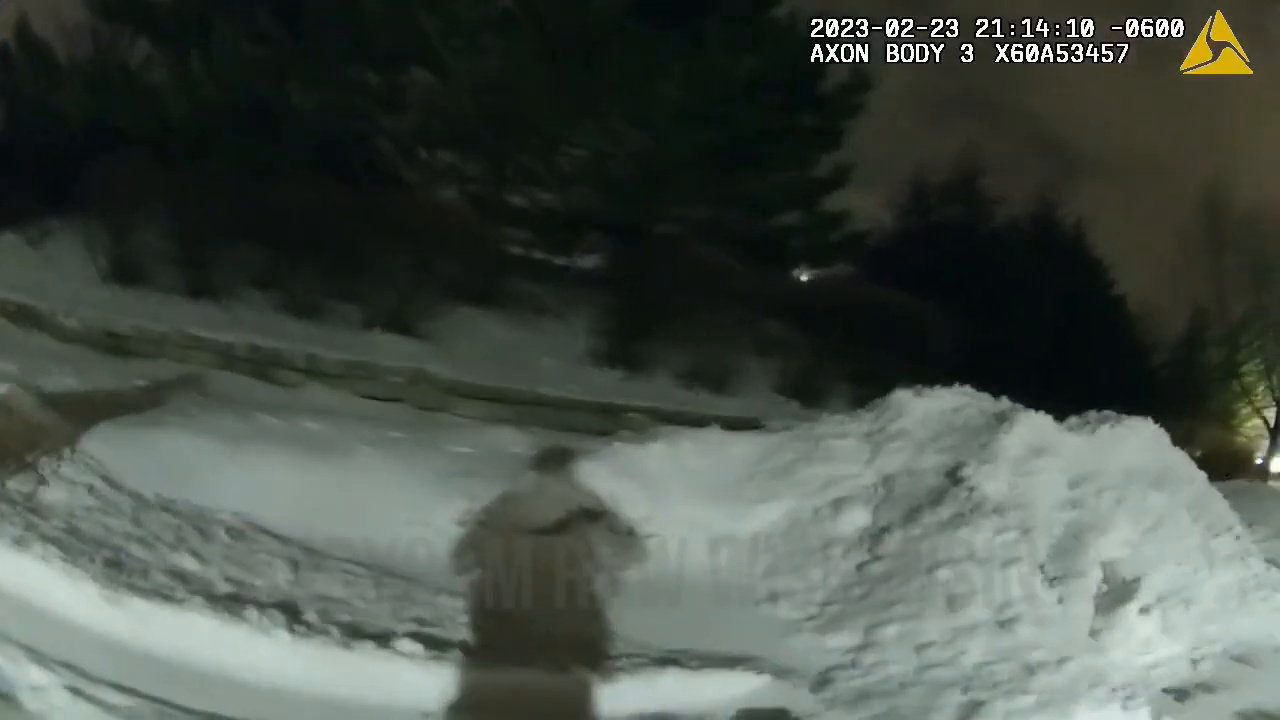
The camera timestamp reads February 23, 2023, matching the date reported in the criminal complaint. The footage also carries a Bodycam Raw Wisconsin watermark, indicating the clip is a republished presentation of law-enforcement footage rather than an original police news release.
The video perspective is very different from a helicopter or highway camera. Instead of seeing the entire pursuit from above, viewers experience the search at officer level. Flashlights illuminate only small portions of the scene. Snowbanks block sightlines. Officers have to move around fences and vegetation without knowing exactly where the fleeing suspect is.
The Search Expands Beyond Waukesha Officers
The complaint says officers saw Patterson climb a barbed-wire fence into a business parking lot.
While Waukesha officers were searching the area, dispatch advised that Brookfield police had located Patterson and were pursuing him on foot near Sunnyslope.
This is a common reality when a pursuit crosses jurisdictional boundaries. A chase may begin with one department but quickly require neighboring agencies to coordinate. Officers arriving from another jurisdiction may have only radio descriptions and updates to work with.
At night, in snow, around wooded property and fencing, that coordination becomes even more important.
The Fence Becomes the Unexpected End of the Chase
Patterson's escape attempt ultimately ended not because an officer tackled him at full speed, but because he became caught in another barbed-wire fence, according to the complaint.
Officers then arrested him.
The bodycam footage shows officers working around fencing and brush during the final phase of the search. One of the clearest frames captures the cramped environment where the pursuit had ended.
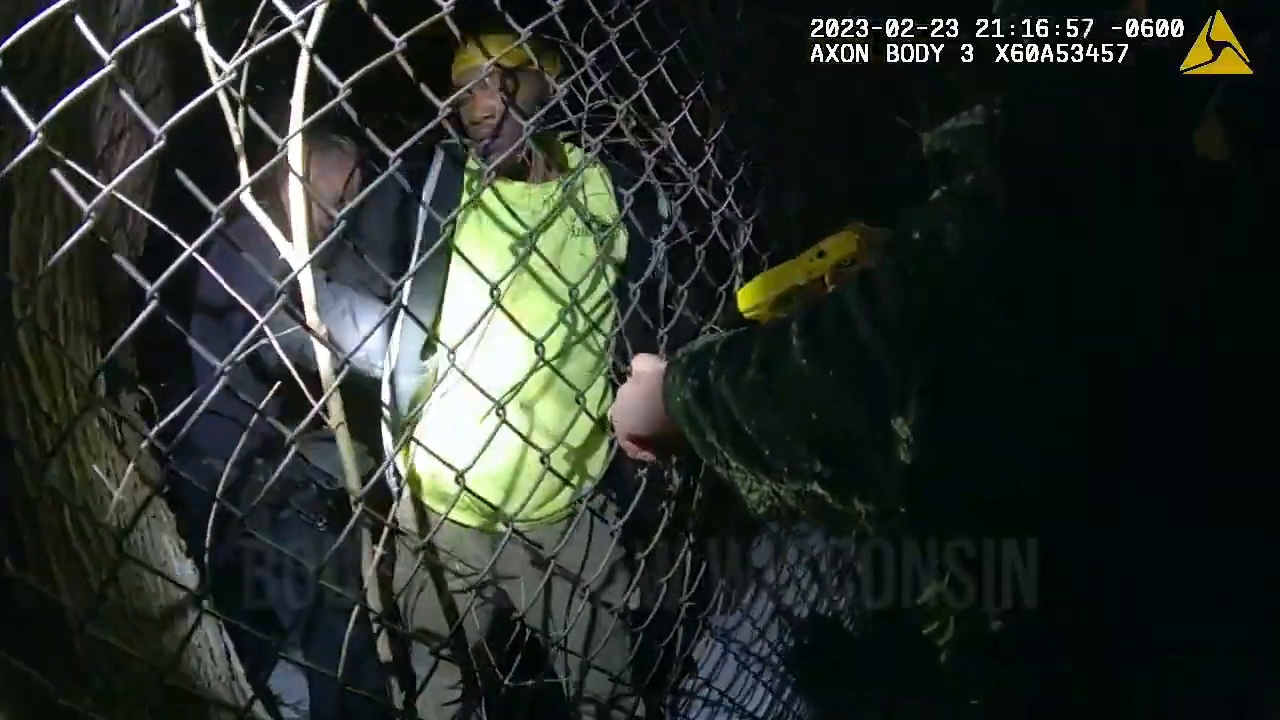
It is an unusual conclusion to an incident that had already moved through several distinct stages: an apartment confrontation, a vehicle escape, a second attempted stop, an interstate pursuit, mechanical trouble, an abandoned vehicle, a freeway crossing, a wooded search and finally the fence.
The title of the supplied video, “This Could Not Have Ended Better for the Police,” reflects that contrast. After a pursuit involving alleged speeds around 110 mph and a suspect running across I-94, officers were able to take Patterson into custody without the sequence ending in a fatal highway collision.
What Led to the Original Call
After Patterson drove away from the apartment complex, the responding officer spoke with the woman involved in the initial confrontation.
FOX6 reported that she had an injury to her lower lip but declined medical treatment.
According to the complaint, she said she had been driving with Patterson earlier and that things initially appeared normal. After she went inside her Waukesha apartment, she heard loud noises and discovered that a window had been broken.
She believed Patterson had broken it. She said he left after she confronted him but returned later with a carton of eggs.
The complaint alleged that Patterson threw eggs through the damaged window and at the woman, including striking her in the face. The confrontation outside followed, bringing police to the apartment complex.
Patterson's Explanation to Investigators
After his arrest, Patterson gave police his account of what happened.
According to FOX6's summary of the complaint, Patterson said he had been arguing with the woman about putting gifts back into his car. He acknowledged breaking the window while banging on it to get her attention and admitted throwing eggs at the woman and apartment.
He also reportedly explained why he drove away from the officer.
The complaint says Patterson told police that he had an open case. He also said he fled onto I-94 because he believed police could not get onto the highway and that he was trying to drive home.
That explanation provides an unusual window into the decision-making behind the pursuit. What may have seemed to the driver like an escape route instead exposed him to a much larger police response and a series of increasingly dangerous choices.
The Open Case Added Another Legal Problem
At the time of the February 23 incident, Patterson was reportedly out on a $1,000 cash bond in a Milwaukee County felony substantial-battery/domestic-abuse case.
That status became relevant because prosecutors charged him with felony bail jumping in connection with the Waukesha incident.
Being released on bond generally comes with conditions. New alleged criminal conduct can therefore create consequences beyond the charges arising directly from the new incident.
FOX6 reported that Patterson faced five charges after the Waukesha pursuit: attempting to flee or elude an officer, resisting an officer, criminal damage to property, misdemeanor battery and felony bail jumping.
His cash bond in the Waukesha case was set at $10,000.
The Bodycam's Closing Graphic Matches the Court Reporting
The supplied video ends with a photograph of Patterson and a caption stating that Deandre was held in jail for 90 days on a $10,000 cash bond.
The $10,000 figure is independently supported by FOX6's February 24 report.
The later court outcome also helps explain the reference to roughly 90 days in custody. Patterson's case reached sentencing on May 24, 2023, approximately three months after the February 23 arrest.
That later reporting is important because it moves the story beyond the dramatic arrest and shows how the allegations were resolved in court.
The Case Reaches a Plea Agreement
FOX6 reported on May 24, 2023 that Patterson pleaded guilty to fleeing or eluding an officer and criminal damage to property.
Additional charges were dismissed as part of the plea agreement.
That distinction matters. Initial criminal complaints describe allegations, not convictions. A responsible account should not present every original charge as something a defendant was ultimately found guilty of.
In Patterson's case, the later plea provides a clear line between the original accusations and the offenses that resulted in guilty pleas.
Three Years of Probation
Patterson was sentenced to three years of probation, according to FOX6's follow-up report.
The sentencing brought the case to a very different conclusion from what the pursuit footage might suggest to a viewer seeing it for the first time.
The video is full of darkness, flashing lights, snowbanks, fences and urgent movement. The legal process that followed was slower and more structured: charging, bond, court appearances, plea negotiations and sentencing.
That difference is worth emphasizing because viral police videos often freeze a case at the moment of arrest. The arrest is only the beginning of the judicial process.
Why the 110 MPH Allegation Matters
The alleged speed on I-94 is one of the most consequential details in the complaint.
At approximately 110 mph, a car travels about 161 feet each second.
A two-second reaction interval at that speed represents more than 320 feet of travel before accounting for braking distance.
Snowy winter conditions make the margin for error even smaller.
A lane change, sudden slowdown or patch of reduced traction can turn a pursuit into a multi-vehicle crash before either the fleeing driver or pursuing officer has enough space to recover.
The fact that the vehicle developed apparent mechanical trouble may have reduced its speed before the chase ended. But mechanical failure can create its own hazards because it makes the vehicle's behavior less predictable.
Why Running Across an Interstate Was Another Major Turning Point
Once Patterson left the vehicle, he escaped one danger but entered another.
A highway is designed for vehicles traveling at sustained high speeds, not pedestrians.
At night, a person crossing lanes can be extremely difficult for motorists to see. Headlights illuminate only part of the road, and drivers may not expect a person to appear from behind a barrier.
The Wisconsin DOT camera footage cited in reporting therefore documents one of the most dangerous moments of the entire incident even though Patterson was no longer behind the wheel.
Winter Conditions Shape the Bodycam Footage
The date of the pursuit coincided with significant winter weather in southeastern Wisconsin.
FOX6 reported that a powerful storm affected the region on February 22 and 23, bringing snow, sleet and freezing rain to different areas. Along the I-94 corridor, snow and sleet were among the conditions reported.
The supplied bodycam visually confirms substantial snow accumulation in the area where officers searched.
That snow affected more than the earlier driving conditions. It also shaped the foot pursuit. Snowbanks slowed movement, concealed uneven ground and made fences and brush harder to navigate.
The Search Environment Favored Neither Side
A wooded commercial area at night offers hiding places, but it also creates traps.
Fences divide properties. Brush can hide wire. Snow can conceal holes, curbs and debris. A person running at full speed may not see an obstacle until it is too late.
Officers face similar problems while searching. They must move quickly enough to maintain contact while avoiding injuries and watching for potential threats.
The bodycam repeatedly shows flashlights sweeping across small areas rather than illuminating the entire scene. That limited field of view is a reminder that officers on the ground do not have the omniscient perspective available to viewers watching edited footage later.
The Barbed Wire Changed the Tactical Problem
When a fleeing person becomes physically entangled, the immediate situation changes.
Officers still need to secure the person, but they also have to avoid worsening injuries caused by the wire. Movement can pull barbs deeper into clothing or skin.
The footage shows officers clustered around fencing and vegetation during the final arrest phase.
What began as an attempt to create distance from police had effectively eliminated Patterson's mobility.
Why the Ending Could Have Been Much Worse
There are several points where this incident could have produced a catastrophic outcome.
The alleged 110 mph interstate driving could have caused a collision with another motorist.
The vehicle's apparent mechanical failure could have caused a sudden loss of control.
The attempted PIT could have resulted in a crash.
Patterson's decision to cross I-94 on foot could have resulted in him being struck by a vehicle or caused a motorist to crash while avoiding him.
The foot pursuit through snow, woods and fencing could have caused serious injuries to Patterson or officers.
Instead, the incident ended with an arrest.
The Value of Combining Video With Court Reporting
The footage and news reporting each answer different questions.
The bodycam shows the conditions officers faced: darkness, snow, fences, brush and the physical difficulty of searching for someone who had run from the interstate.
The criminal complaint, as reported by FOX6, supplies the timeline and allegations that the bodycam alone cannot establish.
The follow-up court story provides the final legal outcome.
Using all three pieces produces a more complete account than relying on the video title alone.
What Is Confirmed and What Is Alleged
The distinction between confirmed court outcomes and allegations is important throughout this case.
The February criminal complaint alleged that Patterson fled the original police encounter, drove through traffic, reached roughly 110 mph, crossed I-94 on foot and became caught in barbed wire.
It also alleged battery, property damage and bail jumping connected to the original confrontation.
By May, Patterson had pleaded guilty to fleeing or eluding an officer and criminal damage to property. Other charges were dismissed as part of the plea agreement.
His sentence was three years of probation.
Those later facts should replace any implication that every original charge resulted in a conviction.
The Footage Shows How Quickly Police Work Can Change
The officers involved moved through several different types of police work during one incident.
It began as a response to a reported confrontation.
Then it became a vehicle search.
That became a high-speed pursuit.
The pursuit became a disabled-vehicle situation.
Then the suspect fled on foot.
The foot chase became a wooded-area search involving another police department.
Finally, officers had to make an arrest around barbed wire.
Each phase required different decisions and different risks.
An Escape Route That Became a Dead End
Patterson reportedly told investigators that he believed police could not follow him onto the highway.
The irony of the incident is that nearly every step intended to increase his distance from officers instead narrowed his options.
The highway pursuit damaged or exhausted the car.
Leaving the car forced him onto foot.
Crossing the interstate led him into woods and commercial property.
The fences that might have seemed useful for separating him from officers ultimately became the obstacle that stopped him.
The Camera Captures the End, Not Just the Arrest
By the time the bodycam reaches the fence, the spectacular part of the pursuit has already happened elsewhere.
That makes the footage more interesting, not less.
Viewers see the consequences of the earlier decisions through the officers' search. The snow is real. The darkness is real. The obstacles are real. The suspect is no longer an abstract vehicle on an interstate camera. He is somewhere beyond the flashlight beam.
The tension comes from uncertainty about exactly where the chase will end.
The Legal Ending Was Quieter Than the Pursuit
Three months later, there were no sirens and no snow-covered foot chase.
There was a courtroom.
Patterson entered guilty pleas to fleeing or eluding and criminal damage to property. The remaining charges in the case were dismissed under the plea agreement, and the court imposed three years of probation.
That is the complete arc of the publicly documented case: from an apartment call, to an interstate pursuit, to barbed wire, and finally to a negotiated court resolution.
Why This Incident Holds Attention
The strongest police stories are not always the ones with the biggest collision or most dramatic confrontation.
This case holds attention because the problem keeps changing.
Just when the vehicle chase appears to be ending, the suspect runs.
Just when he gets away from the car, he crosses the interstate.
Just when he reaches the woods, police from another jurisdiction pick up the search.
And after escaping one fence, another fence finally stops him.
That sequence creates natural suspense without exaggerating the facts.
A Remarkably Fortunate End to a Dangerous Night
By the time Patterson was taken into custody, the incident had involved an alleged domestic confrontation, damaged property, a high-speed interstate pursuit, winter conditions, an attempted police intervention, a freeway crossing and a foot chase through dark commercial property.
Any one of those stages could have produced a serious injury.
The fact that the pursuit ended with Patterson physically trapped by an obstacle rather than with a catastrophic highway crash explains why the video's title feels appropriate.
For police, the final objective was achieved: the fleeing suspect was located and taken into custody.
For the public, the more important outcome was that a dangerous sequence ended without the kind of mass-casualty collision that high-speed pursuits can produce.
Watch the Full Incident
The still images show only a fraction of what officers encountered after the interstate chase. The full body-camera footage reveals the snow-covered search area, the movement between properties, the coordination between officers and the strange final obstacle that brought the escape attempt to an end.
Comments (0)
Loading comments...
May You Like
Female Driver Destroys Three Lives in a Matter of Minutes
Everything Changed When Cops Asked About Weapons

💨 High-Speed Police Pursuits Caught on Dashcam | Intense Moments Across the USA 🇺🇸