This Bad Guest Took Over the Hotel Like He Owned It
Hotel Guest Refuses to Leave and a Routine Removal Spirals Into an Arrest
When a Hotel Dispute Becomes a Police Matter
Most hotel disputes never make it beyond the front desk.
A guest complains about a room. Management explains a policy. Someone becomes frustrated. Eventually, either a compromise is reached or the guest packs up and leaves.
But the encounter captured in this police body-camera footage followed a very different path.
What began as a hotel attempting to remove a troublesome guest developed into a lengthy confrontation involving sheriff’s deputies, repeated discussions inside a cluttered hotel room, resistance to the idea of leaving, and eventually a physical arrest.
Publicly available copies identify the footage as “Woman Gets Kicked out of Ritzy Hotel, Goes Crazy.” A source list documenting police-bodycam material attributes the original upload to Crime Scene Cam and dates its publication to April 3, 2024. Another archived version describes the basic reason for the police response: hotel employees had called law enforcement because they were unable to get a guest who was causing a disturbance to leave.
The bodycam footage itself adds another important piece of context. Its AXON overlay places the police encounter on February 10, 2024.
Yet the most revealing part of the story is not simply that deputies were called.
It is how many opportunities existed for the encounter to end quietly before it finally escalated.
The footage provides an unusually clear example of how a disagreement over remaining on private property can change once management withdraws permission for someone to remain and police become involved.
And throughout much of the encounter, the tension comes from something surprisingly simple: two completely different understandings of what is happening.
The woman appears determined to explain her position.
The deputies are increasingly focused on resolving the immediate problem.
Those goals never truly meet.
Deputies Arrive at the Hotel
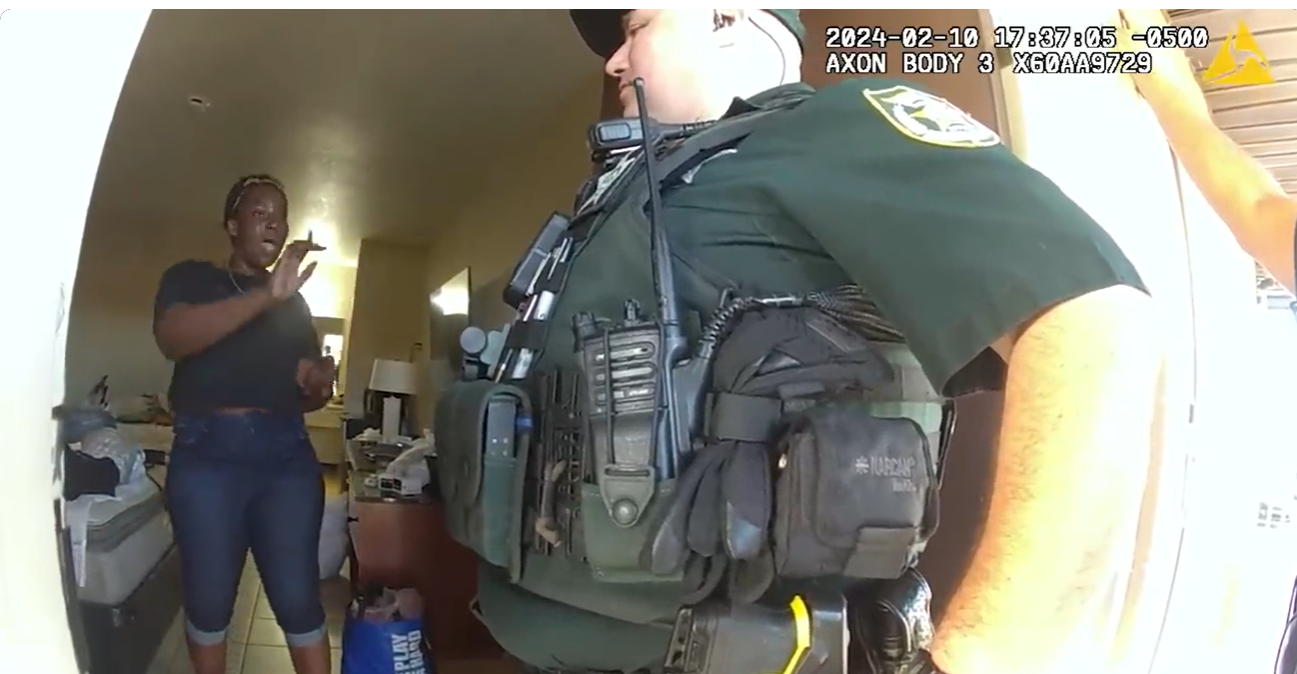
When deputies enter the hotel room, the environment initially looks far removed from the dramatic arrest that will eventually occur.
There is no frantic pursuit.
No one is running through the hallway.
The woman is inside the room, surrounded by personal belongings. Officers stand near the entrance while speaking with her.
The first several minutes therefore feel more like negotiation than enforcement.
That distinction matters.
When viewers encounter short clips of police incidents online, they often see only the final thirty seconds: an argument, officers moving forward, somebody being placed in handcuffs. The minutes preceding that moment can completely change how the encounter is understood.
Here, the extended footage shows deputies spending considerable time talking with the guest.
The fundamental issue, according to descriptions accompanying public versions of the footage, was that hotel management wanted her removed after a disturbance and had been unable to accomplish that without law enforcement assistance.
From that point forward, the hotel-room dispute was no longer merely a disagreement between a customer and an employee.
Police were now standing in the doorway.
The woman nevertheless continued talking at length, questioning the situation and presenting her perspective.
At various moments, the deputies appear willing to listen.
But listening does not necessarily mean that the underlying decision is being reconsidered.
That difference becomes increasingly important.
A person involved in a dispute may believe that if they can explain themselves clearly enough, the original decision will change. Officers responding to a trespass or removal request, however, may be focused on a much narrower question: does the property owner or authorized representative still permit this person to remain?
Once those two perspectives separate, conversation can become circular.
One person keeps explaining why they should stay.
The other side keeps explaining that they must leave.
Nothing moves forward.
That is essentially the tension driving much of this footage.
The woman talks.
Deputies respond.
She challenges aspects of what she is being told.
More officers appear around the doorway.
Minutes continue passing.
The room that had been temporary accommodation gradually becomes the setting for a law-enforcement confrontation.
And yet, even at this point, the encounter still has an obvious off-ramp.
Leaving the property could end the immediate dispute.
Instead, the standoff continues.
Repeated Warnings Change the Situation
As the conversation progresses, the atmosphere becomes noticeably different.
The deputies' presence becomes more pronounced. One stands close to the doorway while others remain nearby. The woman continues moving around the room and talking with them.
The footage is compelling precisely because escalation is gradual.
There is no single cinematic moment when everything instantly changes.
Rather, the situation accumulates pressure.
Each additional explanation is followed by another response. Each refusal or delay narrows the remaining options. What initially looked like a disagreement begins looking increasingly like an enforcement problem.
This is also where understanding the distinction between a hotel room and a permanent residence becomes important.
A hotel guest may have paid for accommodation, but that does not necessarily create an unlimited right to remain regardless of circumstances. Hotels maintain rules designed to protect employees, other guests and the property itself. Serious disturbances or other policy violations can result in management seeking to terminate a stay, subject to applicable state and local law.
In ordinary situations, that ends with the guest leaving voluntarily.
Calling police represents a significant escalation for the hotel as well.
Employees generally have little incentive to transform a customer-service dispute into a prolonged law-enforcement incident unless they believe ordinary efforts have failed.
The public description of this case specifically says the hotel contacted police after employees could not get the guest to leave.
That context helps explain the deputies' priorities once they arrive.
They are not functioning as hotel customer-service representatives.
They are responding to a request for assistance.
The woman's behavior in the footage suggests she still wants to debate the circumstances surrounding that request. The deputies increasingly appear to want action rather than another round of argument.
This is the point at which many encounters captured by bodycams become dangerous.
Not necessarily because anyone arrived intending violence, but because the objectives of the people involved become incompatible.
One side wants more discussion.
The other believes the discussion has finished.
Neither interpretation automatically tells viewers everything about who was right regarding the original hotel dispute. The bodycam does not provide every conversation that occurred before police arrived.
What it does show is the consequence of failing to resolve the situation after deputies were already present.
The longer the confrontation continues, the smaller the peaceful exit becomes.
The Moment Talking Stops Working
Eventually, the encounter reaches the point that had been building throughout the footage.
Deputies move from verbal persuasion toward physical enforcement.
The transition is significant because the entire tone changes immediately.
Until then, the woman has largely controlled her own movements within the room. Once officers decide that the situation requires physical intervention, that freedom disappears.
The footage becomes chaotic.
Several deputies become involved at close range. The body-worn camera shakes as officers attempt to gain control. Commands overlap with the woman's reactions.
The calm hotel-room conversation is gone.
This is the climax toward which the preceding minutes had slowly been moving.
Public summaries of the video report that she resisted during the arrest and subsequently faced charges that included felony battery on law enforcement. Because accessible primary court or sheriff records were not located in the research for this article, those charge descriptions should be understood as reporting from secondary sources rather than an independent determination of guilt.
That distinction is important.
An arrest is not a conviction.
A charge is an allegation that must proceed through the legal system.
What the footage itself can establish more confidently is the sequence visible to viewers: deputies arrived, spent an extended period speaking with the woman, the dispute remained unresolved, officers eventually moved to physically detain her, and a struggle followed.
The final minutes therefore feel dramatically different from the beginning.
At first, she is standing freely inside a hotel room explaining herself.
Later, deputies are physically controlling her.
That transformation is what gives the footage its narrative power.
It also demonstrates why long-form bodycam recordings can provide context that viral excerpts cannot.
A ten-second clip of the arrest shows force.
The full sequence shows the chain of decisions preceding it.
That does not automatically settle every legal or ethical question. It does, however, allow viewers to see escalation as a process rather than a single isolated event.
Why This Encounter Escalated So Far
There is a broader lesson hidden inside what otherwise looks like another unusual hotel disturbance.
Escalation often happens incrementally.
People tend to imagine confrontations as dramatic turning points. In reality, many encounters deteriorate through dozens of small decisions.
One more argument.
One more refusal.
One more warning.
Another opportunity to comply passes.
Then suddenly the range of possible outcomes has narrowed considerably.
That pattern appears throughout this encounter.
The woman seemingly believes continued discussion can change the situation. The deputies increasingly behave as though the question has already been settled.
Neither side's position changes enough to resolve the impasse.
The bodycam also highlights why police recordings have become such powerful forms of public evidence.
Unlike a written incident summary, footage allows viewers to observe timing, tone, distance, repetition and behavior. Those details can be extremely important when evaluating an encounter.
At the same time, bodycam footage has limitations.
It captures what happens in front of the officer wearing it. It does not necessarily show conversations between hotel employees and the guest before deputies arrive. It does not automatically establish the truth of every statement made during the encounter. And it cannot replace court records when determining the final disposition of criminal charges.
Those limitations are particularly relevant here because the public reporting surrounding this specific incident is surprisingly sparse.
The original Crime Scene Cam video is independently referenced in a documented source list, including its April 3, 2024 publication date and original YouTube identifier. A later audio/video distribution describes the hotel calling police because staff could not remove the guest themselves. Other archived summaries consistently describe resistance during the eventual arrest.
Those sources align with the broad sequence visible in the supplied footage.
But they do not justify inventing details that cannot be independently verified.
That is why the woman's name, the exact hotel and any final court outcome have deliberately not been asserted here.
What remains is still a remarkably complete story.
A hotel wants a guest removed.
The guest believes there is more to discuss.
Deputies arrive.
Minutes of conversation follow.
Neither side moves toward the other's interpretation.
Officers eventually decide that talking is no longer resolving the call.
Physical enforcement follows.
And an incident that could theoretically have ended with someone gathering their belongings and walking out of a hotel instead ends with multiple deputies involved in an arrest.
A Hotel Room, a Long Argument and a Very Different Ending
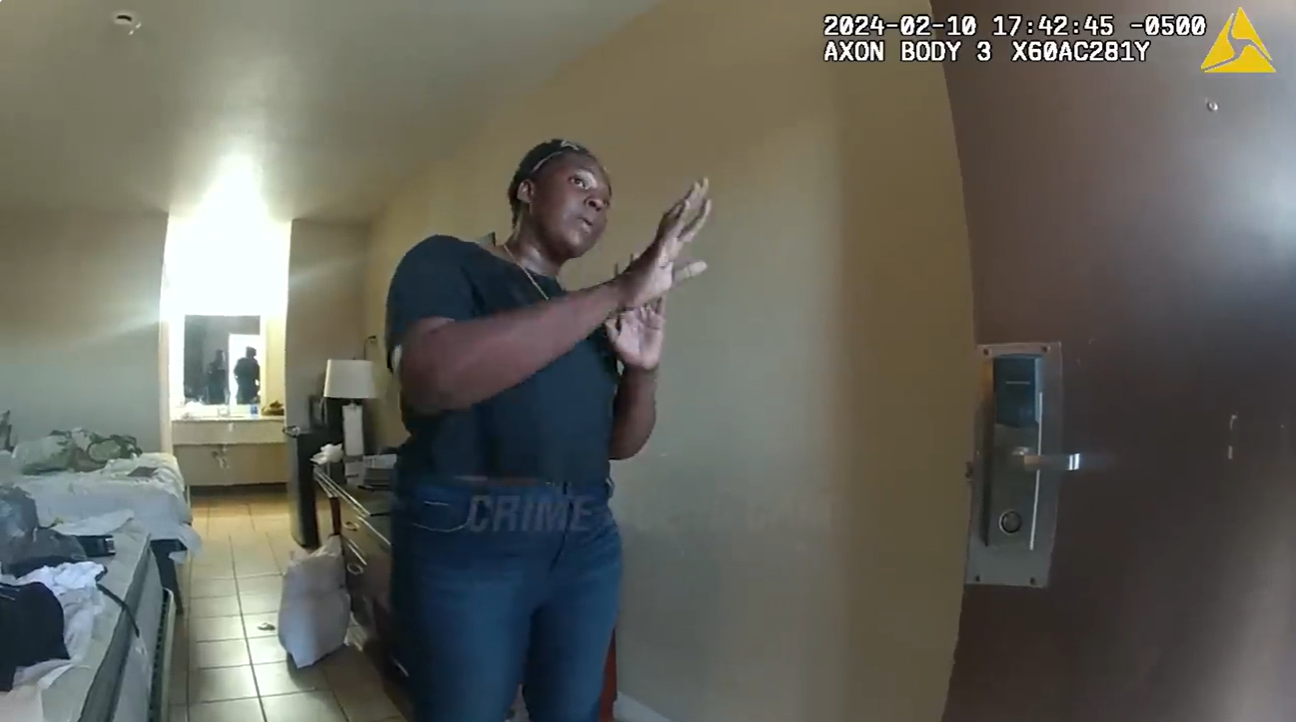
Perhaps the most striking thing about this encounter is how ordinary it looks at the beginning.
There is a bed.
Personal belongings cover parts of the room.
A guest talks to deputies standing near the door.
Nothing about those opening minutes immediately suggests the physical confrontation that follows.
That contrast is precisely what makes the footage so compelling.
The arrest does not appear out of nowhere. Viewers watch the available options disappear one by one.
First there is the possibility of resolving the problem directly with hotel employees.
That fails.
Then police arrive, creating another opportunity for the guest to leave without the situation becoming physical.
The conversation continues instead.
Deputies explain their position.
The woman continues making hers.
Eventually the encounter crosses the line between negotiation and enforcement.
Once it reaches that stage, events accelerate rapidly.
This case therefore offers more than the spectacle suggested by its viral title.
It is an example of how a private-property disagreement can move through several distinct stages: customer-service dispute, management intervention, police response, verbal negotiation and finally arrest.
It also illustrates why context matters when viewing police footage online.
The dramatic moment is usually the easiest part to share.
The ten minutes before it are often the part that explains it.
For hotel guests, the practical lesson is straightforward: a dispute with management should be handled through the appropriate complaint, refund or legal process rather than by allowing a disagreement over remaining on the property to turn into a confrontation with law enforcement.
For viewers, the lesson is slightly different.
Watch beyond the viral moment.
Observe what happens before officers use force. Pay attention to the instructions being given, the opportunities available to everyone involved and the point at which the encounter changes.
In this case, that longer view reveals an incident that escalated not in seconds, but step by step.
A disagreement became a removal request.
A removal request became a police call.
A police call became a prolonged argument.
And the argument eventually became an arrest.
The expensive surroundings could not prevent the simplest conflict from becoming the biggest problem in the building.
Want to see how the entire hotel-room confrontation unfolded from the first conversation to the final arrest? Watch the full incident here: https://www.youtube.com/watch?v=rH9Z0hWRe0M
Comments (0)
Loading comments...
May You Like

Cops Arrive for a Medical Emergency and Walk Into Drunken Chaos

Her Dad Is a Lawyer — Then He Shows Up After Her Arrest | Bodycam US

🚔⚠️ 911 Call Comes Hours Later After a Troubling Bath Incident | Ohio, USA