Teens Meet Police K9 after Armed Robbery
Armed Robbery Suspects Run Into Mayfair Mall Tunnels Before Police K9 Closes In
A Mall Robbery Turns Into a Search Beneath the Building
A late-February armed robbery at Mayfair Mall in Wauwatosa, Wisconsin, quickly became something far more unusual than a routine retail crime call. Officers arriving at the shopping center saw three people running through the parking lot. One stopped and was taken into custody. The other two kept going, disappearing into the underground service corridors beneath the mall.
That decision changed the entire police response.
A large shopping center is already a complicated place to search. There are public entrances, employee corridors, loading areas, stairwells, utility rooms and hundreds of places where a fleeing person can change direction. Mayfair Mall added another layer: tunnels and service areas beneath the complex.
Body-camera footage dated February 27, 2026 shows Wauwatosa officers moving through that environment at night. The scene shifts from the exterior of the mall to stark concrete corridors illuminated by emergency lights and flashlights. Officers communicate while trying to contain exits and locate the people who ran.
Then K9 Zev enters the search.
Wauwatosa police later said Zev tracked and helped apprehend one of the fleeing suspects. During that arrest, a firearm fell from the suspect's pocket. Police said the gun was later confirmed to have been stolen.
The remaining suspect then surrendered.
By the end of the incident, all three people had been detained and police had recovered a firearm. Local reporting in April 2026, when Wauwatosa Police released the footage, described the operation as a coordinated response involving officers, the K9 team and the unusual underground layout of Mayfair Mall.
The bodycam is compelling because the most important part of the incident is not a high-speed vehicle pursuit or a dramatic crash. It is the slow tightening of a search area. The people fleeing police move from an open parking lot into a confined maze, apparently hoping the tunnels will give them an escape route. Instead, those tunnels become the place where officers and Zev progressively remove their options.
The Video Date Matches the Reported Late-February Incident
The supplied footage carries an AXON body-camera timestamp of February 27, 2026.
That fits Wauwatosa Police Department's description of an armed-robbery response at Mayfair Mall in late February.
CBS 58 reported on April 16 that Wauwatosa police had released bodycam from the incident. According to the station, officers arrived at the mall and saw three people running across the parking lot. One was stopped immediately while two others fled into underground tunnels.
A separate report published the next day said the same basic sequence occurred and identified the police dog as K9 Zev.
Those independent reports align closely with what appears in the uploaded footage.
Why Mayfair Mall Creates a Difficult Search Environment
Mayfair is not a small storefront where police can simply watch a front and rear door.
A regional shopping mall contains multiple levels of access and a large footprint. Behind the areas customers see are delivery routes, maintenance spaces and corridors needed to operate the property.
For a fleeing suspect, that complexity can look like an advantage.
For police, it creates a containment problem.
Officers have to determine where corridors lead, which exits need coverage and whether a person could suddenly emerge into a public area. When an armed robbery has just been reported, the possibility that someone may still possess a weapon makes every blind corner more serious.
One Person Stops While Two Keep Running
Police said one of the three people seen running in the parking lot stopped and was taken into custody.
The other two continued into the tunnels.
That split immediately forces officers to handle two tasks at once.
The person already detained must be secured and searched.
At the same time, officers cannot lose momentum on the people still fleeing.
Every additional minute gives someone inside a large building more opportunities to hide, discard evidence or find another exit.
The Underground Corridors Change the Pace
Once officers enter the service areas, the visual character of the bodycam changes.
The open parking lot disappears.
The environment becomes concrete walls, overhead pipes, industrial lighting, dumpsters and narrow passages.
Visibility is limited.
Sound can echo.
An officer may hear movement without knowing exactly which corridor produced it.
This is precisely the kind of environment where a trained police dog can offer an advantage that human eyesight cannot.
K9 Zev Becomes the Key Search Tool
Wauwatosa Police later credited K9 Zev with helping locate one of the people who fled.
A police dog can follow human scent through areas where officers may have no direct visual contact.
That does not make the search automatic. The handler still has to read the dog's behavior, maintain control and coordinate with other officers.
But the K9 can transform a search from checking every possible hiding place into following a more focused trail.
In this incident, Zev's role became the turning point.
The Department's Own Records Explain Zev's Role
Wauwatosa Police Department's annual reporting describes its K9 Unit as supporting patrol officers with criminal apprehension, missing-person searches and detection of illegal narcotics and weapons.
The department identifies Officer Benjamin Ziegler and Zev as one of its K9 teams.
The same report records dozens of Zev deployments, including patrol work.
That broader context matters because the Mayfair Mall incident was not an improvised use of a dog. Tracking and apprehension are part of the specialized work for which the unit exists.
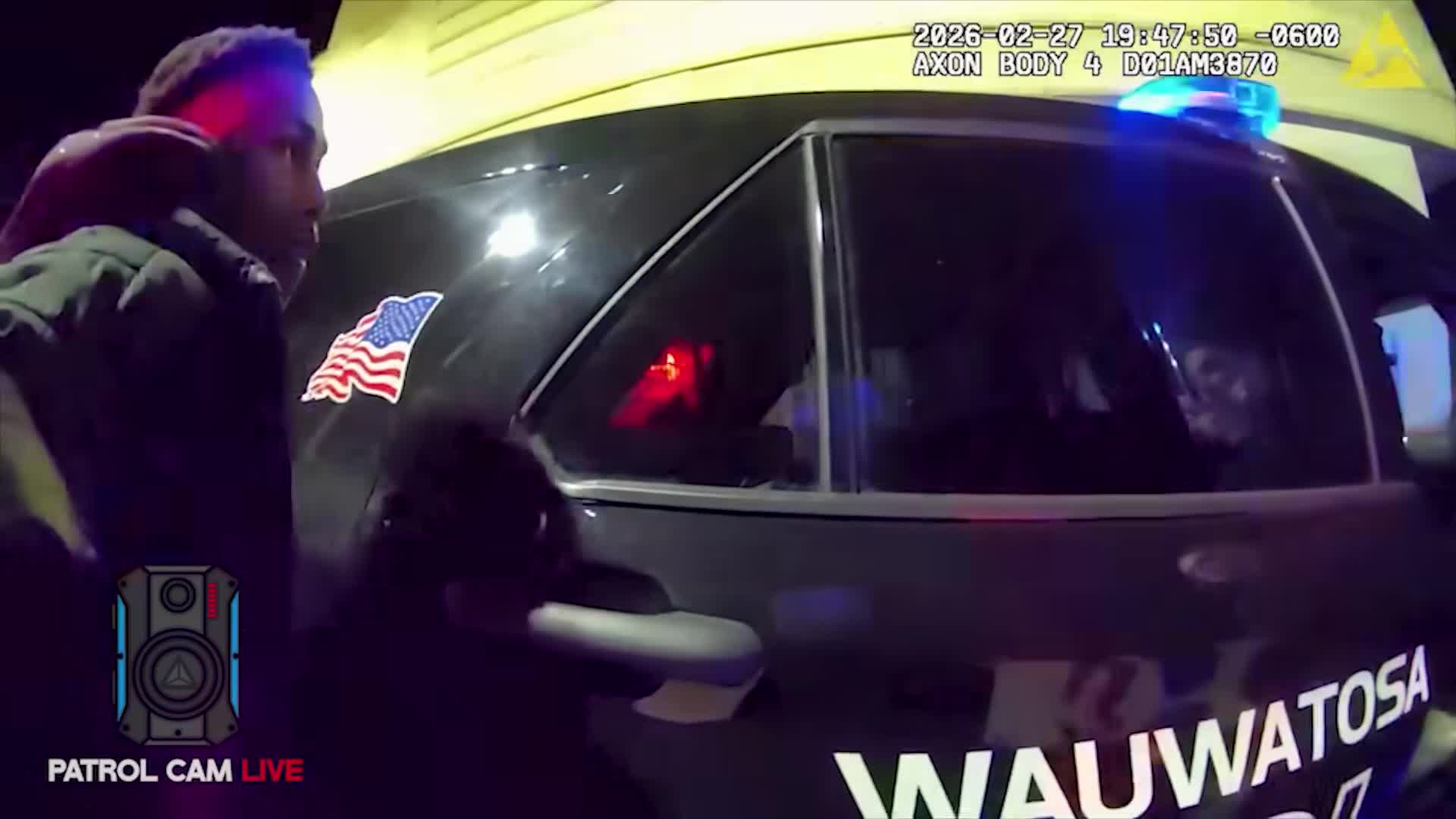
A Bodycam Frame Shows the Police Presence Outside
One of the two images in this article comes directly from the supplied bodycam.
It shows an officer beside a marked Wauwatosa police vehicle while emergency lights reflect across the scene.
The timestamp reads February 27, 2026.
The image helps anchor the incident before the search moves underground.
This is not an AI reconstruction or an unrelated mall photograph. It is a genuine frame from the footage being discussed.
The Search Moves Deeper Into the Service Area
Inside the tunnels, officers have to balance speed with caution.
Moving too slowly can allow a fleeing person to increase distance.
Moving too quickly around blind corners can expose officers to an ambush or collision with another officer.
A reported armed robbery raises the stakes because police cannot assume the people they are chasing are unarmed.
The bodycam therefore captures a search that is urgent without being simple.
Zev Finds One of the Fleeing Suspects
According to Wauwatosa Police and CBS 58, Zev chased down one of the suspects in the underground area and helped officers take that person into custody.
The arrest is significant for another reason.
Police said a firearm fell from the suspect's pocket during the takedown.
Officers recovered it.
The department later said the firearm had been confirmed as stolen.
That discovery provided physical evidence connecting the high-risk nature of the response to something officers could actually recover and document.
Why the Recovered Gun Matters
The presence of a firearm changes how an armed-robbery search must be understood.
Officers responding to a robbery report may begin with information supplied by witnesses or dispatch.
Until a weapon is found, they may not know whether it is still being carried, discarded somewhere along the escape route or never present at all.
Here, police reported recovering a gun during the arrest.
That recovery supported the reason officers treated the search as dangerous.
It also created an evidence issue separate from the apprehension itself because police said the gun was stolen.
The Remaining Suspect Surrenders
After Zev helped take one fleeing suspect into custody, the third person surrendered, according to police.
That ended the active search.
No prolonged standoff was required.
No second K9 apprehension was necessary.
All three people officers had seen running were now detained.
From an operational perspective, the search had moved from uncertainty to control.
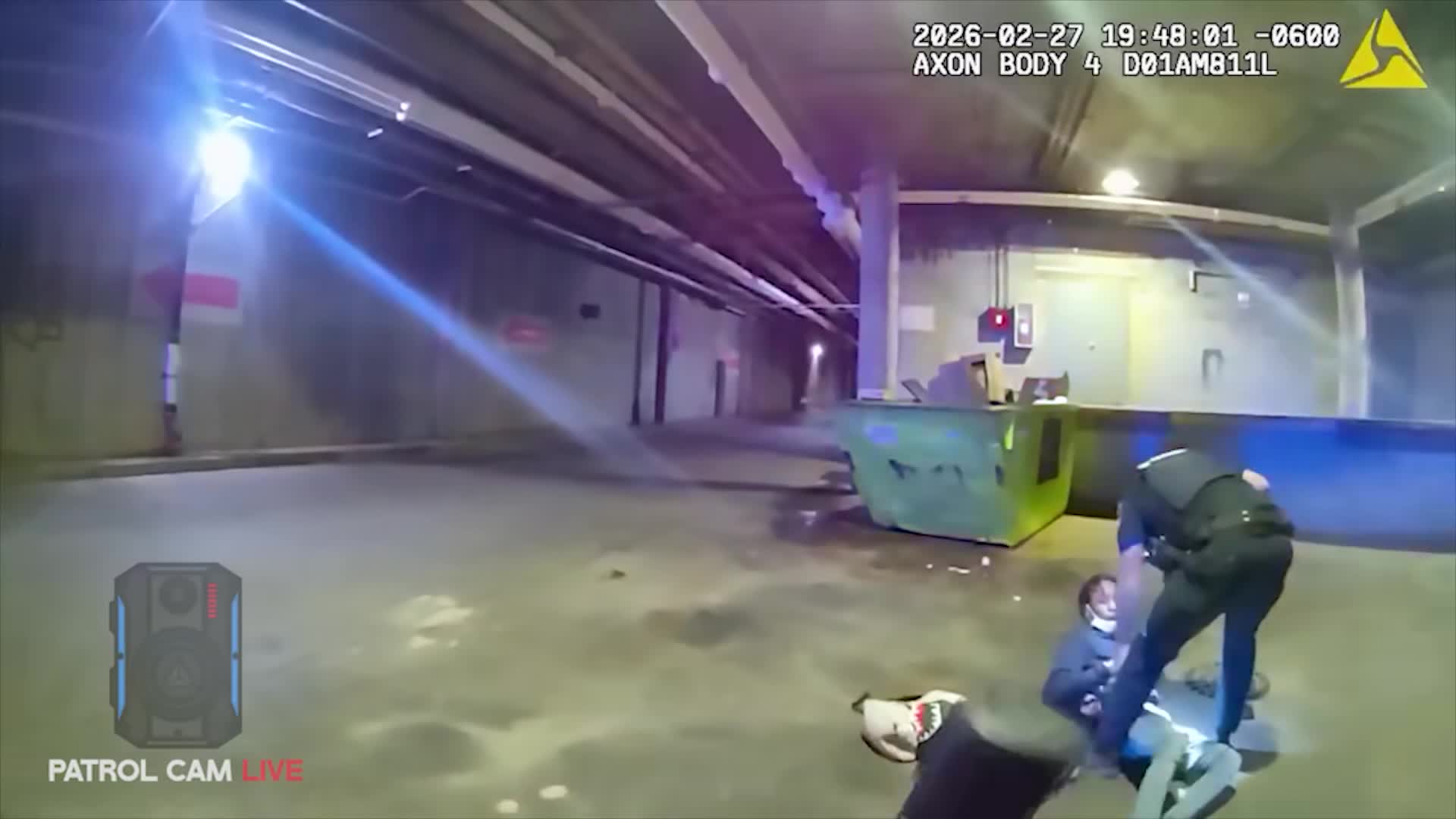
The Second Image Captures the Arrest Environment
The second genuine frame used in this article shows an officer restraining a person on the floor of the underground service area.
Concrete, dumpsters and industrial fixtures surround them.
The image communicates something that a standard exterior news photograph cannot: how confined the search area really was.
It also explains why tracking and containment mattered so much.
The tunnels offered numerous corners and possible hiding places, but very little open visibility.
The Firearm Was Reported Stolen
Local reporting says police later determined that the recovered firearm was stolen.
That is a factual claim attributed to Wauwatosa Police.
The available public reports do not provide enough information to responsibly assign ownership of every alleged offense to a specific detained person beyond what police said about the gun falling during the K9-assisted arrest.
For that reason, this article does not invent individual names or criminal histories.
The central verified facts are the armed-robbery response, flight, K9 apprehension, recovered stolen firearm and detention of all three people.
Why Names Are Not Needed to Tell This Story
The public reporting available for this incident does not identify the detained people by name.
That may reflect age, charging status, investigative considerations or simply the level of detail the department chose to release.
There is no reason to fill that gap with speculation.
The story remains clear without names.
Police respond to an armed robbery.
Three people run.
One stops.
Two enter the tunnels.
A K9 tracks one.
A stolen firearm is recovered.
The final person surrenders.
Those verified facts are enough to build an accurate narrative.
The Difference Between Detention, Arrest and Conviction
Police footage often creates the impression that the legal outcome is obvious because viewers see someone being taken into custody.
But custody is not the same thing as conviction.
The public reports used here describe the suspects as detained or arrested following the armed-robbery response.
They do not establish a final court judgment for each person.
A responsible account should therefore avoid declaring that every detained person was ultimately convicted of armed robbery.
The footage documents police action. The courts determine criminal guilt.
Why K9 Deployments Attract Attention
Police dogs are powerful law-enforcement tools.
They can locate people faster than officers searching visually.
They can track through darkness and complicated terrain.
They can also physically apprehend a person who continues fleeing.
That capability makes K9 deployments both effective and consequential.
A dog bite can cause injury, which is why deployment decisions, warnings, control by the handler and the circumstances of the suspected offense can become important in later review.
In this case, police emphasized the high-risk context of an armed-robbery call and the recovery of a stolen firearm.
The Search Is About More Than Catching Someone
A K9 track can also help police understand the path a fleeing person took.
That matters because suspects sometimes discard clothing, weapons or stolen property while running.
A search team may therefore be looking for both people and evidence.
The Mayfair Mall tunnels created a particularly complicated evidence environment.
An item thrown behind equipment or into a service area could be difficult to locate without a systematic search.
Containment Makes the K9 More Effective
A police dog is most useful when officers can limit the number of directions a suspect can escape.
Other officers can cover exits while the K9 team works inside.
That combination creates pressure from two sides.
The dog narrows the search path.
The perimeter reduces the chance that a fleeing person simply emerges elsewhere and disappears.
Wauwatosa police credited teamwork and coordinated action with bringing the incident to a safe conclusion.
The Mall Remained a Public-Safety Concern
Even when the chase moves into employee-only tunnels, officers still have to think about the public areas above and around them.
A person trying to escape may re-enter a store corridor.
A weapon may be discarded somewhere accessible.
Mall employees may unexpectedly encounter police or fleeing suspects.
That is why quickly containing the underground routes matters beyond the immediate arrest.
The objective is not simply to catch someone. It is to prevent the search from spilling back into populated areas.
The Department Praised the Coordinated Response
In its public account, Wauwatosa Police thanked officers for their quick response, teamwork and decisive action.
The department specifically highlighted the successful apprehension of all suspects and the recovery of a stolen firearm.
It also used the incident to emphasize the role of K9 teams in high-risk operations.
That is the department's perspective on the event, and it should be identified as such rather than treated as an independent legal conclusion.
Local News Coverage Arrives After the Footage Release
The robbery itself happened in late February.
The wider public discussion came in mid-April, when the police department released video.
CBS 58 reported on the bodycam April 16.
Additional regional coverage followed April 17.
This delay is common with body-camera stories.
The incident happens first.
Reports and evidence are processed.
Then edited or selected footage is released weeks later, creating a second news cycle.
The Bodycam Timestamp Provides an Important Check
Because the uploaded footage displays February 27, 2026, it gives a concrete date that fits the department's description of a late-February robbery.
That timestamp is useful when distinguishing this case from other armed incidents at Mayfair Mall.
Large shopping centers can generate multiple police calls over time.
Matching date, agency, location and sequence is essential before attaching news reporting to a video.
Here, those elements align.
Mayfair Mall Has a History of Serious Police Responses
Mayfair Mall has previously been the site of high-profile police incidents, which can make online searches confusing.
A writer could easily attach an older shooting or unrelated robbery to this footage simply because the location is the same.
That would be inaccurate.
The February 27 bodycam is specifically tied to the 2026 armed-robbery response involving three fleeing suspects, the underground tunnels, K9 Zev and the recovered stolen firearm.
Older Mayfair incidents are not used to fill gaps in this story.
The Tunnel Setting Is What Makes the Footage Distinctive
Many police K9 videos unfold in wooded areas, residential yards or open fields.
This one is different.
The search moves through the hidden infrastructure of a major mall.
Pipes run overhead.
Concrete corridors turn sharply.
Industrial equipment blocks sight lines.
Emergency lighting washes the walls in blue and red.
The environment gives the video a claustrophobic quality that helps explain why officers relied on a tracking dog.
The Suspects' Decision to Run Changes the Police Problem
If all three people had stopped in the parking lot, the response would have remained concentrated in one visible area.
Once two ran underground, officers had to locate moving people in a complex structure.
Flight also creates uncertainty.
Police do not know whether a person is looking for an exit, a hiding place or an opportunity to confront officers.
In an armed-robbery investigation, that uncertainty carries obvious risk.
Zev's Speed Reduces the Search Window
The longer a search lasts, the more variables officers face.
A suspect may find another exit.
Evidence may be discarded.
The perimeter may have to expand.
More mall operations may be disrupted.
A successful K9 track compresses that timeline.
According to police, Zev quickly located one of the fleeing suspects.
That apprehension appears to have changed the remaining suspect's calculation as well, because the final person surrendered.
The Gun Recovery Becomes the Evidentiary Turning Point
The physical recovery of the firearm is one of the most consequential moments after the apprehension.
Police no longer have only a report that a weapon may have been involved.
They have an object that can be secured, photographed, tested and traced.
Investigators can examine serial-number information and determine whether the gun has been reported stolen.
Wauwatosa police said that check confirmed the firearm was stolen.
No Injuries Were Highlighted in the Main Reports
The local reports reviewed for this article focus on the apprehensions and gun recovery and do not report injuries to officers or members of the public.
That is notable given the setting and the armed-robbery allegation.
It would still be inappropriate to infer that nobody involved received any medical evaluation unless a source specifically confirms it.
The accurate statement is narrower: the reports emphasize a safe resolution and do not identify injuries to officers or bystanders.
What Can Be Verified With Confidence
Several facts are strongly supported across the video and public reporting.
The incident involved Wauwatosa Police at Mayfair Mall.
The bodycam is dated February 27, 2026.
Police were responding to an armed robbery.
Three people were seen running through the parking lot.
One was detained while two fled into underground tunnels.
K9 Zev helped apprehend one of the people who continued running.
A firearm fell during that arrest and police later said it was stolen.
The final fleeing suspect surrendered.
All three were ultimately in custody.
Those are the facts on which this article is built.
What Is Deliberately Left Out
This article does not invent names for the detained people.
It does not guess their ages.
It does not claim a specific sentence or court outcome.
It does not describe the exact property allegedly taken in the robbery because the sources reviewed do not provide that detail.
It does not assign possession of the recovered gun beyond what police publicly reported about the arrest sequence.
Leaving uncertain details out is more accurate than making the story sound complete by adding unsupported information.
Why the Story Holds Attention Without Exaggeration
The incident already contains a strong narrative arc.
An armed robbery call brings officers to a busy mall.
Three people run.
One stops.
Two disappear underground.
Police enter a maze of service tunnels.
A K9 begins tracking.
One suspect is located.
A firearm falls to the ground.
Police learn it is stolen.
The remaining suspect gives up.
Each stage answers one question while creating another.
That structure keeps a reader moving forward without needing exaggerated claims.
The K9 Is the Turning Point, Not a Side Detail
It would be easy to write this as a generic armed-robbery arrest.
That would miss what makes the footage distinctive.
The key problem is locating people who have disappeared into a complicated underground space.
Zev is the tool that changes that problem.
Once the K9 closes the distance, the search stops being open-ended.
One suspect is apprehended, evidence is recovered and the remaining person surrenders.
The dog's role is therefore central to the story's resolution.
A Hidden Part of the Mall Becomes the Arrest Scene
Customers walking through Mayfair Mall may never think about the tunnels and service corridors underneath the public spaces.
On February 27, those hidden areas became a police search zone.
That contrast gives the footage unusual visual power.
A familiar retail destination contains an infrastructure most visitors never see.
When suspects run into that infrastructure, officers have to operate in a space designed for maintenance and logistics rather than police movement.
The bodycam briefly exposes that hidden world.
The Larger Lesson From the Incident
The Mayfair Mall response shows why specialized police units exist.
Patrol officers can establish containment.
Other officers can secure people already detained.
A trained K9 team can search a difficult environment more efficiently than officers checking every corner visually.
When those pieces work together, a chaotic incident can be brought under control quickly.
Wauwatosa Police presented the case as an example of that coordination.
The recovered stolen firearm also demonstrates why officers treated the flight as a serious threat rather than a simple attempt to avoid questioning.
The End of the Search Is Only the Start of the Case
Once everyone is in custody, investigators still have substantial work to do.
The firearm has to be processed.
Surveillance footage can be collected from the mall.
Witnesses can be interviewed.
Body-camera recordings must be preserved.
Investigators have to determine each person's alleged role in the robbery.
Prosecutors then decide what charges, if any, can be supported.
The bodycam shows the most visually dramatic portion of the police response, but it does not show the entire legal process that follows.
Watch the Full Incident
The complete footage shows how quickly a mall parking-lot pursuit turns into an underground search and how K9 Zev changes the direction of the operation.
Pay attention to the transition from the open exterior to the confined service corridors, the officers coordinating around possible escape routes, and the moment the search finally reaches one of the fleeing suspects.
The most important detail is not simply that police made arrests. It is how the combination of containment, tracking and teamwork brought an armed-robbery response to an end inside a place most mall visitors never see.
Comments (0)
Loading comments...
May You Like
Cops Arrive for a Medical Emergency and Walk Into Drunken Chaos

West Virginia Man Laughs at Police Officer and Ends Up Arrested
Entitled Driver Skips the Line and Gets Instant Karma3