
Street Racers Arrested - “It’s soooo fast”
Street Racers Think They've Gotten Away Until Their Own Dashcam Reveals 107 MPH
Two Cars Line Up on an Ordinary City Street
For a few seconds on Bridgeport Way West, the road apparently became a racetrack.
It was around 9:30 p.m. on September 8, 2026, in University Place, Washington. A Pierce County Sheriff's deputy was conducting a speed-emphasis patrol when two vehicles caught his attention.
They were traveling next to one another.
Then something unusual happened.
Both vehicles slowed.
They remained side by side.
And suddenly, they accelerated together.
For an experienced traffic deputy, the pattern was difficult to mistake.
This did not look like two motorists independently speeding away from the same traffic light.
It looked like a race.
According to the Pierce County Sheriff's Office, the deputy attempted to stop the vehicles, but the initial traffic stop was unsuccessful.
The cars disappeared.
For the drivers, that might have felt like the end of the problem.
It wasn't.
The deputy began checking the surrounding area.
Before long, he spotted the same two vehicles again.
This time they were not flying down Bridgeport Way.
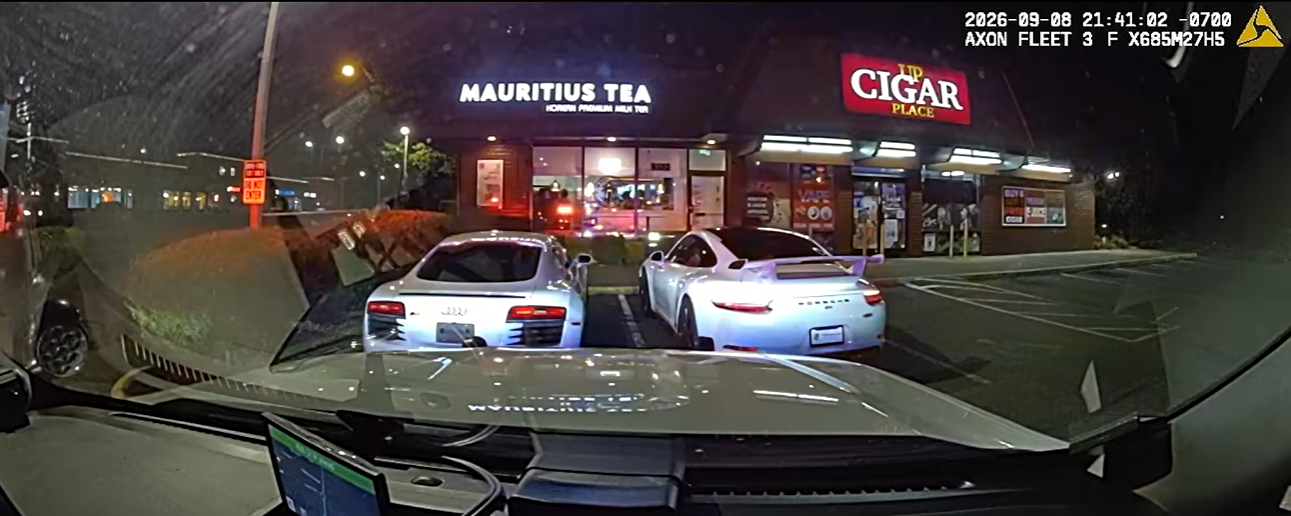
They were parked.
Side by side.
And the deputy already believed he had probable cause for reckless driving and street racing.
Two 25-year-old men would soon be arrested.
But even that was not the most damaging evidence.
The strongest witness against the racers was sitting inside one of their own cars.
A dashcam.
And once investigators obtained a warrant to examine its recording, it revealed something far more extreme than officers had been able to document from the roadside.
One of the vehicles had reached 107 mph.
The posted speed limit was 35 mph.
The drivers had apparently recorded the evidence themselves.
The Deputy Doesn't Need a Long Pursuit to Find Them
Street-racing videos often end with dramatic pursuits.
Police lights fill the mirrors.
Cars weave through traffic.
Speeds climb.
Officers call out intersections over the radio.
Eventually someone crashes, gets boxed in or abandons a vehicle and runs.
This University Place incident followed a different path.
When the deputy initially tried to stop the racers, the attempt was unsuccessful.
But rather than requiring a prolonged high-speed pursuit, the case developed through ordinary police work.
The deputy searched the area.
Then he found the two vehicles parked beside each other in a nearby parking lot.
That detail is almost ironic.
Minutes earlier, the drivers had allegedly been moving at extraordinary speed.
Now their vehicles were stationary and conveniently parked together.
The deputy still had to locate the people responsible.
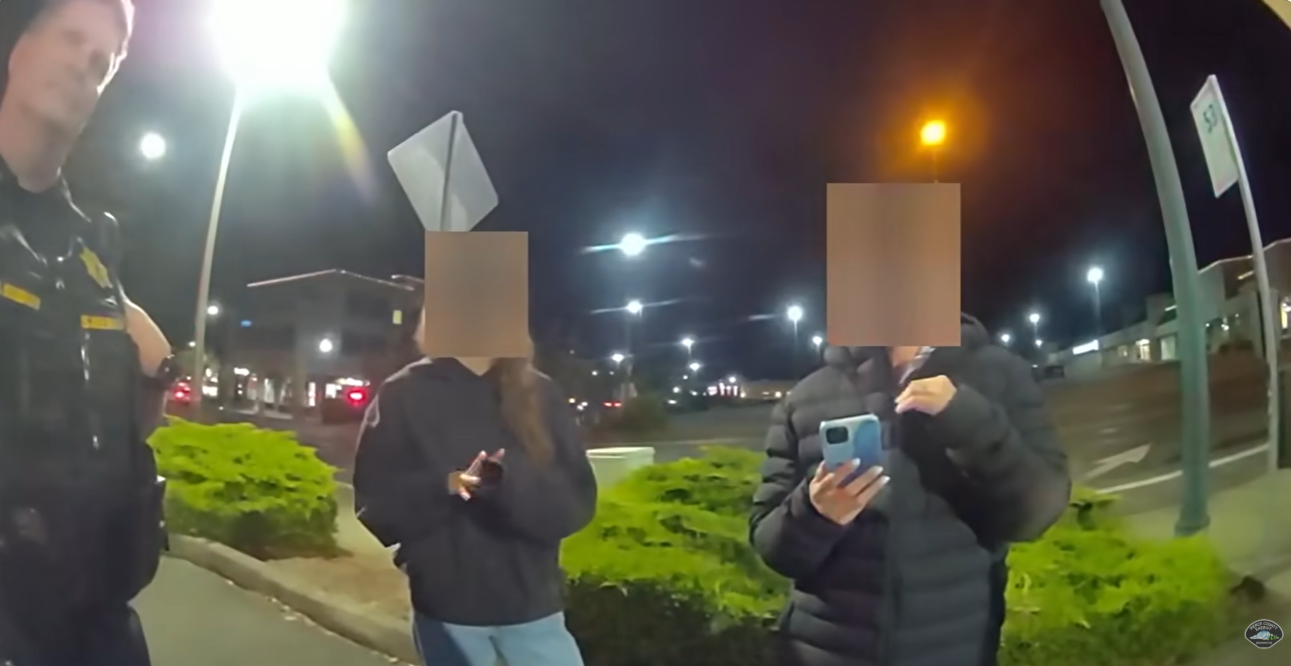
According to subsequent reporting, the suspects were eventually located inside a restaurant.
The investigation had gone from high-speed observation to a much calmer arrest.
The two men were taken into custody and booked into the Pierce County Jail on allegations of reckless driving and street racing. The Sheriff's Office did not publicly identify them in its release, referring only to both as 25-year-old males.
That means there is no responsible reason to attach names from unrelated street-racing cases to this footage.
What police did identify were the cars and the evidence surrounding them.
And under Washington's newer street-racing rules, the vehicles themselves were about to become an important part of the investigation.
Washington Changed the Consequences for Street Racing
The arrests occurred under a legal framework strengthened in Washington beginning in January 2024.
Pierce County Sheriff's Office explained that vehicles involved in street racing are subject to a 72-hour impound hold and can be seized through search warrants so investigators can gather evidence. The department also noted that a vehicle involved in a second street-racing offense may become subject to forfeiture.
That creates consequences beyond the driver's arrest.
A modified performance car can represent years of work and tens of thousands of dollars.
Street racers may invest in engines, turbo systems, suspension, tires, exhaust components, bodywork and electronics.
But once the car itself becomes evidence, the owner temporarily loses control over what happens to it.
In this case, both vehicles received the 72-hour hold.
Investigators then focused on something inside one of them.
The dashcam.
The device was presumably installed for the same reasons enthusiasts often use cameras: to record drives, document performance or preserve memorable moments.
Now it potentially contained evidence of a crime.
The deputy submitted an application for a search warrant.
A judge approved it.
Police removed the dashcam for examination.
And suddenly, the case became much stronger.
The Suspects' Own Video Shows What the Deputy Couldn't
A deputy standing beside a roadway sees only part of a race.
The cars enter view.
They accelerate.
They pass.
Then they disappear.
Radar or lidar can document speed when conditions allow, but officers do not always capture every vehicle at the exact peak of acceleration.
A camera inside the suspect vehicle provides a completely different perspective.
It stays with the car.
That is what made the dashcam so significant here.
According to Pierce County Sheriff's Office, investigators watched the footage and saw the two vehicles traveling side by side at high speed.
Then the speed climbed.
The recording showed one vehicle reaching 107 mph in a 35-mph zone.
That is 72 mph above the posted limit.
Put another way, the vehicle was traveling at more than three times the speed limit.
At 35 mph, a vehicle covers roughly 51 feet every second.
At 107 mph, it covers about 157 feet per second.
That means a car moving at the recorded speed travels the length of a football field in roughly two seconds.
A driver pulling out of a side street may look down the road and believe there is plenty of space.
At ordinary urban speed, there might be.
At 107 mph, that gap disappears almost immediately.
That is the fundamental danger of street racing on public roads.
It is not limited to the people who choose to race.
Everyone around them is forced into the risk.
A driver making a legal turn.
A pedestrian crossing.
A cyclist.
Someone backing out of a business.
Another motorist changing lanes.
None of those people agreed to participate.
Yet a vehicle traveling at triple-digit speed gives them dramatically less time to recognize and avoid danger.
Then the Passenger's Own Words Make the Evidence Even Harder to Explain
The title of the Sheriff's Office release comes from a moment recorded inside the vehicle.
“It's soooo fast.”
The phrase sounds almost harmless by itself.
In context, it becomes memorable for a very different reason.
According to reporting on the footage, the passenger can be heard reacting to the vehicle's speed while the race is happening.
Later, during the police encounter, that same passenger reportedly suggests that the driver would never drive that fast with her inside the vehicle.
But investigators now possess the recording.
The camera does not depend on memory.
It does not become nervous when police arrive.
It does not need to remember exactly how fast the car was traveling.
The evidence is preserved.
That contrast is what gives the bodycam and dashcam combination its unusual narrative.
At the roadside, police hear explanations.
Later, the camera provides a second version of events.
And the two versions do not comfortably fit together.
The Cars May Be Fast, but the Road Is Still Public
There is nothing inherently illegal about owning a powerful vehicle.
Pierce County Sheriff's Office makes essentially that point in its own statement.
The department says it likes cool cars.
The problem is where people choose to test them.
A racetrack is engineered around speed.
Public roads are not.
Tracks typically have controlled access, runoff areas, safety barriers, known direction of travel and rules governing who can enter the course.
Bridgeport Way West has ordinary traffic.
Businesses.
Intersections.
Driveways.
Drivers who have no reason to expect another vehicle approaching at 107 mph.
That difference is enormous.
Modern performance cars can make extraordinary acceleration feel deceptively easy.
A vehicle capable of reaching 100 mph quickly may remain stable and surprisingly quiet inside the cabin.
Advanced tires, suspension, traction control and braking systems can give the driver confidence.
But technology cannot remove the unpredictability of a public street.
It cannot prevent another driver from turning across the road.
It cannot stop a pedestrian from stepping into a crosswalk.
It cannot make a blind driveway transparent.
And it cannot change human reaction time.
The faster the car travels, the less time everyone has.
That is why the Sheriff's Office described the behavior as putting the community in danger rather than simply violating a technical traffic rule.
The Arrest Is Only the Beginning of the Evidence Trail
The bodycam portion of this incident provides the immediate payoff.
Deputies locate the suspects.
Questions are asked.
The men are arrested.
But the investigation does not stop when they enter the Pierce County Jail.
The cars remain important.
So does the recording equipment.
That is one of the more interesting aspects of modern traffic enforcement.
Cars increasingly collect data.
Some have factory event-data recorders.
Others record GPS information.
Performance applications can store acceleration or speed data.
Aftermarket cameras capture the road and sometimes the cabin.
Phones may record routes and video.
Action cameras are common among automotive enthusiasts.
All of those devices can potentially transform a disputed driving incident into something much easier to reconstruct.
In this case, investigators did not simply take the dashcam because they wanted to watch it.
They obtained judicial authorization.
The Sheriff's Office says a search warrant was submitted and approved before the dashcam was removed for evidence.
That legal step matters.
Police now had the ability to examine a recording that allegedly captured the race from inside one of the participating vehicles.
What they found supported the deputy's original observation.
Two vehicles alongside each other.
Both accelerating.
High speed.
Then 107 mph.
The case that began with what a deputy saw from outside the cars now included what one of the suspects' own cameras recorded from inside.
Why 107 MPH in a 35 Zone Is More Serious Than the Number Sounds
“107 mph” is dramatic enough to make a headline.
But numbers can become abstract.
The physical consequences matter more.
At 107 mph, a vehicle is traveling approximately 157 feet every second.
A normal human perception-and-reaction interval can easily consume more than a second before meaningful braking even begins.
During that brief interval, the vehicle may already have traveled well over 150 feet.
Then braking starts.
Stopping distance grows dramatically with speed because the kinetic energy that brakes must dissipate rises with the square of velocity.
The difference between 35 and 107 mph is therefore not simply “72 mph faster.”
The risk increases much more sharply.
And those calculations assume ideal circumstances.
Real roads contain variables.
Wet pavement.
Uneven surfaces.
Traffic.
Curves.
Animals.
Debris.
A driver changing lanes without expecting someone approaching at triple-digit speed.
Even an experienced driver cannot control every other variable.
That is why public-road racing creates risk far beyond the drivers themselves.
If racers misjudge one another, they can collide.
If one loses control, the vehicle can leave the roadway.
If an uninvolved driver enters their path, that person may have virtually no chance to react.
The absence of a crash in this case should not be confused with the absence of danger.
It means the danger did not produce its worst possible result.
This time.
They Apparently Escaped the Initial Stop, but Not the Investigation
There is another lesson buried in the timeline.
Getting away from the first attempt to stop does not necessarily mean getting away.
The deputy loses the immediate opportunity to conduct the traffic stop.
Then he searches.
The vehicles are found.
The drivers are located.
Probable cause already exists based on what the deputy observed.
Arrests follow.
Then investigators find stronger evidence than they had at the beginning.
That progression reverses the usual logic of an escape.
At the moment the cars disappear, the drivers may possess an informational advantage.
Police saw only part of what happened.
By the end, police possess the suspects' own dashcam.
The investigation becomes stronger after the race is over.
Both 25-year-old men were booked on allegations of reckless driving and street racing.
As always, an arrest and criminal allegation are not the same as a conviction.
The legal process determines guilt.
But for investigators, the dashcam provides unusually direct evidence to support the allegations.
It is difficult to imagine a clearer example of technology undermining the person who installed it.
The camera was not a police camera.
It belonged to the suspect vehicle.
Yet it became police evidence.
The Passenger's Reaction Becomes the Line Everyone Remembers
The phrase “It's soooo fast” works as a title because it captures the emotional appeal that makes illegal street racing difficult to eliminate.
Speed can be exciting.
Acceleration creates a physical sensation.
Passengers react.
Drivers chase the adrenaline.
Car culture itself is not the problem.
There are legal venues designed specifically for people who want to discover what their vehicles can do.
The problem begins when that experience is transferred to a public road where everyone else becomes an unwilling participant.
That is why the Sheriff's Office's response is notable.
Its message is not anti-car.
It is anti-racing-on-public-roads.
The agency's blunt warning was that anyone endangering the community through street racing should expect the full consequences of enforcement.
The two cars were impounded.
The drivers were jailed.
A warrant was obtained.
The dashcam became evidence.
The speed was documented.
What may have begun as a few seconds of adrenaline created consequences lasting far longer than the race itself.
A Race That Lasted Seconds Leaves a Much Longer Record
Illegal races can be extremely short.
Two cars line up.
Both accelerate.
Within seconds, one backs off or traffic forces the race to end.
But the consequences can persist.
A collision can alter lives permanently.
An arrest can create criminal charges.
A vehicle can be impounded.
And in the modern world, digital evidence may preserve every second.
That final point defines the University Place case.
The deputy sees enough to recognize what is happening.
The racers disappear before the initial stop can be completed.
The deputy continues looking.
The vehicles are found together.
The suspects are found.
The arrests occur.
Then police obtain the dashcam.
What it shows makes the original roadside observation look almost restrained.
One car reaches 107 mph where the speed limit is 35.
The passenger reacts to the speed.
The recording preserves the race.
And suddenly the title of the video becomes the perfect summary of how the suspects created some of the strongest evidence against themselves.
It's soooo fast.
Yes.
That was exactly the problem.
The Sheriff's Office said both vehicles received the mandatory 72-hour hold associated with the street-racing enforcement process. Investigators also warned that repeat street-racing offenses can expose vehicles to forfeiture under Washington law.
For anyone watching the bodycam simply for the arrest, the more interesting story comes afterward.
Police did not have to guess how fast the cars had been going.
They did not have to rely solely on competing memories.
One of the cars carried the answer.
The suspects had brought their own witness.
And it had been recording the entire time.
Watch the complete encounter and see how a brief race on Bridgeport Way led to two arrests, vehicle impounds and dashcam evidence showing a car reaching 107 mph here: https://www.youtube.com/watch?v=6b2PaO_IpXA&t=35s
Comments (0)
Loading comments...
May You Like

Police Chase Ends as Driver Hits Stoplight, Crashes Into West Towne Mall

COP SLAMS INTO PULLED OVER TRUCK

Entitled Driver Learns Why You Must Obey Lawful Orders During Traffic Stop













