
Something About This Pickup Gets the Trooper’s Attention
SOMETHING ABOUT THIS PICKUP GETS THE TROOPER’S ATTENTION
The pickup truck ahead does not appear to be doing anything dramatic.
It is traveling along a broad highway under a clear sky. Traffic is light, the roadway is open, and there is no obvious emergency unfolding around it. From the patrol vehicle's perspective, this could easily be another routine moment during highway enforcement.
But something about the pickup has caught the trooper's attention.
That is often how a traffic stop begins. Not with a chase, a crash, or a dramatic confrontation, but with a small observation that gives an officer a reason to look more closely.
The supplied image does not provide enough verified information to identify the exact agency, location, driver, or ultimate charges. The small inset appears to emphasize a detail on or around the vehicle, but it would be unreliable to claim exactly what the trooper observed without the complete footage.
What is clear is that the officer has begun paying attention to the truck.
And once that happens, an ordinary drive can quickly become something very different.
THE PICKUP IS STILL MOVING NORMALLY, BUT THE TROOPER HAS ALREADY SEEN SOMETHING WORTH A SECOND LOOK.
A ROUTINE HIGHWAY PATROL SUDDENLY HAS A FOCUS
Highway patrol officers spend hours observing traffic.
Most vehicles pass without becoming part of an enforcement action.
The officer is continuously watching speed, lane position, equipment, plates, registration indicators, driver behavior, and traffic conditions.
Sometimes the reason for additional attention is immediately obvious.
A vehicle is speeding.
A driver crosses the center line.
A brake light is not functioning.
A plate appears expired or obscured.
Other times, the observation is much smaller.
The trooper may follow for a short distance before deciding whether there is a lawful basis to initiate a stop.
That appears to be the important transition in this footage.
The pickup has moved from being just another vehicle on the highway to becoming the vehicle the trooper is watching.
THE FIRST FEW SECONDS CAN DETERMINE EVERYTHING THAT FOLLOWS
Before emergency lights are activated, the driver may not even realize police are interested in the truck.
The pickup continues down the highway.
The trooper maintains position.
During those seconds, the officer can observe how the vehicle is being driven.
Is it maintaining its lane?
Is its speed consistent with surrounding traffic?
Does the driver react unusually to the patrol vehicle?
Is there an equipment issue visible from behind?
If there is a plate, the officer may also be able to check information associated with it through normal law-enforcement systems.
Nothing about this stage necessarily means the driver has committed a serious offense.
It is simply the point where observation begins.
THE DRIVER MAY THINK THIS IS STILL AN ORDINARY TRIP. FOR THE TROOPER, THE TRAFFIC STOP MAY ALREADY BE TAKING SHAPE.
THEN THE EMERGENCY LIGHTS COME ON
The activation of emergency lights creates the first unmistakable moment.
The driver now knows police want the vehicle to stop.
For most traffic stops, what happens next is straightforward.
Signal.
Reduce speed.
Move toward a safe location.
Stop.
Remain inside unless instructed otherwise.
But from the trooper's perspective, the driver's immediate reaction can provide additional information.
Does the pickup slow immediately?
Does it continue at the same speed?
Does the driver change lanes?
Does the truck accelerate?
A delay of several seconds may have an innocent explanation. The driver could simply be searching for a safe shoulder.
A prolonged refusal to stop creates a very different situation.
THE SHOULDER BECOMES THE FIRST TEST
The highway visible in the supplied image appears to provide significant open space along the roadside.
That matters.
A driver cannot easily argue that there is nowhere to stop if a suitable shoulder is available for an extended distance.
If the pickup begins slowing and moves right, the encounter can remain a normal traffic stop.
If it passes one safe location after another, the trooper has to determine whether the driver is deliberately refusing to stop.
There is an important distinction between taking a few extra seconds to find a safe location and clearly attempting to escape.
Officers evaluate the entire sequence rather than a single instant.
THE PICKUP'S BEHAVIOR AFTER THE LIGHTS MATTERS MORE THAN BEFORE
Whatever initially caught the trooper's attention may ultimately become secondary if the driver refuses to stop.
A minor traffic or equipment issue can lead to a relatively routine citation or warning.
Fleeing can create an entirely new set of legal and safety concerns.
This is why the driver's next decision matters so much.
Pull over and address the original reason for the stop.
Or continue driving and dramatically escalate the encounter.
THE ORIGINAL PROBLEM MAY BE SMALL. REFUSING TO STOP CAN MAKE IT MUCH BIGGER.
AN OPEN HIGHWAY CAN ENCOURAGE THE WRONG DECISION
The road ahead looks inviting.
Long sight lines.
Light traffic.
Multiple lanes.
Few immediate obstacles.
For someone considering running from police, those conditions can create false confidence.
The pickup may be able to accelerate.
The driver may believe distance can be created before the trooper responds.
But highway pursuits are not simply contests between two vehicles.
The trooper has a radio.
Dispatch can be updated.
Other officers may be positioned farther ahead.
Vehicle information can potentially be communicated to surrounding agencies.
The driver might create distance from one patrol car without becoming unknown to police.
THE TROOPER DOES NOT HAVE TO SOLVE EVERYTHING ALONE
Once a driver clearly refuses to stop, communication becomes essential.
The pursuing officer can provide the vehicle description.
Pickup truck.
Color.
Plate information, if available.
Direction of travel.
Approximate location.
Speed.
Traffic conditions.
Other units can begin moving toward the pursuit.
That changes the driver's problem completely.
At first, the pickup only needs to stay ahead of one trooper.
As the pursuit continues, the driver may encounter police approaching from exits, intersections, or roads farther ahead.
THE DRIVER IS WATCHING THE MIRROR. THE POLICE RESPONSE CAN BE DEVELOPING MILES DOWN THE ROAD.
SPEED CREATES DISTANCE AND DESTROYS REACTION TIME
If the pickup accelerates, the visual drama increases immediately.
The truck becomes smaller ahead of the patrol vehicle.
Road markings pass faster.
Traffic approaches more quickly.
But every increase in speed reduces the time available to respond to unexpected events.
A vehicle changes lanes.
A truck enters from an on-ramp.
Construction appears.
Traffic slows over a hill.
An animal enters the roadway.
At normal speed, these events may be manageable.
At pursuit speeds, the same events can demand immediate action.
The fleeing driver is also dividing attention between the road ahead and police behind.
That combination creates risk long before any collision occurs.
A PICKUP TRUCK BEHAVES DIFFERENTLY FROM A PASSENGER CAR
Vehicle type matters during aggressive driving.
Pickup trucks can be powerful and fast, but they also have different weight distribution and handling characteristics from lower passenger cars.
Hard steering inputs can create instability.
Roadside terrain becomes particularly important if the driver leaves the pavement.
A pickup may appear capable of traveling across rougher ground, but highway shoulders can conceal drainage areas, soft soil, debris, signs, and steep embankments.
The driver may see the shoulder as an additional lane.
The trooper sees another place where the situation can become unpredictable.
TRAFFIC EVENTUALLY CHANGES THE EQUATION
The highway may be relatively clear in the supplied frame, but that condition rarely lasts forever.
The pickup eventually reaches other motorists.
Now the driver has to begin passing.
Change lanes.
Accelerate around slower vehicles.
Return to the original lane.
Each maneuver creates another opportunity for something to go wrong.
A motorist ahead may not realize a pursuit is approaching.
They may begin changing lanes at exactly the moment the pickup attempts to pass.
Police lights and sirens can further complicate the situation because drivers react differently.
Some pull over immediately.
Some brake.
Others hesitate.
The suspect has to predict all of them.
THE ROAD DOESN'T HAVE TO BLOCK THE PICKUP. ONE DRIVER MAKING AN UNEXPECTED MOVE CAN DO IT.
AN EXIT OFFERS ANOTHER POSSIBLE ESCAPE
If the pickup leaves the highway, the pursuit changes.
The driver may hope that a sudden exit will create separation.
The truck brakes.
Enters the ramp.
The trooper follows.
But exits also remove space.
Several highway lanes become one ramp.
A long straight roadway becomes a curve.
At the bottom may be a stop sign or traffic signal.
The pickup now has fewer directions available.
The driver has traded speed for complexity.
That can work temporarily.
It can also give police the opportunity they need to close the distance.
SMALLER ROADS FAVOR POSITIONING OVER SPEED
Once a pursuit reaches local roads, raw vehicle performance becomes less important.
There are more intersections.
Driveways.
Curves.
Businesses.
Pedestrians.
Stop signs.
The driver has to brake more frequently.
Every time the pickup slows for a turn, police can recover some distance.
Other officers also have more opportunities to approach from connecting roads.
A pursuit that looked wide open on the highway can become increasingly constrained.
The driver may keep moving while the number of realistic escape routes steadily decreases.
THE TROOPER MAY WAIT RATHER THAN FORCE AN IMMEDIATE END
Viewers often wonder why police do not immediately attempt to stop a fleeing vehicle physically.
The environment matters.
A pursuit intervention that might be appropriate on one stretch of road may be too dangerous somewhere else.
Traffic may be too heavy.
The speed may be unsuitable.
A bridge may be nearby.
Pedestrians may be present.
Oncoming traffic could create additional risk.
The trooper may therefore follow while waiting for conditions to change.
Patience can look passive on video.
In reality, the officer may be evaluating the road continuously.
THE BEST TIME TO END A PURSUIT IS NOT ALWAYS THE FIRST TIME THE TROOPER GETS CLOSE ENOUGH.
ONE GOOD OPPORTUNITY CAN END EVERYTHING
Eventually, conditions may improve.
Traffic clears.
The pickup slows.
The road opens.
Another police unit arrives.
The trooper moves closer.
If an authorized intervention is appropriate under the circumstances, the pursuit can change in seconds.
Alternatively, police may use positioning and traffic conditions to contain the truck without intentional contact.
The exact method matters less than the broader goal: stop the vehicle without unnecessarily increasing the danger to everyone around it.
A chase that lasts miles can end within a few hundred feet once the right circumstances develop.
THE PICKUP STOPPING DOES NOT AUTOMATICALLY MEAN SURRENDER
A stationary truck can still move again.
Officers know this.
If the pickup finally stops, police may remain behind their vehicles rather than immediately approaching the driver's window.
Commands can be issued from a distance.
Turn off the engine.
Show your hands.
Do not reach.
Exit as instructed.
The driver's response determines how quickly the tension can decrease.
If the person follows instructions, officers can gradually take control.
If the driver keeps reaching around the cab or attempts to restart the vehicle, uncertainty remains high.
THE DRIVER CAN STILL LEAVE THE TRUCK AND RUN
Even when the vehicle portion of a pursuit ends, the person inside may continue trying to escape.
The door opens.
The driver runs.
Now the truck no longer matters.
The trooper has to stop, exit and transition immediately into a foot pursuit.
If the location is rural, the driver may head toward trees or fields.
In a commercial area, buildings and parking lots provide concealment.
Additional officers can establish containment.
A suspect who was previously moving at highway speed may ultimately be found only a short distance from the abandoned vehicle.
THE ORIGINAL OBSERVATION BECOMES IMPORTANT AGAIN
Once everything is over, investigators can return to the question that began the encounter.
What initially caught the trooper's attention?
That detail matters because it explains the basis for the original contact.
Dashcam can be reviewed.
The officer's report can document observations.
Dispatch records can establish when information was checked or communicated.
If the stop eventually becomes a criminal case, the events leading to the attempted detention may receive careful scrutiny.
This is why the beginning of police footage can be just as important as the dramatic ending.
THE PURSUIT MAY BECOME THE PART EVERYONE WATCHES, BUT THE FIRST FEW SECONDS EXPLAIN WHY THE TROOPER WAS BEHIND THE PICKUP AT ALL.
DASHCAM PROVIDES A TIMELINE THAT MEMORY CANNOT
During a fast-moving incident, officers and drivers experience enormous amounts of information in a short period.
Video preserves it.
Investigators can review when the trooper first began following.
When emergency lights activated.
How long the pickup continued before responding.
Where acceleration occurred.
How traffic changed.
When backup arrived.
What happened during the final stop.
The recording also allows police conduct to be examined rather than relying exclusively on written descriptions.
That becomes particularly important if there is later disagreement about what occurred.
A SHORT CLIP CAN COMPLETELY CHANGE THE STORY
Imagine watching only the moment the pickup accelerates.
It appears to be simply another police chase.
Now watch only the final arrest.
The reason for the pursuit disappears entirely.
But begin with the trooper's initial observation and the story becomes much easier to understand.
Something attracts attention.
The officer watches.
A stop is initiated.
The driver responds.
The situation develops from there.
Context determines whether the viewer understands the incident or merely sees its most dramatic moments.
AN ARREST DOES NOT DETERMINE GUILT
If the driver is eventually arrested, that represents the beginning of the criminal process, not its conclusion.
Police document their observations.
Evidence is reviewed.
Prosecutors determine which allegations are supported.
The accused person can challenge the evidence and police actions.
Charges may change or be dismissed.
A court determines guilt.
Because the supplied screenshot does not reliably identify this exact incident, it would be inappropriate to attach the name, charges, or criminal history of someone from a visually similar case.
The footage should be described according to what can actually be established.
SOMETHING SMALL CAN BECOME THE START OF SOMETHING MUCH BIGGER
Look at the pickup again.
Nothing in this frame resembles the climax of a dramatic police pursuit.
The truck is upright.
The highway is clear.
No collision has occurred.
No one is running.
That is precisely what makes the moment interesting.
The story has not exploded yet.
The trooper has simply noticed something.
Maybe the driver knows why.
Maybe the driver has no idea police are watching.
Either way, the next few moments will determine whether this remains an ordinary traffic stop or becomes something far more serious.
A POLICE PURSUIT DOES NOT ALWAYS BEGIN WITH SOMEONE FLOORING THE ACCELERATOR. SOMETIMES IT BEGINS WITH A TROOPER LOOKING AT ONE SMALL DETAIL AND DECIDING TO TAKE A CLOSER LOOK.
https://www.youtube.com/watch?v=rH6bsr61vrw
At first, it is just another pickup traveling down an open highway. Then something catches the trooper's attention. Watch the full footage to see what the officer notices, how the driver reacts when police move in, and where the encounter ultimately leads.
Comments (0)
Loading comments...
May You Like

What Happens when you get Caught Shoplifter Stealing Local Store

Police vs Chevy Impala High-Speed Pursuit Ends in TVI
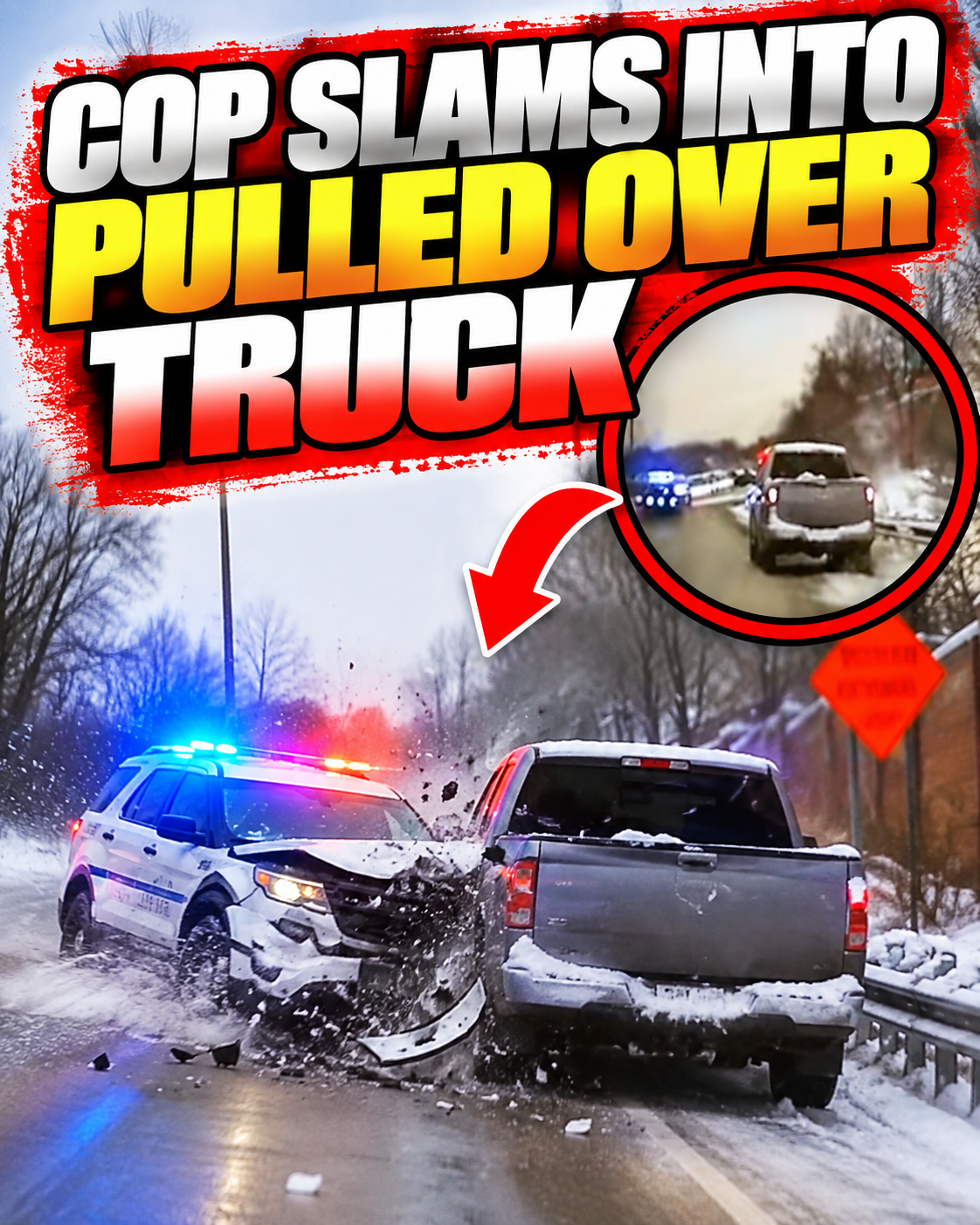
COP SLAMS INTO PULLED OVER TRUCK














