Shocking Moment Suspect Shoots At Cops Through A Mattress
Officers Lift a Mattress and Suddenly Find Themselves Under Fire
HOOK: THE MATTRESS MOVED, THEN THE GUNFIRE STARTED
For several minutes, the search seemed almost routine.
Three Oklahoma City police officers were inside a cramped travel trailer looking for a wanted man. They had been told he was there. A woman at the property said otherwise. Officers called out to him, searched room by room and gradually worked their way deeper into the trailer.
Nothing happened.
Then they reached the bedroom.
A mattress covered a storage compartment.
One officer lifted it.
In an instant, the entire search changed.
Hidden beneath the mattress was 38-year-old Timothy Johnson, the man officers had been trying to find.
And he had a pistol.
Body-camera footage released afterward captures the terrifying transition from search to gunfight. There is almost no warning. Johnson allegedly points the handgun toward officers and opens fire from inside the confined storage compartment.
Officers fire back while desperately trying to escape the narrow trailer.
Seconds later, one of them can be heard shouting:
“I'm hit! I'm hit! I'm hit!”
The officer had been struck in the face by flying debris or shrapnel.
The three officers eventually made it outside.
Johnson remained inside.
What began as an attempt to arrest a fugitive had suddenly become an armed standoff that would last for hours and end with Johnson dead inside the trailer.
OPENING: POLICE RECEIVE A TIP ABOUT A WANTED MAN
The confrontation occurred on November 15, 2022.
According to Oklahoma City police information reported by multiple local outlets, officers learned that a man wanted on an out-of-state felony warrant had been seen entering a travel trailer at 14000 Iron Road and had not been seen leaving.
The location sits in a rural area near South Harrah Road and Southeast 149th Street, several miles from Lake Thunderbird.
The wanted man was Timothy Johnson.
KOCO reported that Johnson was wanted in connection with a burglary case in Missouri.
That gave officers a specific person to locate and a specific place to search.
But finding him would prove considerably more difficult.
When officers arrived, they encountered a woman living at the trailer.
Later reporting identified her as Jennifer Gerner.
According to police, she told officers that Johnson was not inside.
But she also gave them permission to search.
That decision set the next sequence of events in motion.
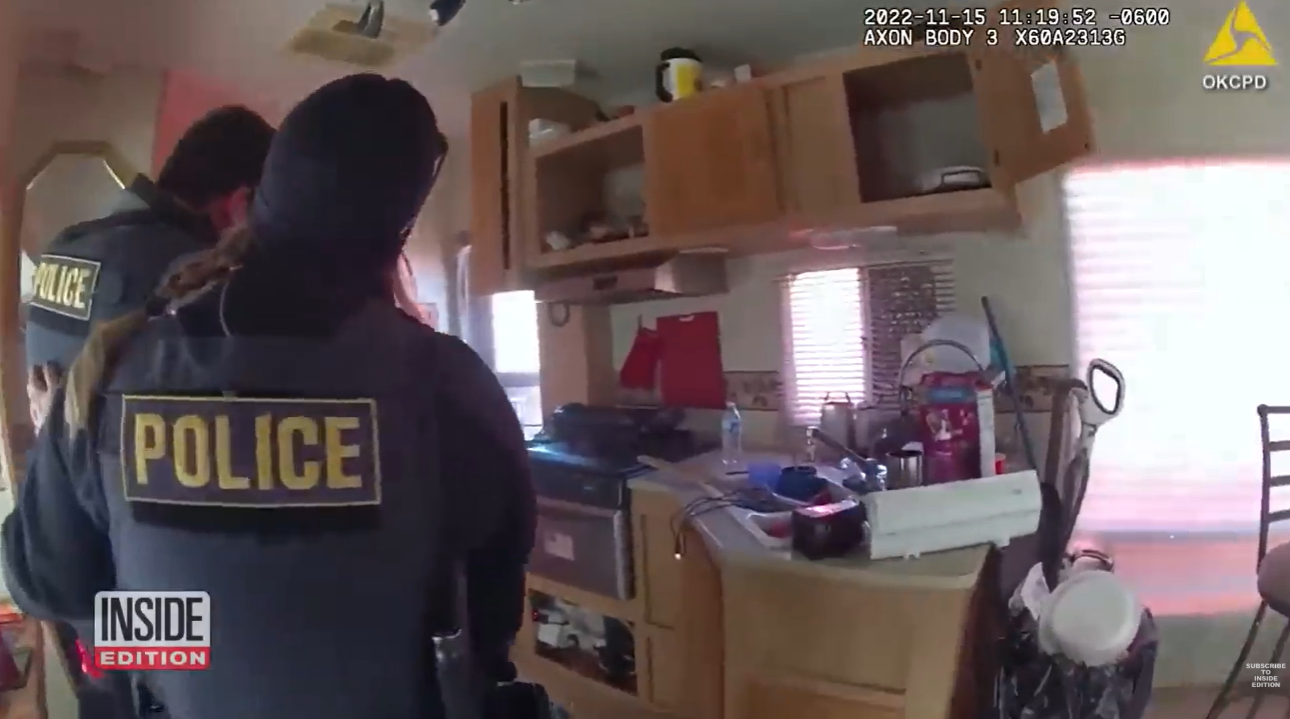
Before entering, officers attempted to get Johnson to surrender.
The released bodycam captures Officer Elisa McCoy calling for him using the name officers believed he was using.
“Sammy, this is the police department. If you are in here you need to make yourself known.”
There was no response.
That silence mattered.
The officers knew Johnson had reportedly entered the trailer.
They had not seen him leave.
The occupant claimed he wasn't there.
And Johnson himself wasn't answering.
So the search continued.
DEVELOPMENT: A SEARCH INSIDE AN EXTREMELY TIGHT SPACE
A travel trailer is very different from a normal house.
Hallways are narrow.
Rooms are compact.
Furniture consumes much of the available space.
Doorways can create bottlenecks.
And officers moving through such an environment have limited ability to maintain distance from a concealed suspect.
The bodycam footage makes those limitations obvious.
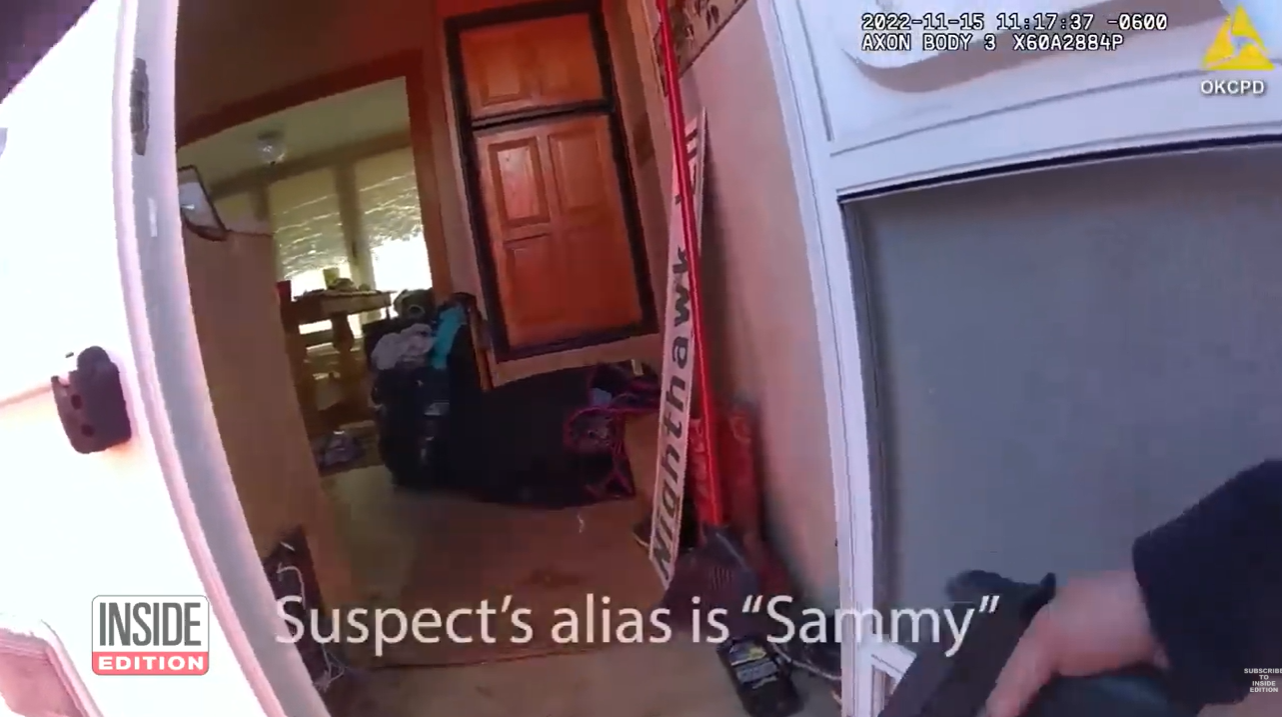
Three officers entered:
Sgt. Cody Rodgers, Officer David Mauck and Officer Elisa McCoy.
At the time, police said Rodgers had nine years of service, Mauck three years and McCoy two years.
They searched the living area before moving farther inside.
Eventually, two officers advanced toward the bedroom.
Nothing immediately revealed where Johnson was hiding.
Then attention turned toward the bed.
The mattress was covering a storage compartment.
An officer began lifting it.
And underneath was Johnson.
According to Oklahoma City Police Capt. Valerie Littlejohn, officers saw Johnson hiding in the storage area armed with a pistol.
Police said he aimed the weapon toward them.
Then came the gunfire.
THE AMBUSH HAPPENS IN SECONDS
This is the moment that makes the footage so disturbing.
There is effectively no transition period.
One second, officers are searching.
The next, they are facing an armed man at extremely close range.
Johnson had the advantage of concealment.
He knew where the officers were.
The officers did not know exactly where he was until the mattress came up.
Once his hiding place was exposed, police said Johnson immediately opened fire.
All three officers returned fire.
The cramped interior amplifies everything.
Gunshots echo violently through the trailer.
Body cameras shake.
Officers attempt to move backward.
There is almost nowhere to go.
Police Magazine reported that two officers quickly moved out of the trailer before rejoining the officer who remained inside, after which another exchange of gunfire occurred.
The video captures officers continuing to command Johnson to surrender:
“Come out with your hands up.”
But the gunfire isn't finished.
Then one officer realizes he has been injured.
“I'm hit!”
The words immediately change the tone.
At that moment, the other officers cannot know how serious the injury is.
They cannot know whether the round struck directly.
They cannot know whether Johnson is preparing to fire again.
They only know that they are inside an extremely confined trailer with an armed fugitive who has already opened fire.
ONE OFFICER IS INJURED
Fortunately, the officer had not suffered a direct life-threatening gunshot wound.
Police later said Officer David Mauck was injured by debris or shrapnel striking his face during the exchange.
He was transported to a hospital.
His injuries were described as non-life-threatening, and he was later released.
That outcome could easily have been different.
The distances inside the trailer were extremely short.
Walls and furniture restricted movement.
Johnson was firing from concealment.
The officers had little time to identify the threat, return fire and find an exit.
Once all three officers were outside, the tactical problem changed.
Police no longer needed to search for Johnson.
They knew where he was.
But going back inside immediately would expose officers to the same confined shooting environment.
So they surrounded the property instead.
The Oklahoma City Police Department's Tactical Unit was activated.
A perimeter was established.
Officers attempted to communicate with Johnson.
They received no meaningful response.
What had been a close-range gunfight now became an extended standoff.
KOCO reported that the situation continued for nearly four hours.
Tactical equipment was brought to the scene.
Police used armored vehicles.
Robotic equipment was also visible as officers worked to determine what was happening inside without unnecessarily exposing additional personnel.
Eventually, tactical officers entered.
Johnson was found dead.
HOW DID TIMOTHY JOHNSON DIE?
One detail required caution in the immediate aftermath.
Early reports established that Johnson had been killed by gunfire.
But authorities initially did not definitively say whether the fatal wound came from police gunfire or was self-inflicted.
Oklahoma City Police spokesman Sgt. Gary Knight said the medical examiner would determine that question.
That uncertainty is important because the bodycam shows an exchange of gunfire but cannot by itself establish the precise origin of every wound.
Inside Edition subsequently summarized the case as Johnson being fatally shot after repeatedly firing toward officers, but the earliest police reporting was more cautious about the precise fatal mechanism.
Rather than filling that gap with speculation, the safest factual description is straightforward:
Johnson was found dead from gunshot wounds after the exchange of gunfire and the subsequent tactical standoff.
THE WOMAN AT THE TRAILER ALSO FACED CONSEQUENCES
The case did not end with Johnson.
Police also investigated the woman who had been inside the trailer when officers arrived.
Jennifer Gerner had reportedly told police Johnson wasn't there before consenting to the search.
She was later accused of harboring a fugitive.
And the legal consequences continued well beyond 2022.
In February 2024, Gerner went to trial on charges including second-degree murder and harboring a fugitive in connection with the events that led to the deadly confrontation.
Reporting from the trial again described how officers arrived after receiving information that Johnson had entered the trailer, how Gerner interacted with police, and how officers eventually discovered Johnson beneath the mattress.
That later prosecution demonstrates something the bodycam alone cannot show.
The shooting lasted seconds.
The legal aftermath lasted years.
WHY THE MATTRESS WAS SUCH AN EFFECTIVE HIDING PLACE
The unusual hiding place is what made this case spread widely online.
At first glance, hiding beneath a mattress sounds almost absurd.
Inside this particular trailer, however, the mattress wasn't simply lying on the floor.
It covered a storage compartment.
That gave Johnson a concealed space where he could remain almost completely out of view.
The officers could search much of the trailer without immediately seeing him.
More importantly, Johnson could potentially hear officers approaching.
That created an enormous tactical disadvantage.
The officers were searching.
Johnson was waiting.
The officers had to discover his exact position.
Johnson already knew theirs.
When the mattress moved, that advantage disappeared.
But only for an instant.
Police said Johnson responded by firing.
This explains why building searches are among the most unpredictable tasks officers perform.
A room that appears empty may contain concealed spaces.
A closet may hide someone.
An attic access point can become a hiding place.
A bed can conceal a storage compartment.
The absence of a visible suspect does not necessarily mean the room is clear.
BODYCAM SHOWS WHAT A WRITTEN REPORT CANNOT
A written police report can summarize the critical moment in one sentence:
Officers lifted a mattress, discovered an armed suspect and exchanged gunfire.
Technically, that describes what happened.
Emotionally, it describes almost nothing.
The bodycam footage provides the missing element: time.
The viewer sees how quickly recognition becomes reaction.
There is no lengthy standoff before the first shot.
No negotiation after Johnson is discovered.
No extended warning period.
The mattress rises.
The gun appears.
Shots erupt.
Officers move backward.
Someone says he has been hit.
That compression is what makes the footage valuable for understanding the incident.
It also demonstrates why individual screenshots can be misleading.
A still image can show Johnson pointing a gun.
Another can show officers firing.
But only the sequence shows which actions occurred first and how quickly officers had to react.
The image also explains why the encounter became dangerous before officers had any meaningful opportunity to retreat.
Johnson was not across a large room.
He was concealed immediately beneath the area officers were searching.
When the mattress lifted, both sides were suddenly separated by only a small amount of space.
THREE OFFICERS WERE PLACED ON ADMINISTRATIVE LEAVE
Following the shooting, Rodgers, Mauck and McCoy were placed on administrative leave while the incident was investigated.
That is an important procedural detail.
Administrative leave following an officer-involved shooting does not itself establish wrongdoing.
It gives investigators time to examine bodycam footage, firearms evidence, witness statements, trajectories and the circumstances surrounding the use of deadly force.
Oklahoma City Police said the department would investigate the shooting and forward its findings to the Cleveland County District Attorney's Office.
At the time, the incident was reported as Oklahoma City's 12th officer-involved shooting of 2022.
The bodycam release followed roughly two weeks later.
Once published, the footage spread nationally because of how unusual and sudden the ambush appeared.
Inside Edition, FOX, police publications and other outlets subsequently covered the video.
ENDING: ONE MOVEMENT CHANGED THE ENTIRE SEARCH
The November 15 encounter began with information.
A wanted man had been seen entering a trailer.
Officers arrived.
They tried to call him outside.
A woman told them he wasn't there.
She allowed them to search.
Three officers entered.
They checked the living space.
They moved toward the bedroom.
And then they noticed the mattress.
Everything that followed was determined by what was underneath it.
Timothy Johnson had chosen a hiding place that allowed officers to come extraordinarily close without seeing him.
When that hiding place was exposed, police say he chose to fire rather than surrender.
Within seconds, three officers were returning fire inside one of the worst possible environments for a gunfight: a narrow travel trailer filled with furniture, walls and limited exits.
One officer was injured.
The others escaped.
Johnson remained inside.
Hours later, a tactical team entered and found him dead.
What makes the footage unforgettable is not the length of the confrontation.
It is the opposite.
The critical moment is almost impossibly short.
The officers have enough time to lift a mattress, recognize a person, see a gun and react.
That's it.
The entire encounter changes in seconds.
Before the mattress moves, they are searching for a fugitive.
After it moves, they are fighting to get out alive.
CTA: WATCH THE MOMENT THE SEARCH TURNS INTO A GUNFIGHT
The final standoff tells only part of the story. Watch the full footage to see how officers searched the trailer, what happened when they finally lifted the mattress, and how quickly the discovery of one hidden compartment turned a warrant search into a close-range exchange of gunfire. https://www.youtube.com/watch?v=WLzlhmUaJtM
Comments (0)
Loading comments...
May You Like

One Driver’s Decision to Flee Brings Police Racing After Him

Police Chase Ends as Driver Hits Stoplight, Crashes Into West Towne Mall