
She Wouldn’t Get Out of the Car—Then the Arrest Spiraled Into Chaos
She Wouldn’t Get Out of the Car—Then the Arrest Spiraled Into Chaos
A woman stays inside a red vehicle as officers close in. Moments later, the encounter is on the ground, commands overlap, and one sentence cuts through the chaos: “I’m on my stomach!” The body camera shows why that line is only one part of a much larger sequence.
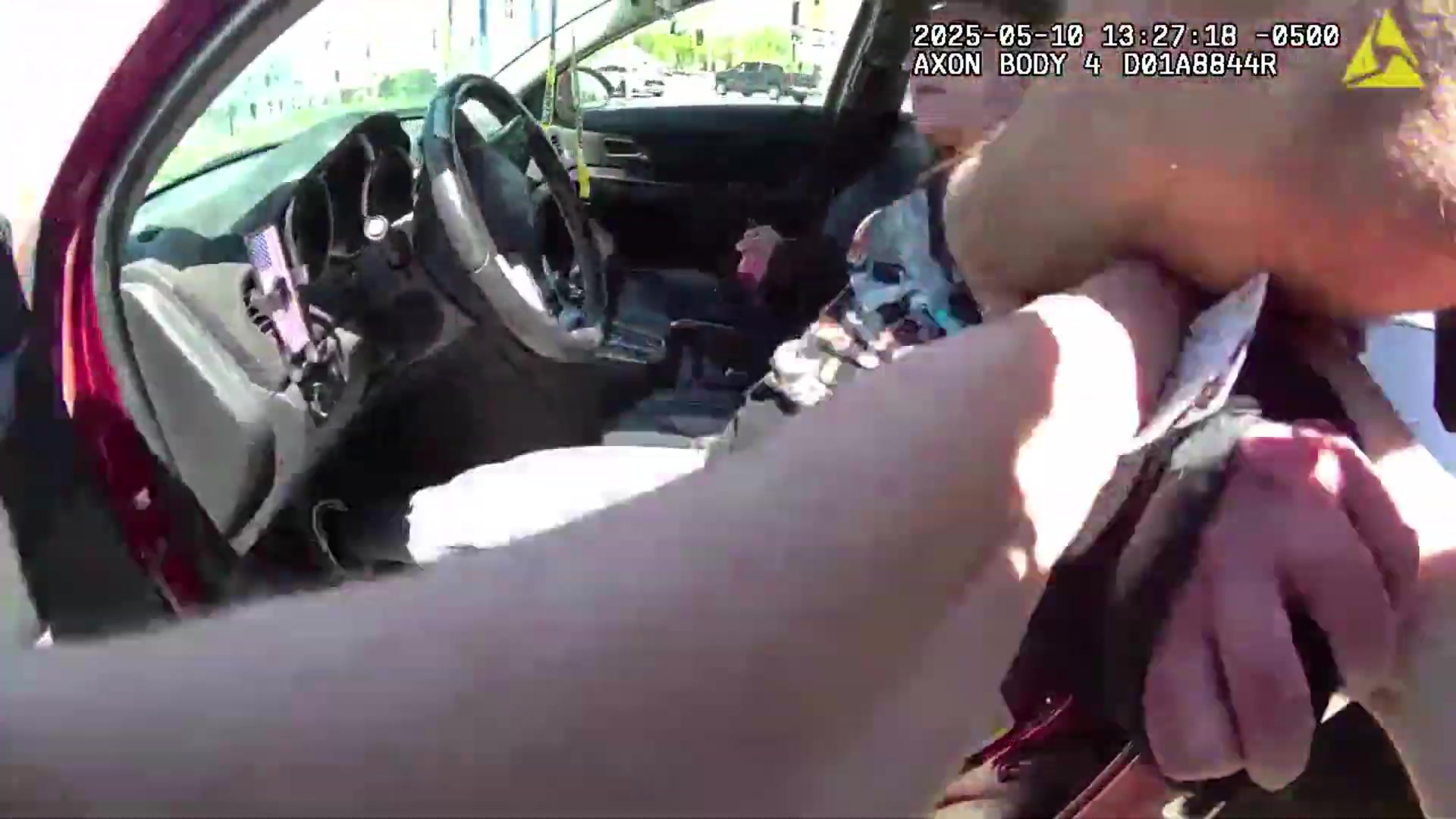
A Traffic-Side Encounter Turns Physical
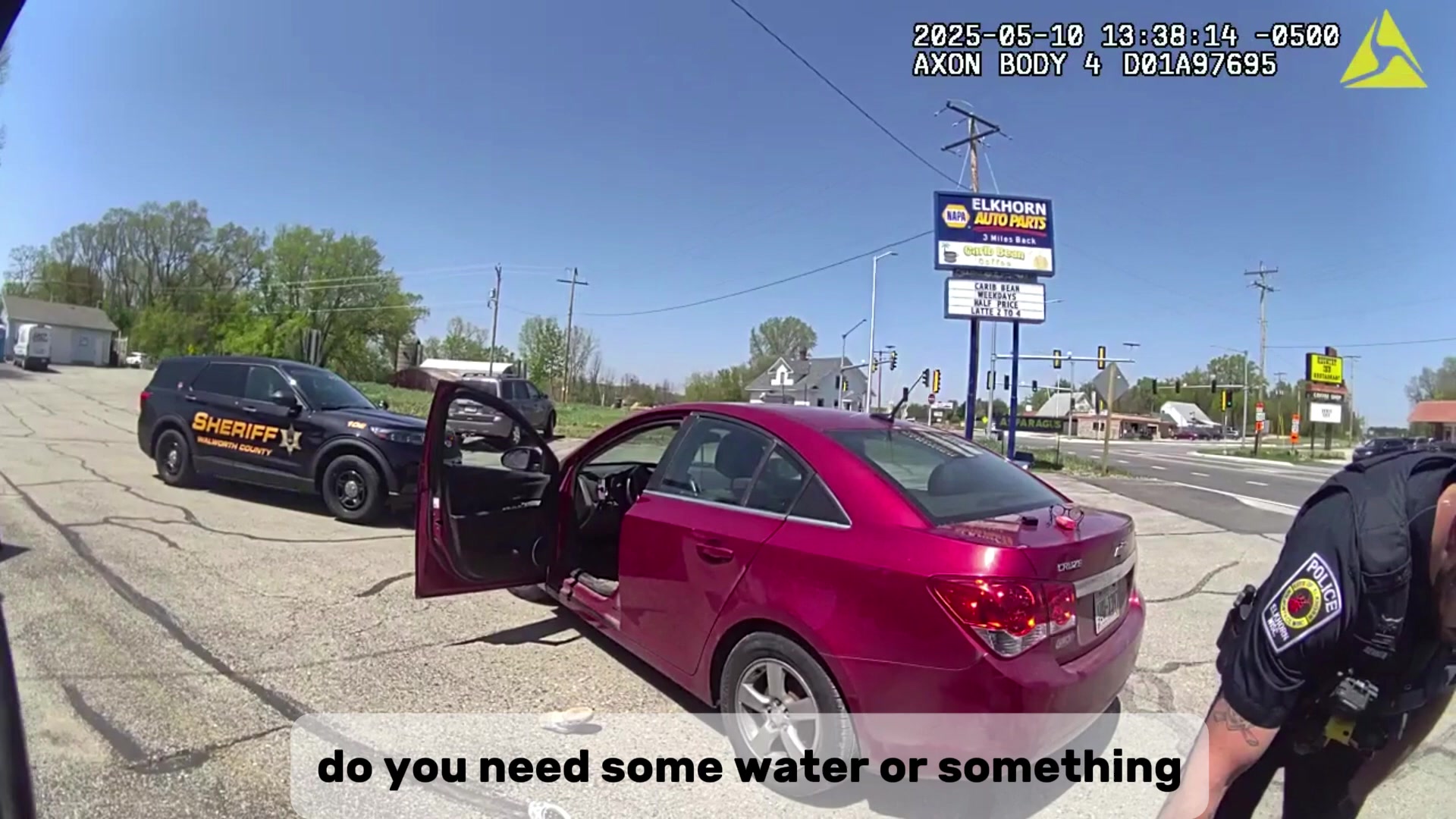
The footage opens in Wisconsin on a bright afternoon, but the calm surroundings do not last. What begins around a red vehicle quickly becomes a hands-on police encounter involving repeated commands, a woman inside the vehicle, and officers trying to gain control of the situation. The body-camera timestamp visible in the supplied footage places the encounter on May 10, 2025. Within minutes, the tone shifts from conversation to physical restraint.
The moment that gives the clip its viral hook comes during the arrest, when the woman loudly insists that she is already on her stomach. Yet focusing only on that sentence misses the larger story preserved by the body camera. The more important sequence is everything that leads up to it: the officers’ approach, the woman remaining in the vehicle, the effort to remove and restrain her, the confusion of multiple voices, and the transition from a roadside disagreement into a custodial encounter.
Body-camera footage is especially valuable in incidents like this because a single quoted line can travel online without the minutes surrounding it. Here, the full recording provides a much better sense of timing. It shows how quickly officers and a subject can begin talking past one another once commands become repetitive and physical control begins.
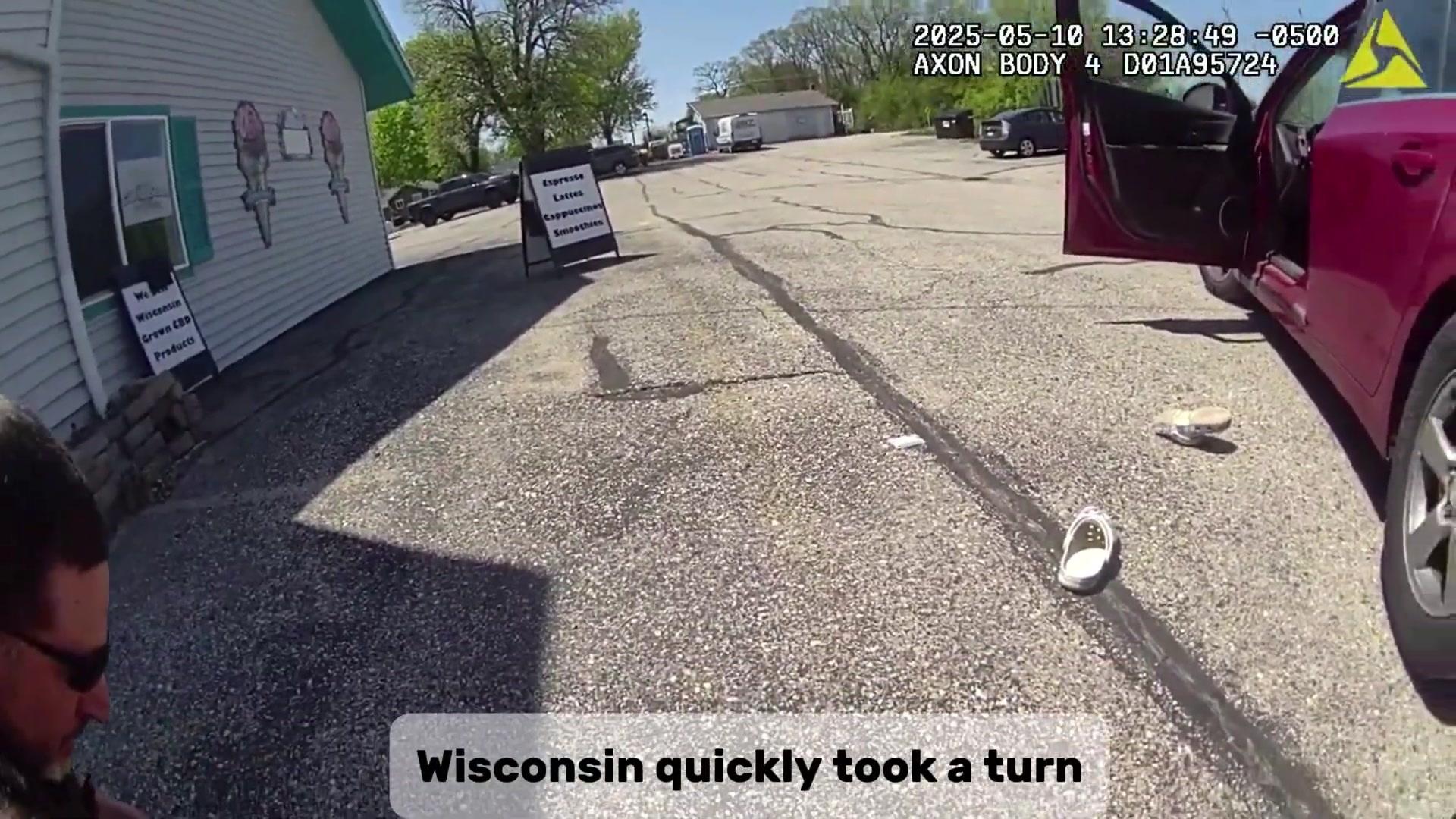
The Red Vehicle Becomes the Center of the Conflict
Early in the footage, the red vehicle is more than a backdrop. It is the physical center of the encounter. The woman remains seated as officers communicate with her, and the body camera repeatedly captures the open driver-side area, the steering wheel, her legs and the officers’ hands as they move closer.
Police encounters involving a person inside a vehicle create a different tactical problem from an ordinary sidewalk conversation. The interior limits visibility. Officers may not be able to see both hands at every moment, and the vehicle itself can become a means of escape or movement. From the occupant’s perspective, however, several officers crowding an open door can feel immediate and overwhelming. Those competing perceptions can make communication deteriorate rapidly.
The supplied footage appears to show that deterioration. Commands become more urgent. The woman responds verbally, but verbal response is not always the same thing as physical compliance. Once officers begin taking hold of her, the encounter enters a new phase in which every movement can be interpreted through the struggle already underway.
This is one reason the chronology matters more than any isolated phrase. A viewer needs to know what officers were asking for, what the woman was doing at that moment, and how the physical contact began before drawing conclusions from what happens seconds later.
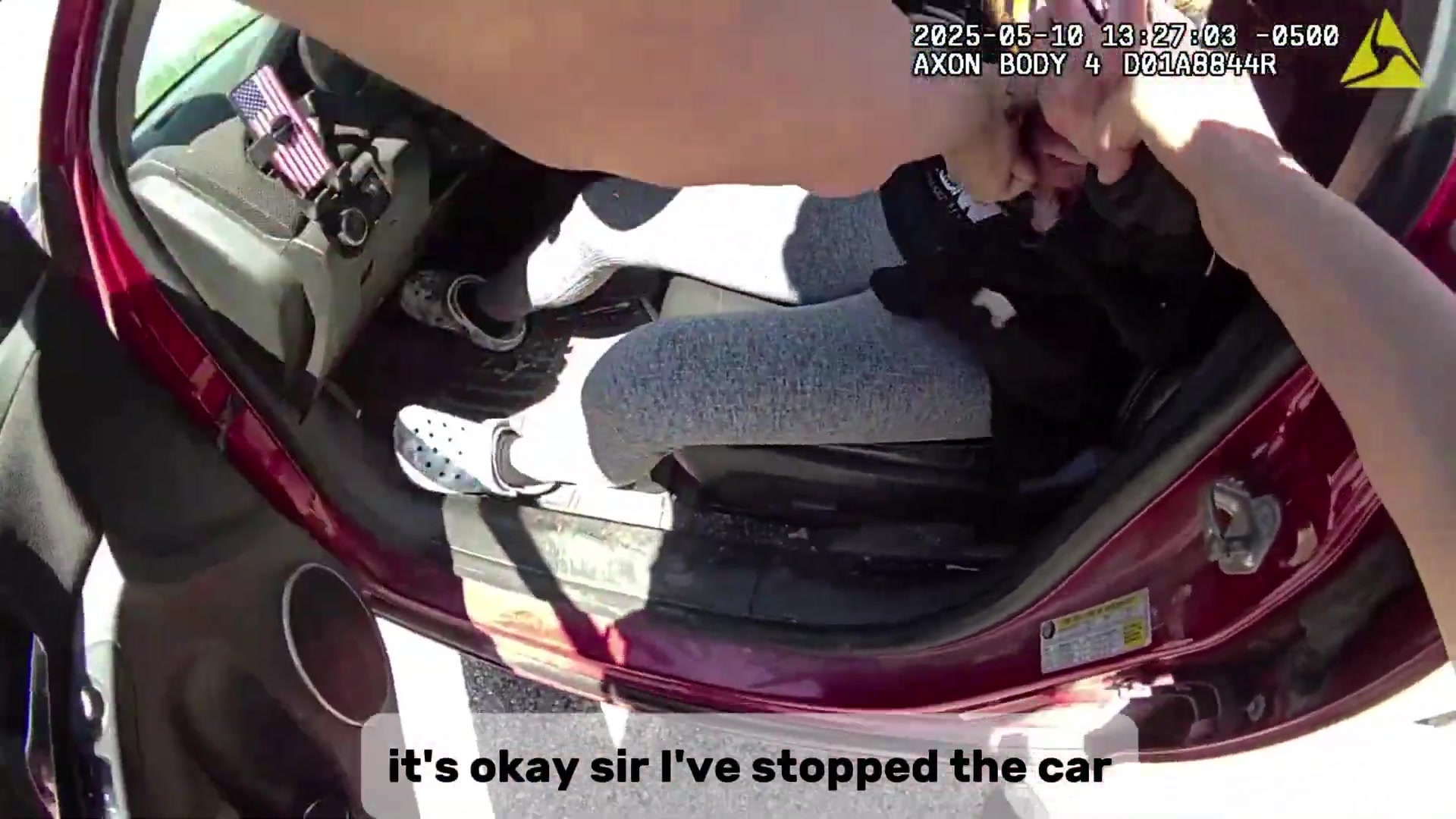
From Commands to Hands-On Restraint
As the officers move in, the body camera becomes close and chaotic. Arms, the vehicle door, clothing and equipment fill the frame. This is typical of body-camera footage during a struggle: the camera is mounted to the officer, so the most intense moment can also be the hardest moment to see clearly.
The woman can be heard reacting as officers attempt to control her. At points, she emphasizes her position and appears to argue that she is already doing what is being requested. The officers, meanwhile, continue working to secure her arms and complete the handcuffing process. The result is a familiar but important communication problem: the subject focuses on one part of a command while officers focus on the part they believe remains incomplete.
That distinction can be crucial. “Get on your stomach,” “give me your hands,” “stop pulling away,” and “put your hands behind your back” are separate instructions even though they may be delivered in rapid succession. A person can satisfy one while still failing—or being physically unable—to satisfy another. During a fast-moving restraint, neither side necessarily experiences the sequence as cleanly as a later viewer can.
The body camera does not eliminate ambiguity. What it does is preserve the raw sequence so that claims can be compared against the visible and audible record rather than reconstructed entirely from memory.
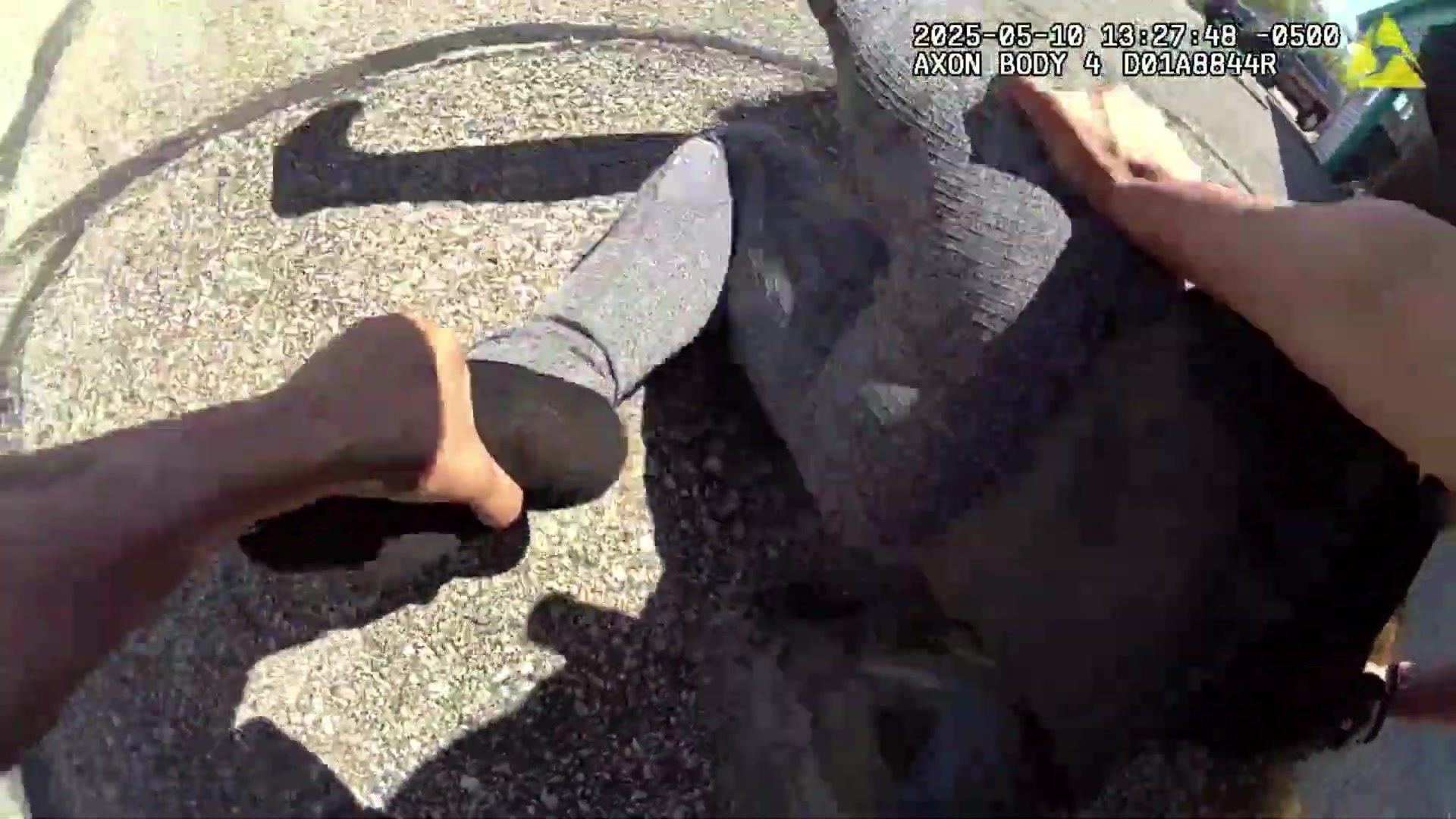
Why “I’m on My Stomach” Became the Defining Line
The line is memorable because it captures the frustration of the encounter in a few words. The woman is focused on her body position. The officers are focused on control of her arms and the completion of the arrest. Both are speaking about compliance, but they are not necessarily speaking about the same action.
For viewers, this is where restraint footage should be watched carefully. A person lying prone is not automatically fully restrained. Officers may still be attempting to secure hands or prevent someone from rolling, reaching or standing. At the same time, prone restraint is a position that requires attention to breathing, medical distress and the amount of pressure being applied. Modern police training and policy discussions increasingly emphasize monitoring a restrained person and repositioning them when it is safe to do so.
Nothing about those general principles decides whether every action in this particular encounter was appropriate. That determination would require the department’s reports, policy, the reason for the arrest, complete unedited footage and potentially additional camera angles. What the supplied video does show is why these encounters become controversial: a shouted statement can sound self-evident while officers may be reacting to a different physical problem just outside the clearest camera view.
The responsible way to report the footage is therefore to describe what can actually be seen and heard without converting uncertainty into accusation.

The Scene Settles After the Most Intense Moments
After the struggle, the pace changes. The camera captures the aftermath rather than the initial confrontation. Officers have more time to communicate, observe the woman and deal with the practical steps that follow an arrest.
That transition is significant. Viral edits often end at the loudest point because conflict holds attention. The minutes after a restraint can be more informative. They reveal whether the person remains combative, whether officers continue using force, whether medical concerns are raised, whether explanations are given, and whether the scene stabilizes.
In the supplied recording, the visual chaos of the vehicle-side struggle eventually gives way to a more controlled scene. The arrest is no longer a question of whether officers can gain control; it becomes a question of what happens after control has been established.
For police, that phase is part of the incident, not an epilogue. Handcuffing does not end an officer’s responsibilities. Officers must continue monitoring the person in custody, manage the scene, preserve evidence when relevant, and document the legal basis for what occurred. For the person arrested, this is also when adrenaline may remain high even though the physical struggle has ended.
What We Could—and Could Not—Verify
The supplied video itself provides several reliable anchors. Its on-screen AXON BODY 4 data shows May 10, 2025, and the video identifies the setting as Wisconsin. The scene is outside a small commercial property, and signage visible in the footage references Wisconsin products and an express-lube-style business.
I searched for public reporting and official material that could independently identify this exact May 10 encounter. I did not locate a sufficiently reliable news report or police release that matched the woman, vehicle, location, timestamp and sequence closely enough to responsibly attach a name, city, department, criminal charge or court outcome to the footage.
That absence matters. Similar arrest videos can look remarkably alike, and search results for phrases such as “I’m on my stomach” return unrelated incidents. One widely reported 2025 case in Orlando, for example, involved a male subject using similar words during an arrest. That is plainly not the Wisconsin encounter shown here. Treating the two as the same case simply because of a matching phrase would produce a false story.
Accordingly, this article does not invent the woman’s identity, the reason officers first contacted her, the precise charges, or the final court disposition. Those facts should be added only if a matching police report, court record or credible local report can be verified.
Why Full Bodycam Context Matters
The strongest lesson from this footage is not contained in a single scream. It is the way context changes interpretation.
Short clips reward certainty. A few seconds can be captioned as proof that an officer ignored compliance, or as proof that a suspect refused to cooperate. Full footage is usually less convenient. It shows partial compliance, overlapping commands, obstructed camera angles, emotional reactions and decisions that develop over time.
That does not mean longer footage automatically vindicates police or the person being arrested. It means the evidence is richer. The viewer can ask better questions: What happened before physical contact? Was the vehicle still capable of moving? What commands were given? Which commands were followed? What were officers trying to control when the woman said she was already on her stomach? How long did the struggle last? What happened once she was restrained?
Those questions are more useful than deciding the entire incident from its most shareable sentence.
The video also demonstrates the limitations of body cameras themselves. A chest-mounted lens does not reproduce an officer’s exact field of vision. During close physical contact, the lens can be blocked by arms, clothing or another person. Audio can capture statements that the picture cannot fully explain. Multiple camera angles, when available, are therefore far more informative than one camera alone.
A Routine Contact Can Change in Seconds
The most striking feature of the recording is speed. The setting looks ordinary: daylight, a commercial parking area and a vehicle. Yet the encounter reaches a point where several people are physically engaged around the driver’s door.
That transformation is why routine police contacts can be unpredictable. Neither the public nor officers experience every encounter as a calm legal analysis. People become frightened, angry or defensive. Officers may interpret hesitation as resistance. Subjects may interpret physical control as unnecessary aggression. Once hands-on force begins, communication becomes harder at precisely the moment when clear communication matters most.
For agencies, footage like this can be useful for training even when a case never becomes major news. Supervisors can examine command clarity, positioning, teamwork, transition to handcuffing and post-restraint monitoring. For the public, it provides a chance to see the difference between a clean written police narrative and the messy reality from which that narrative is later produced.
The value of the video is therefore not that it gives an effortless verdict. Its value is that it preserves a difficult sequence closely enough for viewers to see why simple verdicts can be misleading.
The Ending Is Quieter Than the Arrest—but Just as Important
By the final portion of the footage, the confrontation has largely passed. The scene is no longer defined by the woman’s loudest statements or the officers’ most urgent commands. What remains is the procedural aftermath.
That quieter ending changes the shape of the story. The original title centers on one line—“I’m on my stomach!”—because it is dramatic and instantly understandable. A more accurate title centers the escalation itself: “She Wouldn’t Get Out of the Car—Then the Arrest Spiraled Into Chaos.” It gives viewers a reason to watch without pretending that one sentence explains the entire incident.
The footage ultimately shows why police body cameras matter most when they are treated as evidence rather than as collections of viral moments. The camera records the argument, the physical struggle, the woman’s reactions and the officers’ actions in sequence. It also records uncertainty. Some details remain outside the frame, and without a verified matching report it would be irresponsible to fill those gaps with assumptions.
What can be said with confidence is compelling enough: a Wisconsin encounter on May 10, 2025 rapidly moved from a vehicle-side contact into a physical arrest. During the struggle, the woman repeatedly protested and emphasized that she was already on her stomach. Officers continued working to gain control and complete the restraint. The scene later stabilized, leaving viewers with a fuller record than the headline alone could ever provide.
The most dramatic seconds make sense only when the entire sequence is seen—from the first contact at the vehicle through the physical restraint and the calmer aftermath.
Click here to watch the full incident unfold from beginning to end:
Comments (0)
Loading comments...
May You Like

🚨⛽ Man Caught in a Disturbing Incident at a Gas Station | Police Respond US

Her Dad Is a Lawyer — Then He Shows Up After Her Arrest | Bodycam US

💨 High-Speed Police Pursuits Caught on Dashcam | Intense Moments Across the USA 🇺🇸














