She Was Getting a Warning—Then One Lie Changed Everything
SHE WAS GETTING A WARNING—THEN ONE LIE CHANGED EVERYTHING
It should have been one of the easiest ways for a traffic stop to end.
A woman is pulled over after allegedly running a red light. Officers speak with her, begin checking her information, and—according to the conversation captured on body camera—are initially prepared to let the traffic violation end with a warning.
No arrest.
No trip to jail.
Just a warning and an opportunity to drive away.
Then police ask a basic question:
Who are you?
The answer should have taken seconds.
Instead, the driver allegedly gives officers one name, then another. Her age doesn't appear to match. Information she provides fails to resolve the confusion. Police continue checking databases while the woman offers explanations about why she needs to leave.
Eventually, officers believe they have figured out why she has been so reluctant to reveal her real identity.
SHE HAS OUTSTANDING WARRANTS.
What began as a minor traffic stop now turns into an arrest investigation. The woman's vehicle registration is also expired, officers say her driving privileges are suspended, and police begin discussing additional allegations connected to the false identifying information.
The most remarkable part is that officers repeatedly tell her how differently the stop could have ended.
She was apparently going to receive a warning.
Instead, according to the footage, the driver ultimately leaves in the back of a police vehicle while her car is prepared to be towed.
The uploaded video runs a little over five minutes and appears to be an edited bodycam segment rather than the complete uncut encounter. I found a transcript matching the central dialogue and sequence—including the red-light violation, multiple identities, warrants, expired plates and the officer's statement that the driver had originally been headed for a warning. I could not verify a sufficiently reliable contemporaneous news report or official release establishing the exact agency, date, or final court disposition, so those details are not being invented here.
What the footage itself captures is compelling enough.
A RED LIGHT STARTS THE ENTIRE ENCOUNTER
Traffic stops happen for countless reasons, but this one appears to begin with one of the simplest: an alleged red-light violation.
When an officer sees a vehicle proceed through a red signal, the legal issue is initially straightforward.
The officer stops the car.
The driver provides identification.
The officer checks the information.
A citation or warning may be issued.
Then everyone leaves.
That appears to have been the direction this stop was originally taking.
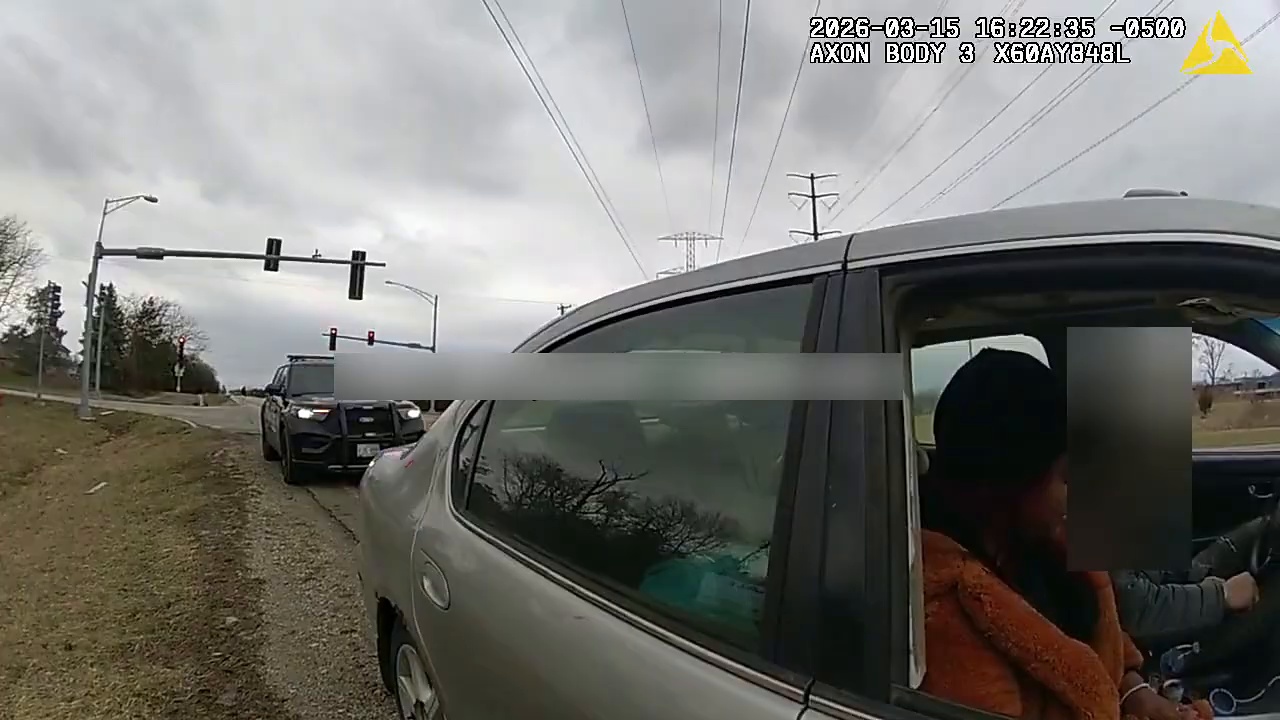
The bodycam shows a woman sitting behind the wheel of a silver sedan as officers communicate with her from outside.
At first glance, nothing about the scene suggests it is about to become a complicated arrest.
There is no crash.
The vehicle hasn't fled.
No one is physically fighting with police.
Instead, the problem develops through conversation.
Officers need to establish who is driving.
And the information they receive begins creating more questions than answers.
According to a transcript matching the encounter, officers later tell the woman explicitly that she had been “about to get a warning for running a red light.”
That detail becomes the central irony of the entire stop.
Had the driver's information checked out, the bodycam might have captured nothing more than a routine warning.
But officers say it didn't.
ONE NAME BECOMES ANOTHER
Police officers conducting a traffic stop generally need to establish the identity and driving status of the person behind the wheel.
That process can reveal whether a license is valid, suspended or revoked and whether there are outstanding warrants associated with the person.
Here, police encounter an immediate problem.
The woman allegedly begins giving information that doesn't line up.
The transcript records officers confronting her about multiple surnames—including Smith, Owens and Ross—while trying to determine her actual identity.
At another point, an officer says the woman claimed to be 18 when records indicated an age of 29.
The interaction stops being about the red light.
Now the officers are trying to answer a more fundamental question:
WHO IS ACTUALLY SITTING IN FRONT OF THEM?
That matters because an officer cannot reliably check a person's license status or warrants if the identifying information itself is false.
The woman appears increasingly anxious as police continue working through the inconsistencies.
She asks questions.
She tries to explain.
But every contradiction appears to make the situation worse.
OFFICERS WARN HER THAT SHE IS DIGGING A DEEPER HOLE
One of the strongest elements of the footage is that the consequences do not appear all at once.
The woman is repeatedly given opportunities to provide accurate information.
Police explain that continuing to give false details can create additional problems.
The matching transcript records an officer warning that the more games she plays, “the worse” the situation will become.
Police discuss allegations involving misrepresenting identity and obstructing official business.
The driver begins asking whether she can simply receive a summons.
But the conversation has already moved far beyond the original traffic violation.
The officer now needs to establish her actual identity before deciding what happens next.
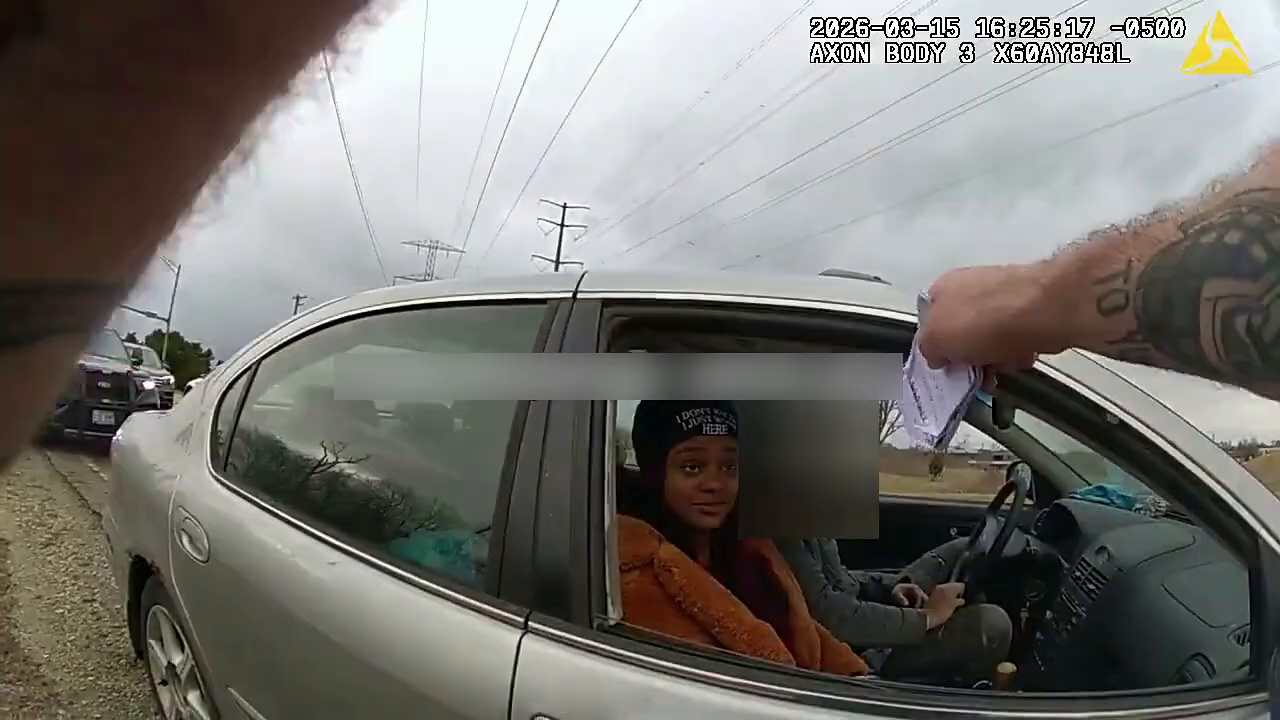
At one point, police tell her that they do not even need her Social Security number to take her to jail; if necessary, she could be booked as a Jane Doe until authorities establish who she is.
That statement makes the situation clear.
Avoiding identification is no longer going to make the problem disappear.
It is doing the opposite.
The longer police remain unable to verify the information, the less likely the encounter is to end on the roadside.
THEN POLICE DISCOVER THE WARRANTS
Eventually, the officers believe they have established the driver's identity.
And that apparently explains why she was reluctant to give it.
Police tell her she has outstanding warrants.
The matching transcript identifies the woman as Deanna/Diona Ross in different portions of the automated transcription, though because I could not independently verify her identity through an authoritative police or court source, I am not treating that spelling as conclusively established.
What is clear from the dialogue is that officers tell the woman that she has warrants.
Her reaction suggests this information isn't a complete surprise.
Later in the encounter, she reportedly acknowledges that she knew she had a warrant and says that was why she had been scared.
That admission changes how the earlier conversation appears.
The inconsistent names no longer look like simple confusion.
From the officers' perspective, they appear to be an attempt to prevent police from discovering the warrant.
And that creates a painful irony.
THE ATTEMPT TO AVOID ONE EXISTING LEGAL PROBLEM ALLEGEDLY CREATES SEVERAL NEW ONES.
THE DRIVER'S EXPLANATIONS KEEP COMING
Once it becomes clear that police are considering taking her to jail, the woman begins emphasizing why she needs to get home.
She tells officers that her husband is sick.
Then she says he is having a seizure.
She says her grandmother is with him and suggests that she needs to provide medication.
The officers are skeptical.
Not necessarily because a medical emergency is impossible, but because they have already concluded that the woman has repeatedly given them inaccurate information.
The transcript captures one officer making exactly that point: after being given multiple false statements, police question why they should believe this new explanation.
This is one of the most consequential effects of lying during an investigation.
It damages credibility.
Once officers catch someone giving false information, even a later truthful statement may become harder for them to trust.
That doesn't prove the husband's medical problem was fabricated.
The footage does not provide enough independent evidence to establish whether that claim was true.
But from the officers' perspective, the previous contradictions have changed the way every new statement is evaluated.
THE WARNING IS NOW OFF THE TABLE
At this point, the driver begins trying to negotiate her way back to where the encounter started.
Could police just give her a warning?
Could they redo the stop?
Could they let her leave?
The questions become increasingly desperate.
But the officers make clear that the original opportunity is gone.
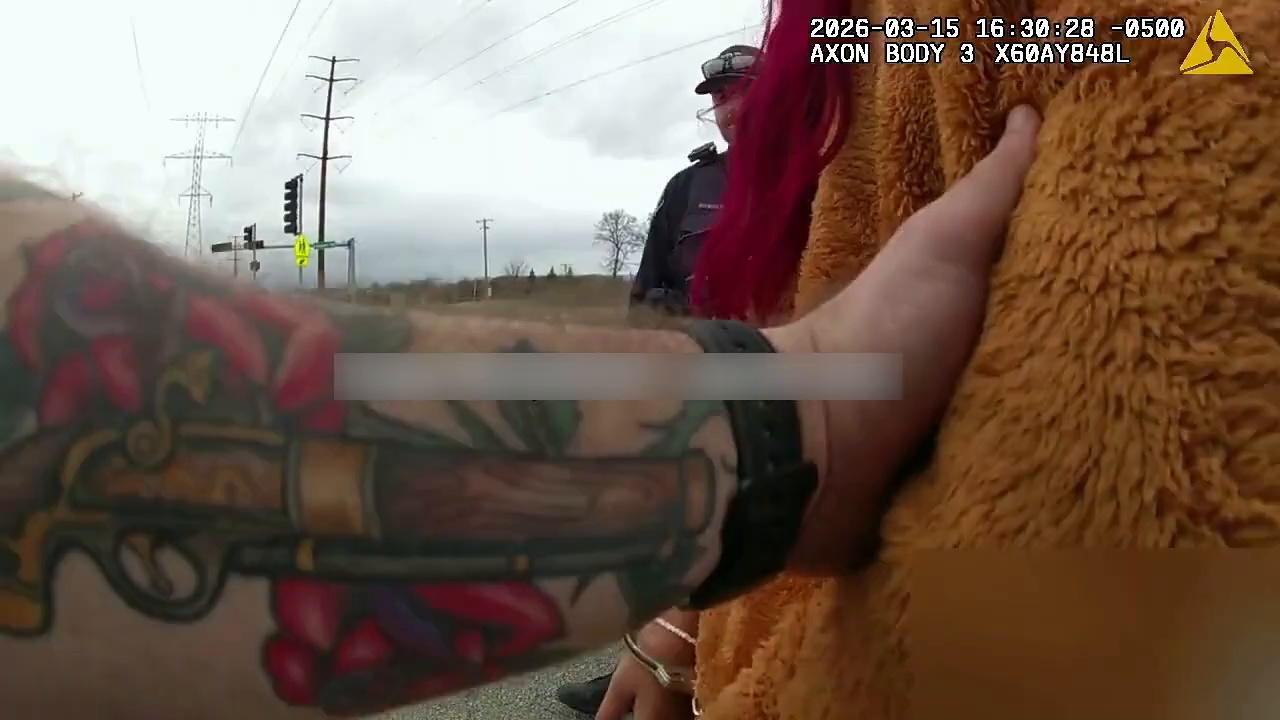
The transcript records one particularly revealing exchange.
An officer explains that she was originally about to receive a warning for running the red light.
Then, the officer says, she repeatedly lied about who she was.
The woman again asks whether they can simply give her a warning.
The officer's response is essentially that the situation has moved beyond that point.
There are now warrants.
There is the false identity issue.
There is the status of the vehicle.
There is her driving status.
What could have been a short traffic stop has become a collection of separate problems.
THE RED LIGHT IS NO LONGER THE MAIN REASON SHE IS NOT LEAVING.
THE CAR CREATES ANOTHER PROBLEM
As officers continue investigating, they also examine the vehicle's status.
According to the dialogue captured in the transcript, the plates had been expired since November.
Police also tell the woman that her driving status is suspended.
Those discoveries matter independently of the warrants.
Even if officers wanted to simply release her from custody at the scene, questions would remain about whether she could lawfully drive the vehicle away.
The officer tells her the car will be inventoried and towed.
The woman objects.
But the explanation is straightforward: police say the registration is expired and that she does not have a valid driver's license.
This is another example of how one traffic stop can uncover multiple unrelated issues.
The officer begins with a red light.
The identity check reveals warrants.
The license check reveals a suspension.
The vehicle check reveals expired registration.
The allegedly false identifying information creates another potential offense.
One observation leads to another until the original violation is almost the least significant issue remaining.
THE PASSENGER IS TREATED DIFFERENTLY
Another important detail emerges as police work through the people associated with the car.
According to the matching transcript, the passenger is ultimately free to go, though an officer warns her about lying to police.
That distinction is useful.
Police do not simply arrest everyone associated with a vehicle because one occupant has warrants.
Each person's legal circumstances have to be evaluated separately.
Who was driving?
Who provided false information?
Who has outstanding warrants?
Who has a valid license?
Who is legally responsible for the vehicle?
Those details determine what happens to each person.
The driver, however, appears to have reached the point where release is no longer an option.
She is placed in handcuffs.
The car is headed for a tow.
And officers begin preparing for transport.
“CAN WE PLEASE REDO THIS?”
Perhaps the most revealing line comes after the consequences have become obvious.
The woman asks whether they can essentially start over.
“Can we please redo this?”
The question captures the entire encounter in a few words.
Minutes earlier, there was effectively a version of this stop that could have ended very differently.
Provide the correct identity.
Allow police to run it.
If there had been no warrants or other legal barriers, perhaps accept the warning and leave.
But police procedure doesn't work like restarting a scene in a video.
Once officers discover an outstanding warrant, they cannot simply pretend they never saw it.
Once they believe someone has intentionally provided false identifying information, that becomes part of the investigation.
Once they determine the driver's license is suspended, that fact does not disappear because the driver asks for another chance.
And once they determine the registration is expired, the vehicle's status has to be addressed.
The stop has accumulated consequences.
There is no reset button.
POLICE EXPLAIN EXACTLY WHY SHE IS GOING TO JAIL
As the encounter continues, the woman again seems uncertain about why officers will not simply let her leave.
One officer takes the time to explain.
The warrants are an obvious reason.
But the officer emphasizes another problem: the repeated lying.
According to the transcript, police tell her that the stop escalated because she gave false information instead of simply cooperating with the identification process.
The woman eventually acknowledges that fear of the warrant influenced her behavior.
That is an understandable emotional reaction.
Knowing that a police database may reveal a warrant can create panic.
But panic does not necessarily produce good decisions.
In this case, the alleged attempt to hide from the warrant appears to have made the legal situation substantially more complicated.
The officer makes the point bluntly.
Next time, if you have a warrant, don't attract attention by driving a vehicle with expired plates and running red lights.
It is a harsh observation, but it captures the sequence perfectly.
Police didn't appear to begin the night searching specifically for this woman.
The traffic violation brought the car to their attention.
Everything else followed from there.
WHY FALSE IDENTIFICATION MATTERS DURING A TRAFFIC STOP
To someone watching casually, giving police a different name may look like a small lie.
Operationally, it can create a serious problem.
Officers rely on identifying information to determine whether the person they have stopped is legally permitted to drive and whether there are active warrants or other alerts associated with that individual.
If the information is false, police may spend additional time checking databases, comparing records and trying to determine whether the person in front of them matches the identity being provided.
It can also create safety issues.
An officer who believes they are dealing with one person may receive incomplete or irrelevant information if the identity is wrong.
That is why the repeated contradictions in this footage become so important.
The red-light violation explains why the stop began.
The identity issue explains why it lasted.
And the warrants explain why it ultimately became an arrest.
THE FOOTAGE IS A LESSON IN HOW TRAFFIC STOPS ESCALATE WITHOUT VIOLENCE
There is another reason this video stands out.
Nothing requires a physical fight for the situation to escalate dramatically.
The woman does not lead police on a high-speed chase.
She does not attack an officer.
She does not pull a weapon.
Instead, the consequences build almost entirely through information.
A name.
A date of birth.
A Social Security number.
A license status.
A warrant check.
A registration check.
Each database response narrows the woman's options.
That makes the footage almost the opposite of a typical viral police pursuit.
The tension isn't about whether officers can physically catch someone.
It is about whether they can establish who the person actually is.
Once they do, the rest of the encounter changes.
THE CAR IS PREPARED FOR TOWING
With the driver under arrest and police saying the vehicle has expired registration, officers begin dealing with the car.
That process can include an inventory of property before towing.
The woman continues speaking with officers.
At times, she still appears to hope that some alternative can be found.
But the encounter has already crossed its decisive point.

By the final portion of the uploaded clip, the visual contrast with the beginning is enormous.
At first, she is sitting behind the wheel of her own car.
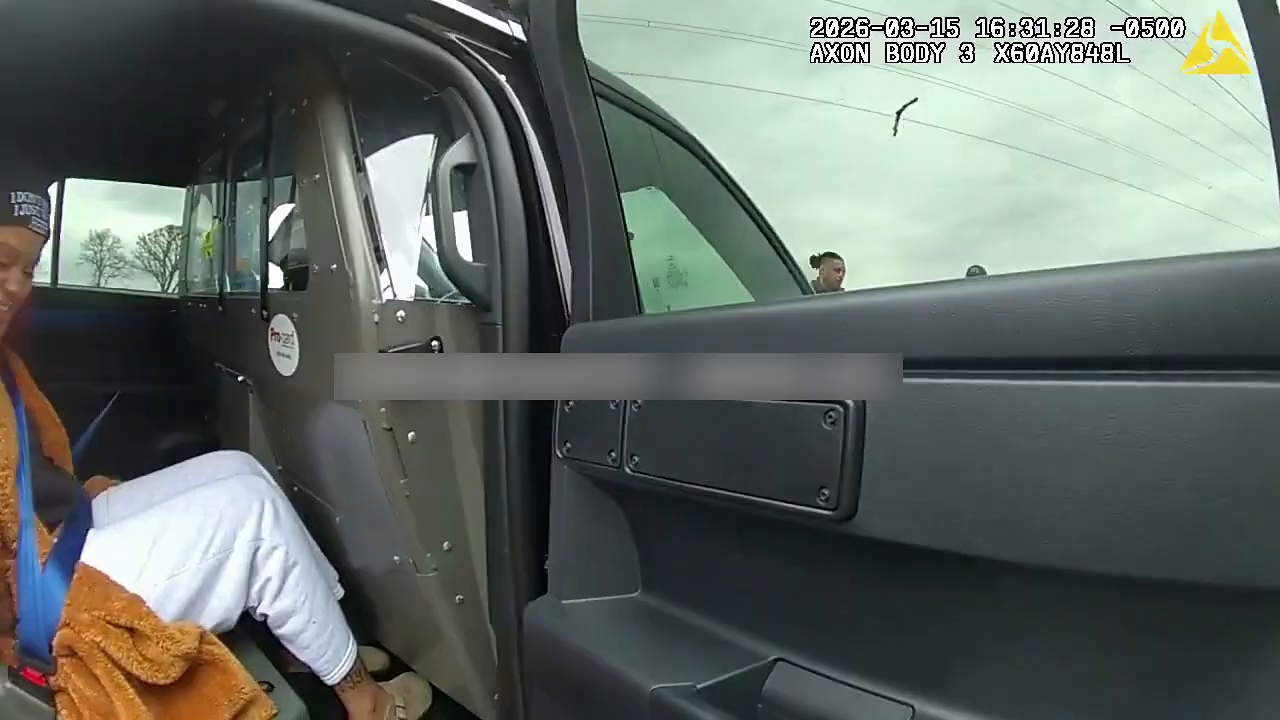
By the end, she is sitting in the back of a police SUV.
That is the entire story in two images.
DRIVER'S SEAT TO BACK SEAT.
And the transition appears to have happened not because of the red light itself, but because of everything police discovered after making the stop.
THE BODYCAM ALSO SHOWS WHY CREDIBILITY MATTERS
Once someone has been caught giving false information, every subsequent statement becomes more difficult to evaluate.
The woman says she is frightened.
That may be true.
She says her husband needs her.
That may also be true.
She describes a medical situation at home.
Again, the footage does not independently establish whether it is true or false.
But the officers have already encountered enough inconsistencies that they no longer appear willing to accept new statements without verification.
This is an important feature of real investigations.
Credibility accumulates—or disappears—over the course of an interaction.
A person who answers straightforwardly from the beginning may receive the benefit of officers believing later explanations.
A person caught repeatedly changing details may find that even legitimate explanations are met with skepticism.
The bodycam captures that deterioration almost in real time.
At the beginning, officers are trying to identify her.
By the end, they openly question almost everything she says.
THE MOST EXPENSIVE DECISION MAY HAVE BEEN THE SIMPLEST ONE
There is an obvious temptation to look for one dramatic turning point.
Was it running the red light?
Was it the warrant?
Was it the suspended license?
Was it the expired registration?
All mattered.
But the footage suggests the most consequential decision may have been much simpler:
NOT GIVING POLICE THE CORRECT IDENTITY FROM THE BEGINNING.
The warrant might still have resulted in an arrest once officers discovered it.
That cannot be ignored.
But according to the officers themselves, the false information created additional allegations and dramatically complicated the encounter.
The driver didn't make the existing warrant disappear.
She allegedly added new problems while trying to prevent officers from finding it.
That is why the repeated statement about the warning is so powerful.
It represents the version of the traffic stop that no longer exists.
WHAT WE CAN—AND CANNOT—SAY ABOUT THE FINAL OUTCOME
The footage provides strong evidence of what officers said and did during the encounter.
The matching transcript provides additional confirmation of the central sequence.
But an arrest is not a conviction.
I could not locate sufficiently reliable public court or police records tying the uploaded footage to a final disposition.
For that reason, it would be inappropriate to claim that the woman was ultimately convicted of obstructing, false identification, driving while suspended, or any other offense merely because those issues were discussed during the stop.
The responsible description is narrower:
Police stopped the vehicle after an alleged red-light violation.
Officers said the driver repeatedly provided false identifying information.
They eventually told her she had outstanding warrants.
They also said her license was suspended and the vehicle's registration had expired.
She was taken into custody and the vehicle was prepared for towing.
Anything beyond that requires a verified matching court record.
FROM A WARNING TO THE BACK OF A POLICE CAR
The encounter works as a story because its beginning and ending could hardly be more different.
At the beginning, police are standing beside a silver sedan conducting what appears to be an ordinary traffic stop.
The alleged offense is a red light.
Officers say they were prepared to issue a warning.
Then the identity questions begin.
One name doesn't resolve the situation.
Another follows.
The age appears wrong.
Police continue searching.
The driver's actual information eventually leads officers to warrants.
Her driving status creates another issue.
The vehicle registration creates another.
The original warning disappears.
The woman asks for another chance.
There isn't one.
By the end, the driver is handcuffed in the rear of a patrol vehicle while officers prepare to tow the car she had been driving only minutes earlier.
There is no dramatic crash.
No physical confrontation.
No pursuit.
Yet the consequences escalate at nearly every stage.
A RED LIGHT STARTED THE STOP. THE WARRANTS HELPED END IT. BUT ACCORDING TO THE OFFICERS, THE LIES IN BETWEEN MADE EVERYTHING WORSE.
That is what makes the footage so effective.
The viewer knows from the title that something is going to go wrong.
What keeps the story moving is discovering exactly how a warning turns into an arrest—one answer at a time.
WATCH HOW THE WARNING DISAPPEARED
The final arrest makes far more sense when the encounter is watched from the beginning. The important moments aren't just the handcuffs; they're the repeated questions, changing information, database checks, and the point when officers finally explain that the driver had originally been headed for a warning.
Click here to watch the full incident unfold from the initial traffic stop to the moment the driver realizes she is going to jail.
Comments (0)
Loading comments...
May You Like

🚨🚗 One Mistake Changes Everything During a DUI Arrest | Bodycam Footage US
Entitled Driver Skips the Line and Gets Instant Karma3