
Santa Ana Traffic Stop Turns Into Officer Shooting With Suspect Injured
TRAFFIC STOP ERUPTS INTO GUNFIRE AFTER SANTA ANA OFFICER SPOTS AN ARMED MAN
HOOK — A TRAFFIC STOP TURNS INTO A LIFE-OR-DEATH ENCOUNTER
A traffic stop is one of the most routine duties in American policing.
An officer sees a violation, activates the emergency lights, approaches the vehicle and begins asking questions. Most stops end without anything more dramatic than a warning, citation or brief conversation.
But on the evening of April 7, 2023, a traffic stop in Santa Ana, California, changed in seconds.
At approximately 6:40 p.m., Santa Ana Police Department officers stopped a vehicle in the 600 block of South Rosewood Street. Initial reporting from CBS Los Angeles said officers encountered an armed person during the stop. Moments later, gunfire erupted.
Body-worn camera footage later released by police provides a much closer view of those critical seconds.
The officer approaches.
The occupants are still inside the vehicle.
Then something catches his attention.
A man appears to have a handgun.
From that point forward, there is almost no time to process what is happening.
WHAT BEGAN AS A TRAFFIC STOP BECOMES AN ARMED CONFRONTATION IN A MATTER OF SECONDS.
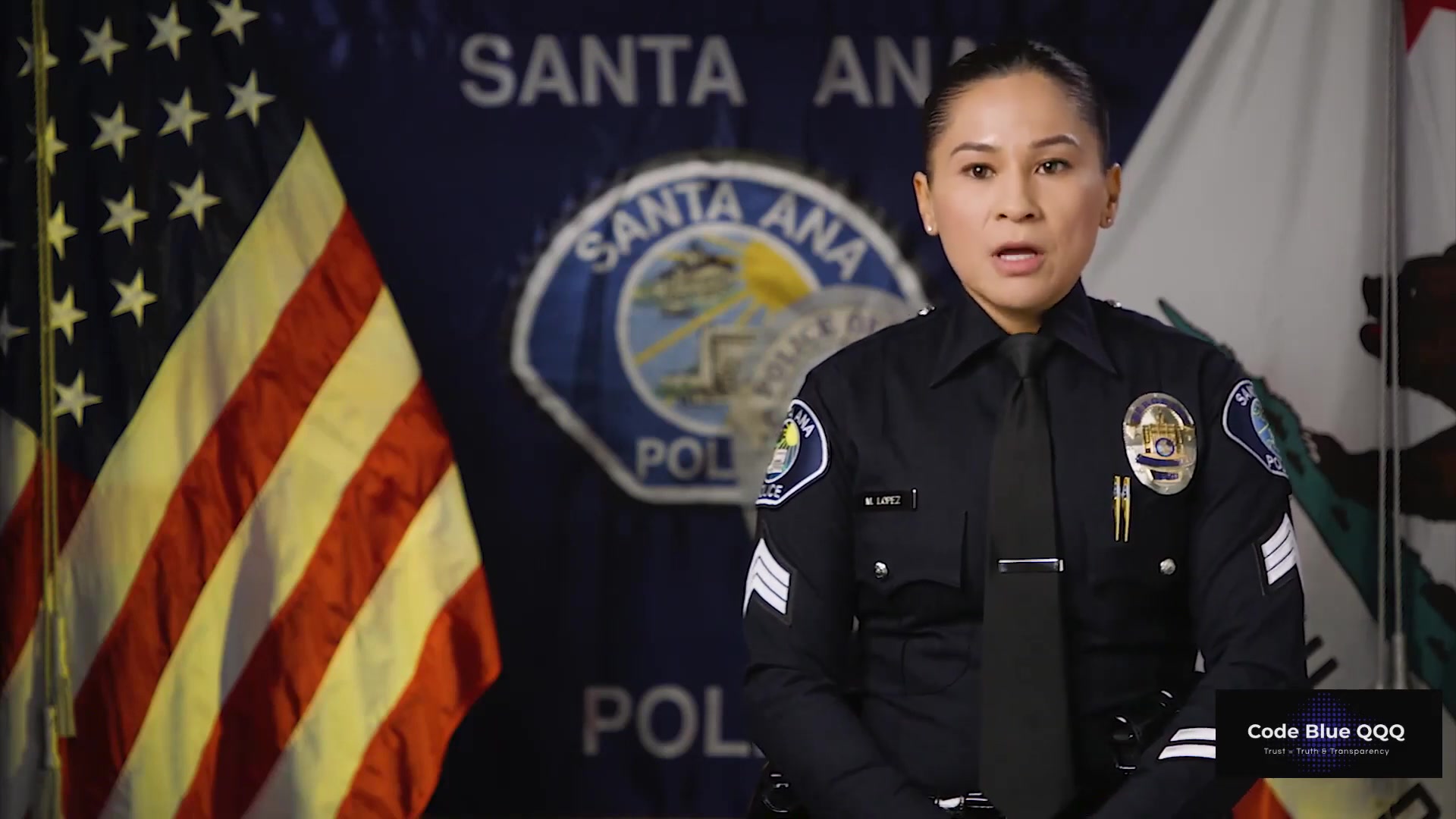
That sudden transition is what makes the footage so intense.
There is no lengthy buildup and no obvious warning to the viewer that violence is about to occur. The officer is performing an ordinary task until the presence of a weapon completely changes the risk.
And what investigators later found around the scene would make the sequence even more serious.
OPENING — APRIL 7, 2023, SANTA ANA
The incident occurred during the early evening of Friday, April 7.
CBS Los Angeles reported that Santa Ana police conducted the traffic stop at approximately 6:40 p.m. in the 600 block of South Rosewood Street. Police initially told the outlet that officers had encountered a person armed with a handgun before an officer-involved shooting occurred.
The timing visible in the department footage is consistent with that account: the critical incident material identifies the event as occurring at approximately 6:41 p.m.
At first glance, the residential surroundings seem almost completely ordinary.
Cars are parked along the street.
Homes line the neighborhood.
It is still daylight.
Nothing about the environment suggests what is about to happen.
That contrast is important because it illustrates one of the central dangers of traffic enforcement: officers often have extremely limited information about the people inside a vehicle.
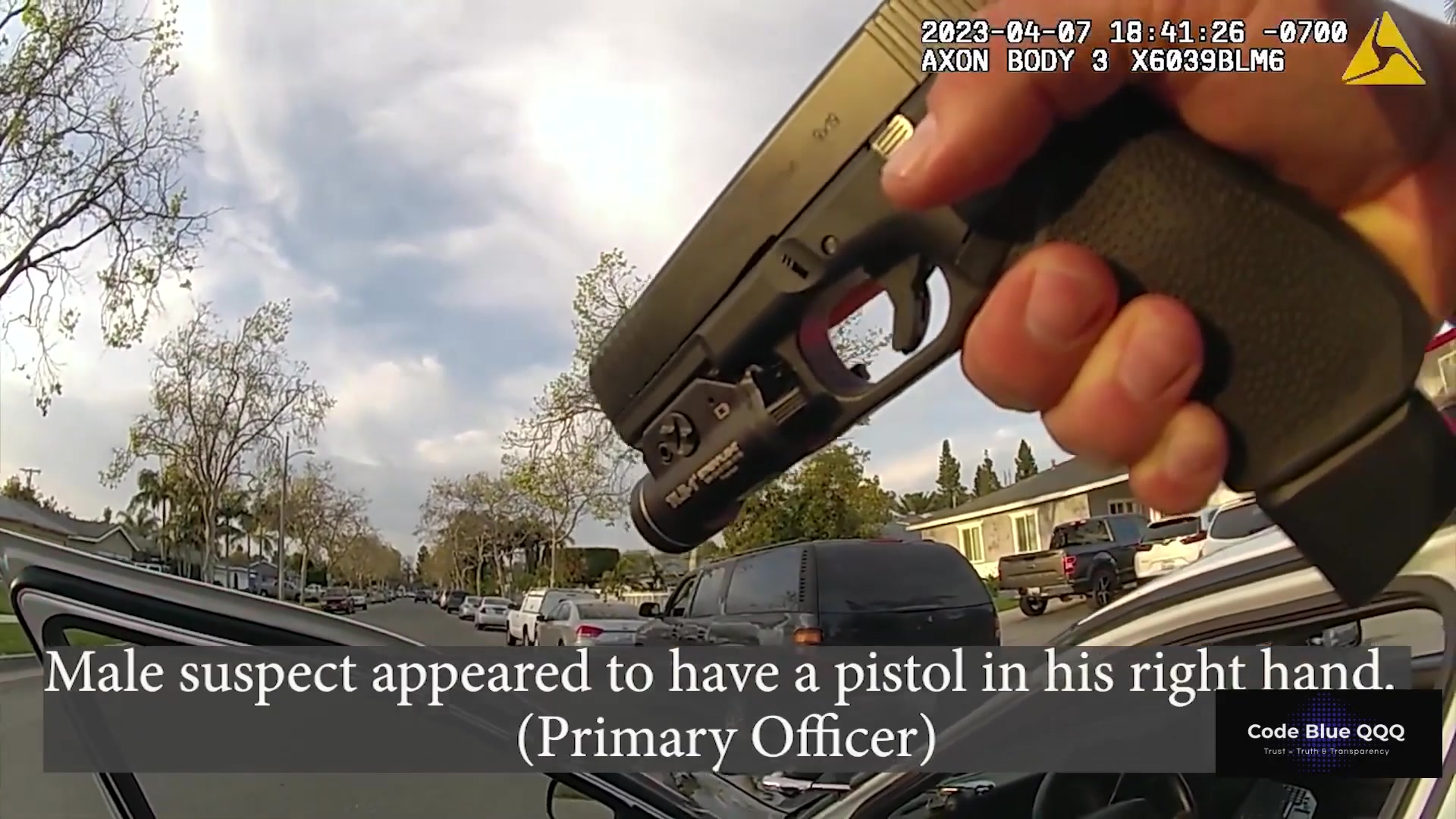
The bodycam sequence shows the officer moving into position beside the stopped vehicle.
Then the threat becomes visible.
Police footage identifies a male occupant who appears to have a pistol in his right hand.
The situation immediately changes from traffic enforcement to an armed encounter.
For the officer, the decision-making window is extraordinarily short.
For viewers watching afterward, it is possible to freeze the footage, replay individual frames and study where everyone's hands are positioned.
The officer standing beside the vehicle did not have that luxury.
THE MOMENT THE HANDGUN APPEARS, THE ENTIRE NATURE OF THE STOP CHANGES.
DEVELOPMENT — THE WEAPON APPEARS
This is the point where the footage becomes most difficult to look away from.
The officer recognizes what appears to be a handgun.
Commands and movement follow almost simultaneously.
There is little separation between recognizing the threat and reacting to it.
The subsequent exchange happens quickly enough that watching it at normal speed makes it difficult to absorb every detail.
That is precisely why critical-incident videos often combine body-camera footage with slower explanations, maps and other evidence. A few seconds recorded by a body camera can represent the most consequential portion of an encounter lasting many minutes.
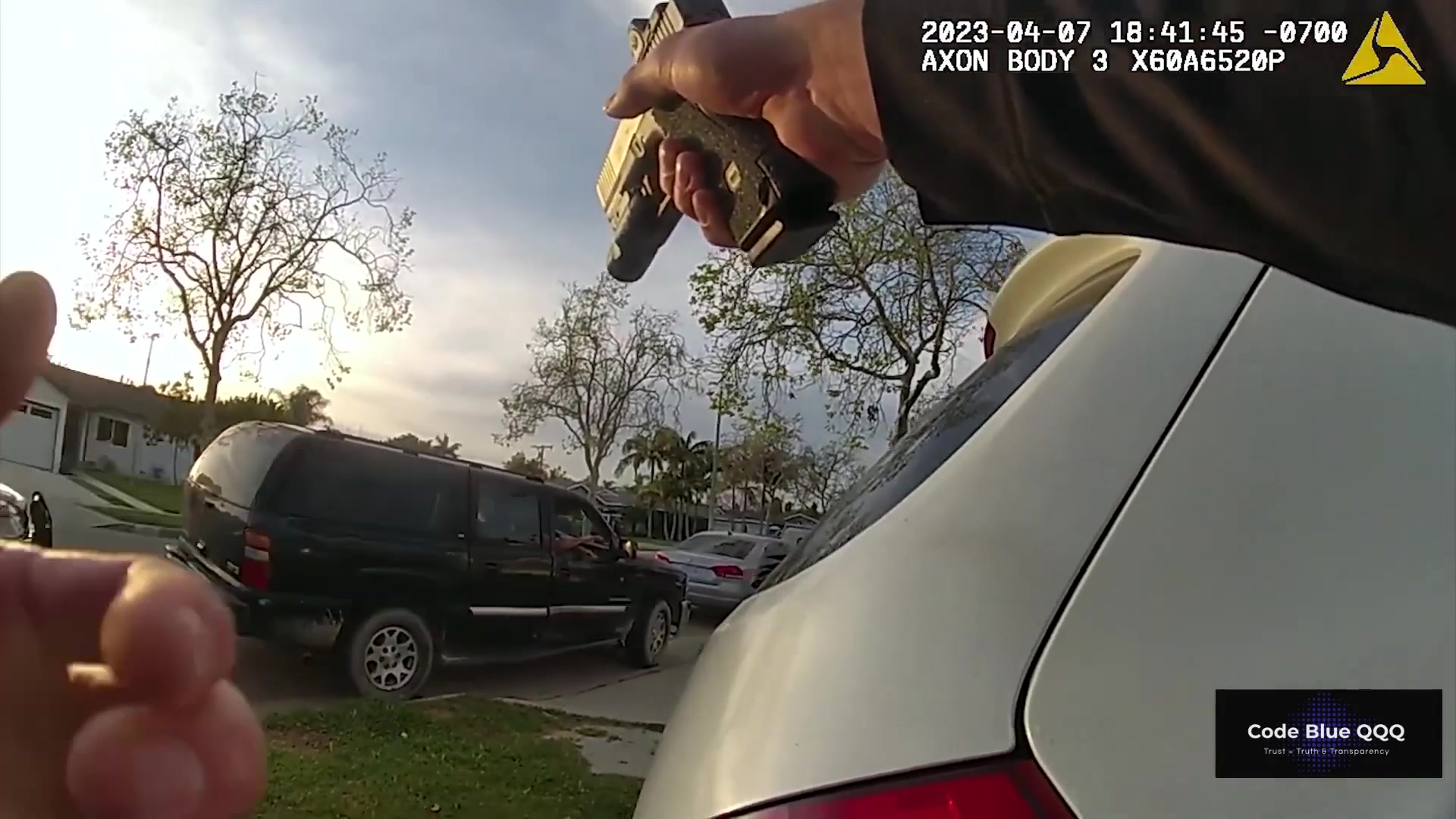
Initial media reports understandably contained relatively little detail.
CBS reported that officers encountered an armed subject and that police gunfire struck one person. The wounded man suffered injuries to his upper and lower body but was reported in stable condition after being transported to a hospital.
Importantly, no officers were reported injured.
Police also said another man who had been inside the vehicle ran from the scene after the shooting.
But the later police presentation adds crucial context that could not have been known during those first hours.
THE EVIDENCE EXTENDED BEYOND THE VEHICLE
The department's reconstruction indicates investigators discovered cartridge casings along the west sidewalk of Shelton Street, south of Myrtle Street.
According to the police presentation included in the supplied video, investigators considered those casings consistent with the location of the suspect's shots as he exited the vehicle and fired in the officer's direction.
That detail changes the understanding of the incident substantially.
This was not merely an officer seeing an armed passenger and firing.
The later evidence presented by investigators indicated that gunfire came from the suspect's position as well.
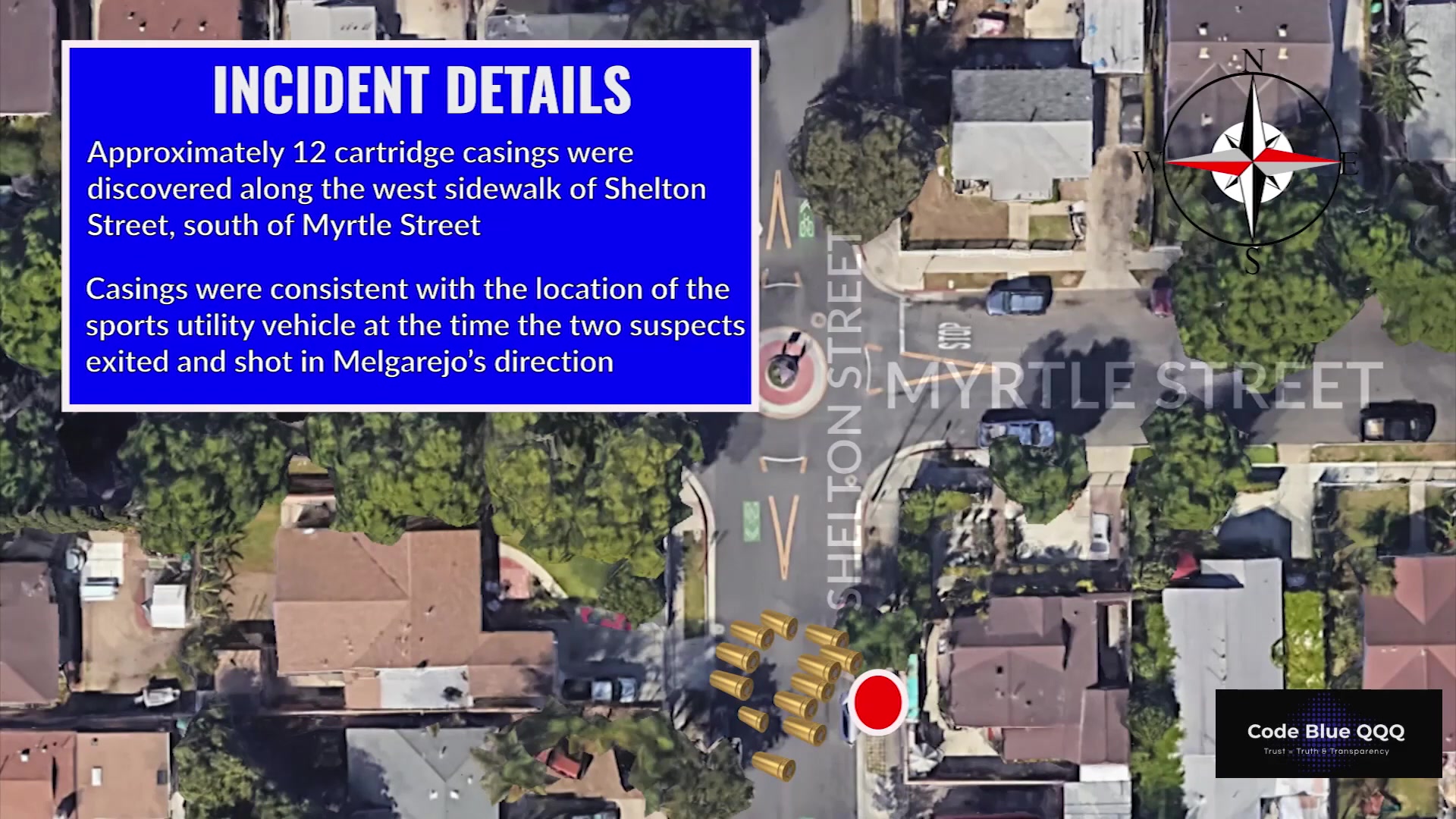 For viewers, the map and physical evidence provide something bodycam footage alone cannot: perspective.
Body-worn cameras are excellent at recording what happens in front of an officer, but they do not automatically explain where every participant is standing or where every round originated.
Investigators therefore have to combine several forms of evidence:
body-camera footage, cartridge casings, firearms, witness accounts, trajectories, medical evidence and the physical layout of the scene.
That broader reconstruction is essential when evaluating an officer-involved shooting.
DEVELOPMENT — A SECOND MAN RUNS FROM THE SCENE
While one man is wounded during the confrontation, another part of the incident is developing simultaneously.
CBS reported that a second male occupant fled after the shooting.
That creates an additional problem for responding officers.
They must deal with the immediate shooting scene while determining whether another potentially dangerous person is moving through the surrounding neighborhood.
At the same time, medical attention has to be provided.
Weapons must be secured.
Witnesses need to be located.
The scene has to be preserved for investigators.
Additional officers begin arriving.
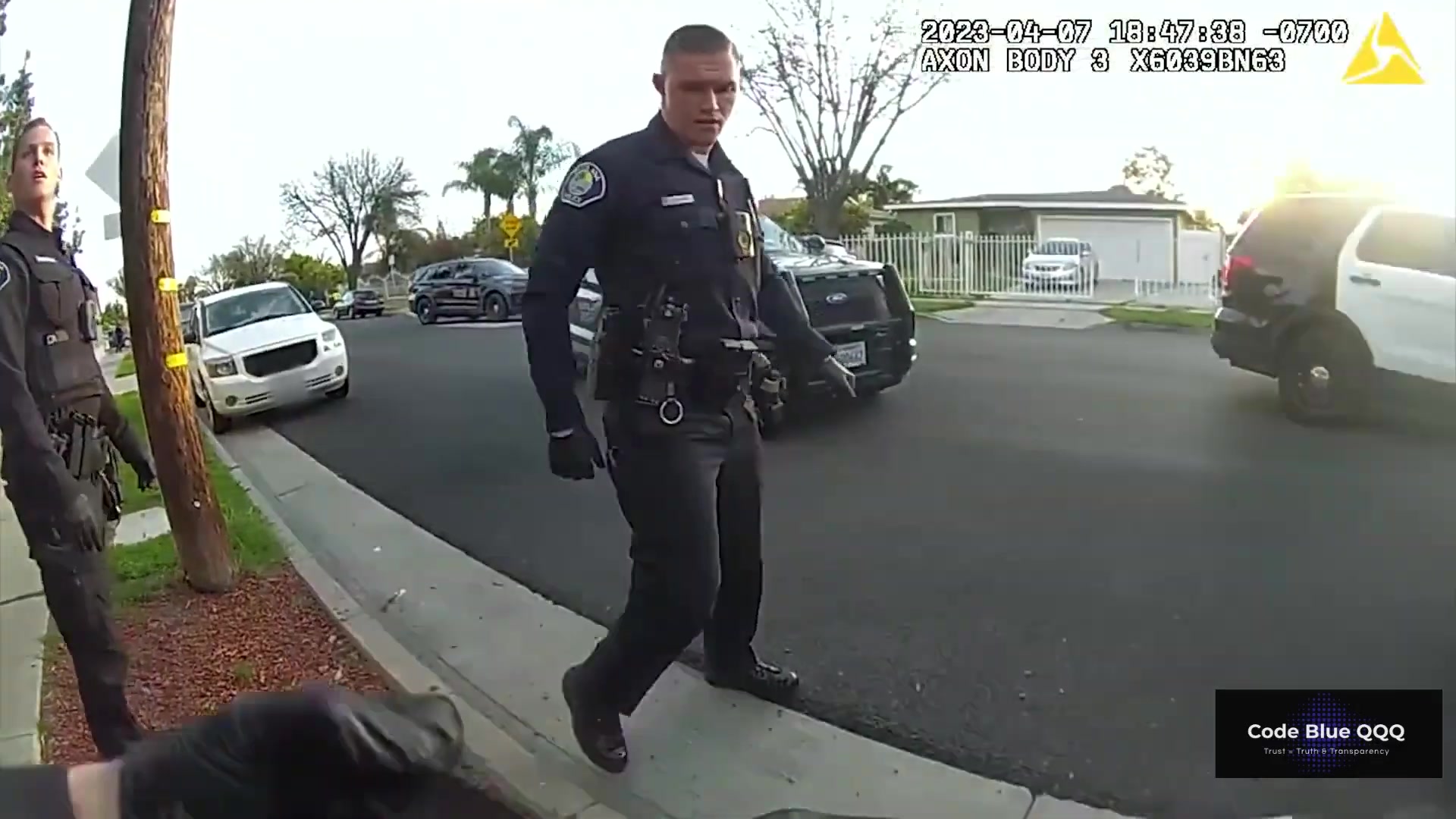
This portion of the footage feels dramatically different from the shooting itself.
The initial confrontation lasts only moments.
The aftermath becomes methodical.
Officers communicate.
The immediate threat is reassessed.
Investigators begin the much slower process of establishing exactly what occurred.
And eventually another important piece of evidence is documented.
POLICE RECOVER A 9MM "GHOST GUN"
The critical-incident presentation identifies the recovered weapon as a 9mm ghost gun containing a loaded magazine.
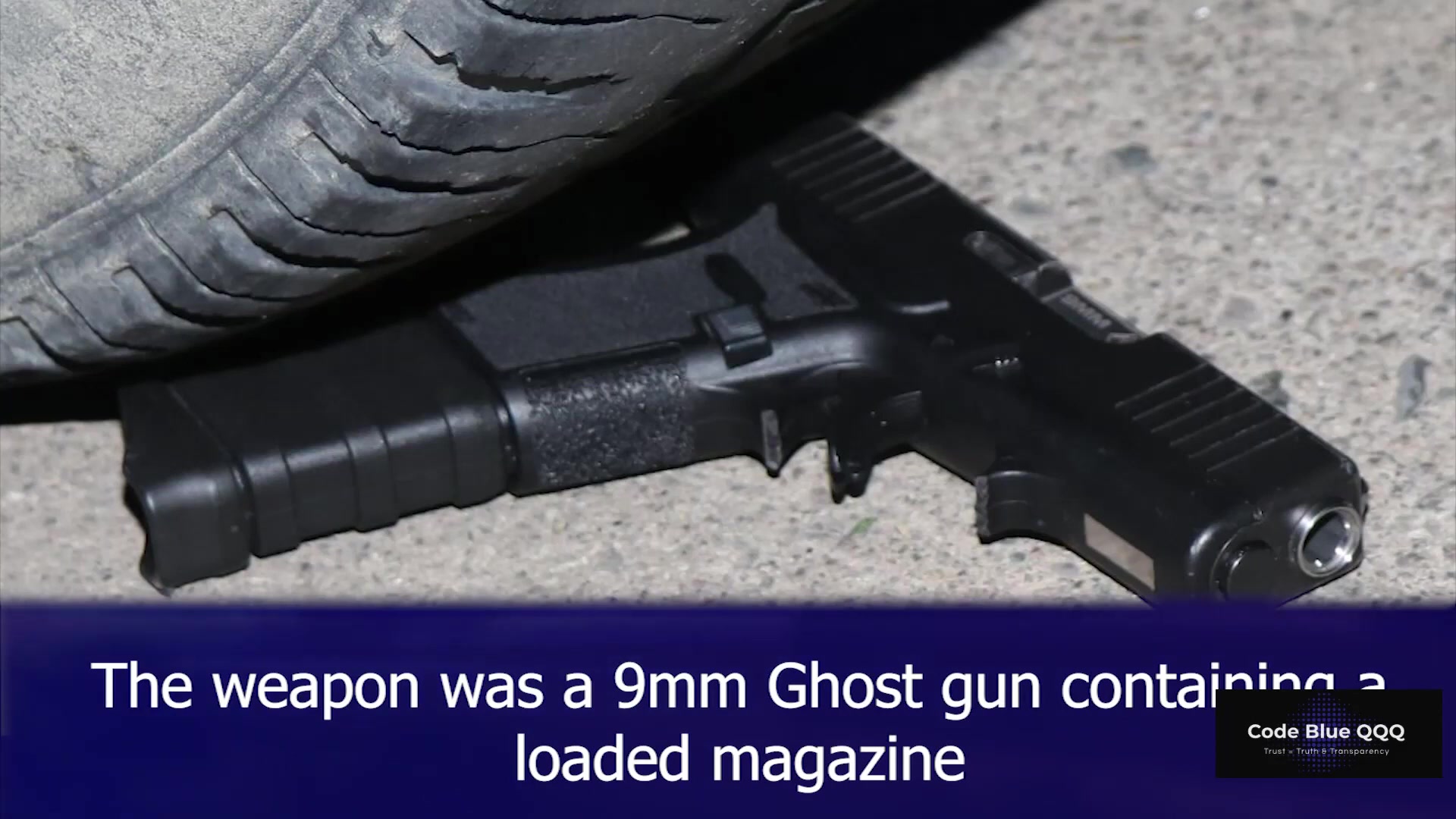
The term "ghost gun" generally refers to a privately made firearm that lacks the conventional manufacturer markings or serial-number framework associated with commercially produced firearms. The terminology and precise legal treatment can depend on the weapon and applicable law.
What matters for understanding this incident is more immediate:
Police recovered what they identified as an operable-looking 9mm handgun associated with the confrontation.
That evidence, together with the casings recovered from the area and the body-camera sequence, became part of investigators' reconstruction of the shooting.
WHY THE FIRST FEW SECONDS MATTER SO MUCH
Officer-involved shootings frequently generate debate because viewers encounter them with information that the participants did not possess at the moment decisions were made.
After an incident, investigators can spend days, weeks or months examining evidence.
They can pause video.
Enhance individual frames.
Measure distances.
Compare cartridge casings.
Interview witnesses.
Review radio transmissions.
The officer at the scene operates in real time.
Santa Ana Police Department's own procedures recognize officer-involved shootings as critical incidents and establish specific requirements for handling body-worn cameras and preserving evidence after such events.
That does not mean bodycam footage automatically settles every question.
Quite the opposite.
It is one piece of evidence.
But in this case it provides a remarkable illustration of just how quickly the risk level of a traffic stop can change.
One moment, an officer is beside a vehicle.
The next, a handgun is visible.
Seconds later, shots have been fired.
ENDING — THE STREET BECOMES A CRIME SCENE
By the time the immediate confrontation ends, the quiet residential street seen at the beginning of the video has become an investigative scene.
One man has been wounded.
Another occupant has fled.
A firearm has been recovered.
Cartridge casings have to be documented.
The body-camera recordings have become evidence.
And investigators now face the task of reconstructing an event that unfolded in only seconds.
CBS reported that the wounded individual was transported to a hospital with gunshot wounds affecting both his upper and lower body and was considered stable. No police officers were injured.
There is an important distinction between this case and many officer-involved shootings that dominate headlines.
The suspect survived the initial incident.
That allows the event to be examined not only as a shooting but as an example of the unpredictable risks surrounding vehicle stops.
The neighborhood itself also matters.
This was not a remote highway.
It happened among homes, parked cars and residents.
Every shot fired in that environment carries risks extending beyond the officer and armed suspect.
The incident therefore contains several overlapping stories:
A routine enforcement action.
An armed encounter.
A police shooting.
A fleeing occupant.
A recovered firearm.
And a neighborhood suddenly transformed into a crime scene.
THE BODYCAM REVEALS WHAT THE FIRST NEWS REPORT COULD NOT
The difference between the initial news report and the later critical-incident video is striking.
On April 7, reporters could only say that officers had stopped a vehicle, encountered an armed person and shot a suspect.
Those facts were accurate but incomplete.
The bodycam footage adds the human-scale sequence.
The officer approaches.
The weapon becomes visible.
The encounter accelerates.
Gunfire erupts.
Additional evidence is discovered afterward.
This is why released body-camera footage can be so valuable when examining police use-of-force incidents.
It does not necessarily answer every legal or tactical question.
But it allows the public to see events from a perspective that written police statements and early breaking-news reports cannot reproduce.
At the same time, responsible viewing requires recognizing the limitations of a single camera.
A body camera records from approximately the officer's position. It may shake during movement, objects can block the lens, lighting can distort details, and the camera does not necessarily point exactly where the officer is looking.
Investigative conclusions therefore require more than simply replaying the most dramatic five seconds.
Physical evidence matters.
Timing matters.
Other cameras matter.
Statements and forensic evidence matter.
That is why the casings and recovered handgun shown later in the Santa Ana presentation are so important to the full narrative.
WHAT MAKES THIS VIDEO HOLD ATTENTION?
From a storytelling perspective, the video contains one of the strongest structures possible for a police/bodycam article:
NORMALITY → WARNING SIGN → IMMEDIATE DANGER → GUNFIRE → UNCERTAINTY → EVIDENCE → RECONSTRUCTION.
The opening is calm enough that viewers do not immediately know what is coming.
Then the handgun appears.
That is the first major retention point.
Once shots are fired, the viewer has new questions:
Did anyone get hit?
Was the officer injured?
What happened to the second occupant?
Was the suspect actually armed?
Where did the shots come from?
The later investigative presentation answers those questions gradually.
That is far more effective than revealing everything in the first paragraph.
The most important rule is not to manufacture drama.
There is already enough.
A title such as "Traffic Stop Erupts Into Gunfire After Santa Ana Officer Spots an Armed Man" communicates the central reversal without claiming facts the footage does not support.
Likewise, the article should not frame the bodycam as proof of every legal conclusion.
Instead, it should take the reader through what was initially known, what the footage shows, what physical evidence police presented, and what remained subject to investigation.
That approach creates suspense while remaining factual.
CTA — SECONDS THAT COMPLETELY CHANGED A ROUTINE STOP
The April 7, 2023 encounter demonstrates how quickly police work can move from routine to critical.
At approximately 6:40 p.m., officers were conducting a traffic stop on a residential street in Santa Ana.
Within moments, an officer was facing an armed man.
Gunfire followed.
One person was wounded.
Another occupant fled.
And the street became the center of an officer-involved shooting investigation.
The later footage and evidence add context that the first breaking-news reports could not provide, including the weapon recovered and investigators' reconstruction of where shots were fired.
But perhaps the most powerful part of the footage remains the beginning.
There is almost nothing to warn the viewer about what is coming.
That is precisely the point.
ONE MOMENT IT IS A TRAFFIC STOP. SECONDS LATER, THE OFFICER IS FACING A GUN.
Click here to watch the full incident unfold and see how quickly this Santa Ana traffic stop turned into an armed confrontation: https://www.youtube.com/watch?v=d_YypnSfpNM
Comments (0)
Loading comments...
May You Like
Police vs Chevy Impala High-Speed Pursuit Ends in TVI

Woman Tries to Stop Police From Arresting “Brother” — He Denies Knowing Her














