
Routine Traffic Stop Instantly Turns Into Chaos
Routine Traffic Stop Explodes Into Chaos After Driver Steps Out of His Jeep
HOOK: THE OFFICER HAD BARELY STOPPED WHEN EVERYTHING CHANGED
A traffic stop usually begins with distance.
The officer parks behind the vehicle. Emergency lights remain on. The driver stays inside. The officer approaches, asks for a license and registration, and tries to determine why the driver was behaving the way they were.
On the afternoon of July 12, 2026, a Greendale police officer never really got that opportunity.
Police say the encounter began after an officer spotted a black Jeep being driven at high speed in the wrong direction on Northway in Greendale, Wisconsin. The vehicle allegedly accelerated toward the rear of a marked police squad and swerved toward another occupied vehicle.
The officer followed.
The Jeep stopped.
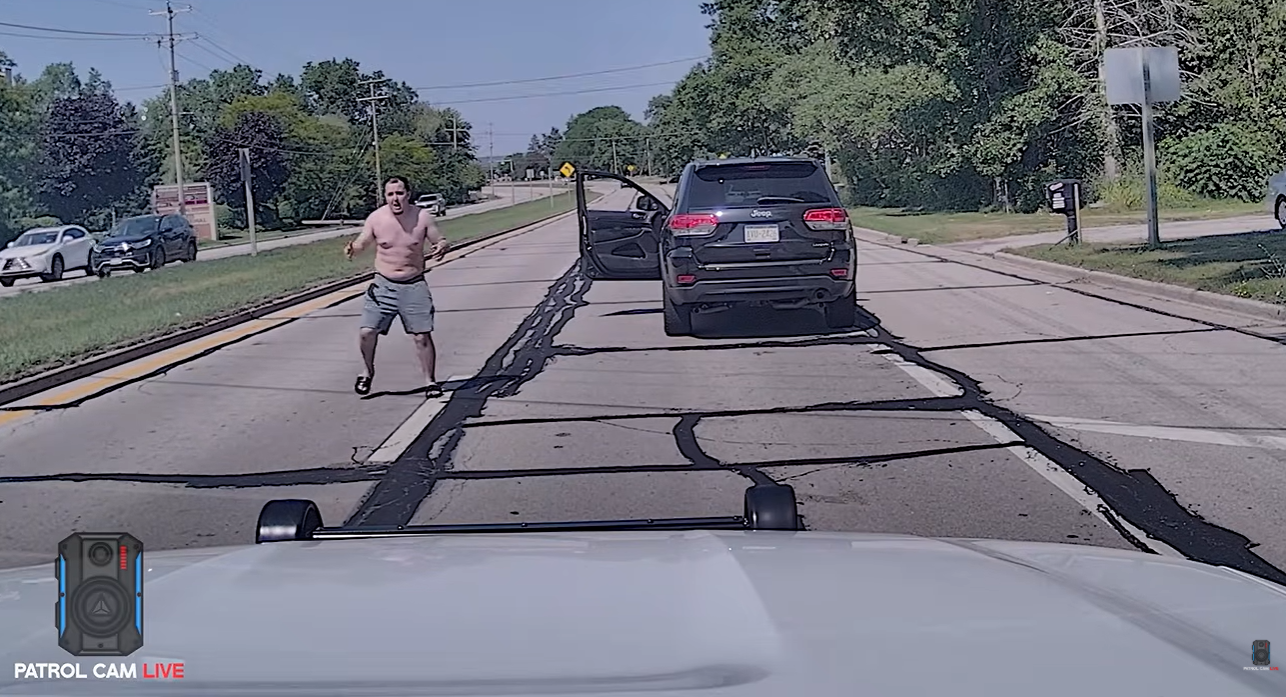
But before the officer could establish anything resembling a normal traffic-stop routine, the driver was already outside.
Body-camera footage captures the sudden shift.
The man walks away from his Jeep.
The officer orders him to stop.
Instead of returning to the vehicle and waiting for instructions, the man becomes increasingly confrontational.
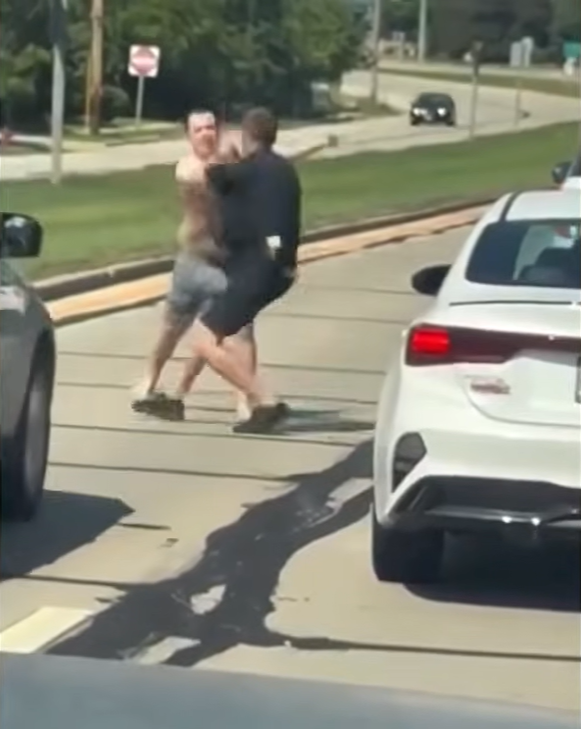
Within moments, the distance between officer and driver disappears.
The encounter becomes physical.
Another officer races to the scene.
A Taser is deployed.
And what started as an investigation into reckless driving becomes an arrest involving allegations of battery against a law-enforcement officer, resisting, threats and reckless endangerment.
The entire transformation happens remarkably fast.
That is precisely what makes this footage so compelling.
OPENING: WHAT FIRST ATTRACTED THE OFFICER'S ATTENTION
It was Sunday afternoon in Greendale, a community southwest of Milwaukee.
At approximately 3:30 p.m., police say an officer observed something that immediately demanded attention.
A vehicle was allegedly traveling the wrong way on Northway.
And it wasn't moving slowly.
According to Greendale Police information reported by CBS 58, the driver was traveling at a high rate of speed, heading toward the rear of a marked squad car and then swerving toward another vehicle that had someone inside.
Those details changed the nature of the encounter before the officer even activated the stop.
This wasn't simply a broken taillight.
It wasn't an expired registration.
It wasn't an ordinary speeding citation.
Police believed they had just witnessed driving capable of putting other road users in immediate danger.
The bodycam timestamp visible in the footage you supplied reads 07/12/2026, matching the date identified by Greendale Police and CBS 58.
The environment also matches.
Bright summer afternoon.
Residential Greendale streets.
A black Jeep.
And officers whose uniforms correspond with the local agencies involved.
There is another particularly strong identifying detail.
Greendale Police Department's published personnel information lists Matthew Amore among its patrol officers and Andrew Mitchell among department personnel, matching names visible on officers in the supplied footage.
Taken together, those details provide a strong match between your video and the July 12 Greendale incident.
What happens next explains why a potentially routine stop required additional officers so quickly.
DEVELOPMENT: THE DRIVER GETS OUT
Traffic-stop safety procedures often rely on predictability.
The officer wants the vehicle stopped.
The officer generally wants occupants to remain where they can be observed.
Commands create structure.
Distance gives everyone time to react.
The July 12 encounter immediately disrupted that structure.
According to police, when the Greendale officer attempted the traffic stop, the 25-year-old driver got out of the Jeep.
The bodycam footage shows why that mattered.
The officer suddenly had to manage a moving person rather than a stationary driver.
Commands followed.
The man did not simply stand next to his vehicle and wait.
Police say he ignored the officer's directions.
The interaction becomes increasingly tense.
Instead of the familiar traffic-stop sequence of identification, explanation and citation, the officer is now attempting to control a person who appears determined to dictate the encounter himself.
That is the moment when the original reason for the stop begins to become secondary.
The alleged reckless driving brought the officer there.
The driver's conduct after stopping would determine what happened next.
THE DISTANCE COLLAPSES
One of the clearest warning signs in the footage is physical distance.
At first, there is space between the two men.
Then there isn't.
The driver approaches.
The officer tries to maintain control.
Commands continue.
The encounter grows louder.
Police later alleged that the man attacked the Greendale officer.
Once that happens, the officer is no longer dealing primarily with traffic enforcement.
He is dealing with a physical confrontation.
That distinction matters because close-range encounters develop extraordinarily quickly.
An officer may have only fractions of a second to respond to grabbing, striking, pushing or sudden movement toward equipment carried on the duty belt or vest.
The bodycam perspective intensifies that effect.
Unlike a fixed surveillance camera, the viewer moves with the officer.
The image shifts as bodies collide.
The horizon changes.
Hands enter the frame.
Commands overlap.
It becomes difficult to maintain a complete view of everyone involved.
That visual confusion isn't merely a limitation of the recording.
It reflects the confusion of the encounter itself.
ANOTHER OFFICER ARRIVES
Police officers rarely know exactly how long they will have to manage a violent confrontation alone.
Sometimes backup is seconds away.
Sometimes it is minutes away.
In this incident, assistance arrived at a crucial moment.
Greendale Police said a Greenfield Police officer responded to help the officer struggling with the suspect.
The involvement of another department isn't unusual.
Greendale borders several Milwaukee County communities, and officers from neighboring agencies can assist when a situation requires immediate manpower.
Here, that additional officer changed the balance of the encounter.
Police said the responding Greenfield officer used a Taser.
The goal was no longer to investigate why the Jeep had been driven recklessly.
The immediate objective was to stop the physical confrontation and bring the suspect under control.
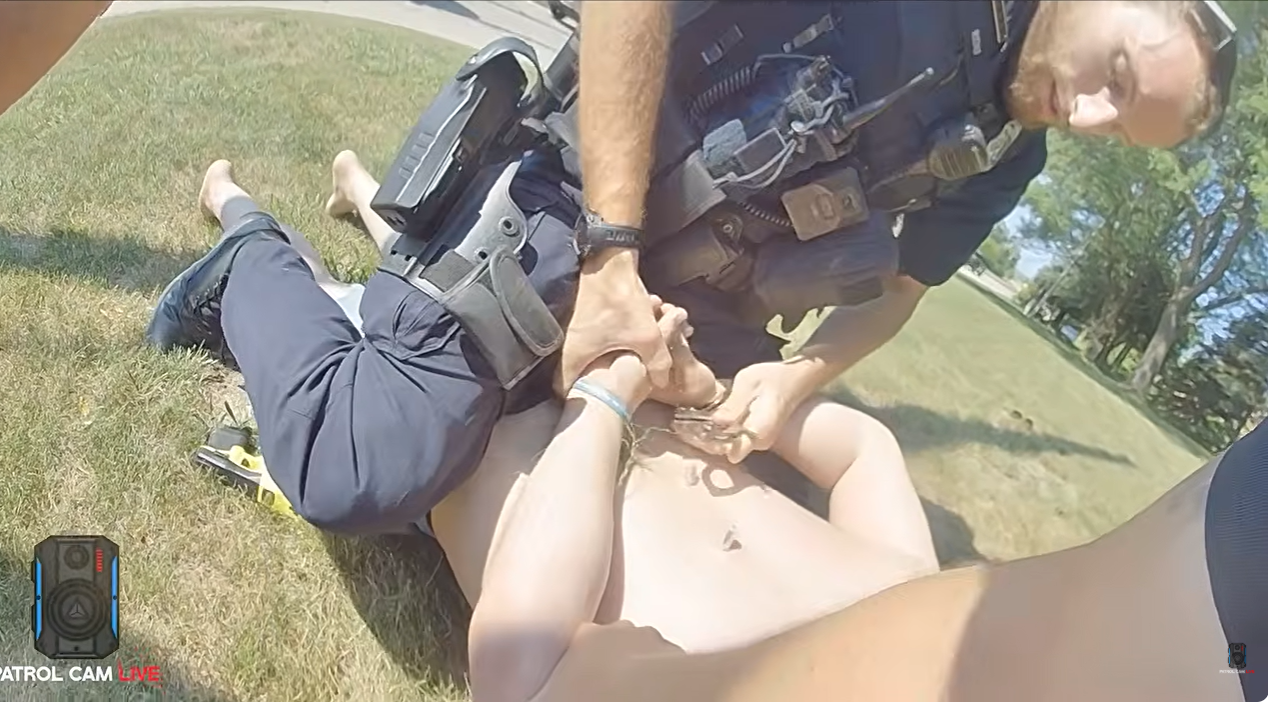
Eventually, officers succeeded.
The man was taken into custody.
But the encounter did not end without injuries.
CBS 58 reported that the Greendale officer suffered minor injuries and was evaluated at the scene. No members of the public were reported injured.
That last detail is important.
The incident began with alleged driving that police said endangered other motorists.
Despite the roadside confrontation that followed, no uninvolved civilian was reported hurt.
THE CHARGES SHOW HOW FAR THE INCIDENT HAD ESCALATED
What makes this case especially revealing is the difference between how it began and what prosecutors were ultimately asked to review.
The original police concern involved driving.
By the end, Greendale Police had referred potential charges including:
second-degree recklessly endangering safety, battery to a law-enforcement officer, resisting an officer, threats to a law-enforcement officer, and expelling bodily substances at a public-safety worker.
These were reported as referred charges, an important distinction.
A police referral represents allegations submitted for prosecutorial consideration. It should not automatically be described as a conviction, and a suspect remains entitled to the legal process that follows.
Still, the list illustrates how dramatically the encounter allegedly escalated.
The driver was not facing consequences solely because of the way police say he drove.
His behavior after the Jeep stopped generated an entirely new set of allegations.
That is one of the most important lessons visible in bodycam footage.
The initial stop and the subsequent arrest are sometimes almost separate events.
A driver can turn a traffic investigation into something far more serious through what happens after the vehicle stops.
WHY EXITING THE VEHICLE CHANGED THE ENCOUNTER
The driver's decision to leave the Jeep is central to understanding why this stop felt chaotic almost immediately.
From an officer-safety perspective, remaining inside a stopped vehicle generally provides structure.
The officer knows approximately where the driver's hands and body are located.
Distance can be maintained.
Communication can occur through a window.
When someone suddenly exits and begins moving toward or away from the officer, that structure disappears.
The officer must determine what the person intends to do.
Are they confused?
Are they trying to leave?
Are they angry?
Are they attempting to confront the officer?
Do they have a weapon?
Will they obey commands?
Those questions must often be evaluated simultaneously.
And they must be evaluated before the officer necessarily knows who the driver is.
This is why the opening seconds of the Greendale footage are arguably more important than the later struggle.
The confrontation does not begin with a single dramatic action.
It begins with the breakdown of predictable behavior.
The driver exits.
Commands are ignored.
Distance closes.
Voices rise.
Then physical contact begins.
Greendale has dealt with other dangerous roadside encounters.
In February 2025, for example, FOX6 reported that a Greendale squad car was sideswiped during an unrelated traffic stop on Loomis Road near Grange Avenue. Neither the officer nor the person sitting in the rear of the squad was injured.
That case was completely separate from the July 2026 arrest.
But it illustrates something easily overlooked when watching bodycam footage: traffic stops happen in uncontrolled environments.
Officers cannot shut down the world around them.
Vehicles continue passing.
Pedestrians remain nearby.
Drivers may behave unpredictably.
And even the person being stopped may react in a way that instantly changes the officer's priorities.
THE BODYCAM MAKES THE SPEED OF ESCALATION VISIBLE
Written police reports reduce events to sentences.
"Driver exited."
"Driver ignored commands."
"Suspect attacked officer."
"Backup arrived."
"Taser deployed."
"Suspect taken into custody."
On paper, those statements appear orderly.
Bodycam footage reveals that reality is not.
Actions overlap.
The officer is speaking while moving.
The suspect is moving while responding.
Another officer is arriving while the struggle is already underway.
Nobody gets to pause the encounter and decide what should happen next.
That is why footage like this can be useful even when viewers disagree about individual decisions.
It preserves timing.
And timing matters enormously in police encounters.
A decision that looks obvious after watching a recording several times may not have been obvious to the people who had only a second to make it.
At the same time, video gives the public an opportunity to evaluate whether official descriptions are consistent with observable events.
That combination is one reason body-worn cameras have become such an important source of evidence and public accountability.
THE OFFICERS IN THE VIDEO MATCH GREENDALE RECORDS
There is another detail worth mentioning because it helps verify the source footage.
The names visible on the officers' uniforms correspond with publicly available Greendale Police personnel information.
The Village of Greendale's department material lists Matthew Amore, who joined in 2021, and Andrew Mitchell, who joined in 2023, among patrol personnel.
The same surnames are visible in the footage supplied with this article.
That is significant because reposted police footage is frequently mislabeled online.
Dates can be changed.
Cities can be misidentified.
Titles can exaggerate what happened.
Sometimes footage from completely different incidents is combined.
Here, however, multiple independent details align:
July 12, 2026.
Greendale.
The black Jeep.
The approximate 3:30 p.m. time.
The officer names.
The reckless-driving allegation.
The roadside confrontation.
The arrival of another officer.
Together, those details establish a strong identification of the incident described by CBS 58 and Greendale Police.
THE INCIDENT ALSO SHOWS WHY BACKUP MATTERS
The arrival of the Greenfield officer is easy to overlook because it happens after the confrontation is already underway.
But operationally, it may be one of the most important moments in the footage.
A one-on-one physical confrontation creates enormous uncertainty.
Even if an officer is physically capable of controlling a suspect, doing so while protecting a firearm, radio, Taser and other equipment is difficult.
Adding another trained officer changes the equation.
One officer can focus on controlling one part of the suspect's body.
The other can issue commands or control another side.
Less-lethal equipment becomes easier to deploy without simultaneously wrestling with the individual.
And once handcuffs are applied, officers can more safely evaluate injuries and stabilize the scene.
In this case, police say the Greenfield officer deployed the Taser before the suspect was taken into custody.
The Greendale officer was evaluated for minor injuries.
The suspect was detained.
And despite the dangerous driving that reportedly started the encounter, no civilian injuries were reported.
This distinction between exact-case imagery and contextual imagery matters.
The July 12 case is very recent, and at the time of this research CBS 58's report is the principal independent local-news account I could verify. I therefore have not substituted photographs from unrelated arrests and presented them as the July 12 suspect.
The facts are strong enough without doing that.
ENDING: THE TRAFFIC STOP WAS ONLY THE BEGINNING
When the Greendale officer first encountered the black Jeep, the problem was driving behavior.
Police say the Jeep was traveling quickly in the wrong direction.
It approached a marked squad car.
It swerved toward another occupied vehicle.
Those allegations were serious enough by themselves.
But the Jeep eventually stopped.
That could have been the point where the danger began to decrease.
Instead, police say it was the point where an entirely different danger began.
The driver exited.
Commands were ignored.
The officer and driver confronted one another.
The encounter became physical.
Another department responded.
A Taser was deployed.
An officer was injured.
And a 25-year-old man was taken into custody with multiple serious allegations referred for potential prosecution.
The most interesting part of this footage is therefore not simply that a traffic stop "turned chaotic."
It is how little time it took.
There was no long roadside argument before the confrontation.
There was no lengthy investigation that slowly deteriorated.
The structure of a normal traffic stop barely had time to form.
That is what makes the video difficult to look away from.
Viewers can see the exact moment when the encounter could have gone in one direction but instead goes in another.
The Jeep stops.
The door opens.
The driver steps out.
And from there, almost everything changes.
In only minutes, an alleged reckless-driving incident becomes a physical arrest involving officers from two police departments.
The roadside is eventually brought under control.
But by then, what might have ended with a driving investigation has become something far more serious.
CTA: WATCH THE MOMENT THE STOP CHANGES COMPLETELY
The final arrest tells only part of the story. Watch the full footage to see why the Greendale officer initially followed the black Jeep, what happened when the driver immediately stepped out, and how quickly a roadside stop turned into a physical confrontation requiring another officer to rush in. https://www.youtube.com/watch?v=IMDk8Qqds5E
Comments (0)
Loading comments...
May You Like

Police Follow the Driver Until His Escape Route Runs Out

Woman Tries to Stop Police From Arresting “Brother” — He Denies Knowing Her

Police vs Chevy Impala High-Speed Pursuit Ends in TVI













