
Robbery Suspect Speeds Away With an Officer Trapped Inside His Car
Robbery Suspect Speeds Away With an Officer Trapped Inside His Car
A 5 A.M. Robbery Call Sets Everything in Motion
At 5:16 a.m. on February 20, 2026, Antioch police officers were dispatched to the 4500 block of Lone Tree Way after a report of a robbery in progress at a FoodMaxx grocery store. According to the Antioch Police Department, the caller told dispatchers that one of the suspects was armed with a firearm and had threatened him. That information meant responding officers were not approaching a routine property-crime call. They were entering a scene where a weapon had reportedly been involved and multiple people could still be present.
The body-camera footage supplied for this article matches the official incident closely. Its AXON overlay shows February 20, 2026, shortly after 5:19 a.m. The setting is a large commercial parking lot at night, and marked Antioch police vehicles are visible as officers arrive. These visual details line up with the department's public release and later critical-incident materials.
Police later identified the driver at the center of the encounter as 23-year-old Dominick DeSouza. The department's April video-release notice identified him by name and confirmed that the incident remained under investigation. Officer Travis Donaldson was later identified in public reporting and Antioch's compliance materials as the officer who became trapped inside DeSouza's vehicle.
Surveillance footage described by police and local reporting showed a vehicle backing into the store's front glass doors before officers arrived. Multiple suspects were involved in the attempted robbery. By the time officers reached the parking lot, the scene was already unstable, and the vehicle itself had been used aggressively around the storefront.
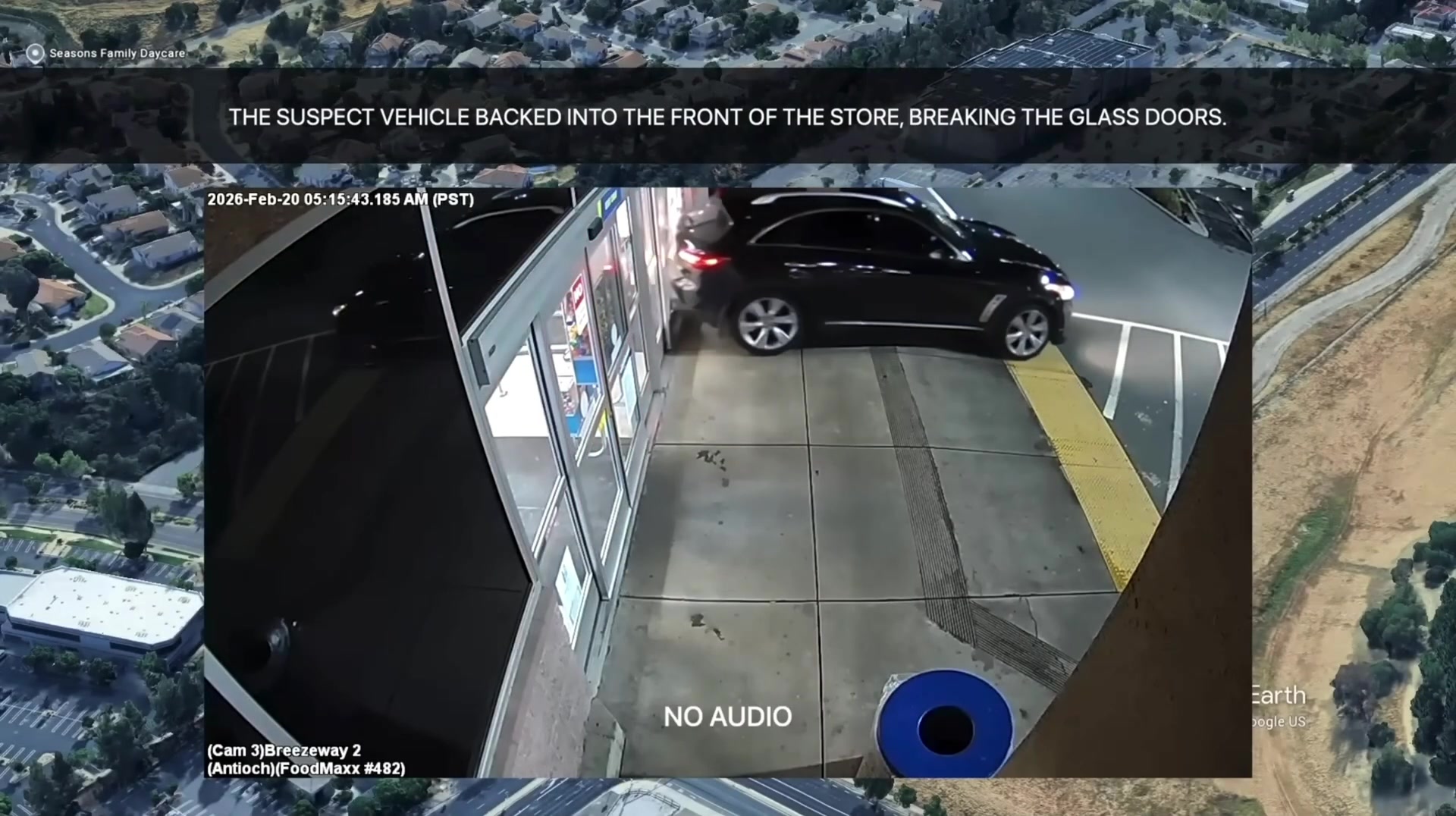
The Suspect Vehicle Collides With a Patrol Car
The confrontation escalated almost immediately after police arrived. Antioch police said DeSouza rammed his vehicle into an occupied patrol car. The supplied footage shows officers rapidly repositioning around the suspect vehicle in the FoodMaxx parking lot, with emergency lights washing the storefront and pavement in red and blue.
Donaldson approached on foot and came into contact with the driver. What might normally be an effort to pull a resisting driver from a car became much more dangerous when the vehicle began moving. According to the department, a physical struggle developed and Donaldson was pulled into the suspect vehicle as DeSouza drove forward. The moving car struck a patrol vehicle and the nearby store during the confrontation.
This is one of the most important moments in the entire sequence because it changes the officer's options. Outside the vehicle, Donaldson could potentially disengage, move behind cover or coordinate with other officers. Once his body was pulled into the passenger area of a moving car, those options became drastically narrower. He was now sharing a confined space with the driver while the vehicle itself became an immediate source of danger.
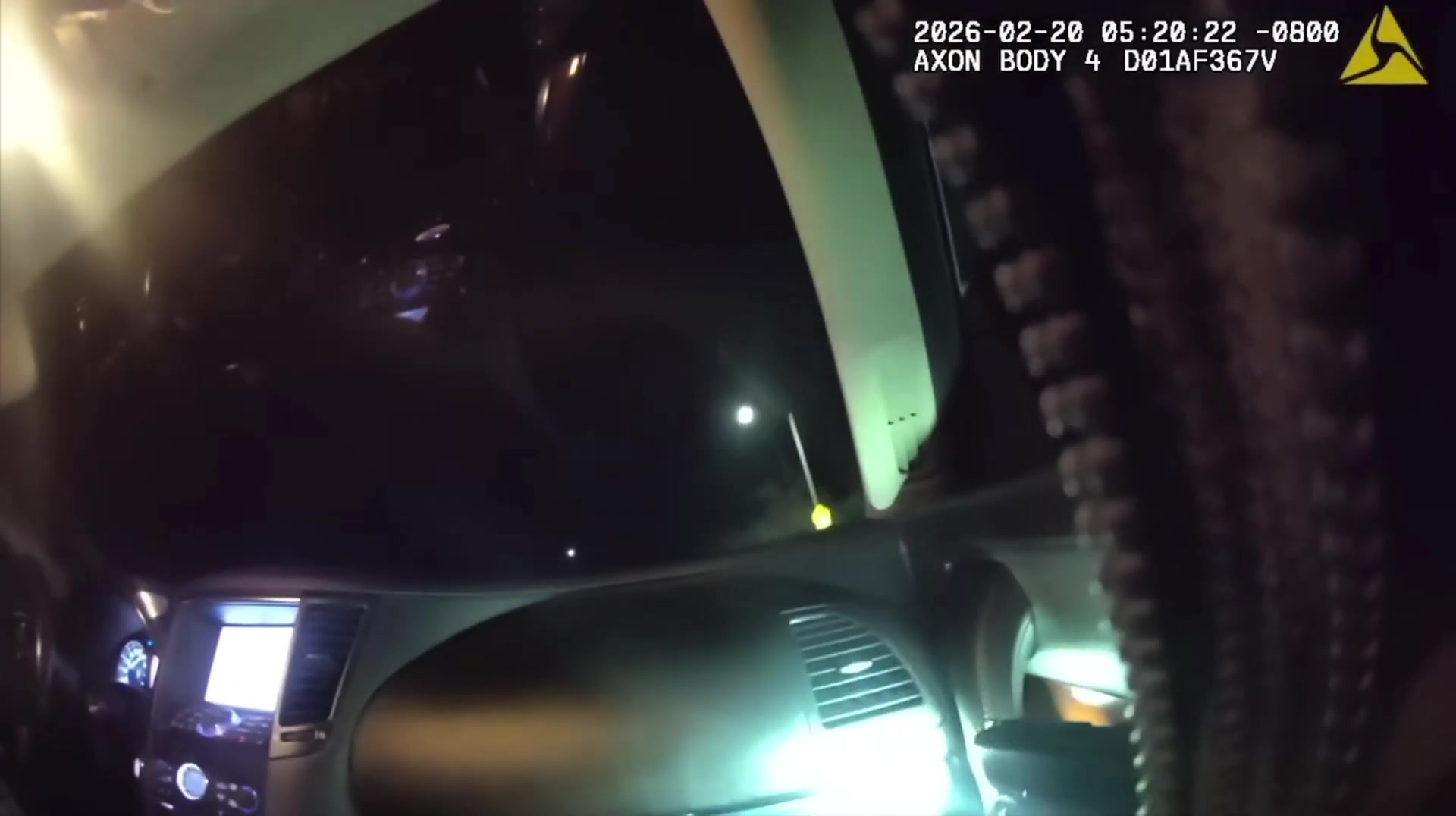
The camera angle reflects that sudden loss of control. Instead of a stable view from outside, the footage becomes tight and chaotic. The dashboard, passenger-side interior and rapidly changing exterior lights dominate the frame. The camera is no longer documenting an officer approaching a suspect car. It is documenting an officer unexpectedly traveling inside it.
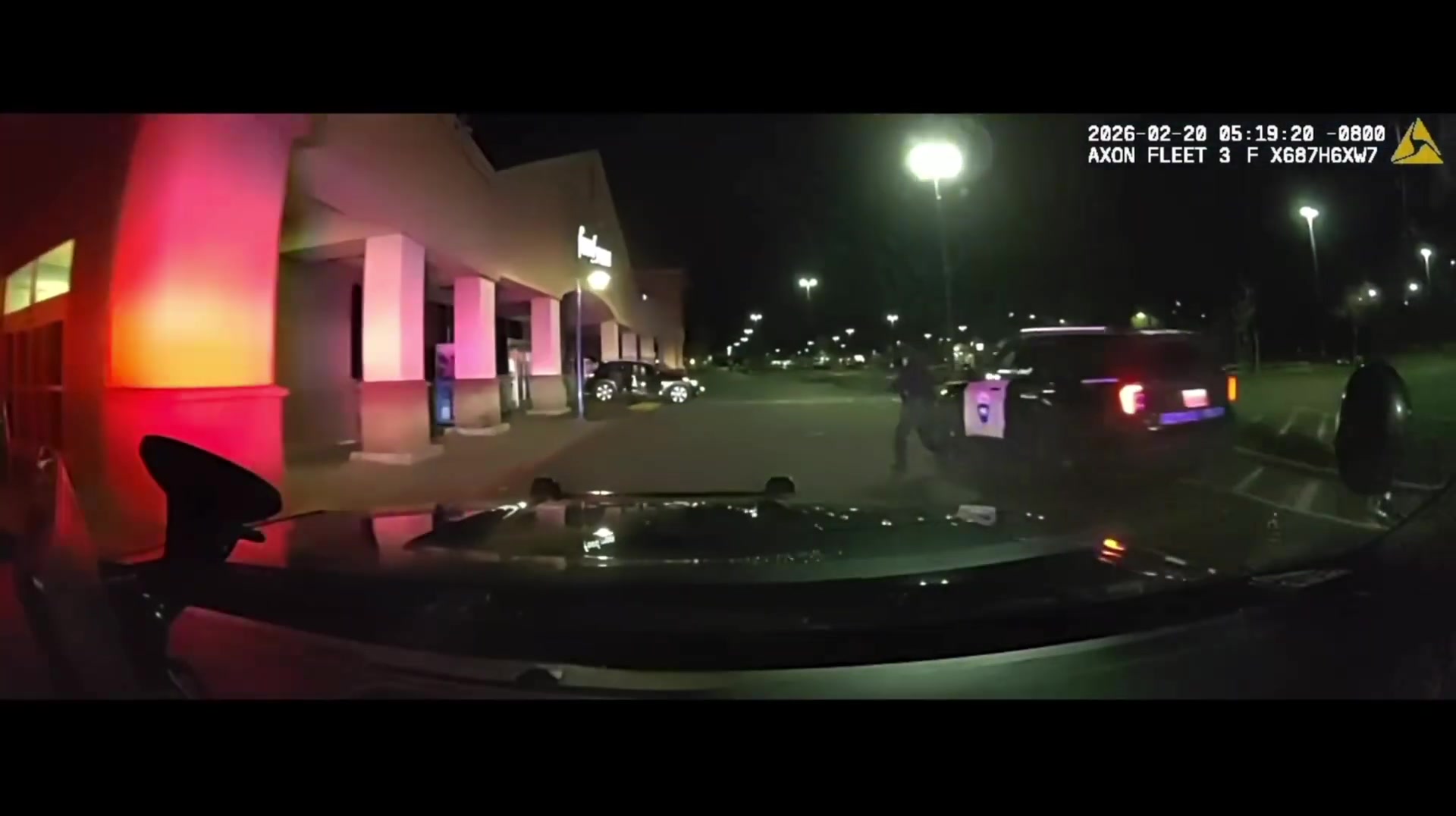
The Officer Is Carried Away From the Scene
Antioch police said DeSouza accelerated away with Donaldson trapped inside. Later reporting described the vehicle traveling roughly two miles through city streets. Donaldson repeatedly ordered the driver to stop. The commands are central to understanding what follows because they show that the officer was trying to end the moving confrontation rather than simply remaining in the vehicle by choice.
The footage captures a remarkable conversation under extreme pressure. Donaldson attempts to persuade the driver to stop while also trying to physically interfere with the vehicle's operation. Police said he tried to put the vehicle into neutral, while DeSouza repeatedly prevented him from doing so. The two men struggle over control inside a moving car while the road continues passing outside the windows.
At several points, DeSouza can be heard refusing to stop and discussing the possibility of crashing. Publicly released critical-incident material shows Donaldson attempting to de-escalate verbally, telling him that stopping is preferable to continuing the dangerous flight. The officer is simultaneously faced with a tactical dilemma: jumping from a moving vehicle could cause catastrophic injury, but remaining inside means being carried wherever the driver chooses to go.
This is why the incident cannot be understood simply as an officer riding in a fleeing suspect's car. The key fact is that Donaldson had lost the ability to safely exit. A vehicle traveling at speed can become a lethal hazard even without being intentionally used as a weapon. Sudden turns, collisions with parked vehicles, roadside objects or another patrol car could injure both occupants and anyone nearby.
The officer's attempts to reach the gear selector are therefore significant. Stopping the vehicle mechanically could have ended the danger without gunfire. But the footage and police narrative indicate that DeSouza repeatedly interfered with those attempts and continued driving.
A Moving Vehicle Becomes a Confined Struggle
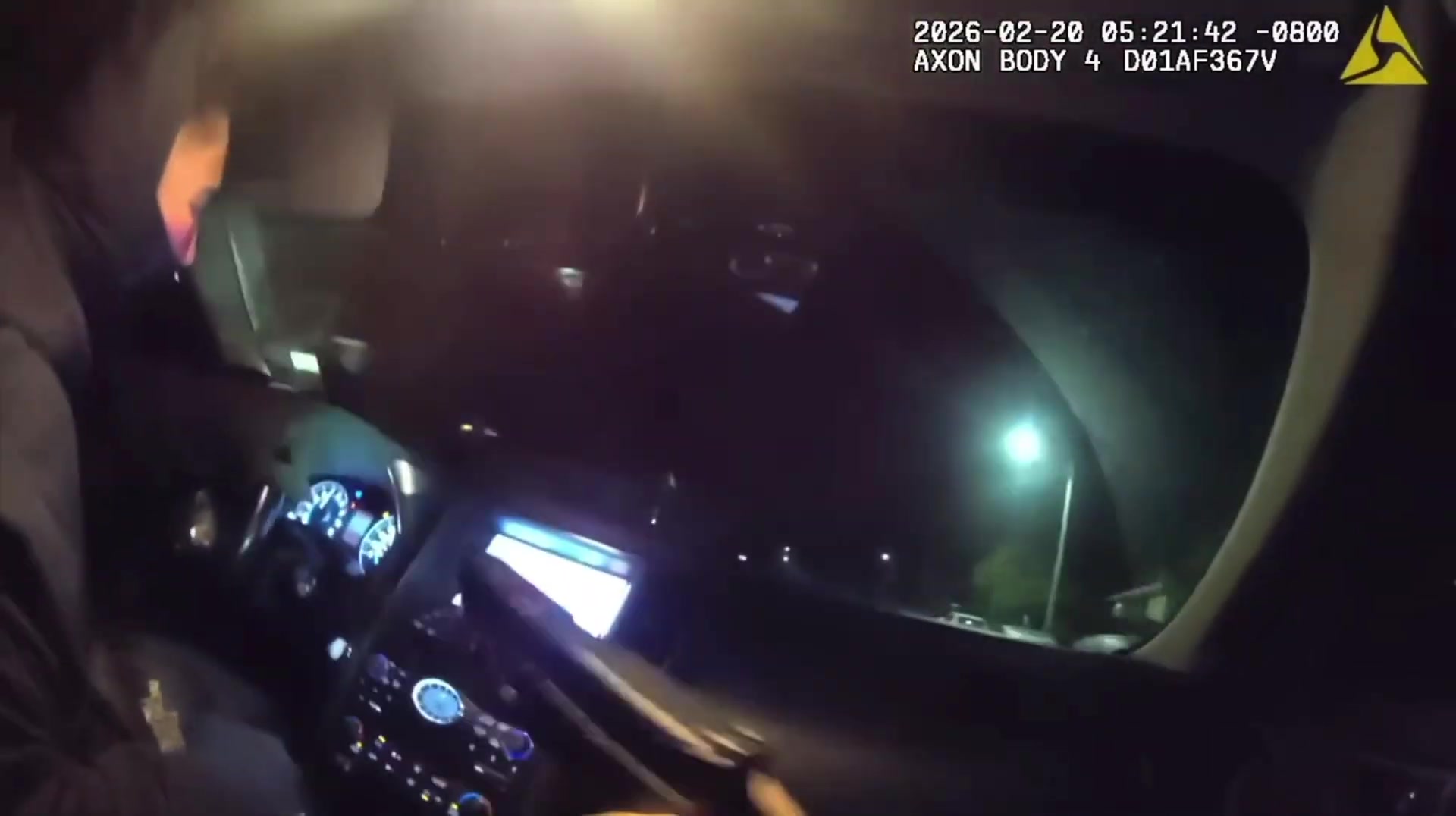
Inside the car, there is almost no meaningful distance between officer and driver. That matters because many police tactics depend on distance, cover and time. Donaldson has virtually none of those advantages. He is close enough to physically reach the driver, but he is also vulnerable to every steering input and acceleration. The driver, meanwhile, is trying to maintain control of the vehicle while resisting the officer's efforts.
The body camera shows Donaldson escalating through several responses. He uses verbal commands, tries to manipulate the transmission and physically strikes DeSouza. He also draws his service weapon and warns the driver that he may be shot if he refuses to stop. These actions occur while the vehicle remains in motion, making the encounter unlike a conventional roadside arrest.
Antioch's later critical-incident narrative said Donaldson intentionally fired at DeSouza's leg in an effort to stop the dangerous driving while reducing the likelihood of a fatal outcome. The original February press release used more limited language, stating simply that the officer discharged his service weapon and struck the suspect after repeated commands to stop were ignored.
That distinction is worth preserving. The fact that Donaldson fired is verified. The department's later explanation of his intended target and reasoning is also part of the official record, but it comes from the agency's reconstruction of the incident. The ultimate legal and policy review belongs to investigators and prosecutors, not to a body-camera viewer.
The shooting occurred only after the moving struggle had continued for an extended period. Donaldson had warned DeSouza and repeatedly tried other methods to stop the vehicle. According to public reporting, one round struck DeSouza in the leg.
The Car Crashes and the Driver Runs
After being struck, DeSouza eventually lost or relinquished effective control of the vehicle. Police and local reporting said the car collided with a parked vehicle in a residential area. DeSouza then got out and fled on foot. The suspect vehicle continued moving before coming to rest near a residence.
For Donaldson, the crash did not instantly resolve the emergency. He had just spent minutes trapped in a moving vehicle, had fired his weapon, and now had to determine where the driver had gone. His police radio had reportedly been disabled or shut off during the struggle, complicating his ability to immediately communicate what had happened.
The transition is striking. Seconds earlier, the officer's world was the passenger compartment of a speeding car. Now he is outside, trying to orient himself in a residential neighborhood and communicate that shots had been fired. This kind of abrupt change is one reason critical incidents are reconstructed frame by frame after the fact. Officers at the scene do not experience them with the clean chapter breaks available to later viewers.
Additional Antioch officers responded and began searching for DeSouza. Police said he was located a short time later hiding nearby and was taken into custody without further incident. Officers provided medical aid for his leg injury. The department described the wound as non-life-threatening. Donaldson sustained minor injuries.
The peaceful end to the foot search is also important. Once DeSouza was no longer driving and was ultimately located, the circumstances facing officers had changed. The encounter could move from an immediate vehicle threat to arrest and medical care.
What Investigators Confirmed Afterward
Antioch Police released its initial account on the day of the incident and later published critical-incident video while the investigation was still ongoing. The department identified the case as file 26-1688 and described it as an armed robbery and officer-involved shooting. The April release named Dominick DeSouza as the suspect and emphasized that the material was being made public before the investigation was complete.
The Contra Costa County District Attorney's Office was involved in the investigation alongside the Antioch Police Department Investigations Bureau. This kind of outside participation is important in an officer-involved shooting because investigators must examine both the underlying alleged crimes and the officer's decision to use force.
Later public materials identified Officer Travis Donaldson and provided additional detail about the nearly two-mile drive. Antioch's 2025-2026 compliance report described DeSouza as 23 and Donaldson as an Antioch officer hired in 2024. NBC Bay Area and other local outlets also identified Donaldson when the body-camera footage was released.
Reports about criminal charges should be understood as allegations, not findings of guilt. Public reporting has described charges connected with the robbery, the forced movement of the officer and the confrontation. Those legal allegations extend beyond what a viewer can independently prove from the body-camera recording alone.
The footage does, however, verify the core physical sequence with unusual clarity: officers respond to the FoodMaxx; a confrontation occurs around the suspect vehicle; Donaldson ends up inside as the car leaves; he repeatedly orders the driver to stop; the struggle continues while the vehicle moves; a shot is fired; the driver eventually exits and flees; and officers later take him into custody.
Why This Encounter Was So Dangerous
A moving-car confrontation compresses several hazards into one place. Donaldson had to manage a resisting driver, the speed and direction of the vehicle, traffic and roadside obstacles, his own inability to safely exit, and the possibility of a collision. At the same time, any use of a firearm inside a vehicle carries obvious risks of its own.
Police officers are generally trained to avoid placing themselves inside moving suspect vehicles when possible, precisely because doing so can eliminate distance and escape options. But body-camera footage often records situations where an officer's intended position changes instantly. In this case, the official account says Donaldson was pulled or knocked into the vehicle during the struggle rather than deliberately choosing to ride with the fleeing driver.
The encounter also illustrates the difference between a weapon threat and a vehicle threat. The original robbery caller reported that a suspect was armed with a firearm, but the danger Donaldson faced inside the car was not limited to whether DeSouza personally displayed a gun. The car's speed, the driver's refusal to stop, collision threats and the officer's inability to safely escape were themselves central to the risk.
That context does not remove the need to scrutinize the shooting. Officer-involved shootings are investigated precisely because lethal force requires close review. But meaningful review requires the entire sequence, not merely the fraction of a second in which a trigger is pulled.
The Full Footage Shows a Crisis Developing in Real Time
The most compelling part of this video is not any single dramatic frame. It is the progression from one failed opportunity to stop the situation into the next. Officers arrive at a robbery scene. The suspect vehicle collides with police. Donaldson reaches toward the driver. The car moves. The officer ends up inside. Commands fail. Attempts to shift the car into neutral fail. Physical control fails. The vehicle continues through Antioch.
That progression explains why the tone inside the car changes. Donaldson alternates between commands, warnings and attempts to talk DeSouza into stopping. The footage does not sound like a conventional arrest because it is not one. It is an improvised effort to survive and end a moving confrontation without causing an even larger crash.
Eventually, the officer fires once and the encounter enters its final phase. DeSouza leaves the vehicle, runs and is captured nearby. Both men survive. The suspect receives medical treatment, and the officer's injuries are described as minor.
The department's later release gives the public a chance to examine those decisions rather than relying solely on an initial press statement. It also makes clear why official investigations remain necessary even when video exists. Cameras show actions, but investigators still have to establish distances, speeds, physical evidence, statements, policies and the precise legal significance of each decision.
For viewers, the safest way to understand the case is to keep three categories separate. The video shows the physical encounter and the officer's perspective. Antioch Police provides the official reconstruction and evidence-based details such as the case number and suspect identity. News reporting supplies additional context about the participants and subsequent legal proceedings. Where those sources overlap, confidence is high. Where they do not, the article should not invent the missing pieces.
The result is an incident that sounds almost unbelievable when reduced to a headline: an officer becomes trapped in a fleeing robbery suspect's car and ultimately fires at the driver. The body-camera footage shows why that headline is only the beginning of the story. For several minutes, Donaldson is trying to stop a moving vehicle from inside it while the driver refuses to surrender.
Comments (0)
Loading comments...
May You Like

UCF Student’s Pronoun Dispute With Campus Police Escalates Into an Arrest

Entitled Driver Skips the Line and Gets Instant Karma3
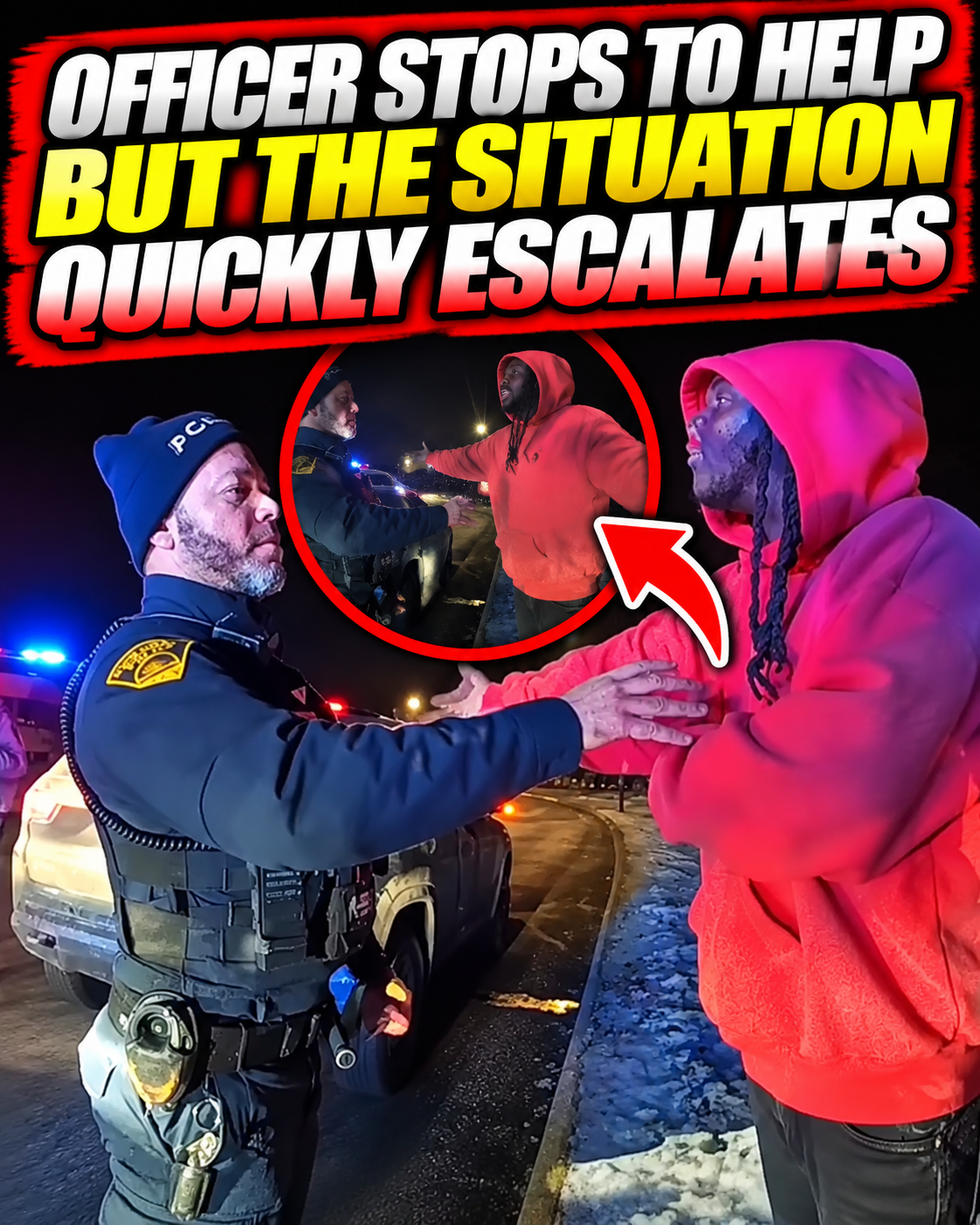
Officer Stops to Help but the Situation Quickly Escalates















