
Road Rager Calls Police On Biker Only To Get Arrested
Driver Calls Police After Road Rage Clash but the Evidence Turns the Case Against Him
One Traffic Dispute, Six 911 Calls and Two Armed Men
Road rage has an unsettling ability to transform an insignificant driving mistake into a confrontation that can change several lives.
One vehicle merges too closely.
Someone honks.
A gesture follows.
Instead of allowing a few seconds of irritation to disappear in the rearview mirror, somebody decides to follow the other driver.
Then both vehicles stop.
People get out.
Weapons appear.
By the time everyone realizes how far the situation has escalated, police are already on their way.
That is essentially what unfolded in Palm Coast, Florida, on May 17, 2022.
According to a police report reproduced with the body-camera footage, Deputy P. Kotowski responded to the intersection of Pine Lakes Parkway and Whirlaway Drive for what dispatch classified as a weapons disturbance.
This was not a call coming from one confused witness.
Six 911 calls had reportedly been made concerning two men fighting in the roadway.
When deputies arrived, they encountered the aftermath of a confrontation involving a motorcycle, a silver Toyota Tacoma, metallic knuckles, a fixed-blade knife and a firearm.
Both men were initially placed in handcuffs while officers investigated.
At that moment, police did not yet have the luxury of knowing exactly which story was accurate.
Each participant had his own explanation.
But this confrontation had something many road-rage cases do not.
A witness had recorded it.
That recording would change the entire direction of the investigation.
The person who believed he had called police to report the other man was about to discover that contacting law enforcement does not automatically make someone the victim.
Evidence decides that.
The Argument Begins Before Anyone Gets Off the Road
The motorcyclist told Deputy Kotowski that he had been riding with his wife when he became involved in a road-rage encounter with the silver Toyota Tacoma.
According to his account, the Tacoma cut him off.
He also alleged that the Tacoma's driver threw something toward his motorcycle.
Instead of separating, the vehicles remained involved with one another until reaching the intersection of Pine Lakes Parkway and Whirlaway Drive.
That decision is where the situation changed.
Traffic conflicts usually have an easy escape route.
Keep driving.
Create distance.
Turn onto another road.
Pull into a safe public place while calling police.
The moment both sides stop and begin confronting one another, however, the risk increases dramatically.
According to the police report, Rafael exited the Toyota carrying a fixed-blade knife.
The motorcyclist responded by equipping himself with metallic knuckles because he believed a physical confrontation was developing.
At this stage, both men were now armed.
That does not mean their actions were legally equivalent.
The sequence matters.
Who produced a weapon first matters.
Who approached whom matters.
Whether someone attempted to disengage matters.
And those details soon became central to the deputies' investigation.
The argument continued.
Rafael reportedly told the motorcyclist not to approach him.
But according to the report, Rafael then moved toward the rider himself.
The distance between them closed.
The knife moved.
The motorcyclist responded by drawing his firearm and pointing it at Rafael while ordering him to step away.
Fortunately, no shots were fired.
The men were eventually separated.
Had the confrontation lasted only a few seconds longer, this story could have been about a fatal shooting rather than an arrest.
Instead, deputies arrived to find two men offering different perspectives on what had just happened.
Now the difficult part began.
They had to determine which version matched the evidence.
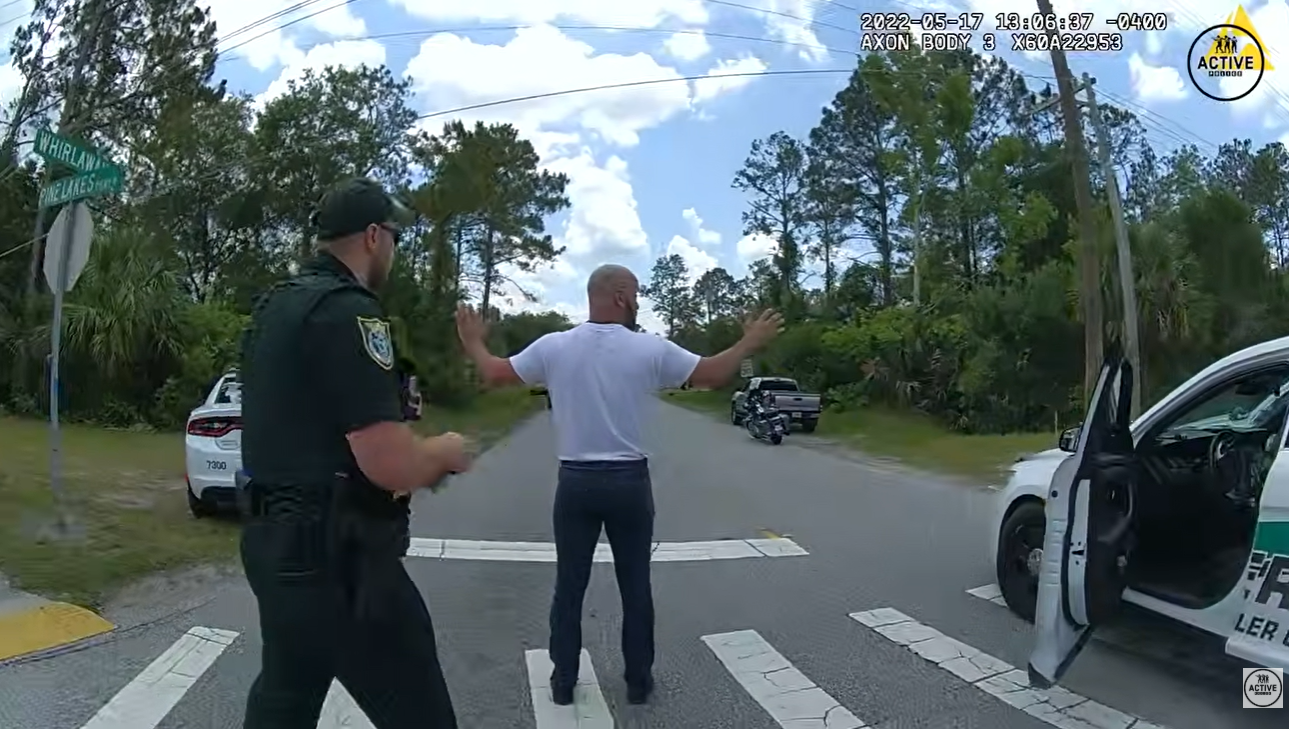
Two Stories Cannot Both Explain the Same Video
Body-camera footage is especially revealing during investigations like this because the most important action may have occurred before police arrived.
The officers did not personally witness the road-rage confrontation.
They arrived afterward.
That means they initially had to work backward.
Talk to one person.
Talk to the other.
Identify witnesses.
Recover weapons.
Determine whether anyone was injured.
Then compare the accounts.
The motorcyclist described Rafael approaching with a knife.
Rafael gave officers a different explanation.
According to the report, Rafael said the motorcycle had been operating erratically and that its rider had shown him the middle finger.
He acknowledged eventually stopping near the intersection and getting out with a knife.
But he told deputies that he had done so because he was afraid of what might happen and had seen the other man with metallic knuckles.
That explanation creates an obvious investigative question.
Which weapon appeared first?
The report addressed that point directly.
According to Deputy Kotowski, the motorcyclist did not put on the metallic knuckles until after the knife had already been displayed.
Still, officers had more than competing statements.
They had video.
A woman at the scene had recorded the confrontation on her phone.
Deputy Kotowski reviewed the footage.
Suddenly the investigation no longer depended exclusively on memory.
The video reportedly showed both men arguing and challenging one another verbally.
Then came the moment that mattered most.
According to the deputy's description, after roughly a minute of arguing, Rafael aggressively stepped toward the motorcyclist with the knife in his right hand.
He then made a slashing movement.
The blade contacted the exterior of the motorcyclist's leather jacket.
That was a critical piece of evidence.
A verbal argument had become physical contact involving a knife.
The video also created a problem for Rafael's version of events.
He reportedly denied approaching the rider aggressively.
But officers had just watched footage that, in their interpretation, showed exactly that.
When confronted with the discrepancy, the report says Rafael responded that he did not remember it occurring.
Memory was no longer the strongest evidence at the scene.
The recording was.
An Independent Witness Changes the Picture Even Further
The cellphone video was not the only evidence supporting the motorcyclist's account.
Deputy Somers located and interviewed an independent witness.
That witness reportedly saw the two vehicles stop on the side of the road.
More importantly, the witness said he saw Rafael exit the vehicle carrying a knife and behave as though he was going to cut the motorcycle rider.
Now investigators had multiple sources pointing in the same direction.
There was the rider's account.
There was cellphone footage.
And there was an independent witness.
This is how a chaotic roadside confrontation becomes an evidence-based police investigation.
The first person to call 911 does not automatically win.
The angriest person does not automatically lose.
The person with the most convincing story does not necessarily determine the outcome.
Officers compare statements against physical and recorded evidence.
That distinction is especially important in road-rage incidents.
People involved are often emotionally charged.
Their perception of what happened can be distorted by fear, anger and adrenaline.
Each side may sincerely believe the other person started everything.
Video does not solve every evidentiary problem, but it can provide a fixed reference point.
In this case, the cellphone footage apparently captured the exact moment officers needed to evaluate.
Rafael said he had not aggressively approached the rider.
The video showed an approach and knife movement, according to the report.
The independent witness described seeing similar behavior.
That combination changed the nature of the investigation.
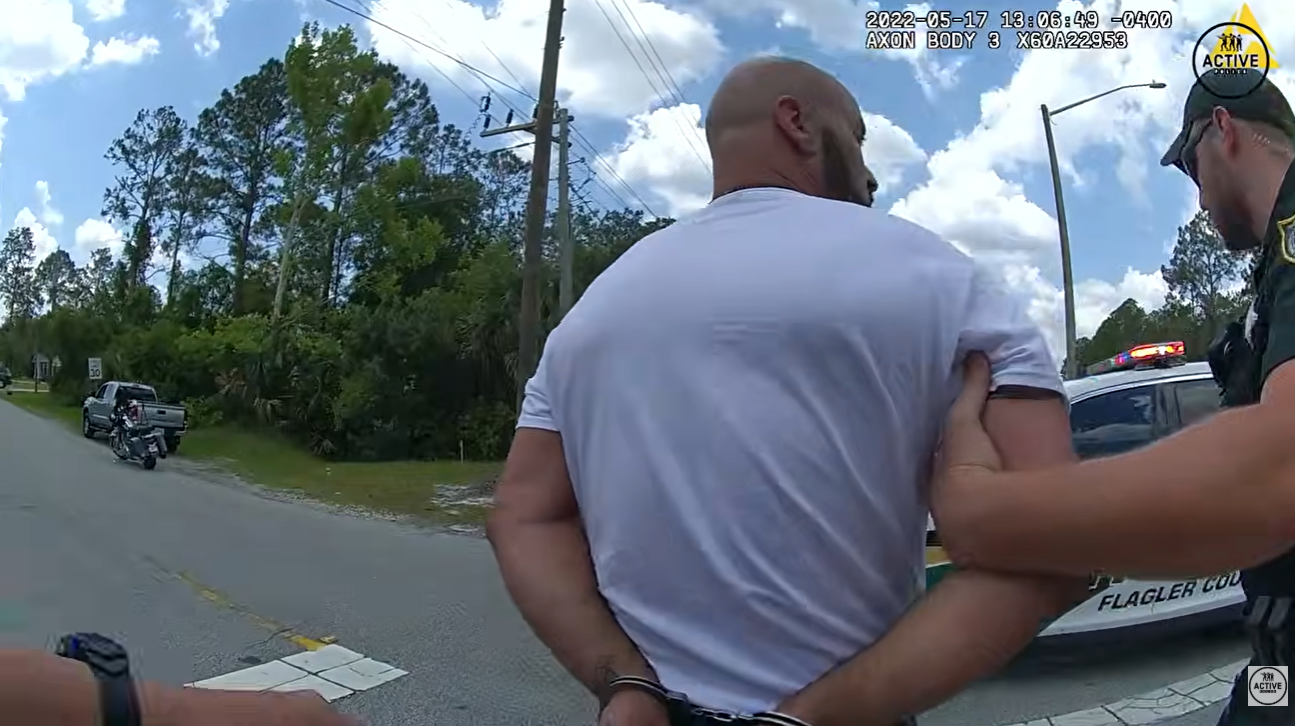
Why the Firearm Did Not Automatically Make the Motorcyclist the Suspect
One of the most interesting elements of this incident is the presence of multiple weapons.
Rafael had a knife.
The motorcycle rider had metallic knuckles.
Then the rider drew a firearm.
Looking only at the final moment could make the situation appear straightforward: one person has a knife, another points a gun.
But self-defense investigations depend heavily on sequence and circumstances.
The question is not simply who possessed the more powerful weapon.
Investigators need to know what threat existed when that weapon was displayed.
According to the police narrative, the rider produced his firearm after Rafael advanced with the knife and swung it close enough to contact the rider's leather jacket. The rider then pointed the firearm at Rafael and ordered him to move away.
No shot was fired.
That fact matters.
The firearm appears in the report as a response to the escalating knife threat rather than the beginning of the armed confrontation.
The motorcyclist's metallic knuckles created another issue, but again the timing was significant.
Deputy Kotowski specifically noted that the rider put them on only after Rafael had already displayed the knife.
That does not make road rage a sensible place to test the boundaries of self-defense law.
Quite the opposite.
This encounter demonstrates why stopping to confront another road user can be extraordinarily dangerous.
Once weapons appear, every movement becomes open to interpretation.
A step forward can look like an attack.
Reaching toward a waistband can trigger a defensive reaction.
One misunderstanding can turn a shouting match into a homicide.
The best outcome is to avoid creating that situation in the first place.
Neither participant benefited from continuing the dispute.
But one participant's actions were ultimately supported by evidence as defensive responses to the other's escalation.
That difference would determine who left the scene in custody.
The Caller Learns That Police Investigate Everyone
There is an irony at the heart of the video that explains why it became so popular online.
Someone involved in the confrontation expected police intervention to resolve the situation in his favor.
Instead, deputies investigated what happened.
The evidence pointed somewhere else.
The original Active Police Cam upload, published August 31, 2022, eventually accumulated nearly two million views. Its title summarized the twist succinctly: the road rager calls police concerning the motorcycle and ends up arrested himself.
But the bodycam shows that the arrest was not simply a comedic reversal.
Deputies had to establish probable cause.
They questioned both men.
They reviewed the cellphone recording.
They interviewed an independent witness.
They compared Rafael's statements against what the video showed.
Only then did the outcome become clear.
That investigative process is arguably more interesting than the arrest itself.
Police calls often begin with an assumption built into the language of the caller.
Someone says, “He threatened me.”
Someone says, “She attacked me.”
Someone says, “This driver pulled a gun.”
Dispatch relays that information.
Responding officers still have to determine what actually occurred.
The caller is a source of information, not automatically the victim.
This case demonstrates that principle almost perfectly.
Rafael acknowledged having the knife.
He said he feared the motorcyclist.
He denied aggressively approaching him.
But the video and witness account reportedly contradicted that denial.
The police report therefore moved from conflicting claims to corroborated evidence.
And the arrest followed.
The Cellphone Recording Becomes the Most Important Witness
Imagine the same incident without the video.
There would still be physical evidence.
Officers could recover the knife, firearm and metallic knuckles.
There would still be an independent witness.
There would still be statements from both participants.
But the investigation would be more difficult.
A recording preserves details human memory can lose.
Who stepped forward?
Where was the knife?
When did the firearm appear?
How much distance separated the two men?
What was being said immediately before the movement?
In this case, the cellphone footage reportedly showed Rafael making a cross-like slashing movement that struck the exterior of the rider's jacket.
That detail is far more specific than a general statement that the men “got into a fight.”
It helps explain why the motorcyclist said he feared for his life.
It also helps explain why Rafael's denial became difficult to sustain.
The role of video is particularly relevant in modern road-rage cases because cameras are everywhere.
Motorcycles frequently carry action cameras.
Cars have dashcams.
Businesses have surveillance systems.
Homes have doorbell cameras.
Passengers have phones.
Police arrive wearing body cameras.
A confrontation that someone believes occurred without witnesses may actually be recorded from several directions.
That should create an additional reason to disengage.
Anger can disappear.
Video does not.
A Few Seconds of Anger Create a Police Case
Road rage often begins with something remarkably trivial.
The police report says Rafael believed the motorcycle was being driven erratically and that its operator had given him the middle finger.
The rider said the Tacoma had cut him off and that Rafael threw something toward the motorcycle.
Whatever the precise beginning, neither grievance justified allowing the situation to reach the point captured in the cellphone video.
That is the larger lesson.
A gesture from another driver is not a command to follow them.
Being cut off does not require confrontation.
An insult does not need an answer.
The road offers an escape route almost constantly.
Turn away.
Slow down.
Increase distance.
Call police if a genuine threat continues.
What happened at Pine Lakes Parkway and Whirlaway Drive was the opposite.
The conflict was carried forward until both sides were standing in the roadway with weapons.
Six people were concerned enough to call 911.
Deputies had to respond to a weapons disturbance.
Both men were handcuffed while investigators determined what had happened.
A knife, metallic knuckles and a firearm became part of the investigation.
And video evidence ultimately helped establish the sequence.
All of that grew out of a traffic disagreement.
The most remarkable part is how easily the outcome could have been worse.
When Rafael allegedly swung the knife, the motorcyclist had a firearm.
Had he fired, officers would have arrived at a shooting scene.
Investigators then would have faced a far more serious question about whether deadly force was justified.
Instead, the rider displayed the gun and ordered Rafael back.
No one was shot.
That decision left police with an assault investigation rather than a possible homicide.
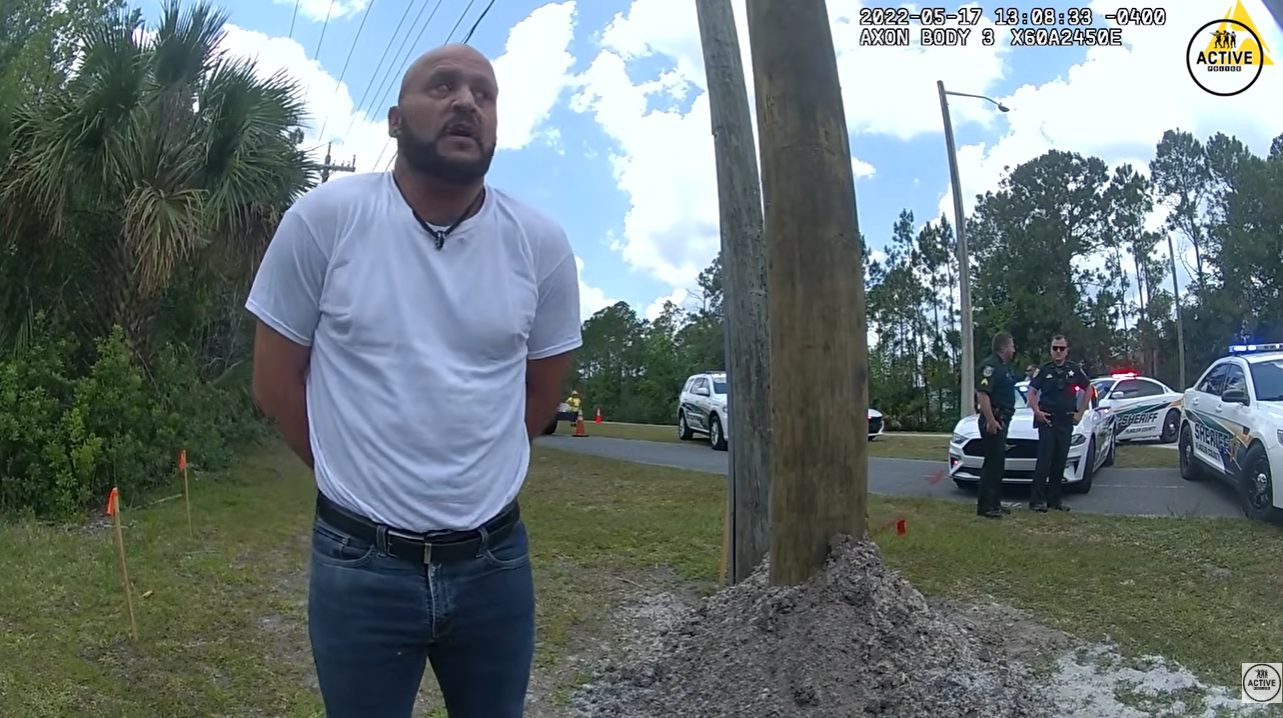
The Road Rage Ends With Handcuffs
By the conclusion of the body-camera footage, the emotional chaos of the roadside argument has been replaced by the methodical work of an investigation.
The men have been separated.
Deputies have statements.
They have the cellphone video.
They have an independent witness.
And the pieces line up.
The evidence described in Deputy Kotowski's report supported the conclusion that Rafael had exited the Tacoma armed with the fixed-blade knife and later moved aggressively toward the motorcycle rider, making a slashing motion that contacted his jacket.
His own explanation did not overcome what investigators believed the video showed.
That is ultimately what makes this case more than another viral road-rage clip.
The arrest is the punch line.
The evidence is the real story.
The person who contacts police first does not control the investigation.
The person who sounds most confident does not control it either.
Recorded evidence, witnesses and the sequence of actions matter.
This confrontation also shows how thin the line can become between road rage and lethal violence.
A knife came out.
Metallic knuckles came out.
A firearm came out.
Yet everyone survived.
That is fortunate.
But it should not obscure how unnecessary the entire encounter was.
One vehicle could have continued down the road.
One driver could have refused to engage.
One person could have decided that being angry was not worth stopping.
Any one of those choices could have prevented six 911 calls, an armed confrontation and an arrest.
Instead, everyone stopped.
The argument intensified.
Weapons appeared.
And the person who apparently expected police to validate his version of events discovered something very different when officers watched the recording.
Road rage rarely produces a winner.
Sometimes it merely determines who drives away and who leaves in handcuffs.
Watch the full encounter and see how deputies used witness statements and cellphone footage to uncover what happened before making the arrest: https://www.youtube.com/watch?v=5t-rFNQS5hc
Comments (0)
Loading comments...
May You Like

Couple Arrested for leaving 10 Dogs and Cats in Hot car in Florida

What Happens when you get Caught Shoplifter Stealing Local Store

Stolen Charger Flees Police During Highway Traffic Stop












