
Red Light Runner Launched Into The Air After Violent Crash!
Red-Light Crash Sends a Car Flying Across an Indianapolis Intersection
HOOK: THE PEDESTRIAN WAS ONLY SECONDS AWAY
The traffic light was red.
Cars were stopped.
A pedestrian was crossing the road.
For the husband and wife sitting behind the dashcam, it looked like an ordinary Sunday afternoon at an Indianapolis intersection.
Then a vehicle came through the light.
What happened next lasted only seconds.
A violent collision erupted in the middle of the intersection. One vehicle was struck with enough force to send it into the air. Pieces of the wreckage scattered across the roadway. The airborne vehicle came down onto another car, rotated forward on its nose and crashed into a Jaguar SUV waiting at the light.
And directly beside the chaos was the pedestrian who had just been crossing 82nd Street.
A few seconds earlier or later could have produced an entirely different outcome.
Instead, despite a collision involving six damaged vehicles, the person who supplied the footage to ViralHog reported something remarkable:
Nobody was injured.
The footage is only about 30 seconds long, but it demonstrates one of the most dangerous characteristics of red-light crashes.
The person who ignores the signal may make the initial mistake.
Everyone else in the intersection can pay for it.
OPENING: A NORMAL SUNDAY AFTERNOON IN INDIANAPOLIS
The crash occurred on October 17, 2021, in Indianapolis, Indiana.
The dashcam timestamp visible in the video confirms the date, while the street sign directly ahead identifies Hague Road.
ViralHog's original description provides the rest of the location.
The vehicle carrying the dashcam was facing west on 82nd Street at Hague Road.
The occupants were a husband and wife.
They were stopped for the red light.
At approximately 12:30 p.m., a pedestrian was crossing 82nd Street in front of them.
Everything visible in the opening seconds looks routine.
Traffic is waiting.
Visibility is excellent.
It is broad daylight.
The intersection is large and clearly controlled by traffic signals.
Nothing suggests that a major collision is seconds away.
That ordinary appearance is precisely what makes the footage so effective.
There is no police chase.
No extreme weather.
No obvious road hazard.
The intersection itself isn't malfunctioning.
All it takes is one vehicle entering at the wrong moment.
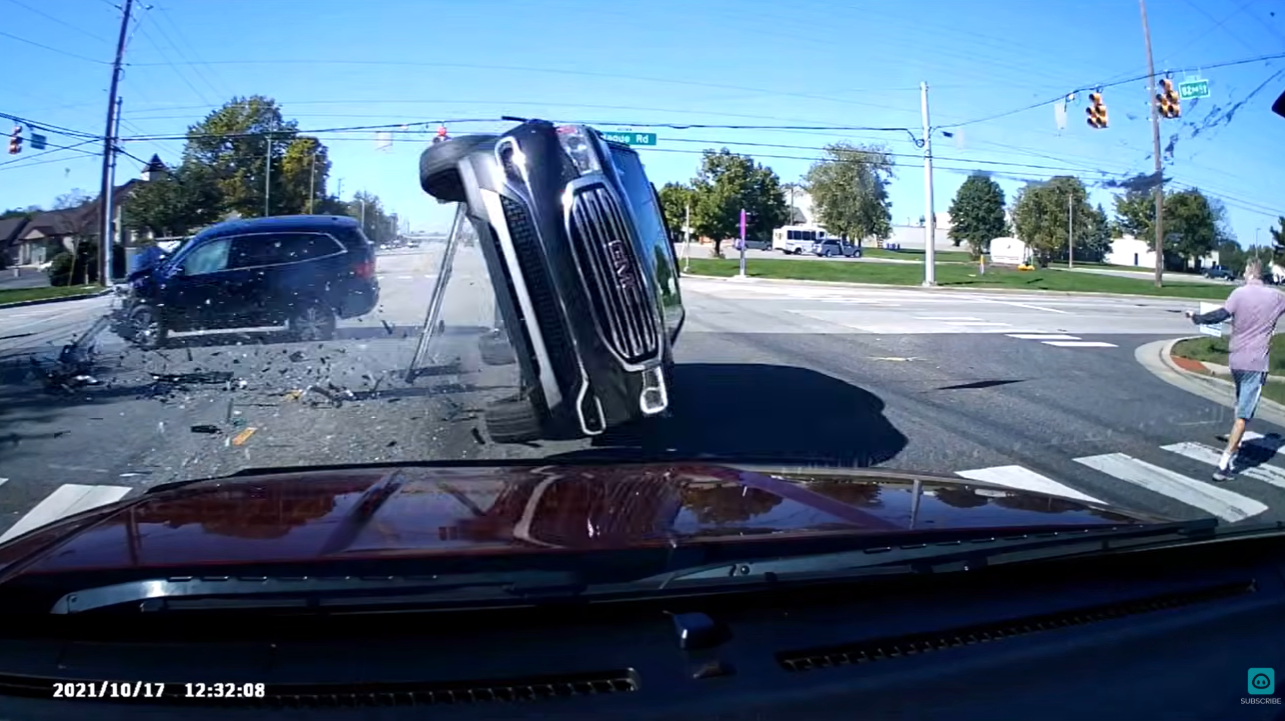
The person who supplied the video explained that an eastbound driver on 82nd Street ran the red light.
At the same time, another vehicle was moving through the intersection.
Neither vehicle had enough time or distance to prevent what happened next.
The collision was enormous.
DEVELOPMENT: THE IMPACT LAUNCHES A VEHICLE INTO THE AIR
Most intersection crashes remain on the pavement.
Vehicles rotate.
They slide.
They spin into nearby lanes.
This one was different.
The impact redirected enough energy into one of the vehicles that it became airborne.
ViralHog's description says the struck vehicle sent debris toward the dashcam car, including pieces from its sunroof.
Then it flew across the intersection.
The video captures the extraordinary moment clearly.
For a fraction of a second, the vehicle is completely above the roadway.
Its wheels are no longer touching the pavement.
The car passes over another vehicle and comes down amid traffic that had simply been waiting for the light.
It then rotates forward.
According to the person who recorded the incident, the vehicle spun on its nose before falling onto a Jaguar SUV that was stopped at the signal.
The chain reaction ultimately damaged six vehicles.
NDTV, which reported on the viral footage shortly after it appeared online, described the speeding vehicle crashing into another car and sending it into the air before it landed on another SUV.
That sequence explains why intersection collisions can become multi-vehicle events even when only two vehicles make the initial contact.
The first crash changes the trajectories of both vehicles.
After that, the drivers may have almost no control over where their vehicles travel.
Momentum takes over.
And everyone nearby becomes part of the danger zone.
THE PEDESTRIAN MAY HAVE BEEN THE LUCKIEST PERSON THERE
It is easy to focus on the flying vehicle.
But watch the pedestrian.
In the seconds immediately before the crash, someone is crossing the roadway.
That person has no steel frame.
No airbags.
No seat belt.
No crumple zones.
Indiatimes highlighted the same detail when reporting on the footage, noting how narrowly the pedestrian escaped the chaos created by the airborne vehicle.
The timing is extraordinary.
Had the pedestrian started crossing slightly later, the person could have been directly in the path of the collision.
Had the impact sent the vehicle in a slightly different direction, the outcome could also have changed.
Instead, the pedestrian escapes.
That is one reason this video remains so startling even years later.
The most spectacular element is the vehicle flying through the air.
The most consequential element may be where it didn't land.
WHY RED-LIGHT COLLISIONS CAN BE SO VIOLENT
The geometry of an intersection helps explain what viewers see.
When vehicles collide while traveling in roughly the same direction, some of their momentum is shared along similar paths.
Intersection crashes are often different.
Vehicles can meet at large angles, sometimes close to perpendicular.
That creates the classic side-impact or T-bone collision.
The side of a passenger vehicle generally provides less physical space between the point of impact and the occupant than the front or rear of the vehicle.
There is another problem.
A strong side impact can redirect the struck vehicle rather than simply bringing it to a stop.
That is exactly what appears to happen here.
The initial impact doesn't end the crash.
It begins the second phase.
The struck vehicle is redirected upward and across the intersection.
Then gravity brings it back down into traffic.
At that point, drivers waiting innocently at their light have virtually no opportunity to escape.
A driver can react to a vehicle approaching normally.
Reacting to a car suddenly falling out of the air is another matter entirely.
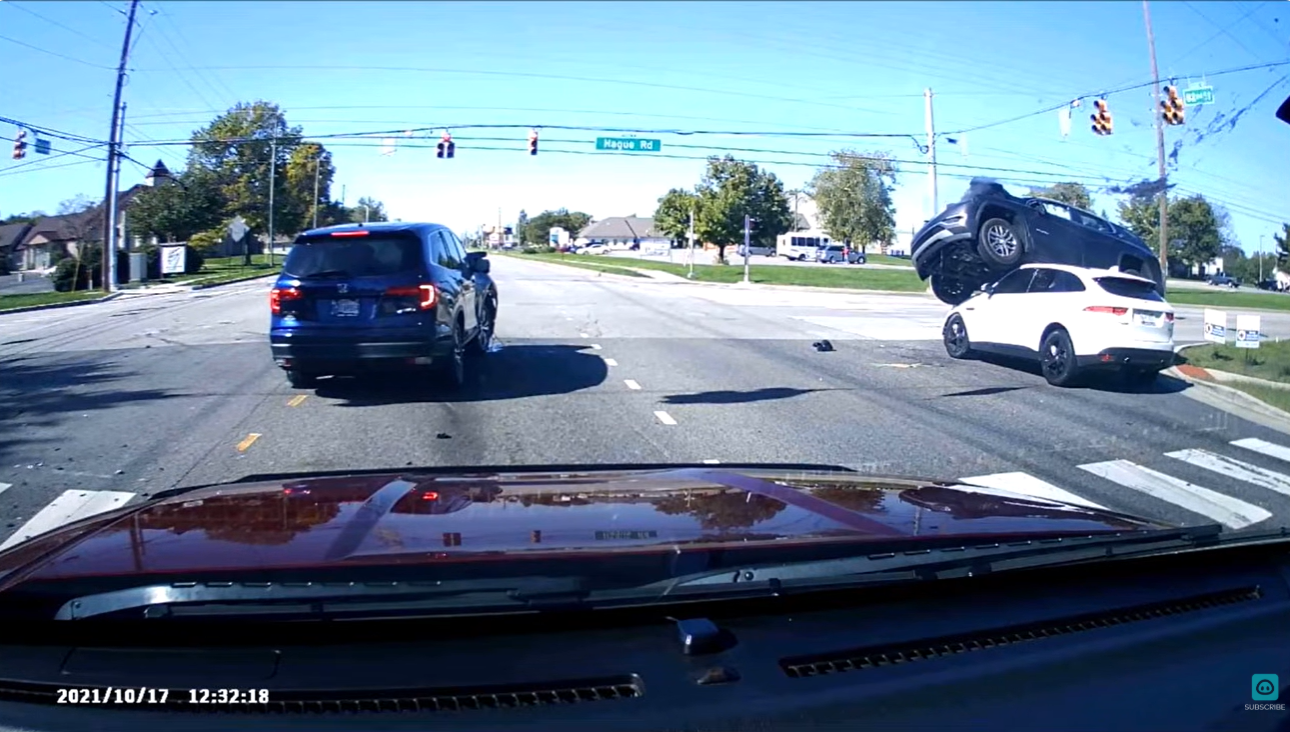
This is the image that made the incident viral.
But a still photograph hides the most important part of the story.
The airborne vehicle is not the beginning of the crash.
It is the consequence.
Seconds earlier, everyone was simply using the intersection.
The people waiting at the red light had done what they were supposed to do.
The pedestrian was using the crossing.
Other traffic was moving through the intersection.
Then one driver's failure to stop changed the situation for everyone.
THE DASHCAM CAR WAS HIT WITHOUT EVER MOVING
There is another detail that illustrates how unpredictable the collision became.
The husband and wife recording the incident were not driving through the intersection.
They were stopped.
Yet their vehicle was still damaged.
The person who supplied the footage said debris from the struck vehicle showered their car, including material from the vehicle's sunroof.
That is an important reminder about crash scenes.
Danger does not stop at the physical boundaries of the vehicles involved.
Glass travels.
Plastic panels break apart.
Metal fragments separate.
Cargo can become airborne.
Vehicle components can be thrown considerable distances.
In a high-energy collision, someone can be affected without their vehicle ever making direct contact with the original cars.
The dashcam vehicle demonstrates that perfectly.
Its occupants were waiting at a red light.
They did not enter the intersection.
Yet the crash reached them anyway.
SIX VEHICLES DAMAGED AND NO REPORTED INJURIES
Perhaps the most surprising fact about the incident is the final injury count.
Six vehicles were damaged.
One became airborne.
Another ended up beneath it.
Debris scattered through the intersection.
A pedestrian was nearby.
Yet according to the eyewitness account supplied with the original ViralHog footage, there were no injuries.
That outcome should not make the crash appear less serious.
It shows how narrow the margin was.
Change any one variable and the result could have been very different.
Move the pedestrian several feet.
Change the angle of impact.
Move one waiting vehicle forward.
Alter the speed of either vehicle slightly.
The airborne car could have landed differently.
A driver or passenger could have been struck more directly.
The pedestrian could have been caught in the collision.
Instead, the primary result was property damage.
That is extraordinarily fortunate given what the video shows.
WHY THE DRIVER MAY NOT HAVE SEEN THE RED LIGHT
The account accompanying the video says the approaching driver didn't see the red light.
It does not establish why.
That distinction matters.
The footage alone cannot prove whether the driver was distracted, confused, fatigued, looking elsewhere or simply failed to recognize the signal in time.
It would therefore be inaccurate to assign a specific cause without police findings or another reliable record.
What can be established from the video is much simpler:
The vehicle enters when cross traffic has the right of way.
The collision follows almost immediately.
This is also why phrases such as "distracted driver" should not automatically be added to viral crash footage unless supporting evidence exists.
A dramatic video does not reveal what a driver was thinking.
It reveals what the vehicle did.
In this case, that observable sequence is already compelling enough.
THE CAMERA CAPTURED THE ENTIRE CHAIN REACTION
Dashcams have changed the way traffic collisions are understood.
Without this recording, the Indianapolis crash might have been remembered primarily through damaged vehicles and witness accounts.
The camera provides something different.
It preserves the order of events.
The signal.
The pedestrian.
The waiting vehicles.
The approaching traffic.
The impact.
The launch.
The landing.
And the aftermath.
That sequence is especially important in intersection crashes because witnesses may see different pieces of the event.
Someone facing one direction may see the first impact but not the traffic signal.
Someone farther away may see the airborne vehicle but not which car entered first.
A driver involved in the collision may remember only fragments.
The dashcam simply keeps recording.
And in this case, it happened to be pointed directly toward the intersection.
The image looks almost impossible.
A vehicle appears suspended over ordinary traffic.
But the dashcam proves how quickly that extraordinary moment emerged from an ordinary traffic situation.
WHY THIS 30-SECOND VIDEO ATTRACTED SO MUCH ATTENTION
The footage was published by ViralHog on November 22, 2021, a little over a month after the crash.
It quickly spread beyond the original upload.
NDTV reported on it the following day, while other outlets and social-media pages circulated the footage internationally.
The appeal is easy to understand.
The clip requires almost no explanation.
Anyone who has driven through a signal-controlled intersection immediately recognizes the situation.
Everyone has waited at a red light.
Everyone has crossed an intersection after the signal changes.
Most drivers assume that traffic facing the red signal will stop.
The entire road system depends on that assumption.
The Indianapolis footage shows what happens when it fails.
And unlike many dramatic crash videos, the ending provides relief rather than tragedy.
The vehicles are heavily damaged.
The crash looks catastrophic.
But everyone reportedly survives without injury.
That makes the video shocking without ending in a fatal outcome.
A FEW SECONDS CAN SEPARATE A NEAR MISS FROM A TRAGEDY
The pedestrian provides the clearest illustration.
Crossing a street normally requires trusting several independent systems.
The traffic light must function.
Drivers must see it.
Drivers must obey it.
Vehicles must be mechanically capable of stopping.
And people approaching the intersection must remain attentive enough to react.
The pedestrian in this video had no meaningful ability to influence the approaching vehicle.
By the time the crash occurred, the only protection was timing.
Fortunately, the timing worked.
The same is true for the people inside the waiting vehicles.
They had obeyed the signal.
They were stationary.
Yet one of those vehicles still ended up beneath the airborne car.
This is why defensive driving can reduce risk but never eliminate it.
Sometimes another driver's mistake reaches you even when you do everything correctly.
ENDING: THE RED LIGHT WAS THERE FOR A REASON
The Indianapolis crash lasts only seconds.
But its sequence is worth remembering.
It is Sunday afternoon.
Traffic is waiting at Hague Road.
A pedestrian crosses 82nd Street.
An eastbound vehicle approaches.
The red signal is missed or ignored.
The vehicle enters the intersection.
Impact.
Another car is launched into the air.
Debris hits the dashcam vehicle.
The airborne car comes down onto another vehicle, rotates forward and falls against the Jaguar SUV waiting nearby.
When everything finally stops, six vehicles have been damaged.
Yet the most important number is zero.
Zero reported injuries.
Given the violence visible in the footage, that outcome seems almost unbelievable.
The pedestrian escaped.
The people inside the waiting vehicles escaped serious physical harm.
The husband and wife behind the dashcam watched debris strike their vehicle but were not reported injured.
The footage therefore becomes more than another viral crash.
It is a remarkably clear demonstration of how one traffic decision can affect an entire intersection.
A red light is not merely an instruction to one driver.
It protects everyone whose path is about to cross that driver's path.
Ignore it, and the danger doesn't belong only to you.
It belongs to the pedestrian crossing the street.
The driver with the green light.
The family waiting in the next lane.
And even the people sitting perfectly still behind a dashcam.
On October 17, 2021, all of those factors collided at 82nd Street and Hague Road.
The vehicles can be replaced.
The remarkable part is that no lives had to be.
CTA: WATCH THE FULL DASHCAM SEQUENCE
A photograph shows a car in the air, but it cannot show just how suddenly the crash developed. Watch the full footage to see the intersection seconds before impact, the pedestrian's incredibly close escape, and the moment one collision sends a vehicle flying across waiting traffic: http://youtube.com/watch?v=3nvNWTDTwq4
Comments (0)
Loading comments...
May You Like

Police Chase Ends as Driver Hits Stoplight, Crashes Into West Towne Mall

Traffic Stop Turns Deadly After Man Steps Out of Stolen Car

Woman Tries to Stop Police From Arresting “Brother” — He Denies Knowing Her












