
POLICE VS SUZUKI GSX750 HIGH SPEED PURSUIT
Arkansas Motorcycle Pursuit Tops 109 MPH Before Trooper Uses TVI to End the Chase
A Nighttime Traffic Encounter Escalates in Seconds
On the night of February 6, 2025, Arkansas State Police Trooper Clayton McDonald was patrolling Interstate 630 in Little Rock when a motorcycle moved past his marked unit at a speed that immediately drew his attention. The report displayed later in the supplied video says the motorcycle was unlicensed and that McDonald was traveling about 60 mph when the rider overtook him. Radar then recorded the motorcycle at more than 80 mph.
What happened next transformed a speeding observation into a dangerous pursuit through the Little Rock road network.
According to the report reproduced in the footage, the rider, identified there by the surname Mitchell, accelerated after emergency lights were activated. McDonald wrote that the motorcycle reached 107 mph in a posted 60 mph zone. The trooper initially lost sight of the bike after it took the Fair Park off-ramp, but the encounter did not end there.
Minutes later, McDonald located the motorcycle again around 12th Street and Fair Park. The rider headed back toward I-630, and the pursuit resumed. The report states that the motorcycle exceeded 109 mph westbound on 12th Street.
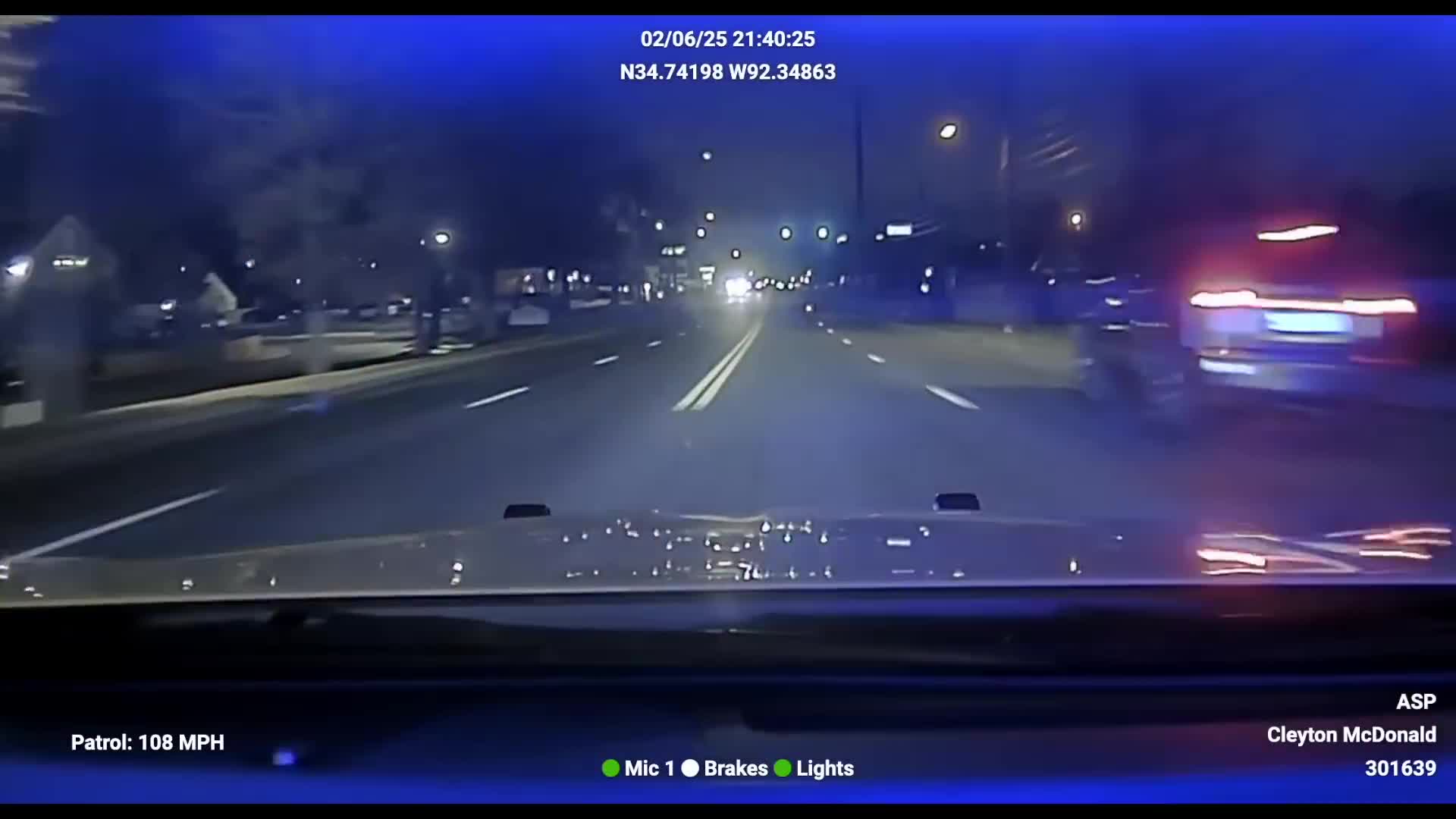
Dashcam footage gives the written account a visual intensity that a police narrative alone cannot convey. Streetlights blur. Traffic closes rapidly. The patrol-speed display climbs into triple digits. At one point the dashcam shows McDonald's cruiser traveling at 108 mph.
Then, as the motorcycle attempts to turn toward I-630 East from South Rodney Parham Road, the pursuit reaches its decisive moment. McDonald's report states that he performed a Tactical Vehicle Intervention, placing the patrol car's push bumper against the motorcycle's rear wheel. The motorcycle falls and the rider slides across the roadway.
The chase is over, but the arrest is not.
The report says Mitchell got back to his feet and ran. McDonald pursued him on foot, deployed a Taser after a warning, and ultimately restrained him with assistance from Trooper Chance Fortune. Emergency medical personnel were requested because of the rider's injuries.
This is a story about escalation, pursuit tactics and the extraordinary risks created when a motorcycle reaches highway speeds on urban streets. It is also a case where the supplied video itself contains unusually detailed source material, including the trooper's written narrative and the list of pending charges.
The Dashcam Identifies the Trooper and the Place
The video overlay identifies the pursuing officer as Arkansas State Police Trooper Clayton McDonald.
The GPS coordinates shown during the pursuit place the action in Little Rock, while visible interstate signage confirms I-630 and exits for University Avenue, Mississippi Avenue and Rodney Parham Road.
This geographic evidence matches the narrative displayed later in the video.
McDonald is not merely a name added by an uploader. Independent public records also identify Clayton McDonald as an Arkansas State Police trooper. A federal appellate opinion from 2025 describes him responding to another Little Rock-area police incident, and archived Arkansas State Police material identifies him as a Troop A trooper who previously received the agency's Medal of Valor.
Those records provide useful background, but the February 6 pursuit is best reconstructed from the dashcam and the incident narrative contained inside the supplied video.
The First Speed Reading Changes the Encounter
McDonald's report says he observed the motorcycle moving quickly on I-630 East near mile marker 6.
He activated his front radar and recorded the motorcycle at more than 80 mph as it passed his patrol car.
At that point, the situation could still have ended with a conventional traffic stop.
Instead, the rider accelerated.
The report states that the motorcycle reached 107 mph in a 60 mph zone.
That decision dramatically changed the risk for everyone on the roadway.
Why 107 MPH Is So Dangerous in an Urban Corridor
At 107 mph, a vehicle covers roughly 157 feet every second.
That means the rider can travel the length of a football field in less than two seconds.
Other motorists do not expect a motorcycle to close distance that quickly.
A driver who checks a mirror, sees what appears to be distant traffic and begins changing lanes may suddenly have the motorcycle directly behind them.
At night, judging closing speed becomes even harder.
Headlights reveal position, but not always velocity.
McDonald Temporarily Loses the Motorcycle
The report says McDonald deactivated his emergency lights at approximately 9:37 p.m. after the motorcycle took the Fair Park off-ramp and disappeared from view.
That is an important part of the timeline.
The pursuit was not one uninterrupted chase from first observation to final intervention.
There was a period in which the rider escaped the trooper's direct view.
McDonald then canvassed the area around 12th Street and Fair Park.
At approximately 9:39 p.m., he encountered the motorcycle again.
The Rider Heads Back Toward I-630
The report describes Mitchell traveling northbound on Fair Park at high speed toward I-630 West.
The rider then took the University Avenue exit, made a U-turn and headed back toward 12th Street.
That route matters because it moves the incident from an interstate environment into surface streets.
Interstates are designed for higher speeds and controlled access.
City streets introduce intersections, driveways, traffic signals, pedestrians and vehicles entering from side roads.
A motorcycle traveling above 100 mph in that environment leaves almost no margin for error.
The Second Pursuit Reaches More Than 109 MPH
At University Avenue and 12th Street, McDonald activated his emergency lights and siren and notified dispatch of the pursuit.
The report says Mitchell accelerated to more than 109 mph while traveling westbound on 12th Street.
The dashcam visually supports the extreme-speed character of the pursuit.
One genuine frame from the supplied footage shows the patrol vehicle at 108 mph as the chase moves through a lit urban roadway.
There is no need to exaggerate the speed. The dashboard overlay already tells the story.
A Motorcycle at 109 MPH Has Almost No Protection
Cars provide crumple zones, airbags, seat belts and a passenger compartment.
A motorcycle provides none of those things.
At triple-digit speed, even a relatively small loss of control can produce severe injury.
The rider also has to manage braking, steering and balance while reacting to police lights and changing traffic.
Every turn becomes more demanding.
Every obstacle becomes more dangerous.
That vulnerability is central to understanding why the final police intervention is so significant.
The Pursuit Approaches South Rodney Parham Road
The report says Mitchell turned right onto South Rodney Parham while attempting to re-enter I-630 East.
By this stage, McDonald had closed the gap considerably.
The dashcam shows the motorcycle directly ahead of the patrol car.
The rider is no longer a distant taillight.
The trooper is close enough that any intervention requires precise timing.
The roadway curves toward the interstate entrance.
That curve becomes the point where the pursuit ends.
The Trooper Describes a Tactical Vehicle Intervention
McDonald's report uses a specific term: Tactical Vehicle Intervention, or TVI.
He wrote that he placed the patrol car's push bumper on the rear wheel of the motorcycle as the rider attempted to turn right onto I-630 East.
According to the report, the contact caused Mitchell to fall from the motorcycle and ended the vehicle pursuit.
This is an important distinction.
The intervention was not an accidental collision according to the officer's written account.
It was a deliberate pursuit-ending maneuver.
The Dashcam Captures the Moment the Motorcycle Goes Down
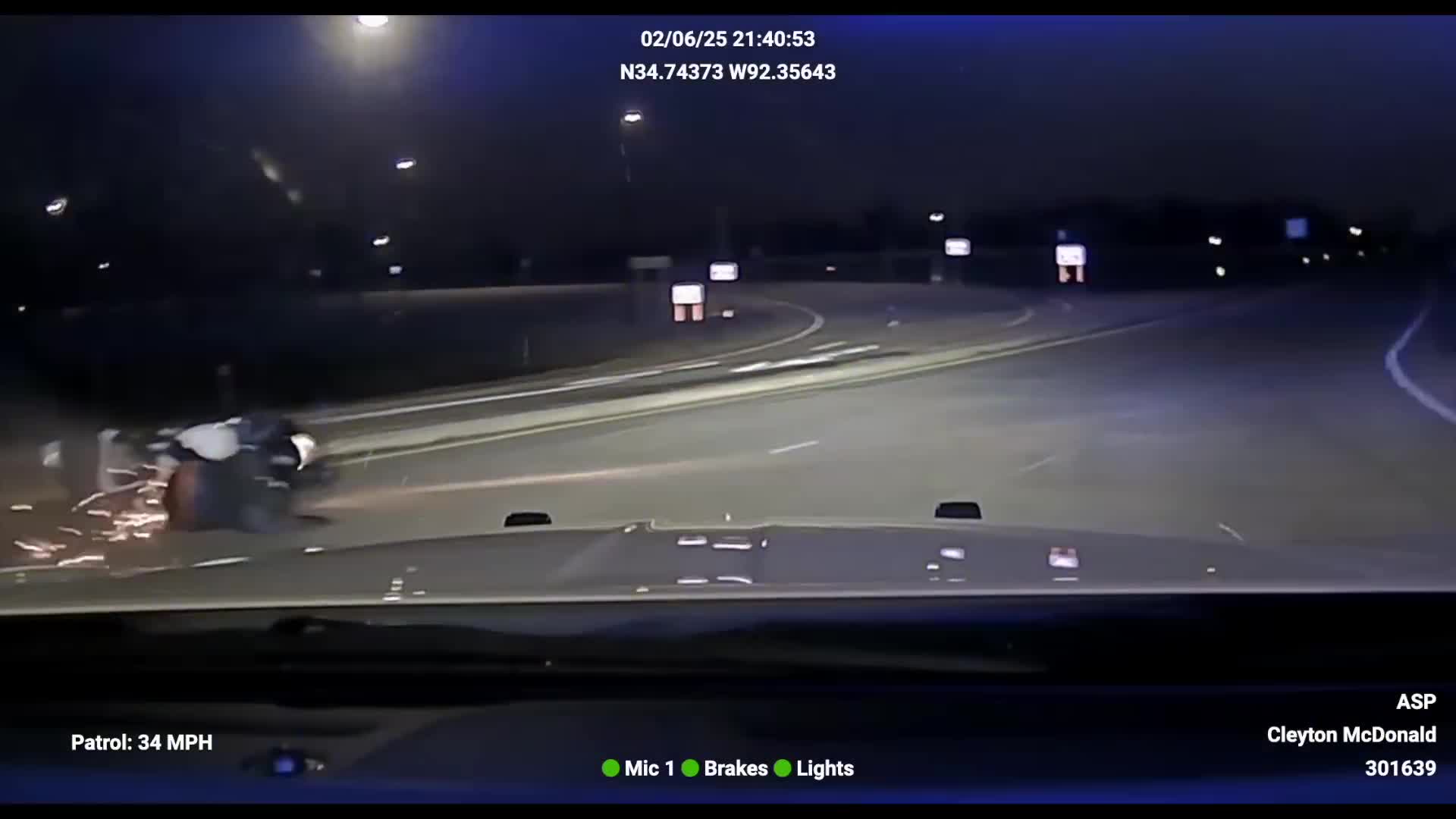
The second image embedded in this article comes directly from the supplied video.
It captures the motorcycle and rider sliding after the intervention.
Sparks are visible near the pavement as the bike goes down.
The patrol car is moving much more slowly than it had during the triple-digit portion of the chase, but the physical consequences of motorcycle contact are still obvious.
Unlike a passenger car that spins on four wheels, a motorcycle immediately loses its stable platform once the rear wheel is disrupted.
Why TVI on a Motorcycle Is Especially Significant
Arkansas State Police has become widely known for using Tactical Vehicle Interventions to end dangerous pursuits.
Most public examples involve passenger vehicles.
A motorcycle presents a fundamentally different risk.
The rider's body is exposed.
There is no steel structure surrounding the person.
A maneuver that rotates a sedan may throw a motorcycle rider directly onto the road.
That does not automatically determine whether a particular intervention is justified. It does mean that the facts surrounding speed, traffic, the seriousness of the fleeing behavior and the precise method of contact become especially important.
The Vehicle Pursuit Ends, but Mitchell Runs
According to McDonald's report, Mitchell quickly regained his footing after falling from the motorcycle.
He then fled on foot.
That choice extended the encounter into another phase.
McDonald left the patrol vehicle and initiated a foot pursuit.
The report says the trooper activated his Taser and warned Mitchell that it would be deployed if he did not comply.
Mitchell continued running.
The Taser Deployment
McDonald wrote that he successfully deployed the Taser after the warning.
The report further states that Mitchell continued resisting arrest and did not comply with commands to place his hands behind his back.
McDonald reported using knee strikes and a controlled hold until another trooper arrived.
Trooper Chance Fortune then assisted in securing Mitchell in handcuffs.
The pursuit had moved through three distinct phases: high-speed motorcycle flight, a deliberate vehicle intervention, and a foot pursuit ending in physical custody.
Medical Assistance Is Requested
The report states that Metropolitan Emergency Medical Services was requested because of Mitchell's injuries.
That is consistent with the obvious risks of being thrown from a motorcycle.
The motorcycle was subsequently towed by Walker Wrecker, according to the narrative.
This medical response is an important part of the incident because a pursuit ending with a motorcycle crash does not simply become an arrest scene.
It is also a potential trauma scene requiring evaluation and treatment.
The Motorcycle and License Status Become Part of the Investigation
The report says the motorcycle was checked through the Arkansas Crime Information Center.
McDonald also checked Mitchell's driving status.
According to the narrative displayed in the video, Mitchell's driver's license was expired and he did not have a motorcycle endorsement.
Those details appear in the officer's report and help explain several of the pending traffic-related allegations listed later in the footage.
The Pending Charges Shown in the Video
The report reproduced in the supplied video lists several pending charges.
They include improper display of license tags, speeding more than 15 mph over the limit, fleeing on foot, fleeing in a vehicle while exceeding the speed limit, failure to register the vehicle, and having no valid driver's license or an expired license.
The report also states that felony fleeing warrants would be pursued.
These should be described as allegations or pending charges, not convictions.
A police report documents the officer's basis for enforcement. A court determines guilt.
Why the Difference Between a Charge and Conviction Matters
Police footage can make an incident feel complete because viewers see the pursuit and arrest.
Legally, however, an arrest is only one stage.
Charges may be amended.
Some allegations may be dismissed.
A defendant may plead to a different offense.
A case may proceed to trial.
Without a verified final court record, the safest language is that the report lists or alleges particular violations.
This article therefore does not describe Mitchell as convicted of the pending offenses shown in the video.
The Motorcycle Model in the Upload Title
The uploaded file identifies the motorcycle as a Suzuki GSX750.
The night footage makes exact model identification difficult from visuals alone, so that description is treated as metadata supplied with the video rather than independently confirmed from a clear VIN decode or registration record.
What is visually clear is that the motorcycle is a sport-style machine capable of rapid acceleration.
The pursuit demonstrates that capability repeatedly.
The Route Makes the Speed More Alarming
I-630 runs through Little Rock and connects with major surface roads including University Avenue and Rodney Parham.
A motorcycle traveling at high speed on the interstate already presents danger.
Moving the same chase onto 12th Street adds intersections and roadside development.
The dashcam shows businesses, traffic signals and other vehicles.
This is not an empty test track.
It is a functioning city road system at night.
The Trooper's 108 MPH Dashcam Reading
One of the clearest frames shows McDonald's patrol speed at 108 mph.
The motorcycle is ahead.
Other traffic is visible.
This frame is useful because it avoids speculation about how intense the chase was.
The number is recorded directly by the police video system.
It also helps readers understand why the situation could not continue indefinitely without substantial risk.
Police Pursuit Decisions Are About Competing Risks
Every pursuit creates competing dangers.
Continuing allows officers to maintain pressure on a fleeing suspect but can encourage higher speeds.
Terminating the pursuit may reduce immediate traffic risk but can allow the suspect to escape.
Intervening physically can stop the chase quickly but may cause a crash.
There is no option without consequences.
The February 6 footage puts those competing risks on screen in real time.
Why the Final Turn Became the Intervention Point
McDonald's report says he used the TVI as Mitchell attempted to turn toward I-630 East.
A turn naturally reduces motorcycle speed compared with a straight 109 mph run.
The patrol car's overlay around the intervention is far below the earlier triple-digit readings.
That lower speed does not remove the danger of contact with a motorcycle, but it changes the physical circumstances.
The intervention occurs during a maneuvering phase rather than while both vehicles are traveling straight at maximum speed.
The Rider Is Thrown Clear
The dashcam shows the motorcycle tipping and sliding.
The rider separates from the bike and moves across the roadway.
The scene illustrates why motorcycle pursuit interventions receive scrutiny.
The same action that ends the chase also creates immediate injury risk.
The fact that Mitchell was able to stand and run afterward does not mean the fall was harmless.
The report confirms that emergency medical transport was requested.
The Foot Chase Adds Another Layer of Risk
After a high-speed crash, officers cannot assume a fleeing person is physically incapable of continuing.
Adrenaline can mask pain.
A rider may stand quickly even with injuries.
McDonald had to transition from driving at extreme speed to pursuing on foot within moments.
That kind of transition is demanding.
The officer must reassess surroundings, determine where the suspect is going and decide what level of force is appropriate while backup is still arriving.
Backup Brings the Encounter Under Control
Trooper Chance Fortune's arrival marks the final shift from pursuit to custody.
According to the report, Fortune assisted McDonald in placing Mitchell in handcuffs.
Once the rider was secured, the priorities changed again.
Medical care, evidence, vehicle recovery and charging decisions replaced the immediate need to stop movement.
The chase that had crossed interstate and city streets was finally contained to one scene.
What the Video Establishes Clearly
The supplied video gives unusually strong evidence for several key facts.
The incident occurred on February 6, 2025.
Arkansas State Police Trooper Clayton McDonald was involved.
The pursuit took place in Little Rock around I-630, Fair Park, University Avenue, 12th Street and South Rodney Parham.
The officer's report says the motorcycle reached 107 mph during the initial flight and later exceeded 109 mph.
The dashcam itself shows the patrol car at 108 mph.
McDonald states that he deliberately used a Tactical Vehicle Intervention against the motorcycle's rear wheel.
The rider fell, ran on foot, was pursued, and was ultimately taken into custody.
Emergency medical assistance was requested.
Those details do not require speculation because they are either visible in the footage or reproduced in the incident narrative included in the video.
What This Article Does Not Claim
The article does not claim that every pending charge resulted in conviction.
It does not add a criminal history for Mitchell.
It does not infer an exact Suzuki model from blurry nighttime imagery beyond the GSX750 description supplied with the upload.
It does not claim that every Arkansas motorcycle pursuit is handled this way.
And it does not substitute a different Arkansas chase merely because another incident may have received more news coverage.
The goal is to stay with this specific February 6 event.
Why This Footage Holds Attention
The video has a natural narrative structure.
The opening is deceptively routine: a trooper traveling on I-630.
The first turning point is the motorcycle passing at high speed.
The second is the rider accelerating rather than stopping.
Then the trooper loses sight of the motorcycle, creating uncertainty.
The rider reappears.
The chase becomes faster.
The route moves onto surface streets.
The patrol speed reaches 108 mph.
Finally the trooper closes the distance and deliberately ends the motorcycle pursuit.
Then, unexpectedly, the rider gets up and runs.
Each stage raises a new question, which is exactly what keeps viewers watching.
The Bigger Lesson From the Pursuit
The most striking fact is not simply that a sport motorcycle can exceed 100 mph.
It is how rapidly the consequences expand once a rider refuses to stop.
A speeding violation becomes a police pursuit.
The pursuit moves from interstate to city streets.
The risk spreads to uninvolved motorists.
A tactical intervention becomes necessary in the trooper's judgment.
The rider crashes.
A foot pursuit follows.
A Taser is deployed.
Medical personnel are called.
Whatever the rider hoped to avoid by fleeing, the final encounter became far more serious than the initial speeding observation.
A Chase Measured in Minutes Creates a Long Legal Aftermath
The vehicle pursuit itself unfolds quickly.
The legal process does not.
Reports have to be completed.
Video is preserved.
Use-of-force actions may be reviewed.
Medical treatment is documented.
The motorcycle is towed.
Warrants and charging paperwork can follow.
Prosecutors then decide how to proceed with the allegations.
For viewers, the dashcam may end when the suspect is secured.
For everyone involved in the case, that moment is only the beginning of the administrative and legal aftermath.
Watch the Full Pursuit
The complete footage shows the progression that still images cannot fully reproduce: the initial interstate encounter, the temporary loss of the motorcycle, the renewed chase through Little Rock, the patrol car reaching triple-digit speed, and the final TVI that sends the motorcycle down before the rider attempts to escape on foot.
Watch the speed overlay, the changing road environment and the closing distance between the patrol car and motorcycle. Those details explain why the final seconds matter.
Click here to watch the full incident unfold.
Comments (0)
Loading comments...
May You Like

Stolen Charger Flees Police During Highway Traffic Stop

Karen Entitled’ Woman Gets Tased After Allegedly Ramming Police Cars

Couple Arrested for leaving 10 Dogs and Cats in Hot car in Florida












