
Police uses Taser on Shoplifting suspect
Jacksonville Shoplifting Call Turns Serious After Taser Deployment During Foot Chase
A Routine Call Becomes a Medical Emergency
On May 11, 2023, a Jacksonville Sheriff's Office officer was already handling a call for service near 929 South McDuff Avenue when a Family Dollar employee flagged him down. The employee told the officer that a man had just stolen merchandise from the store and was running away.
The man was later identified by police as Daniel Forrest. What began as a shoplifting allegation quickly became a foot pursuit across an area cut by railroad tracks and surface streets. Within moments, the officer had left his patrol vehicle, issued commands, deployed a conducted electrical weapon, and placed Forrest in handcuffs.
Then the character of the incident changed again.
Forrest fell after being struck by the Taser and hit his head on the pavement. The officer called for rescue personnel. Jacksonville Fire and Rescue Department transported Forrest to a hospital, where authorities later said doctors discovered internal bleeding.
The supplied body-camera video matches this incident precisely. Its Axon overlay shows May 11, 2023, shortly after 12:23 p.m. The surroundings match the McDuff Avenue railroad corridor, and the sequence corresponds with the account later released by the Jacksonville Sheriff's Office and reported by Action News Jax.
The incident became notable not because of the alleged shoplifting itself, but because a short attempt to stop a fleeing suspect resulted in a serious medical situation and an administrative review of the officer's use of force.
The Encounter Begins at a Family Dollar
According to Jacksonville Sheriff's Office information reported by Action News Jax, an officer was at 929 South McDuff Avenue when an employee from the nearby Family Dollar approached him.
The employee told the officer a man had stolen from the store and was running through the parking lot.
That information gave the officer an immediate description of an alleged offense and a fleeing suspect nearby. Rather than beginning with a planned arrest or warrant service, the encounter developed spontaneously.
The bodycam footage reflects that sudden shift. The officer moves from the original call into a search for the person pointed out by the store employee.
The allegation at this stage was shoplifting. It is important not to inflate that allegation into something more serious simply because the later medical consequences were severe.
The Search Moves Toward the Railroad Tracks
The officer used his marked patrol vehicle to catch up with Forrest.
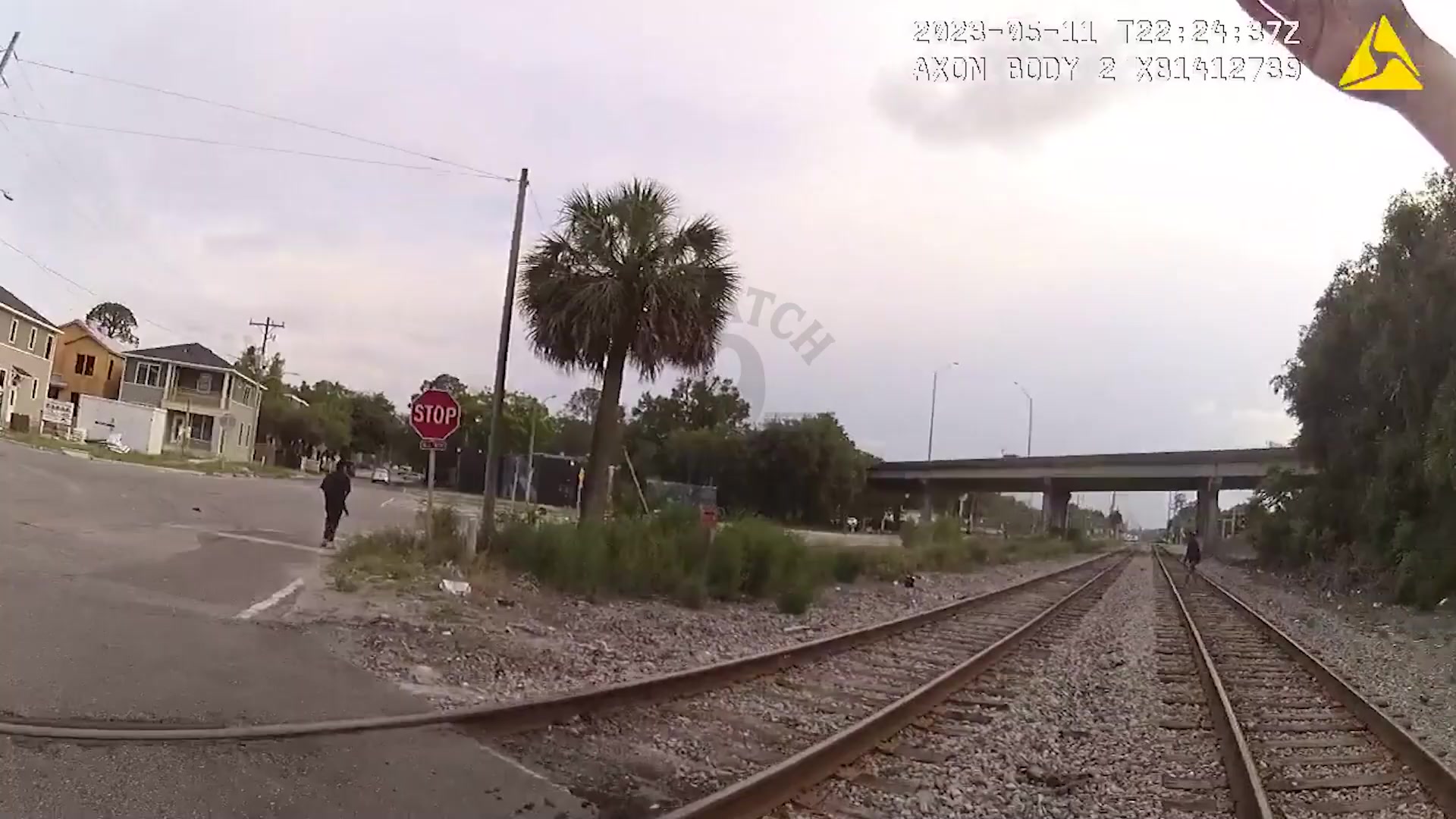
The surrounding geography is an important part of the footage. Railroad tracks run through the area, dividing streets and creating a route that a person on foot can use to move away from the roadway.
The bodycam shows the officer moving through an open area near the tracks. Cars continue along nearby roads while the suspect remains ahead.
For an officer, a fleeing person near active railroad infrastructure creates additional hazards. Uneven ballast, rails, crossings, traffic and limited vehicle access can complicate a pursuit.
The officer eventually exits his vehicle and continues after Forrest on foot.
Commands Come Before the Taser
Action News Jax reported that the officer gave Forrest multiple commands as Forrest began to run.
The footage captures the officer warning Forrest that he is going to use the Taser if he does not stop.
This detail matters because the deployment was not shown as an unannounced action. The officer was attempting to get Forrest to stop while closing distance on foot.
Forrest continued moving.
The officer then deployed the conducted electrical weapon.
The entire transition from verbal command to deployment occurs rapidly, illustrating how little time can separate an attempted detention from a use-of-force decision during a foot pursuit.
The Taser Connects
The Taser struck Forrest while he was running.
A conducted electrical weapon is intended to temporarily incapacitate a person by disrupting voluntary muscle control. When it works as intended, the sudden loss of muscular control can cause a person to fall immediately.
That fall is an inherent part of the risk.
In this case, Forrest fell onto a hard surface and struck his head.
The serious consequence did not come from a prolonged struggle after the deployment. It came from the fall that followed it.
The Bodycam Captures the Immediate Aftermath
The supplied footage becomes especially important after Forrest goes down.
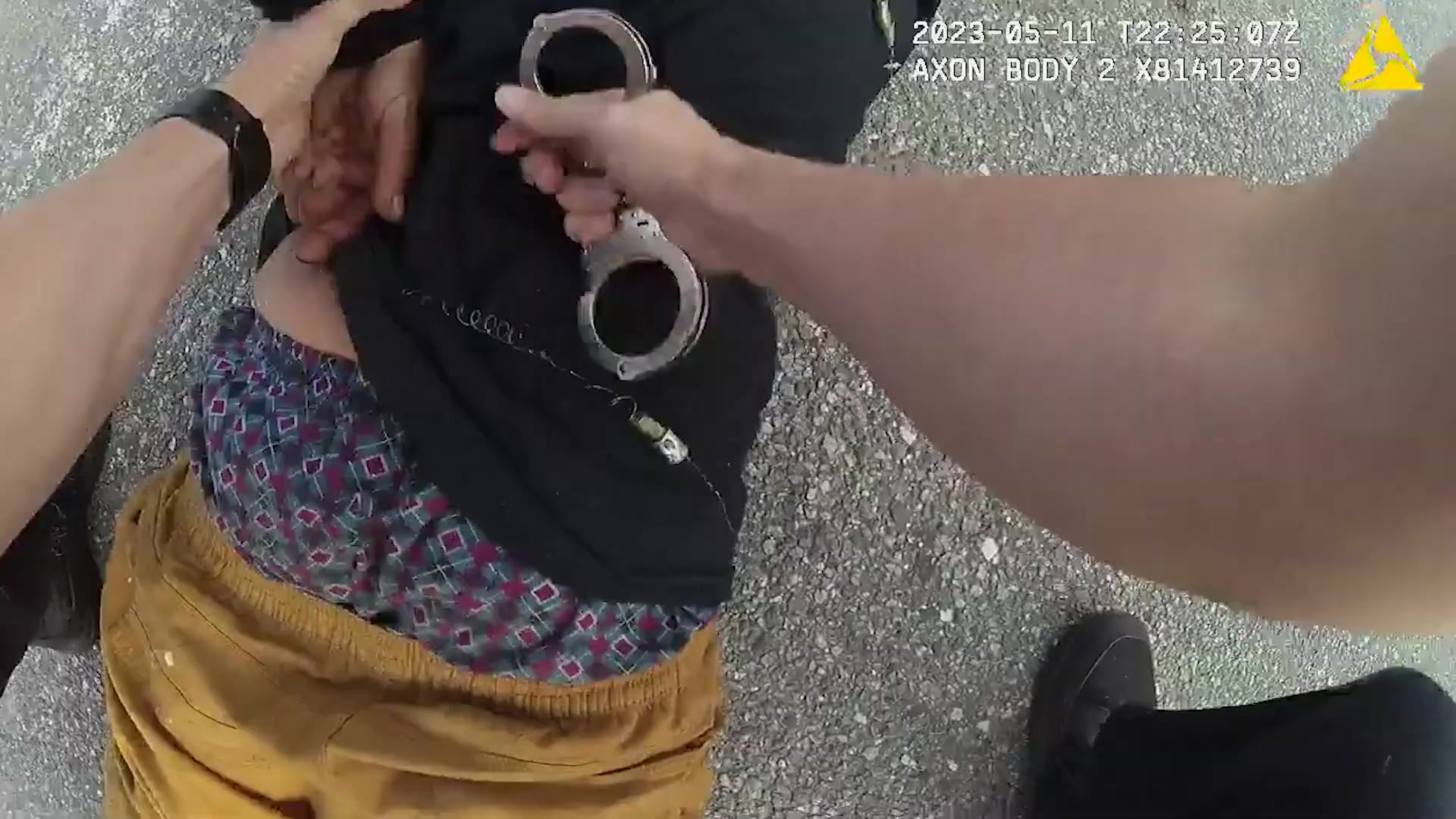
The officer approaches, controls Forrest's arms and begins handcuffing him. The camera is close enough to show the speed with which the pursuit has changed into an arrest scene.
Forrest is no longer running. The officer is no longer chasing him. The immediate priorities become restraint, assessment and medical response.
The bodycam timestamp continues to document the sequence second by second.
The visual transition is abrupt: one moment the camera is moving quickly near the tracks, and the next it is pointed down at Forrest as the officer secures his wrists.
Handcuffs Are Applied
The officer handcuffed Forrest after the fall.
That step is visible in the supplied footage and is consistent with the Jacksonville Sheriff's Office account.
Handcuffing a person after a Taser deployment does not eliminate the need for medical evaluation. A suspect may have injuries from the fall, from the probes, or from a preexisting medical condition.
JSO policy required a medical response following the CEW deployment, and the officer requested Jacksonville Fire and Rescue Department assistance.
The footage therefore documents two parallel responsibilities: completing the arrest and responding to the possibility of injury.
The Officer Calls for Rescue
After Forrest was secured, the officer requested rescue personnel.
Action News Jax quoted the officer telling dispatch to send rescue.
That request became far more significant once Forrest reached the hospital.
The Jacksonville Sheriff's Office later said that medical personnel discovered internal bleeding. Forrest remained hospitalized when the agency publicly discussed the incident later in May.
His family told Action News Jax that doctors had warned them he might not survive.
Those statements reflected the seriousness of his condition at that time. The reporting reviewed for this article does not establish a later death, and this article does not make one up.
Internal Bleeding Raises the Stakes
A shoplifting case would ordinarily be a relatively minor item in a large city's daily police activity.
The discovery of internal bleeding transformed this encounter into a far more consequential use-of-force incident.
The medical outcome drew public attention to the decision to use a Taser on a person who was running on a hard surface.
It also raised a broader question familiar in conducted-energy-weapon cases: how should agencies weigh the need to stop a fleeing person against the possibility that sudden incapacitation will cause a dangerous fall?
That question cannot be answered by the injury alone. Police use-of-force reviews generally examine what the officer knew and perceived at the moment force was used, rather than judging the decision solely by the eventual medical result.
JSO Reviews the Deployment
Jacksonville Sheriff's Office conducted an administrative review of the incident.
The agency later said the officer's use of the CEW was within policy.
Action News Jax reported JSO's conclusion in a story examining two separate recent use-of-force incidents.
That finding is important, but it should be described accurately. An administrative determination that conduct was within agency policy is not the same thing as a court ruling, a civil verdict, or a universal statement that no one can question the tactic.
It means the department reviewed the officer's actions under its own Response to Resistance policy and concluded the deployment complied with that policy.
Why the Foot Pursuit Matters
The context immediately before a Taser deployment is crucial.
The officer was not confronting Forrest while Forrest stood still. The encounter involved a suspect who police said had just been identified by a store employee as the person who stole merchandise and who continued moving away when the officer tried to stop him.
Running changes the mechanics of a Taser deployment.
A person who loses muscular control while stationary may collapse from a standing position. A person already running has forward momentum and less ability to protect the head and face during a fall.
The footage shows why the outcome can be unpredictable even when the electrical weapon functions as designed.
The Railroad Corridor Adds Another Layer of Risk
The chase occurred around railroad tracks near South McDuff Avenue.
Bodycam frames show rails, gravel, crossings and an overpass in the immediate environment.
These are not trivial details. Foot pursuits often move through spaces that were never designed for running: tracks, medians, alleys, drainage areas and construction zones.
An officer has to watch the suspect while also avoiding obstacles and traffic.
The suspect faces those same environmental hazards.
In this incident, the critical fall appears to occur after the pursuit moves from the track area toward pavement, where the hard surface increases the potential consequences of an uncontrolled fall.
What the Video Shows and What It Does Not
The video is strong evidence for the physical sequence.
It shows the date and approximate time.
It shows the officer moving through the McDuff Avenue area.
It shows the pursuit near railroad tracks.
It records commands.
It shows the officer deploy the Taser and then move in to secure Forrest.
It shows the handcuffing and immediate aftermath.
What the video alone does not establish is the complete medical diagnosis, the full underlying shoplifting evidence, or the later legal disposition of any criminal charge.
Those details require external records.
For that reason, this article relies on the Jacksonville Sheriff's Office account and contemporary Action News Jax reporting for the medical and administrative-review information.
Why the Date Overlay Helped Confirm the Incident
The filename supplied with the video is generic: “Police uses Taser on Shoplifting suspect.”
A generic filename is not enough to identify a case safely.
The Axon overlay, however, provides a specific date: May 11, 2023.
Searching that date together with Jacksonville, shoplifting and Taser leads directly to reporting about Daniel Forrest and the Family Dollar on South McDuff Avenue.
The footage then supplies a second layer of verification because the sequence described in those reports matches what appears on screen.
This type of cross-check is essential when working with reposted bodycam footage. It prevents names and allegations from unrelated cases being attached to the wrong video.
The Original Call Was Not for Forrest
One subtle detail in the police account is that the officer had responded to another call for service at the address before the Family Dollar employee flagged him down.
That means the Forrest encounter was not necessarily the reason the officer was already in the area.
The alleged theft happened close enough that the employee could immediately alert a nearby officer.
This helps explain how quickly the response began. There was no delay for dispatch to send a unit from another neighborhood. An officer was already present and able to pursue the reported suspect almost immediately.
From Store Parking Lot to Hospital
The entire story spans only a short geographic distance, but the consequences stretch much farther.
It begins with an employee reporting an alleged theft.
It moves into a parking lot and toward railroad tracks.
The officer catches up.
Forrest runs.
Commands are issued.
The Taser is deployed.
Forrest falls and hits his head.
Handcuffs are applied.
Rescue is requested.
Jacksonville Fire and Rescue transports Forrest to a hospital.
Doctors discover internal bleeding.
The department reviews the officer's actions.
That progression is what makes the incident more than a routine shoplifting arrest.
Why the Medical Response Is a Key Part of the Story
Use-of-force videos are often edited to end immediately after a suspect is handcuffed.
Doing so can leave out an important part of the event.
Here, the medical response is essential because the injury became one of the central facts in subsequent reporting.
The officer's request for rescue is not an afterthought. It connects the visible fall in the footage with the later discovery of internal bleeding.
It also demonstrates why post-force procedures matter. Officers may not be able to determine the severity of an internal injury simply by looking at a person on scene.
Hospital evaluation revealed a problem that was more serious than the short bodycam sequence alone could establish.
The Difference Between a Taser and the Result of a Taser
Public discussion often treats the word “Taser” as if it describes a single predictable level of harm.
The reality is more complicated.
The electrical effect is one component. The resulting fall is another.
Where a person is standing, how fast the person is moving, the direction of travel and the surface below can all influence the outcome.
In Forrest's case, the reported internal bleeding made the secondary consequences of the fall central to the incident.
That does not by itself determine whether the officer's deployment was permissible. It does explain why agencies review these events and why bodycam footage can become important evidence.
The Department's Policy Finding
JSO publicly stated that the officer's use of the conducted electrical weapon was found to be within policy after administrative review.
The agency referred to its Response to Resistance process.
That finding gives the story a confirmed administrative outcome that many bodycam incidents lack.
At the same time, it should not be stretched beyond its meaning. The public reporting reviewed for this article does not provide a detailed written analysis explaining every factor considered by reviewers.
The most accurate formulation is therefore straightforward: JSO reviewed the deployment and said it complied with department policy.
The Family's Perspective
Action News Jax reported that Forrest's family shared photographs of him in the hospital and described receiving an extremely serious prognosis from doctors.
Their perspective introduced a human dimension not visible in the bodycam.
The officer saw a fleeing shoplifting suspect and made a rapid force decision.
The family saw a relative hospitalized with internal bleeding after a police encounter.
Those perspectives can coexist without changing the underlying facts.
A careful account should neither erase the officer's reason for trying to stop Forrest nor minimize the medical consequences that followed.
Why This Video Holds Attention
The footage has a naturally effective narrative structure.
At first, the viewer does not know why the officer is moving quickly through the area.
Then the suspect becomes visible.
The pursuit shifts toward the railroad tracks.
The officer closes distance and issues a warning.
Forrest continues running.
The Taser is deployed.
The chase stops instantly.
Then the central question changes from whether police will catch him to whether he has been seriously hurt.
That shift is what gives the incident its strongest narrative turn. It does not require sensational language or invented details.
The Most Important Confirmed Facts
The incident occurred in Jacksonville, Florida, on May 11, 2023.
The Jacksonville Sheriff's Office said an officer was at 929 South McDuff Avenue when a Family Dollar employee reported that a man had just stolen from the store.
Police identified the man as Daniel Forrest.
The officer caught up with Forrest near railroad tracks and gave commands as Forrest ran.
The officer deployed a conducted electrical weapon.
Forrest fell and struck his head on pavement.
The officer handcuffed him and requested medical assistance.
Jacksonville Fire and Rescue transported Forrest to a hospital.
JSO later said doctors discovered internal bleeding and that Forrest remained hospitalized at the time of the agency's public statement.
JSO administratively reviewed the use of force and said the CEW deployment was within policy.
What Remains Unclear From Public Reporting
The sources reviewed for this article do not provide a complete later medical update for Forrest.
They also do not establish the final disposition of any shoplifting or resisting-related criminal case arising from the encounter.
Those gaps matter.
It would be easy to fill them with assumptions based on unrelated booking records or people with similar names, but doing so would weaken the accuracy of the story.
The article therefore ends its factual claims where the verified record ends: Forrest was hospitalized with internal bleeding, his family described his condition as critical, and JSO said the officer's Taser deployment was within policy.
A Few Seconds With Lasting Consequences
From the officer's perspective, the decisive part of the encounter lasted only seconds.
A store employee identifies a fleeing suspect.
The officer catches up.
The suspect runs.
A warning is given.
The Taser is fired.
The suspect falls.
But those seconds produced consequences that lasted far longer than the chase.
Forrest was taken to a hospital rather than simply transported to jail. His medical condition became serious enough to draw news coverage. The department reviewed the force. The bodycam footage was released and scrutinized publicly.
That contrast between the short decision and the long aftermath is the core of the story.
The Incident Beyond the Headline
“Police uses Taser on Shoplifting suspect” describes the basic event, but it leaves out almost everything that makes the case important.
It does not mention the Family Dollar employee who alerted the officer.
It does not mention the railroad tracks.
It does not mention the warning before the deployment.
It does not mention the head impact.
It does not mention the internal bleeding.
And it does not mention the department's later policy review.
The complete sequence is more informative than the headline because it shows how a relatively ordinary property-crime allegation developed into a serious medical and use-of-force case.
Watch the Full Encounter
The body-camera footage provides the clearest sense of how quickly the incident unfolded, from the officer's search near South McDuff Avenue to the foot pursuit, Taser deployment and immediate medical response.
Comments (0)
Loading comments...
May You Like

A Suspicious Vehicle Leads Officers Into an Unexpected Chase

Cop thinks sandwich is phone

[DASHCAM] Drunk Driver Leads Trooper on High-Speed Pursuit Through City Streets













