
Police Rush In As Suspect Attacks Victim With A Weapon During Home Burglary
DEPUTIES BREAK INTO LYNWOOD HOME AS MAN ATTACKS WOMAN WITH A KNIFE
HOOK — DEPUTIES COULD SEE HIM THROUGH THE WINDOW. THEN THE SCREAMING STARTED.
Just after midnight in Lynwood, California, Los Angeles County sheriff's deputies arrived outside a home expecting to investigate a residential burglary.
Within minutes, they would be trying to reach a woman trapped inside with an armed man.
The call came at approximately 12:32 a.m. on June 9, 2025. Deputies from the Los Angeles County Sheriff's Department's Century Station were dispatched to the 3300 block of Los Flores Boulevard after a 911 report of a residential burglary in progress.
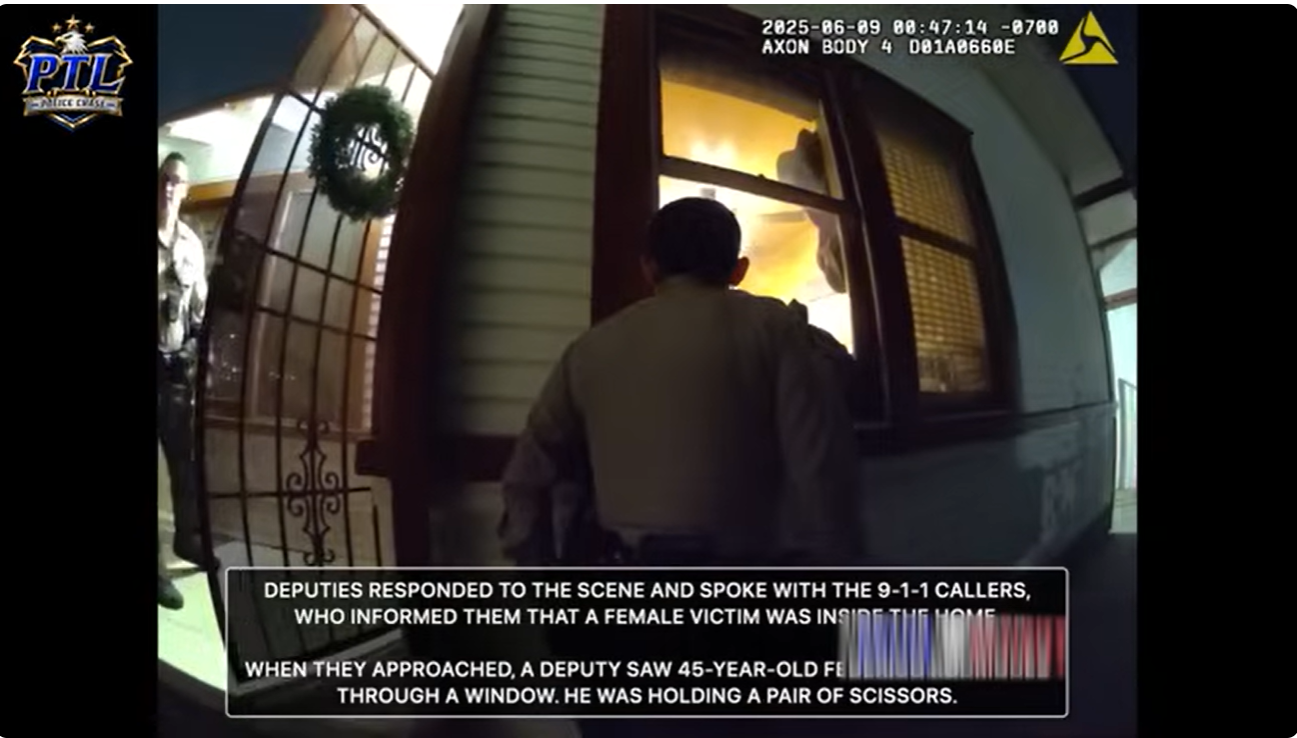
A WOMAN WAS STILL INSIDE THE HOUSE.
The man inside was subsequently identified by authorities as 45-year-old Federico Rodriguez.
Deputies moved toward the residence.
Looking through a window, one deputy could see Rodriguez inside.
And he appeared to be holding a pair of scissors.
That observation immediately changed the problem facing the deputies. This was no longer simply about locating someone suspected of breaking into a residence. Officers now had an apparently armed man inside a confined home with another person.
The body-camera footage shows deputies attempting to communicate with Rodriguez through the window.
Commands are given.
Rodriguez is instructed to put down what he is holding.
But he doesn't come outside.
Instead, according to LASD's subsequent account, he moves away from the deputies' view and deeper into the house.
Then the situation changes again.
Deputies hear screaming.
What happens over the next few moments transforms the call from a burglary response into an emergency rescue.
THE WOMAN INSIDE NO LONGER APPEARS TO HAVE TIME TO WAIT.
OPENING — A MIDNIGHT BURGLARY CALL IN LYNWOOD
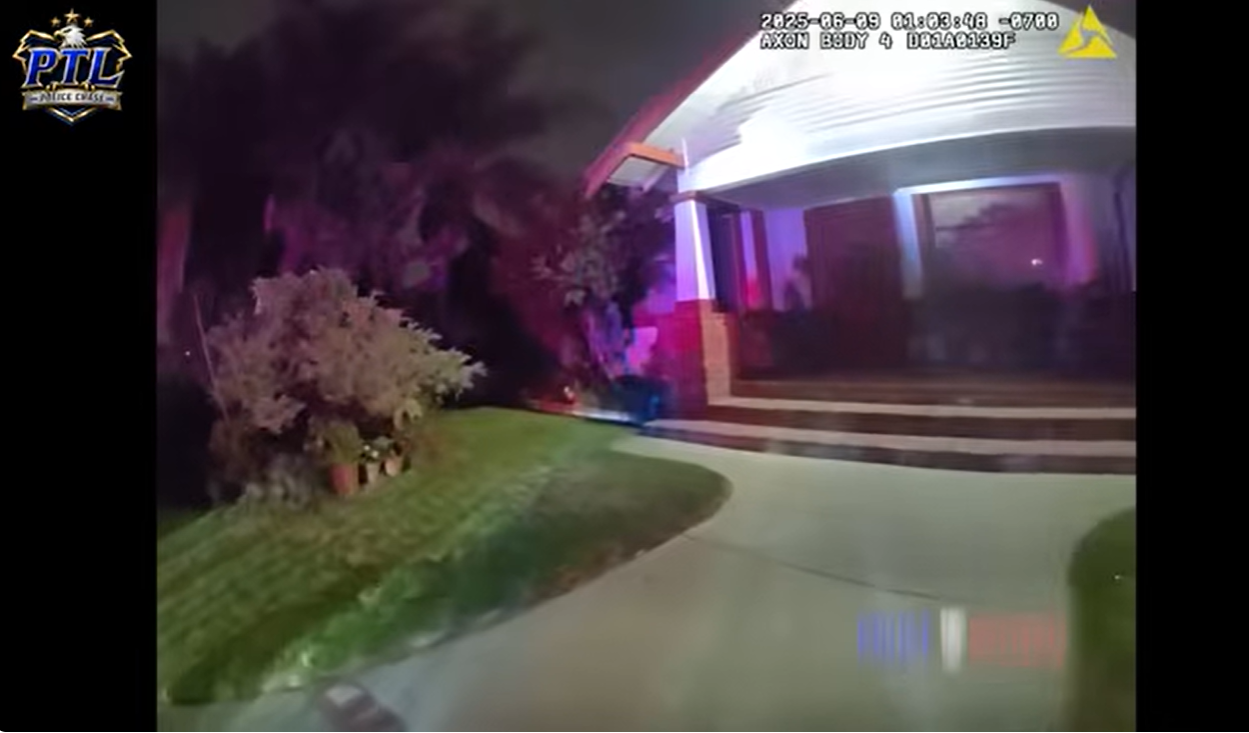 The location is Lynwood, a city in southeastern Los Angeles County.
The neighborhood is quiet when deputies begin arriving.
Patrol vehicles illuminate the street with flashing emergency lights while deputies gather information from the people who called 911.
The department's official critical-incident summary says deputies were told Rodriguez had broken into the residence and remained inside with the victim.
That distinction matters.
Officers were not responding to a report about a suspicious person who had already left.
According to the information available to them, the suspect and victim were still together inside the house.
The footage then brings the viewer directly to the window.
The scene is unusually tense because deputies can see part of what is happening without having full access to the residence.
Rodriguez appears at the window.
The department later said deputies believed the object he was holding at that stage looked like a pair of scissors.
The deputies issue commands.
But seeing an armed person through a window and safely reaching the person trapped inside are two very different things.
Walls, doors and windows restrict movement.
Deputies cannot clearly see every room.
They do not know precisely what Rodriguez will do once he moves away from the window.
And most importantly, they have a potential victim inside.
That creates the central dilemma of the first portion of the encounter:
HOW LONG CAN THEY REMAIN OUTSIDE IF SOMEONE INSIDE MAY BE IN IMMEDIATE DANGER?
DEVELOPMENT — RODRIGUEZ DISAPPEARS FROM THE WINDOW
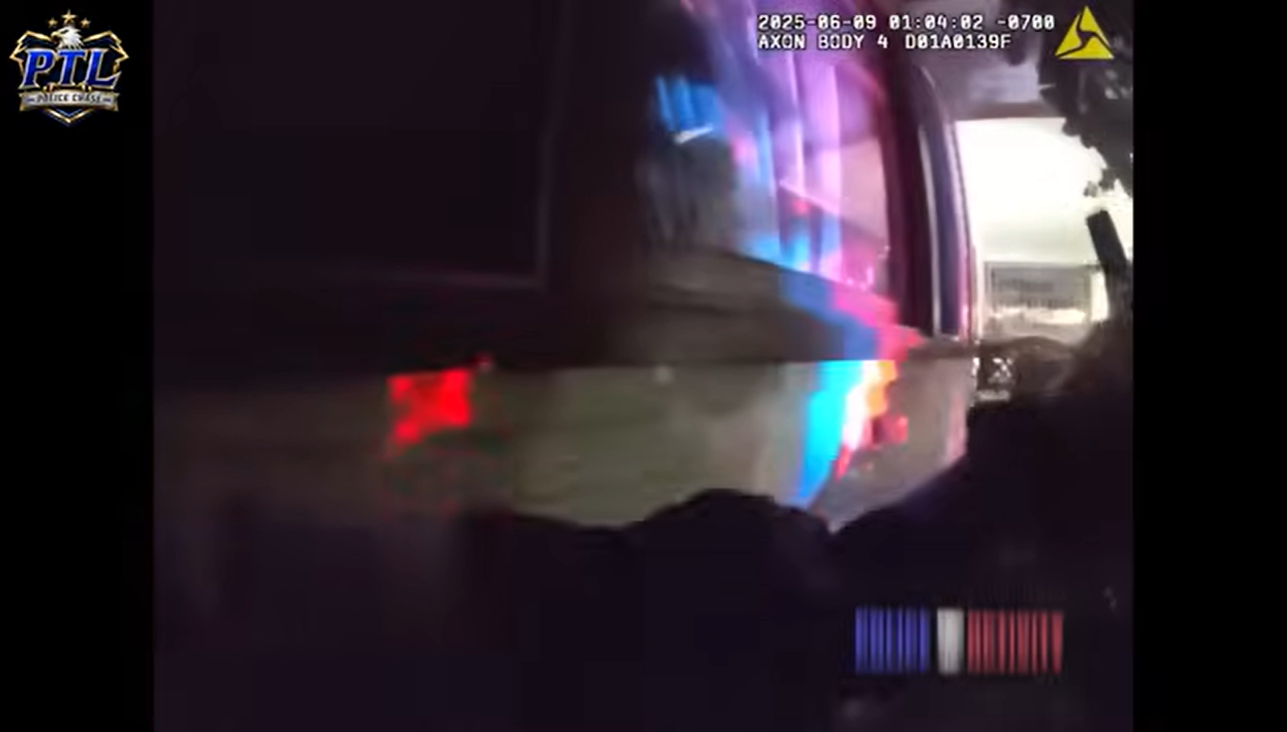 The body-camera footage becomes increasingly tense when Rodriguez moves away.
For the deputies outside, losing visual contact creates another layer of uncertainty.
They know someone is inside.
They believe he is armed.
They know a woman is also inside.
But they can no longer continuously see what he is doing.
Deputies begin developing what LASD later described as a tactical rescue plan.
One part of that plan involves breaking a bedroom window to create another possible access point into the residence.
That decision becomes the turning point.
An officer moves toward the window.
Glass is broken.
Then deputies hear something far more urgent.
SCREAMS FROM INSIDE THE HOUSE.
According to the Sheriff's Department, deputies were then able to see Rodriguez attacking the woman.
At this point, the nature of the response changes completely.
Seconds earlier, deputies were attempting to establish access while monitoring an armed suspect.
Now they believe they are witnessing an active attack.
There is no longer simply a potential threat to the victim.
The department says the threat is happening in front of them.
THE RESCUE PLAN BECOMES AN EMERGENCY ENTRY
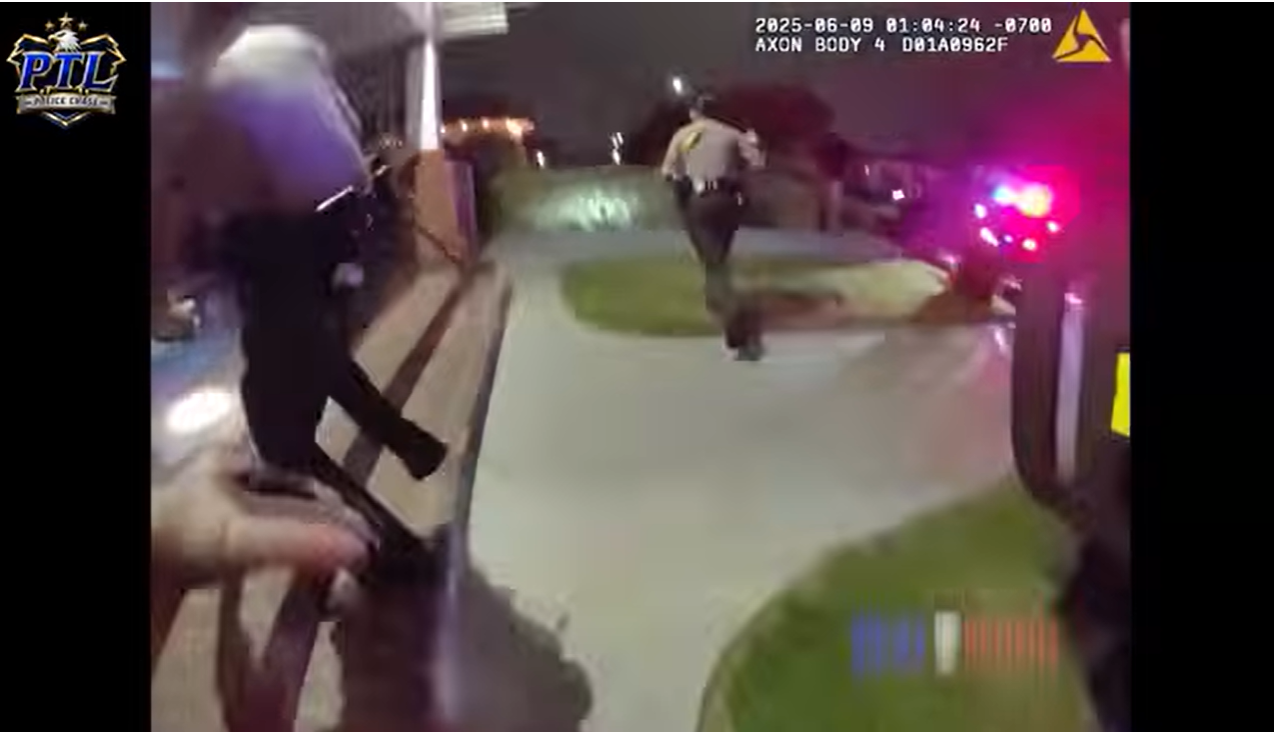 Deputies abandon the idea that this can remain a controlled perimeter situation.
They move toward a door.
The body-camera footage conveys how rapidly the pace changes.
Commands become more urgent.
Deputies converge on the entrance.
The door becomes the fastest route to the woman inside.
Then they force their way in.
This transition is one of the strongest moments in the footage because the viewer moves with the deputies from relative visibility outside into an environment where almost everything becomes more difficult.
Outside, officers have distance.
Inside, they enter narrow rooms and hallways.
Visibility is limited.
Reaction time shrinks.
And they know an armed man and the victim are somewhere only a few feet away.
Police1's account of the released footage says deputies forced their way through the door after hearing screams and seeing Rodriguez attack the victim.
THE INCIDENT HAS NOW BECOME A RACE TO REACH HER.
DEPUTIES ENTER THE HALLWAY
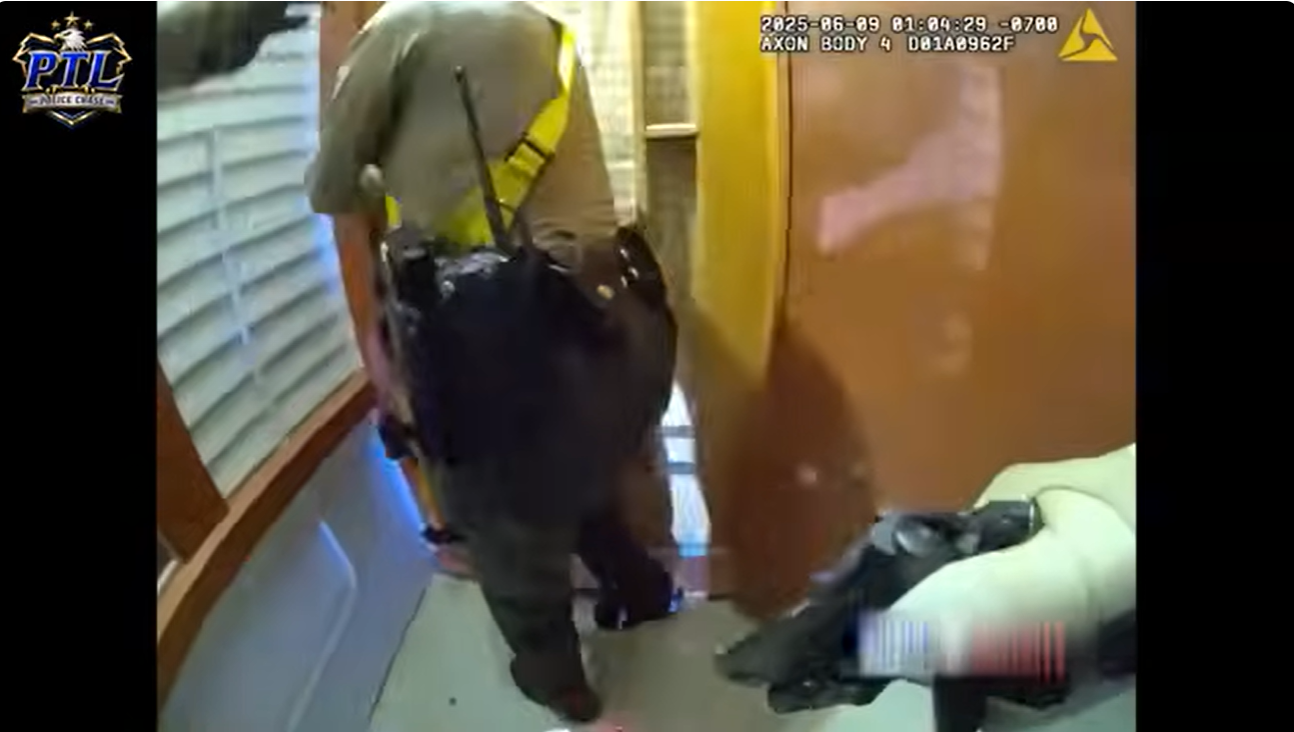 Once inside, deputies encounter the scene LASD later described in its official account.
Rodriguez is in the hallway.
He is down near the victim.
According to investigators, Rodriguez was on his knees and armed with a knife while repeatedly stabbing the woman, who was lying on the floor.
This is the most critical moment of the encounter.
The bodycam perspective becomes extremely compressed.
There is a wall on one side.
A doorway nearby.
The victim and Rodriguez are close together.
Deputies are only a short distance away.
There is almost no physical space separating everyone involved.
The officers now face an immediate decision.
The woman is directly beside the armed man.
Any delay potentially allows the attack to continue.
But any use of force inside such a confined space also carries enormous risk.
Then shots are fired.
A DEPUTY-INVOLVED SHOOTING OCCURS WHILE AUTHORITIES SAY RODRIGUEZ IS ACTIVELY STABBING THE VICTIM.
Rodriguez is hit.
The attack stops.
And the deputies immediately move toward the woman.
THE PRIORITY CHANGES INSTANTLY: GET THE VICTIM OUT
The moment Rodriguez is no longer attacking, the deputies' priority changes.
The victim has to be removed from the immediate danger zone.
This transition happens extremely quickly in the footage.
One second the deputies are confronting an armed attacker.
The next they are trying to reach and protect the woman.
LASD says the shooting stopped Rodriguez's attack and allowed deputies to immediately rescue the victim.
The significance of this portion can easily be lost because the gunfire naturally draws most viewers' attention.
But the shooting is not the endpoint of the deputies' response.
The original reason for forcing entry was the victim.
Once the threat is stopped, the rescue continues.
Police1 similarly reported that deputies were able to pull the woman to safety following the shooting.
The scene now divides into two urgent tasks.
One group must protect and assess the victim.
Another must deal with Rodriguez.
And even though deputies have just shot him, they now have a responsibility to transition from force to medical response once the immediate threat has ended.
MEDICAL AID BEGINS
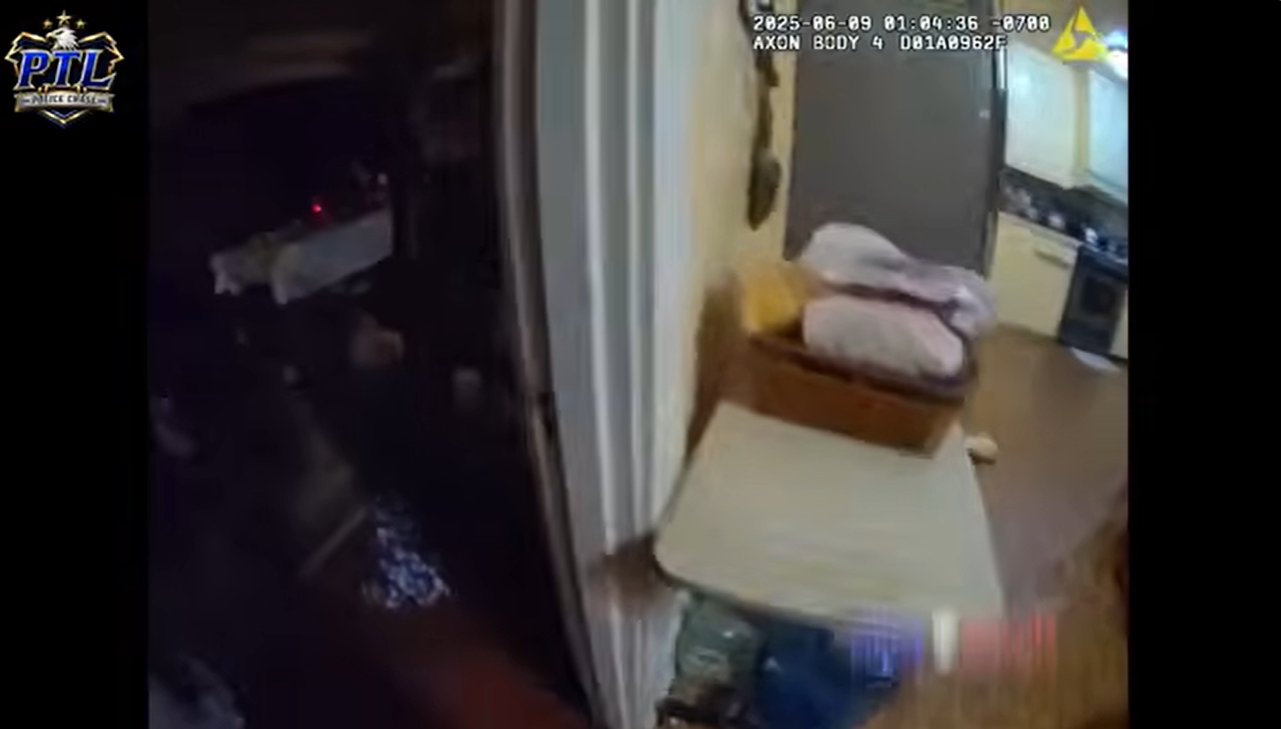 Rodriguez is wounded by the deputy's gunfire.
The department says deputies provided medical aid while waiting for Los Angeles County Fire Department personnel.
This stage of critical incidents often looks dramatically different from the seconds preceding it.
The confrontation may be violent and extremely fast.
The aftermath becomes controlled and procedural.
Weapons must be secured.
People must be separated.
Medical treatment has to begin.
Additional responding personnel need to know which areas of the residence are safe.
Potential evidence must be preserved.
And investigators will eventually need to understand exactly where everyone was positioned when force was used.
Rodriguez was transported to a local hospital.
He was later pronounced dead.
A knife was recovered at the scene.
LASD reported that no deputies or additional people were injured during the incident, though the woman had been the subject of the stabbing attack described by investigators.
ENDING — THE HOUSE BECOMES AN INVESTIGATION SCENE
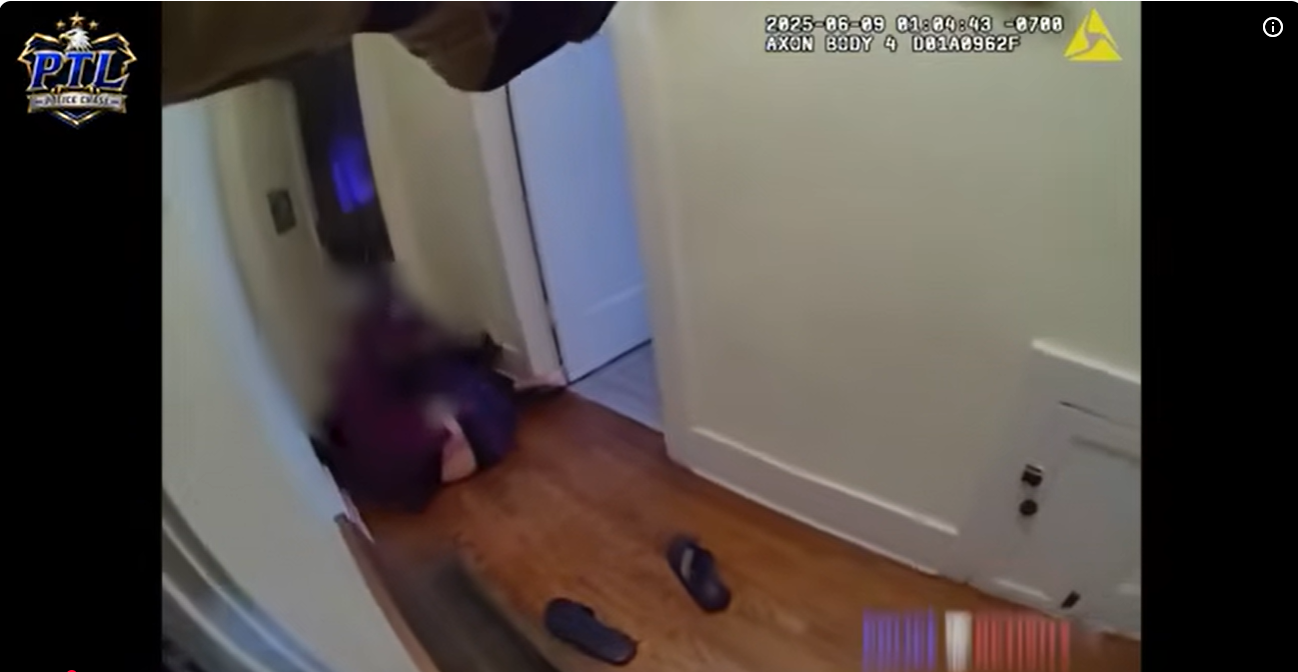 The immediate emergency is over.
But the investigation is only beginning.
Sheriff's Homicide investigators respond to process the residence, conduct interviews and collect evidence.
The department's official summary says representatives from several oversight and investigative bodies were also involved, including the Office of the Inspector General, Internal Affairs Bureau and the Los Angeles County District Attorney's Office Justice System Integrity Division.
That multi-layered review is important.
When law enforcement officers use deadly force, the incident does not simply end when the scene is secured.
Investigators examine the circumstances surrounding the shooting.
Physical evidence is collected.
Body-camera footage is preserved.
Witnesses are interviewed.
The actions leading to the shooting are reconstructed.
LASD stated that after completion of its criminal investigation, the matter would be forwarded to the District Attorney's Office to determine whether the personnel involved violated criminal law. The Sheriff's Department would separately evaluate the incident under its own policies, procedures and tactics.
The body-camera footage was subsequently released publicly.
PoliceActivity's July 11 publication of the incident identifies the same sequence: the 12:32 a.m. burglary call, Rodriguez inside with the victim, deputies seeing what appeared to be scissors, the forced entry, the stabbing and the deputy-involved shooting.
WHY THE WINDOW SCENE IS SO IMPORTANT
From a storytelling perspective, the strongest part of this incident begins before anyone enters the house.
The window creates a natural barrier between the deputies and the danger.
Viewers can see Rodriguez.
Deputies can see him.
But neither the viewer nor the deputies can see everything happening elsewhere inside.
That creates uncertainty without requiring exaggerated narration.
The story develops naturally:
911 CALL → WOMAN TRAPPED INSIDE → ARMED MAN SEEN THROUGH WINDOW → COMMANDS IGNORED → SUSPECT DISAPPEARS → SCREAMS → ATTACK SEEN → FORCED ENTRY → SHOOTING → RESCUE.
Every stage answers one question while creating another.
When deputies arrive, viewers ask:
What is happening inside?
When Rodriguez appears with what looks like scissors:
Will he surrender?
When he disappears:
Where did he go?
When screaming begins:
What is happening to the woman?
When deputies enter:
Can they reach her in time?
That is the key to retention.
The story doesn't need artificial cliffhangers because the information available to the viewer changes continuously.
WHY THE BODYCAM MATTERS
The official written account gives us the essential facts.
The bodycam gives those facts time and space.
A report can say deputies "forced entry."
The video shows how little time exists between hearing the victim and making that decision.
A report can say deputies encountered Rodriguez in a hallway.
The camera demonstrates just how confined that hallway is.
A report can say a shooting occurred.
The footage allows viewers to understand the positions and movements immediately before it.
This does not mean bodycam alone answers every investigative question.
A camera sees from one location.
Its lens can be obstructed.
Rapid movement creates blur.
Its microphone records sounds differently from the human ear.
And it cannot show what is happening behind the wearer.
That is why investigators combine footage with physical evidence, witness statements, forensic findings and other recordings.
The Lynwood case later became part of a separate public dispute involving oversight access to deputy-involved shooting scenes. The Los Angeles Times reported that the county Office of Inspector General and Sheriff's Department disagreed about the degree of access provided to oversight personnel at the Rodriguez scene. LASD disputed the claim that OIG personnel had been denied access, saying an OIG representative was present and received a briefing.
That later controversy is separate from the immediate events captured on bodycam, but it illustrates another reason critical-incident footage and independent review matter: the public examination of a police shooting can continue long after the emergency itself has ended.
WHAT MAKES THIS VIDEO HOLD ATTENTION?
There is no vehicle pursuit here.
There is no prolonged standoff.
The central confrontation takes place inside a small home.
Yet the footage has exceptionally strong natural retention because the urgency rises continuously.
The strongest opening is not the shooting itself.
Showing the shooting immediately would reveal the outcome too early.
A better hook begins at the window.
The viewer sees deputies confronting Rodriguez but doesn't yet know what will happen.
Then he disappears.
That creates uncertainty.
Then comes the scream.
That is the emotional turning point.
Deputies now move from trying to contain the situation to trying to reach the victim.
The viewer follows them through the door.
Only then does the confrontation reach its climax.
This structure gives the story a clean progression:
DANGER IS SUSPECTED → DANGER IS SEEN → DANGER DISAPPEARS FROM VIEW → THE VICTIM SCREAMS → DEPUTIES ENTER → THE ATTACK IS CONFIRMED → FORCE IS USED → THE VICTIM IS RESCUED.
That is much stronger than beginning with a sensational description of the shooting.
It allows the reader to understand why the deputies entered the house before describing what happened after they crossed the doorway.
THE MOST IMPORTANT DETAIL COMES BEFORE THE GUNFIRE
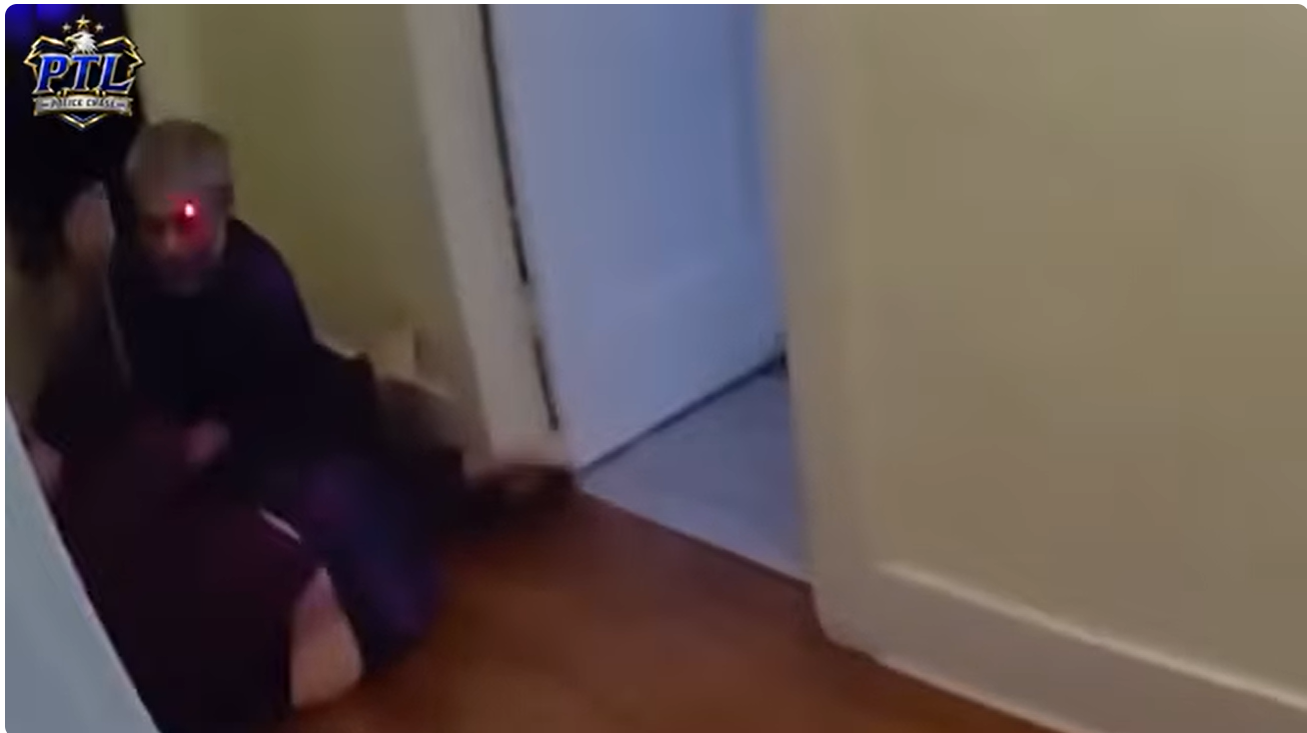 It would be easy to reduce this incident to a headline:
Deputies Shoot Armed Man Inside Lynwood Home.
But that misses what makes the encounter significant.
The deputies were not initially inside looking for a confrontation.
They were outside.
They could see Rodriguez.
They attempted to give commands.
They then developed a plan to reach the woman.
According to the official account, it was when they broke the bedroom window that they heard screaming and saw the attack occurring.
That sequence matters because it explains why the pace suddenly accelerates.
Once deputies believe a victim is actively being stabbed, every additional second becomes significant.
The footage therefore captures two very different forms of police decision-making within the same encounter.
The first is deliberate:
Observe.
Communicate.
Coordinate.
Develop an entry plan.
The second is immediate:
Hear screaming.
Identify an active attack.
Enter.
Stop the threat.
Reach the victim.
The transition between those two phases occurs in only moments.
CONCLUSION — A BURGLARY CALL BECOMES AN EMERGENCY RESCUE
At approximately 12:32 a.m., deputies were dispatched to investigate a residential burglary.
By the end of the incident, 45-year-old Federico Rodriguez had been shot by a deputy after authorities say he was found actively stabbing a woman inside the home.
Rodriguez was given medical aid and transported to a hospital, where he was pronounced dead.
The victim was rescued.
A knife was recovered.
And the incident entered the formal investigative and oversight process required after a deputy-involved shooting.
But the body-camera footage makes the chronology much more powerful than those facts alone.
Deputies arrive outside a quiet home.
They look through a window.
They see a man holding what appears to be scissors.
They order him to put the object down.
He disappears deeper into the residence.
Deputies prepare to reach the victim.
Then they hear her scream.
Everything changes.
THE MOST IMPORTANT MOMENT IN THE VIDEO ISN'T NECESSARILY WHEN THE SHOTS ARE FIRED. IT'S THE MOMENT DEPUTIES REALIZE THE WOMAN INSIDE CAN NO LONGER WAIT.
CTA
This incident shows how rapidly a burglary response can turn into a rescue operation when officers discover that someone inside is facing an immediate threat.
The bodycam captures that transition almost second by second — from the first view through the window, to the deputies' attempt to gain access, to the screams that send them through the door.
And once they enter the hallway, the situation reaches its conclusion in only moments.
What happened behind that window completely changed the deputies' plan — and forced them to make a decision with almost no time left.
Click here to watch the full bodycam footage and see how the Lynwood burglary call turned into a desperate rescue inside the home: https://www.youtube.com/watch?v=J3jINHJcjrQ
Comments (0)
Loading comments...
May You Like

What Happens when you get Caught Shoplifter Stealing Local Store

Woman Tries to Stop Police From Arresting “Brother” — He Denies Knowing Her

A Suspicious Vehicle Leads Officers Into an Unexpected Chase












