
Police K9 Ice tracks down dangerous suspect
K9 Ice Tracks Down Fleeing Passenger After Pierce County Pursuit
A patrol sergeant leaving the Pierce County Sheriff’s Department’s South Hill precinct on March 22, 2024, unexpectedly spotted a vehicle connected to a serious investigation. Five days earlier, according to the Sheriff’s Department, a woman had allegedly shot her former boyfriend in Graham. Now a vehicle associated with that suspect was moving through the South Hill area, giving deputies an opportunity to locate people they had been looking for.
What followed developed quickly. The sergeant followed the vehicle through a shopping complex and back onto the road. As traffic approached a red light, the driver moved onto the shoulder, passed several vehicles and continued through the light. A pursuit began. During that pursuit, the sergeant reported seeing the male passenger throw a gun into a ditch. When traffic slowed the vehicle near the 8300 block of 160th Street East, the passenger jumped out and ran while the female driver remained with the vehicle and complied with deputies.
The passenger still had one major problem: Puyallup Police K9 Ice and his handler were responding to the scene.
Ice began tracking the fleeing man through the surrounding area. The search eventually led officers into a residential property where the suspect was concealed inside a shed. The sound of the police dog changed the situation almost immediately. According to the official account, the man opened the shed door and surrendered as Ice barked outside.
Deputies then returned to the location where the firearm had allegedly been discarded and recovered a gun from the ditch. The 36-year-old woman and 29-year-old man were both booked into jail. Prosecutors charged the woman with first-degree assault, second-degree unlawful possession of a firearm and attempting to elude. The male passenger was charged with first-degree assault, misdemeanor hit-and-run connected to the earlier incident, and obstructing.
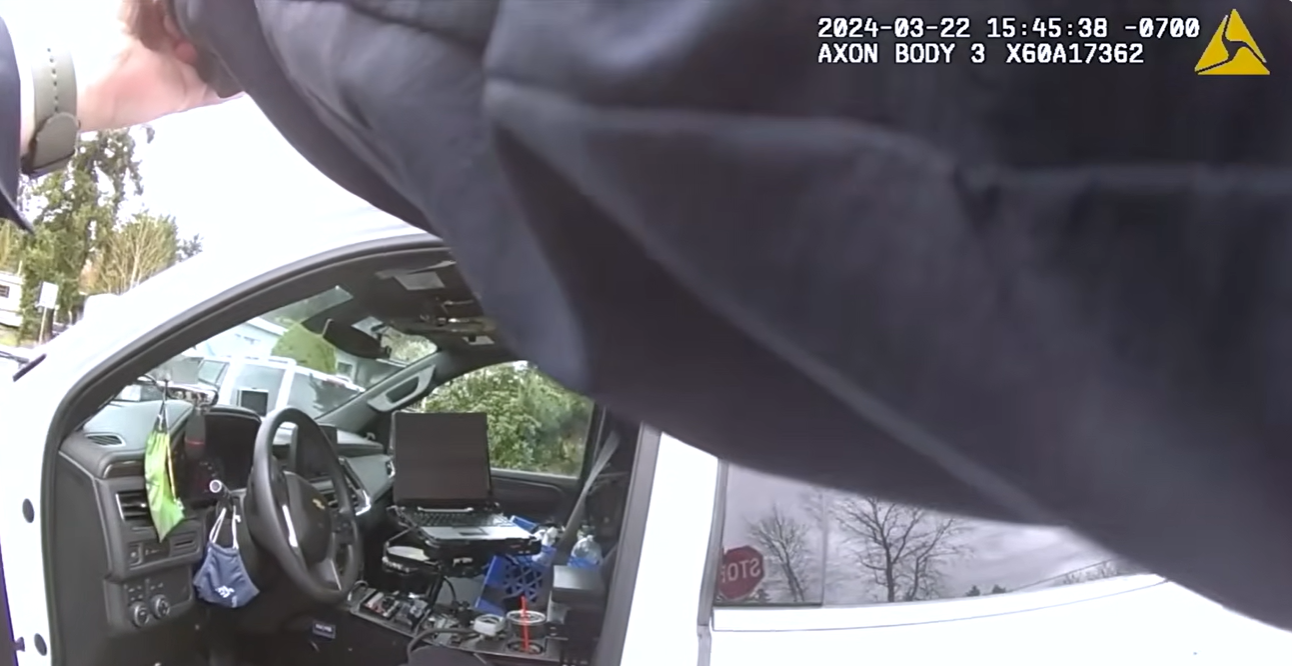
The body-camera images supplied with this article match the official timeline. Their AXON overlays show March 22, 2024. One frame records officers working around a patrol vehicle at approximately 3:45 p.m.; another, roughly twenty minutes later, shows the search moving into a backyard area containing a shed. Together with the Pierce County Sheriff’s Department’s detailed public account, the footage provides a clear view of how a routine sighting by an alert sergeant turned into a pursuit, a K9 track and two arrests.
An Earlier Shooting Investigation Sets the Stage
The March 22 encounter did not begin as an isolated traffic stop. Pierce County officials said the vehicle was associated with a woman suspected in a shooting that had occurred five days earlier in Graham.
That background explains why the sergeant paid attention when he recognized the vehicle. Investigators were not simply checking a random car. They were attempting to locate a person connected to an unresolved violent-crime investigation.
According to the Sheriff’s Department, the female suspect was accused of shooting her former boyfriend. The agency’s later public summary did not identify either arrested person by name, so this article does not add identities that were not confirmed in the official release.
The lack of publicly released names does not prevent the sequence from being reconstructed. The department provided the ages of both defendants, the conduct officers said they observed, the charges prosecutors filed and the bail information available when the story was published.
That is enough to establish the central timeline without speculation.
The Sergeant Recognizes the Vehicle
On March 22, a Pierce County patrol sergeant was leaving the South Hill precinct when he noticed the vehicle associated with the shooting suspect.
This was the kind of observation that can change an officer’s entire shift. A vehicle bulletin or investigative notice may circulate for days without producing a useful lead. Then an officer happens to see the right vehicle at the right time.
The sergeant began following it through a shopping complex. At this stage, the goal was to maintain observation and determine whether the wanted person was inside.
The vehicle eventually returned to the road. As it approached a red light, the driver moved onto the shoulder, passed multiple vehicles and ran the light, according to the Sheriff’s Department.
That behavior turned surveillance into a pursuit.
A Gun Is Thrown Into a Ditch
During the pursuit, the sergeant reported seeing the male passenger throw a firearm from the vehicle into a ditch.
That observation immediately created another important piece of the investigation. Officers now had not only a fleeing vehicle but a specific location where potential evidence had been discarded.
Recovering a thrown firearm is more complicated than simply picking it up. Police need to document where it was located, preserve it properly and potentially submit it for fingerprint, DNA, ballistic or ownership analysis. If investigators believe the gun is connected to an earlier shooting, the evidentiary significance becomes even greater.
But during the active pursuit, officers first had to deal with the people in the moving vehicle.
The sergeant therefore had to remember or communicate the approximate location of the discarded weapon while continuing after the suspects.
Traffic Gives Deputies Their Opening
The pursuit did not end with a high-speed collision or a tactical vehicle intervention. Instead, ordinary traffic slowed the suspect vehicle near the 8300 block of 160th Street East.
That slowdown created an opportunity, but it also triggered another escape attempt.
The male passenger jumped from the vehicle and ran.
The female driver reacted differently. She complied with deputies’ commands and was taken into custody.
This split created two simultaneous police tasks. Officers needed to secure the driver and the vehicle while another group searched for the passenger. Because the passenger had already allegedly discarded a firearm, deputies also had reason to approach the foot search cautiously. They could not automatically assume that the gun thrown from the vehicle was the only weapon involved.
K9 Ice Is Called Into the Search
The fleeing passenger had gained some distance, but officers had a specialized resource available nearby. Puyallup Police K9 Ice and his handler responded to assist Pierce County deputies.
Police dogs are particularly valuable when a suspect leaves a vehicle and disappears into an area containing houses, vegetation, fences and outbuildings. Ground officers can search visually, but they may have to check dozens of possible hiding places. A trained K9 can follow human scent and help narrow that search.
Ice was an experienced Puyallup Police German Shepherd. City records show that he served for four years and accumulated more than 208 applications before retiring in 2025. His handler was Officer Nathan Jendrick, who was later promoted to sergeant. When Ice retired, the Puyallup City Council authorized his transfer to Jendrick for one dollar so the dog could live with his former handler’s family.
The March 2024 track therefore came during the final year of Ice’s operational career.
The Track Moves Into a Residential Area
The body-camera imagery shows how quickly the environment changes during the search. The earlier frame centers on police vehicles and the roadway. Later footage places officers behind homes, among trees, fences, tarps and small structures.
For a fleeing suspect, a residential area can appear full of concealment. A person can move behind fences, enter yards, crouch behind vegetation or try an unlocked shed.
For officers, however, those same features create uncertainty. They cannot see through walls or closed doors. They must also consider the people who actually live on the property. A homeowner may step outside without understanding why armed officers and a police dog are moving through the yard.
A K9 track can reduce the amount of blind searching officers have to perform. Rather than opening every shed or moving randomly through multiple properties, the dog can indicate where the scent trail leads.
In this case, the trail led to a shed.
The Shed Becomes the Final Hiding Place
The later body-camera frame shows officers working in a cluttered backyard environment. A small shed stands nearby, surrounded by trees, fencing and household items.
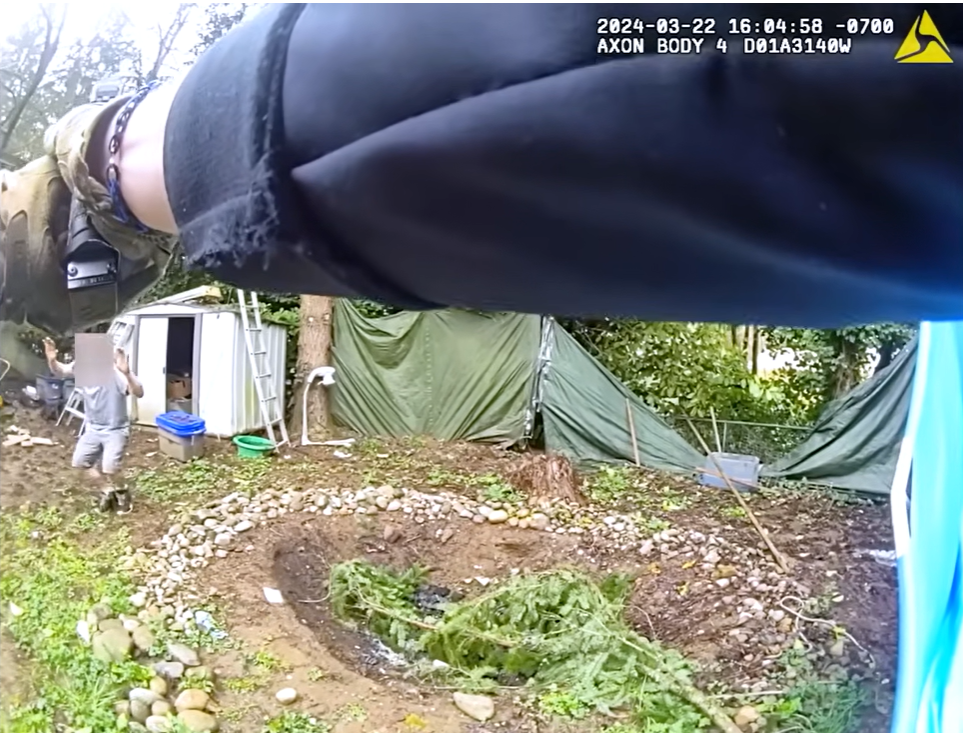
According to Pierce County, the fleeing passenger was hiding inside a shed in the area.
Once Ice and his handler reached the location, the tactical situation changed. The suspect might have been out of direct sight, but officers no longer needed to search an entire neighborhood. They had narrowed the problem to a specific structure.
The police dog began barking.
The response from inside was immediate enough to make physical apprehension unnecessary. The Sheriff’s Department said that when the suspect heard Ice barking, he opened the shed door and surrendered.
That outcome is important. Police K9 deployments are often remembered for bites or physical captures, but a dog’s effectiveness is not limited to making contact with a suspect. The presence and warning of a trained K9 can persuade someone to surrender before a bite occurs.
Here, Ice helped locate the suspect, and the sound of the dog appears to have ended the standoff without the K9 needing to physically apprehend him.
Why a Police Dog Can Change a Suspect’s Decision
From a suspect’s perspective, hiding from human officers can seem possible. Officers have limited sightlines, especially in yards filled with structures and vegetation. A person may believe that remaining completely still will allow the search team to pass.
A trained tracking dog changes that calculation.
K9 teams use scent rather than ordinary visual observation. While scent tracking is not infallible and environmental conditions matter, a dog can follow a trail through areas where a human officer sees nothing obvious.
Once a K9 begins indicating on a particular hiding location, officers can issue commands while maintaining distance. A suspect then has to decide whether continuing to hide is worth the possibility of the dog being deployed into the confined space.
In this incident, the barking was apparently enough.
Deputies Return for the Discarded Gun
With both occupants now in custody, deputies could return to another unresolved part of the pursuit: the firearm the sergeant said he saw being thrown into the ditch.
Officers went back to the area and located a gun.
The recovery mattered because the original investigation involved a shooting. A firearm discarded during a police pursuit may become relevant not only to possession allegations but potentially to forensic testing associated with an earlier offense.
The Sheriff’s Department’s public post did not state that the recovered firearm had been conclusively matched to the earlier shooting. For that reason, it would be inaccurate to claim that the gun was definitively the weapon used five days earlier.
What can be said is that the sergeant reported seeing a gun thrown from the suspect vehicle and deputies subsequently recovered one from the ditch where it had been discarded.
Both Occupants Are Booked Into Jail
Pierce County identified the driver as a 36-year-old woman and the passenger as a 29-year-old man.
Both were booked into jail.
Prosecutors charged the woman with assault in the first degree, unlawful possession of a firearm in the second degree and attempting to elude police. The Sheriff’s Department said she was being held on $200,000 bail when its public account was released.
The agency also reported that the woman had outstanding warrants in two other felony cases at the time of the March 22 events. One of those cases reportedly involved another domestic-violence offense and another victim.
The male passenger was charged with assault in the first degree, misdemeanor hit-and-run connected with the assault incident and obstructing. His bail was set at $5,000, which the Sheriff’s Department said he posted on the Wednesday before the agency published its March 29 summary.
These are charging-stage facts. They should not be described as final convictions unless later court records establish that result.
The Case Shows How Separate Police Agencies Work Together
One reason the arrest succeeded is that the investigation did not remain limited to a single department.
Pierce County deputies initiated and managed the pursuit and arrest operation. Puyallup Police supplied Ice and his handler for the track.
Cross-agency cooperation is common in Pierce County because municipal boundaries do not mean much to a fleeing suspect. Someone can move from a county area into a city jurisdiction within minutes. A specialized unit such as a K9 team may be closer than the requesting agency’s own resource.
When that happens, radio coordination allows agencies to combine capabilities without waiting for a single department to handle every stage alone.
The March 22 incident is a straightforward example: Pierce County had the investigation and pursuit; Puyallup had an available tracking dog. The resources were combined.
Ice Had Already Proven Himself on Similar Searches
The March 2024 arrest was not Ice’s first high-profile track.
In September 2023, Pierce County deputies called for Puyallup K9 Ice after an armed robbery at a GameStop near 136th Street and Meridian. The robber had taken PlayStation 5 consoles and fled on foot.
Ice and his handler tracked through woods and past two schools. Deputies located the stolen property behind a residential fence and eventually found the suspect hiding in a shed.
The similarity to the March 2024 case is striking: another fleeing suspect, another residential search and another shed.
In the GameStop case, deputies said the suspect had to be pulled from the shed and handcuffed. In the March 2024 case, the suspect surrendered after hearing Ice bark.
Those incidents demonstrate the practical value of a dog that can remain focused on a scent trail through changing terrain.
More Than 208 Applications Before Retirement
Puyallup city records provide a useful epilogue to Ice’s career.
On March 11, 2025, the Puyallup City Council approved a resolution formally retiring K9 Ice. The resolution stated that the German Shepherd had served for four years and participated in more than 208 applications.
The city decided to transfer Ice to his previous handler, Sergeant Nathan Jendrick, for one dollar.
Council minutes explain that Ice was retiring because Jendrick had been promoted to sergeant. City officials praised the partnership and the dog’s contributions to the Police Department.
The retirement record helps put the March 2024 footage into perspective. Viewers see only one track lasting minutes. The city’s records show that the track was one of more than two hundred operational applications over Ice’s career.
The Pursuit Could Have Ended Very Differently
The sequence contains several points where the danger could have increased dramatically.
The driver could have collided with another vehicle while passing traffic on the shoulder and running the red light.
The passenger could have kept the firearm rather than throwing it away.
The fleeing man could have confronted officers when they reached the shed.
Instead, the pursuit slowed in traffic, the driver surrendered, the gun was recovered from a ditch and the passenger came out after hearing the K9.
No dramatic collision or K9 bite was necessary to bring the incident to an end.
That makes the footage less sensational than some police videos, but arguably more instructive. It shows how observation, coordination and specialized resources can resolve a dangerous situation without every available tactic needing to be used.
The Body Camera Adds Context to the Official Account
The Pierce County Sheriff’s Department’s written account provides the chronology. The body-camera images add a sense of place.
The AXON timestamp confirms the date as March 22, 2024. The earlier footage places officers around marked law-enforcement vehicles during the afternoon. The later footage shows the search moving into a residential yard.
That transition helps readers understand the work involved after the passenger ran. A sentence such as “K9 Ice tracked him to a shed” sounds simple. The video shows that officers were actually moving through uneven, cluttered private property while trying to locate someone who had deliberately concealed himself.
Video does not replace the police report. The camera does not automatically reveal why officers were searching or what charges were later filed. But when the footage and official account are considered together, each fills gaps left by the other.
Why the Suspect’s Escape Became Harder With Every Decision
The male passenger’s options became progressively narrower.
At first, he was inside a moving vehicle.
Then the vehicle slowed and he ran.
Once on foot, he had more possible hiding places but far less mobility. Officers could establish a perimeter, and a K9 could follow his scent.
Entering the shed provided concealment but removed nearly every remaining escape route.
By the time Ice arrived outside, the suspect’s hiding place had become a trap.
The decision to surrender avoided another escalation. Instead of forcing officers to enter a confined structure or deploy the dog inside, the man opened the door and came out.
The Strongest Moment Is Not a Bite but a Bark
Police K9 videos are often promoted around physical apprehensions. This incident offers a different example of effectiveness.
Ice did not need to bite the suspect to resolve the search.
The dog tracked the fleeing man to his hiding place. Then the sound of Ice barking communicated something the suspect already understood: officers knew where he was, and continuing to hide was unlikely to work.
That was enough.
From a public-safety perspective, voluntary surrender is the preferable ending. Officers avoid a close physical confrontation. The suspect avoids injury from a K9 apprehension. The dog avoids being exposed to a potentially armed person in a confined space.
The tool worked through detection and deterrence rather than force.
From a Chance Sighting to Two Arrests
The entire incident began because a patrol sergeant recognized a vehicle.
That observation led to surveillance through a shopping complex.
The driver then passed traffic on the shoulder and ran a red light.
A pursuit followed.
The passenger allegedly threw a firearm into a ditch.
Traffic slowed the vehicle near 160th Street East.
The passenger ran while the driver surrendered.
K9 Ice arrived and began tracking.
The trail led through a residential area to a shed.
The suspect heard Ice barking and came out.
Deputies returned to the ditch and recovered the discarded firearm.
Both occupants were booked into jail, and prosecutors filed serious charges.
The sequence is compelling because there is no single spectacular moment responsible for the arrests. Instead, the case advances through a chain of smaller actions: recognition, observation, pursuit, evidence recovery and a specialized K9 track.
Why This Incident Holds Attention
The story naturally creates a series of unanswered questions.
Does the sergeant have the right vehicle?
Will the driver stop?
What did the passenger throw from the car?
Where will he go after jumping out?
Can officers locate him in a residential area?
What happens when K9 Ice reaches the shed?
Each answer leads directly into the next stage. That structure is what keeps a viewer or reader engaged without requiring exaggerated language.
The official facts already provide escalation. A shooting investigation becomes a vehicle pursuit. The pursuit becomes a foot search. The search becomes a K9 track. The track ends at a shed.
Then the investigation circles back to the roadway, where deputies recover the gun that had been thrown away earlier.
An Experienced K9 Team Brings the Search to a Quiet End
For Puyallup Police K9 Ice, the March 22 track became another entry in a four-year service career that would exceed 208 applications.
For Pierce County investigators, it helped bring a wanted passenger out of hiding without a prolonged standoff.
And for the suspects, the attempted escape did not erase the investigation that preceded it. The woman was taken into custody at the vehicle. The man was located in the shed. The firearm was recovered.
The official account was published by the Pierce County Sheriff’s Department on March 29, one week after the arrests. Its title focused on the two decisions that defined the outcome: an alert sergeant recognizing the suspect vehicle and K9 Ice tracking the fleeing passenger.
Those two moments bookend the entire incident.
One officer noticed the car.
One police dog found where the passenger had gone.
Watch the Full Incident
The body-camera footage provides the best sense of how the operation moved from the roadway into a residential search and why K9 Ice became so important once the passenger fled on foot.
Comments (0)
Loading comments...
May You Like

Police vs Chevy Impala High-Speed Pursuit Ends in TVI

Entitled Driver Learns Why You Must Obey Lawful Orders During Traffic Stop

One Driver’s Decision to Flee Brings Police Racing After Him













