
Police K9 Dogs Take Down Real Suspects in Intense Arrests
A WRONG-WAY PARKED TRUCK BECOMES A DEADLY MANHUNT: INSIDE THE PASADENA PURSUIT OF RICARDO ANDRADE
HOOK — IT STARTED WITH A TRUCK PARKED THE WRONG WAY
At 8:39 p.m. on April 13, 2024, Pasadena police officers approached a white pickup truck on Hudson Avenue near Del Mar Boulevard.
There was nothing spectacular about the first thing that caught their attention.
THE TRUCK WAS SIMPLY PARKED FACING THE WRONG DIRECTION ON A ONE-WAY STREET.
Within minutes, however, that seemingly minor encounter would explode into a police pursuit, a violent crash, a neighborhood search, two alleged home invasions, a K-9 deployment and ultimately a fatal officer-involved shooting.
The man behind the wheel was later identified as 36-year-old Ricardo Guade Andrade of San Fernando.
Officers initially spoke with Andrade and discovered that he did not have a driver's license. Police asked him to get out of the pickup.
Instead, he started the engine.
Then he accelerated away.
An assisting officer had to move as the truck passed dangerously close to him. Pasadena Police subsequently treated Andrade as wanted for assault with a deadly weapon on a police officer.
AND THAT WAS ONLY THE BEGINNING.
What followed shows how quickly an apparently ordinary police contact can transform into an emergency affecting an entire residential neighborhood.
THE FIRST FEW MINUTES CHANGED EVERYTHING
The encounter began on Hudson Avenue.
Police had not responded to a violent crime in progress. According to Pasadena Police's official account, officers were investigating an occupied suspicious vehicle.
The white pickup was positioned incorrectly on the one-way street.
REAL FRAME FROM THE VIDEO
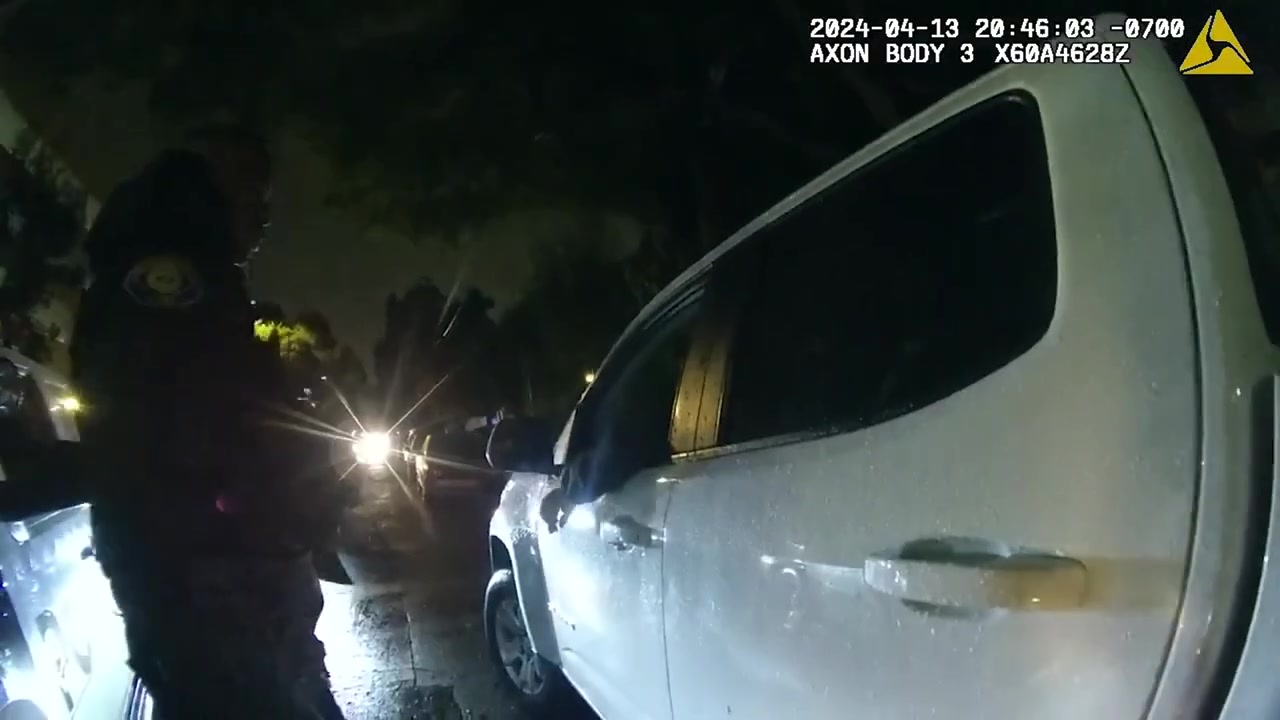
The officers began speaking with the driver.
According to reporting based on the department's subsequently released bodycam and dashcam footage, officers ran Andrade's information and determined that he did not have a driver's license.
He was asked to exit.
This is the critical decision point in the entire story.
Had the encounter ended there, the extraordinary events that followed would never have happened.
Instead, Andrade started the pickup and drove away.
Pasadena Police said the vehicle narrowly missed striking an assisting officer as it left.
The stakes instantly changed.
Police were no longer dealing only with an improperly parked vehicle or an unlicensed driver.
They now had a fleeing pickup and an officer who had nearly been struck.
Units began pursuing it.
THE PICKUP TEARS THROUGH PASADENA
The chase was relatively brief, but that did not make it uneventful.
ABC7 reported that investigators said Andrade ran a red light and reached approximately 80 mph while traveling the wrong way before the pursuit ended.
At that point, every second mattered.
Residential streets are not designed for vehicles traveling at highway speeds. Driveways, intersections, parked cars and homes leave very little room for error.
Andrade eventually reached the area of Hudson Avenue and Arden Road.
Then control was lost.
REAL FRAME — THE PURSUIT ESCALATES
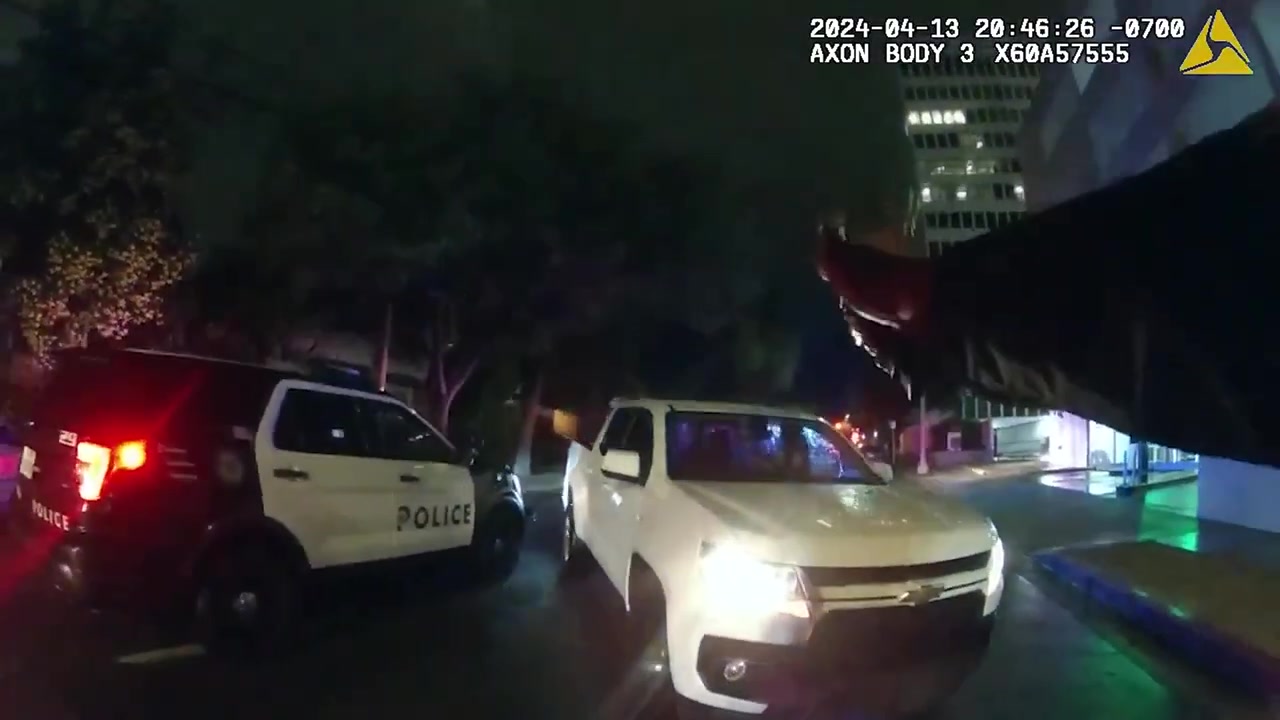
The pickup crashed violently into a vehicle parked in the driveway/front-yard area of a residence in the 800 block of Arden Road.
A family's Tesla was struck in the collision, according to local reporting.
For officers, a major crash often represents the moment a pursuit ends.
Not this time.
ANDRADE GOT OUT OF THE WRECKED PICKUP AND RAN.
The incident immediately transformed from a vehicle pursuit into a neighborhood manhunt.
THE DRIVER DISAPPEARS BETWEEN HOMES
Once Andrade abandoned the pickup, police had an entirely different problem.
They were dealing with a fleeing person in a residential neighborhood after dark.
Officers began establishing containment while organizing a yard-to-yard search.
REAL FRAME — OFFICERS SEARCH THE NEIGHBORHOOD
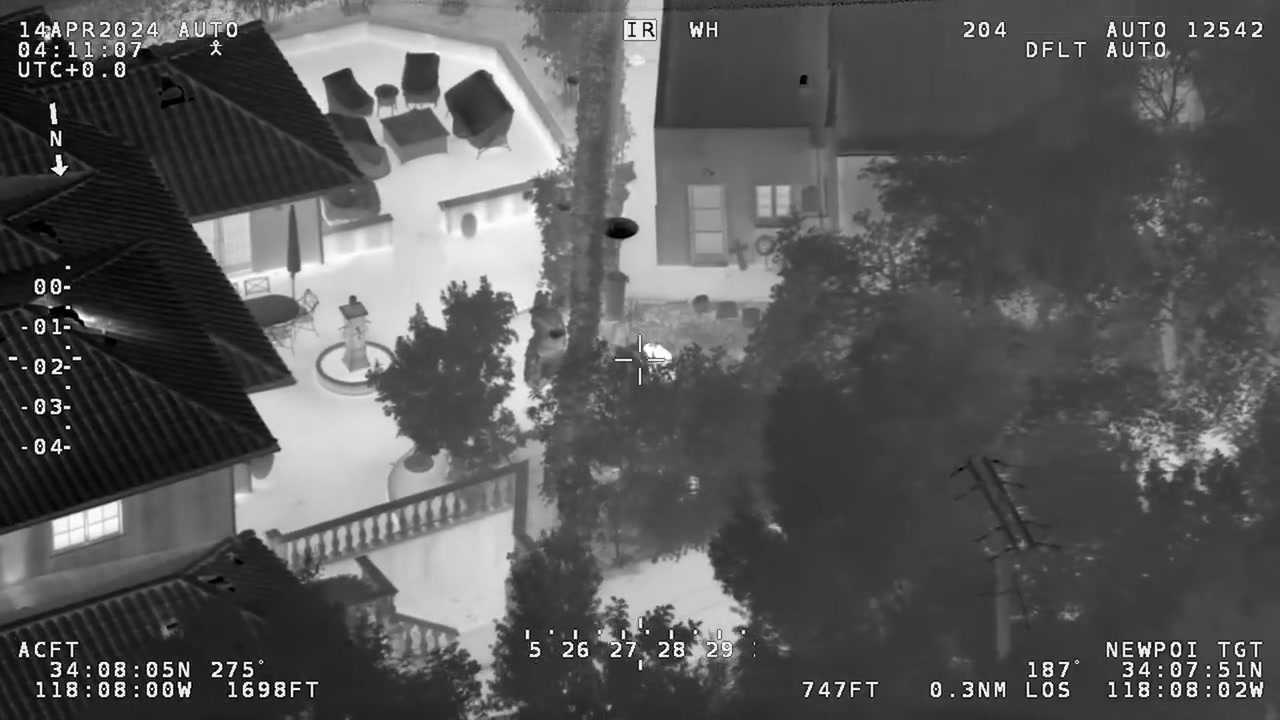
This portion of the bodycam footage changes the entire atmosphere of the incident.
The open roadway disappears.
Now officers are moving around homes, fences, gates, narrow side yards and dark backyards.
Visibility is limited.
Flashlights become essential.
Every doorway or corner can conceal someone.
Meanwhile, the people living in those homes suddenly find themselves inside an active police search.
Andrade did not simply hide outside, according to investigators.
POLICE SAID HE FORCIBLY ENTERED TWO OCCUPIED RESIDENCES WHILE TRYING TO ESCAPE.
That development substantially raised the danger.
Now officers were not merely searching for a fleeing driver.
Residents were potentially being placed directly in his path.
THE FIRST HOME: RESIDENTS HIDE WHILE A STRANGER ENTERS
CBS Los Angeles reported that Andrade entered a residence in the 900 block of Oak Knoll Circle by breaking through a front window.
The homeowners were inside.
According to that account, they retreated and hid in bedroom closets while Andrade moved through the residence, apparently looking for car keys.
Imagine the situation from their perspective.
Minutes earlier, their neighborhood was ordinary.
Then police vehicles arrived.
A helicopter was overhead.
Officers were moving through yards.
And suddenly the person police were searching for was allegedly inside their home.
REAL FRAME — SEARCHING AROUND THE RESIDENCES
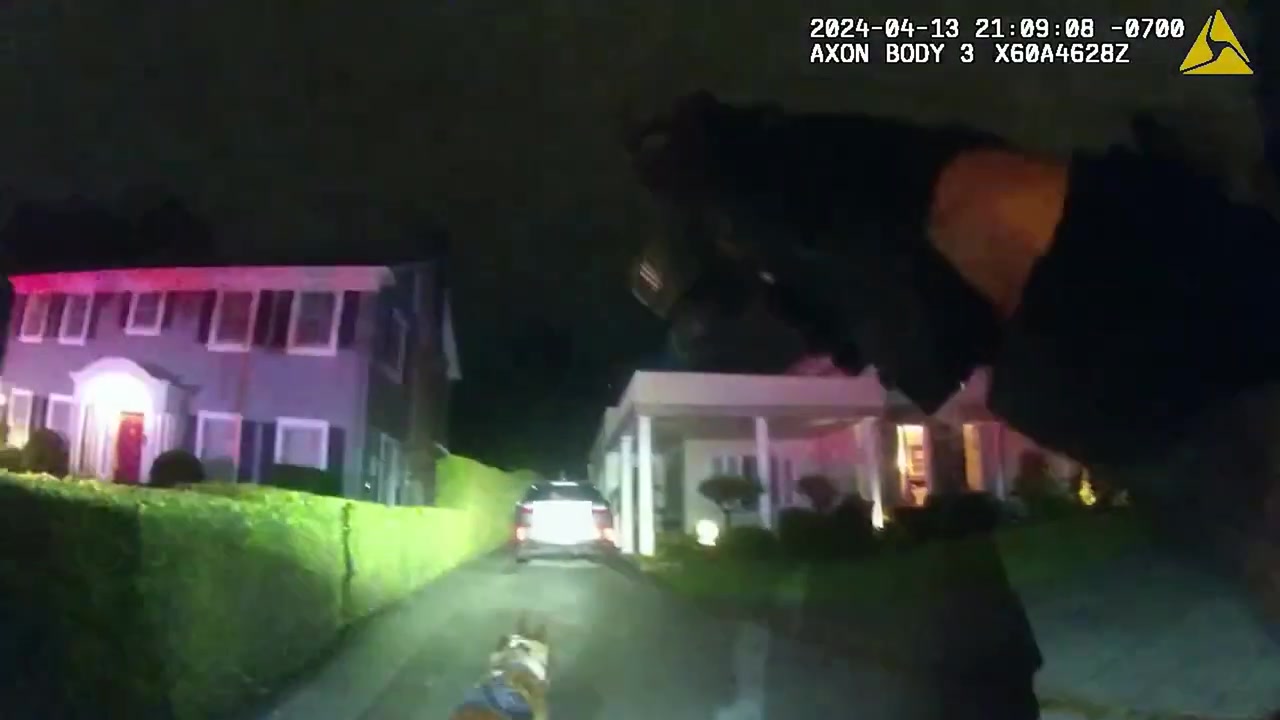
This is where the incident becomes much more than a police chase.
A pursuit is often presented as a contest between police and a fleeing driver.
But innocent residents can become involved without making a single decision of their own.
Their driveway can become a crash scene.
Their yard can become a search area.
Their house can become somewhere a fleeing person attempts to hide.
In this case, police said Andrade eventually left the first residence.
But he did not surrender.
He moved toward another home.
A SECOND OCCUPIED HOME IS BREACHED
Investigators said Andrade then forcibly entered another residence in the 700 block of Oak Knoll Circle.
This time, police were already closing in.
According to CBS Los Angeles, Andrade entered through the rear while the homeowners escaped from the front toward an officer positioned outside.
The bodycam footage captures the tension of officers working around homes while trying to determine exactly where the suspect is.
REAL FRAME — POLICE CLOSE IN
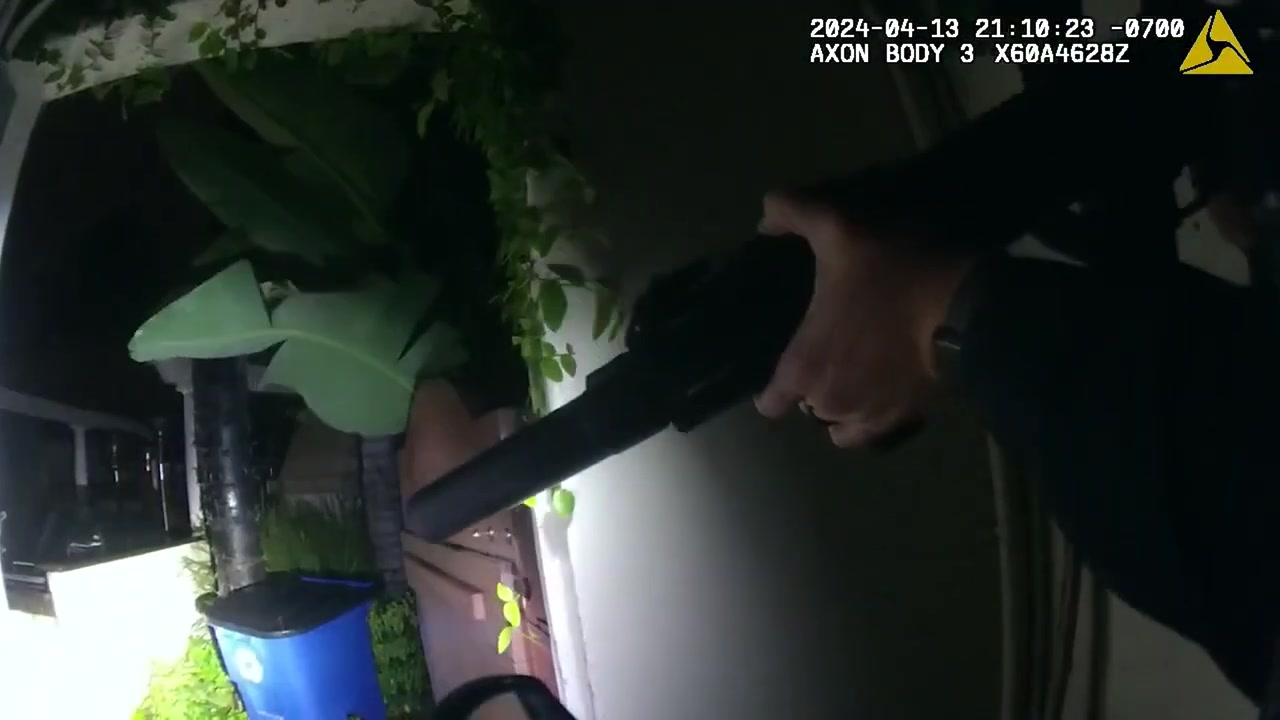
The geography is difficult.
Officers cannot simply rush blindly through a backyard.
They have to distinguish residents from the person they are searching for.
They have to consider whether someone may be armed.
They have to communicate with other officers positioned on different sides of the property.
And they need to prevent the suspect from slipping through containment and reaching yet another residence.
Pasadena Police had another advantage overhead.
A POLICE AIRSHIP WAS TRACKING AND HELPING LOCATE ANDRADE.
Eventually, officers identified his location in a rear yard in the 700 block of Oak Knoll Circle.
The vehicle pursuit was over.
The home entries were over.
The final confrontation was about to begin.
K-9 BARRY MOVES IN FIRST
One of the clearest identifiers in the video is K-9 Barry of the Pasadena Police Department.
Once police located Andrade in the backyard, a K-9 was deployed to make contact.
REAL FRAME — K-9 DEPLOYMENT
The police dog reached Andrade first.
Officers then began moving toward him.
This is one of the most intense sections of the footage because officers still did not have complete control of Andrade's hands.
Police repeatedly gave commands.
The critical-incident footage later released by Pasadena Police shows officers trying to determine whether he had a weapon while the K-9 remained engaged. Pasadena Now reported that officers repeatedly instructed Andrade to show his hands.
Then the situation changed again.
POLICE SAID ANDRADE PRODUCED A HANDGUN.
The department's official April 14 release states that Andrade refused commands to drop the weapon and an officer-involved shooting occurred.
CBS reported that Andrade could be heard saying he was going to shoot himself during the confrontation.
The officers continued issuing commands.
Then gunfire erupted.
THE FINAL SECONDS
Body-camera footage can make incidents like this feel chaotic because the camera records what the officer wearing it experiences rather than providing a perfect cinematic view.
Bodies overlap.
Flashlights illuminate only pieces of the scene.
The police dog is moving.
Officers are shouting.
The suspect's hands may be difficult to see.
REAL FRAME — K-9 AND OFFICERS AT THE FINAL LOCATION
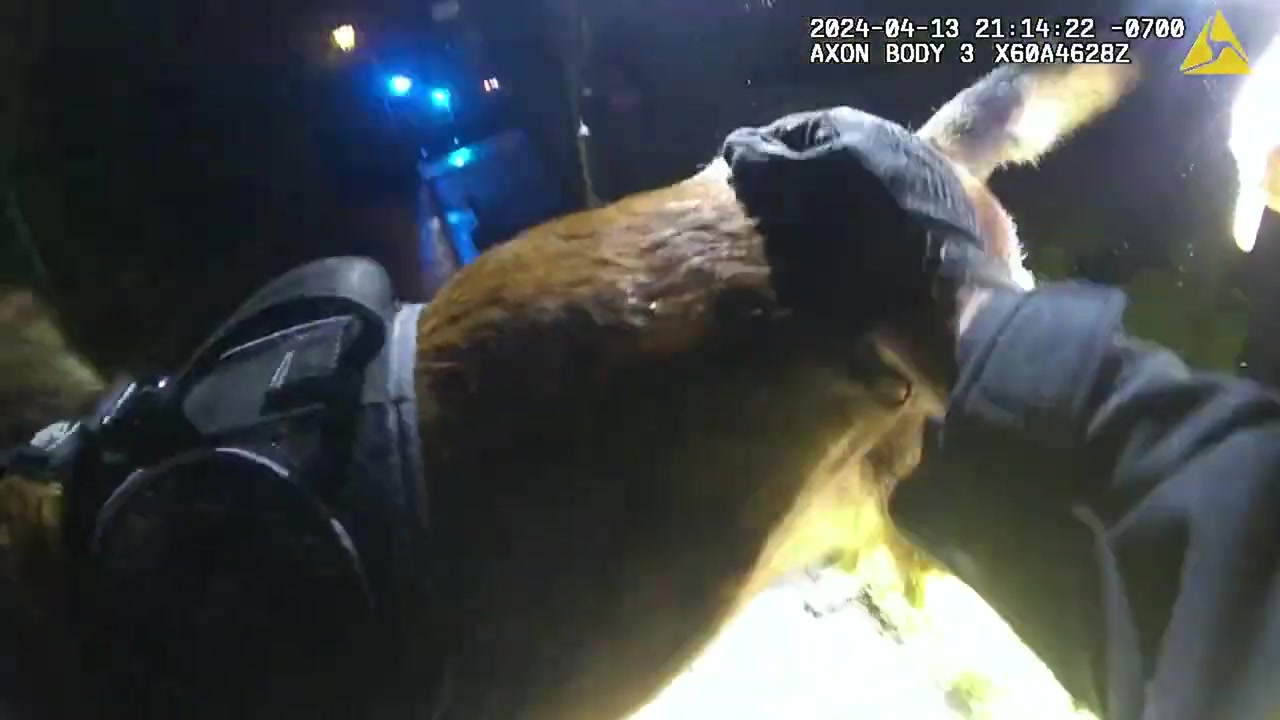
Pasadena Police said Andrade had produced a handgun and refused commands to drop it before an officer fired.
The shooting left Andrade wounded.
Officers then shifted immediately from confrontation to medical response.
Police performed life-saving measures until Pasadena Fire Department paramedics arrived. Andrade was transported to a hospital but was later pronounced dead.
No officers were injured.
Investigators recovered a handgun at the scene.
Later reporting added an unusual detail: the firearm reportedly contained a spent cartridge case that had not ejected from the chamber. Authorities said it was unclear whether Andrade had fired the weapon during this encounter or at some earlier point.
That distinction is important.
It would be inaccurate to state as fact that Andrade fired at officers when investigators themselves had not established that.
What police did state was that he produced the handgun during the confrontation and refused commands to drop it.
WHY THE BODYCAM VIDEO MATTERS
There are several different ways to understand this case.
A police press release provides the sequence.
News reporting adds witness accounts and additional details.
Bodycam and dashcam footage provide something neither can fully reproduce: timing.
The video demonstrates how quickly the situation changes.
At first, officers are talking to someone sitting in a pickup truck.
Seconds later, the truck accelerates away.
Then officers are pursuing it.
Then it crashes.
Then the driver is gone.
Now police are searching yards.
Then residents are fleeing their homes.
Then a helicopter helps locate the suspect.
Then the K-9 goes in.
Then officers discover a gun.
Then shots are fired.
EACH ESCALATION LEAVES LESS TIME FOR THE NEXT DECISION.
That is what makes this incident particularly compelling as bodycam footage.
The viewer can see the consequences of each previous decision creating the conditions for the next stage.
AN ORDINARY CONTACT BECOMES A CITY-BLOCK EMERGENCY
There is also an important contrast between where this incident started and where it ended.
At 8:39 p.m., police were investigating a pickup truck facing the wrong direction.
There was no neighborhood perimeter.
There was no K-9 deployment.
There were no homeowners hiding in closets.
There was no wrecked vehicle in a family's driveway.
There was no armed confrontation in a backyard.
Those things developed afterward.
The official Pasadena Police account describes the progression in remarkably compact terms: suspicious vehicle, fleeing driver, near-strike of an officer, pursuit, crash, foot escape, two forced residential entries, airship search, K-9 contact, handgun and officer-involved shooting.
On paper, it takes only a paragraph.
In reality, every step represents a major change in risk.
THE PEOPLE INSIDE THE HOMES WERE PART OF THE STORY TOO
Police pursuit stories naturally focus on officers and suspects.
But the residents of Oak Knoll Circle had no role in creating the incident.
Yet they were forced into it.
One family had a vehicle struck when Andrade's pickup crashed.
Residents of the first house reportedly hid while a stranger searched inside.
Occupants of the second residence escaped as Andrade allegedly entered from another direction.
Those experiences explain why fleeing through residential neighborhoods can become so dangerous even after a suspect abandons a vehicle.
The pursuit may technically be finished.
THE PUBLIC-SAFETY THREAT MAY NOT BE.
A person desperate to escape may seek transportation, concealment or access through private property.
That creates unpredictable encounters between the fleeing person and residents who have little warning.
For police, every additional house also creates another location that must be cleared or protected.
WHY THE K-9 WAS USED
The final phase illustrates one of the traditional roles of police K-9 teams.
A dog can search terrain, track a person's movement and make contact in locations where sending officers directly forward could expose them to an unknown threat.
In this case, officers knew Andrade had fled police, allegedly entered occupied residences and was hiding in a backyard.
What they did not initially have was complete control of his hands or certainty about whether he was armed.
Police deployed the K-9 while officers moved in behind it.
Only during that final confrontation did the handgun become central to the encounter.
The bodycam perspective makes the uncertainty particularly visible.
The officers are close.
The K-9 is engaged.
Commands are being issued.
There is very little physical distance available once the weapon is identified.
THE MANHUNT THAT HAD STRETCHED ACROSS MULTIPLE BLOCKS HAD COLLAPSED INTO A CONFRONTATION MEASURED IN FEET.
THE INVESTIGATION DID NOT END WITH THE SHOOTING
As with any officer-involved shooting, the final seconds on bodycam were not the end of the official process.
Pasadena Police's Robbery/Homicide Unit responded and began the follow-up investigation. The department stated that criminal and administrative reviews would examine witness interviews, video, forensic evidence and the actions surrounding the shooting.
California law also requires public release of recordings from qualifying critical incidents within specified timelines, which is why the department later released the bodycam, dashcam and explanatory material.
The Pasadena Police critical-incident page lists the case as Incident PA2024-28813 and summarizes the same chain of events captured in the video.
That official material is particularly useful because it allows the dramatic footage to be compared against a documented timeline.
And in this case, the major visual markers match closely.
The April 13 timestamp.
Pasadena Police.
The pickup.
The nighttime residential search.
K-9 Barry.
The backyard confrontation.
Those details establish the identity of the case far more reliably than relying on a reposted video's title alone.
ENDING — FROM A PARKED PICKUP TO A FATAL BACKYARD CONFRONTATION
The distance between the beginning and end of this incident is extraordinary.
IT STARTED WITH A WHITE PICKUP TRUCK PARKED THE WRONG WAY.
Police contacted the driver.
They discovered he was unlicensed.
They asked him to step out.
Instead, authorities said Ricardo Guade Andrade drove away and nearly struck an officer.
The pursuit began.
The pickup reportedly reached dangerous speeds.
Then came the crash.
Andrade ran.
Police established containment.
Residents found themselves caught inside the search area.
Police said Andrade forced his way into one occupied house and then another.
A police airship helped officers locate him.
K-9 Barry reached him in a backyard.
Officers approached.
A handgun appeared.
Commands were shouted.
Then shots were fired.
Andrade was transported to a hospital, where he was pronounced dead.
No police officers were injured.
The entire sequence is a striking example of how an encounter can escalate not through one single dramatic moment, but through a chain of decisions that continuously raises the stakes.
Had Andrade remained at the original stop, everything that followed might have been avoided.
Instead, a suspicious-vehicle investigation expanded across Pasadena streets and eventually entered the private homes and backyards of people who had nothing to do with the original encounter.
The pursuit itself was only one chapter.
The crash didn't end it.
The foot chase didn't end it.
The first house didn't end it.
Neither did the second.
Only in a dark backyard, after the police dog made contact and officers confronted an armed suspect, did the chase finally reach its fatal conclusion.
WHAT BEGAN AS ONE OFFICER CHECKING A PARKED TRUCK ENDED WITH AN ENTIRE NEIGHBORHOOD DRAWN INTO A DEADLY POLICE MANHUNT.
CTA
A truck parked the wrong way looked like a routine police contact — until the driver suddenly accelerated away and nearly struck an officer. What happened next included an 80-mph escape, a violent driveway crash, two occupied homes and a K-9 tracking the suspect into a dark backyard.
WATCH THE FULL VIDEO BELOW TO SEE HOW THE ENCOUNTER ESCALATED FROM THE FIRST POLICE CONTACT TO THE FINAL BACKYARD CONFRONTATION: https://www.youtube.com/watch?v=16YCMQERQVQ
Comments (0)
Loading comments...
May You Like

Cop thinks sandwich is phone

Police Follow the Driver Until His Escape Route Runs Out

A Suspicious Vehicle Leads Officers Into an Unexpected Chase












