
Police K9 Dogs Catch Real Criminals
ARMED SUSPECT DISAPPEARS INTO A SPOKANE NEIGHBORHOOD UNTIL K9 HAYWIRE PICKS UP HIS TRAIL
A CRASH THAT WAS ONLY THE BEGINNING
On the afternoon of November 20, 2021, police in Spokane, Washington, were confronted with the kind of incident that changes character almost immediately.
At approximately 2:30 p.m., a collision occurred near Calispel Street and Wellesley Avenue.
According to Spokane Police, a vehicle driven by 39-year-old Brandon O. Keele ran a stop sign and collided with another vehicle carrying three occupants. Those occupants suffered minor injuries.
At that point, the situation could have remained a traffic investigation.
It didn't.
Police said Keele left the scene on foot.
A witness followed him.
Then came the information that dramatically changed the police response: authorities said Keele pointed a firearm at the person following him before continuing to flee into the surrounding residential neighborhood.
Now officers were no longer simply looking for someone who had left a crash.
They were searching for a man suspected of an armed assault.
And somewhere among the houses, yards, garages, bushes and narrow alleys of Spokane, Keele had disappeared.
Police brought in SWAT resources.
They also brought in K9 Haywire.
What happened next turned an ordinary-looking Spokane neighborhood into the setting for a nearly 20-minute search that ended with the suspect concealed in vegetation, a police dog injured and a loaded handgun recovered nearby.
KEELE HAD ESCAPED THE OFFICERS' LINE OF SIGHT. BUT HE HADN'T ESCAPED THE SEARCH.
THE INFORMATION OFFICERS HAD CHANGED EVERYTHING
The allegation involving the handgun is critical to understanding the footage.
If police had been looking only for a driver who walked away from a collision, the tactical problem would have been very different.
But officers had been told the fleeing man had pointed a firearm at another person.
That meant every backyard could potentially contain an armed suspect.
Every corner mattered.
Every fence obscured what officers could see.
Every garage, hedge and narrow passage became a potential hiding place.
Spokane Police responded by bringing on-duty SWAT and K9 resources into the search.
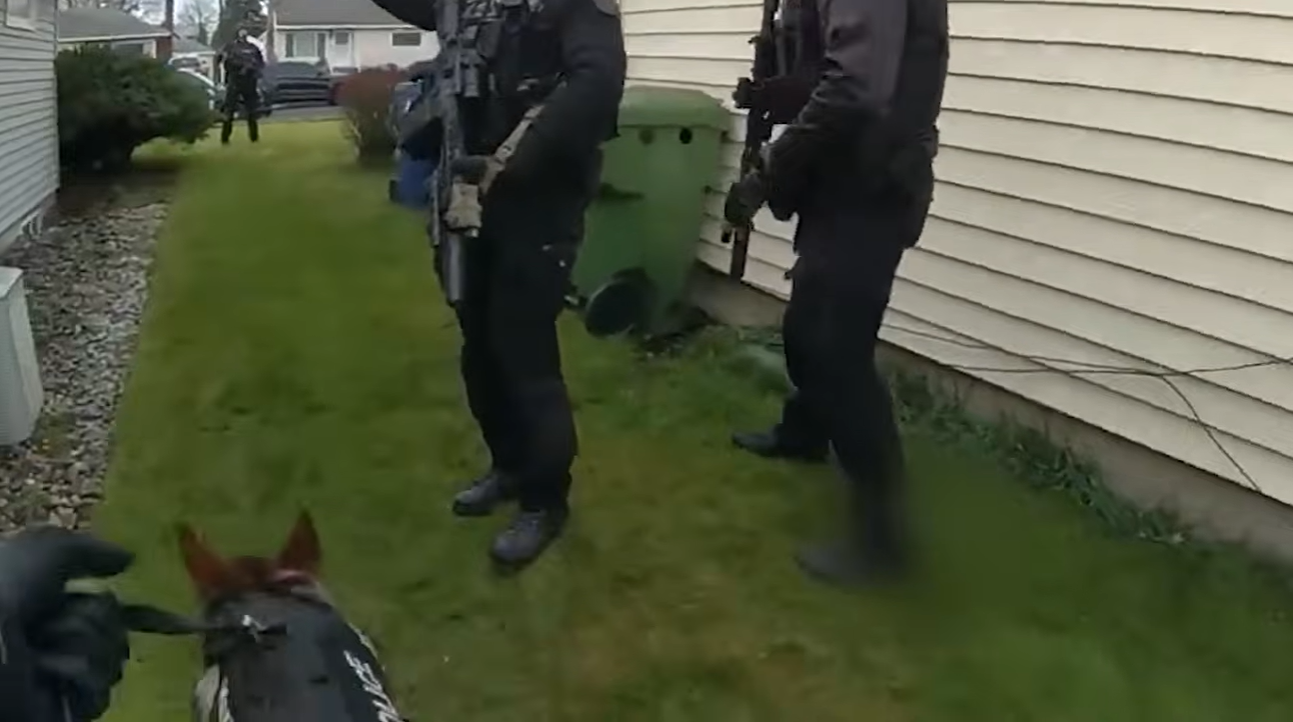
The bodycam footage makes the geography immediately understandable.
This isn't an open field.
It isn't a parking lot where officers can maintain long sightlines.
It is a neighborhood.
Homes stand close together.
Shrubs block portions of yards.
Fences divide properties.
Garages and alleys create routes invisible from the street.
A fleeing person can turn one corner and effectively disappear.
That is exactly the problem officers now faced.
HAYWIRE ENTERS THE SEARCH
The K9 shown in your footage is Haywire, a Spokane Police Department dog partnered with Officer David Stone.
Haywire was an experienced police K9. A Spokane-area K9 organization identifies Officer Stone as his handler, while Spokane Police records document Haywire's involvement in multiple apprehension operations.
The task on November 20 was straightforward to describe:
FIND KEELE.
Actually doing it was much harder.
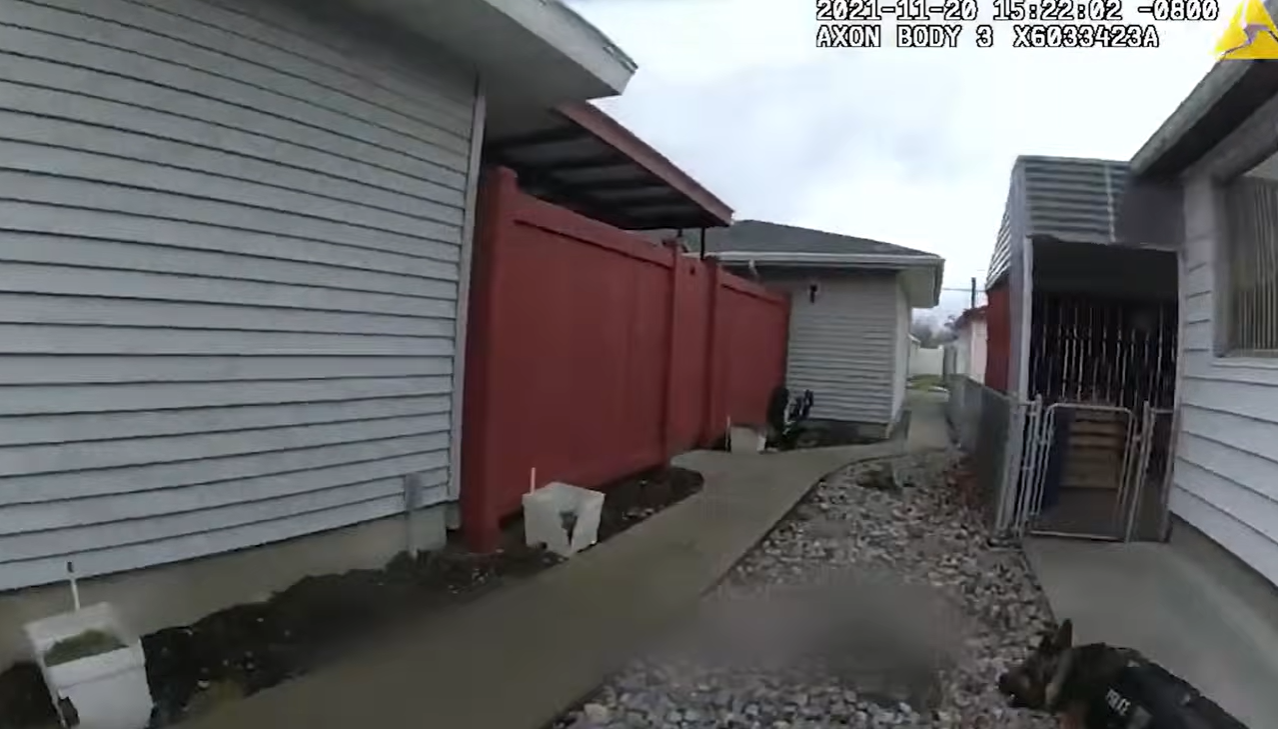
Haywire moves ahead on a long lead.
His handler follows.
Other officers provide security.
The bodycam perspective creates an unusual kind of tension because the viewer knows approximately what the officers know:
The suspect is somewhere ahead.
Police believe he may have a firearm.
But nobody looking through the camera can see him.
This is where Haywire's job becomes critical.
A human officer primarily searches visually.
A tracking dog has another source of information.
Scent.
THE SEARCH LEAVES THE STREET
The team begins moving through residential properties.
The footage shows Haywire crossing lawns and pulling his handler toward the next section of the neighborhood.
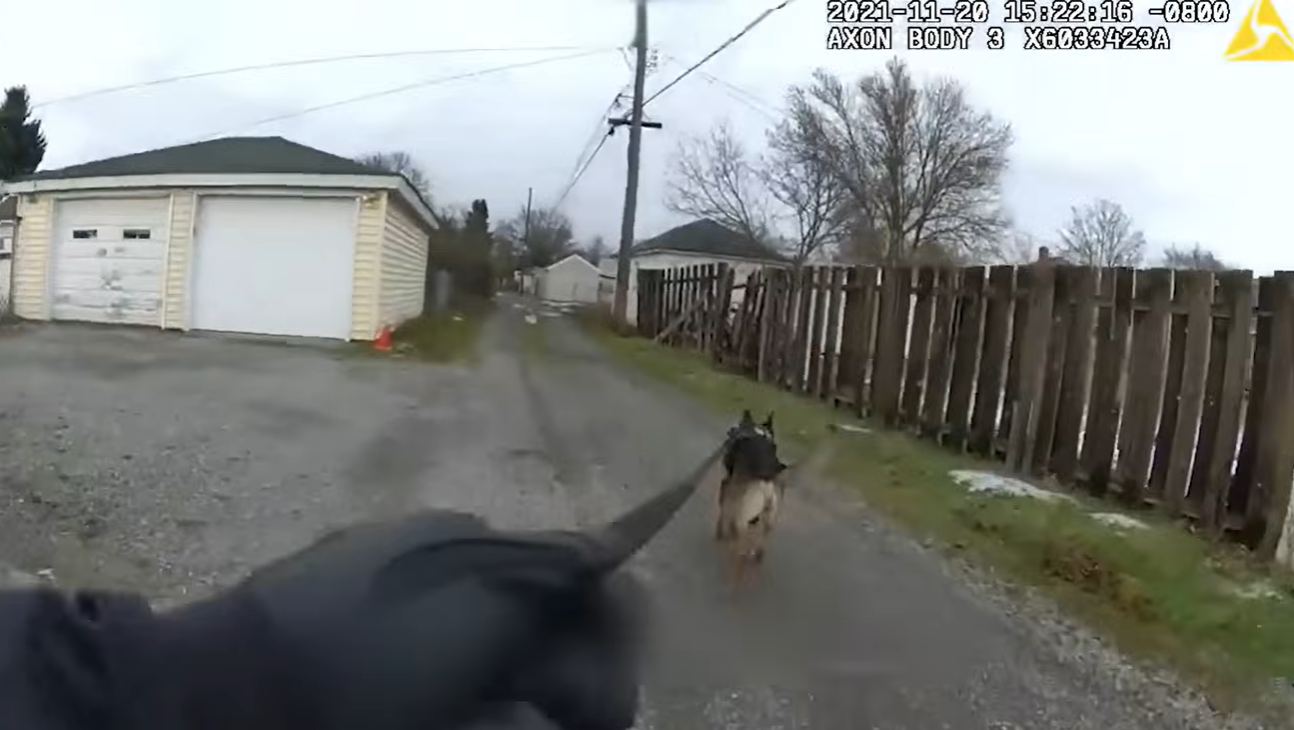
For the viewer, these moments may initially look uneventful.
There is no suspect visible.
No confrontation.
No arrest.
But narratively, this is precisely what creates suspense.
Every yard Haywire crosses narrows the possibilities.
The officers aren't simply wandering.
They are following a trail.
And unlike a vehicle pursuit, there is no guarantee that the person being followed will remain in motion.
Keele could be running.
He could have entered a structure.
He could have doubled back.
Or he could simply be waiting somewhere out of sight.
Police said the search continued for nearly 20 minutes.
Twenty minutes is a long time when officers believe the person they're searching for may be armed.
FROM FRONT YARDS TO ALLEYS
The search continues.
Haywire pulls forward.
The terrain changes from open lawns to tighter residential passages.
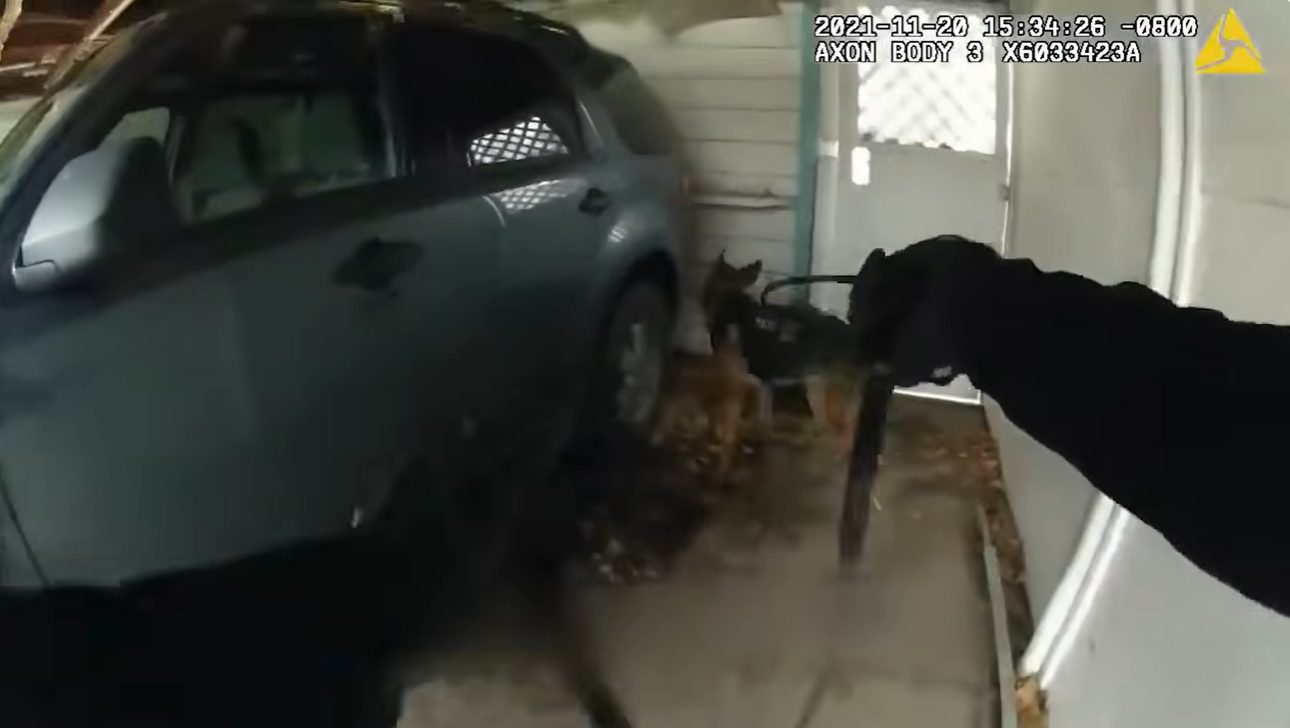
Alleys create another tactical problem.
They provide routes between streets while also giving a fleeing person access to numerous backyards.
Wood fences restrict visibility.
Garages interrupt sightlines.
Vehicles provide concealment.
A person can move parallel to the street without ever being visible from it.
But Haywire keeps working.
This is where the bodycam sequence gains much of its retention power.
The audience hasn't seen Keele.
There is no guarantee that the next turn will reveal him.
So each movement creates another unanswered question:
Is he behind this house?
Did he cross the next yard?
Has Haywire lost the trail?
Or is the dog getting closer?
The footage doesn't need artificial suspense.
The uncertainty is genuine.
THE TRACK BEGINS TO CLOSE IN
Eventually, the K9 team's behavior indicates that the search is becoming more focused.
Officers coordinate positions.
Haywire continues toward residential vegetation.
The suspect has done something that often works against purely visual searches.
He has stopped running.
Police later said Keele was hiding in bushes in the backyard of a residence along Whitehouse Street.
That decision makes sense from the fugitive's perspective.
Running creates movement.
Movement attracts attention.
Hiding removes the most obvious visual cue.
A person lying beneath dense vegetation can be remarkably difficult to spot even from a short distance.
But hiding creates a different problem when a K9 is tracking you.
STOPPING YOUR MOVEMENT DOESN'T ERASE THE TRAIL THAT LED THERE.
Haywire found him.
THE COMMANDS BEGIN
Once officers knew where Keele was, the operation changed immediately.
This was no longer a broad neighborhood search.
They had a specific location.
Police said Keele was ordered to surrender.
According to investigators, he refused.
That refusal created the final tactical problem.
Officers believed they were dealing with a man who had already pointed a gun at someone.
He was concealed in vegetation.
And he wasn't coming out.
Police deployed Haywire.
This is the point where the incident becomes much more physical.
HAYWIRE MAKES CONTACT
Haywire moved into the vegetation and reached Keele.
The purpose was to apprehend and hold him long enough for officers to move in.
Instead of surrendering, police said Keele began fighting the dog.
And what happened next became the defining detail of the case.
According to Spokane Police, Keele used his fingers to gouge Haywire's eyes while resisting arrest.
Despite the injury, Haywire remained engaged.
The dog did not immediately disengage.
That gave officers the opportunity to close the distance.
The confrontation was now happening at extremely close range.
The suspect.
The K9.
The handler.
Additional officers.
All compressed into a small section of a residential backyard.
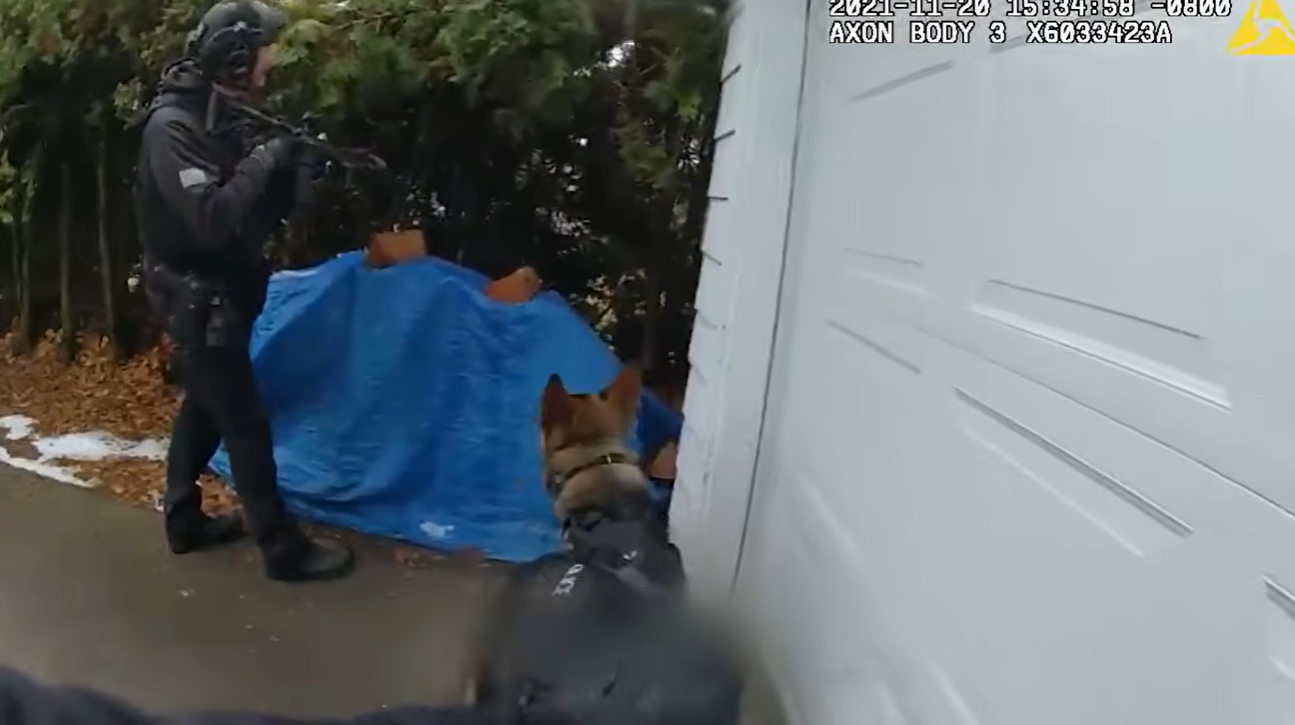
Eventually, officers were able to place Keele under arrest.
The nearly 20-minute search was over.
But police then discovered something that reinforced why officers had treated the entire operation as a potentially armed encounter.
A LOADED HANDGUN IS FOUND
Investigators searched the hiding location.
According to Spokane Police, officers found a loaded handgun in the area where Keele had been hiding.
That discovery connected the final hiding place back to the allegation that had changed the police response after the crash.
The witness had reported being threatened with a firearm.
Police searched for Keele as a potentially armed assault suspect.
And after the arrest, a loaded gun was recovered from his hiding location.
That does not mean every movement Keele made during the K9 confrontation can be inferred from the firearm's presence.
It does mean the officers' concern about a weapon was not hypothetical.
There was a loaded gun at the scene.
HAYWIRE IS INJURED BUT RECOVERS
Once Keele was secured, attention also turned to Haywire.
Police said the dog had suffered an eye injury during the struggle.
The department's November 22 release summarized the incident starkly: an armed assault suspect had injured Haywire during the arrest.
Fortunately, the injury did not end Haywire's career.
The department subsequently reported that he recovered.
That outcome is particularly significant when viewed alongside the bodycam.
The K9 is at the front of the search for much of the sequence.
Haywire is the one moving into spaces before the officers.
He is the one following the scent.
And when the suspect is finally located, he is the first member of the team to physically reach him.
The danger of that role becomes obvious in seconds.
THE SUSPECT FACES A LONG LIST OF ALLEGATIONS
The arrest did not result from a single alleged offense.
Police said Keele faced multiple felony allegations following the incident, including first-degree assault, second-degree burglary, vehicle hit-and-run with injury, resisting arrest, harming a police dog, unlawful possession of a firearm and driving with a suspended license.
The first-degree assault allegation stemmed from police saying he pointed the firearm at the witness who followed him.
The K9-related allegation resulted from the struggle with Haywire.
The hit-and-run allegation traced back to the collision that started the entire chain of events.
This is what makes the chronology so important.
Looking only at the final arrest removes the context.
The incident is not simply:
Police dog finds man in bushes.
It is:
CRASH
↓
DRIVER RUNS
↓
WITNESS FOLLOWS
↓
GUN ALLEGEDLY POINTED AT WITNESS
↓
SUSPECT DISAPPEARS INTO NEIGHBORHOOD
↓
SWAT AND K9 CALLED
↓
20-MINUTE SEARCH
↓
HAYWIRE FINDS HIDING PLACE
↓
SUSPECT REFUSES TO SURRENDER
↓
K9 DEPLOYED
↓
HAYWIRE INJURED
↓
OFFICERS MAKE ARREST
↓
LOADED HANDGUN RECOVERED
That is the complete narrative.
WHY THIS K9 SEARCH WORKS SO WELL AS BODYCAM FOOTAGE
There is an interesting difference between this footage and a conventional pursuit.
In a car chase, viewers can normally see the target.
The suspect's vehicle is ahead.
Police are behind.
The question is when and how the pursuit will end.
Here, the target is invisible for most of the sequence.
That creates a different form of suspense.
The viewer is following the search process itself.
Haywire becomes the only member of the team who appears to know where the story is going.
His handler has to trust the dog's behavior.
The officers providing security have to trust the handler.
And the viewer follows all of them.
The strongest hook therefore isn't the arrest.
It is a much earlier image:
Haywire pulling hard on the lead through an ordinary Spokane neighborhood while officers know an armed suspect may be somewhere ahead.
That image creates a question.
The arrest answers it.
AN ORDINARY NEIGHBORHOOD BECOMES A SEARCH ZONE
One of the most striking things about your footage is how normal everything looks.
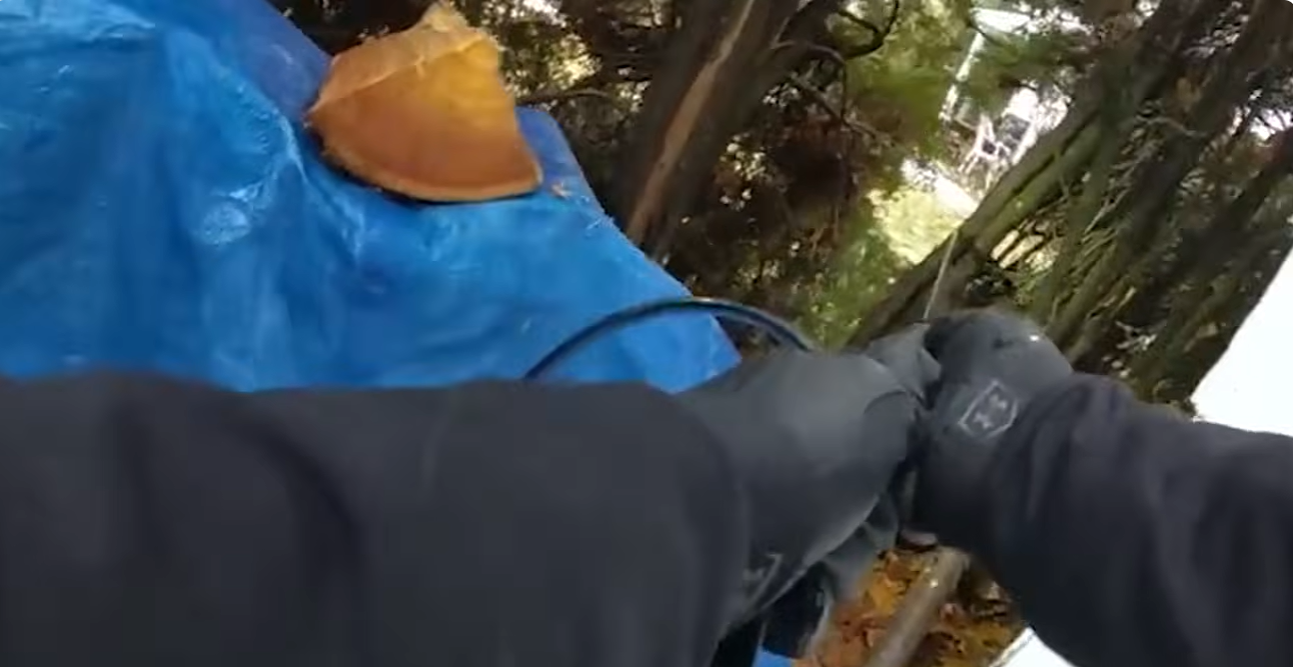
Single-family homes.
Front lawns.
Garages.
Leafless trees.
Cars moving along the street.
Nothing visually announces that a potentially armed man is hiding somewhere nearby.
That's precisely why residential fugitive searches can be difficult.
Residents may still be inside homes.
People may drive through nearby streets.
Officers cannot assume every property is empty.
At the same time, the suspect can use normal neighborhood features as concealment.
A hedge that exists for privacy can hide a person.
A backyard fence can break visual contact.
A garage can block an officer's view.
An alley can provide another escape route.
The environment is familiar.
The tactical problem is not.
WHY HAYWIRE'S ROLE MATTERED
The value of the K9 becomes easiest to understand by imagining the same search without him.
Officers know Keele fled into the neighborhood.
They establish containment.
Then what?
Every possible hiding location needs attention.
Every yard takes time.
Every bush can conceal someone.
And officers believe the man may have a firearm.
A K9 doesn't eliminate those risks.
But a tracking dog can dramatically change how officers prioritize the search.
Haywire gives them direction.
Instead of treating every possible hiding location equally, the handler can follow the dog's indications.
The search becomes progressively narrower.
Eventually it reaches the bushes.
And inside those bushes is the person they were looking for.
THE FINAL CONFRONTATION ALSO SHOWS THE RISK TO THE DOG
Police K9 footage is sometimes viewed as though the dog is simply another piece of equipment.
This incident demonstrates why that comparison has limits.
Haywire was physically exposed to the suspect.
When Keele allegedly attacked the dog's eyes, Haywire couldn't simply be replaced or reset.
He was injured.
His handler then had to manage an arrest scene while his partner had been hurt.
The footage therefore contains two simultaneous responsibilities.
Apprehend the suspect.
Protect the dog.
The department's later announcement that Haywire recovered provides an important ending to that part of the story.
A SINGLE CRASH CREATED A CHAIN OF ESCALATIONS
From a storytelling standpoint, the most powerful feature of this case is escalation.
At each stage, the incident could have ended.
After the collision, Keele could have remained at the scene.
Instead, police say he ran.
After the witness followed him, he could have stopped.
Instead, police say he displayed a firearm.
Once police surrounded the area, he could have surrendered.
Instead, he hid.
When officers located him, he could have followed their commands.
Instead, police say he refused.
When Haywire made contact, the confrontation could have ended.
Instead, police say Keele fought the dog and injured him.
Each decision pushes the incident one stage further.
That means the blog doesn't need exaggerated language to maintain attention.
The verified sequence already does it.
THE MOMENT THAT CHANGES THE STORY
The most dramatic image is naturally the arrest.
But the most important narrative moment happens earlier.
It happens when Keele disappears into the neighborhood.
Up to that point, the incident is understandable visually.
There was a crash.
A man fled.
Someone followed him.
Then he disappears.
Now police have incomplete information and a large search area.
That is when Haywire enters.
From that point onward, the audience isn't watching officers chase Keele.
THE AUDIENCE IS WATCHING HAYWIRE FIND HIM.
That distinction makes the K9 the central character of the footage without needing to anthropomorphize the dog or exaggerate his role.
He tracks.
He locates.
He apprehends.
He remains engaged despite being injured.
Officers complete the arrest.
That is enough.
THE AFTERMATH
Keele was taken into custody.
Haywire received care for his injury and recovered.
Police recovered the loaded handgun.
The occupants of the other vehicle involved in the original collision suffered minor injuries.
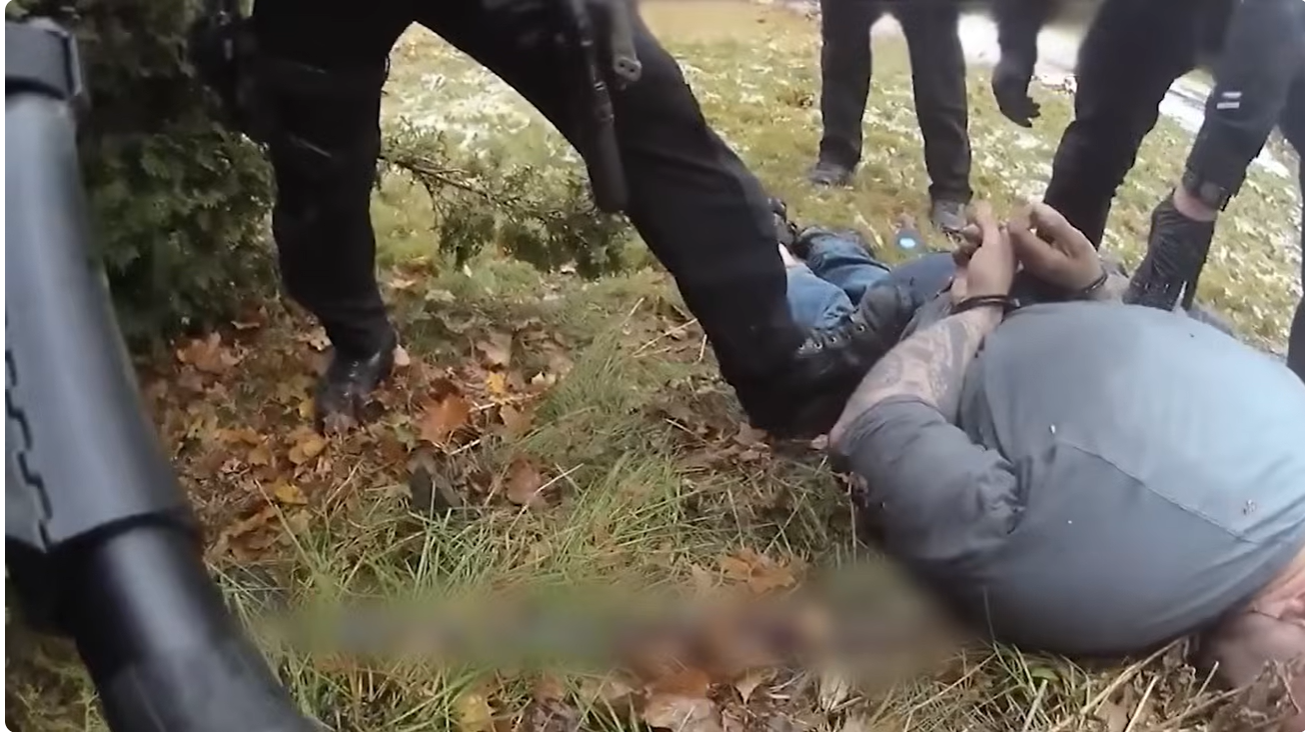
The neighborhood slowly returned to normal.
But the footage preserved how quickly an ordinary Saturday afternoon had changed.
A traffic collision led to a foot pursuit.
The foot pursuit became an armed-suspect search.
The search moved through residential yards and alleys.
A K9 picked up the trail.
A suspect was found hidden in bushes.
The police dog was injured.
And a loaded firearm was recovered from the hiding location.
From beginning to end, the incident demonstrates why the most dangerous part of a pursuit is not always the pursuit itself.
Sometimes it is the moment the person being chased disappears.
THE ENDING: HAYWIRE FOUND WHAT OFFICERS COULDN'T SEE
For nearly 20 minutes, Spokane officers searched for Brandon Keele.
The neighborhood offered countless places to hide.
Keele chose vegetation in the backyard of a residence along Whitehouse Street.
From a purely visual perspective, the strategy had worked.
He had broken contact.
Officers could no longer simply follow him with their eyes.
But Haywire wasn't relying only on eyesight.
The K9 worked through the neighborhood until the trail reached the bushes.
Then the entire operation changed.
Commands were given.
Police said Keele refused to surrender.
Haywire was sent in.
During the struggle, police say Keele injured the dog's eyes.
Haywire stayed engaged long enough for officers to move forward and make the arrest.
A loaded handgun was found nearby.
And Haywire eventually recovered from his injuries.
THE SUSPECT HAD FOUND A PLACE WHERE PEOPLE COULDN'T EASILY SEE HIM.
THAT DIDN'T MEAN HAYWIRE COULDN'T FIND HIM.
CTA: THE SEARCH LOOKED QUIET UNTIL HAYWIRE REACHED THE BUSHES
For much of this bodycam footage, there is no suspect in sight.
There are only officers, residential streets, yards, alleys and one K9 pulling steadily forward.
But that's what makes the ending so effective.
Viewers know police believe an armed man is somewhere ahead.
Haywire keeps following the trail.
House after house passes.
The search continues.
Then the dog reaches a backyard.
The hiding place is found.
And within moments, the quiet tracking sequence becomes a close-range struggle involving the suspect, Haywire and multiple officers.
THE MOST IMPORTANT MOMENT ISN'T WHEN THE SUSPECT RUNS. IT'S WHEN HE STOPS RUNNING AND THINKS HE HAS DISAPPEARED.
Click here to watch the full bodycam sequence and follow K9 Haywire from the first residential track to the moment the hidden suspect is finally located and taken into custody: https://www.youtube.com/watch?v=16YCMQERQVQ
Comments (0)
Loading comments...
May You Like

UCF Student’s Pronoun Dispute With Campus Police Escalates Into an Arrest
Everything Changed When Cops Asked About Weapons

Neighborhood Grocery Store Suddenly Erupts Into Chaos













