
Police Confront Man With SAMURAI SWORD
Poughkeepsie Police Respond to Sword Assault Before Encounter Turns Fatal
A Crisis Call That Changed in Seconds
On the afternoon of June 5, 2025, Town of Poughkeepsie police officers were sent to a home in Dutchess County, New York, after a 911 call reported an assault involving a sword. What officers encountered inside the residence would become the subject of a New York Attorney General investigation and, two months later, a public release of body-worn camera footage.
The man who died was identified as 36-year-old Brian Czornyj. According to the New York Attorney General's Office of Special Investigation, responding officers found two men standing side by side and both holding the same sword. Czornyj, the younger man, appeared uninjured and was holding the weapon by its handle. The older man appeared injured and was holding the sword by its blade.
Officers repeatedly ordered the sword to be dropped. It was not. An officer then fired his service weapon, striking Czornyj. He was taken to a hospital and pronounced dead. The older man was treated and released later that night. Police recovered what authorities described as a Samurai sword.
The supplied video, “Police Confront Man With SAMURAI SWORD,” matches the official footage release. Its Axon timestamp shows June 5, 2025, at approximately 2:21 p.m., and the interior of the residence corresponds with the sequence described by the Attorney General's office. The video gives viewers only seconds to absorb a scene that investigators have spent far longer examining.
Why Officers Were Sent to Fair Oaks Drive
Contemporary reporting placed the incident at a home on Fair Oaks Drive in the Town of Poughkeepsie. Police said the original call concerned an active assault involving a sword and members of the Dutchess County Mobile Crisis Team.
That detail is significant. Officers were not responding to a vague report of a person simply possessing a sword inside a private residence. They were arriving after an emergency call describing an assault already in progress.
The Times Union reported that the encounter occurred at approximately 2:15 p.m. The body-camera timestamp in the supplied footage shows officers at the property only minutes later.
When police arrive at a call involving an edged weapon, the information available before they enter can be incomplete. They may know that someone is hurt and that a weapon is involved without knowing exactly who is holding it, whether the assault is continuing, or how many people are inside.
The Bodycam Begins Outside the Home
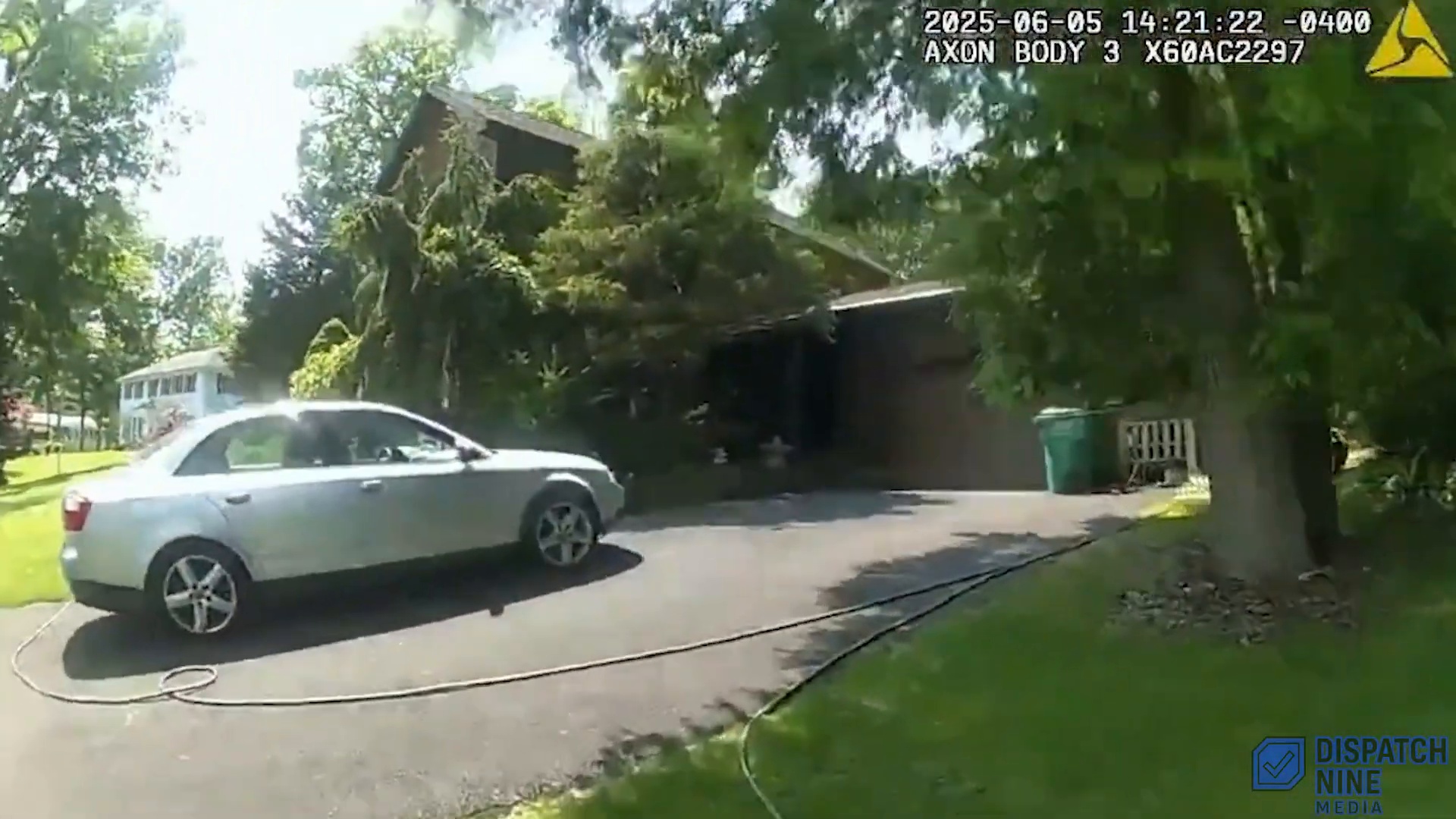
The footage first places the viewer outside a tree-covered residential property. A silver sedan sits in the driveway. The house is surrounded by mature trees and dense greenery, giving the scene an almost peaceful appearance.
Nothing about the exterior conveys the urgency of the call.
That contrast is one of the reasons the footage is so striking. The camera moves from an ordinary suburban driveway toward a residence where officers believe an armed assault has just occurred.
The date and time displayed on the Axon overlay are especially valuable for verification. They match the June 5, 2025 incident described by the Attorney General and local news reports.
Officers Move Toward an Uncertain Interior
As officers approach and enter, the tactical problem changes immediately. Outdoors, they have room to move and clearer lines of sight. Inside a home, hallways, furniture, walls and doorways restrict movement.
Officers also have to distinguish between the person suspected of causing the emergency and anyone who may have been injured or caught in the confrontation.
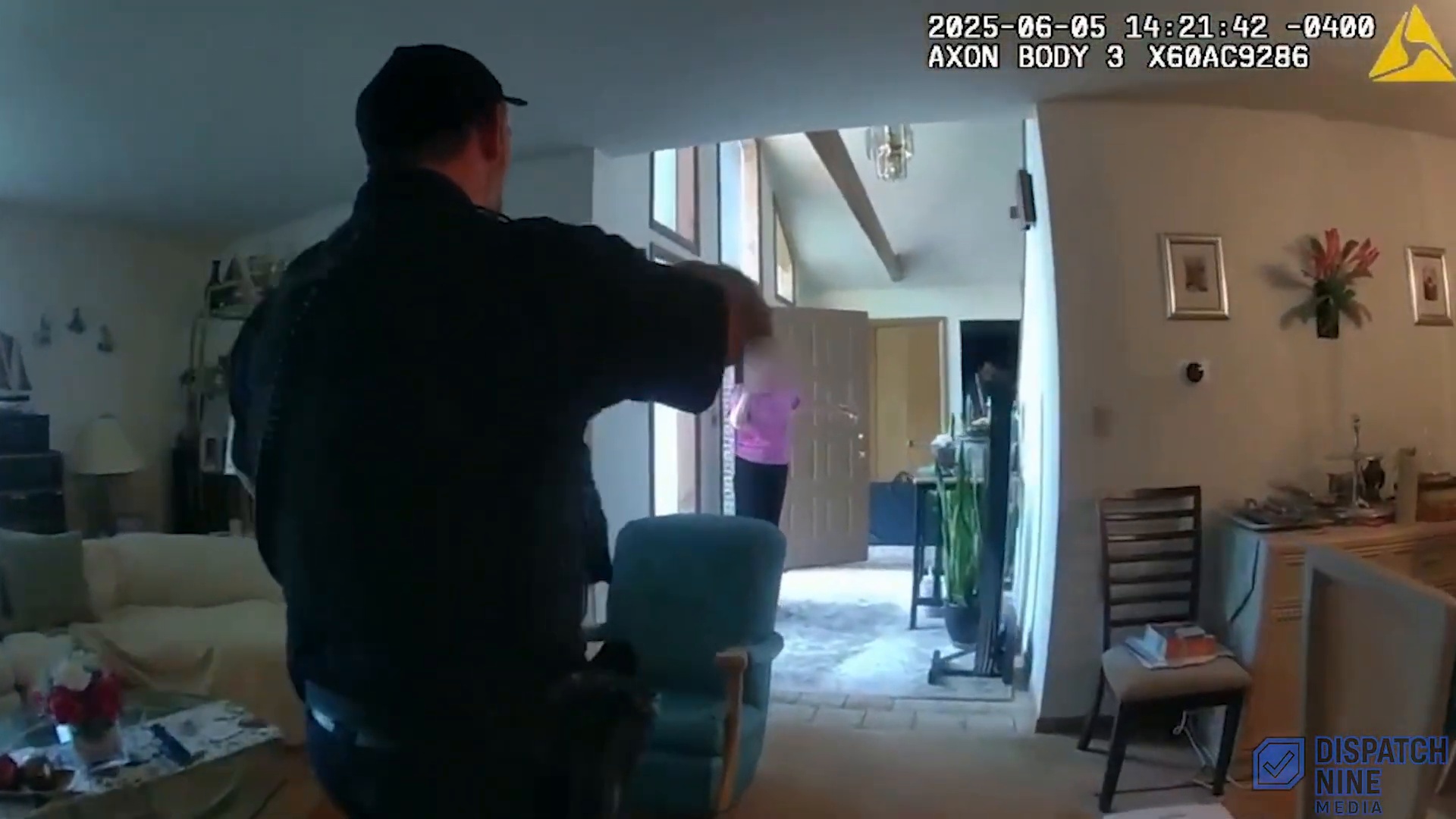
The official description later provided by OSI makes clear just how unusual the scene was. Police did not encounter one person standing alone with a sword. They encountered two men physically connected to the same weapon.
That detail complicated what officers were seeing in real time.
Two Men, One Sword
According to the Attorney General's office, Czornyj held the sword by its handle while the older man held the blade. The older man appeared injured. Czornyj appeared uninjured.
That positioning is central to understanding the bodycam footage.
A sword is a close-range weapon, but the danger it presents can change instantly depending on distance, grip and movement. The fact that two people were holding the same weapon created a scene that was difficult to interpret at a glance.
OSI's initial statement carefully described what the footage appeared to show rather than assigning every movement a motive. That same caution is appropriate here. The video documents the positions of the people involved and the commands officers gave, but questions about intent belong to the investigation rather than speculation.
Repeated Commands to Drop the Weapon
The Attorney General's office said officers repeatedly gave commands to drop the sword and appeared to direct those commands at Czornyj.
The bodycam captures the urgency of those commands.
This is the point where the encounter becomes compressed into seconds. Officers have entered a residence after a report of an assault. They see an injured person, another man and a large edged weapon being held between them.
Commands are intended to simplify that scene. If the weapon is dropped, officers can separate the people involved, provide medical care and investigate what happened.
But the sword was not dropped.
The Encounter Turns Fatal
An officer discharged his service weapon and struck Czornyj.
The New York Attorney General's office has not treated the released footage as a final judgment about the officer's actions. When it published the bodycam in August 2025, OSI specifically said the release was not an expression of any opinion about guilt, innocence or whether anyone should be charged.
That distinction matters.
Body-camera footage can be powerful, but an investigation into a fatal police encounter considers more than the visible frames. Investigators can review 911 calls, dispatch information, officer statements, witness accounts, physical evidence, medical findings, scene measurements and the timing of each action.
As of September 2026, the Attorney General's public OSI case index still lists the Czornyj matter with the investigation announcement and video release, but no final investigative report or findings notice is shown for the case. The investigation therefore should not be described as resolved.
The Older Man Was Also Injured
The older man who had been holding the blade was treated after the encounter.
The Attorney General's office said he was released from medical care on the night of June 5. His name was not provided in the official OSI announcement.
This is another detail that can disappear when the incident is reduced to a headline about a police shooting. Officers had arrived at a scene where someone was already visibly injured before the gunfire.
The nature and circumstances of those injuries are part of the broader investigation, and this article does not add unsupported details about how they occurred.
A Samurai Sword Was Recovered
Authorities recovered a Samurai sword at the scene.
That physical evidence matters because it independently confirms the central object visible in the encounter. It was not merely a description supplied by a reposting channel or an interpretation of a blurred bodycam frame.
The Attorney General's June 10 announcement and August 13 footage release both specifically refer to the recovered Samurai sword.
For investigators, the weapon itself can help reconstruct the scene. Its size, condition and location after the encounter can be compared with bodycam footage and witness accounts.
Why the Attorney General Automatically Became Involved
New York's Office of Special Investigation reviews incidents in which a police or peace officer may have caused a person's death.
The Attorney General explained that state law requires OSI to assess such incidents regardless of whether the officer was on duty or whether the person who died was armed, unarmed, in custody or outside custody.
After its initial assessment of the Poughkeepsie incident, OSI opened a full investigation.
That process is separate from ordinary police reporting. Its purpose is to independently examine whether the evidence supports criminal charges in connection with the death.
The August Release Added Crucial Transparency
On August 13, 2025, Attorney General Letitia James' office released body-worn camera footage obtained during the investigation.
The public release included recordings from two officers, identified on the OSI footage page as Officer Gouger and Officer Spruill.
The video supplied for this article is consistent with that official material. It shows the June 5 timestamp and the rapid movement from the exterior of the home into the interior confrontation.
Releasing footage does not settle the legal questions surrounding a police shooting, but it allows the public to see evidence that otherwise would exist only inside investigative files.
The Camera Shows Only One Perspective at a Time
One of the limitations of bodycam is easy to forget: the camera does not see exactly what the officer sees.
It is mounted on the body rather than the eyes. An officer can turn his head without the camera following immediately. Hands or arms can block the lens. Doorways and other officers can obscure important details.
In this footage, those limitations are visible. The interior scene changes quickly as officers position themselves. At moments, the camera's view is partially blocked.
That is why investigators compare multiple cameras rather than treating one frame as a complete record.
The Scene Was More Complex Than a Typical Armed-Person Call
A person holding a sword alone presents one kind of problem. Two people simultaneously holding the same sword present another.
The older man's hand on the blade indicates that the weapon was not simply being carried casually. At the same time, the precise physical struggle and intentions of each person cannot be reconstructed responsibly from a few still frames.
The Attorney General's wording is deliberately restrained: Czornyj held the handle, the older man held the blade, commands were given, the sword was not dropped, and an officer fired.
Those verified facts are enough to explain the core sequence without inventing dialogue, motives or movements that the official investigation has not established.
Why Seconds Matter in an Edged-Weapon Encounter
Edged weapons are dangerous at close range because they require little preparation to cause serious injury. Inside a home, officers may have limited space to create distance.
That does not automatically answer whether any particular use of force was legally justified. It does explain why the timing and positioning in this case are central to OSI's review.
Investigators will be interested in where each officer stood, where Czornyj and the older man were positioned, what commands were given, how much time passed, and what movements occurred immediately before the shot.
Bodycam can help answer those questions frame by frame, but the final legal analysis requires the complete evidentiary record.
A Fatal Encounter Under Independent Review
The shooting transformed a local police response into a state-level investigation.
Czornyj was transported to a local hospital after being shot and was pronounced dead. His death triggered the statutory review by OSI.
The public case index remains important because it provides a way to distinguish an active or unresolved investigation from one in which the Attorney General has published final findings.
As of the current public listing, Czornyj's entry includes the investigation announcement, video announcement and released footage. It does not show a final report link.
That means any claim that the officer was cleared, charged or found criminally liable would go beyond the public record currently available.
What Contemporary Reporting Added
Local and regional reporting helped establish details surrounding the official statements.
The Times Union reported that Czornyj was 36 and lived at the residence where the shooting occurred. It also reported that police said members of the Dutchess County Mobile Crisis Team had been attacked before officers arrived.
The Poughkeepsie Journal similarly reported the Fair Oaks Drive location and the Attorney General's description of the two men holding the sword.
These reports align with the state investigation announcement rather than contradicting it, giving additional confidence that the supplied video has been matched to the correct incident.
The Role of the Mobile Crisis Team
The presence of a Mobile Crisis Team is an important part of the background, although the publicly available official OSI release focuses primarily on the police encounter.
Mobile crisis programs are designed to respond to behavioral-health emergencies and connect people with services. But when a scene involves an active physical assault or weapon, police may be called because the situation has moved beyond what unarmed crisis personnel can safely manage.
Reporting indicated that the emergency call involved an assault on crisis-team members.
This article does not speculate about Czornyj's medical history or diagnosis. Those are sensitive facts that should not be inferred from the presence of a crisis team.
Why the Video Title Needs Context
The supplied file is titled “Police Confront Man With SAMURAI SWORD.”
That title is broadly accurate, but it leaves out the most important complexity: another injured man was also holding the same weapon by the blade.
It also does not tell the viewer that the encounter ended in a fatal police shooting or that the New York Attorney General opened an independent investigation.
A good long-form account therefore has to go beyond the title and reconstruct the sequence from primary sources.
The Difference Between Observation and Conclusion
Several things can be stated directly from the footage and official records.
Police arrived at the home on June 5, 2025.
The call involved a reported sword assault.
Two men were holding one sword when officers encountered them.
Czornyj held the handle.
The older man held the blade and appeared injured.
Police repeatedly ordered the sword to be dropped.
It was not dropped.
An officer fired.
Czornyj died after being taken to a hospital.
The sword was recovered.
What cannot responsibly be added without the final investigation is a definitive legal conclusion about the officer's use of force.
The Most Important Moments Happen Indoors
The exterior footage creates anticipation, but the critical portion occurs after officers cross the threshold.
Inside, there is very little distance between the officers and the people involved. Furniture, walls and the home's layout narrow the available space.
The camera records officers trying to control a scene that is already physically entangled.
For viewers, this is where the pace becomes difficult to process. The commands, movements and gunfire occur far faster than they can be described in writing.
That is precisely why slow, careful review matters after the event.
A Case That Remains Open in the Public Record
More than a year after the shooting, the Attorney General's public investigation page still lists the Czornyj case without a final report.
That does not predict what OSI will ultimately conclude. Investigations into fatal police encounters can involve extensive evidence review and legal analysis.
It does, however, establish the correct status for this article: the incident has been investigated by OSI, bodycam has been released, and no final public findings are currently linked on the state's case index.
That is more accurate than treating the footage release itself as the end of the investigation.
Why This Incident Holds Attention Without Exaggeration
The story has a naturally powerful structure.
Police receive a report of a sword assault.
They arrive at a quiet suburban home.
They enter expecting an active threat.
Inside, they find an injured man and Czornyj holding opposite parts of the same sword.
Commands are issued.
The weapon is not released.
An officer fires.
Czornyj is taken to a hospital and dies.
The state Attorney General opens an independent investigation.
Months later, the bodycam is released to the public.
Each stage changes the reader's understanding of the previous one. No invented twist is necessary.
The Questions the Investigation Must Answer
The bodycam gives the public evidence, but OSI's task is broader.
Investigators must evaluate what officers knew before entering, what they saw once inside, how the sword was being held, whether the injured man's position affected the perceived threat, how much time officers had to react, and whether the shooting complied with New York criminal law.
Those questions are legal and factual, not simply emotional.
Different viewers may watch the same few seconds and reach different immediate conclusions. An independent investigation exists precisely because a fatal use of force requires more than an instant reaction to a video clip.
The Final Outcome Is Not Yet Public
The most responsible ending to this story is also the least dramatic one: the public record remains incomplete.
Brian Czornyj died on June 5, 2025 after being shot by a Town of Poughkeepsie police officer during the sword encounter.
The New York Attorney General opened an investigation five days later and released body-camera footage in August.
As of September 2026, the state's OSI investigation index does not display a final report or findings notice for Czornyj's case.
Until such findings are published, the footage should be presented as evidence from an incident under review, not as proof of a final legal judgment.
Watch the Full Incident
The body-camera footage shows how quickly officers moved from a quiet driveway into a confined and complicated armed encounter inside the home. Watching the complete sequence alongside the official investigative account provides far more context than any isolated frame.
Comments (0)
Loading comments...
May You Like

One Driver’s Decision to Flee Brings Police Racing After Him

What Happens when you get Caught Shoplifter Stealing Local Store

Couple Arrested for leaving 10 Dogs and Cats in Hot car in Florida












