
Police Confront a Driver Before His Escape Attempt Turns Into a Crash
Police Confront a Driver Before His Escape Attempt Turns Into a Crash
A Gas-Station Contact Begins in Broad Daylight
The supplied body-camera footage opens on March 28, 2025, at approximately 3:28 p.m., according to the AXON overlay. Officers are standing beside a dark sedan at a Sinclair gas station in a busy commercial area. The location can be narrowed substantially from visible landmarks: a VIA 313 Pizzeria and the Sinclair station appear in the same immediate complex, a combination that matches the Main Street commercial corridor in Lehi, Utah.
That geographic match is useful, but it is not enough by itself to identify the driver or attach a particular criminal history to him. Searches of public police and local-news sources did not produce an official report that could be matched to this exact footage with the required combination of time, location, vehicle, officers and outcome. Because of that, this article does not repeat the original video's “former prison inmate” description as a verified fact.
The same caution applies to the phrase “after doing THIS.” The video clearly shows officers conducting an investigation before the attempted escape, but without a matching report it would be irresponsible to invent the exact offense that brought police to the sedan. What can be analyzed with confidence is what happens once the roadside contact begins to unravel.
The first minutes are deceptively controlled. Officers speak with the driver through the window and remain positioned around the vehicle. The sedan is stationary, traffic and customers continue moving around the businesses, and there is still an opportunity for the encounter to end without a chase or collision.
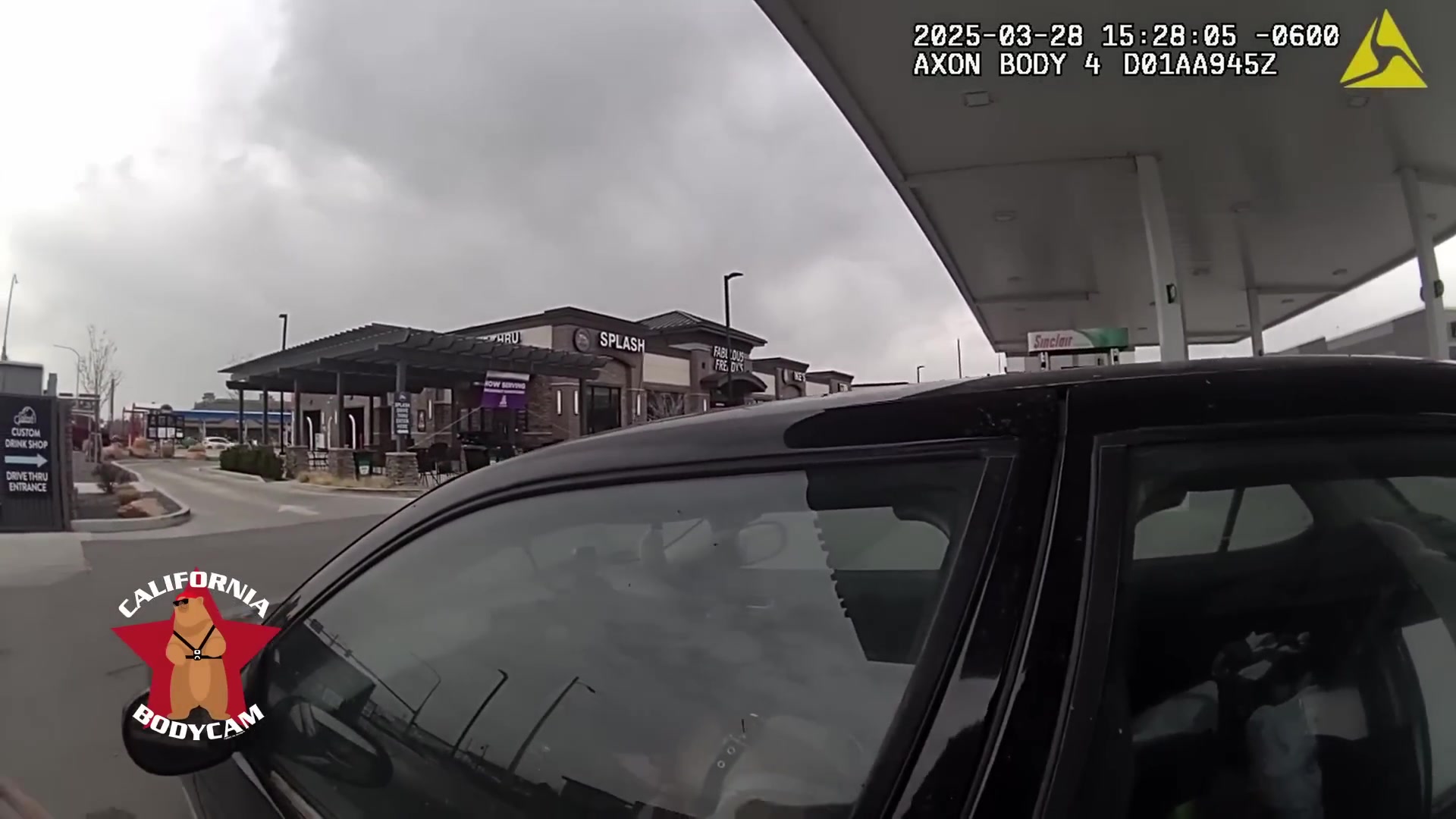
Officers Keep the Driver Contained While They Investigate
A vehicle contact in a public parking lot presents officers with several competing concerns. They need to communicate with the driver, monitor the passenger compartment and remain aware of pedestrians and vehicles moving through the lot. Unlike a traffic stop on an empty shoulder, this scene is surrounded by businesses and potential bystanders.
The body-camera perspective shows officers remaining close to the sedan. The driver is visible through the side window while officers continue giving instructions. Nothing about his appearance alone establishes criminal conduct, and the footage should not be used to infer more than it actually records.
What matters tactically is that the vehicle itself remains capable of moving. Whenever an officer is standing beside a running car, a sudden acceleration can instantly change the danger level. An officer positioned near the front quarter panel, door or open window may have only a fraction of a second to move away.
That risk becomes increasingly important as the encounter progresses. The officers' attention is not only on what the driver says but also on his hands, the controls inside the vehicle and whether he appears willing to remain where police have directed him.
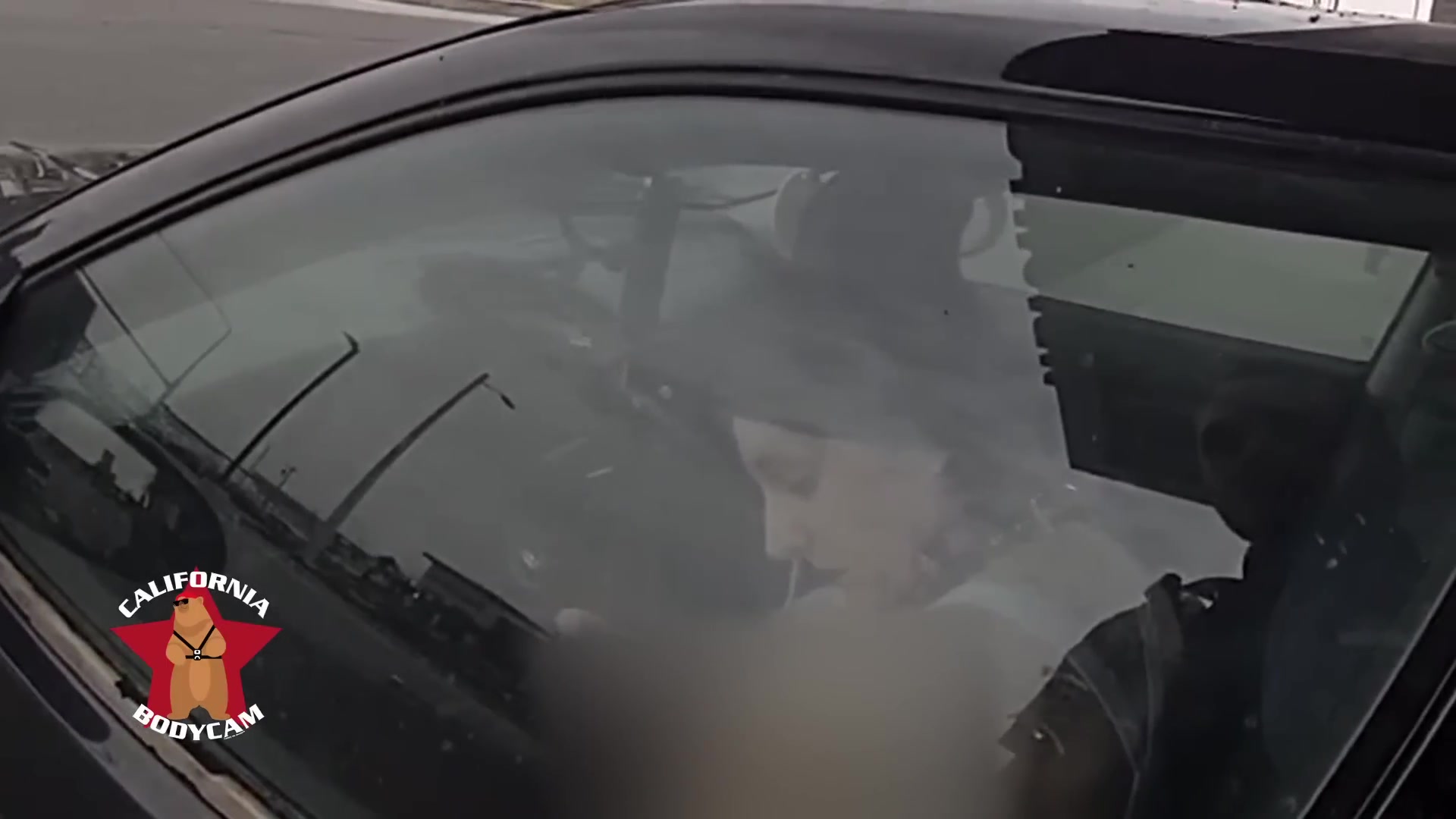
The Sedan Suddenly Becomes the Center of the Threat
The encounter eventually reaches the moment that gives the original title its urgency. The driver attempts to leave while officers are still trying to control the situation. What had been a stationary police contact becomes a moving-vehicle emergency almost immediately.
Body cameras are especially revealing during moments like this because the camera moves with the officer. There is no detached aerial view showing every inch between the sedan and the police vehicles. Instead, viewers experience the rapid shift in perspective as officers react, move away from the car and try to prevent the driver from escaping.
A vehicle does not have to reach highway speed to create serious danger. In a confined parking lot, even a short burst of acceleration can pin a person against another vehicle, strike an officer or send the car into a building or pedestrian area. Police therefore have to reassess the encounter the instant a driver begins using the vehicle to force a path out.
The supplied footage shows officers reacting to that movement rather than continuing the calm conversation seen earlier. Commands become more urgent, weapons are drawn and the scene transforms from an investigation into an effort to stop a moving threat.
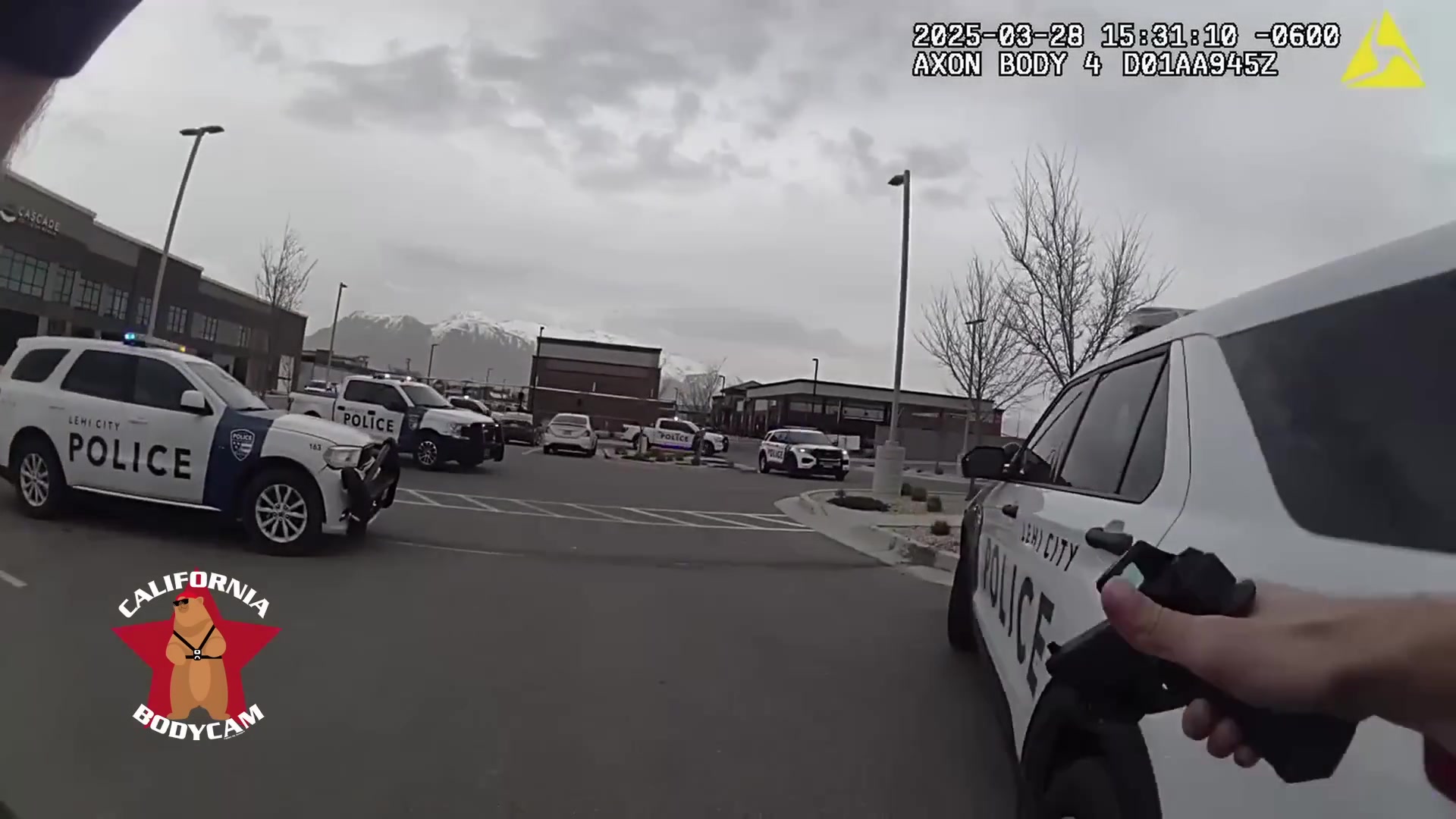
The Escape Attempt Ends Against Concrete
The driver's attempt to get away does not carry him far. The sedan sustains major front-end damage and comes to rest against a raised concrete area near the VIA 313 restaurant. Debris is scattered around the front wheel and bumper, and the car is no longer in a condition to simply accelerate away.
This is one of the clearest visual facts in the footage. The front corner of the sedan is heavily damaged, and officers immediately reposition around the vehicle. Their focus is now on preventing another movement, controlling the driver and safely completing the arrest.
The crash also changes the physical environment. A damaged vehicle may have deployed airbags, broken steering or suspension components, leaking fluids or sharp debris. Officers approaching after a collision have to consider those hazards while still treating the occupant as someone who has just attempted to escape.
The body-camera footage shows officers using firearms as they issue commands toward the driver. The presence of drawn weapons reflects the perceived danger at that moment, but it should not be used to invent a claim that the driver possessed a gun. No such claim is made here because it could not be independently verified.
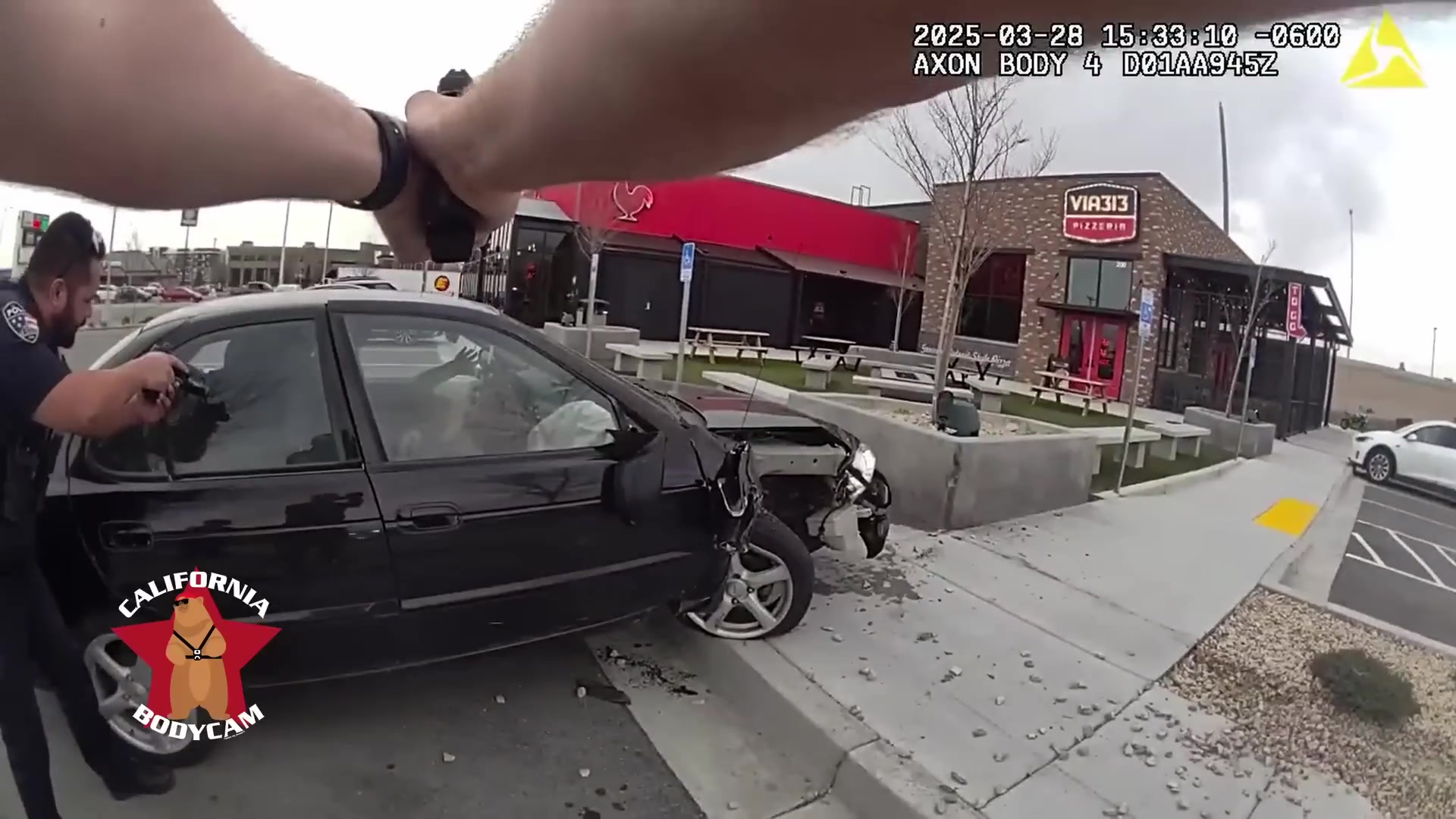
Officers Move In Once the Vehicle Can No Longer Flee
Once the sedan is immobilized, the tactical problem changes again. Officers no longer need to chase a moving car, but they still have to remove and secure the driver. The safest moment to approach depends on whether officers believe the vehicle can move again, whether the driver's hands are visible and whether he follows commands.
The footage shows several officers converging after the crash. Their positions give them overlapping views of the passenger compartment and reduce the chance that one officer has to manage the arrest alone. This is a common advantage of backup during vehicle incidents: one officer can give commands while others watch the driver's hands and the surrounding area.
A dramatic crash can make the final arrest appear inevitable, but officers cannot assume that a collision has ended resistance. Drivers sometimes attempt to restart disabled vehicles, climb out another door or run. Officers therefore continue issuing commands until they can physically control the person.
In this incident, the attempted escape has effectively collapsed under its own momentum. The sedan that moments earlier offered the driver a possible route away is now damaged against the curb, surrounded by officers and unable to provide the same mobility.
What the Footage Establishes With Confidence
Several facts can be stated directly from the supplied recording. The body-camera timestamp shows March 28, 2025. The encounter takes place during daylight at a Sinclair station beside a VIA 313 Pizzeria. Officers are conducting a vehicle-related police contact with a male driver. The driver later attempts to move away, the vehicle is damaged in the process, and officers surround it and move toward an arrest.
The commercial landmarks strongly point to Lehi, Utah. Public business-location information places VIA 313 Pizza on East Main Street in Lehi and a Sinclair station on the same immediate corridor. That is a much stronger geographic match than simply guessing from the mountain landscape or police uniforms.
Other details remain unverified. The driver's name, his previous incarceration history, the exact reason for the initial police contact, the final list of charges and any later court outcome could not be matched to an authoritative public source. Those details are therefore intentionally excluded rather than borrowed from another March 28 Utah arrest.
This distinction is especially important because Salt Lake-area police reported several unrelated vehicle and arrest incidents around the same date. Matching only a date and a broad region would create a real risk of attaching another person's allegations to the wrong footage.
Why the Original Title Needs More Context
“Former Prison Inmate Rams Police While Trying to Escape After Doing THIS” is built to create curiosity, but it also makes two claims that require evidence outside the most obvious visual sequence. The driver's prior incarceration and the conduct that triggered the original police contact cannot be responsibly established from the video frames alone.
The escape attempt, however, is visually clear. Officers are positioned around the sedan, the driver attempts to move the vehicle, and the car ends up badly damaged while officers respond with heightened urgency. That sequence is dramatic without adding an unverified criminal biography.
For a factual retelling, the better approach is to let the verified escalation carry the story. A daytime police contact at a gas station becomes unstable. The driver tries to use the vehicle to get away. Officers are forced to move and react. The car crashes and becomes immobilized. Police then surround it and bring the moving portion of the encounter to an end.
That sequence also explains why a seemingly ordinary parking-lot interaction can become dangerous so quickly. A car gives a driver both mobility and mass. Once it begins moving through a space occupied by officers, the entire risk calculation changes in seconds.
A Failed Escape Leaves the Driver With Nowhere to Go
The strongest part of this footage is the contrast between the beginning and the aftermath. Early in the recording, the sedan is intact and parked beside a fuel station. Officers are talking to the driver at close range. The environment looks controlled.
Minutes later, the front of the vehicle is torn apart against a concrete curb near the restaurant. Officers are aiming toward the passenger compartment, debris covers the pavement and the driver's ability to leave has disappeared.
That transformation is why the full sequence matters. A viewer who sees only the damaged car may assume it was a routine collision. A viewer who sees only officers with weapons drawn may not know how the vehicle came to be immobilized. The complete recording shows the progression between those two moments.
It also reinforces the importance of careful incident verification. The date and location can be supported by the AXON overlay and commercial landmarks. The more specific claims in the original title require records that could not be conclusively located. Rather than fill those gaps with assumptions, this account keeps the story tied to what the camera and independently verifiable location evidence actually establish.
The encounter does not need extra embellishment. A police contact in a crowded commercial area turns into an attempted vehicle escape and ends with a wrecked sedan surrounded by officers. The visual progression is compelling on its own.
Follow the link to watch the complete encounter and see how a controlled gas-station contact turns into a sudden escape attempt before the damaged car is finally surrounded by police.
Comments (0)
Loading comments...
May You Like

Woman Refuses Repeated Orders to Exit Her Car Before Officers Move In
Female Driver Destroys Three Lives in a Matter of Minutes
High-Speed CHP Chase Ends When Spike Strips Stop Suspect














