
Police Chase Escalates as Suspect Tries Sudden Escape
Late-Night Greenwood Traffic Stop Escalates Into a Foot Chase and Arrest
At 2:46 in the morning on July 14, 2025, a Greenwood police officer approached a brown Infiniti on a quiet, nearly empty road. The first moments of the body-camera recording look like an ordinary late-night traffic stop. Streetlights stretch into the distance. The driver remains seated behind a partially lowered window. The officer stands beside the car and begins an encounter that, at first, gives little indication of how dramatically it will change.
The supplied footage, published under the title “Drug Dealer Jumps Out of the Window During Police Chase,” runs for a little more than eight minutes and carries a Patrol Cam Live watermark. Its embedded timestamp places the encounter in the early hours of July 14, 2025. Later frames clearly show a Greenwood Police uniform patch. The footage itself therefore provides two strong identifiers: the date and the agency name.
What follows is a rapid transition from conversation to movement, pursuit and arrest. The suspect does not remain in the Infiniti. Officers eventually pursue him away from the vehicle and through a residential environment before bringing him into custody. By approximately 3:01 a.m., the bodycam shows the man handcuffed beside a Greenwood Police officer and patrol vehicle.
Extensive searches were conducted for a matching public news report, police release and court record. At the time of writing, no publicly indexed article was located that could be tied to this exact July 14 encounter with enough confidence to responsibly identify the suspect, the precise location, the substances allegedly recovered or the final charges. Because of that, this article deliberately separates what the camera proves from what the video title claims. It does not invent a name, quantity of drugs, criminal history or court outcome.
That limitation does not make the footage less compelling. In fact, the video demonstrates why body-camera evidence can be valuable even before every document connected to an incident becomes publicly searchable. It captures the progression of a police encounter in real time: an officer at a car window, a suspect who does not remain where police expect him to remain, a sudden escape attempt and a search that ends with handcuffs.
A Quiet Road at 2:46 A.M.
The opening setting is unusually calm. The roadway is illuminated by evenly spaced streetlights, but there is little visible traffic. The officer is positioned at the driver's side of a brown Infiniti. The driver's window is lowered enough for the two to communicate.
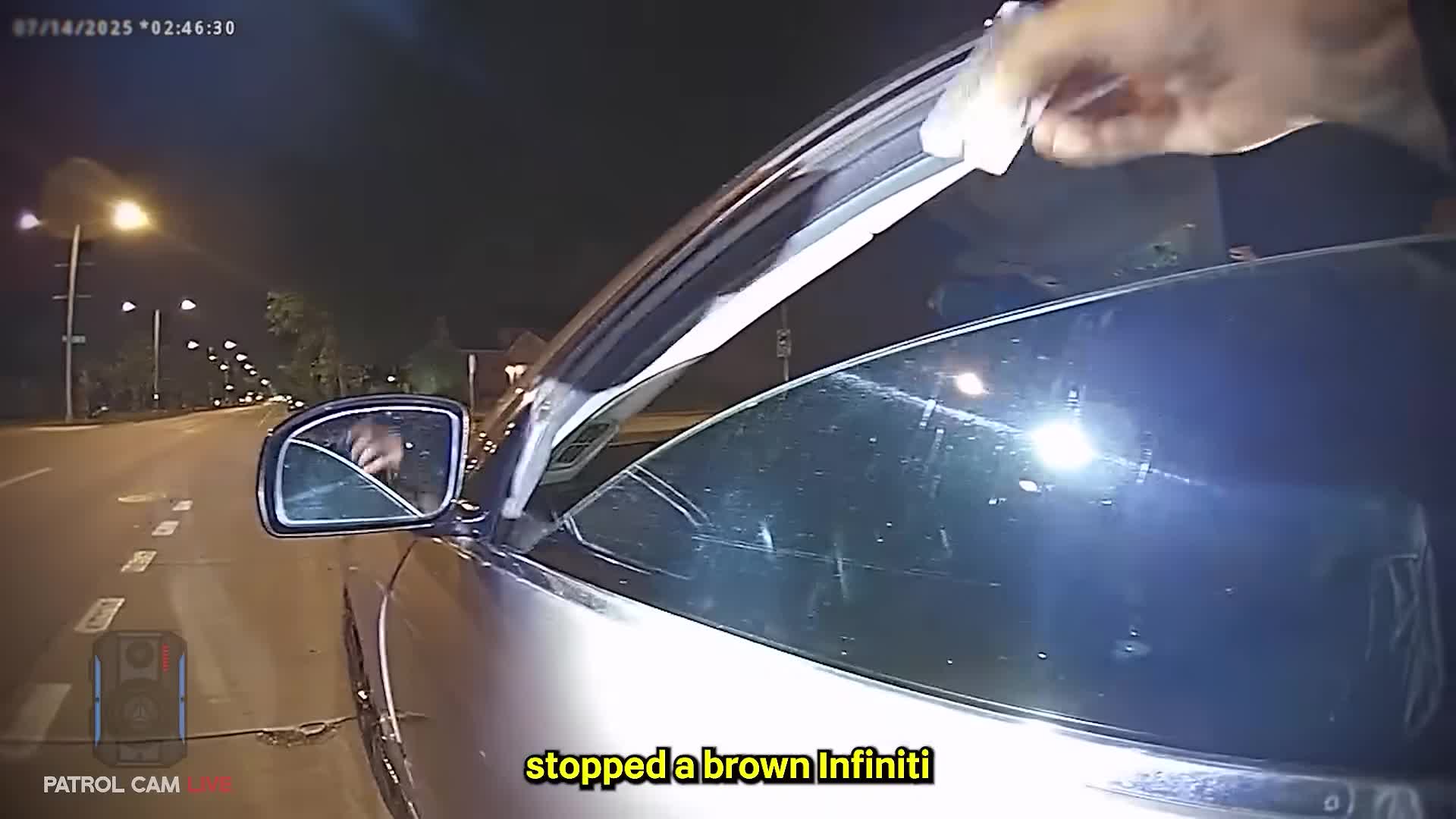
That calm beginning matters because traffic stops are unpredictable by nature. An officer may approach a vehicle expecting to deal with a license issue, speeding, equipment violation or another routine matter and discover something entirely different. Conversely, an encounter that initially appears suspicious may end without an arrest.
The bodycam timestamp is particularly useful. It reads July 14, 2025, at approximately 2:46 a.m. Unlike an added social-media caption, an embedded camera timestamp gives investigators and researchers a concrete clue that can be compared against dispatch logs, arrest records and police reports.
The Brown Infiniti Becomes the Center of the Encounter
The video presentation identifies the vehicle as a brown Infiniti. That description is consistent with what can be seen in the footage: a dark metallic luxury sedan stopped along the roadway.
The officer remains close to the driver's window. At this stage, the camera does not show a foot pursuit or physical struggle. It shows an officer gathering information while maintaining a position beside a vehicle.
Late-night stops can present additional challenges. Darkness reduces visibility inside the passenger compartment. Reflections from flashlights and emergency lights can make it difficult to see a person's hands. The officer must listen to the driver while simultaneously watching the interior of the car and the surrounding roadway.
The Situation Does Not Stay at the Car
The defining feature of the supplied video is that the encounter moves away from the Infiniti.
At some point during the interaction, the suspect attempts to escape. The video title characterizes the man as a drug dealer and describes him jumping out of a window during a police chase. The footage clearly supports the escape-and-pursuit portion of that description. The “drug dealer” label, however, would require an arrest affidavit, charging document or police release to establish precisely what officers allegedly found and what prosecutors later charged.
That distinction is important. A video title is useful as a research clue, but it is not a substitute for a court record.
A Traffic Stop Turns Into a Search
Once a person flees from a traffic stop, an officer's priorities change immediately.
The first task is maintaining visual contact if it can be done safely. At the same time, the officer must communicate the direction of travel, suspect description and location to other units. If the abandoned vehicle contains another person, that person may also need to be secured.
A foot pursuit at night is especially difficult because the suspect can disappear from view after only a few seconds. A fence, parked vehicle, alley, backyard or building corner can break visual contact instantly.
The officer cannot simply focus on running faster. He or she has to continue assessing threats while moving through unfamiliar terrain.
The Bodycam Perspective Makes the Chase Feel Different
Edited police videos often compress a pursuit into its most dramatic moments. Bodycam footage is different. The viewer experiences the officer's limited perspective.
The camera moves with every step. A flashlight illuminates only a narrow section of the scene. Objects enter and leave the frame rapidly. The suspect may be visible for a moment and then disappear behind a structure.
That instability can make the footage harder to watch, but it also communicates something a fixed security camera cannot: the officer does not know what is around the next corner either.
Why Officers Call for Backup During a Foot Pursuit
A fleeing suspect can force one officer to cover a large area very quickly. Backup allows police to contain that area rather than relying entirely on the officer directly behind the suspect.
Additional units can move toward likely escape routes. One officer may stay with the original vehicle while others search. Dispatch can coordinate information from multiple officers.
The later portion of this footage shows that the incident is no longer a one-officer traffic stop. Other police personnel are present by the time the suspect is secured.
The Residential Environment Creates New Obstacles
A roadway provides relatively predictable terrain. Residential property does not.
Fences, porches, narrow passages, landscaping, stairs and parked vehicles can all affect a foot chase. At night, even a small change in elevation can become a hazard.
The supplied footage shows the pursuit moving through a built environment rather than remaining on the open road. That transition gives a fleeing person more places to hide, but it also limits his possible routes.
Every barrier becomes a decision point: go over it, go around it or change direction.
Why Running From a Vehicle Can Make Escape Harder
A car gives a fleeing driver speed and distance. Once that person abandons the vehicle, those advantages disappear.
An officer can radio the suspect's direction while other units converge. The suspect may know the immediate neighborhood better than police, but officers have vehicles, radios and multiple approach routes.
The longer the foot pursuit continues, the more likely it becomes that additional units will cut off possible exits.
In the supplied footage, the escape attempt ultimately fails.
The Arrest Brings the Encounter Back Under Control
Near the end of the recording, the suspect is in handcuffs. The bodycam timestamp has advanced to approximately 3:01 a.m., roughly fifteen minutes after the earliest visible timestamp from the stop.
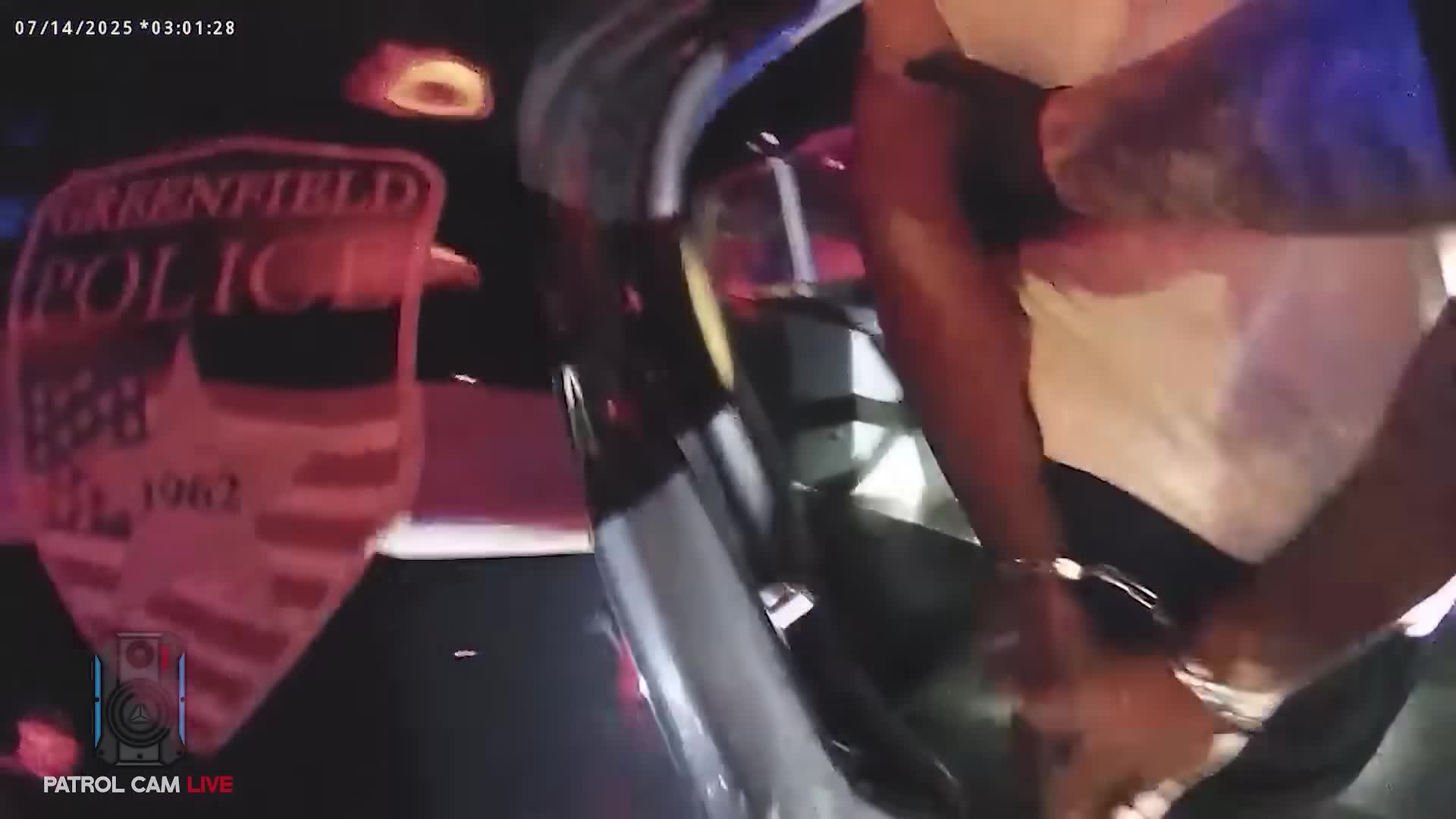
A Greenwood Police patch is clearly visible on the officer standing beside him. This is one of the strongest agency identifiers in the footage and is more reliable than trying to infer the department from the architecture, road markings or patrol-car design.
The suspect is wearing a light-colored shirt and has his hands restrained behind him. Emergency lighting reflects across the scene.
The pursuit phase is over.
The Fifteen-Minute Window Shows How Quickly Police Calls Change
From approximately 2:46 a.m. to shortly after 3:01 a.m., the encounter moves from a driver sitting in a car to a handcuffed suspect beside police.
That short time span is one reason the footage holds attention.
There is no long buildup. The situation changes while the officer is already committed to the stop.
For the viewer, the central question becomes simple: what will the driver do next?
What Can Be Verified Directly From the Video
Several facts are visible without relying on the upload title.
The encounter occurred during the early morning hours of July 14, 2025.
The initial vehicle is a brown or dark-colored Infiniti.
The interaction begins as a roadside police encounter.
The suspect does not remain at the vehicle and police pursue him.
The incident moves through an urban or residential environment.
Multiple officers are involved by the end.
A uniform patch identifies Greenwood Police.
The suspect is ultimately handcuffed and placed under police control.
Those observations form the factual backbone of this article.
What the Video Title Adds, and Why It Needs Verification
The supplied file is titled “Drug Dealer Jumps Out of the Window During Police Chase.”
That title suggests that narcotics were central to the incident. It may accurately summarize information contained in an original police report or court filing. But a title alone cannot establish what substance was allegedly involved, how much was recovered, whether officers accused the driver or another occupant of dealing, or what charges survived in court.
For that reason, the article does not convert the title into unsupported specifics.
This is particularly important with police footage that has been republished by third-party channels. Titles are often shortened or made more dramatic for an online audience.
The Search for the Matching Public Record
The visible date and Greenwood Police patch were used to search public reporting for the incident.
Searches focused on July 14, 2025, Greenwood police activity, Infiniti traffic stops, foot pursuits, narcotics arrests and fleeing suspects.
Public search results contained other Greenwood incidents and Indiana drug cases, but none matched the combination of date, vehicle, early-morning timestamp and bodycam sequence closely enough to identify the suspect without risking a false match.
That is why no unrelated name has been inserted into this story.
Why False Matches Are a Serious Problem
Police-video research often produces cases that look similar at first.
A city may have several pursuits in a month. Multiple departments can share the same city name. A suspect in another case may drive the same brand of vehicle. Search engines can also prioritize newer or more widely reported cases over the exact incident being researched.
Using one incorrect article can contaminate an entire story with the wrong name, charges and outcome.
A responsible match requires multiple independent points of agreement.
Greenwood Is Not a Unique Police Department Name
Another complication is geography.
There are law-enforcement agencies using the Greenwood name in multiple U.S. states. A patch reading “Greenwood Police” narrows the search but does not, by itself, justify attaching a specific state unless another clue confirms it.
The streetscape in the supplied video is consistent with an American municipal police jurisdiction, but appearance alone is not enough to determine the state.
The safest approach is therefore to identify the agency exactly as the uniform does: Greenwood Police.
The Vehicle Could Hold the Missing Clue
The Infiniti is one of the most useful identifiers in the recording.
A full police report would likely include its model, registration, plate information and registered owner. Those details could connect the video to an arrest affidavit or court case.
The public version of the footage, however, does not provide a readable license plate in the frames reviewed for this article.
Without that unique identifier, matching the incident becomes much more difficult.
Why the Original Stop Matters
The reason an officer first approached a vehicle often explains the entire chain of events that follows.
A stop could begin with speeding, a registration problem, an equipment violation, suspicious driving or information connecting the vehicle to another investigation.
In this case, the footage does not provide enough verified context to state the original violation as fact.
That missing detail is significant because fleeing from a minor traffic stop can create far more serious legal exposure than the issue that originally attracted police attention.
Fleeing Changes the Legal and Tactical Landscape
Once a suspect runs, police are no longer dealing only with the reason for the original stop.
The escape itself becomes part of the investigation.
Officers must document the suspect's actions, the route of flight, commands given and the circumstances of the arrest. If evidence is discarded during the chase, police may need to retrace the route to recover it.
Bodycam footage can become crucial because it preserves the sequence in a way written recollection cannot.
Evidence Can Be Lost During a Foot Chase
When someone runs from police, officers may later search the path for items that were dropped or intentionally discarded.
That could include a phone, wallet, weapon, bag or suspected contraband.
The video title's reference to drug dealing makes that possibility relevant here, but without the matching report it would be speculative to claim that a particular item was recovered along the route.
The footage should therefore be read for what it visibly shows, not for what viewers expect a drug-related chase to contain.
The Arrest Is Not the Same as a Conviction
Even when police announce charges after a pursuit, those charges remain allegations unless and until they are resolved in court.
Prosecutors may file different counts from those recommended by officers. Charges can be dismissed or amended. A defendant may plead guilty to some counts and not others. A case may also remain pending for months.
Because the exact court case has not been confidently identified, this article does not claim a conviction or sentence.
Why Bodycam Time Is So Valuable
The timestamps in this recording provide a miniature timeline.
At about 2:46 a.m., the officer is beside the Infiniti.
Minutes later, the encounter has escalated.
By about 3:01 a.m., the suspect is in custody.
That progression allows the viewer to understand that the incident unfolded rapidly even without a dispatch log.
A Chase at Night Is a Visibility Problem
Darkness changes how officers perceive movement.
A person in dark clothing can disappear beyond the reach of a flashlight. Reflections from windows and wet or polished surfaces can obscure details. Emergency lights create alternating bright and dark areas.
The officer's camera records those limitations rather than eliminating them.
For viewers accustomed to brightly lit television scenes, real bodycam can feel chaotic because it captures what the officer actually has available in the moment.
The Suspect's Decision Creates the Story's Turning Point
The most important decision in the footage is not made by police.
It is the decision to leave the encounter and run.
Before that moment, the situation is geographically contained around one vehicle. After it, officers have to search a larger area and react to an unpredictable route.
That is the natural turning point of the story and the reason the footage becomes compelling without needing exaggerated language.
The Camera Keeps the Viewer Close to the Officer
Unlike dashcam footage, which often maintains a stable forward view, bodycam places the viewer directly inside the movement.
When the officer turns, the scene changes instantly. When the officer runs, the image shakes. When police close in on the suspect, the camera is only a few feet away.
This creates tension because the viewer receives information at almost the same pace as the officer wearing the camera.
The End of the Chase Is Also the Beginning of the Case
Once handcuffs are applied, the public-facing drama may be over, but police work continues.
Officers must identify the suspect, search according to law and policy, secure the vehicle, collect evidence, document the pursuit and prepare reports.
If drugs were recovered, they would typically need to be weighed, packaged and submitted as evidence. Laboratory testing may later be necessary to confirm the substance.
Those steps matter because the courtroom case depends on evidence, not the drama of the chase.
Why This Video Holds Attention
The footage has a simple but effective narrative structure.
It begins quietly.
The driver is still in the Infiniti.
The officer appears to have the situation contained.
Then the suspect leaves.
The camera moves from a static traffic stop into a pursuit.
The environment changes.
More officers become involved.
Finally, the man who tried to escape is standing in handcuffs beside Greenwood Police.
Each stage answers one question while creating another, which naturally keeps the viewer engaged.
What a Matching Police Report Could Confirm
The remaining gaps are exactly the kind of information an incident report or probable-cause affidavit could resolve.
It could establish the state and exact location, identify the officer and suspect, explain why the Infiniti was stopped, document the route of the chase, list any recovered evidence and provide the initial charges.
A court docket could then show whether those charges were formally filed and how the case was resolved.
Until those records are matched confidently, leaving the gaps open is more accurate than borrowing details from a similar arrest.
The Most Important Fact Is Visible on Camera
Whatever the underlying investigation eventually reveals, the core sequence does not depend on speculation.
A Greenwood Police officer encounters a man in a brown Infiniti during the early hours of July 14, 2025.
The encounter does not end at the driver's window.
The suspect attempts to get away.
Police pursue him.
Minutes later, officers have him in handcuffs.
The bodycam captures the entire change in tone from a quiet roadside conversation to a nighttime arrest.
A Routine-Looking Stop With an Unpredictable Ending
The first frame gives no obvious indication of the pursuit that will follow.
That is precisely what makes the footage effective.
Police work often changes without warning. A person can remain calm for several minutes and suddenly run. A car can appear stationary and then accelerate. An officer who was speaking through a window can find himself moving through yards moments later.
The Greenwood footage compresses that unpredictability into a short sequence.
The Final Image Completes the Story
By approximately 3:01 a.m., the suspect is no longer running.
His hands are cuffed behind his back. A Greenwood Police officer stands beside him. Patrol lights illuminate the scene.
The contrast with the opening could hardly be clearer.
Fifteen minutes earlier, the man was seated in the Infiniti while an officer spoke to him through the window.
Now the vehicle is behind them in the timeline, the pursuit is over, and the incident has become an arrest investigation.
Watch the Full Incident
The still images capture the beginning and the end, but the full recording shows the abrupt transition between them: the late-night stop, the escape attempt, officers moving through the area and the final arrest.
Comments (0)
Loading comments...
May You Like

Traffic Stop Turns Deadly After Man Steps Out of Stolen Car

Woman Tries to Stop Police From Arresting “Brother” — He Denies Knowing Her

A Late-Night Escape Attempt Ends With Officers Making an Arrest












