
Polaris ATV Hits 60 MPH Fleeing Arkansas State Police With Female Passenger
Polaris Rider Pushes 60 MPH With a Passenger as Arkansas Trooper Closes In
A Routine Sight on the Shoulder Suddenly Changes
There was nothing about the first few seconds that suggested a police pursuit was about to begin.
At approximately 5:35 p.m. on August 7, 2026, Arkansas State Police Trooper Ronald Weast Jr. was sitting stationary on an unnamed dead-end road near State Highway 114, just east of State Highway 530.
Then something caught his attention.
A red ATV was traveling east along the southern shoulder of Highway 114.
It was not alone.
The vehicle carried two people, a male driver and a female passenger, both wearing dark clothing. According to the subsequent police narrative, the ATV was a 1999 Polaris Scrambler 500.
Weast pulled out behind it.
What could have become a straightforward traffic stop was about to turn into something entirely different.
The trooper activated his emergency lights and siren as the ATV approached the intersection of Highway 114 and Freedom Road. By then, the Polaris had started turning north.
The driver saw the patrol car.
Instead of stopping, he accelerated.
Within moments, the ATV was pulling away and Weast was notifying dispatch that he was in pursuit.
Police would later identify the driver as Timothy Kearney.
The woman riding behind him was identified as Felicia Edgin.
The chase that followed was relatively short compared with some Arkansas State Police pursuits.
But duration does not necessarily determine danger.
Kearney had a passenger sitting directly behind him.
He was driving an ATV designed primarily for off-road recreational use.
And he was accelerating down a public road toward speeds normally associated with cars and motorcycles.
The entire situation had changed in seconds.
The Polaris Accelerates Down Freedom Road
After turning onto Freedom Road, Kearney continued north.
Trooper Weast remained behind him.
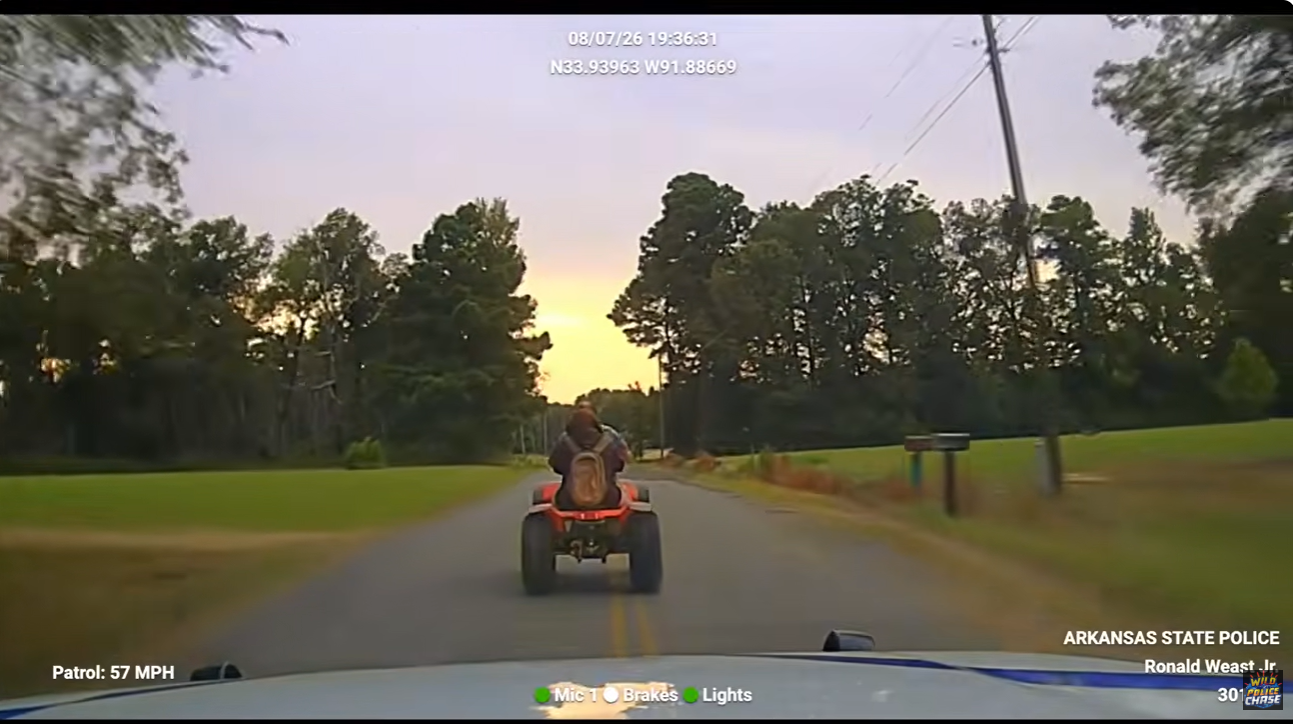
According to Weast's narrative, the ATV eventually reached approximately 60 mph in a posted 40-mph zone. Kearney continued northbound for roughly one mile.
Sixty miles per hour may not sound extraordinary when compared with highway pursuits involving cars traveling well beyond 100 mph.
On an ATV, however, the circumstances are very different.
ATVs are built primarily for off-road recreational use. In fact, Arkansas law generally prohibits operating them on public streets and highways except under specified exceptions. A federal court discussing Arkansas law in an unrelated case specifically noted that Arkansas defines an ATV as a vehicle designed primarily for off-road recreational use and that state law generally prohibits their operation on public roads.
That distinction becomes important when watching this pursuit.
The Polaris does not provide the same protection as a passenger vehicle.
There is no enclosed cabin surrounding the occupants.
There are no doors.
There is no conventional roof.
Both riders are exposed.
And Edgin, the passenger, has virtually no control over what happens next.
She is dependent entirely on the driver's decisions.
Every increase in speed therefore increases the stakes for two people rather than one.
The chase footage creates tension precisely because the patrol car does not need to be dramatically gaining ground.
It simply needs to remain behind the ATV.
Kearney is driving a vehicle that was never intended to outrun a modern police cruiser on pavement.
The longer the pursuit continues, the more difficult his position becomes.
That raises an obvious question for the viewer:
What exactly is the driver hoping to accomplish?
There is no clear answer visible from behind.
But police pursuits frequently demonstrate the difference between immediate decision-making and rational long-term planning.
A driver sees emergency lights.
He decides not to stop.
That decision creates another problem.
Now stopping means facing not only the reason for the original attempted traffic stop but also the consequences of fleeing.
So the driver keeps moving.
Seconds become minutes.
Speed increases.
And what began as a traffic violation becomes an arrest situation.
That pattern unfolds quickly here.
Weast's original observation involved an ATV traveling along the highway shoulder.
After the driver failed to stop, the trooper was dealing with a fleeing vehicle traveling approximately 20 mph above the posted limit.
The risk had been transformed almost entirely by one decision.
Two Riders, One Decision Maker
The presence of a passenger makes this particular pursuit more unsettling.
Kearney was not taking only his own safety into his hands.
Edgin was riding behind him.
A passenger on an ATV is in an unusually vulnerable position during rapid acceleration, abrupt turns or a collision.
There is little separating either rider from the pavement.
Even a relatively minor loss of control could produce serious consequences.
Arkansas State Police crash records provide grim examples of what can happen when ATVs lose stability on public roads. Those incidents are unrelated to this pursuit, but they demonstrate why the vehicle type matters. State records document cases in which Polaris ATVs or similar off-highway vehicles overturned or collided with other vehicles, sometimes ejecting occupants.
Nothing comparable occurred during Kearney's pursuit.
That is important.
The chase did not end in a crash.
Neither rider was reported injured in the police narrative.
But the potential for a very different outcome remained throughout the pursuit.
At 60 mph, the margin for correcting a mistake becomes much smaller.
A pothole that is insignificant to a car can be far more consequential to an ATV.
An unexpected vehicle entering the roadway can force a sudden evasive maneuver.
A sharp steering input can destabilize the machine.
And because a passenger changes the vehicle's weight distribution, the driver is not dealing only with his own movement.
The situation could have deteriorated extremely quickly.
Yet Kearney continued north.
The patrol vehicle remained behind.
Emergency lights flashed.
The distance between the Polaris and the trooper changed as both vehicles moved along Freedom Road.
But there is another notable aspect of this pursuit.
Weast did not need to force a dramatic conclusion.
There was no immediate PIT maneuver.
There was no collision between police and the ATV.
There was no attempt to physically ram the Polaris off the road.
Instead, the trooper maintained the pursuit.
That choice allowed the driver another opportunity to make the decision he had rejected at the beginning.
Stop.
Eventually, that is exactly what happened.
After a Mile of Running, the Driver Changes His Mind
Approximately one mile into the pursuit, the dynamic abruptly changes.
Kearney begins pulling toward the right side of Freedom Road.
The ATV slows.
Then it stops.
There is no spectacular crash.
No trooper sends the Polaris spinning.
No desperate turn onto a dirt trail.
The driver simply reaches the point where continuing no longer appears worthwhile.
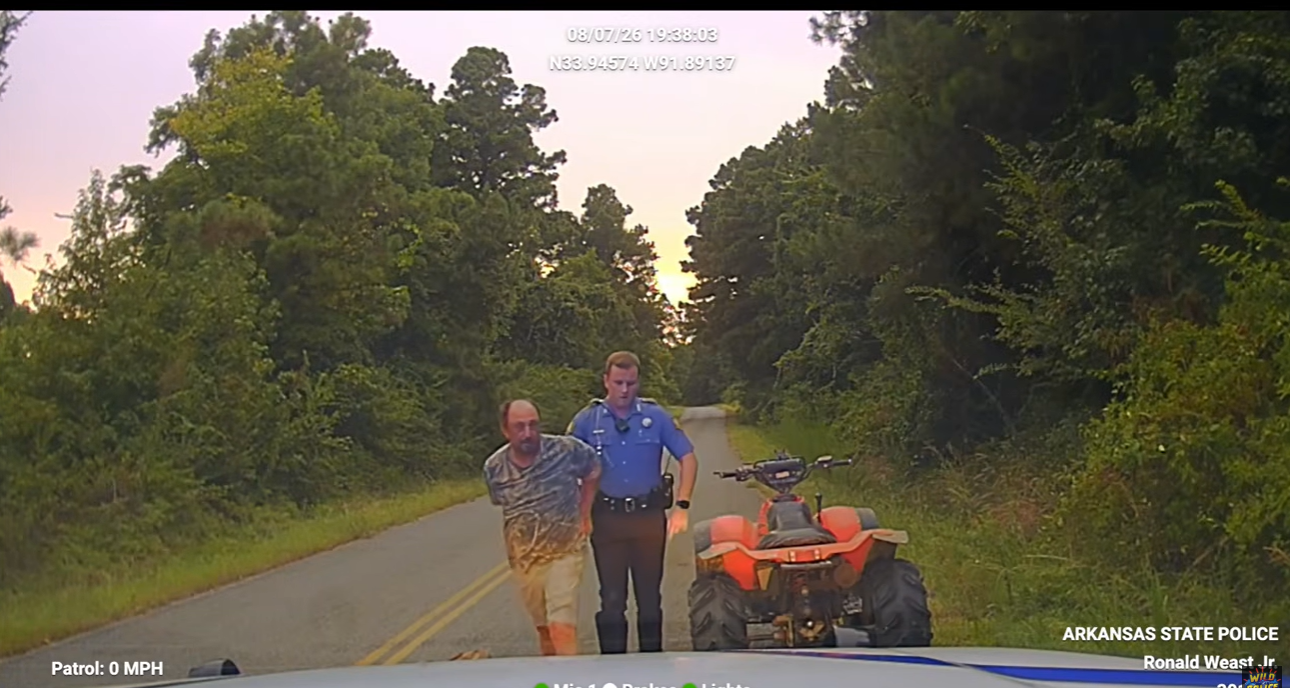
Trooper Weast stops behind him and exits his patrol vehicle.
Now comes another critical moment.
A fleeing driver who finally stops can still turn a pursuit into a dangerous confrontation.
Officers do not necessarily know why someone fled.
They do not automatically know whether the person is armed.
They do not know whether the driver intends to surrender or is merely pausing before running again.
That uncertainty shapes what happens next.
Weast orders Kearney to get off the ATV and lie on the ground with his arms extended.
This time, Kearney complies.
The contrast with the preceding minute is striking.
Moments earlier he was traveling approximately 60 mph while refusing to stop for emergency lights and sirens.
Now he follows the trooper's instructions.
Weast approaches, places him in hand restraints and searches him.
According to the police narrative, the search produces no contraband.
Kearney is then helped to his feet and placed in the rear of the patrol vehicle.
The female passenger is dealt with separately.
Police identify her as Felicia Edgin.
She is ultimately released following Kearney's arrest.
That fact is significant because it reinforces the distinction between the driver's decisions and the passenger's presence.
The available police narrative does not describe Edgin as being arrested or charged in connection with the pursuit.
The ATV itself is searched.
Again, officers report finding no contraband.
Ricks Towing of Star City eventually arrives and takes possession of the Polaris.
The physical pursuit is over.
But the legal consequences of those few minutes are only beginning.
One Mile Creates a Much Longer List of Problems
Kearney was transported to the Lincoln County Jail.
According to the trooper's narrative reproduced with the released footage, he was booked on allegations including fleeing in a vehicle or conveyance while exceeding the speed limit, speeding more than 15 mph above the limit, operating an ATV on a public highway, careless and prohibited driving, an offense involving a vehicle equipped with an ignition-interlock device, and driving while his license was suspended in connection with DWI.
Those are allegations recorded at booking, not findings of guilt.
But they demonstrate how dramatically the driver's situation changed during a pursuit that covered only about a mile.
Before the emergency lights came on, Weast had simply observed an ATV traveling along the shoulder of Highway 114.
Had the encounter remained an ordinary traffic stop, the resulting situation would necessarily have looked very different.
Instead, Kearney accelerated.
The decision added the pursuit itself to the incident.
The speed then added another element.
Continuing down a public roadway on the ATV added still another.
This is why fleeing from police so often creates consequences far beyond whatever motivated the driver to avoid the original stop.
The act of running becomes its own event.
And in this case, it became the defining event.
The footage is also unusual because it avoids the violent ending that viewers may expect after watching hundreds of police-pursuit videos online.
There is no collision.
Nobody is thrown from the ATV.
The female passenger does not appear to suffer an injury.
The Polaris is not destroyed.
The trooper does not need to physically tackle Kearney.
Once the driver stops, he follows the commands being given.
In other words, the most dangerous portion of the encounter ends the instant the driver decides to stop making it dangerous.
That simplicity is perhaps the strongest element of the entire video.
Why 60 MPH on an ATV Is Different From 60 MPH in a Car
Speed is always contextual.
Sixty miles per hour on an interstate can feel routine.
Sixty miles per hour on a narrow public road while riding an ATV with another person directly behind you is a very different proposition.
A conventional automobile surrounds its occupants with a rigid structure designed around roadway collisions.
Modern cars generally include seat belts, airbags, crumple zones and extensive stability systems.
An ATV offers a fundamentally different environment.
Its advantages are maneuverability and off-road capability.
Those advantages do not make it an ideal high-speed road vehicle.
Arkansas law reflects that distinction. State law generally restricts ATVs from public streets and highways, with specific exceptions.
The pursuit therefore creates a strange mismatch.
Behind Kearney is an Arkansas State Police patrol vehicle engineered for highway use.
Ahead is a 1999 Polaris Scrambler.
The Polaris may be nimble, but running indefinitely from the patrol vehicle on a paved road is not a realistic long-term strategy.
Kearney ultimately appears to recognize that.
After roughly one mile, he stops.
The decision arrives late, but it prevents the incident from developing into something far worse.
That matters because ATV crashes can be unforgiving.
Again, unrelated Arkansas crash reports illustrate the underlying risk. State Police records include cases involving Polaris vehicles in which occupants were ejected or vehicles overturned after control was lost.
Those examples should not be confused with Kearney's case.
Nobody was ejected here.
But they explain why watching an exposed passenger travel at pursuit speeds produces a different kind of tension from watching two people flee inside an enclosed automobile.
Every second the Polaris remains upright is one more second in which a catastrophic outcome has been avoided.
And the driver has complete control over whether that risk continues.
The Best Decision of the Pursuit Comes at the End
Police pursuits often become memorable because of spectacular endings.
A PIT maneuver sends a vehicle rotating across a highway.
A driver crashes through a fence.
A suspect abandons a vehicle and runs.
This pursuit ends differently.
Timothy Kearney simply stops.
That might sound anticlimactic, but it is precisely what makes the ending worth examining.
The pursuit demonstrates how quickly risk can disappear once a fleeing driver makes a different decision.
Kearney had already accelerated away from a traffic stop.
He had already reached approximately 60 mph in a 40-mph zone.
He had already carried a passenger through the pursuit.
None of those decisions could be undone.
But he could still prevent the next bad decision.
So he pulled over.
Once he complied with Trooper Weast's commands, the arrest proceeded without the kind of physical struggle frequently seen at the end of police chases.
No contraband was reported on his person.
No contraband was reported inside the ATV.
Edgin was released.
The Polaris went to a towing company.
Kearney went to Lincoln County Jail.
The contrast is almost instructional.
The first decision to flee turned an attempted traffic stop into a police pursuit.
The later decision to stop prevented that pursuit from becoming a crash.
And between those two decisions came approximately one mile during which a 1999 Polaris Scrambler, a passenger and an Arkansas State Police trooper traveled north on Freedom Road with very little room for error.
A Short Chase With a Simple Lesson
This incident lacks the massive speeds and violent vehicle interventions associated with many Arkansas State Police pursuit videos.
That does not make it insignificant.
In some ways, its simplicity makes the lesson clearer.
A trooper sees an ATV operating along a highway.
He activates his emergency equipment.
The driver sees the lights.
The driver accelerates.
For approximately a mile, the Polaris runs at speeds reaching around 60 mph.
Then the driver finally stops.
That is the entire arc.
But inside those few minutes are several decisions that could have produced a dramatically different ending.
Kearney could have lost control.
The passenger could have fallen.
Another vehicle could have entered their path.
The Polaris could have overturned.
Instead, the pursuit ended on the roadside.
The footage therefore provides an unusually clean example of a principle that can get lost in more spectacular chase videos:
Stopping does not erase what already happened.
But continuing to flee can always make the situation worse.
Kearney's decision to accelerate transformed the traffic stop.
His decision to finally pull over prevented another transformation.
Police still arrested him.
The ATV was still towed.
The alleged violations did not disappear.
But everyone involved walked away from the roadway.
For a pursuit involving an exposed passenger on an ATV traveling at approximately 60 mph, that is an outcome that easily could have been very different.
Watch the full pursuit from the trooper's first attempt to stop the Polaris to the driver's eventual surrender here: https://www.youtube.com/watch?v=EwfyyuvfmkA
Comments (0)
Loading comments...
May You Like

What Happens when you get Caught Shoplifter Stealing Local Store

Cop thinks sandwich is phone
Police vs Chevy Impala High-Speed Pursuit Ends in TVI













