
Oklahoma City standoff ends in officer-involved shooting
ARMED STANDOFF TURNS CHAOTIC AS DRIVER RAMS POLICE CARS
A domestic-disturbance call involving a firearm was already dangerous before Oklahoma City officers even reached the property.
Then the man sitting inside a pickup truck refused to come out.
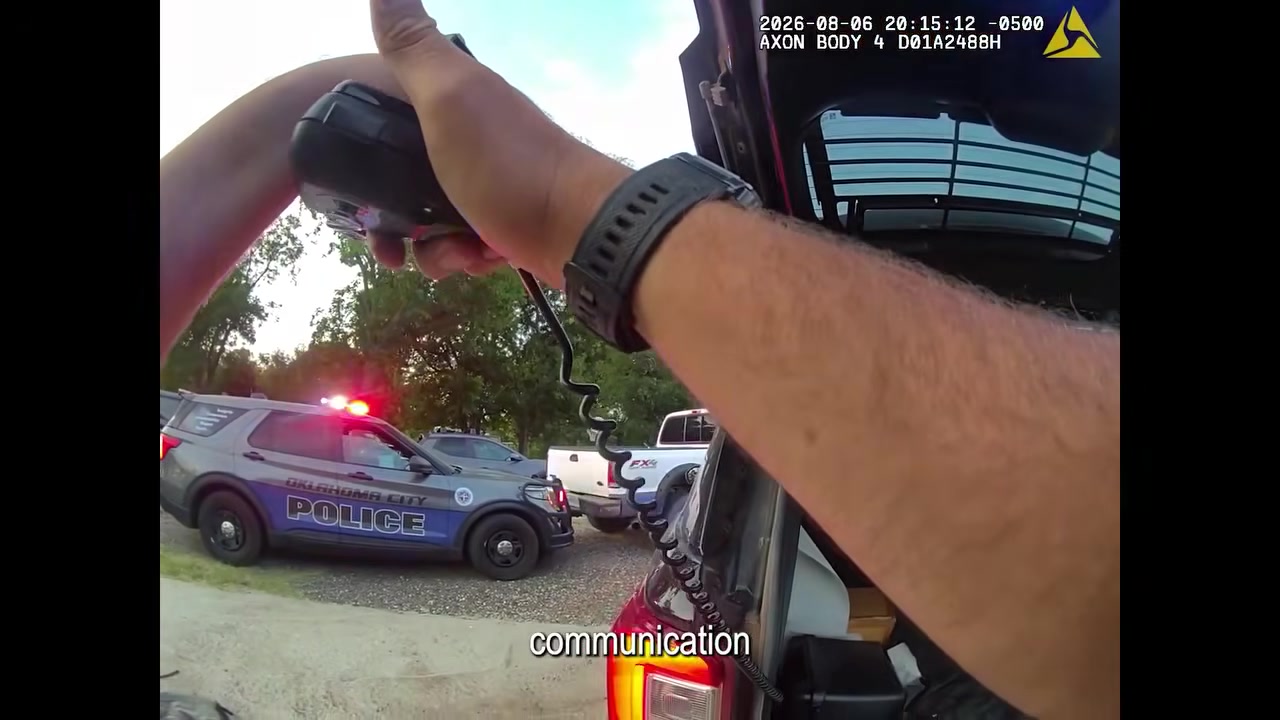
Officers spent several minutes trying to communicate with him. They issued commands, positioned patrol vehicles around the property and attempted to keep family members—including children—away from danger.
Then everything changed.
The pickup suddenly moved.
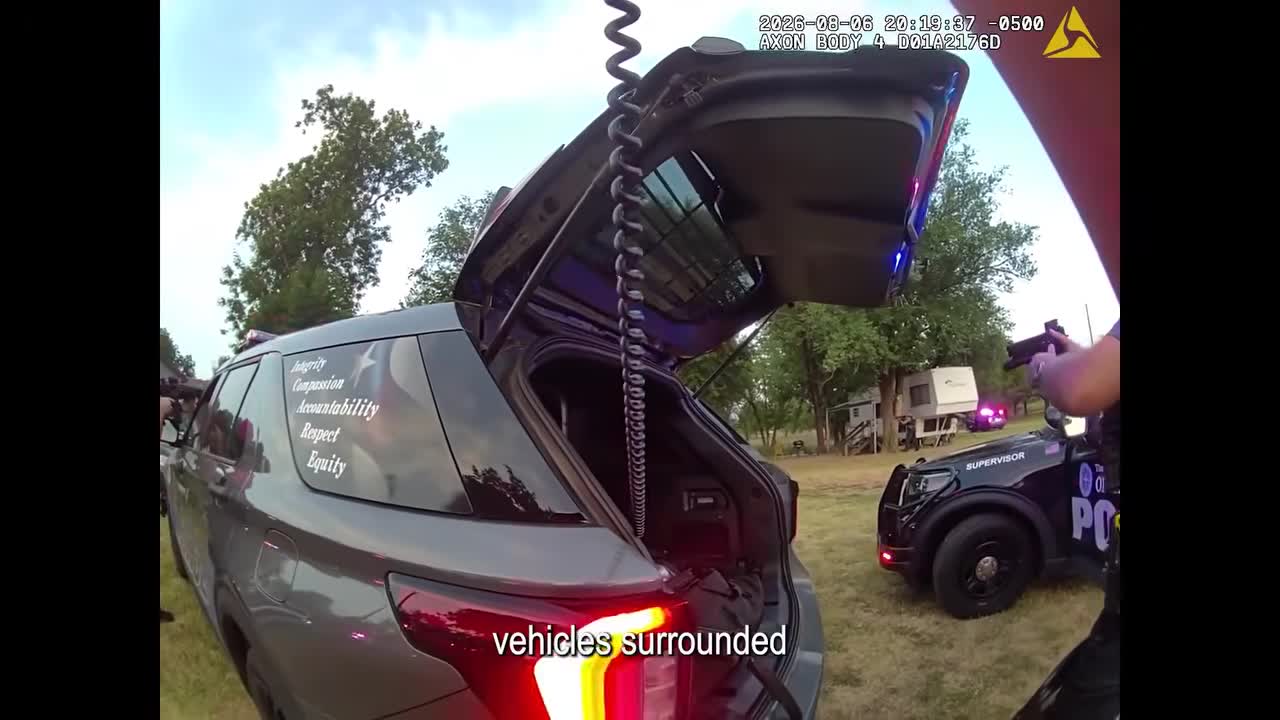
Within seconds, police said the driver was ramming patrol vehicles and attempting to strike officers with the truck. Bodycam and dashcam footage show officers scrambling away as the vehicle forces its way through the police perimeter. One officer is nearly trapped between vehicles.
Then a sergeant gets out of his cruiser.
Shots are fired.
The pickup crashes near a metal shipping container.
Yet even after being wounded, the driver initially refuses to surrender.
The August 6, 2026 confrontation near Spencer, Oklahoma, would eventually end with 45-year-old Johnny Kemp in custody and an Oklahoma City police officer placed on routine administrative leave while the shooting was investigated.
What makes the footage particularly striking is how rapidly the situation changes—from negotiation, to a vehicle escape, to an alleged attack on officers, to gunfire, and finally back to another tense standoff.
POLICE RESPOND TO A DISTURBANCE INVOLVING A GUN
The incident unfolded on the evening of August 6, 2026, in the 8900 block of Nettie Street, near Westminster Road and Britton Road in the Oklahoma City/Spencer area.
According to the Oklahoma City Police Department, officers were dispatched at approximately 6:48 p.m. after receiving a report of a disturbance involving a man with a firearm.
Contemporary reporting provided an even more concerning detail.
Police said information associated with the call indicated that the man had allegedly been pointing a firearm at relatives, including children.
That meant officers weren't responding to an ordinary argument.
They had to approach the property while considering the possibility that an armed person was present and that family members could still be in danger.
When officers arrived, they located the suspect—later identified as Johnny Kemp—inside a vehicle.
Instead of immediately rushing toward him, officers attempted to communicate.
The goal was straightforward: get Kemp out of the truck without creating an armed confrontation.
For several minutes, police tried to persuade him to exit.
THE SITUATION WAS TENSE, BUT IT HAD NOT YET BECOME VIOLENT BETWEEN KEMP AND THE RESPONDING OFFICERS.
That would soon change.
OFFICERS TRY TO CONTROL THE SCENE
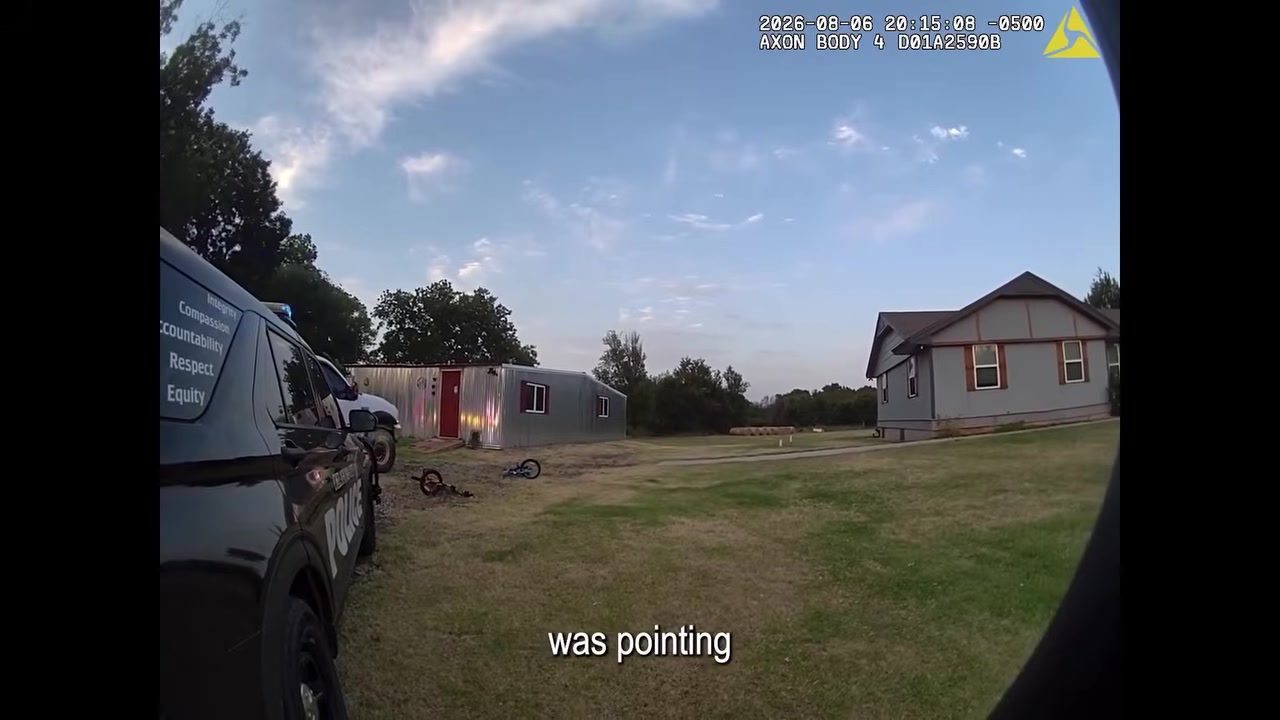
The footage provides a useful perspective on what happens during the early stages of a potentially armed standoff.
Police don't simply focus on the suspect.
They also have to control everything around him.
Where are the family members?
Where are the children?
Can people safely leave the property?
Does the suspect still have access to the reported firearm?
Where can officers position themselves without unnecessarily exposing themselves?
Every vehicle and structure can suddenly matter.
Patrol cars can provide some protection, but they can also become obstacles if officers need to move quickly. Buildings, fences and parked vehicles can restrict visibility.
And in this case, the suspect was already inside a vehicle.
That introduced another danger.
A stationary truck can become mobile almost instantly.
According to the police department's official account, officers spent several minutes trying to talk Kemp out of the vehicle.
The released footage shows officers positioned around the area while commands are issued.
Then the truck starts moving.
What had been a negotiation becomes something dramatically different.
THE PICKUP SUDDENLY DRIVES AWAY
Police footage shows the truck moving from its position as officers react.
Commands become more urgent.
Officers reposition.
The driver does not simply leave the immediate area and disappear.
According to police, Kemp began using the vehicle against the police perimeter.
He rammed police cars.
Police1's review of the footage reports that Kemp initially drove away from officers before turning the truck around and driving toward them.
That maneuver created an immediate threat.
An officer standing near a patrol vehicle suddenly has very little protection when a pickup truck is moving directly toward the position.
The footage shows just how quickly the distance disappears.
A STANDOFF THAT HAD BEEN CONTROLLED FROM A DISTANCE WAS NOW MOVING DIRECTLY TOWARD THE OFFICERS.
ONE OFFICER IS NEARLY PINNED
One of the most dangerous moments comes as the truck forces its way between police vehicles.
According to Police1's account of the released bodycam, an officer was nearly pinned against a vehicle when Kemp drove between two police cruisers positioned close together.
That detail explains why the officers' response suddenly changes.
From a viewer's perspective, it can be tempting to focus exclusively on the moment gunfire occurs.
But the seconds immediately beforehand are essential.
Police had received a call involving a firearm.
They had located the reported suspect inside a vehicle.
They had attempted to negotiate with him.
The vehicle then moved.
Police say it rammed cruisers.
And officers now believed the truck was being driven at them.
A motor vehicle can cause fatal injuries regardless of whether another weapon is visible at that exact moment.
The situation was no longer simply about whether Kemp possessed a firearm.
It was also about what the truck itself was doing.
Officers scattered away from its path.
But the truck continued moving.
THE SERGEANT'S CRUISER IS HIT
The pickup eventually reaches another police vehicle.
Police1 reports that Kemp rammed a sergeant's cruiser during the confrontation.
The dashcam footage from Sgt. John Farrington's vehicle captures the truck approaching the area.
Dust rises around the property as the pickup moves between structures and patrol vehicles.
Then the situation reaches its critical point.
The sergeant gets out.
According to Oklahoma City police, Kemp continued trying to strike officers with his vehicle.
An officer discharged his firearm.
Kemp was hit.
The police department's initial release does not frame the shooting as occurring merely because Kemp refused commands. Its account specifically states that the shooting occurred as Kemp continued trying to strike officers with his car.
That distinction is important for understanding the sequence shown in the video.
The shooting followed the vehicle confrontation.
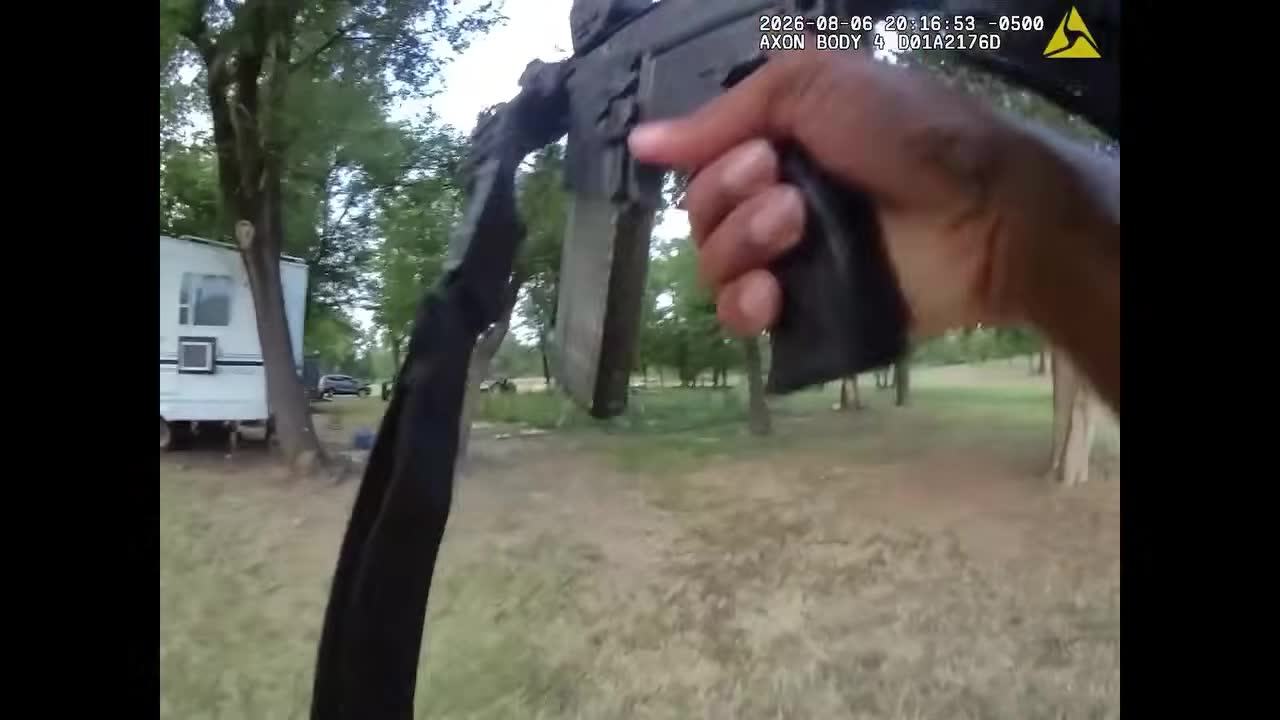
SHOTS ARE FIRED—BUT THE INCIDENT STILL ISN'T OVER
In many police videos, the moment shots are fired represents the immediate end of the confrontation.
Not here.
Kemp had been struck, but police still did not have physical control of him.
The pickup crashed near a metal shipping container.
The footage shows the truck stopped in the dusty area beside the residence.
Officers remain at a distance.
Weapons are trained toward the vehicle.
Commands continue.
The situation has effectively returned to a standoff—but now everyone involved knows that gunfire has already occurred.
Police also cannot assume that a wounded suspect is incapable of continuing to present a threat.
They still have to consider the original report involving a firearm.
They have to determine whether Kemp still has access to a weapon.
And officers cannot simply rush toward the truck without knowing what awaits them.
So the next phase becomes another negotiation.
THE TRUCK HAD STOPPED. THE SHOOTING HAD STOPPED. BUT THE DANGER HAD NOT YET BEEN RESOLVED.
Police said Kemp initially refused to leave the vehicle.
Officers continued communicating with him.
That decision transformed the encounter again.
Seconds earlier, the footage had been filled with moving vehicles, shouting and gunfire.
Now officers were trying to produce a surrender.
POLICE RETURN TO NEGOTIATION
This part of the encounter demonstrates something easily lost in short viral edits.
Police confrontations do not always move in one direction.
An incident can escalate and then immediately return to negotiation.
Officers may use force at one moment and then spend the next several minutes trying to convince the same person to surrender peacefully.
That is what happened here.
After the shooting, officers did not continue firing indefinitely.
Instead, they maintained their positions and communicated with Kemp.
The footage shows police surrounding the area while the damaged or disabled pickup remains near the shipping container.
Officers repeatedly direct the occupant to come out.
The challenge is significant.
They need Kemp to surrender.
But they also need him to do so in a manner that officers can clearly interpret.
Sudden movements can be dangerous when multiple armed officers are watching someone connected to an earlier firearm complaint.
Instructions therefore become very specific.
Show your hands.
Exit the vehicle.
Move away from it.
Follow commands.
Each step is designed to reduce uncertainty.
KEMP FINALLY SURRENDERS
Eventually, the standoff ends without another exchange of gunfire.
Kemp gets out.
Officers take him into custody.
According to the Oklahoma City Police Department, he was transported to an area hospital, where he was treated for the gunshot wound and released.
He was then booked into the Oklahoma County Detention Center.
The official police release listed booking complaints including assault and battery with a deadly weapon, assault and battery with a dangerous weapon, pointing a firearm, and possession of a firearm after a former felony conviction.
KOCO likewise reported Kemp's arrest and identified him as 45 years old.
The allegations reflected more than the final seconds captured by one body camera.
Investigators had to examine the entire event—from what allegedly happened before officers arrived to the vehicle confrontation and subsequent shooting.
As with any criminal case, booking complaints and charges are allegations; they do not by themselves establish guilt.
THE OFFICER WHO FIRED WAS PLACED ON LEAVE
The police shooting triggered another process separate from Kemp's criminal case.
The officer who fired at Kemp was placed on routine administrative leave pending the investigation, according to Oklahoma City police.
That step is consistent with the department's published procedure for officer-involved shootings.
Oklahoma City explains that shootings involving officers trigger separate criminal and administrative investigations.
Homicide investigators handle the criminal investigation and prepare the case for presentation to the appropriate district attorney.
Crime-scene personnel process physical evidence.
Body-worn camera footage is secured and reviewed.
Investigators search for additional surveillance footage.
Witnesses are interviewed.
The involved officer's weapon is examined.
Only after the criminal review progresses does the department's Office of Professional Standards conduct an administrative investigation into whether the officer's actions complied with departmental directives and training.
This matters because a short bodycam video is not itself the entire investigation.
The footage may be among the most compelling pieces of evidence, but investigators also consider physical evidence, vehicle positions, witness accounts, radio communications and other recordings.
THE CAMERA SHOWS WHAT ONE OR MORE OFFICERS COULD SEE. THE INVESTIGATION ATTEMPTS TO RECONSTRUCT EVERYTHING THAT HAPPENED.
WHY THE VEHICLE MATTERS SO MUCH
One of the most important elements in this incident is that the central threat changes.
The original call concerned a man with a gun.
When officers arrived, they were therefore prepared for the possibility of an armed confrontation.
But the critical moment shown in the released footage revolves heavily around the pickup.
Police said Kemp used it to ram patrol cars and tried to strike officers.
That distinction helps explain why vehicles can become central to use-of-force investigations.
A pickup truck weighs thousands of pounds.
At even relatively modest speed, it can seriously injure or kill someone who cannot get out of its path.
Officers positioned around vehicles also face a particular problem: patrol cars that provide cover against some threats can restrict movement when another vehicle suddenly drives into the same space.
The moment described by Police1—where an officer was nearly pinned as Kemp allegedly drove between two cruisers—illustrates that danger.
There is little time for extended deliberation when the distance between a moving truck and a person collapses within seconds.
That does not eliminate the need for investigation afterward.
It makes reconstructing those seconds even more important.
THE FOOTAGE SHOWS HOW FAST CONTROL CAN DISAPPEAR
At the beginning, police appear to have several advantages.
Multiple officers are present.
Patrol cars surround the area.
The suspect is stationary.
Officers can communicate from a distance.
They have time to issue commands.
Then the vehicle moves.
Suddenly, all of those advantages become less certain.
Officers have to move.
Their lines of sight change.
Police cars become obstacles.
Dust reduces visibility.
A vehicle that was previously stationary is now moving through the scene.
And decisions must be made in seconds.
This is why the released video is more revealing than a simple description such as "standoff ends in police shooting."
The phrase compresses a complicated event into a few words.
The footage shows the transitions.
NEGOTIATION BECOMES FLIGHT.
FLIGHT BECOMES AN ALLEGED VEHICLE ATTACK.
THE VEHICLE ATTACK BECOMES AN OFFICER-INVOLVED SHOOTING.
THE SHOOTING BECOMES ANOTHER STANDOFF.
THE SECOND STANDOFF FINALLY BECOMES A SURRENDER.
Those transitions are the real story.
NO OFFICER WAS REPORTED SHOT DURING THE INCIDENT
Considering the original firearm complaint and the vehicle movements visible in the footage, the confrontation had the potential to produce substantially more serious injuries.
The available police account reports Kemp being wounded by the officer's gunfire but does not report an officer being shot.
Kemp was treated at a hospital and later taken to jail.
That outcome does not diminish the seriousness of what occurred.
Instead, it highlights how close the incident allegedly came to producing additional casualties.
Police1's description of the footage emphasizes the moment an officer was nearly pinned by the pickup.
That single moment could have produced a very different ending.
A person trapped between two vehicles has almost no ability to absorb the impact safely.
A few feet of additional movement can make the difference between escape and catastrophic injury.
THE BODYCAM WAS RELEASED WEEKS LATER
The confrontation occurred on August 6.
The bodycam footage reached wider public attention in September as Oklahoma City police released material showing the incident.
Police1 reported on the released video on September 16, 2026, describing footage showing Kemp ramming cruisers and attempting to run down officers before the shooting.
That delay between an incident and the release of body-camera footage is not unusual.
Investigators first have to secure evidence, conduct interviews and determine what portions of video can appropriately be released.
Oklahoma City's own description of its officer-involved-shooting process says the department creates Community Incident Briefing videos that can include bodycam footage, dashcam video, photographs and other information relevant to an incident.
For the public, those releases can dramatically change how an incident is understood.
A written police statement might say that a suspect attempted to strike officers with a vehicle.
Video allows viewers to see the vehicle moving through the police positions.
A statement might say an officer fired.
Video can show the seconds leading to the gunfire.
A report might say the suspect later surrendered.
Footage captures the long period of commands and negotiation that occurs between the shooting and the arrest.
That additional context is precisely why body-camera releases attract so much attention.
ONE CALL, MULTIPLE CRITICAL DECISIONS
It is tempting to think of this incident as having one decisive moment: the shooting.
In reality, there were many.
The first officers had to decide how to approach a call involving a firearm and children.
They had to determine where to position themselves.
They had to decide whether to continue negotiating with a man inside a vehicle.
When the truck moved, individual officers had to decide where to run.
When police vehicles were allegedly rammed, officers had to determine whether they were facing an immediate deadly threat.
The officer who fired had to make a decision within seconds.
After Kemp was hit, police had another decision: rush the vehicle or return to negotiation.
They chose to continue communicating.
Eventually, Kemp surrendered.
Each decision influenced the next.
That chain is what makes the footage so compelling.
There is no clean separation between "the standoff" and "the shooting."
One grows directly out of the other.
WHAT HAPPENS AFTER THE CAMERA STOPS
The moment handcuffs are applied may feel like the end of the story, but legally it is only the beginning.
Kemp's hospital treatment had to be completed.
He was booked.
Detectives began reconstructing the incident.
Evidence had to be processed.
Bodycam and dashcam recordings had to be preserved.
The involved officer entered the department's post-shooting investigative process.
Prosecutors would ultimately be responsible for evaluating the criminal allegations against Kemp, while the officer's conduct would be separately reviewed through the mechanisms Oklahoma City uses for officer-involved shootings.
That separation is essential.
There are effectively two questions.
What criminal conduct, if any, can prosecutors establish regarding the suspect?
And was the officer's use of force legally and administratively justified?
The same footage may be relevant to both questions, but the questions themselves are not identical.
A STANDOFF THAT NEARLY ENDED MUCH WORSE
The opening call already contained nearly every ingredient for a dangerous encounter.
A domestic dispute.
A reported firearm.
Family members.
Children.
A suspect refusing to leave a vehicle.
Then the vehicle itself became part of the confrontation.
Police say Kemp rammed cruisers and attempted to strike officers.
The released footage shows how quickly officers had to move when the pickup began driving through their positions.
A sergeant's vehicle was hit.
An officer fired.
Kemp was wounded.
Then, remarkably, the confrontation slowed down again.
Police resumed communication.
The wounded suspect eventually exited.
Officers arrested him without another reported exchange of gunfire.
The result was an incident that lasted only a fraction of an evening but moved through several radically different phases.
WHAT BEGAN AS AN ATTEMPT TO TALK AN ARMED-DISTURBANCE SUSPECT OUT OF A TRUCK BECAME A CHAOTIC VEHICLE CONFRONTATION—AND THEN, AFTER GUNFIRE, RETURNED TO A STANDOFF THAT ENDED IN SURRENDER.
The bodycam makes those transitions impossible to miss.
WATCH THE COMPLETE ENCOUNTER
The most dramatic seconds show the truck moving through the police perimeter and the shooting that follows, but those moments make far more sense when viewed alongside everything that came before and after.
The officers first attempt to negotiate.
The vehicle suddenly moves.
Police scramble.
Cruisers are hit.
Gunfire erupts.
Then officers spend more time trying to persuade the wounded driver to surrender.
The entire sequence shows why a police encounter can shift from controlled to chaotic almost instantly—and why the moments surrounding the use of force can matter just as much as the shooting itself.
Click here to watch the full incident unfold from the first police contact to the final surrender:
Comments (0)
Loading comments...
May You Like

Entitled Driver Learns Why You Must Obey Lawful Orders During Traffic Stop

What Happens when you get Caught Shoplifter Stealing Local Store

A Suspicious Vehicle Leads Officers Into an Unexpected Chase












