
Official Bodycam: Officer Involved Shooting
Armed Man Retreats Into Milwaukee Apartment as Hour-Long Police Standoff Reaches a Deadly End
A Gun Call Becomes Something Far More Complicated
Just before 11 a.m. on June 12, 2026, Milwaukee police officers were sent to what was already a dangerous call.
Someone was reportedly armed with a gun.
The caller said the armed man was threatening to shoot them.
Investigators would later say the encounter also involved an attempted robbery.
By the time officers reached the area around West Kaul Avenue on Milwaukee's northwest side, the person they were looking for was moving away from the original scene with a revolver.
Police identified him afterward as 22-year-old Jaylyn J. Brown.
The encounter might have ended almost immediately.
Officers saw Brown.
They attempted to stop him.
Instead, according to police and subsequently released body-camera footage, Brown held the revolver toward his own head and repeatedly challenged officers to shoot him.
An officer can be heard trying to communicate rather than immediately firing.
Brown did not surrender.
Instead, he ran.
His destination was a nearby apartment building.
That decision transformed an armed encounter on the street into something considerably more difficult.
Now police were dealing with an armed man inside a residential structure.
There were walls.
Doors.
Stairs.
Apartments.
Potential residents.
Limited sightlines.
And an armed person positioned above officers on a second-floor landing.
Within minutes, the narrow staircase would become the center of an encounter lasting roughly an hour.
Police would try verbal negotiation.
They would offer Brown water and a cigar.
They would attempt less-lethal tactics.
Gunfire would erupt more than once.
And by the end, Brown would be mortally wounded.
The supplied bodycam captures one of the most intense portions of that encounter: officers entering the apartment building, weapons raised, staring up a narrow staircase toward a man they believe is armed.
It is a scene where every doorway matters.
And nobody knows exactly how the next few seconds will end.
Officers Find Brown With a Revolver
Milwaukee Police Department's official account places the beginning of the incident at approximately 10:58 a.m.
Uniformed officers responded to the 8500 block of West Kaul Avenue after receiving a call about an armed individual threatening the caller.
Police later said investigators learned Brown had attempted to rob that person.
Officers found him walking away.
He had a revolver.
The weapon fundamentally changes everything about the police response.
Officers cannot simply chase Brown into close quarters as though he were an unarmed shoplifting suspect.
Distance matters.
Cover matters.
His hands matter.
The direction of the muzzle matters.
The location of other people matters.
According to MPD, Brown held the revolver to his own head while telling officers to shoot him. Police also said he threatened officers.
The later-released footage adds an unsettling human dimension to that summary.
At one point Brown asks officers to shoot him.
An officer responds that he does not want to do that.
The exchange illustrates the dilemma facing police.
Brown is armed, which means officers must treat him as potentially capable of using deadly force.
At the same time, his statements suggest that simply confronting him with firearms may be exactly the reaction he wants.
The objective therefore becomes more complicated than making an arrest.
Police need to prevent Brown from shooting someone.
They need to prevent him from being shot if possible.
They need to protect themselves.
And they need to somehow convince an armed, agitated man to surrender.
Then Brown runs into the apartment building.
The tactical problem changes instantly.
The Staircase Becomes the Center of the Standoff
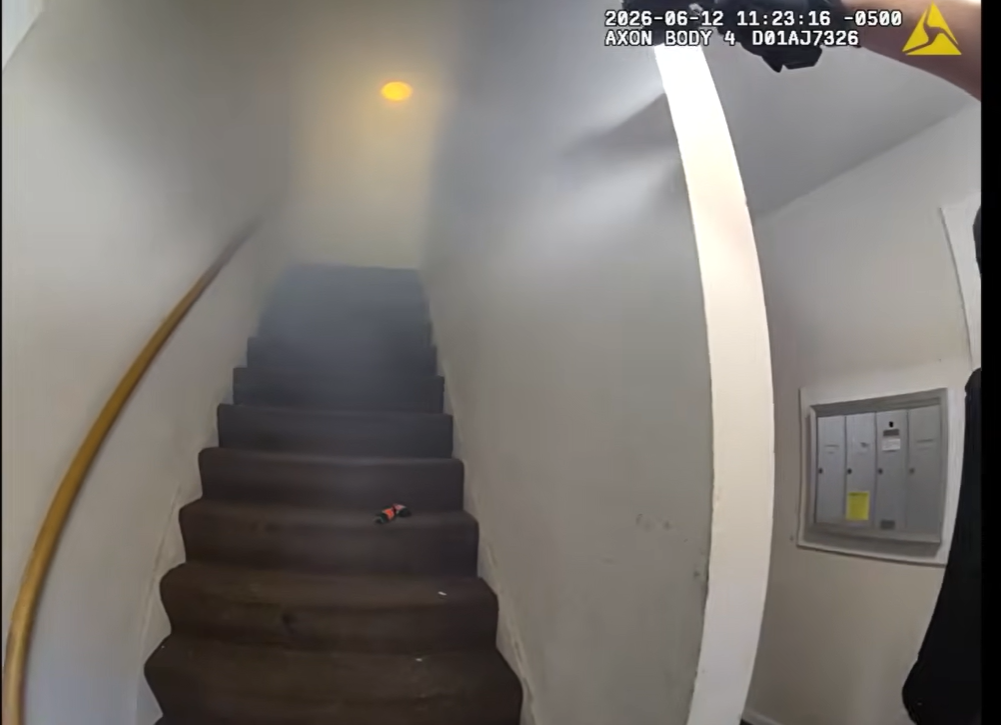
Brown retreats to a second-floor common hallway.
The bodycam supplied for this article shows why that location is so difficult.
Officers enter through a ground-level doorway.
Immediately ahead is a narrow staircase.
At the top is another door and landing.
There is very little room to maneuver.
An officer moving upward has limited visibility while Brown potentially has the advantage of elevation.
The AXON timestamp visible in the footage reads approximately 11:22 a.m., placing this sequence around 24 minutes after the initial dispatch time reported by MPD.
Then officers hear a gun discharge.
That sound changes the urgency immediately.
Milwaukee Police said officers repeatedly ordered Brown to drop the revolver. During this first confrontation inside the building, one officer fired at Brown.
Nobody was hit during that initial police gunfire.
The bodycam shows officers focusing on the top of the staircase.
Weapons remain aimed upward.
Commands echo through the enclosed hallway.
The walls make the environment feel even smaller than it is.
There is almost no neutral space between the officers below and the landing above.
Yet after the first exchange, the situation does not immediately become a full gunfight.
Instead, police begin doing something that would continue for roughly the next hour.
They talk.
An Hour of Negotiation Instead of an Immediate Rush Upstairs
It would be easy to watch the first minutes of the footage and assume officers simply stormed the second floor.
That is not what happened.
MPD says officers negotiated with Brown for approximately one hour.
This period is essential to understanding the incident.
Police had an armed man contained in a relatively confined location.
Moving directly toward him could expose officers to the revolver.
Waiting indefinitely also carried risks.
Brown had reportedly already threatened another person.
Police believed he had attempted a robbery.
A gunshot had been heard inside the building.
And officers had to consider the possibility of other residents nearby.
Negotiation therefore became one of the safest available tools.
The conversation eventually produced something surprisingly ordinary.
Brown wanted a bottle of water.
And a cigar.
Officers agreed.
On the surface, offering those items to an armed suspect may seem strange.
Tactically, however, the request created an opportunity.
If Brown came downstairs to retrieve them, he would leave the stronger position he had maintained on the upper landing.
Police could potentially arrest him without having to climb directly toward an armed person.
Brown eventually agreed to come down.
For a moment, the standoff appeared to be approaching a peaceful resolution.
He descended the stairs.
Officers had spent roughly an hour talking to him.
The water and cigar were waiting.
Then police attempted to take him into custody.
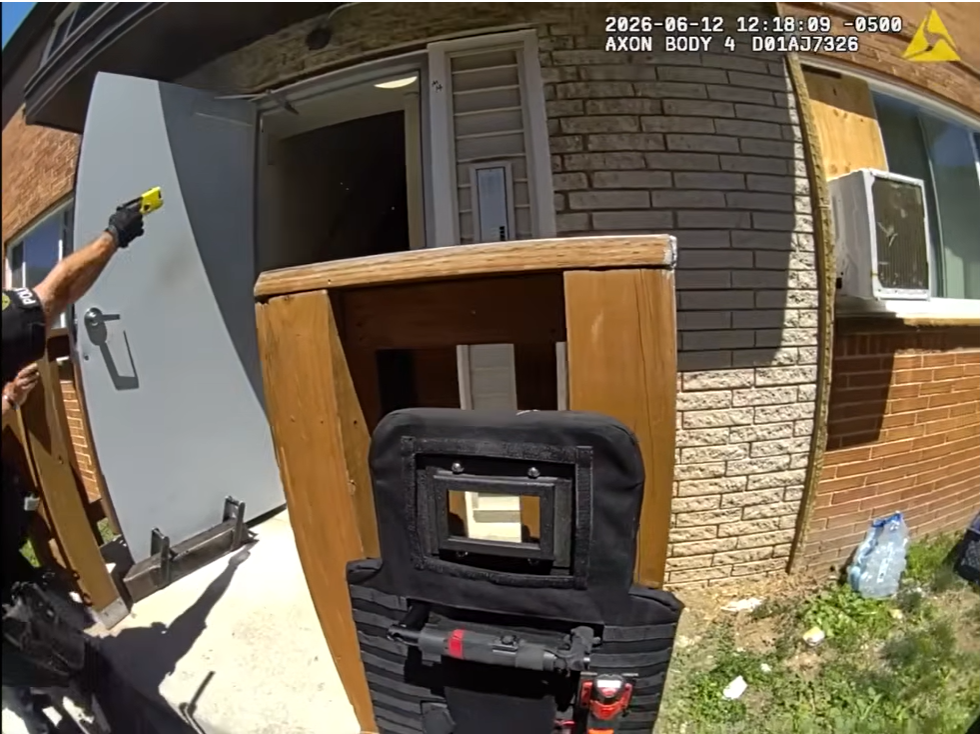
Less-lethal options were deployed.
Reports on the released footage describe officers using a police K-9, a stun gun and less-lethal impact rounds during the attempted apprehension.
But the attempt did not produce the surrender officers wanted.
Brown retreated.
He went back upstairs.
The opportunity disappeared.
And the confrontation returned to the exact location that had made the situation so dangerous from the beginning.
The staircase.
Less-Lethal Options Fail to End the Encounter
The failed arrest attempt is one of the most important moments in the entire sequence.
Until then, officers still have several possible routes toward resolution.
Negotiation might work.
Brown might surrender.
The less-lethal tactics might incapacitate him long enough for officers to secure the revolver.
None of those possibilities succeeds.
Brown gets back upstairs.
This is where the phrase “less lethal” needs to be understood correctly.
It does not mean guaranteed.
A Taser can fail.
Impact rounds can fail to stop a determined person.
A police dog cannot magically eliminate the danger presented by a firearm.
These tools provide officers with alternatives to firearms when circumstances permit, but their effectiveness depends heavily on distance, placement, clothing, movement and the behavior of the person involved.
In this case, Brown remained capable of retreating after police tried to take him into custody.
Now officers faced the same armed standoff, but with even greater uncertainty.
According to reporting by the Milwaukee Courier, officers then moved into positions upstairs. Gunshots were heard, and the final confrontation developed quickly.
The final bodycam footage does not provide a perfect unobstructed view of Brown at every instant.
That limitation matters.
Body cameras record from the officer's chest and can be blocked by arms, weapons, walls or movement.
They do not reproduce exactly what an officer's eyes see.
But police said officers encountered Brown armed with the revolver.
Then officers fired.
This time, Brown was struck.
The hour-long effort to achieve a surrender had reached its final seconds.
Gunfire Ends the Standoff
After Brown was shot, the officers' role changed immediately.
The armed confrontation was over.
Now medical care became the priority.
Police took Brown into custody and rendered aid.
The revolver was recovered near him, according to MPD.
No officers were injured by gunfire.
Brown was transported to a local hospital.
At approximately 12:50 p.m., he was pronounced dead.
From the initial dispatch at 10:58 a.m. to Brown's death at the hospital, the incident had stretched across nearly two hours.
The active standoff itself lasted about an hour.
The shooting became the most dramatic part of the story, but it was not the only important part.
Officers had repeatedly tried to communicate with Brown.
They had avoided simply rushing the landing.
They had created an opportunity involving water and a cigar.
They had attempted less-lethal tactics.
Only after those efforts failed did the encounter reach its fatal conclusion.
That chronology does not, by itself, resolve every question surrounding the shooting.
Officer-involved shootings require independent investigation precisely because police accounts are not the final legal judgment.
Wisconsin has a formal process for investigating deaths involving law enforcement.
In this case, the Milwaukee Area Investigative Team took responsibility, with the Waukesha Police Department serving as the lead investigative agency.
The three Milwaukee officers directly identified by the department as involved in the shooting were described as a 39-year-old officer with more than 13 years of service, a 46-year-old officer with more than 22 years, and a 41-year-old officer with more than 22 years.
They were placed on administrative duty, which MPD described as routine following a critical incident.
Investigators Learn There May Have Been Another Victim
The investigation also uncovered information about what Brown had allegedly been doing shortly before police encountered him.
MPD said another person later came forward and reported that Brown had attempted to steal their vehicle while armed with a revolver.
That incident allegedly occurred in the 8400 block of West Kaul Avenue, shortly before the original call.
If accurate, that allegation expands the context considerably.
Police were not merely responding to a man possessing a firearm.
They believed they were dealing with someone who had been involved in multiple armed confrontations within a relatively short period.
The original caller had allegedly been threatened and subjected to an attempted robbery.
Another person reported an attempted armed carjacking.
Then responding officers encountered Brown carrying the revolver.
He refused to stop.
He told police to shoot him.
He ran into the apartment building.
And a firearm was discharged from inside.
Each event increased the uncertainty facing officers.
The encounter also illustrates why information available after an incident must be separated from what officers knew at the moment they acted.
Investigators can later assemble the entire timeline.
An officer standing at the bottom of a staircase does not have that luxury.
That officer knows only the information already communicated and what can be seen and heard in the moment.
That distinction becomes critical whenever police use deadly force.
The legal question is generally centered on what a reasonable officer could perceive under the circumstances at the time, not on facts discovered days later.
The bodycam provides one part of that evidence.
Witness interviews, physical evidence, the recovered revolver and independent investigation provide the rest.
Brown's Family Questions Whether the Ending Could Have Been Prevented
There is another side of this story that should not disappear behind the police footage.
Brown was 22 years old.
He had a family.
And after his death, his mother publicly questioned whether police had exhausted every possible way to bring the standoff to a nonfatal conclusion.
CBS 58 interviewed Brown's mother, D'Lynn Brown, after the shooting. She said she wanted accountability and believed her son's death could have been prevented.
FOX6 also reported that she said her son struggled with bipolar disorder and ADHD.
Those statements provide important context but should not be used to retrospectively diagnose Brown's behavior during the encounter.
They represent his family's perspective on what happened.
Police, meanwhile, emphasized the firearm, alleged robberies, threats toward officers, the discharge heard inside the building and Brown's actions during the attempted arrest.
Both perspectives became part of the public discussion once the footage was released.
That release occurred on June 29, 2026, a little more than two weeks after the shooting.
Four video clips were released.
Together, they show an incident considerably more complicated than a few seconds of final gunfire.
They show Brown speaking with officers.
They show officers attempting to communicate.
They show the staircase.
They capture the initial gunfire that does not hit anyone.
They document the later attempt to use less-lethal force.
And they show the chaotic final moments.
Why the Staircase Made Everything More Dangerous
The physical environment deserves special attention because it shaped almost every tactical decision.
The apartment building's stairwell is narrow.
The footage shows officers standing near the bottom with very limited visibility of the second-floor landing.
That creates what police tactics often describe as a dangerous angle.
An officer moving upstairs exposes more of their body before gaining a complete view of what is waiting above.
Brown, meanwhile, could potentially remain partially concealed.
Walls prevent officers from simply moving sideways to create more distance.
The stairs channel everyone toward the same narrow route.
That helps explain why negotiation continued for so long.
Police already had Brown relatively contained.
Charging directly upward could transform containment into a close-range gunfight.
Waiting created time for communication.
The water-and-cigar plan attempted to reverse the positional advantage by encouraging Brown to come toward officers voluntarily.
For a moment, it worked.
He came downstairs.
What failed was the effort to secure him before he returned upstairs.
Once that happened, the tactical problem reset.
But now the standoff had been going on for approximately an hour.
Less-lethal methods had failed.
And police still believed Brown had the revolver.
The final encounter developed within that context.
A Few Minutes of Bodycam Cannot Tell the Entire Story
The supplied video is approximately 80 seconds long.
The incident lasted far longer.
That difference is essential.
A short bodycam clip can capture the most dramatic moments without showing the hour of negotiation separating them.
That is why combining footage with official reports and independent news coverage matters.
MPD's release establishes the broader timeline.
Local outlets such as WTMJ, CBS 58, FOX6, WISN and the Milwaukee Journal Sentinel/Courier reporting add further detail about the negotiations and footage.
Together, they reveal an encounter with several distinct phases.
First came the alleged armed crimes.
Then police contact.
Then Brown's flight.
Then the apartment standoff.
Then the first exchange of gunfire.
Then negotiation.
Then the water and cigar.
Then the attempted less-lethal arrest.
Then Brown's retreat.
Finally came the shooting that killed him.
Reducing all of that to “police shoot armed man” loses important context.
So would reducing it to “man killed after asking police to shoot him.”
Both descriptions contain fragments of the story.
Neither captures the sequence.
And sequence is everything in a case like this.
An Hour of Attempts Ends in Seconds
The most striking contrast in the Milwaukee footage is the relationship between time and outcome.
Officers spend roughly an hour attempting to resolve the situation.
The final confrontation lasts seconds.
That is often how critical incidents unfold.
Negotiation is slow.
Movement is fast.
For most of the encounter, officers have time to communicate, reposition and consider alternatives.
Then something changes.
The armed person moves.
A weapon appears.
Distance closes.
Suddenly decisions that could previously be discussed must be made immediately.
On June 12, that shift happened inside a cramped Milwaukee apartment building.
Jaylyn Brown had allegedly threatened people with a revolver before police arrived.
He refused officers' attempts to stop him.
He fled upstairs.
A shot was heard.
Police fired once during an earlier confrontation without hitting him.
Negotiations followed for about an hour.
Officers eventually persuaded him to come downstairs for water and a cigar.
They attempted less-lethal methods.
He escaped back upstairs.
Then officers encountered him again.
Gunfire followed.
Brown was hit.
Officers provided aid.
He died at the hospital at approximately 12:50 p.m.
The independent investigation is what ultimately determines how the officers' actions are evaluated under Wisconsin law.
But the footage already demonstrates why the incident cannot be understood solely through its final seconds.
Before the shooting came conversation.
Before the conversation came flight.
Before the flight came an armed encounter.
And before officers ever entered that narrow stairwell, police say there were already people reporting that a man with a revolver had threatened them.
The ending was fast.
Everything leading to it was not.
That is precisely why watching the full chronology matters.
See how the Milwaukee apartment standoff developed from the first armed encounter through negotiations, less-lethal attempts and the final confrontation in the complete footage here: https://www.youtube.com/watch?v=bbwNNKvM9_w
Comments (0)
Loading comments...
May You Like

Stolen Charger Flees Police During Highway Traffic Stop

Cop thinks sandwich is phone

The Truth Behind the Suspicious Vehicle and the Standoff with Police













