Noise Complaint Escalates When a Man Confronts a Deputy With a Sword
Noise Complaint Escalates When a Man Confronts a Deputy With a Sword
A Noise Complaint Brings a Deputy to a Rosamond Mobile Home Park
On August 3, 2026, a Kern County sheriff’s deputy responded to what initially sounded like a neighborhood quality-of-life complaint at Desert Oasis Mobile Estates in Rosamond, California. The caller, later identified by authorities as 22-year-old Joshua Dribin, was upset about a nearby driver who he said repeatedly revved an engine at night and disturbed his sleep.
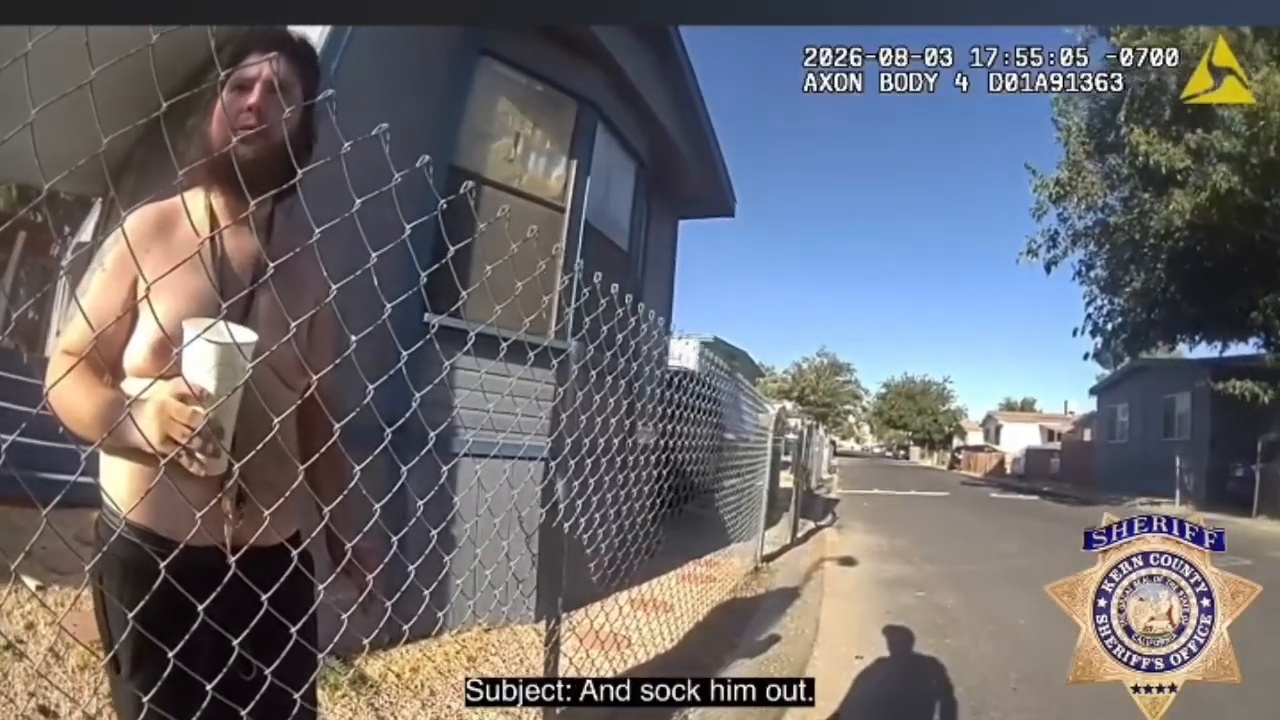
The supplied footage can be matched confidently to this incident. Its AXON overlay shows August 3, 2026 at approximately 5:55 p.m., the Kern County Sheriff’s Office emblem is visible, and the residential environment matches the agency’s description of the incident in the 3300 block of 15th Street West. Local reporting and the Sheriff’s Office account place the original dispatch at about 5:30 p.m.
The call itself already contained warning signs. According to audio later released with the body-camera footage, Dribin told dispatch that the recurring engine noise was making him extremely angry and threatened the person he blamed for it. Still, when the deputy first meets him, the scene looks more like a conversation between an irritated resident and a responding officer than the beginning of a critical incident.
Dribin stands behind a chain-link fence holding a drink while explaining his frustration. The deputy listens and discusses possible ways of addressing the complaint. Within minutes, however, the subject shifts from noise and neighborhood conflict to threats of physical violence.
The Conversation Becomes Increasingly Hostile
Dribin tells the deputy that he wants the other man kept away from him. When the discussion turns to what he might do if the neighbor returns, Dribin begins talking about physically confronting him. The deputy repeatedly explains that attacking the neighbor would itself be a crime.
This exchange is important because it shows the deputy attempting to redirect the situation before any weapon appears. The officer does not arrive expecting a sword confrontation. He is responding to a disturbance complaint and trying to prevent a dispute between neighbors from becoming violent.
The body-camera perspective also shows the physical separation between the two men. Dribin remains behind a chain-link fence near his residence while the deputy stands on the roadway side. That barrier initially provides distance and gives the deputy time to communicate rather than immediately resorting to physical control.
But Dribin’s statements continue to intensify. Instead of accepting the deputy’s warning that he cannot assault the neighbor, he abruptly announces that he is going to retrieve a sword. At that point, the encounter changes completely.
Dribin Announces He Is Going to Get a Sword
The escalation is unusually explicit. Dribin tells the deputy that he is going back inside for his sword and indicates that he intends to deal with the neighbor himself. The deputy immediately tells him that he cannot do that.
Dribin nevertheless disappears toward the residence. The deputy now has information that a person who has already threatened another individual is deliberately retrieving a weapon. That is fundamentally different from discovering a weapon unexpectedly during an encounter. The threat has been verbalized in advance, and the officer has only seconds to respond.
The deputy radios for assistance and begins creating distance. This is a critical tactical choice. A sword is a contact weapon, but it can become lethal extremely quickly when a person closes distance at a run. Space gives an officer additional reaction time and creates an opportunity for the armed person to comply with commands before force becomes necessary.
The video makes the transition unmistakable. The earlier discussion over engine noise is over. The deputy is now preparing for an armed confrontation while waiting for backup that has not yet arrived.

He Returns Carrying the Weapon
Dribin soon reappears holding a long, curved sword. Kern County authorities described it as a sword, while later reporting characterized it as Japanese-style or samurai-style. The exact label matters less than the immediate fact visible on camera: he is now armed with a large bladed weapon after threatening violence.
The deputy orders him to drop it. Instead of putting the sword down, Dribin continues moving and shouting. The chain-link fence still separates them for part of the exchange, but the deputy cannot assume that barrier will remain effective.
Dribin also directs the deputy to shoot him. Those statements add another dimension to the encounter, but they do not remove the danger posed by the weapon. An officer confronted by someone advancing with a sword still has to respond to the physical threat regardless of what the person says about wanting to be shot.
This is one reason the full footage matters. A short clip beginning only when the deputy draws his firearm would omit the earlier threats, the announcement that Dribin was going to retrieve a sword, the deputy’s warnings and the time Dribin had to change course.
The Fence Stops Being a Safety Barrier
The confrontation reaches its most dangerous stage when Dribin moves beyond the fence line. According to the Sheriff’s Office and reporting based on the released footage, he climbed over the barrier while holding the sword and continued toward the deputy despite repeated commands to stop and drop the weapon.
Once that happens, the deputy’s available reaction time shrinks dramatically. Distance that previously provided a margin of safety disappears as Dribin advances. The officer continues backing away, keeping his firearm directed toward the threat while issuing commands.
At one point Dribin also approaches the patrol vehicle and attempts to open the driver-side door. The cruiser cannot simply be treated as a safe refuge if the armed man can reach it. The deputy has to continue moving and maintaining separation.
Nothing in this sequence requires speculation about what Dribin might have done later. The immediate facts are sufficient: he had made threats, deliberately retrieved a sword, refused repeated orders to drop it, crossed the fence and advanced toward the deputy with the weapon.
The Deputy Fires as Dribin Advances
The encounter culminates when Dribin moves toward the deputy with the sword raised. The deputy fires three rounds, according to the Kern County Sheriff’s Office review. Dribin is struck and falls to the ground.
The gunfire ends the forward movement. The deputy continues issuing commands, including instructions concerning the sword. Dribin eventually moves the weapon away from himself as officers work to secure the scene.
Authorities reported that no deputies or additional civilians were injured. Dribin survived and was treated for non-life-threatening injuries. Deputies provided aid at the scene before he was transported by ambulance to a hospital.
The survival outcome is important because the incident is sometimes described simply as an officer-involved shooting, a phrase that does not reveal whether the person died. In this case, official reporting specifically states that Dribin’s wounds were non-life-threatening.
The Sheriff’s Office Reviews the Use of Force
Kern County Sheriff’s Office detectives investigated the shooting, as the agency does with deputy uses of deadly force. The case was also submitted for the appropriate criminal review. On September 3, 2026, the Sheriff’s Office convened an Incident Review Board to examine the deputy’s actions.
The agency later announced that the use of force was determined to be within department policy. That administrative finding does not mean viewers are required to agree with every tactical decision, but it is an important verified part of the incident’s official outcome.
The released body-camera video and 911 audio provide much of the context behind that conclusion. The deputy did not encounter an unknown weapon without warning. Dribin told him he was going to retrieve a sword, returned with it, ignored commands and advanced.
The sequence also demonstrates why critical-incident releases often include the events leading up to gunfire rather than only the moment shots are fired. Whether force is reasonable depends heavily on what officers knew and what the person was doing immediately beforehand.
The Criminal Case Continues After the Shooting
Authorities initially reported Dribin’s arrest on allegations including resisting or obstructing, exhibiting a deadly weapon to resist arrest and attempted murder of a peace officer. Later official information associated with the completed review listed charges including assault with a deadly weapon on a peace officer, resisting a peace officer using force, exhibiting a deadly weapon at a peace officer to resist arrest and misdemeanor resisting or delaying an officer.
These are criminal allegations and charges, not a statement that every count has resulted in a conviction. That distinction is especially important because the court proceedings were still developing in September 2026.
Local reporting says the criminal case was paused while Dribin underwent an evaluation concerning his competency to proceed. A September hearing was postponed after the expected medical report was not available, and another hearing was scheduled for October.
Competency proceedings address whether a defendant is presently able to understand the criminal process and assist counsel. They are not themselves a determination of guilt or innocence and should not be confused with a final disposition of the charges.
Why the Original Noise Complaint Matters
The extraordinary part of the incident is how far it travels from its starting point. Dribin was the person who called law enforcement. He wanted help with a neighbor whose engine noise he said was repeatedly disturbing him. The deputy came to address that complaint.
Had the interaction remained focused on documenting the disturbance or discussing lawful options, it might have ended as an ordinary service call. Instead, Dribin’s own threats and decision to retrieve a sword transformed him from the caller seeking police assistance into the armed person the deputy had to confront.
That progression is why a title focused only on the sword misses part of the story. The weapon is the climax, but the earlier conversation explains how the situation developed. The deputy repeatedly tells Dribin that he cannot attack the neighbor, while Dribin becomes increasingly determined to handle the dispute himself.
It is also why the case provides a strong example of escalation occurring through a series of choices rather than one instantaneous event. The noise complaint creates the contact. Threats raise concern. Retrieving the sword creates an armed crisis. Crossing the fence and advancing brings the confrontation to its final seconds.
A Neighborhood Dispute Becomes a Critical Incident in Minutes
The body-camera footage begins with an almost mundane scene: bright afternoon sunlight, a chain-link fence, a resident holding a cup and a deputy listening to a complaint about engine noise. There is nothing visually dramatic about those opening moments.
By the end, the same deputy is retreating from an armed man, repeatedly ordering him to drop a sword and ultimately firing when the man continues advancing. The contrast is what makes the footage so striking.
The exact incident can be verified unusually well. The AXON date matches the August 3, 2026 event. The Kern County Sheriff’s Office emblem appears directly in the footage. The mobile-home setting matches Desert Oasis Mobile Estates in Rosamond. The dialogue about the neighbor, the sword and the demand to be shot matches the Sheriff’s Office release and local reporting.
Official sources identify the man as Joshua Dribin, 22. They confirm that he survived, that no deputy or civilian was injured, and that the Sheriff’s Office later found the deputy’s use of force within policy. The criminal case, however, had not reached a final verified disposition at the time of the latest reporting.
The incident does not need additional exaggeration. A man calls police over a noise complaint, threatens the neighbor he is complaining about, announces that he is retrieving a sword, returns armed and advances toward the deputy who came to help him. Within minutes, a neighborhood dispute has become a deputy-involved shooting.
Comments (0)
Loading comments...
May You Like

Woman Refuses Repeated Orders to Exit Her Car Before Officers Move In

Neighborhood Grocery Store Suddenly Erupts Into Chaos

911 Call Leads Police to a Disturbing Family Situation