
Night Ride That Turned Into a Police Hunt
Nighttime UTV Pursuit Ends in a Fatal Crash After Police Close the Gap
A Dark Road, a Side-by-Side, and a Pursuit That Would End in Tragedy
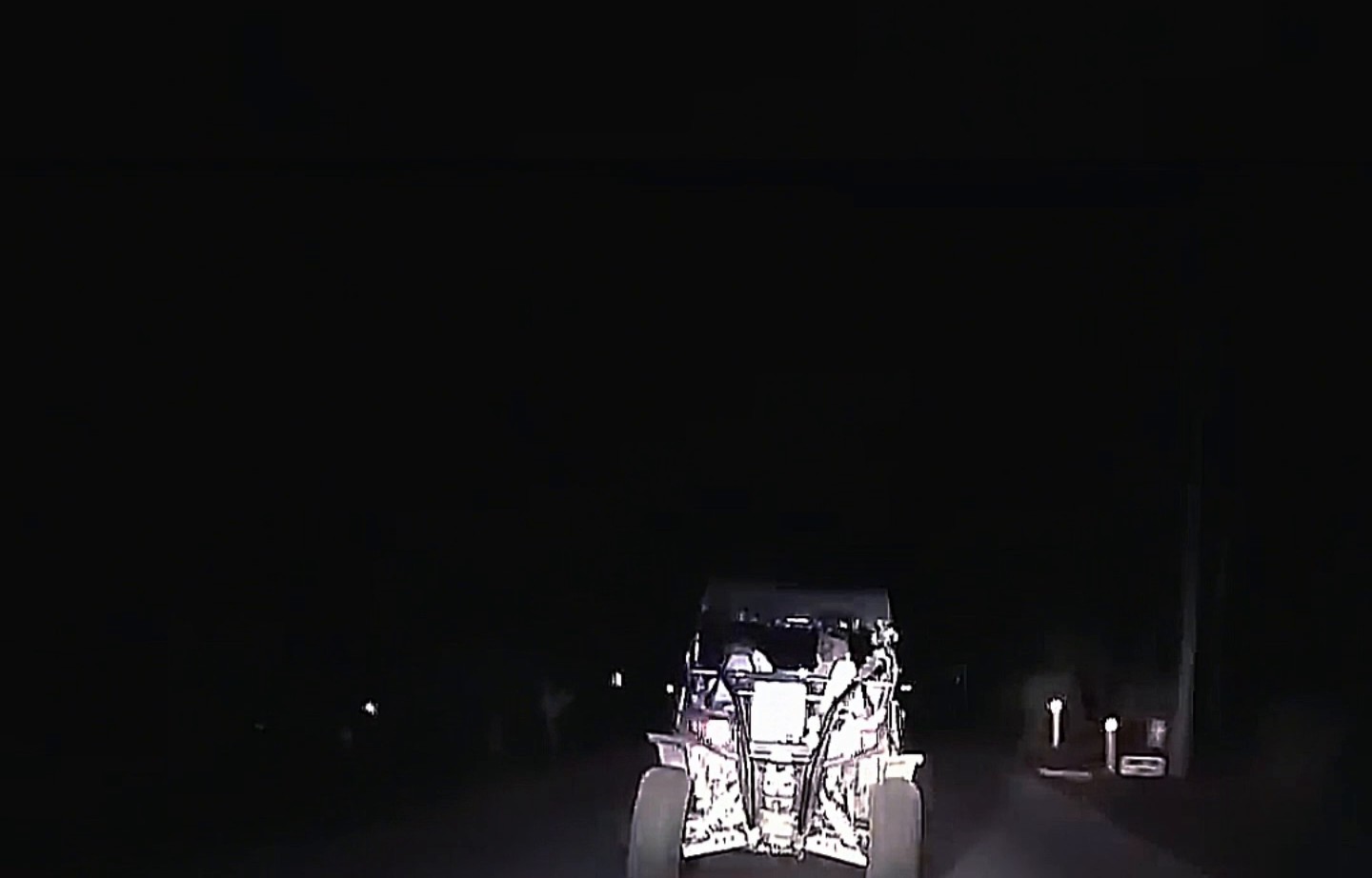
The video begins with the kind of scene that can look almost routine for only a few seconds: a dark road, the headlights of a patrol vehicle, and a side-by-side utility vehicle moving ahead in the beam. There are no crowded downtown streets or bright freeway signs to orient the viewer. Instead, the road is narrow, the surroundings are mostly black, and the UTV becomes the single point of focus. The patrol vehicle follows closely enough that the rear suspension, tires, and roll cage remain visible in the headlights.
What follows is not simply a nighttime chase. Public reporting and released investigative material identify the footage as part of the October 21, 2023 pursuit in Bay, Arkansas, involving then-Bay Police Officer Christopher Shull and Stephen Kyle McMasters. Arkansas State Police later released the dash-camera footage after its investigation. KAIT reported that Shull struck the side-by-side driven by McMasters and that the UTV ultimately crashed into a utility pole, killing McMasters.
The footage is unsettling because the danger develops through repetition. The police vehicle closes on the UTV, contact occurs, the side-by-side continues, and the pursuit resumes. The road remains dark and the margins remain small. Each time the patrol vehicle gains ground, the viewer can sense that another impact is possible.
NEA Report, which reviewed the released footage, reported that Shull collided with the utility vehicle three times without stopping it. The officer then lost distance, accelerated to catch up, and made contact a fourth time as the UTV's brake lights came on. According to that report, the dash camera showed the patrol vehicle traveling about 68 mph at the final impact. Shull then radioed dispatch that he had hit the vehicle and that it had wrecked.
The incident later became the subject of an Arkansas State Police investigation and a Craighead County grand-jury review. The grand jury did not return an indictment against Shull. That criminal charging decision did not end the broader dispute surrounding the pursuit. McMasters' family publicly challenged the officer's account and later litigation followed. A federal civil-rights case filed in December 2025 remained on the docket in 2026, with trial scheduling extending into 2028.
That later legal history matters, but the dashcam itself remains the emotional center of the story. It records a sequence in which a fleeing UTV and a police vehicle move through darkness at speed until the space between them disappears. The final outcome transforms every earlier second of the chase. Once the viewer knows someone died, the ordinary-looking moments before the crash take on a different weight.
Why the Pursuit Began
Contemporary reports describe the pursuit as beginning late on October 21, 2023, near Bay City Hall in Craighead County, Arkansas. Reporting based on investigative records says Shull encountered McMasters operating the side-by-side at night and attempted to stop him. The vehicle did not stop, and the encounter became a pursuit.
One detail became especially controversial afterward: the possibility that the UTV was stolen. KAIT reported that Shull told dispatch during the pursuit that he thought the vehicle might be stolen because it appeared new. McMasters' family strongly disputed the implication that there was a factual basis for treating the UTV as stolen. The disagreement illustrates an important distinction between what an officer suspects during a rapidly unfolding event and what investigators can establish afterward.
The video itself cannot settle that question. A dash camera records what is in front of the patrol vehicle; it does not record everything the officer knows, believes, hears over radio, or infers. That is why the surrounding dispatch records and investigative documents became so important after the crash.
What the footage does establish visually is that McMasters did not immediately stop once the patrol vehicle was behind him. The UTV continues along the roadway and, at different points, moves through areas where the road surface and surrounding terrain appear increasingly difficult to read in the darkness. The patrol vehicle remains in pursuit.
This is the first major turning point. A traffic stop, had the vehicle yielded, would have been a stationary encounter. Once the UTV continued, both vehicles entered a dynamic situation in which speed, visibility, road geometry, and distance changed constantly. The officer had to decide whether and how to continue. The driver of the UTV had repeated opportunities to stop. Every additional second created another chance for the situation to resolve, but also another opportunity for it to become more dangerous.
The footage therefore should not be reduced to a single impact. The fatal collision came at the end of a chain of decisions. Understanding that chain does not require assigning all responsibility to one person. It requires recognizing that pursuits develop through successive choices, and that the consequences of those choices can become irreversible long before anyone realizes exactly where the chase will end.
The Camera Shows the Gap Closing Again and Again
One of the clearest patterns in the video is the changing distance between the patrol vehicle and the UTV. At times the side-by-side pulls farther ahead, becoming a smaller silhouette in the headlights. Then the police vehicle accelerates and the UTV rapidly grows larger in the frame.
That visual expansion is more than a cinematic effect. It represents shrinking reaction time. When two vehicles are moving quickly in the same direction, a driver following closely has less time to respond to braking, swerving, road hazards, or sudden changes in speed. A side-by-side also behaves differently from a conventional passenger car. It is lighter, narrower, and designed around a different structure. Contact from a much heavier road vehicle can have consequences that are difficult to predict.
NEA Report's description of the released footage says there were several contacts before the final crash. The report states that the patrol vehicle struck the UTV three times while the UTV continued moving. The officer later regained ground and made another impact at higher speed.
That repeated-contact sequence is central to why the case drew scrutiny. It raises questions not only about the driver's decision to flee, but also about how police may use their vehicles during a pursuit. Was the contact an attempt to end the pursuit? Was it a collision caused by changing speed? Did the officer believe the UTV was intentionally braking in front of him? Different participants and attorneys later characterized aspects of the incident differently.
The dashcam is valuable precisely because it allows investigators, jurors, journalists, and the public to examine the movement rather than relying solely on memory. Yet video does not automatically answer every question of intent. A camera can show one vehicle approaching another. It can show brake lights and impact. Determining why a driver accelerated, braked, or steered in a particular way can require testimony and other evidence.
For viewers, however, the repeated closing of the gap creates unmistakable tension. The patrol vehicle is not simply maintaining a distant visual track. It is close enough for physical contact to become part of the encounter. Each time the UTV moves away, the chase appears to reset. Each time the police vehicle catches up, the possibility of another collision returns.
A Pursuit Through Darkness Changes the Margin for Error
Nighttime driving narrows the amount of information available to any driver. Headlights illuminate only part of the road. Curves, poles, ditches, driveways, animals, and other vehicles can appear with little warning. At pursuit speeds, that reduced visual horizon becomes more consequential.
The supplied video captures this limitation clearly. Outside the headlight beam, much of the environment disappears. The UTV is easy to see because it reflects the patrol vehicle's lights, but the road beyond it is often much harder to read. That means both drivers are operating in a corridor of partial visibility.
The UTV itself adds another layer. Side-by-sides are built for utility and off-road recreation, but their crash dynamics are not identical to those of full-size passenger vehicles. Their exposed structure and comparatively low mass can make contact with a large pickup or patrol vehicle especially significant.
Jonesboro Right Now reported that Shull was driving an unmarked black Ram 1500 police pickup. The same report, citing the dispatch log, said Shull reported pursuing the side-by-side and later reported that he had hit it and that it had wrecked. McMasters' family's attorney later emphasized the weight difference between the police truck and the UTV when criticizing the officer's actions.
The officer's attorneys presented a different interpretation. KAIT reported that Shull's attorney argued he had acted within policy and training and blamed McMasters' flight for the fatal outcome. The grand jury ultimately did not indict Shull. Those competing accounts are essential because the case is not accurately represented by presenting only one side of the controversy.
The road itself remains a silent participant in the footage. At night, a slight bend can hide an obstacle. A shoulder can turn into soft ground. A utility pole that is barely visible to the camera can become lethal when a vehicle leaves the roadway. The final crash demonstrates how quickly the environment can transform a pursuit from a moving confrontation into an irreversible emergency.
The Final Approach
The final phase is difficult to watch because the outcome is already known. The police vehicle again gains on the side-by-side. The UTV remains centered in the dashcam view, its rear structure illuminated by the patrol vehicle's headlights. The distance contracts.
According to NEA Report, the dashcam indicated a speed of approximately 68 mph at the final contact. The outlet reported that the UTV's brake lights illuminated and that Shull's vehicle struck it with greater force than during the earlier contacts. Afterward, Shull told dispatch that he had hit the vehicle and that it had wrecked.
KAIT reported that the UTV crashed into a utility pole and McMasters died. The station later obtained and published the Arkansas State Police investigative material after the criminal review had concluded.
It is important not to overstate what a single edited clip can prove about the precise mechanics of the collision. Video compression, darkness, perspective, and the relative movement of both vehicles can make distance and speed difficult to judge by eye. Investigators had access to material beyond the social-media edit, including original recordings and records.
Still, the visual sequence is stark. A pursuit that has continued through the night reaches the point where the vehicles are again almost on top of each other. Then the UTV is no longer traveling normally ahead of the patrol car. The chase has become a crash scene.
For a reader following the story from the beginning, this is the moment when the central question changes. Before impact, the question is whether the UTV will stop. After impact, the question is whether the driver will survive.
That shift happens in seconds. It is one reason pursuit cases can become so controversial. Decisions made while vehicles are moving may be judged later in a quiet courtroom, frame by frame, with time to measure distances and debate alternatives. The people inside the vehicles had none of that time. Their decisions unfolded at road speed.
The Immediate Aftermath
Once the UTV crashed, the nature of the police response changed instantly. A pursuit became a medical emergency and crash investigation. Dispatch records reported in local coverage indicate that Shull requested emergency medical assistance after the wreck.
Jonesboro Right Now reported that the call log recorded Shull saying McMasters was bleeding from the nose and mouth and asking for EMS. The same account said the coroner was notified shortly afterward. McMasters died at the scene.
Those few minutes are a reminder that the end of a pursuit is not necessarily the end of danger. Officers arriving at a crash must determine whether anyone can be rescued, secure the scene, manage traffic, preserve evidence, and begin documenting what happened. When an officer's own vehicle is involved in the fatal collision, the investigative stakes become even higher.
Arkansas State Police took responsibility for investigating the incident. The review included video and other records that would later become public after the criminal charging process ended. The existence of the recording allowed the sequence to be examined long after the road was cleared.
The human consequences, however, cannot be reduced to investigative files. McMasters' family lost a husband and father. Reporting from KAIT later quoted the family's attorney describing the family's grief and disputing the officer's characterization of the incident. The officer, meanwhile, faced an investigation, termination from the Bay Police Department, public scrutiny, and the possibility of criminal charges before the grand jury declined to indict him.
That is why the aftermath belongs in the story. Viral chase footage often ends when the moving vehicles stop. Real events continue for families, officers, investigators, lawyers, and communities for years.
The Arkansas State Police Investigation
Arkansas State Police investigated Shull's actions following McMasters' death. The investigation became the foundation for the later grand-jury process and the public release of records.
KAIT reported in June 2024 that ASP released the dashcam video and investigative records after the grand jury failed to find probable cause to indict Shull. The station said the prosecuting attorney's office considered the criminal case closed and that no further charges would be filed at that time.
The distinction between an investigation and a prosecution is important. Investigators collect evidence, interview witnesses, review recordings, and reconstruct events. Prosecutors then determine how that evidence fits criminal law and whether charges should be sought. A grand jury considers whether probable cause exists to indict. It does not conduct a civil trial and it does not resolve every factual dispute surrounding an incident.
The McMasters case demonstrates those distinctions particularly clearly because the grand-jury outcome was later described as divided. KAIT reported a statement from the family's attorney saying eight jurors voted that sufficient probable cause existed to indict Shull while eight did not. Under the applicable process, that split did not produce an indictment.
Shull's legal representatives characterized the outcome as vindication and maintained that the pursuit was lawful and justified. The family's attorney rejected that characterization and stressed that a grand jury does not decide civil liability or make a final determination on every disputed fact.
For readers, those competing statements can seem contradictory, but they refer to different legal questions. A decision not to indict means the criminal charging threshold was not met in that proceeding. It does not prevent a family from pursuing civil claims under a different legal standard.
The dashcam therefore occupies two worlds at once. It is public footage that people can watch and debate, and it is evidence embedded in legal processes with specific standards and consequences.
Why the Grand Jury Decision Did Not End the Dispute
In June 2024, local outlets reported that the grand jury did not charge Shull. KAIT said the Arkansas Department of Public Safety had received notice that the investigation was closed and no criminal charges would be filed.
The family's attorney responded publicly, emphasizing the divided vote and arguing that the result should not be described as complete vindication. The attorney also announced an intention to pursue civil litigation.
That distinction later became concrete. Federal court records show that Janie McMasters filed a civil-rights lawsuit against Christopher Shull and other unnamed defendants in the Eastern District of Arkansas on December 23, 2025. As of 2026, the docket showed the case moving through scheduling and discovery, with a jury trial reset for July 10, 2028.
The existence of that lawsuit does not establish liability. It means allegations are being litigated in a civil forum. Shull has appeared through counsel and filed an answer. The ultimate civil outcome remains for the court process to determine.
Including this update matters because the legal story did not freeze in June 2024. A reader encountering the dashcam in 2026 should not be left with the impression that every dispute surrounding the incident disappeared when the grand jury declined to indict.
The criminal and civil systems ask different questions and apply different standards. Criminal prosecution concerns whether the government can prove a charged offense beyond a reasonable doubt after the required charging process. Civil litigation can address constitutional or other claims under a different burden of proof and may seek monetary or other relief.
For the public, it can be tempting to treat any one legal milestone as the final verdict on an incident. This case shows why that can be misleading. The pursuit ended in 2023. The criminal investigation and grand-jury process continued into 2024. Civil litigation began in 2025 and remained active in 2026. The consequences of roughly a few minutes on a dark Arkansas road have therefore extended across years.
What the Video Can Prove and What It Cannot
Dashcam footage is powerful because it gives the viewer a direct perspective, but it should not be mistaken for complete knowledge. The camera points forward. It records a limited field of view. Its microphone captures only some sounds clearly. It does not show what a driver is thinking or what an officer believes unless those thoughts are expressed.
The footage can help establish vehicle positions, visible braking, approximate timing, the sequence of contacts, road conditions, and the moment the UTV leaves normal travel. Investigators can combine those images with vehicle data, measurements, radio logs, witness statements, photographs, and other evidence.
The footage alone cannot determine legal intent. It cannot tell us with certainty why McMasters continued to flee. It cannot independently establish whether Shull believed every contact was necessary or accidental. It cannot decide whether a particular use of the patrol vehicle met a legal standard. Those are questions requiring a broader evidentiary record.
This distinction is especially important online. Short edits often remove timestamps, radio traffic, pauses, or earlier portions of an encounter. The supplied video is formatted vertically and includes decorative graphics around the central dashcam image. For this article, the embedded photographs were cropped from the actual dashcam portion of the supplied footage so that the visuals show the real pursuit rather than the surrounding design elements.
The same caution applies to titles. A dramatic headline can attract attention, but it should not invent facts. The new title for this article identifies the event as a nighttime UTV pursuit ending in a fatal crash after police closed the gap. That description reflects the documented outcome without claiming a criminal conclusion that the grand jury did not reach.
Responsible storytelling is not less compelling. In a case like this, the verified facts are already powerful: a driver fled, a police officer pursued, the vehicles made contact multiple times according to reporting on the released footage, the final collision occurred at high speed, the UTV crashed, and a man died. Nothing needs to be exaggerated.
The Hard Question at the Center of Police Pursuits
Every police pursuit contains a tension between enforcement and risk. Officers have legitimate reasons to stop drivers who refuse lawful commands. Allowing every fleeing driver to escape could encourage dangerous behavior and make enforcement impossible. At the same time, a pursuit can increase the danger to the fleeing driver, officers, passengers, pedestrians, and uninvolved motorists.
That is why agencies use pursuit policies. Those policies can consider the seriousness of the suspected offense, traffic density, weather, road conditions, speed, the identity of the suspect, available backup, and whether officers can apprehend the person later without continuing the chase.
The McMasters incident adds another layer because the vehicle being pursued was a side-by-side. The size and construction of a UTV make vehicle-to-vehicle contact particularly consequential. A patrol pickup has substantially greater mass and a different crash structure. At highway speeds, the energy involved in contact can be enormous.
The family's attorney focused heavily on that disparity when criticizing Shull's actions. Shull's lawyers, by contrast, emphasized McMasters' continued flight and argued that the officer acted lawfully within his training. The grand jury's decision not to indict meant there would be no criminal trial resolving those competing narratives.
The dashcam leaves viewers to confront the practical question in real time: at what point does catching a fleeing driver create more danger than allowing the pursuit to continue differently or disengaging? There is no universal answer that can be applied without context.
A driver also bears responsibility for the decision to flee. Stopping removes the moving hazard and gives officers and the driver a chance to resolve the encounter without a chase. Continuing to flee forces new decisions and can expose everyone nearby to risk.
But recognizing the driver's role does not eliminate scrutiny of police tactics. Law-enforcement officers are given special authority and training precisely because their decisions can involve force. Pursuit reviews therefore examine not only what the fleeing driver did, but also how officers responded.
The video is compelling because those two truths coexist. McMasters continued to drive away. Shull continued to pursue and repeatedly closed the gap. The final collision ended both the chase and McMasters' life. Any serious account has to hold the entire sequence in view.
Why This Footage Still Matters Years Later
The incident occurred in October 2023, but the public release of the footage in 2024 and subsequent legal developments have kept it relevant. Video changes the lifespan of a police encounter. Before widespread in-car and body-worn cameras, many disputes depended heavily on written reports and witness testimony. Now a recording can be replayed frame by frame years later.
That transparency can benefit everyone when used carefully. It can confirm parts of an officer's account, reveal details that witnesses missed, expose misconduct when it occurs, or show why a split-second decision was made. But it can also encourage false certainty when viewers assume the camera captured everything.
The McMasters footage is a strong example. The central movements are visible. The UTV is ahead. The patrol vehicle catches it. Contacts occur. The chase continues. The final crash follows. Yet the legal meaning of those movements has been contested by the officer's attorneys and McMasters' family.
The continued federal litigation shows that the footage remains part of an unresolved civil story. Court proceedings may bring additional evidence, expert analysis, testimony, or settlements that change what the public knows. Until that process concludes, it is appropriate to describe allegations and defenses as such.
For publishers, the lesson is equally important. A police video should be treated as a source, not as an entire investigation. Matching the footage to reliable reporting, identifying where claims originate, and avoiding unsupported details creates a stronger article.
For viewers, the lesson may be simpler: the few seconds that look most dramatic rarely contain the whole story. The chase on screen lasted minutes. The consequences have lasted years.
From a Night Ride to a Case Still Moving Through Court
The original clip title describes a night ride turning into a police hunt. The verified story is more consequential. A late-night encounter in a small Arkansas city became a pursuit. The officer's vehicle repeatedly closed on a side-by-side. The vehicles made contact. The final collision was followed by a crash into a utility pole. Stephen Kyle McMasters died.
Then the second phase began. Arkansas State Police investigated. Bay Police fired Christopher Shull. A grand jury considered whether criminal charges should be brought and did not indict him. The officer's attorneys said his actions were justified. McMasters' family disputed that conclusion and criticized the tactics used during the chase.
The third phase is now civil. A federal lawsuit filed by McMasters' family remains part of the public record. Its existence means the legal consequences of the incident are not fully settled, even though the criminal charging process ended without an indictment.
That long timeline changes how the dashcam should be watched. It is not merely a clip of one vehicle chasing another. It is the visual record of the event at the center of years of investigation, argument, grief, and litigation.
The footage also demonstrates how quickly a situation can move beyond anyone's ability to reverse it. Before the crash, there are repeated opportunities for the pursuit to end differently. After the crash, those possibilities vanish.
For that reason, the strongest ending is not a sensational claim about who won or lost. Nobody wins a pursuit that ends with a death. The meaningful conclusion is that the video preserves a chain of decisions whose consequences continue long after the headlights disappear from the road.
Continue With the Full Incident
The excerpt above captures the pursuit and the pressure building between the patrol vehicle and the UTV, but the complete case includes the crash aftermath, investigative response, and later legal developments. Use the continuation button below to send readers to your full video, extended footage, or next page.
Replace the placeholder URL with your destination before publishing. The button is deliberately separated from the article so readers can immediately see where to continue after reaching the end of the story.
WATCH THE COMPLETE INCIDENT
Paste your continuation link into the button below before publishing.
Click through to follow the complete sequence and see how this nighttime pursuit reached its final, consequential moments.
The Record Beyond the Viral Clip
The public record surrounding this pursuit is unusually valuable because several stages of the case have been documented independently. KAIT reported the original death and the officer's termination, then later reported the grand-jury outcome and the release of Arkansas State Police records. NEA Report reviewed the released dashcam and described the repeated vehicle contacts. Jonesboro Right Now reported details from the dispatch log. Federal court records now document the later civil action.
Looking across those sources prevents one dramatic clip from carrying more evidentiary weight than it should. News reports can also contain differences in wording or emphasis, so the most reliable approach is to identify which source supports each disputed point. The fact of McMasters' death following the pursuit is well established. The fact that Shull was not criminally indicted is also established. The characterization of the officer's tactics remains contested, and the civil litigation is still a live process rather than a final judgment.
The grand-jury result deserves particular care. A no-indictment outcome is not the same thing as a jury verdict after a criminal trial. It means the charging process did not produce an indictment. KAIT's coverage of the family's attorney described an evenly divided vote and stressed the attorney's view that the result should not be treated as a finding on civil liability. Shull's counsel publicly presented the outcome much more favorably to the officer. Both positions are part of the documented aftermath.
The federal docket adds a current dimension. Janie McMasters filed suit in December 2025. The docket shows appearances by counsel, an answer from Shull, scheduling activity, and a trial date set well into 2028. Those procedural entries do not prove the plaintiff's allegations or the defendant's defenses. They show that a court has an active case in which those issues can be litigated.
For readers arriving through social media, this timeline may be the most important context the article can provide. A two-minute video feels immediate, but the legal and personal consequences do not fit inside two minutes. The crash happened in 2023. Records became public in 2024. Litigation began in 2025. Court scheduling continued in 2026. What appears online as a brief pursuit is, for the people involved, a story spanning years.
There is also a broader lesson about edited footage. The supplied file contains the real dashcam in the center of a vertical composition with a headline and an illustrated racing-car graphic. Those additions are presentation devices, not evidence. The HTML article therefore uses only crops of the actual dashcam area for its thumbnail and five embedded images. No AI-generated scene, unrelated police photograph, or decorative illustration is presented as part of the event.
That visual discipline is especially important in fatal cases. An unrelated crash photograph can accidentally imply damage that did not occur. A stock photograph of an officer can imply that a person pictured was involved. AI imagery can fabricate road conditions, vehicle positions, uniforms, or injuries. Real frames may be grainy, dark, and imperfect, but they preserve the limits of what the camera actually recorded.
The same principle governs the wording of this article. Where the video shows something directly, the text says so. Where a news organization attributes a statement to police, an attorney, or a family representative, the text preserves that attribution. Where the current civil case has not reached judgment, the article does not predict the result. This is not merely cautious writing; it is what allows a dramatic police video to be turned into a credible long-form account.
Ultimately, the record is powerful without embellishment. A side-by-side traveled through Bay late at night. A police officer pursued it. The patrol vehicle and UTV came into contact repeatedly according to reporting on the released video. The final sequence ended at a utility pole. McMasters died. Shull was investigated and fired, but was not indicted. The family continued to challenge his actions and later filed a federal lawsuit. Each of those developments is significant on its own. Together they explain why this short, dark dashcam recording continues to attract attention.
Comments (0)
Loading comments...
May You Like

MERIDEN POLICE OFFICER SHOOTS MAN BEATING FATHER WITH A BASEBALL BAT

A Suspicious Vehicle Leads Officers Into an Unexpected Chase

Woman Tries to Stop Police From Arresting “Brother” — He Denies Knowing Her












