
Man Tries to Talk His Way Out After Officers Confront Him Over Shoplifting
Man Tries to Talk His Way Out After Officers Confront Him Over Shoplifting
A Retail Theft Investigation Is Already Underway
The encounter begins inside a Walgreens, where officers are already focused on a man they believe has been involved in shoplifting. The supplied body-camera footage is dated September 9, 2025 and shows multiple officers inside the store. Halloween merchandise and ordinary pharmacy aisles provide the backdrop to what quickly becomes a formal detention.
The man is kept near a shopping cart while officers speak with him and begin checking what he has on his person. The video makes one point clear very early: this is not a random street stop. Police are dealing with a specific retail-theft complaint inside the store where the alleged conduct occurred.
What cannot be established confidently from currently available public reporting is the man's identity, the exact city, or the final court disposition. Searches using the title, date, store type and visible details produced several unrelated shoplifting cases, but none could be matched strongly enough to this footage. For that reason, this article does not attach a name, department, charge list or case outcome that cannot be verified.
That limitation does not prevent the footage from telling a detailed story. The body cameras show the officers' interaction, the man's explanations, the physical evidence being examined and the gradual shift from questioning to arrest processing.

The Man Immediately Tries to Control the Conversation
Instead of giving short answers and waiting for officers to finish their investigation, the man repeatedly tries to explain what happened. His approach is conversational and persistent. He appears to believe that if he can provide the right explanation, the situation may still be reframed as a misunderstanding.
This is the behavior captured by the original title's use of the word “manipulate.” That word is an interpretation, however, not a legal finding. A more precise description is that he repeatedly attempts to persuade officers to accept his version of events after they have detained him in connection with suspected shoplifting.
Officers do not simply argue back. They continue the practical work of the investigation: controlling the scene, keeping the man in place and examining items associated with him. That difference in priorities becomes increasingly obvious as the encounter continues.
For a detained person, talking can feel like the only remaining source of control. For officers, however, an explanation is only one piece of evidence. Store employees, surveillance footage, recovered merchandise, receipts and the location of items can all matter more than a persuasive story.
The Search Happens in the Middle of the Store
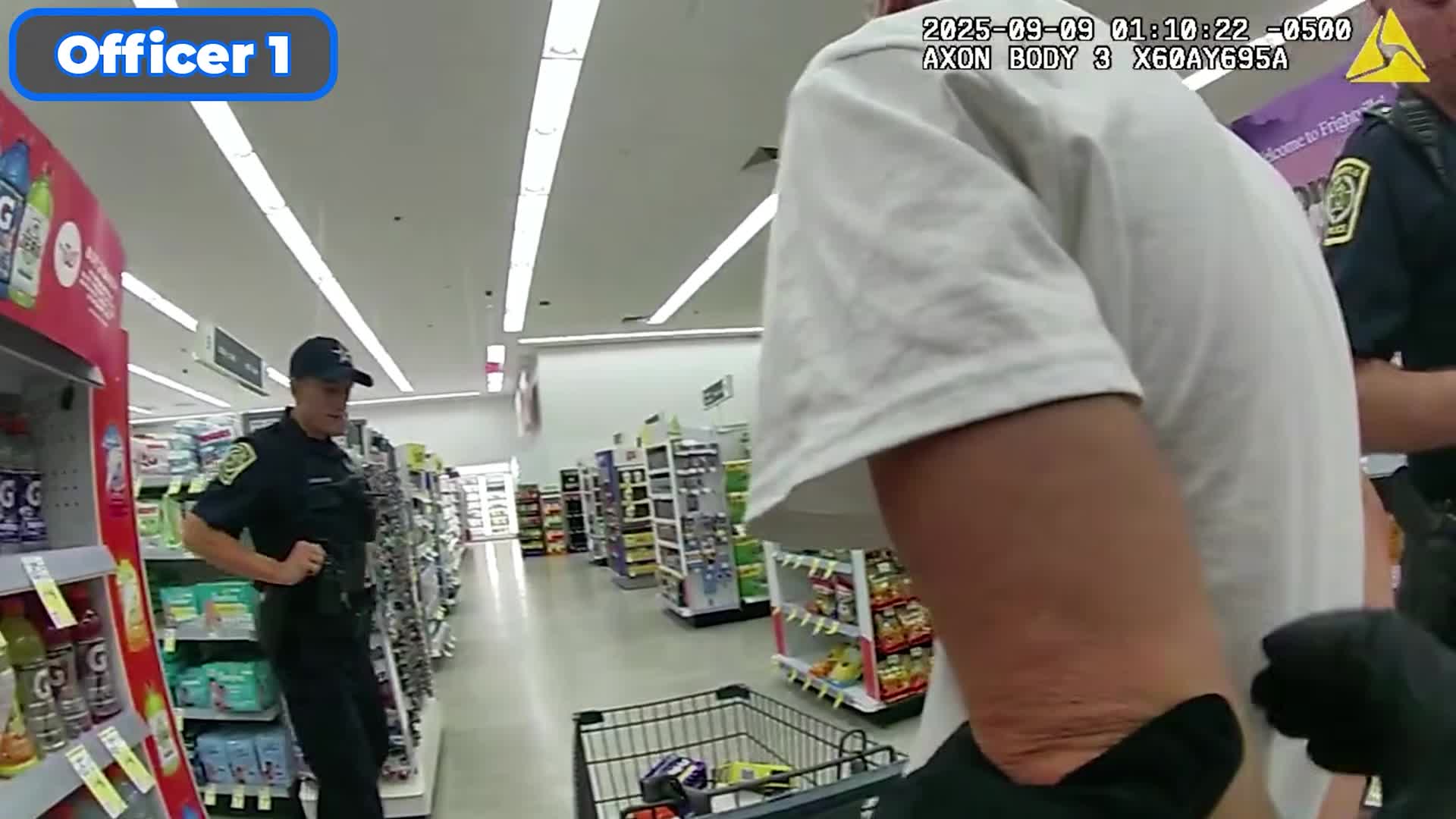
One of the clearest sequences in the video shows two officers searching the man's clothing while he stands with his hands behind his head. The setting is unusually public. Customers, shelves and store displays remain only a few feet away while officers check pockets and clothing.
A shopping cart sits directly in front of the group. The officers appear methodical rather than rushed. One maintains control while another checks the man's waistband and pockets. The man continues speaking throughout much of the process.
The body camera also demonstrates why retail-theft investigations often depend on more than a single officer's observation. Store loss-prevention personnel may have watched a person move through several aisles before police arrive. Surveillance can document concealment or movement past points of sale, while officers arriving afterward may only see the final detention.
Because the supplied edit does not include every piece of store surveillance or a complete police report, this article does not claim exactly which item established probable cause. It describes what is visible: officers clearly treat the incident as an active shoplifting investigation and proceed with a detention and search.

Explanations Do Not Stop the Evidence Check
As the encounter progresses, the man's strategy remains largely verbal. He tries to clarify ownership, explain circumstances and influence how officers understand what they are seeing. Yet the officers keep returning to concrete questions about the merchandise and the reported theft.
This creates the central tension of the footage. The man is attempting to make the incident about his explanation. The officers are attempting to make it about verifiable evidence.
In a shoplifting investigation, that distinction matters. A person may claim an item was already theirs, that they intended to pay, that another person was responsible, or that a store employee misunderstood what happened. Police do not have to resolve every disputed fact on the sales floor before taking enforcement action if the evidence available to them establishes the required legal basis.
At the same time, an arrest is not a conviction. The ultimate legal question belongs to the criminal process, where reports, surveillance, witness testimony and any defense can be evaluated more fully. The body-camera footage captures the police response, not a complete trial record.
The Officers Remain Focused on Procedure
Another notable feature of the footage is how little the officers appear to be moved by attempts to redirect the conversation. They continue asking direct questions and completing the steps of the detention.
This is common in encounters where a suspect offers long explanations. Officers may listen, but they also have to preserve evidence and document the incident. If store staff say merchandise was concealed or taken past the final point of sale, the officer must compare that allegation with what can actually be recovered and verified.
The man's demeanor shifts during the encounter, but the police response remains relatively structured. Multiple officers are present, reducing the need for one officer to simultaneously search, question, watch the man's hands and communicate with store personnel.
That division of tasks also helps explain why the footage switches perspectives. One body camera may capture the search clearly while another records conversation or the surrounding store. Together, the angles provide a more complete picture than a single fixed camera would.
Being Caught in the Store Changes the Dynamic
The original title emphasizes being “caught red-handed.” The video certainly places the confrontation inside the Walgreens, but that phrase should not be stretched into a claim about evidence that is not fully shown. What can be said is that officers are already on scene, the man is detained inside the retail location, and the investigation centers on merchandise allegedly taken from the store.
That setting gives officers immediate access to potential witnesses and store records. Employees can identify merchandise, check inventory or receipts and direct police to surveillance footage. Unlike a theft reported hours later, the relevant people and property may still be in one location.
For the detained man, this makes a purely verbal explanation harder to separate from the surrounding evidence. If officers can compare his statements with store video or recovered products, inconsistencies can be checked almost immediately.
The footage repeatedly returns to this contrast: he talks, while officers verify. That is a more factual way to describe the encounter than assuming every statement he makes is intentionally deceptive.
Why Officers Do Not Have to Debate Every Claim on Scene
Police encounters sometimes become circular when a detained person believes officers must accept an explanation before proceeding. In practice, officers are not judges conducting a trial on the sales floor. Their immediate role is to determine whether the available facts justify detention, citation or arrest and then document the evidence.
A suspect can dispute the allegation. That dispute can be written into a report, raised by an attorney or presented in court. But disagreement does not automatically require officers to end an otherwise supported investigation.
This distinction is particularly relevant in retail cases because shoplifting often involves intent. Someone may argue that they forgot to pay or planned to return to the register. Investigators therefore look at behavior as a whole: concealment, movement through the store, passing checkout points, removal of packaging and other facts that may show intent.
The supplied video does not give enough verified information to state which of those factors were present before officers made contact. It does show that the man's explanations do not cause the officers to abandon the case.
The Body Camera Preserves More Than the Arrest
One reason footage like this attracts viewers is that it records the negotiation that happens before a final enforcement decision. A written arrest summary might reduce the incident to a few sentences: police responded to a theft complaint, detained a man and took him into custody.
The camera shows something more human and complicated. The man tries different ways of presenting himself and the situation. Officers repeatedly bring the discussion back to the investigation. The interaction becomes a contest between narrative and evidence rather than a dramatic physical confrontation.
That makes the video useful even without a spectacular chase or use of force. It illustrates a common part of police work: sorting through competing claims while the person under investigation is standing only a few feet away and actively trying to influence the interpretation of events.
It also demonstrates why full footage matters. A short clip of one unusual statement can make a person appear irrational or dishonest without showing the questions that preceded it. A longer sequence allows viewers to judge how the explanation develops and how officers respond.
What Can and Cannot Be Verified From This Footage
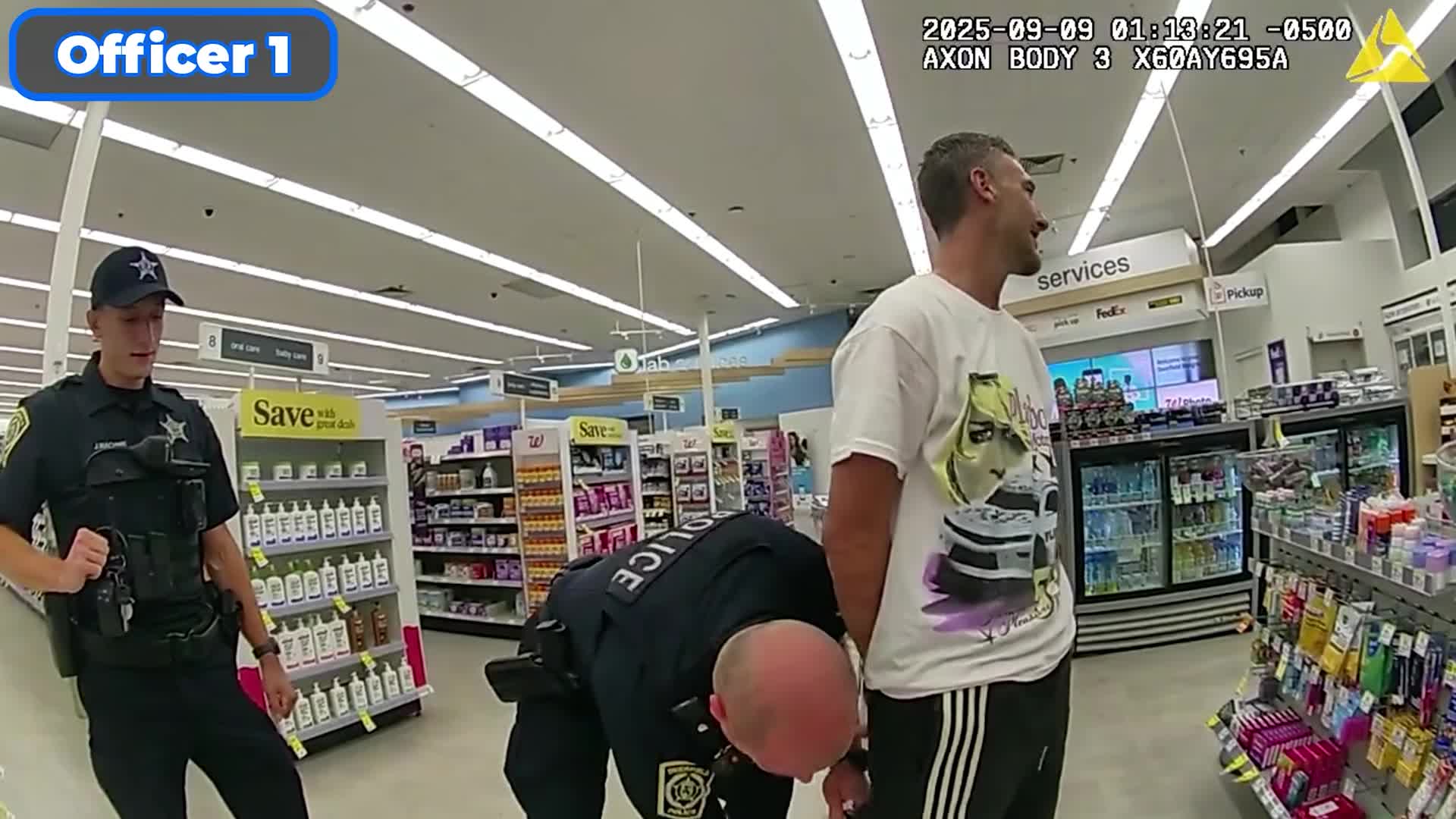
Several details are directly observable. The encounter takes place in a Walgreens. Multiple uniformed officers are present. The body-camera overlay shows September 9, 2025. The man is detained, searched and questioned in connection with suspected shoplifting. The officers maintain control of the scene while investigating merchandise and his account.
Other details remain unverified. The body-camera identifier alone does not establish the department for a public article. No reliable source found during research could be matched to the footage using the full combination of date, store, appearance and sequence. A similarly dated retail-theft report from another jurisdiction is not enough.
For that reason, no identity has been assigned to the man and no exact dollar amount has been invented. The article also does not claim a conviction, sentence, prior record or final charge when those facts cannot be tied confidently to this specific incident.
This approach may be less sensational, but it protects the central rule of incident research: a near match is not the same as the correct case.
A Simple Shoplifting Call Becomes a Test of Competing Stories
The footage does not need an invented backstory to be compelling. Officers arrive with a retail-theft allegation to investigate. The man quickly begins offering explanations and continues trying to shape how they view the situation. The officers respond by checking the facts available to them rather than allowing the conversation alone to decide the outcome.
That pattern continues throughout the video. Questions lead to more explanations. Searches lead to more discussion. The man appears to hope that continued talking can change the direction of the encounter, while officers become increasingly committed to processing the case based on evidence.
The title “Man Tries to Manipulate Officers After Caught Red-Handed Shoplifting” captures the creator's interpretation, but a careful account should avoid treating manipulation as a proven fact. What viewers can actually observe is a man trying repeatedly to persuade police after being detained in a store-theft investigation.
The distinction matters because good body-camera reporting separates behavior from motive. We can describe what a person says and does. We should be cautious about claiming to know exactly why he does it unless he states his motive or reliable evidence establishes it.
In the end, the most revealing part of the encounter is not a dramatic physical struggle. It is the repeated failure of conversation to override the officers' evidence-based process. The man keeps trying to explain his way out of the situation, but the investigation continues around him.
Comments (0)
Loading comments...
May You Like

911 Call Leads Police to a Disturbing Family Situation

Female Driver Destroys Three Lives in a Matter of Minutes

West Virginia Man Laughs at Police Officer and Ends Up Arrested













