Man Throws Part of His Sandwich at an Officer and Instantly Regrets It
Man Throws Part of His Sandwich at an Officer and Instantly Regrets It
Verified incident: The footage matches the May 9, 2023 Port Orange, Florida arrest of William Busi, 69. Police said Busi threw a piece of lunch meat from his sandwich and struck an officer in the chest after being issued a trespass warning. He was arrested for battery on a law-enforcement officer. A reliable final court disposition for that case was not located, so no conviction or sentence is claimed.
A Routine Trespass Call Takes an Unusual Turn
On May 9, 2023, a Port Orange Police officer was sent to a smoke shop after an employee reported a customer who had been disrupting the business. The call did not begin as an arrest. According to the arrest affidavit later described by local and national news outlets, the employee wanted 69-year-old William Busi formally trespassed from the store.
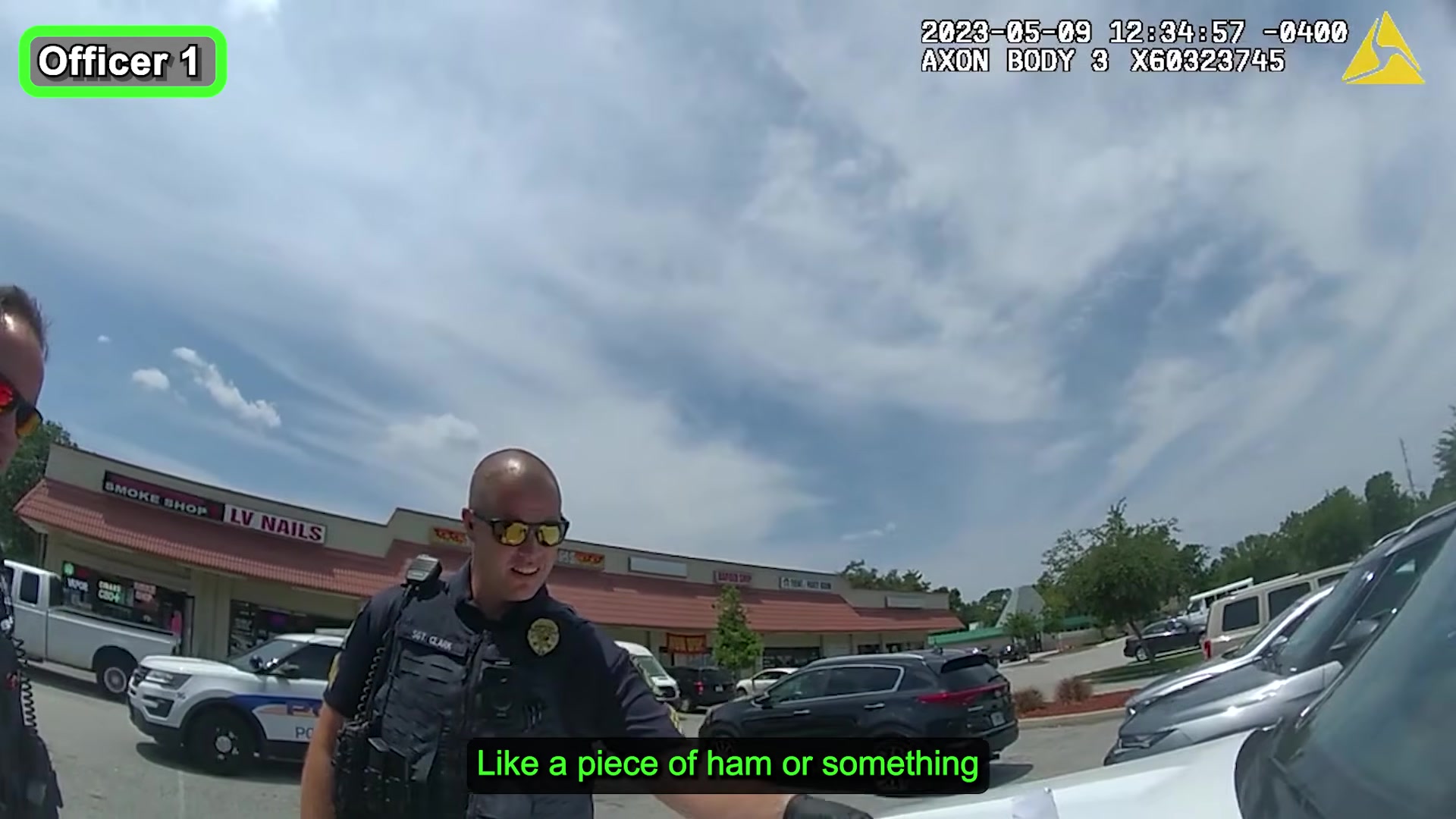
The supplied footage matches that incident precisely. The AXON Body 3 overlay shows May 9, 2023, shortly after noon. The officer enters the business, speaks with an employee, and then goes back outside to contact Busi, who is sitting near the storefront with food. A marked Port Orange Police vehicle is visible later in the recording.
The original title says Busi throws a sandwich at a cop and instantly regrets it. More precisely, police and contemporary reporting say he threw a piece of lunch meat from his sandwich, striking the officer in the chest. That small distinction matters because the body-camera video became viral largely because of how bizarre the object was, while the legal issue was not the nutritional content of what was thrown. The officer treated the intentional contact as battery on a law-enforcement officer.
What makes the video memorable is how unnecessary the escalation appears. The officer initially tells Busi that he has been trespassed from the business and cannot return. Busi could simply leave. Instead, the conversation expands into lawsuits, money, martial-arts claims, threats and finally the piece of lunch meat that turns the encounter into an arrest.
The Store Employee Explains Why Police Were Called
Before confronting Busi, the officer speaks with the smoke-shop employee. Contemporary reports based on the arrest affidavit say she told police Busi had repeatedly bothered customers, made vulgar comments, touched merchandise and attempted to go behind the counter. She said his behavior made her uncomfortable and wanted him formally barred from returning.
A trespass warning is often straightforward. A business open to the public can generally withdraw permission for a person to remain on the property. Police may be called to communicate that decision and document the warning. If the person leaves and stays away, the encounter can end without an arrest.
That is the position Busi is in when the officer walks outside. The officer is not shown immediately putting him in handcuffs. Instead, the body camera records a lengthy conversation.
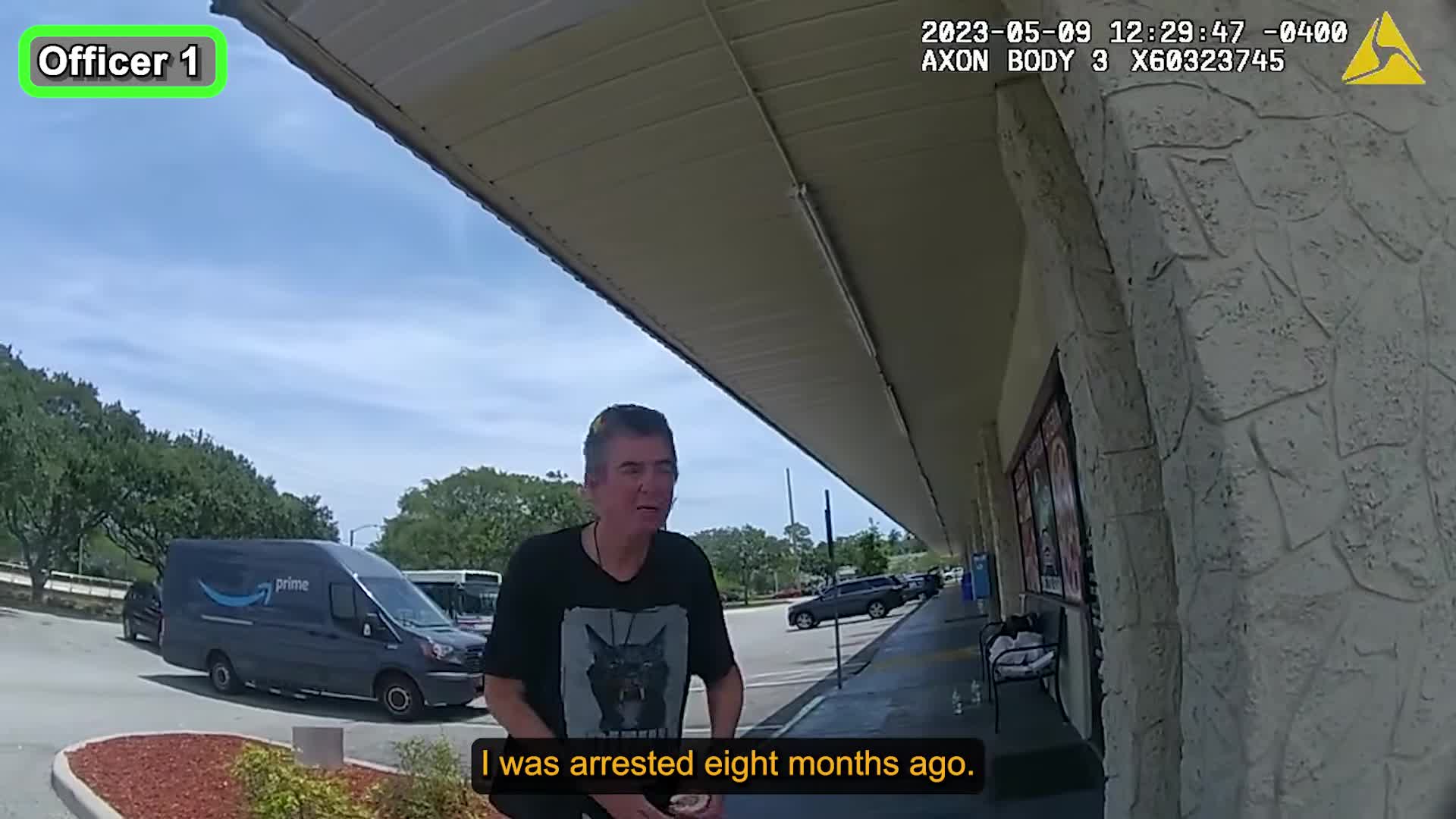
Busi initially talks about an earlier arrest and says he intends to sue law enforcement. He asks the officer questions about hypothetical lawsuit money and whether it would be taxable. The officer repeatedly indicates that he cannot answer those questions. The conversation is unusual but, at this stage, largely verbal.
The officer then returns to the reason he was called: the employee does not want Busi inside the store. He explains that Busi is trespassed and must not return. That should have been the practical end of the police contact.
Busi Turns a Simple Warning Into an Argument
Busi does not accept the warning quietly. He claims the business has merchandise belonging to him and insists the officer go back inside and speak to the employee. His language becomes increasingly hostile.
The footage is a useful example of the difference between disagreeing with police and creating a new legal problem. Busi is free to dispute the employee's account, complain about the business and pursue whatever civil remedies he believes are available. None of that requires him to threaten the officer or make physical contact.
The officer remains comparatively calm while Busi's intensity increases. Rather than matching the insults, he repeatedly tries to keep the interaction focused on the trespass warning.
This contrast is part of why the footage spread so widely. Busi appears to expect a dramatic reaction to his threats and claims. The officer often responds with short, flat answers. That leaves Busi doing most of the escalating himself.
The body camera also preserves a detail that became widely quoted after the video was released: Busi says he had been arrested months earlier and had spent a substantial period incarcerated. Whatever he intended to communicate with that history, it does not persuade the officer to abandon the trespass warning.
Claims of Karate and Judo Raise the Temperature
The confrontation becomes more serious when Busi begins talking about fighting.
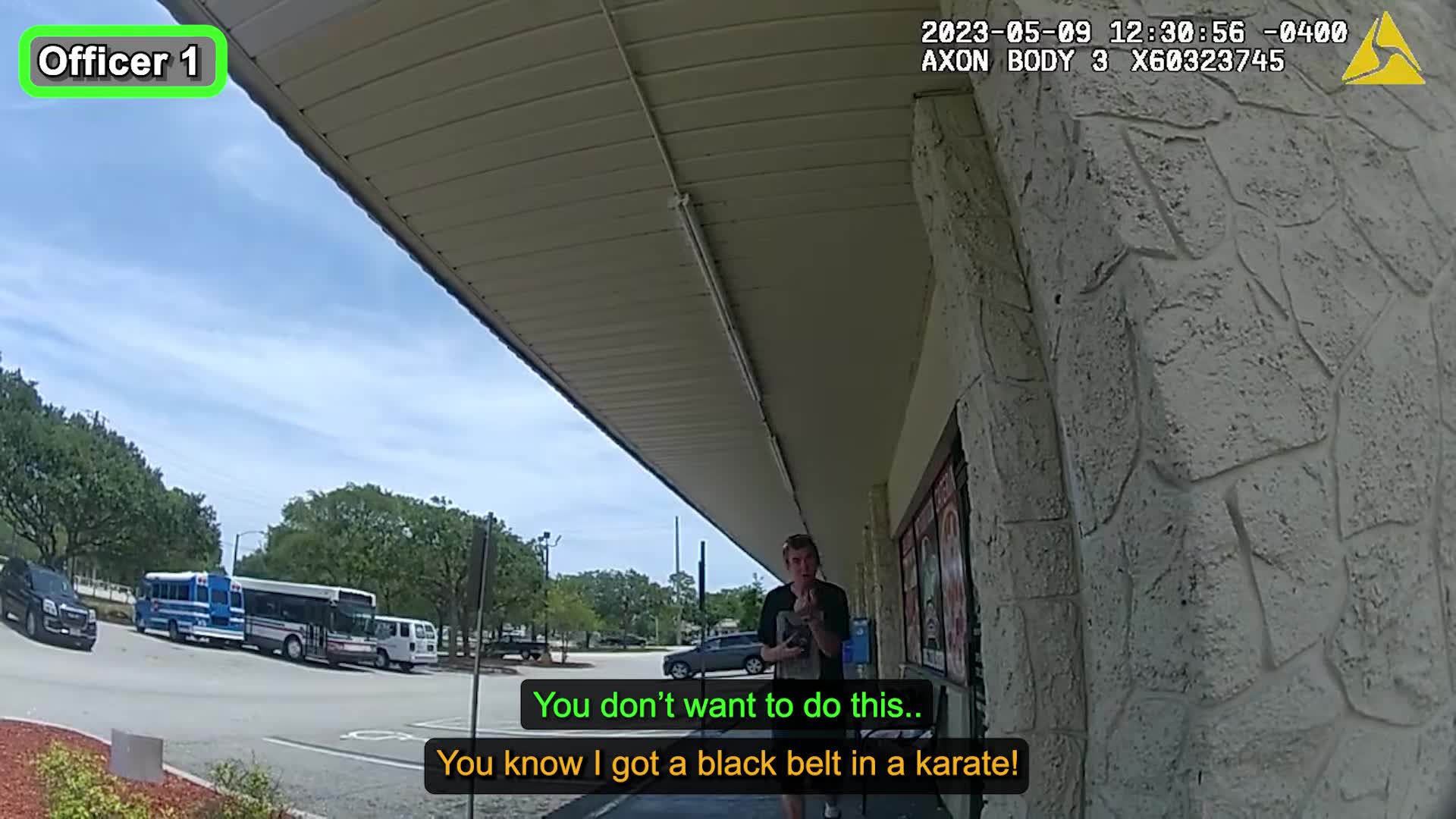
According to the arrest affidavit and the video, he claims to have black belts in karate and judo. He takes a fighting posture and challenges the officer. At one point he attempts a kicking motion while continuing to talk about what he could do.
An officer does not have to treat every boast as proof that someone can actually fight. But threats and aggressive body language matter when assessing risk. Busi is standing only a short distance away, has already become angry and is now describing his ability to hurt the officer.
The officer still does not immediately tackle him. He maintains distance and continues talking. That restraint is significant because it shows the later arrest is not simply a response to rude language.
Busi also makes statements about taking the officer's gun and radio and driving away in the police vehicle, according to reporting on the footage. Even if those comments were bluster, they add to the officer-safety concerns surrounding an encounter that began with nothing more than a request to issue a trespass warning.
The Piece of Lunch Meat Changes the Encounter
The turning point is almost absurdly small.
Busi reaches toward the food near him, takes a piece of deli meat and throws it at the officer. Police said it strikes the officer on the left side of his chest.
The object itself is soft and unlikely to produce the kind of injury associated with a punch, bottle or weapon. But Florida battery law focuses on intentional unwanted touching or striking, and Florida law provides enhanced treatment when the alleged victim is a law-enforcement officer engaged in lawful duties.
The officer immediately changes from conversation to arrest. He tells Busi to put his hands behind his back and moves in to control him.
This is the instant-regret moment suggested by the original title. Busi has spent several minutes arguing that the officer is creating problems for him. Then he commits an act directly in front of the body camera that gives the officer a new and much clearer reason to take him into custody.
The footage is almost a textbook demonstration of how a person can transform a noncustodial police contact into an arrest through one unnecessary decision.
The Arrest Is Not as Easy as the Throw
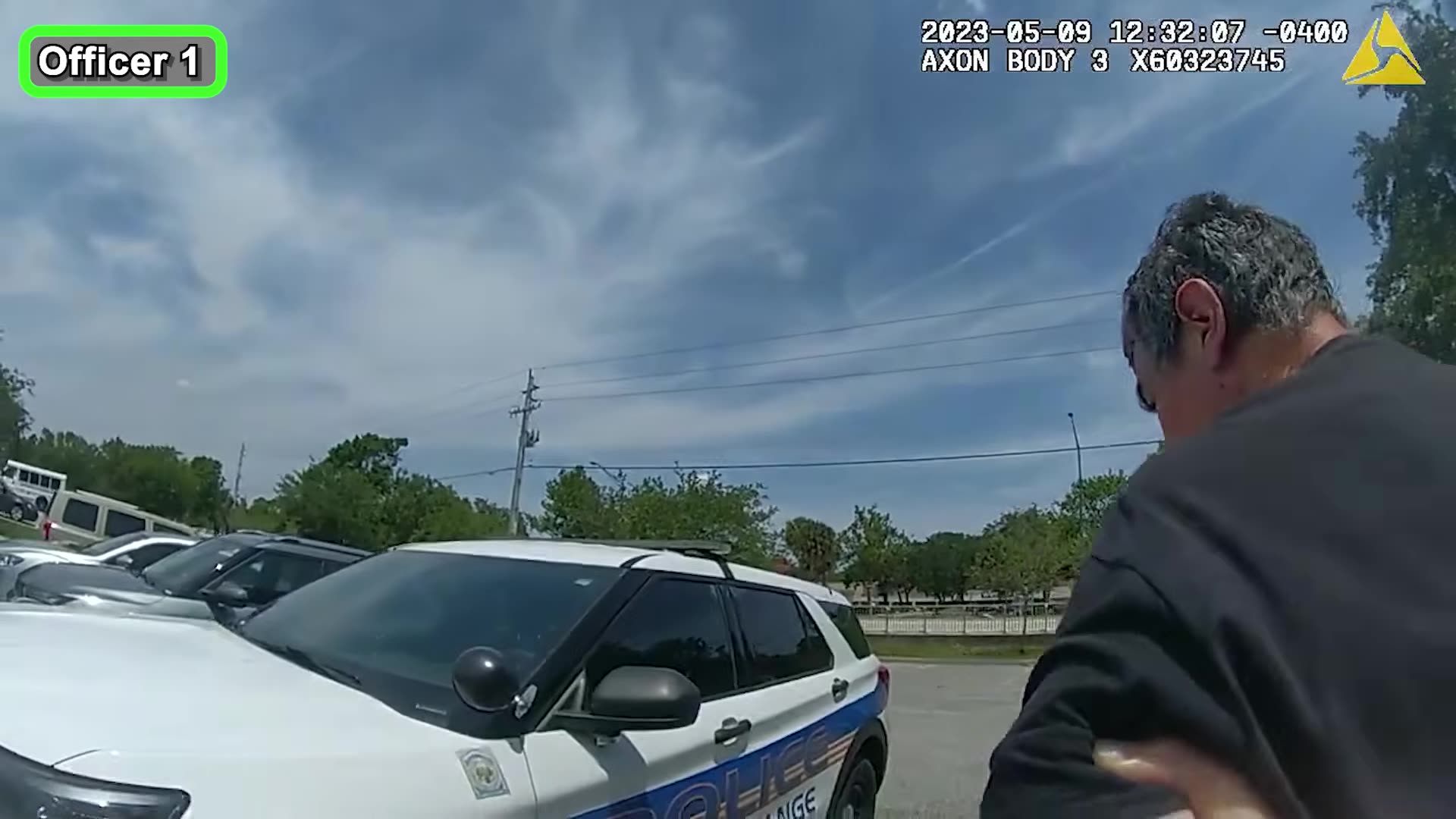
Once the officer attempts to handcuff Busi, the scene becomes physical.
The arrest affidavit says Busi grabs onto a bench and makes it more difficult for the officer to secure his hands. The body camera moves rapidly as the officer works to gain control. Unlike the earlier conversation, the view becomes tight and unstable because the camera is attached to the officer involved in the struggle.
Busi continues talking throughout the arrest. He complains about the officer's actions even though the physical confrontation follows directly after the lunch-meat throw.
At one point, according to the affidavit and widely published video, Busi says the officer is lucky he does not have his pocketknife. He makes an additional threatening statement about what could have happened if he had the knife.
That remark is particularly damaging to any claim that the officer had no reason to treat the encounter cautiously. The officer had already heard claims about martial arts and taking police equipment. Now, during the arrest, Busi is invoking a knife.
The officer ultimately gets him under control without the encounter becoming a more serious use-of-force event.
Why a Piece of Food Can Still Support a Battery Charge
The bizarre nature of the object caused many viewers to treat the case as a joke, but the legal principle is relatively ordinary.
Florida Statute 784.03 defines battery to include actually and intentionally touching or striking another person against that person's will. When the alleged victim is a law-enforcement officer engaged in the lawful performance of duties, Florida Statute 784.07 can reclassify the offense and increase the potential penalty.
That does not mean every accidental contact with an officer is a felony. Intent and circumstances matter. Nor does the seriousness of a criminal charge depend entirely on whether the object used could cause major injury.
In Busi's case, contemporary reporting states that the arresting officer alleged Busi deliberately threw the lunch meat and struck him in the chest after the argument had escalated.
The body camera gives prosecutors unusually direct evidence of the contact because the incident happens in front of the officer's own camera. There is little need to reconstruct whether something was thrown. The more conventional legal questions would concern intent, the officer's lawful duty and the precise charging decision made after arrest.
The Viral Video Is Funnier Than the Legal Consequences
The Port Orange Police Department recognized the unusual nature of the incident when it shared the footage publicly. Its social-media description offered what it called a crash course in behavior unlikely to work out well in Port Orange, including disrupting businesses, threatening workers, threatening officers, claiming imaginary martial-arts credentials and hitting an officer with lunch meat.
That humorous presentation helped the video spread. News organizations across Florida and nationally picked up the story.
But the humor should not obscure how close the confrontation came to becoming more dangerous. Busi talked about fighting, taking police equipment and later referenced a pocketknife. The officer had no way to know whether those statements were empty boasts.
A thrown slice of meat sounds harmless in isolation. In context, it is the final act in a sequence of increasingly aggressive behavior.
The officer's measured demeanor is therefore an important part of the footage. He allows Busi to talk for several minutes, keeps distance and repeatedly gives him an opportunity to simply leave. The arrest occurs only after Busi crosses from speech into intentional physical contact.
The Footage Confirms the Incident Better Than the Viral Retellings
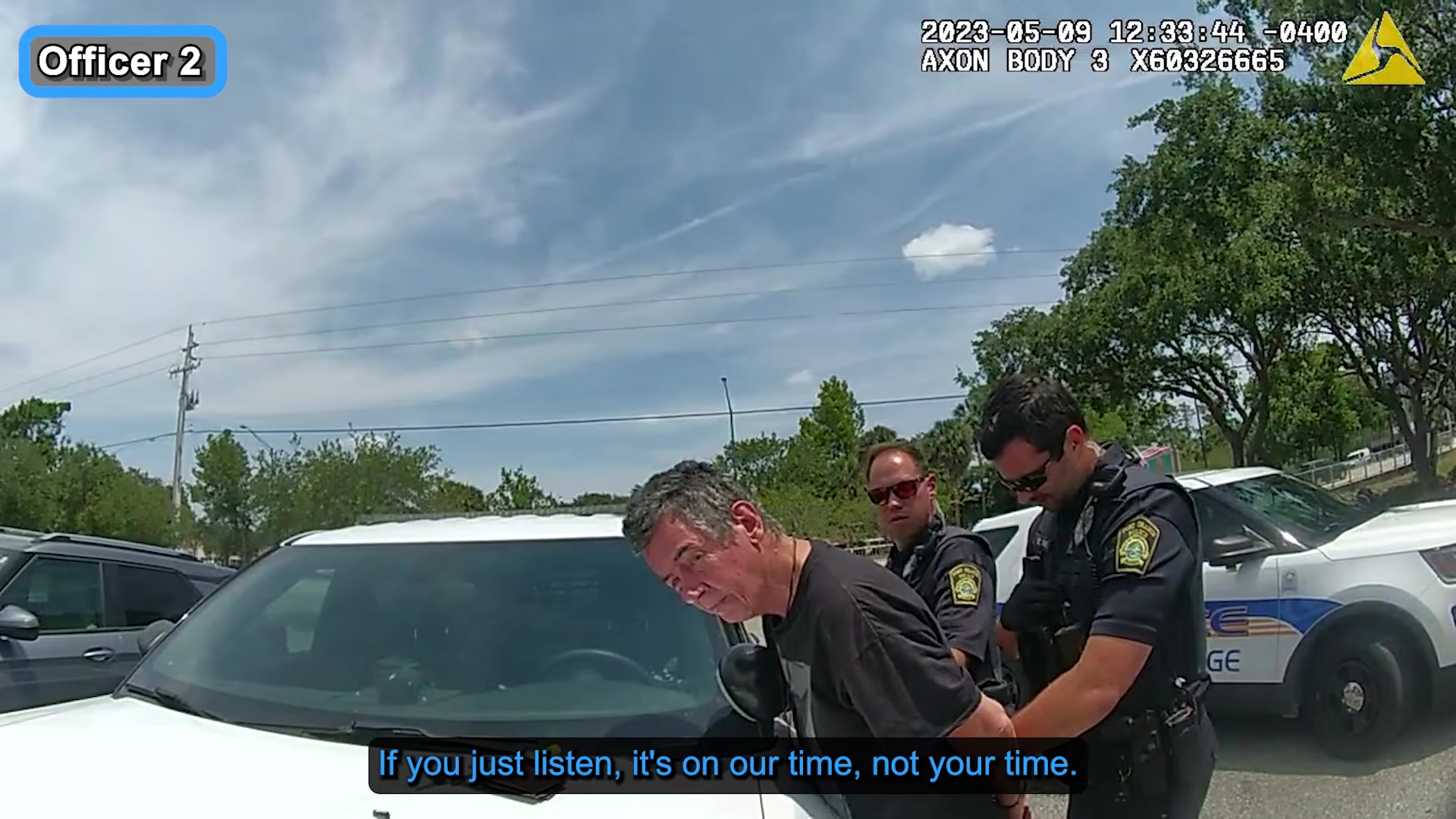
The supplied file provides several strong identifiers. The AXON overlay reads May 9, 2023. The setting matches the Port Orange commercial property shown in news coverage. The man's clothing and appearance match published images of William Busi. The dialogue about lawsuits, previous incarceration, martial arts and the trespass warning also matches the arrest-affidavit descriptions.
Those details make this a much stronger identification than a title-only match.
Contemporary reporting identifies the business as Puff N' Stuff in Port Orange, Florida. Busi was 69 at the time. The officer had been called around noon after the employee complained about Busi's behavior.
After the lunch-meat strike and arrest, Busi was taken to the Volusia County Jail. Published reports identify the booking charge as battery on a law-enforcement officer.
A public arrest index also associates William A. Busi with a May 9, 2023 Volusia County booking under Florida Statute 784.07(2)(b), with case reference 2023 302248 CFDB. That corroborates the charge reported by contemporary news outlets.
However, I did not locate a sufficiently authoritative online court docket showing the final disposition of that 2023 case. The article therefore does not invent a plea, conviction, probation term or sentence.
What Happened After May 2023
Public arrest indexes indicate that a William Busi matching the Port Orange man had later contacts with the Volusia County criminal-justice system, including arrests in 2024 and 2025. Those later records are not necessary to understand the sandwich incident and should not be used to imply a conviction in the May 2023 case.
This distinction is important because arrest histories are easy to misuse. A later arrest does not prove an earlier charge, and a booking record is not the same as a court judgment.
For the May 9 encounter, the strongest verified outcome is the immediate one: Busi was arrested and booked on a battery-on-a-law-enforcement-officer allegation after the deli meat struck the officer.
Without the final docket, that is where the legal narrative should stop.
The body-camera story itself has a complete arc even without a sentencing record. Police arrive to deliver a trespass warning. Busi argues. The officer gives him repeated opportunities to disengage. Busi escalates verbally, challenges the officer physically, throws food and is arrested moments later.
A Trespass Warning That Never Needed to Become an Arrest
The most striking aspect of the case is how avoidable the outcome appears.
The employee wanted Busi out of the store. The officer communicates that decision. Had Busi left and stayed away, there is no indication in the footage that the officer was planning to arrest him simply for the earlier argument with the clerk.
Instead, Busi continues engaging. He turns the discussion toward lawsuits, challenges the officer, boasts about martial arts and threatens to take police equipment. Even then, the officer continues talking rather than immediately making an arrest.
Only after the intentional throw does the interaction cross into a straightforward physical allegation.
This sequence makes the video useful beyond its comic value. It illustrates how de-escalation requires participation from more than one side. An officer can remain calm and create opportunities for a person to leave, but the person can still make a decision that closes those options.
Why the Officer's Calm Response Matters
Police encounters involving angry people can escalate through reciprocal emotion. A person shouts, the officer shouts louder, and each new exchange increases the likelihood of physical confrontation.
That pattern is largely absent here. The officer repeatedly answers Busi without matching his intensity. When Busi talks about lawsuits, the officer does not debate him. When he claims martial-arts expertise, the officer does not try to prove who is tougher.
This is practical de-escalation. The officer does not have to agree with Busi or tolerate physical contact. He simply avoids adding unnecessary emotion while there is still an opportunity for Busi to walk away.
Once the lunch meat hits him, the officer's objective changes. He moves to arrest and physically control Busi. De-escalation does not require an officer to continue negotiating indefinitely after probable cause for an arrest develops.
The contrast between the calm conversation and rapid arrest is what gives the video its pacing. Busi appears to believe the officer's patience means he can keep escalating. The moment he throws the food, that assumption collapses.
What the Video Actually Shows
It is tempting to exaggerate a viral Florida story, but this one does not need embellishment.
The footage shows a Port Orange officer responding to a smoke-shop complaint on May 9, 2023. The employee wants William Busi trespassed. The officer informs him that he cannot return. Busi argues, makes threats, claims martial-arts expertise and throws a piece of lunch meat that hits the officer in the chest. The officer then arrests him.
Reliable reporting confirms Busi was 69 and was booked into the Volusia County Jail on a battery-on-a-law-enforcement-officer charge.
What the available sources do not clearly establish is the final court disposition. This article therefore does not say Busi was convicted of that charge or assign him a sentence that has not been verified.
That boundary between arrest and conviction matters even in a case whose central act is recorded on video. The camera can establish what viewers see. The court record determines the final legal outcome.
The Sandwich Was Never Really the Point
The lunch meat is why the incident became famous, but it is not why the encounter matters.
The real story is the progression from a simple business complaint to an arrest. Each stage gives Busi an opportunity to stop escalating. He can accept the trespass warning. He can stop threatening the officer. He can leave the food on the bench. Instead, he keeps pushing the encounter forward.
By the time he throws the slice, the officer has already heard enough aggressive language to take the act seriously. The arrest follows almost immediately.
For viewers, the absurdity makes the lesson memorable. Something as trivial as part of a sandwich can become evidence in a felony-level allegation when it is intentionally thrown at an officer performing official duties.
The body camera also prevents the story from depending on competing memories. The employee's complaint, the officer's warning, Busi's statements and the throw itself are preserved in sequence.
That is why the full footage is more revealing than the headline. “He throws a sandwich at a cop” sounds like a one-line Florida joke. Watching the entire interaction shows the long chain of choices that leads to that moment.
Comments (0)
Loading comments...
May You Like

Entitled Driver Skips the Line and Gets Instant Karma3

911 Call Leads Police to a Disturbing Family Situation