
Man Sprays Officer With Flammable Liquid Before Wild Police Confrontation
MAN ATTACKS OFFICERS WITH FLAMMABLE LIQUID AFTER POLICE RESPOND TO CIRCLE K FIRE CALL
It was shortly before 5 a.m. when an officer arrived at a brightly lit Circle K convenience store.
From the outside, there was little to suggest how dangerous the next few minutes could become. The parking lot was nearly empty. The store was illuminated against the darkness, and the officer appeared to be responding to another late-night call at a gas station.
But dispatch had provided disturbing information.
A man was reportedly trying to set things on fire inside the store.
Even more concerning, police had been advised that something similar had allegedly happened the previous night, when the same individual was reported to have set trash on fire inside a bathroom. According to the description accompanying a copy of the footage, there had apparently been no 911 call concerning that earlier incident.
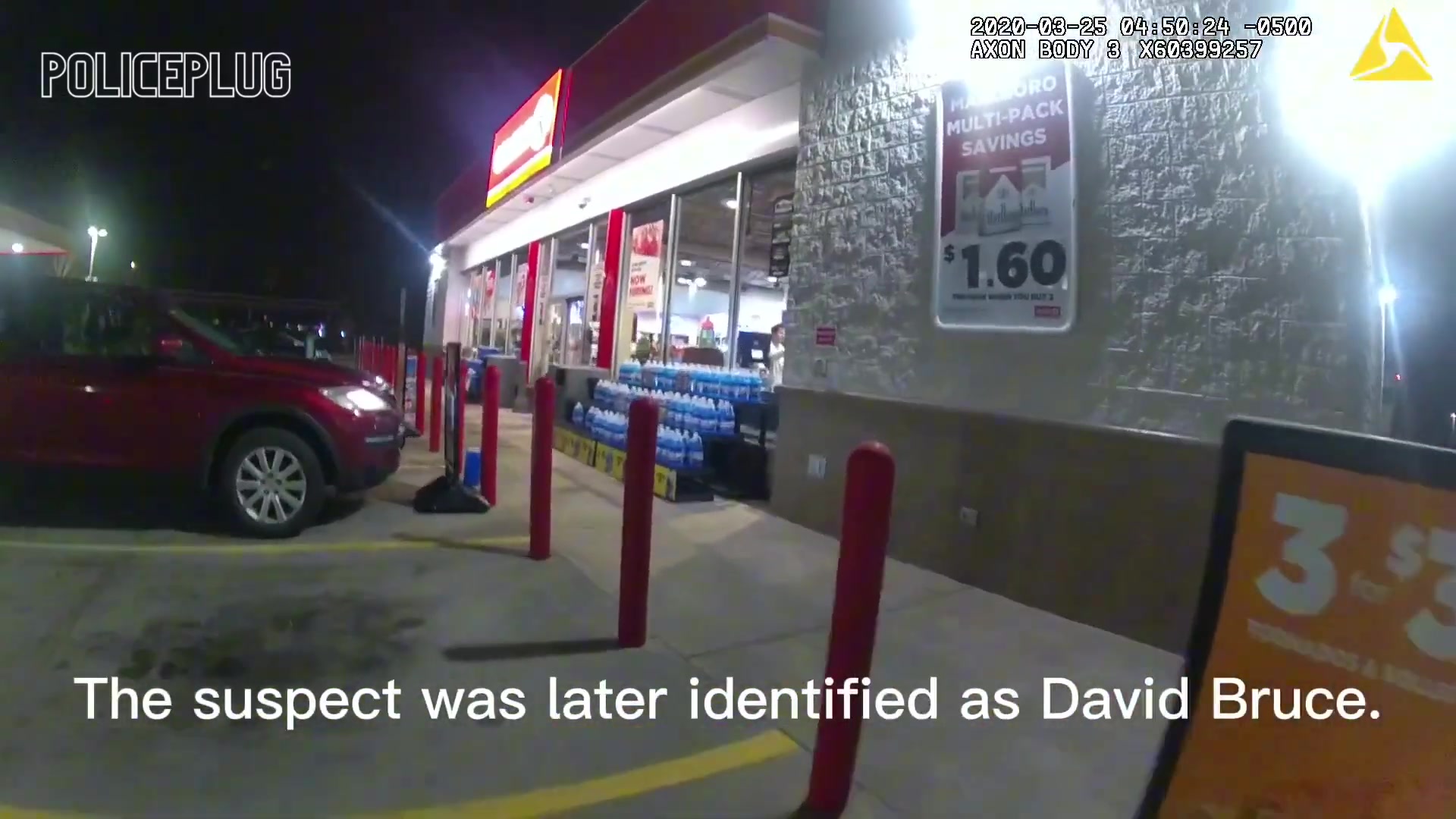
The man police encountered was later identified as David Bruce.
What followed was anything but an ordinary disturbance call.
Within minutes, the officer would encounter smoke inside the store, attempt to control an increasingly unpredictable situation, pursue Bruce outside and face an entirely different threat when liquid was thrown toward officers.
THE BODYCAM SHOWS HOW QUICKLY A CALL ABOUT A SMALL FIRE CAN DEVELOP INTO A DANGEROUS POLICE ENCOUNTER.
A QUIET GAS STATION HIDES A VERY DIFFERENT SCENE INSIDE
The bodycam timestamp places the officer outside the Circle K at approximately 4:50 a.m. on March 25, 2020.
The contrast is striking.
Outside, the convenience store appears normal. The lights are on, merchandise is visible through the windows and a vehicle is parked near the entrance.
Inside, however, officers are dealing with something potentially far more serious.
The information available with the footage says police had been dispatched after receiving a report of a male subject attempting to ignite objects inside the business.
A fire inside a convenience store presents an obvious danger beyond the flames themselves.
Smoke can quickly reduce visibility. Customers and employees may be trapped or disoriented. Nearby merchandise can accelerate a fire. And because the location is a gas station, officers arriving at the scene have additional reasons to treat any deliberate fire-setting behavior seriously.
The officer therefore enters an environment in which the threat is difficult to predict.
This is one reason the beginning of the footage matters.
If viewers saw only the physical confrontation later in the video, they would miss the information officers had when they first arrived.
THE CALL WAS ALREADY ABOUT FIRE BEFORE THE CONFRONTATION BECAME PHYSICAL.
That context shapes everything that follows.
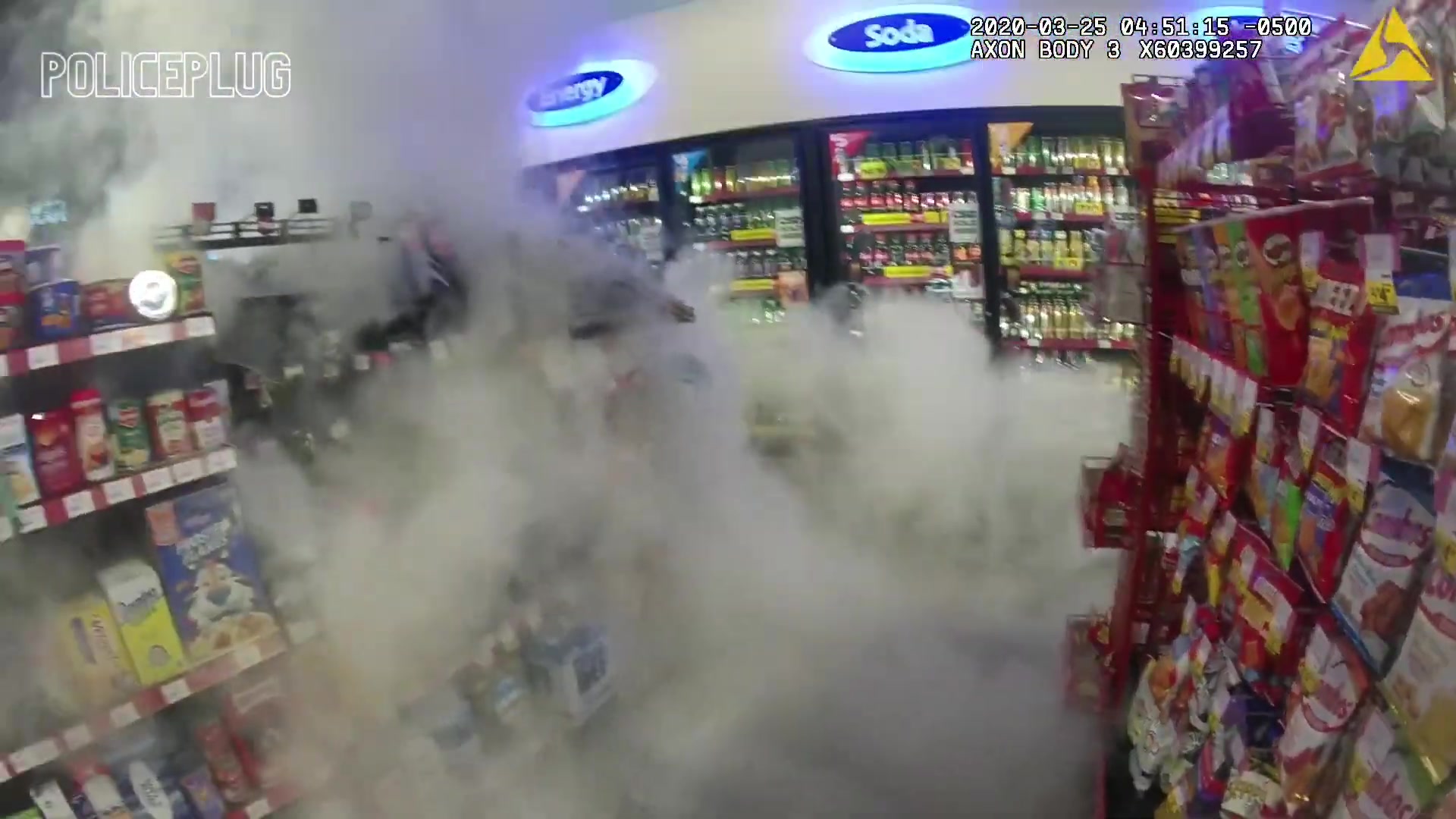
SMOKE QUICKLY FILLS THE STORE
Once inside, the scene becomes dramatically different.
Smoke begins spreading through the store, obscuring aisles and reducing visibility.
The brightly lit shelves and refrigerated cases remain visible through the haze, creating one of the most striking images in the footage.
For the officer, the situation now involves several problems simultaneously.
There is the suspected source of the fire.
There is the person allegedly responsible.
There is the store employee.
There is the possibility of the fire spreading.
And there is the challenge of dealing with all of this inside a confined commercial space where visibility is rapidly deteriorating.
Bodycam footage is particularly effective in scenes like this because the camera does not provide the calm, wide perspective of a security camera mounted in a corner.
Instead, viewers experience the scene from roughly the officer's position.
When the officer turns, the camera turns.
When smoke blocks the officer's view, it blocks the viewer's view.
When the officer moves quickly, the footage becomes unstable.
That makes the confusion of the scene much easier to understand.
The encounter isn't taking place in an open parking lot with every person's movements visible.
It is happening inside a smoke-filled convenience store.
THE OFFICER IS TRYING TO CONTROL A PERSON WHILE ALSO DEALING WITH AN ACTIVE FIRE HAZARD.
THE ENCOUNTER MOVES OUTSIDE
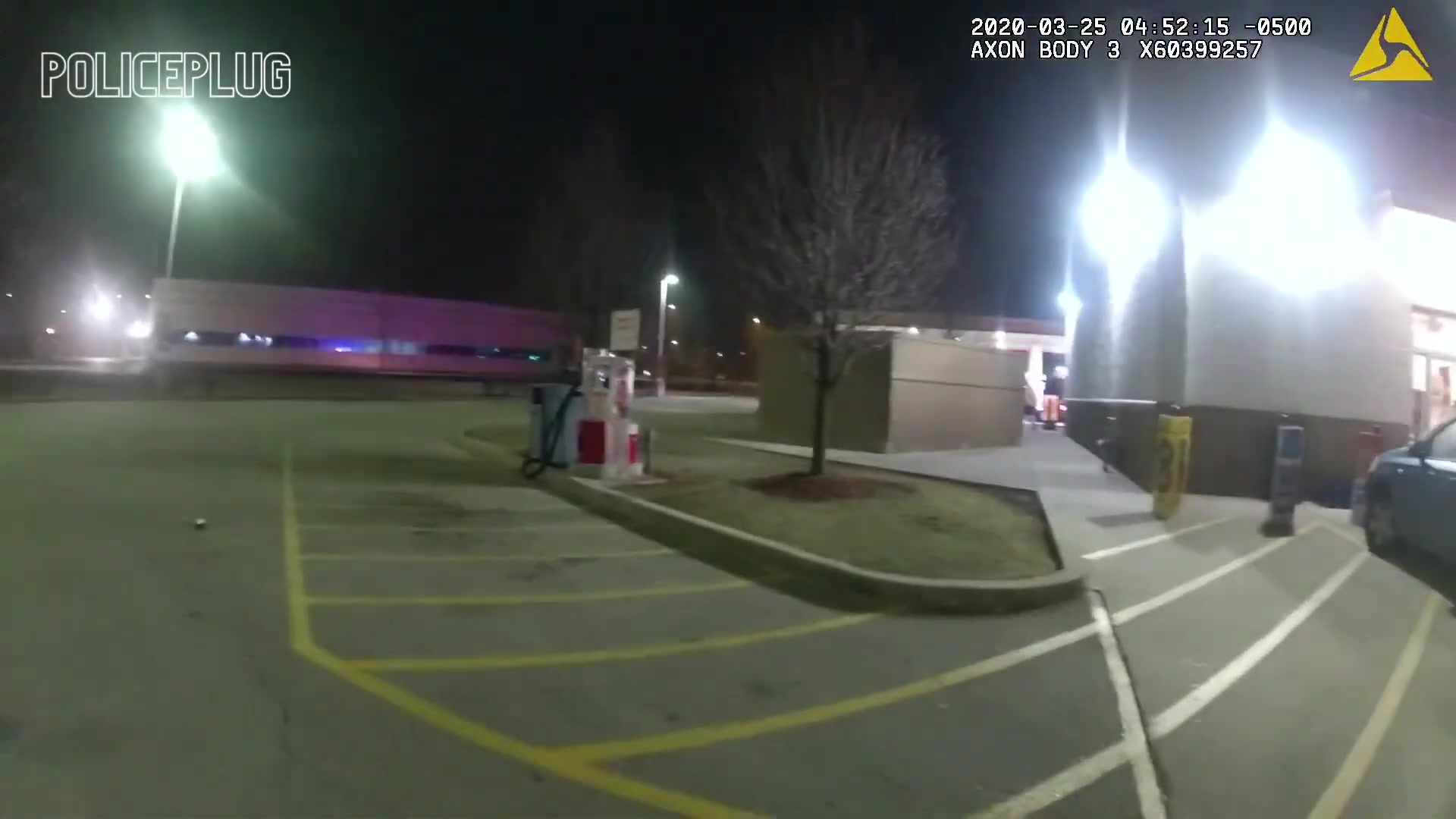
As the incident develops, the confrontation moves from the store into the parking lot and surrounding area.
That transition changes the situation again.
Outside, officers have more space and better visibility.
But the suspect also has more room to move.
The footage shows police attempting to maintain control while additional officers respond.
What began as an investigation into reported fire-setting behavior has now become a rapidly evolving police encounter.
The timestamp visible in the footage shows only a few minutes separating the officer's initial arrival from the more serious confrontation.
That is one of the most important elements of the video.
THERE IS VERY LITTLE TIME FOR OFFICERS TO ADAPT.
At one moment, the officer is approaching a convenience store.
Minutes later, smoke has filled part of the building.
Then the incident moves outside.
Then another threat emerges.
This rapid sequence illustrates why bodycam videos often look chaotic when watched without context. Officers may be switching between entirely different problems in seconds.
A fire call becomes a suspect-control problem.
The suspect-control problem becomes a pursuit.
The pursuit becomes a confrontation.
And then the nature of the threat changes again.
THE LIQUID CHANGES EVERYTHING
The most unusual and dangerous moment comes when Bruce is seen with liquid during the confrontation.
The video is commonly circulated under the title “Man Attacks Officers with Flammable Liquid.” The accompanying description identifies Bruce as the suspect and describes the original dispatch as a fire-related call.
Given that context, officers have an obvious reason to treat an unknown liquid as a potentially serious threat.
This is especially true after responding to a reported intentional fire.
A liquid thrown onto another person can create several risks.
If it is flammable, ignition becomes a possibility.
If its chemical composition is unknown, it can potentially cause irritation or injury.
And even if officers cannot immediately identify exactly what the liquid is, they have to make decisions based on the information available to them at that moment.
The bodycam captures the resulting confusion.
Commands are given.
Officers reposition.
The suspect continues moving.
And police attempt to gain control.
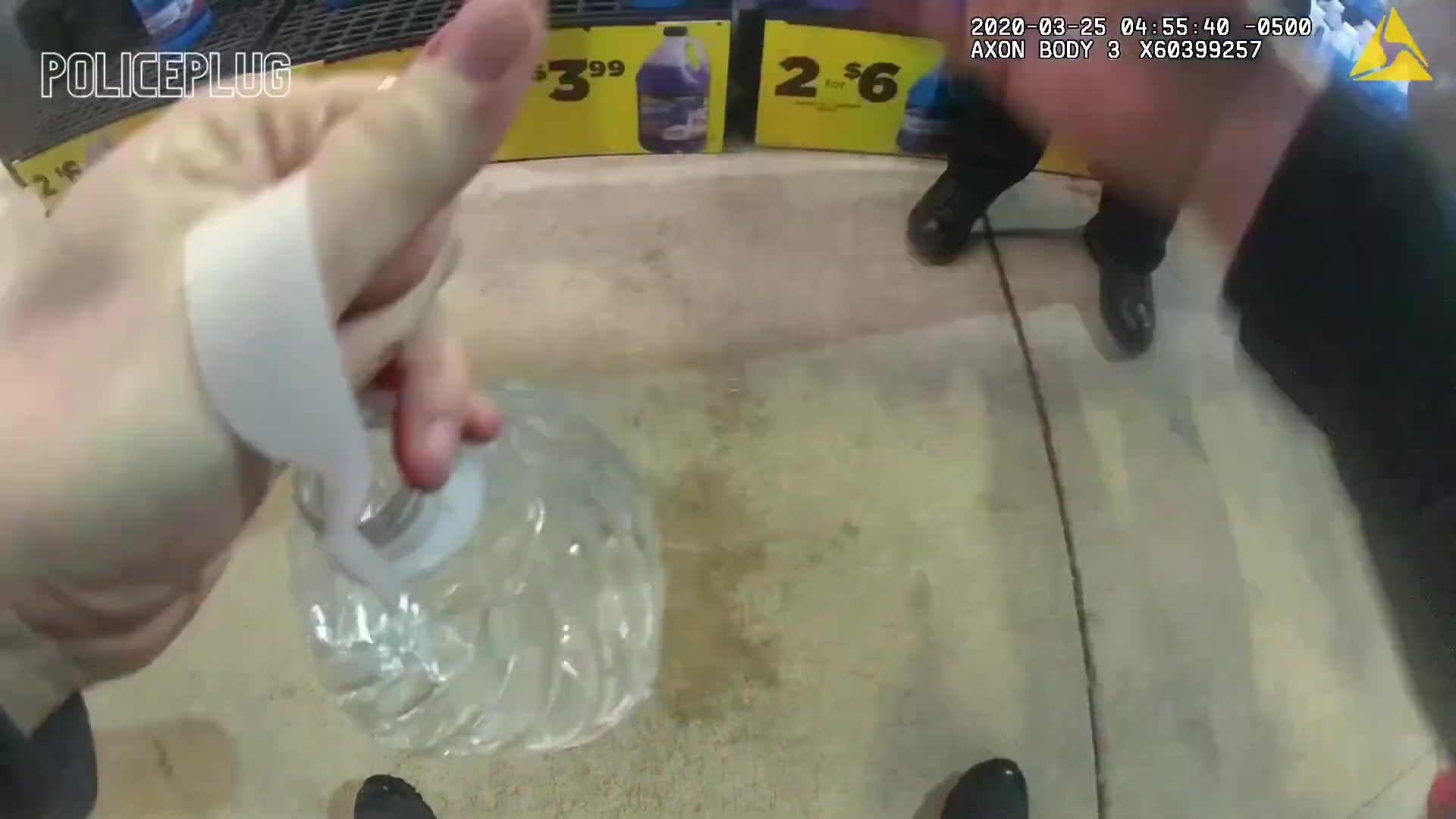
At one point in the aftermath, the footage shows officers handling a container while continuing to deal with the consequences of the confrontation.
That image is easy to overlook.
Yet it represents an important aspect of the encounter: officers do not necessarily know immediately what substance they have encountered.
The scene must be stabilized first.
Then the substance, injuries and evidence can be evaluated.
WHY THE OFFICERS' RESPONSE CHANGES SO QUICKLY
This encounter provides a useful example of what is sometimes called rapid threat reassessment.
An officer's response is not determined once at the beginning of a call.
It changes as circumstances change.
Consider the progression captured here.
The initial information concerns a person allegedly trying to start fires.
The officer arrives and enters the store.
Smoke becomes a significant problem.
The suspect moves outside.
The encounter becomes physical.
Then a liquid is introduced into the confrontation.
Each new development forces officers to reassess what they are dealing with.
A person who is merely refusing to cooperate presents one kind of problem.
A person believed to have deliberately started a fire presents another.
A person using a potentially dangerous liquid against officers can represent another level of risk entirely.
THE CRITICAL DETAIL IS THAT OFFICERS DO NOT HAVE THE BENEFIT OF WATCHING THE VIDEO FIRST.
Viewers can replay the footage.
They can pause it.
They can slow it down.
They can read comments and descriptions.
They can examine individual frames.
The officers in the footage have to make decisions while events are occurring.
That doesn't mean every police action is automatically justified simply because circumstances are stressful.
It means that evaluating an encounter fairly requires considering what officers could reasonably perceive at each stage rather than relying entirely on information learned afterward.
THE POLICE VEHICLE BECOMES PART OF THE CONFRONTATION
The footage becomes particularly chaotic outside the store.
Additional police resources arrive, and a patrol vehicle becomes directly involved as officers attempt to stop Bruce's movement.
The sequence has circulated widely online precisely because it is so unusual.
A forum discussion linking directly to the original YouTube upload shows viewers focusing heavily on the patrol vehicle's involvement as well as the warning against using a Taser in a situation involving a potentially flammable substance.
That second point is particularly noteworthy.
Electrical devices and ignition risks can become a serious concern when potentially flammable vapors or liquids are present.
The footage therefore contains an unusual tactical problem.
Police need to stop the person.
But they also need to consider whether certain tools could create another hazard.
That is something a short viral clip can easily miss.
The encounter isn't simply:
suspect refuses → police use force.
The environment matters.
The reported fire matters.
The liquid matters.
And the available police options matter.
BRUCE IS FINALLY BROUGHT UNDER CONTROL
Eventually, officers are able to stop Bruce and restrain him on the ground.
The bodycam shows him lying on a grassy area while officers secure the scene.
This image represents the turning point.
Until this moment, the incident remains active and unpredictable.
Once the suspect is under control, officers can begin shifting their attention toward the aftermath.
That includes checking injuries.
Determining whether anyone has been exposed to the liquid.
Securing possible evidence.
Dealing with the fire scene.
And arranging medical assistance.
This is another important difference between real bodycam footage and edited entertainment.
The moment a person is handcuffed does not necessarily end the emergency.
Officers may still need to deal with injuries, chemicals, fire, witnesses and the damaged location.
Here, emergency medical personnel eventually arrive.
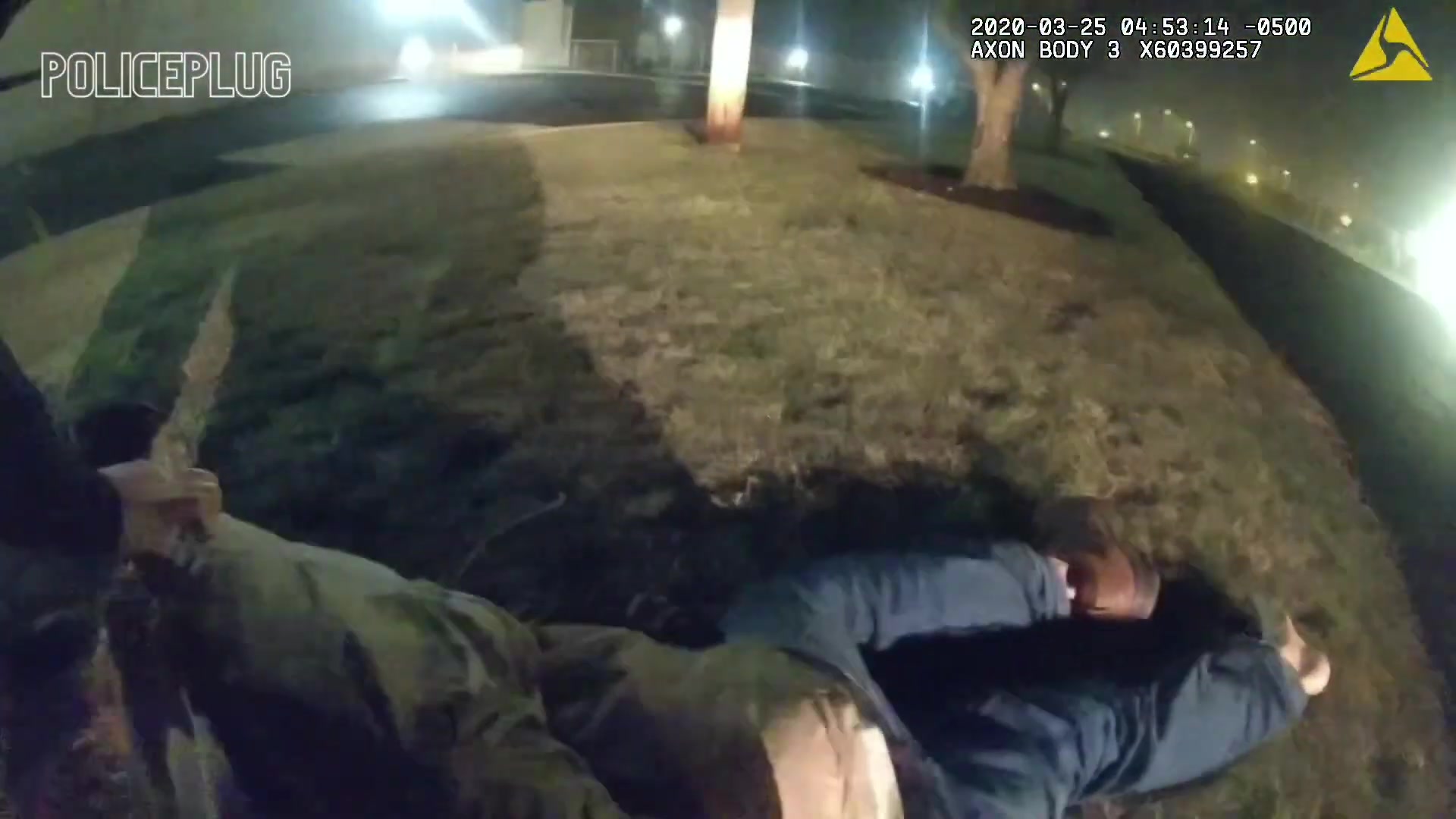
By this stage, the atmosphere is dramatically different from the first minutes of the video.
The rapid movement has stopped.
The suspect is controlled.
Officers are no longer chasing or confronting him.
The priority shifts toward medical evaluation and scene management.
FROM POLICE CONFRONTATION TO MEDICAL RESPONSE
The final portion of the video provides an important piece of context that short clips often remove.
Emergency medical personnel treat the person involved while officers remain nearby.
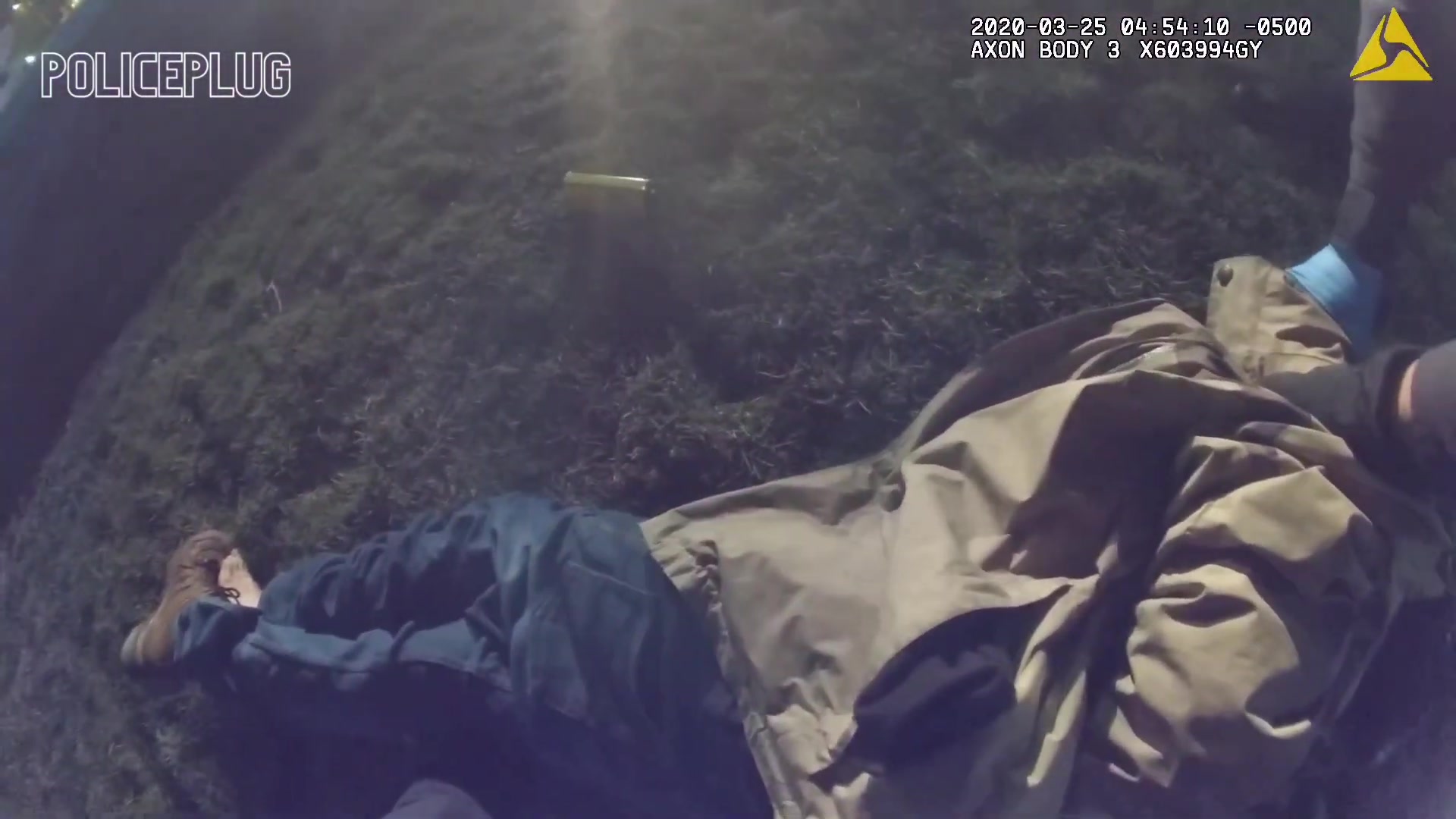
That transition is worth including because it completes the sequence.
The story is not simply about officers confronting someone.
It begins with a call for service.
It develops into an emergency.
It becomes a physical confrontation.
The person is restrained.
And then medical care becomes part of the response.
That full progression gives viewers a more accurate understanding of how such incidents unfold.
It also illustrates why a seven-minute bodycam video can contain far more information than a 20-second social-media clip.
The shorter version might show only the most dramatic physical moment.
The full video explains why officers were there in the first place.
THE PREVIOUS NIGHT ADDS ANOTHER LAYER
The available description of the incident includes one particularly important detail.
While officers were responding on March 25, dispatch reportedly informed them that a similar incident had occurred the night before, when the same male subject allegedly set trash on fire in a bathroom. The description says there had been no 911 call concerning that previous incident.
That information potentially changes how responding officers understand the situation.
They are not simply receiving a vague report about suspicious behavior.
They are hearing about what may be repeated fire-setting behavior.
Again, this should be framed carefully.
The information comes from the account accompanying the footage rather than a detailed court judgment or independent investigative report.
But it helps explain why the officer treats the situation seriously from the beginning.
REPEATED FIRE-RELATED BEHAVIOR INSIDE A PUBLIC BUSINESS CREATES AN OBVIOUS SAFETY CONCERN.
A convenience store employee may be present.
Customers may enter unexpectedly.
Flammable materials may be nearby.
Smoke can spread.
And an individual willing to start one fire may attempt to start another.
Those possibilities make immediate intervention understandable.
WHAT THE VIDEO CAN CONFIRM — AND WHAT IT CANNOT
There is an important reason to be careful with this particular story.
Unlike major officer-involved shootings or nationally covered police incidents, this case does not appear to have generated a large archive of easily accessible mainstream reporting.
I found the footage and descriptions of the incident, but not enough authoritative reporting to responsibly fill in every detail of Bruce's background, the exact final criminal disposition or other facts that are not visible in the recording.
So those details should not be invented.
What can be established with considerably more confidence is the central sequence:
Police responded to a Circle K on March 25, 2020, after a report that a man was trying to set objects on fire.
The suspect was identified in the footage's accompanying account as David Bruce.
Police had reportedly been advised of a similar fire-related incident the previous night.
The uploaded bodycam itself then documents the police arrival, smoke inside the store, the confrontation moving outside, the use of liquid during the encounter, Bruce being restrained and emergency personnel responding afterward.
Those facts are enough to tell the story without adding unsupported details.
WHY THIS BODYCAM FOOTAGE IS SO EFFECTIVE
The most compelling police videos are not necessarily those containing the most violence.
They are often the ones in which the situation repeatedly changes.
This footage does exactly that.
At the beginning, the officer is outside a convenience store.
Then smoke fills the interior.
Then the suspect moves outside.
Then the confrontation becomes physical.
Then liquid becomes part of the encounter.
Then officers have to reconsider how they can safely stop the suspect.
Finally, the scene shifts again as medical personnel arrive.
EVERY STAGE CREATES A NEW QUESTION.
What is burning?
Where is the suspect going?
What is in the container?
Can officers safely use a Taser?
How will they stop him?
Is anyone injured?
That chain of unanswered questions naturally keeps viewers engaged because each answer creates another problem.
It is also why the footage works well as a long-form story rather than only as a viral clip.
SEVEN MINUTES THAT STARTED WITH A SIMPLE DISPATCH CALL
Return to the opening seconds.
A police officer walks toward a Circle K in the darkness.
The store looks ordinary.
Its windows are brightly illuminated.
A vehicle is parked outside.
Nothing about that first image reveals what the officer is about to encounter.
Minutes later, the same body camera has recorded smoke filling the store, a confrontation outside, officers dealing with an unknown liquid, a suspect on the ground and emergency personnel arriving.
The physical distance between those moments is only a few hundred feet.
The time separating them is only several minutes.
But the situation has completely transformed.
That is the central lesson of the footage.
POLICE CALLS ARE NOT STATIC.
What officers believe they are responding to can change the moment they arrive.
A property-damage call can become an assault.
A traffic stop can become a pursuit.
A welfare check can become a rescue.
And in this case, a report of someone attempting to start a fire inside a convenience store became a dangerous confrontation involving smoke, a potentially flammable liquid and multiple responding officers.
The bodycam preserves that transformation almost from beginning to end.
And perhaps the most important moment isn't the dramatic confrontation itself.
It is the quiet image at the beginning.
The officer walking toward the store without yet knowing exactly what the next several minutes will bring.
That contrast is what makes the footage difficult to look away from.
The call began with reports of someone trying to start a fire inside a Circle K. Minutes later, officers were dealing with smoke, a dangerous liquid and a rapidly escalating confrontation. Watch the full bodycam footage to see how the entire encounter unfolded.
▶ WATCH THE FULL VIDEO HERE: https://www.youtube.com/watch?v=dtZlXz3_Q7g
Comments (0)
Loading comments...
May You Like

Karen Entitled’ Woman Gets Tased After Allegedly Ramming Police Cars

MERIDEN POLICE OFFICER SHOOTS MAN BEATING FATHER WITH A BASEBALL BAT

Chrysler 300 Gapped Cops at 150+ MPH | Police Dashcam












