
Man in Stolen Mercedes Driver Nearly Hits a Cop During Pursuit
STOLEN MERCEDES DRIVER TAKES OFF WITH AN OFFICER JUST FEET AWAY — THEN THE SEARCH MOVES INTO THE WOODS
ONE MOMENT, THE CAR IS PARKED. SECONDS LATER, AN OFFICER IS FACING A MOVING VEHICLE AT POINT-BLANK RANGE.
A stolen vehicle investigation can change in a fraction of a second.
The body-camera footage from this July 5, 2024 encounter demonstrates exactly why.
At first, officers appear to have located what they believe to be a stolen black Mercedes-Benz in a residential area. The vehicle is stationary. Officers can approach it. The situation appears contained enough for police to begin dealing directly with the person inside.
But that sense of control does not last.
As an officer positions himself beside the Mercedes, the encounter suddenly escalates. The driver begins maneuvering the vehicle while police are still extremely close.
The distance between an officer and thousands of pounds of moving metal becomes frighteningly small.
Commands are shouted.
The vehicle moves.
The officer has only moments to react.
And then the Mercedes is gone.
What follows is no longer simply an investigation into a stolen car. It becomes a search for a fleeing driver who has just demonstrated a willingness to escape while an officer is standing directly beside the vehicle.
THE MOST IMPORTANT MOMENT OCCURS BEFORE THE PURSUIT EVEN REALLY BEGINS: THE DRIVER CHOOSES FLIGHT WHILE POLICE ARE WITHIN FEET OF THE CAR.
That decision changes everything that follows.
Real frame from the supplied bodycam
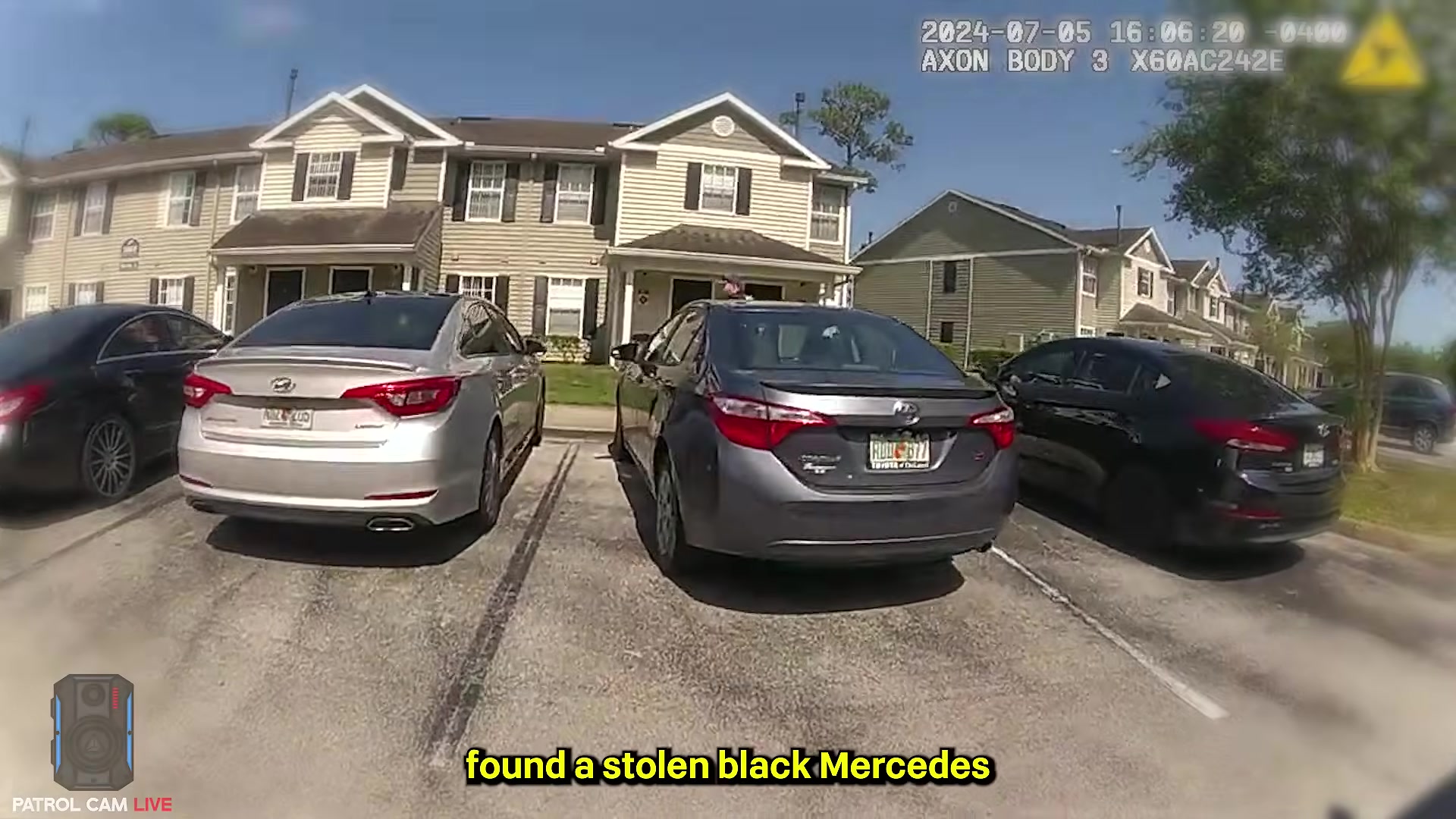
OFFICERS LOCATE THE BLACK MERCEDES
The footage begins in a residential complex in daylight.
Parked vehicles line the area, with apartments or townhouses immediately nearby. It is an ordinary environment — exactly the kind of place where residents might be walking outside, arriving home or moving between vehicles.
The bodycam overlay places the encounter on July 5, 2024.
The footage indicates that officers have located a black Mercedes believed to be stolen.
That immediately creates a difficult situation.
A parked stolen vehicle can be evidence.
But the moment someone is found occupying it, officers must also determine who that person is, whether they know the car is stolen and whether they intend to cooperate.
Most importantly, police do not yet know what the person inside might do.
A stationary vehicle can create a false sense of security.
An officer approaching the driver's window may appear to have the advantage. But the driver still controls a powerful machine capable of moving almost instantly.
The footage soon demonstrates exactly why that distinction matters.
Real frame from the video
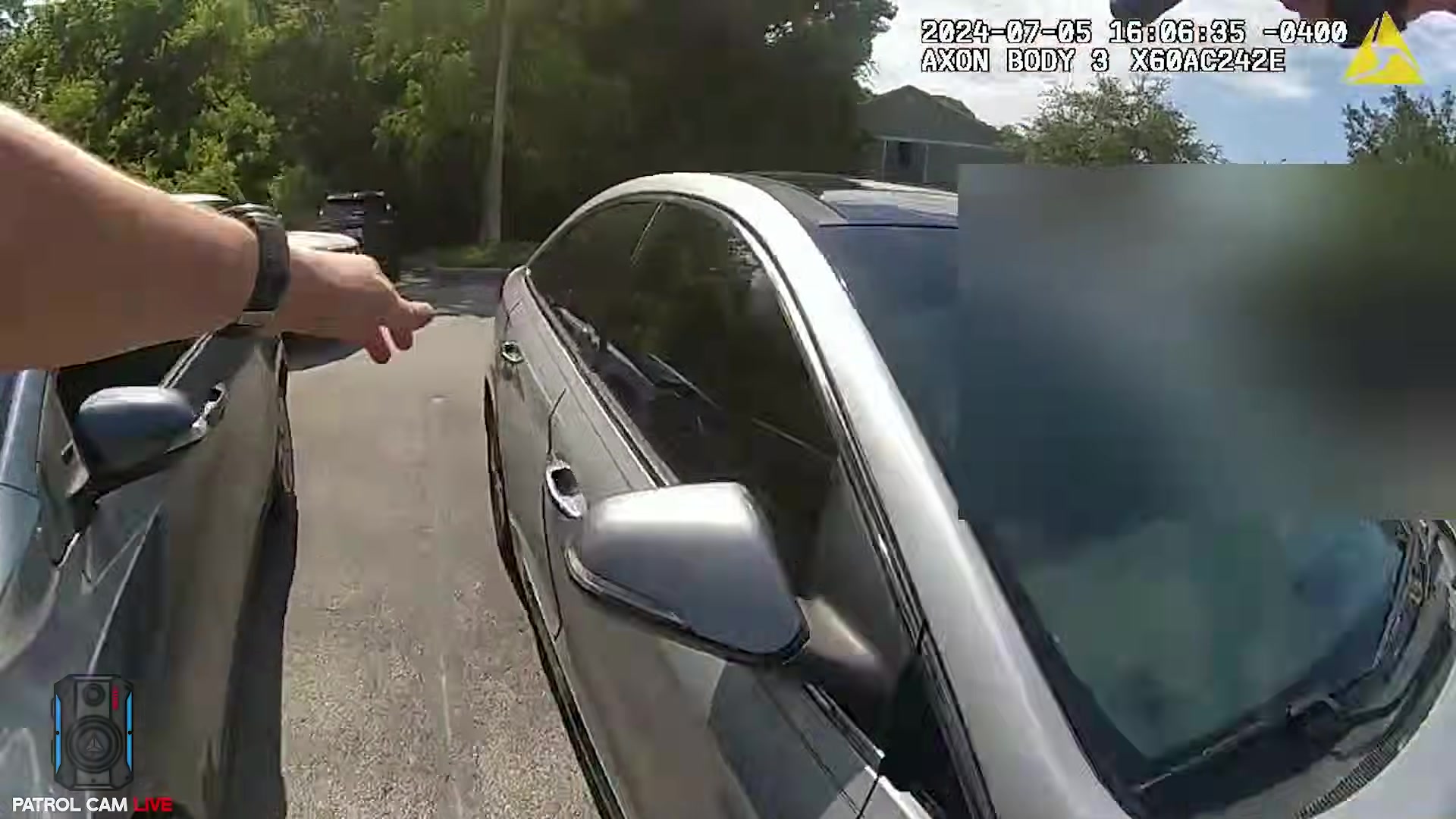
The officer moves alongside the car.
From the bodycam perspective, the distance is extremely short.
The vehicle fills much of the frame.
The officer attempts to control the encounter from outside while the driver remains behind the wheel.
For a viewer, this is where tension begins building even before anything dramatic occurs.
The Mercedes is not moving yet.
But the person inside controls whether it stays that way.
THE DRIVER MAKES HIS MOVE
Then the situation changes.
Instead of remaining where he is and following police instructions, the driver begins moving the Mercedes.
There is very little room between the vehicle, the officer and surrounding objects.
The bodycam captures the confusion from the officer's perspective.
The officer has to react immediately as the vehicle moves through the confined space.
This is the moment that gives the video its defining tension.
A vehicle does not need to be traveling at highway speed to create a serious danger to someone standing beside it.
At close range, even a sudden acceleration or turn can leave an officer almost no time to get clear.
The footage shows just how quickly a seemingly controlled vehicle encounter can become unpredictable.
SECONDS EARLIER, THE OFFICER WAS TALKING TO A DRIVER IN A PARKED CAR. NOW HE HAS TO AVOID A MOVING VEHICLE.
Real frame from the escape sequence
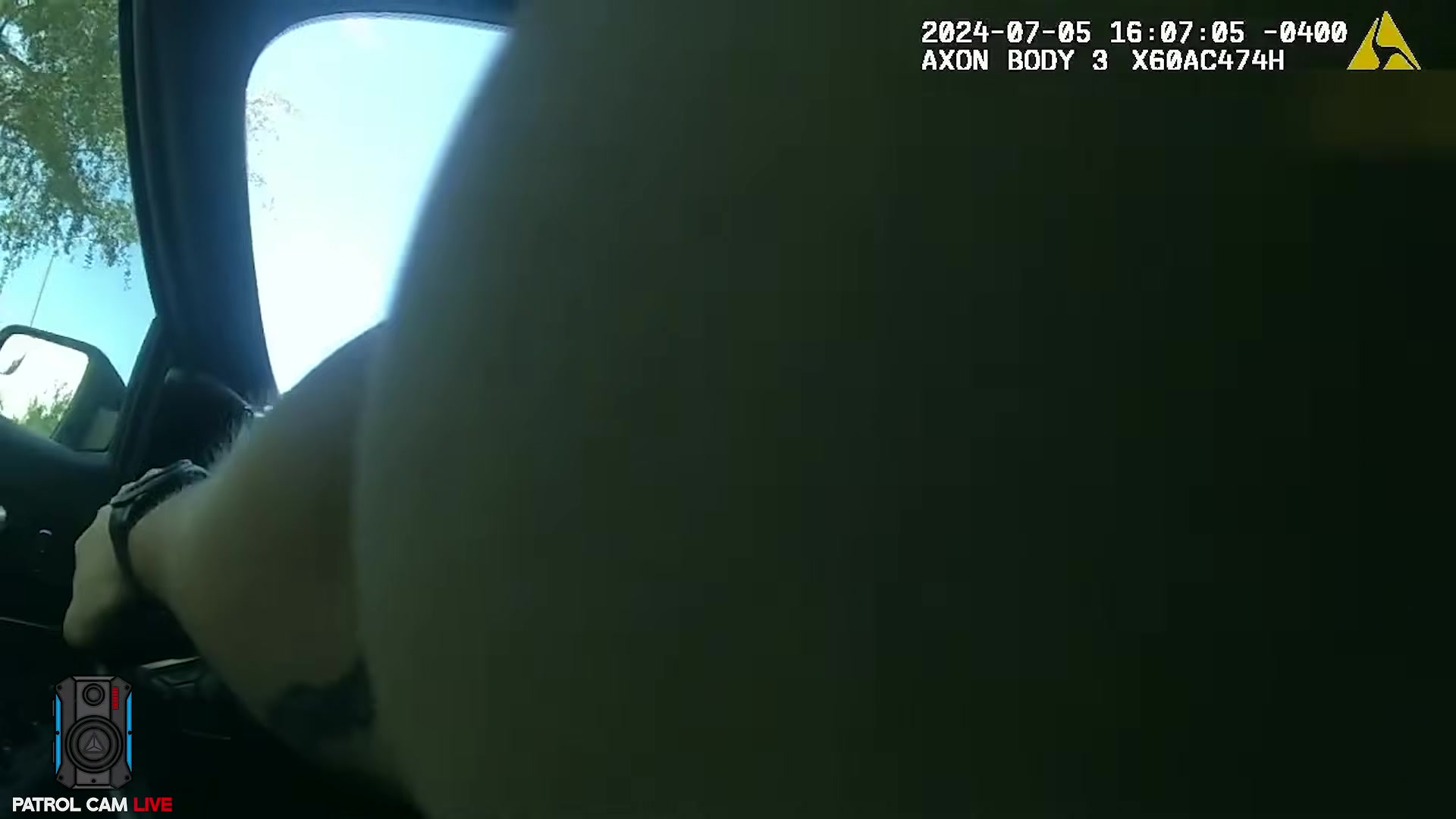
The Mercedes gets away from the immediate scene.
But escaping the parking area does not end the police response.
Instead, the encounter enters its second phase.
Officers now have to locate the person who fled.
And the driver is about to abandon one advantage — the car itself.
FROM STOLEN-CAR INVESTIGATION TO MANHUNT
Once a suspect leaves a vehicle and runs, the dynamics change completely.
A car is large and relatively easy to see.
A person on foot can disappear behind buildings, fences, vegetation or terrain within seconds.
That is particularly important in this encounter.
The footage eventually shifts away from the residential parking area and toward rougher terrain.
Officers begin searching on foot.
Now the bodycam becomes much more than a recording of a vehicle encounter.
It becomes a first-person view of officers trying to locate someone who has deliberately disappeared into an environment that makes movement difficult.
Vegetation restricts visibility.
Branches and fallen trees create obstacles.
The ground itself becomes part of the challenge.
Officers do not know exactly where the fleeing person will emerge.
They have to keep moving while watching areas where someone could potentially hide.
The pace of the video changes as well.
The sudden burst of danger around the Mercedes gives way to uncertainty.
That contrast is important for maintaining tension.
The viewer has seen the suspect flee.
Now the question becomes:
WHERE DID HE GO?
THE SEARCH MOVES INTO HEAVY VEGETATION
As officers continue, the terrain becomes increasingly difficult.
This is where the bodycam perspective becomes particularly useful.
A traditional news camera would likely show officers entering a wooded area from a distance.
The bodycam shows what navigating that environment actually looks like.
Branches fill the field of view.
Officers have to work around natural obstacles.
Visibility can shrink dramatically from one moment to another.
Someone hiding only a relatively short distance away could potentially be difficult to see.
That uncertainty increases the stakes.
Officers know they are looking for the person who fled from the Mercedes.
But they do not have the benefit of the overhead perspective a viewer might imagine.
Every tree, bush and fallen branch can conceal part of the landscape.
Eventually, the search pays off.
The suspect is located.
And the encounter immediately becomes physical.
Real frame from the arrest
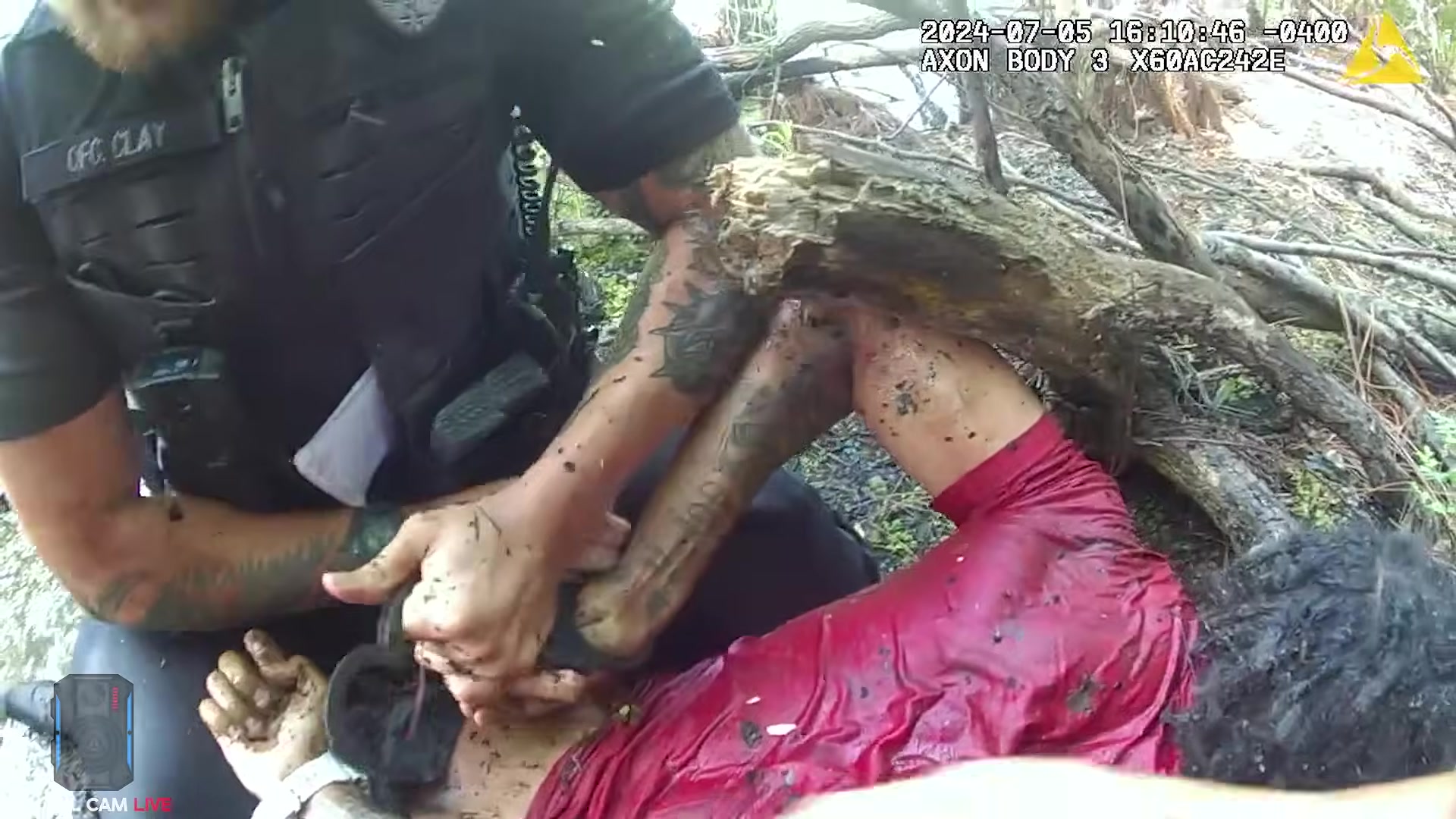
The footage shows officers working to control the man amid branches, dirt and fallen vegetation.
The environment makes the arrest more complicated than it would be on a flat sidewalk or open parking lot.
There is limited space.
The suspect's position is awkward.
Officers have to gain control while simultaneously navigating the terrain around them.
The man who had escaped the Mercedes is no longer behind the wheel.
He is now on the ground with officers attempting to secure him.
THE FLIGHT THAT STARTED WITH A CAR ENDS IN THE WOODS.
WHY THE ARREST SCENE LOOKS SO DIFFERENT FROM THE OPENING
One of the strongest visual elements of this footage is the contrast between its beginning and ending.
At the start, the setting is almost mundane.
Sunshine.
Apartment buildings.
Parked cars.
A Mercedes sitting among ordinary vehicles.
Nothing about the environment itself suggests what is about to happen.
Later, the bodycam shows officers surrounded by trees, broken branches, dirt and vegetation while physically taking a suspect into custody.
Those two settings tell the story almost without narration.
The suspect has moved from a place where police could clearly see and approach him to terrain where concealment was possible.
Yet the attempt to disappear does not succeed.
Real frame from the detention
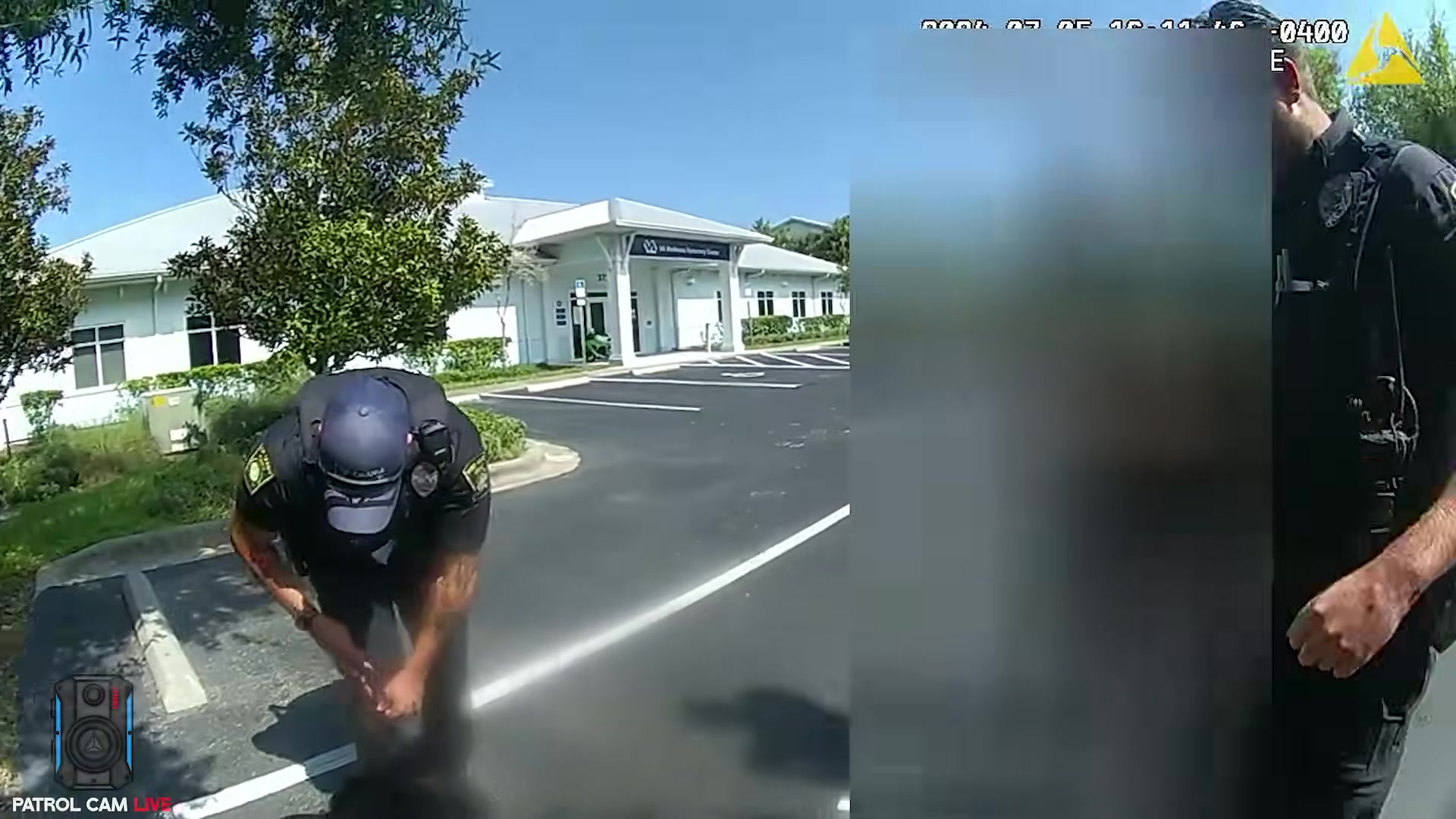 Once officers gain control, the tempo of the incident changes again.
The urgent search is over.
The immediate need is now to secure the suspect, check the situation and safely move him out of the difficult terrain.
This is another aspect of police footage that short viral clips often remove.
The dramatic moment may last only seconds.
But officers still have to manage everything that follows.
An arrest is not complete simply because someone has stopped running.
Officers need to establish control.
They need to determine whether the person has weapons.
They need to communicate with one another.
They may need to assess injuries.
They need to move the person safely.
And they still have to preserve evidence connected to the original investigation.
THE BODYCAM SHOWS HOW FAST THE RISK CHANGES
This footage is a useful example of something easily overlooked when watching police encounters online:
THE TYPE OF THREAT CAN CHANGE LONG BEFORE THE INCIDENT ENDS.
At first, the primary issue is a reportedly stolen vehicle.
Then the immediate concern becomes the driver.
Next, the moving Mercedes itself becomes a danger because an officer is standing extremely close to it.
Once the vehicle escapes, location becomes the problem.
Once the suspect runs into vegetation, visibility becomes the problem.
Once officers find him, physical control becomes the problem.
There is no single risk throughout the encounter.
There is a chain of different risks.
That distinction helps explain why officers may appear calm in one moment and dramatically more urgent seconds later.
They are responding to changing circumstances rather than a single static event.
Real frame from later in the incident
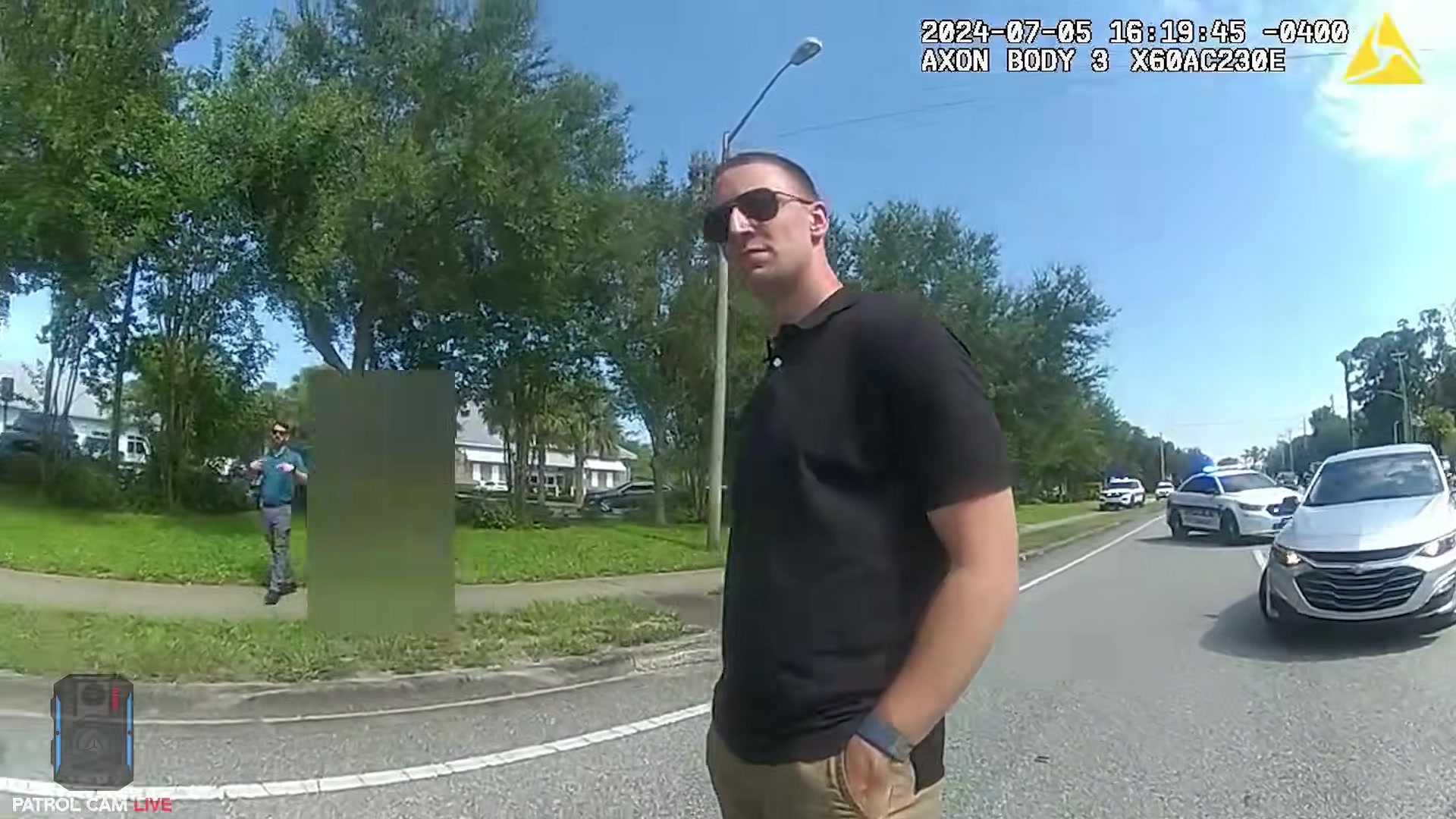 For viewers, the bodycam also demonstrates the limits of hindsight.
Once we know that the suspect eventually runs and is caught, it becomes easy to watch the opening while anticipating what will happen.
The officer in the video does not have that advantage.
When he approaches the Mercedes, he does not know exactly when — or whether — the driver will move.
When the vehicle begins moving, the officer does not have time to replay the previous five seconds and choose a different position.
The decision has to happen immediately.
That is why the close-range escape is arguably more significant than the later chase.
It represents the instant when a relatively controlled encounter becomes something else entirely.
WHY VEHICLES CREATE SUCH A DIFFICULT POLICE ENCOUNTER
Police encounters involving occupied vehicles contain an unusual imbalance.
The officer is normally standing.
The driver is seated inside a protective structure weighing thousands of pounds.
The officer may be able to give commands, but the driver controls the accelerator, brakes and steering wheel.
That means distance matters enormously.
A driver who suddenly accelerates can transform the vehicle into an immediate hazard before an officer has enough time to move.
This video illustrates that problem visually.
The bodycam does not provide an aerial view or a wide television shot.
Instead, viewers see the Mercedes from almost exactly where the officer experiences it.
The car occupies much of the officer's visual field.
There is little apparent separation.
Then it moves.
The sequence lasts only moments, but those moments explain why officers treat an uncooperative driver differently from someone simply standing nearby.
The ability to flee is not the only issue.
The vehicle itself can become part of the threat.
THE SUSPECT'S ESCAPE CREATES ANOTHER PROBLEM
Leaving the vehicle does not necessarily make a fleeing suspect easier to catch.
Sometimes it does the opposite.
Once the suspect is on foot, officers lose the ability to track one large, highly visible object.
Instead, they are searching for a person who can use the environment.
The footage shows the result.
The search moves away from pavement and into vegetation.
Officers have to follow.
That introduces new risks that did not exist beside the Mercedes.
Uneven ground can cause falls.
Branches can obstruct movement.
Dense vegetation can prevent officers from seeing what a suspect is doing with his hands.
Multiple officers moving through a confined space have to avoid interfering with one another.
And once the suspect is located, there may be very little room to perform an arrest.
Real frame from the aftermath
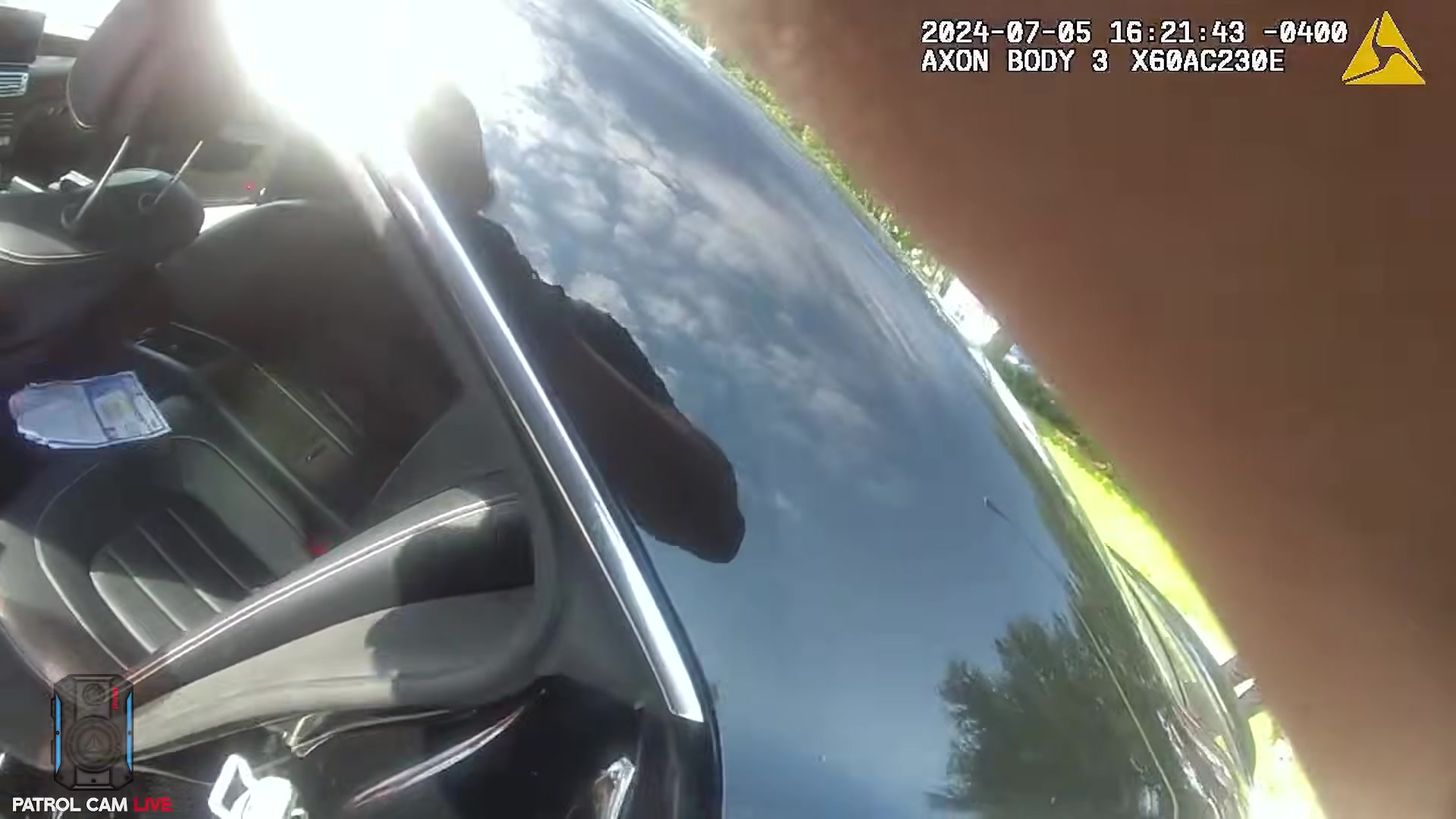
The video therefore contains several distinct stages:
A stolen vehicle is located.
Police approach.
The driver attempts to escape.
An officer is placed dangerously close to the moving Mercedes.
The suspect gets away from the immediate location.
Police search for him.
The search enters difficult terrain.
Officers locate him.
A physical arrest follows.
Only then does the incident finally begin to settle.
WHAT WE CAN — AND CANNOT — CONFIRM FROM THIS FOOTAGE
There is an important distinction between analyzing video and identifying a criminal case.
The supplied footage clearly provides several pieces of information.
The bodycam timestamp shows July 5, 2024.
The video itself identifies the central vehicle as a black Mercedes reported as stolen.
It visually documents police approaching the vehicle, the driver escaping while an officer is very close to it, the subsequent search and the suspect's eventual detention.
Those points can be described confidently because they are visible within the supplied footage.
However, my searches did not produce a sufficiently reliable independent local-news report that I could match to this exact footage with confidence.
For that reason, I am deliberately not inserting a suspect's name, city, police department or specific criminal charges merely to make the article appear more detailed.
That would turn uncertainty into misinformation.
The footage itself is strong enough to tell the story without doing that.
And in this case, the strongest story is not a name or a charge sheet.
It is the speed with which the encounter changes.
FROM A PARKING SPACE TO A WOODED ARREST
At the beginning of the video, the Mercedes is surrounded by ordinary parked cars.
By the end, the person who allegedly fled from it is being detained among fallen trees and vegetation.
The distance between those two moments is only a few minutes.
But the operational situation changes repeatedly.
That is what makes the footage compelling.
The story does not rely on a huge crash or an extended highway pursuit.
Its tension comes from proximity.
An officer is right beside the car.
The driver suddenly decides to move.
For a brief moment, the margin for error becomes almost nonexistent.
The subsequent search provides the second half of the story: getting away from the officer does not mean getting away from the police response.
The driver abandons the security and speed of the vehicle and attempts to use terrain instead.
Eventually, officers catch up.
THE MERCEDES GOT AWAY FROM THE PARKING SPACE. THE DRIVER DID NOT GET AWAY FROM THE SEARCH.
THE MOMENT THAT DEFINES THE ENTIRE VIDEO
If there is one image that captures the encounter, it is not necessarily the final arrest.
It is the officer standing beside the Mercedes moments before it moves.
Everything still appears manageable.
The vehicle is there.
The officer is there.
The suspect has not yet escaped.
Then one decision changes the entire trajectory of the encounter.
The car moves.
The officer reacts.
The suspect flees.
Other officers become involved.
The search expands.
And what began beside a parked Mercedes ultimately ends on the ground in dense vegetation.
That transformation is what makes bodycam footage valuable when viewed in context.
It captures not simply what happened, but how quickly officers had to transition from one problem to another.
The video also provides an important reminder about viral police clips.
A dramatic five-second escape may attract attention.
But understanding the encounter requires watching what happened immediately before it — and what officers had to do afterward.
In this case, the full sequence tells a much more complete story.
WATCH HOW THE ENTIRE ENCOUNTER UNFOLDS
A description can explain the sequence, but the bodycam makes the speed of the escalation much clearer.
The most striking moment happens almost instantly: the Mercedes begins moving while the officer is standing only feet away.
From there, the encounter transforms into a search that eventually takes officers away from the residential parking area and into dense vegetation, where the fleeing suspect is finally located and detained.
Watch the full footage to see the moment the stolen Mercedes suddenly takes off, how close the officer comes to the moving vehicle, and how the search ultimately ends far from where it began.
Click the link to watch the complete encounter from the first approach to the final arrest: https://www.youtube.com/watch?v=aHoTw_13ORs
Comments (0)
Loading comments...
May You Like

Stolen Charger Flees Police During Highway Traffic Stop
Police vs Chevy Impala High-Speed Pursuit Ends in TVI

Police Follow the Driver Until His Escape Route Runs Out













