
Man Charged Officer With Crowbar And Instantly Regretted It On Bodycam
Man Raises a Crowbar at West Valley Officers and a Taser Fails to Stop Him
A Burglary Call Takes a Dangerous Turn
The first calls came in around 1:30 in the morning.
Residents in a West Valley City neighborhood were reporting a stranger moving through the area with a metal object. Windows were being broken. Someone appeared to be attempting to enter homes and vehicles.
One woman reported that the man was breaking into a truck parked in her driveway.
She confronted him and told him to leave or she would call police.
Instead of leaving, according to charging documents later described by KSL, the man chased her toward her house. She managed to get inside and close the door.
Then the crowbar struck the house.
The window in the door shattered. More blows followed against the front door, and the man reportedly began kicking it hard enough to damage it.
By the time West Valley City police officers reached the neighborhood, they were no longer responding to a vague suspicious-person report.
They knew someone in the area was reportedly armed with a heavy metal tool and had already behaved aggressively.
Body-camera footage would soon show just how quickly the situation could become life-threatening.
Police encountered the man, later identified as 25-year-old Denny James Clark, standing in a driveway with a large crowbar.
An officer immediately gave him a simple command.
Drop it.
Clark refused.
Again, police told him to put it down.
Again, he refused.
What followed lasted only a short time, but every few seconds removed another possible peaceful ending.
Officers attempted verbal commands.
They created distance.
They called for additional units.
They tried a Taser.
Nothing stopped Clark from continuing forward.
Then he suddenly changed direction and moved toward Officer Kurtis Braley with the crowbar raised.
Five gunshots followed.
The confrontation was over almost as quickly as it had begun.
Clark survived.
But the body-camera footage would later become central evidence in determining whether Braley's decision to shoot had been legally justified.
Officers Find Clark Holding the Crowbar
The footage begins with officers arriving in a quiet residential neighborhood.
That setting makes what happens next particularly jarring.
There is no crowded entertainment district.
No busy commercial intersection.
No chaotic public event.
There are houses, driveways, lawns and parked vehicles.
Then an officer spots Clark.
He is holding the crowbar.
According to the Salt Lake County District Attorney's later review, the tool was approximately three feet long.
The distance between Clark and the officers initially provides some room for communication.
Police try to use it.
Commands begin immediately.
Clark is repeatedly instructed to drop the object.
He doesn't.
Instead, the interaction develops into a strange and increasingly threatening standoff.
At one point, Clark demands car keys and warns that otherwise someone is going to “get it,” according to the accounts of the footage and charging documents.
That statement changes the officers' problem.
They are not simply dealing with someone carrying a tool.
They are dealing with someone who has reportedly damaged property, pursued a resident and is now refusing repeated commands while holding an object capable of causing severe injury.
An officer radios dispatch and requests that additional units be expedited.
The officers continue maintaining distance.
That becomes important later.
When the shooting was reviewed, Salt Lake County District Attorney Sim Gill specifically pointed to the officers' attempts to create space, issue commands and use less-lethal force before the firearm was used.
But none of those options can work unless Clark chooses to cooperate.
He doesn't.
Instead, the footage reaches its first major turning point.
Clark announces that he is coming toward the officers.
Then he begins moving.
And the crowbar is raised above his head.
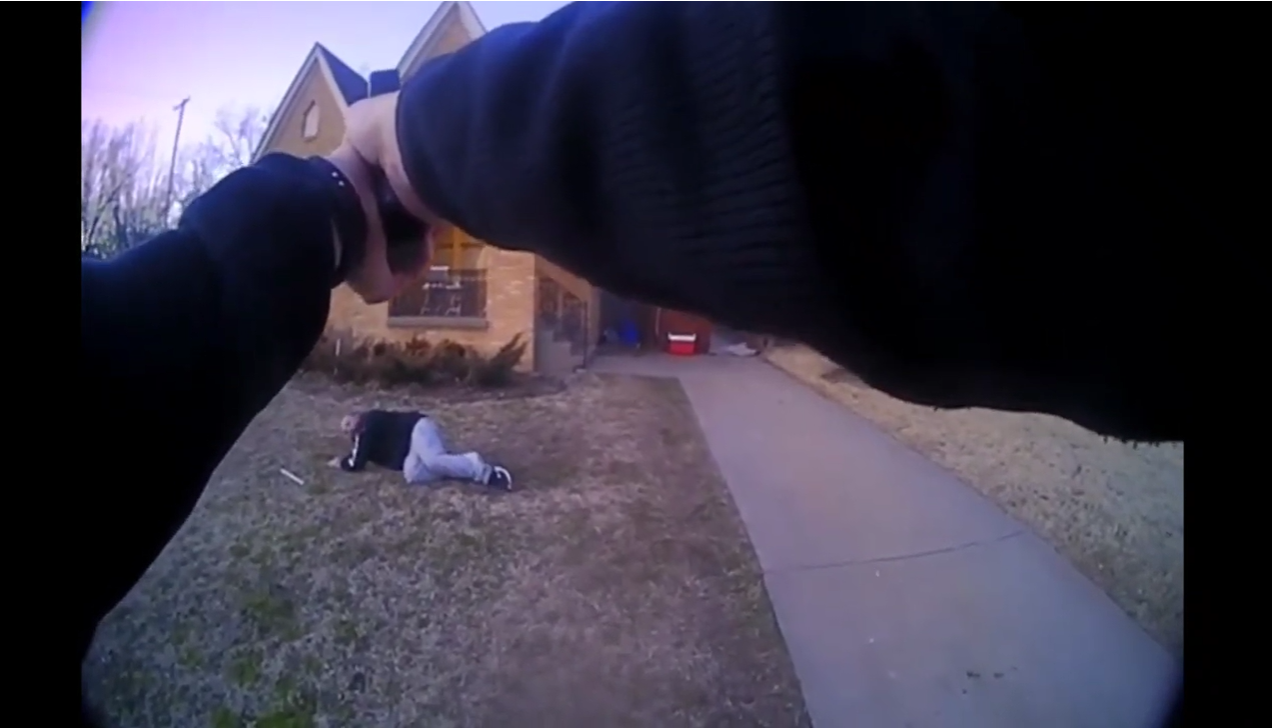
The Officers Retreat Instead of Closing the Distance
One of the most important details in the footage is what police do when Clark begins advancing.
They move backward.
That may appear counterintuitive to viewers accustomed to seeing officers immediately rush toward a suspect.
But distance is protection when someone is carrying an impact weapon.
A crowbar does not need ammunition.
At close range, its weight and leverage can make it capable of inflicting catastrophic injuries.
The officers therefore attempt to preserve space between themselves and Clark.
One officer later explained that he was also concerned about what was behind Clark and did not want to immediately fire with bystanders potentially in the background. KSL reported that the officer retreated as Clark pursued him toward the street.
This is where the footage becomes intensely dynamic.
Clark moves forward.
The officer moves backward.
Other officers reposition.
Commands continue.
Everyone is moving at once.
Yet the central fact remains unchanged.
The crowbar is still in Clark's hands.
One of the officers now attempts a less-lethal option.
A Taser is deployed.
For a fraction of a second, this looks like the moment that might finally end the confrontation.
It doesn't.
According to the later district attorney review, officers actually deployed Tasers during the confrontation without successfully stopping Clark.
That failure matters enormously.
Police officers generally prefer distance and less-lethal options when circumstances permit them.
But a Taser is not guaranteed to incapacitate someone.
Its effectiveness can depend on probe placement, clothing, distance and other factors.
Here, whatever the precise reason, the deployment does not resolve the threat.
Clark keeps moving.
The officer who had been retreating continues trying to create distance.
Another officer follows.
Then Clark makes the movement that changes everything.
He turns.
Instead of continuing after the first officer, his attention shifts toward Officer Kurtis Braley.
Clark still has the crowbar raised.
And now he moves toward Braley.
The remaining distance disappears rapidly.
A Split-Second Change in Direction
The critical moment occupies only seconds of the recording.
Clark has already ignored repeated commands.
The Taser has failed to stop him.
He has pursued one officer.
Now he suddenly redirects himself toward another.
The crowbar remains overhead.
Braley orders him to drop it.
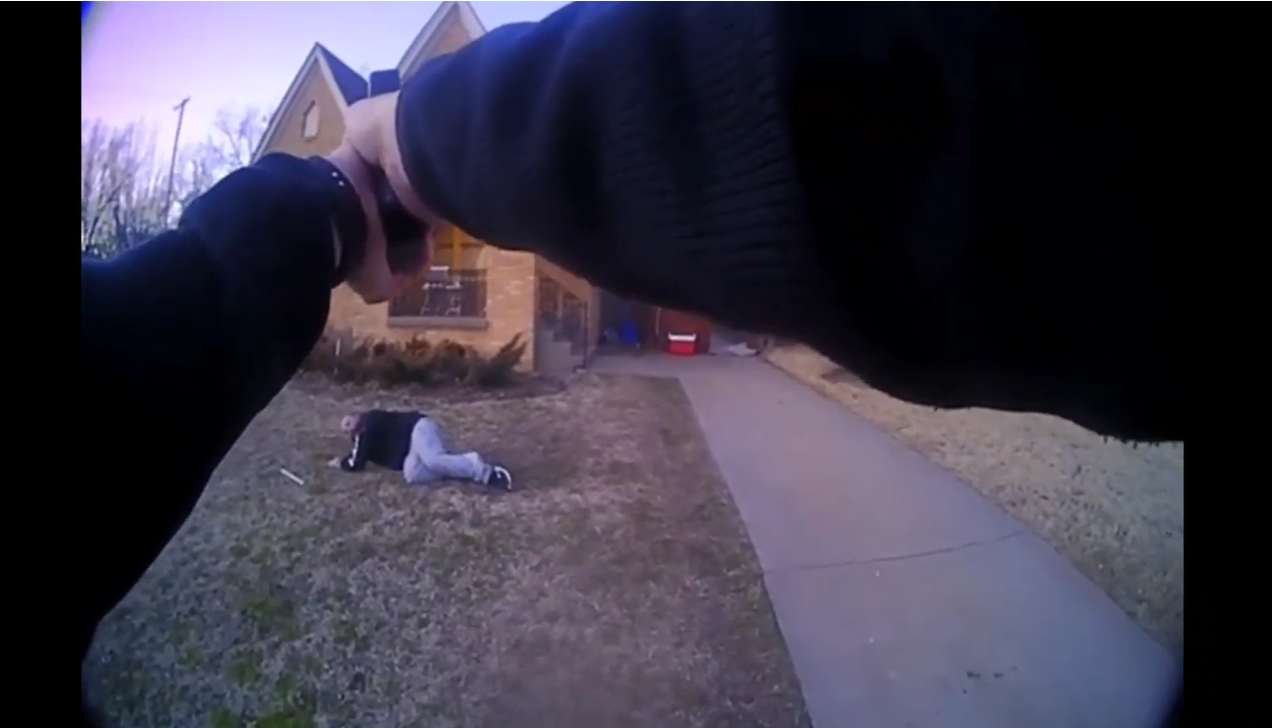
Then the officer fires.
Five rounds are discharged.
Clark falls.
The frantic movement immediately stops.
The officers' priorities change just as quickly.
Seconds earlier, they were trying to avoid being struck.
Now they need to secure Clark, determine where he has been hit and get medical assistance.
The body-camera footage records Clark on the ground in obvious pain.
KSL reported that he told officers he could not move one of his arms. After officers instructed him to roll over, he complied and was handcuffed.
An officer asks where he has been hit.
Clark's answer communicates the confusion of the moment.
He says, essentially, everywhere.
The subsequent investigation established that he had actually been struck twice, including wounds to the lower abdomen and right elbow.
He survived.
Police then provided medical attention before Clark was transported to a hospital.
After being released from medical care, he was booked into the Salt Lake County Jail.
The encounter itself was finished.
But two very different legal processes were only beginning.
One concerned Clark's alleged actions before and during the confrontation.
The other concerned the officer's decision to fire.
The Events Before Police Arrived Mattered
Body-camera footage is powerful, but it does not necessarily show the beginning of a police incident.
This case is a good example.
If someone watched only the final confrontation, they would see a man carrying a crowbar, officers retreating and a shooting.
The emergency calls explain why police were there in the first place.
According to charging documents summarized by KSL, multiple people called dispatch around 1:30 a.m. to report a man using a metal object to damage windows and attempt to enter residences around 3850 South and 4800 West.
One resident's experience was particularly important.
She reportedly saw Clark attempting to break into a truck in her driveway.
When she confronted him, he chased her.
She escaped into her home.
Clark then allegedly shattered the window in her door with the crowbar, struck the front door repeatedly and kicked it hard enough to crack it.
That information shaped what responding officers knew.
They were not encountering someone merely walking home carrying a construction tool.
They were responding to reports involving attempted entry, property destruction and aggressive behavior.
Police eventually located Clark in a driveway.
And he was still holding the crowbar.
The footage therefore represents the continuation of an emergency rather than its beginning.
That distinction matters when evaluating what officers could reasonably perceive when they arrived.
Charges Follow the Shooting
Clark survived his injuries and subsequently faced criminal charges.
KSL reported that prosecutors charged him in Utah's 3rd District Court with aggravated burglary, a first-degree felony; two counts of assault on a police officer, second-degree felonies; along with vehicle burglary and criminal mischief, both class A misdemeanors.
Those charges were allegations and should not be confused with convictions merely because they were filed.
But they show how prosecutors interpreted the sequence described by witnesses, charging documents and body-camera footage.
Meanwhile, Officer Braley's use of deadly force required a separate investigation.
Officer-involved shootings are not legally justified simply because a suspect survives or because police say they perceived a threat.
Investigators have to examine what happened and determine whether the officer's belief that deadly force was necessary was reasonable under the circumstances.
In this case, the body-camera recordings gave investigators an unusually direct view.
The footage showed the commands.
It showed Clark refusing.
It showed the crowbar.
It showed officers retreating.
It showed the unsuccessful attempts to use a Taser.
And it showed Clark turn and advance toward Braley.
Months later, prosecutors announced their conclusion.
Prosecutors Rule the Shooting Justified
On August 6, 2021, Salt Lake County District Attorney Sim Gill announced that Officer Kurtis Braley was legally justified in shooting Clark.
The reasoning centered on the threat facing the officer when the shots were fired.
The Salt Lake Tribune reported that prosecutors concluded it was reasonable for Braley to believe deadly force was necessary to prevent death or serious bodily injury.
Gill also emphasized the actions officers took before the shooting.
They maintained distance.
They repeatedly ordered Clark to drop the crowbar.
They attempted less-lethal intervention.
Despite those efforts, the confrontation continued escalating.
West Valley City's own 2021 police annual report later summarized the case in similar terms.
The department recorded that officers responded on May 10 to reports of a man burglarizing residences or vehicles near 4701 West Huntington Street. Officers encountered the suspect in a driveway with a three-to-four-foot crowbar. The report states that he failed to comply, aggressively chased an officer, was unsuccessfully subjected to a Taser deployment and then charged another officer, who shot and injured him.
That official summary strips the incident down to a few lines.
The footage demonstrates how much happened inside those lines.
There is a crucial difference between reading that someone “charged an officer” and watching the distance between two people disappear on body-camera video.
That is one reason this case attracted public attention.
Viewers can see many of the factors prosecutors later had to evaluate.
Why the Failed Taser Is So Important
The Taser attempt is one of the most revealing moments in the entire incident.
In hindsight, it creates an obvious question.
What happens when the option intended to prevent deadly force does not work?
Officers have only seconds to answer.
A Taser is classified as a less-lethal tool, not a guaranteed stop button.
If it works properly and achieves neuromuscular incapacitation, officers may have an opportunity to restrain someone without using a firearm.
If it fails while an armed person continues closing distance, the tactical situation can deteriorate immediately.
That is what makes this footage so tense.
The officers do not know in advance whether the Taser will work.
The viewer, watching the video for the first time, doesn't know either.
Then it is deployed.
Clark remains mobile.
Suddenly an option has disappeared.
The distance between the officers and the crowbar becomes more important than ever.
The situation then becomes even more unpredictable when Clark changes direction.
An officer who was following the confrontation becomes the person directly facing the threat.
The entire geometry of the incident changes in seconds.
That unpredictability was part of what prosecutors later evaluated when determining whether Braley reasonably perceived an imminent danger.
They ultimately concluded that he did.
A Few Seconds That Were Reviewed for Months
The actual shooting takes almost no time.
The investigation into it took considerably longer.
That contrast is common in critical police incidents.
An officer may have seconds to decide whether to fire.
Investigators can spend weeks or months replaying those same seconds.
They can synchronize multiple body cameras.
Review 911 calls.
Examine physical evidence.
Interview witnesses.
Study the suspect's movements.
Measure distance.
Analyze what officers knew before arriving.
Compare those facts with Utah law.
That later scrutiny is essential precisely because the original decision happened so quickly.
Here, the bodycam provided investigators with recordings from the officers who were present.
KSL reported that West Valley police eventually released a nine-minute presentation containing footage from all three officers along with the initial 911 call.
Those multiple perspectives are important.
A single body camera never provides a perfect objective view.
It sees from one position.
Another officer may see something different because of distance, angle, obstacles or background.
Multiple cameras help reconstruct the encounter more completely.
In this case, that reconstruction supported the conclusion that Braley's use of force was justified.
The Moment That Could Have Ended Everything Earlier
Watching the entire confrontation reveals something almost painfully simple.
There were repeated opportunities for the encounter to end before anyone was shot.
The clearest one came at the beginning.
Drop the crowbar.
Officers repeated the instruction.
Clark refused.
The officers maintained distance.
Clark moved toward them.
They attempted a Taser.
It failed.
He continued moving.
Then he redirected toward Braley.
By that stage, the number of safe alternatives had dramatically narrowed.
This does not mean every police shooting can be explained with such a straightforward sequence.
They cannot.
Each incident depends on its own facts.
But this particular case is unusually well documented.
There are witness calls.
Charging documents.
Multiple body cameras.
News reports.
An official police summary.
And a subsequent district attorney review.
All of those sources broadly converge on the same core sequence.
Clark was armed with a large crowbar.
He refused commands to drop it.
He advanced on officers.
Less-lethal force did not stop him.
He turned toward Braley while still carrying the raised crowbar.
Braley fired.
Clark survived.
And after reviewing the shooting, prosecutors determined the officer's actions were legally justified.
That sequence is what gives the footage its impact.
It is not merely the five shots at the end.
It is everything that happens before them.
Every command creates another possible ending.
Every refusal removes one.
Every step forward shortens the distance.
And when the Taser fails, the encounter enters its final seconds.
The bodycam captures all of it.
A burglary investigation in a quiet Utah neighborhood becomes a confrontation with an armed man.
A less-lethal option is tried and fails.
One sudden turn changes which officer is directly threatened.
And a decision that takes only moments becomes the subject of months of legal review.
The final ruling cannot undo what happened that morning.
But it answers the central legal question surrounding the footage.
According to the Salt Lake County District Attorney, Officer Kurtis Braley was justified in firing when Denny Clark advanced toward him with the crowbar.
For viewers, the lasting lesson lies in how quickly the options disappear.
At the beginning, there is distance, conversation and time.
At the end, there are only a few feet and a few seconds.
Watch the complete encounter, including the repeated commands, attempted Taser deployment and the seconds leading to the shooting here: https://www.youtube.com/watch?v=QdxMk38QTTA
Comments (0)
Loading comments...
May You Like
Everything Changed When Cops Asked About Weapons

Neighborhood Grocery Store Suddenly Erupts Into Chaos
💨 High-Speed Police Pursuits Caught on Dashcam | Intense Moments Across the USA 🇺🇸














