LAPD Officer Opens Fire After Woman Strikes Pedestrian With Car During Custody Dispute
LAPD Officer Opens Fire After Woman Strikes Pedestrian With Car During Custody Dispute
Latest case status: Miesha Licole Scott pleaded no contest to attempted murder arising from the custody-exchange incident and was sentenced to 14 years in prison under California's Three Strikes law. The California Court of Appeal affirmed the judgment on March 19, 2026.
A Custody Dispute Draws LAPD to a San Pedro Parking Lot
On the night of October 1, 2023, Los Angeles Police Department Harbor Division officers were dispatched to a Target shopping-center parking lot near Gaffey Street and Capitol Drive in San Pedro. The call involved a custody dispute, and what initially looked like a situation that might be resolved through conversation ultimately developed into a vehicle assault, an officer-involved shooting and a police pursuit.
The woman at the center of the encounter was 39-year-old Miesha Licole Scott. LAPD's official account says officers and a supervisor met with the involved parties and spent considerable time sorting out who had legal custody. The body-worn-camera footage reflects that lengthy process. Officers talk with Scott, speak with the other parties and work through the competing claims before the immediate custody issue appears to be settled.
The footage is significant because it records the period before the violence. Nothing about the early portion resembles a conventional high-risk vehicle pursuit. Officers are talking, checking information and trying to facilitate a peaceful transfer. The eventual escalation therefore arrives after an extended period in which the encounter appears to be moving toward a nonviolent conclusion.
Public reporting later clarified that Scott was attempting to keep her son after a visitation while foster caregivers had legal custody. Officers contacted child-welfare authorities and ultimately facilitated the transfer. The child was removed from Scott's vehicle and placed with the appropriate caregiver without injury.
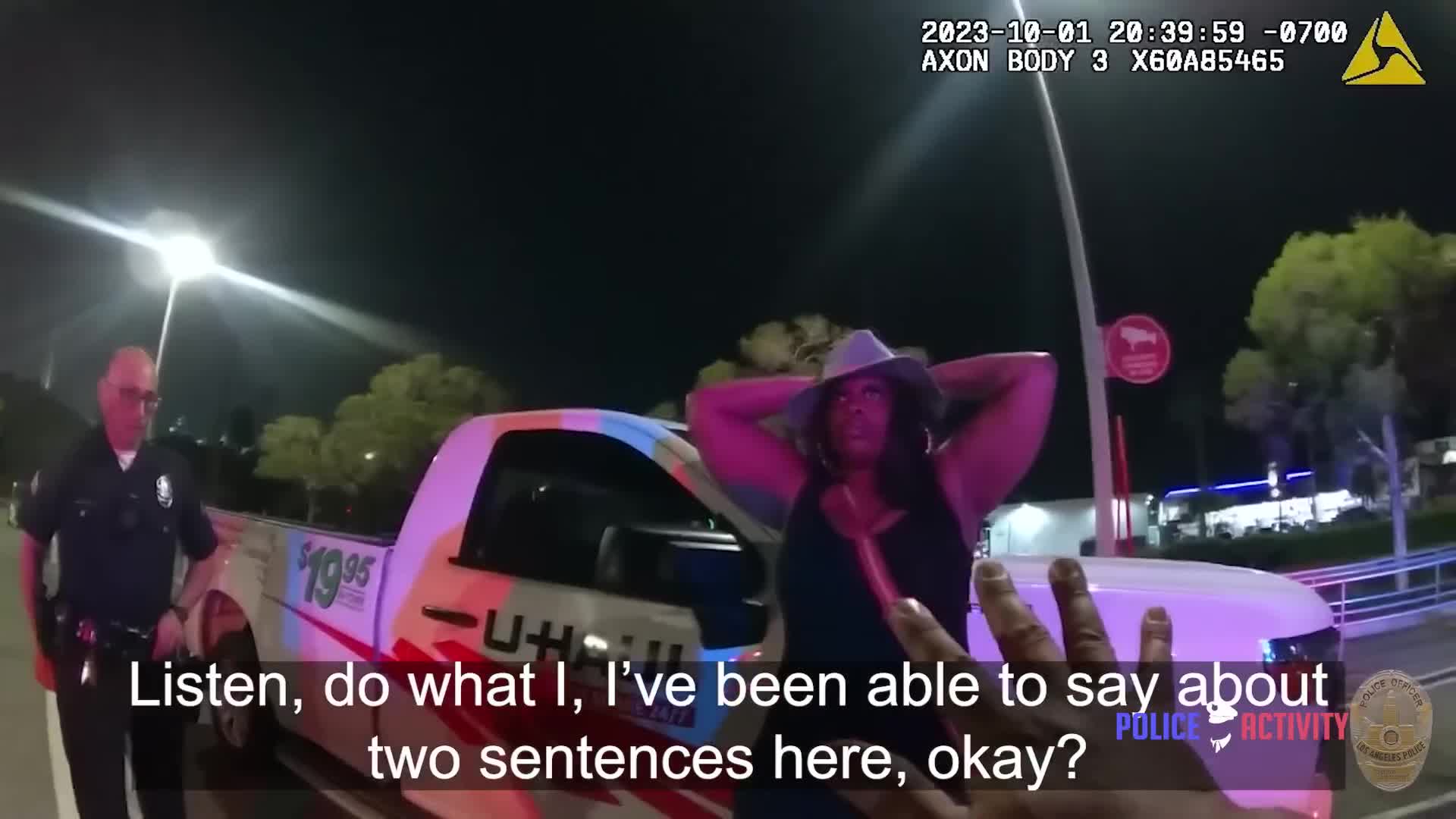
Officers Spend Time Trying to Resolve the Dispute Peacefully
The length of the discussion is one of the most important elements of the full video. Short clips of the shooting can make the event appear to begin with a vehicle suddenly moving through a parking lot. The longer sequence shows how much happened before that moment.
Scott talks with officers about the custody arrangement and expresses frustration with the situation. Officers continue checking the information available to them rather than simply accepting one side's version. That is particularly important in custody disputes, where family relationships do not necessarily determine who has legal authority to take a child.
Eventually, police determine that Scott does not have the legal right to leave with the child. Officers facilitate the transfer. At that point, the central reason for the original call appears to have been resolved.
This is where the encounter could have ended. Scott still has her vehicle, officers are present, and the child is no longer inside the truck. Instead, the next phase unfolds rapidly once Scott begins driving through the parking lot.
The White U-Haul Pickup Becomes the Center of the Incident
LAPD identified Scott's vehicle as a white Chevrolet U-Haul pickup truck. Its size and bright markings make it easy to track across the different camera views included in the released video.
After the custody exchange, Scott gets into the truck and initially appears to be leaving. Officers and the other involved adults remain in the parking lot. According to LAPD, Scott then turns and drives north toward the victim and an officer.
The victim was later identified in news reporting as April Barnes, who was assisting the foster caregiver. Surveillance footage provides a wider view than the body cameras and captures the truck accelerating across the parking area. Barnes is struck by the vehicle while an officer nearby narrowly avoids being hit.
That moment changes the nature of the police response immediately. The original custody dispute is no longer the primary problem. Officers are now confronting what LAPD describes as a deliberate vehicle assault.
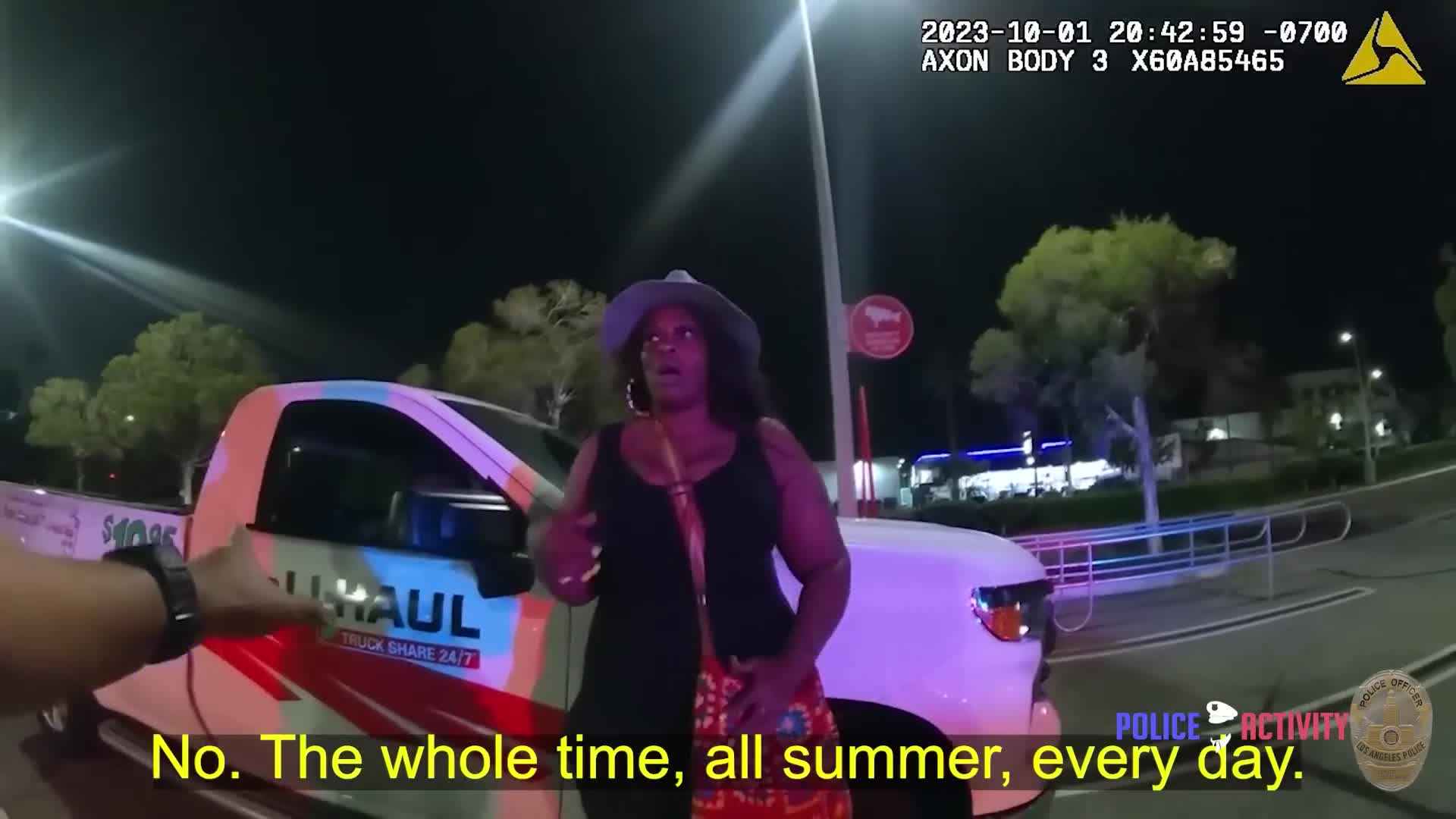
A Pedestrian Is Struck as an Officer Narrowly Avoids the Truck
The surveillance perspective is especially important because body-worn cameras have limitations during a fast-moving vehicle event. An officer may turn, run or lose sight of the vehicle, while a fixed camera preserves the wider geometry of the scene.
LAPD's investigation concluded that Scott accelerated into Barnes and nearly struck one of the officers. Barnes later spoke publicly about the incident and described ongoing pain after being run over. Initial reports said she was treated at the scene and released.
The footage should be described carefully. The truck's movement, the collision and the proximity of officers are visible. The legal question of Scott's intent was ultimately resolved later through the criminal case rather than solely through interpretation of the video.
At the time of the incident, police treated the vehicle as an immediate threat. Officers broadcast an emergency help call, and another officer positioned farther along Scott's path was confronted with the approaching pickup.
Sergeant Jose Pedroza Fires as the Truck Approaches
LAPD later identified the officer who fired as Sergeant I Jose Pedroza of Harbor Division. According to the department's preliminary release, Scott drove south toward Pedroza and another officer after striking Barnes.
Pedroza fired at the moving vehicle. Scott was not hit by the gunfire. The footage captures how little time separates the collision with Barnes from the officer-involved shooting. The parking-lot dispute has transformed into a rapidly moving vehicle threat in seconds.
The distinction between firing at a vehicle and firing at a person who happens to be inside a vehicle is important in police policy. Vehicle-related shootings receive intense scrutiny because bullets may not immediately stop a moving car and because officers can sometimes move out of a vehicle's path. At the same time, a vehicle deliberately driven at people can constitute deadly force.
LAPD's Force Investigation Division responded to investigate the shooting. The department's process required the incident to be reviewed by the Chief of Police, Board of Police Commissioners and Office of the Inspector General. The Los Angeles County District Attorney's Office was also expected to review the evidence regarding the use of force.
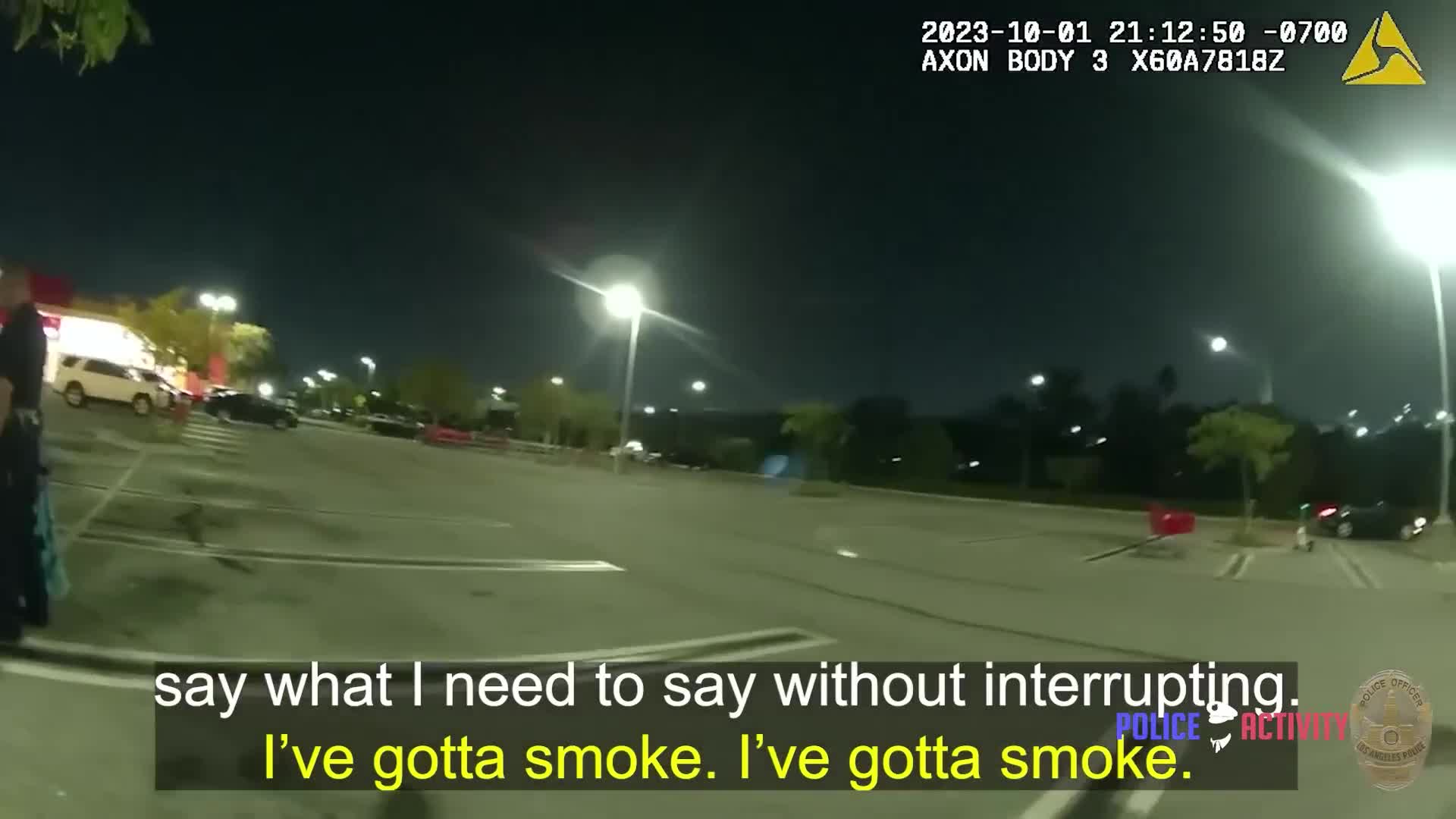
The Encounter Turns Into a Pursuit
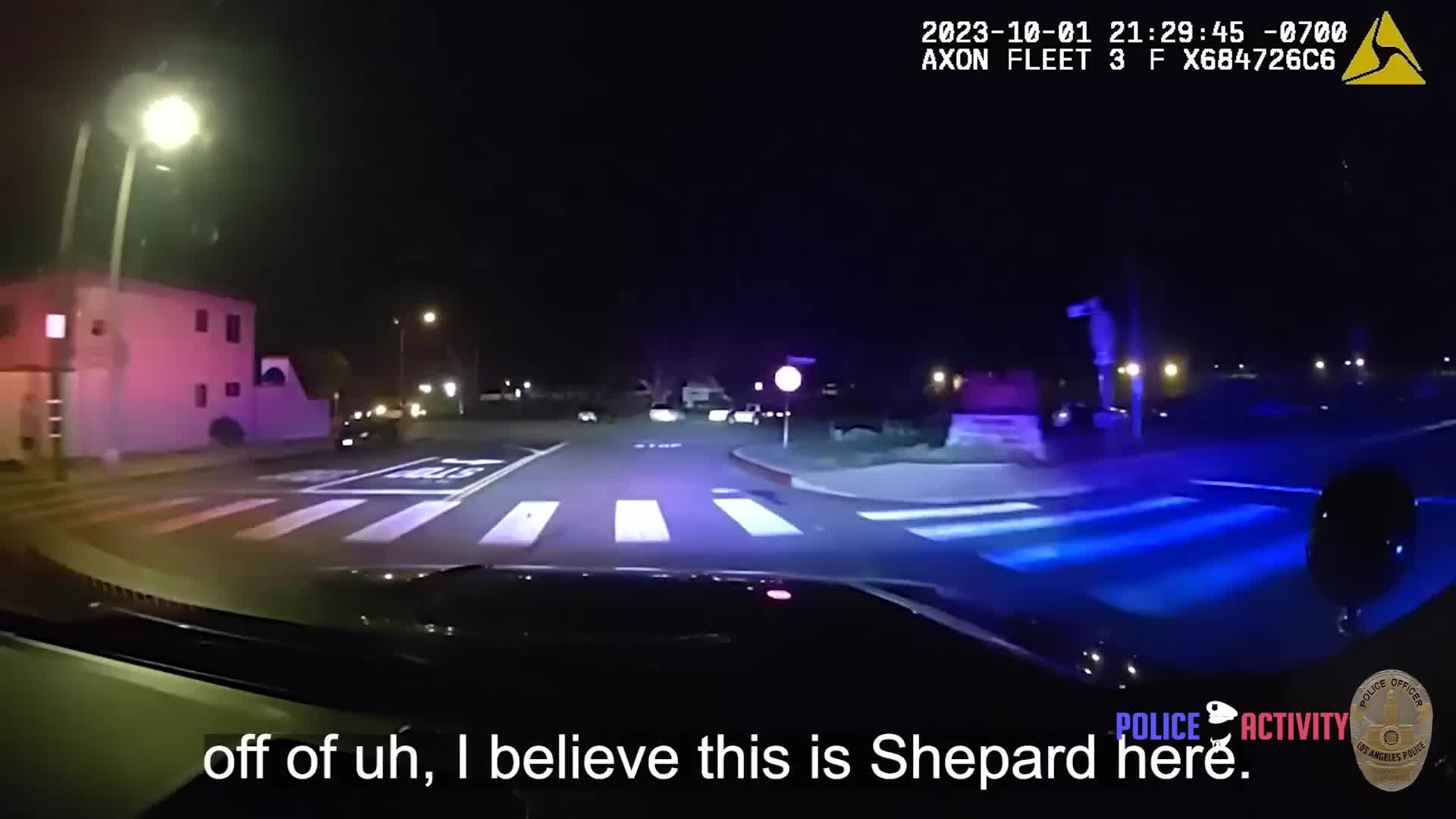
Scott does not stop after the officer fires. She leaves the Target parking lot, and officers initiate a pursuit.
The released video shifts among body-worn cameras and vehicle-mounted views, allowing the viewer to follow the transition from a static custody dispute to a moving police response. Officers broadcast information and coordinate as they follow the U-Haul through San Pedro.
Pursuits create a different category of risk from the confrontation in the parking lot. Officers have to balance apprehending a person suspected of serious violence against the danger that continued high-speed driving creates for uninvolved motorists and pedestrians.
In this case, the pursuit does not continue indefinitely. LAPD says it ends near Pacific Avenue and Paseo Del Mar when Scott's truck crashes into a tree. The collision disables the vehicle and brings the moving phase of the incident to an end.
The Crash Ends the Flight
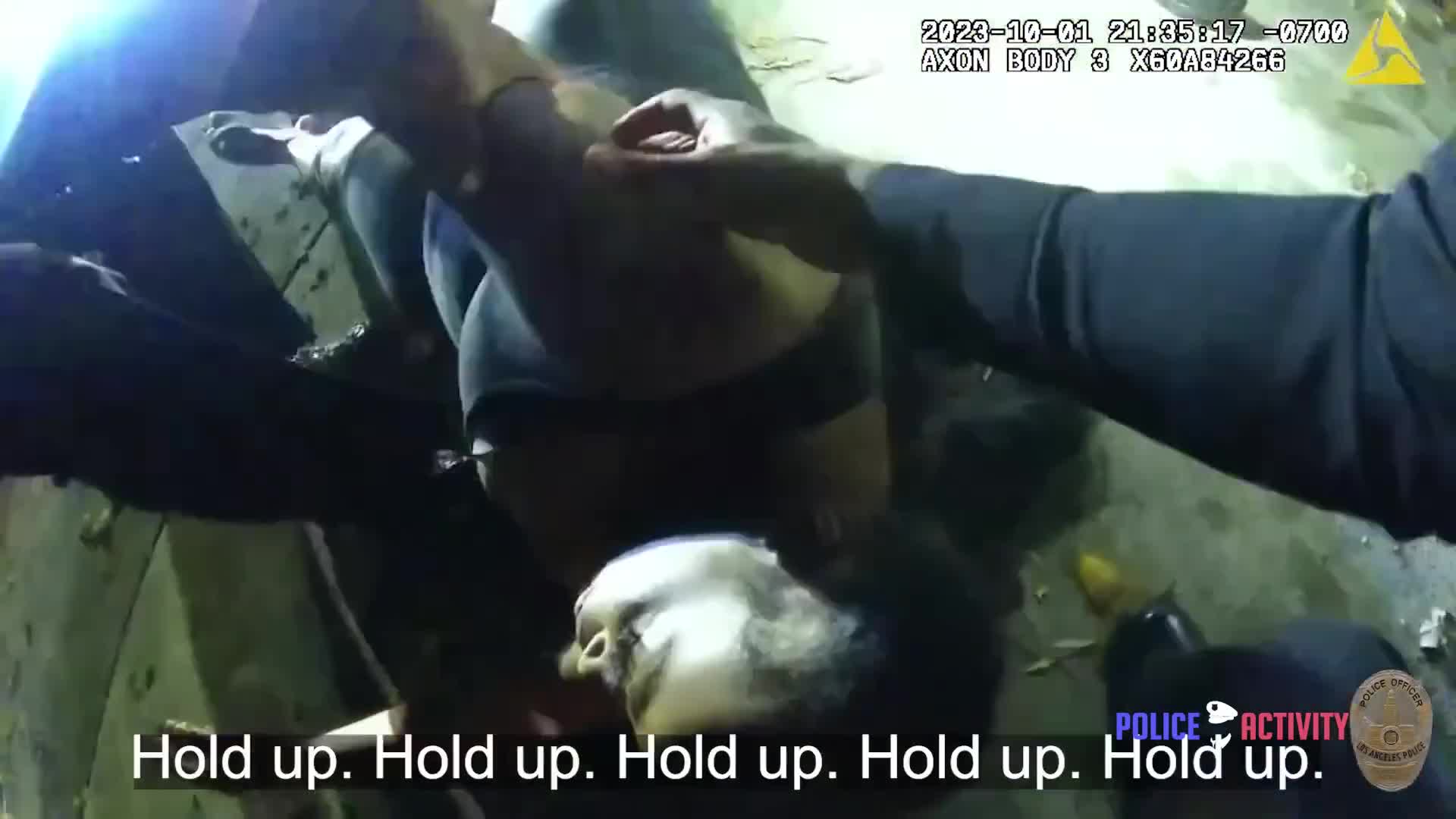
After the U-Haul strikes the tree, officers converge on the vehicle and Scott is taken into custody without another major confrontation.
Los Angeles Fire Department personnel respond to the pursuit termination and transport Scott to a hospital. LAPD said she suffered injuries from the crash rather than from police gunfire. Medical staff later cleared her for booking.
Barnes also received medical attention for the injuries caused when the truck struck her. LAPD reported that no officers or other community members were injured during the incident.
The truck was impounded as evidence. Investigators then faced several related questions: the circumstances of the vehicle assault, Scott's actions toward officers, the pursuit and collision, and the separate question of whether the officer-involved shooting complied with department policy and law.
Initial Charges Were Serious, but They Were Not the Final Outcome
LAPD initially booked Scott for attempted murder and assault with a deadly weapon on a peace officer using a vehicle. Contemporary news reports said prosecutors also pursued allegations connected to the pursuit and described two attempted-murder counts.
Those early charges were allegations. At that stage, Scott had not been convicted, and it would have been inaccurate to describe every booking offense as a proven crime.
The case eventually reached a much clearer legal resolution. California appellate records now show that Scott pleaded no contest to one count of attempted murder arising from the custody-exchange incident in which she struck the victim with her vehicle.
The court record also states that Scott admitted a prior strike conviction under California's Three Strikes law. The trial court selected the middle term of seven years for the attempted-murder conviction and doubled it to 14 years because of the prior strike.
The Latest Court Record Provides a Definitive Legal Ending
The most important update came from the California Court of Appeal in March 2026. In People v. Scott, case number B346633, the Second District Court of Appeal reviewed Scott's judgment.
The appellate opinion identifies her as Miesha Licole Scott and confirms that she pleaded no contest to one count of attempted murder under Penal Code sections 187 and 664. It specifically describes the offense as arising from a custody exchange in which Scott hit the victim with her vehicle.
Scott received a 14-year prison sentence after the seven-year middle term was doubled under the Three Strikes law. She appealed the judgment and requested a certificate of probable cause.
Appointed appellate counsel ultimately filed a Wende brief, asking the Court of Appeal to independently examine the record for arguable issues. The appellate court did so and concluded that no arguable issues existed. On March 19, 2026, it affirmed the trial court's judgment.
That appellate decision gives this incident a far more complete ending than the original 2023 reports. Scott is no longer simply a woman “facing” attempted-murder charges. Her case resulted in a no-contest plea, a 14-year sentence and an affirmed judgment.
Why the Full Video Changes the Story
The most dramatic seconds are easy to isolate: a pickup accelerates, a pedestrian is hit, an officer fires and a pursuit begins. But those seconds make more sense after watching the lengthy police interaction that precedes them.
Officers did not arrive for a report of a vehicle assault. They arrived for a custody dispute. They spent time verifying the legal arrangement and facilitated a peaceful transfer. Only after that transfer did Scott's behavior create the immediate physical danger documented in the later footage.
The multiple camera angles are also valuable. Body-worn footage captures the officers' limited perspectives and communications. Surveillance footage shows the truck's path across the parking lot. Dash-camera material follows the pursuit. Taken together, the recordings provide a much fuller reconstruction than any one camera could.
External records then add what the video cannot: Scott's identity, the formal investigation, the charges and the final court outcome.
A Case With Two Separate Questions of Accountability
This incident involved two different accountability processes. The first concerned Scott's conduct. Police and prosecutors investigated the vehicle assault and related events, and the criminal case ultimately produced an attempted-murder conviction based on a no-contest plea and a 14-year prison sentence.
The second concerned the officer's use of deadly force. Officer-involved shootings in Los Angeles trigger a specialized investigative and administrative process. The fact that Scott was later convicted does not automatically answer every policy question about the shooting. Those reviews examine what the officer reasonably perceived at the instant force was used.
This separation is important. Criminal liability for a suspect and administrative or legal review of police force are not mutually exclusive. Both can be examined using their own standards.
LAPD's later categorical-use-of-force materials describe the incident as an officer-involved shooting in which the subject drove toward officers after intentionally striking the victim. Those official records preserve the department's reconstruction of the event beyond the initial press release.
From a Family Dispute to a 14-Year Sentence
Few elements of the opening encounter predict where the case will end. The initial problem is a disagreement about custody. Officers talk with the adults, verify information and transfer the child. For a brief moment, the police mission appears complete.
Then Scott enters the U-Haul and the character of the incident changes entirely. Barnes is struck. Officers scatter from the vehicle's path. Sergeant Pedroza fires. Scott flees, and the chase ends against a tree near the coast.
The criminal process lasts far longer than the footage. What viewers saw in 2023 as breaking news eventually became a Superior Court judgment and then an appellate case. By March 2026, the Court of Appeal had affirmed the judgment and confirmed the 14-year sentence.
That updated outcome is essential to a current account. Older articles correctly describe Scott as charged with attempted murder and assault-related offenses because that was her legal status at the time. Today, the stronger and more precise statement is that she pleaded no contest to attempted murder for striking the victim with her vehicle and received a 14-year prison sentence.
What the Footage Leaves Behind
The full release documents an unusual chain of escalation: a family dispute, a prolonged police negotiation, a peaceful custody transfer, a sudden vehicle assault, an officer-involved shooting, a pursuit and a crash.
No single frame explains all of it. That is why the complete sequence matters. It shows officers before the threat develops, the people standing in the parking lot, the truck's movement, the immediate police reaction and the pursuit that follows.
The later appellate record completes the story in a way the cameras cannot. Miesha Scott's legal case did not disappear after the viral footage. It ended with a no-contest plea to attempted murder, a sentence enhanced by California's Three Strikes law and an unsuccessful appeal.
The case is therefore best understood not simply as an officer firing at a fleeing vehicle, but as a sequence in which a resolved custody exchange suddenly became a serious vehicle assault and then a criminal case carrying a lengthy prison term.
Comments (0)
Loading comments...
May You Like
Everything Changed When Cops Asked About Weapons

Neighborhood Grocery Store Suddenly Erupts Into Chaos
Female Driver Destroys Three Lives in a Matter of Minutes