
K9 Gunner Tracks Down Dangerous Carjacking Suspect
K9 Gunner Leads an Oklahoma City Search Through Yards and Tight Backyard Spaces
A clear winter morning in Oklahoma City turned into a methodical K9 search on February 12, 2026. Body-camera footage supplied for this story shows an Oklahoma City Police Department dog team moving from an open residential street into increasingly confined spaces around homes, fences, outdoor equipment and backyards. At the center of the operation is K9 Gunner, a police dog already known well beyond Oklahoma City because of an earlier national news story about his handler and the department’s experiment with artificial-intelligence-assisted police reports.
The footage carries an AXON BODY 4 timestamp of February 12, 2026. At 10:03 a.m., Gunner can be seen on leash in the street as his handler prepares to continue the search. Less than a minute later, the team is moving into the narrow space behind a residence. The transition is important: an open roadway offers long sightlines, while a backyard filled with fences, air-conditioning equipment, furniture and corners can conceal a person only a few feet away.
The images do not, by themselves, establish every detail of the underlying call. Publicly searchable reporting reviewed for this article did not provide a sufficiently detailed incident report matching the February 12 footage, so names, charges and an arrest outcome are not being invented. What can be established is the date shown by the body camera, the Oklahoma City Police K9 identification supplied with the footage, and Gunner’s documented service with Oklahoma City police.
That verified background makes the video worth examining closely. Gunner is not simply an unidentified police dog appearing in a random body-camera clip. National Associated Press reporting previously identified him as the K9 partner of Oklahoma City Police Sgt. Matt Gilmore. During an earlier search, Gilmore and Gunner spent nearly an hour looking for a group of suspects while the sergeant’s body camera captured the search, radio traffic and even Gunner’s barking. The recording later became a prominent example of Oklahoma City’s testing of Axon’s Draft One system, which could create a first draft of a police report from body-camera audio.
The February 2026 footage provides a newer look at the practical work behind that kind of report: a handler reading a dog, controlling a leash, checking corners and moving through spaces where visibility changes every few steps.
A K9 Team Begins Working a Residential Street
The first supplied body-camera frame is timestamped 10:03:56 a.m. The weather is clear and bright. Leafless trees suggest the winter season, and the sun is high enough to create sharp shadows across the pavement.
Gunner is visible at the end of the leash, moving forward with his body low and attention directed toward the search area. The handler’s hands dominate the foreground because leash management is a constant part of K9 work. The officer has to give the dog enough freedom to work while maintaining enough control to prevent Gunner from moving too far ahead or entering an unsafe location before officers can assess it.
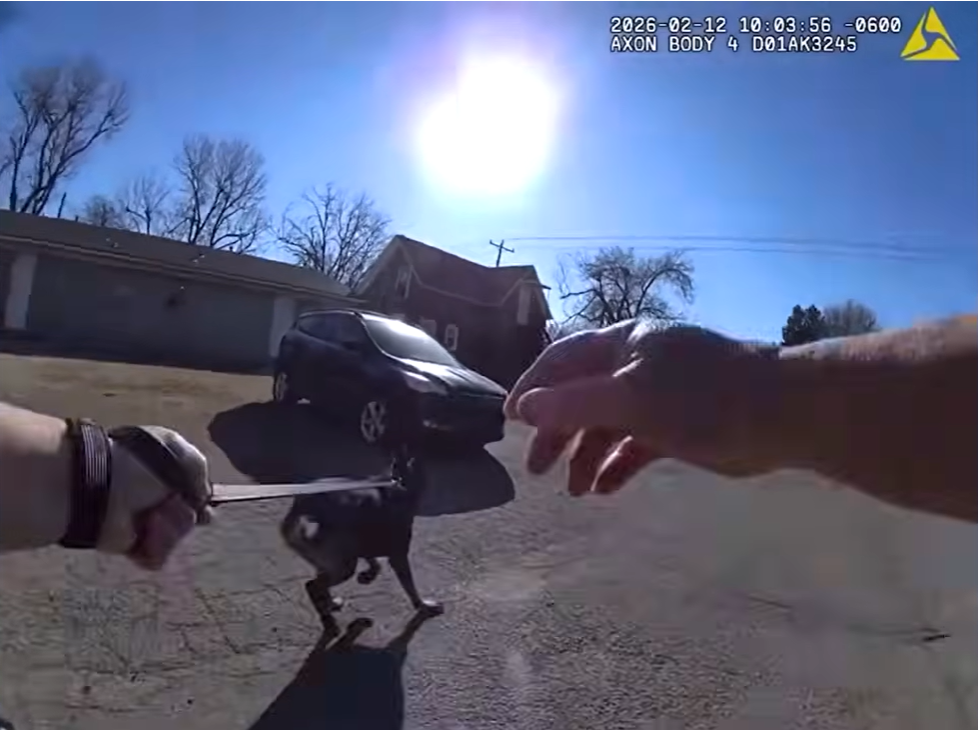
Unlike a conventional foot search, the handler is not simply looking for a person. He is also watching the dog for behavioral changes. A trained police K9 may change pace, pull differently, focus on a particular opening or show other indications as it encounters scent.
That makes the handler-dog relationship central to the operation. Gunner cannot explain what he detects. The handler has to interpret his behavior while simultaneously remaining aware of fences, vehicles, residents and other officers.
The Search Moves Off the Street
Only 33 seconds separate the first supplied search frame from the second. Yet the environment changes completely.
At 10:04:29 a.m., the team is beside a house. A tall white privacy fence blocks the view ahead. An outdoor air-conditioning unit occupies much of the narrow path. Chairs, containers and other objects create additional obstacles. Gunner is partly visible at the left side of the frame as the handler works the dog through the area.
This is where K9 tracking becomes particularly useful.
A person fleeing through a neighborhood can disappear from human sight almost instantly. Turn around a garage, pass through a gate or move between houses and visual contact is gone. Officers arriving seconds later may face several possible directions of travel.
A dog trained to follow human scent offers another source of information. Instead of relying exclusively on what officers can see, the K9 team can work the path left by the person they are searching for.
Backyards Create a Different Kind of Risk
Residential searches are complicated because every fence or shed creates another blind spot.
An officer walking through an open field can often see a significant distance. Behind a house, the officer may not know what is around the next corner. A suspect could be crouched behind an appliance, inside a shed, beneath a deck or on the opposite side of a fence.
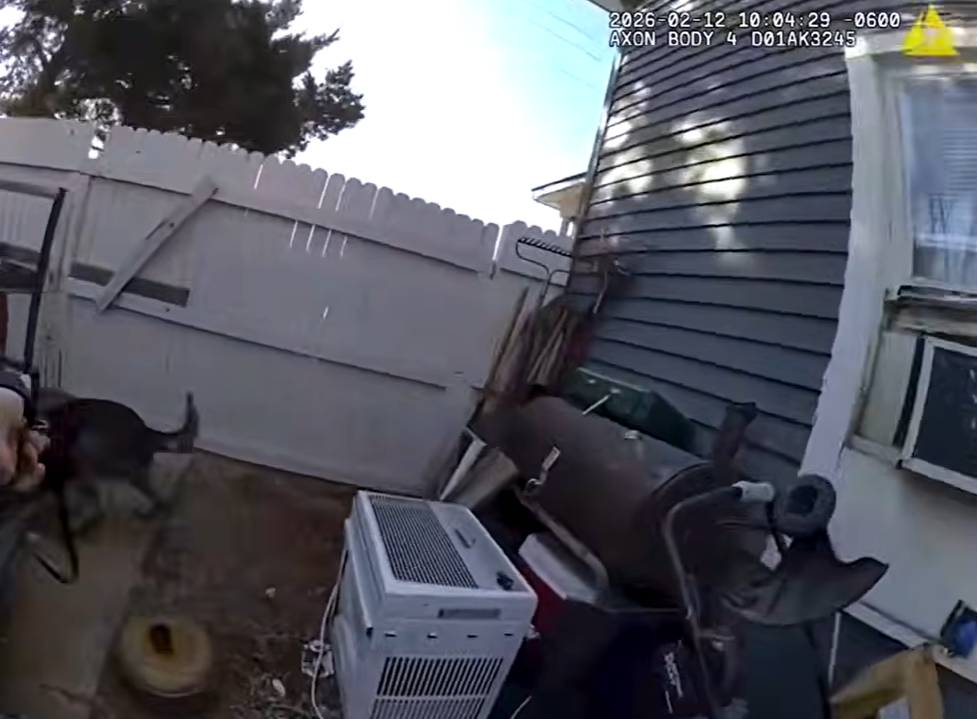
There are also people who have nothing to do with the police operation. Homeowners may step outside. Pets may be present. Gates may lead into neighboring properties. Officers must balance the need to continue the search with the need to avoid surprising residents or allowing a police dog to enter an area without control.
The second frame illustrates those constraints clearly. Gunner and the handler are not moving through an empty training field. They are navigating an ordinary residential space packed with objects and limited sightlines.
Why Gunner Is a Recognizable Oklahoma City Police K9
Gunner gained national attention in 2024 for a reason unrelated to a dramatic K9 apprehension.
The Associated Press reported that Sgt. Matt Gilmore and Gunner had searched for a group of suspects for nearly an hour. Gilmore’s body camera recorded the operation. Normally, the sergeant said, he would then spend roughly 30 to 45 minutes writing a report.
Oklahoma City Police was experimenting with Axon’s Draft One, an artificial-intelligence system designed to generate the first draft of an incident report using body-camera audio. In Gilmore’s example, the system produced a draft in seconds.
The AP story made Gunner part of a national debate over AI in policing. Supporters emphasized the amount of administrative time officers might save. Critics and legal scholars raised questions about accuracy, disclosure, evidence and whether officers might become too dependent on automatically generated narratives.
For Gunner, of course, none of that changed the physical job. The dog still had to search.
The Dog Does the Same Work Regardless of How the Report Is Written
The contrast between the technology story and the February 2026 footage is useful.
Draft One deals with what happens after or during the documentation of an incident. Gunner’s work occurs in the physical environment.
No software can smell a track through a backyard. It cannot pull a handler toward a gate because a scent continues in that direction. It cannot distinguish between the dog’s normal movement and a behavioral change that an experienced handler recognizes as significant.
The body camera can preserve what happens, and software may help organize recorded information later, but the search itself remains dependent on training, judgment and the relationship between the officer and the dog.
Body Cameras Show Only One Piece of the Search
Body-camera footage can feel comprehensive because the viewer sees what the officer sees. In reality, it is a narrow perspective.
The camera is attached to the officer’s body, so the image moves whenever the officer turns, bends or uses his hands. The dog may move outside the frame. Another officer may be speaking from behind the camera. A person being searched for may be only a few yards away but completely hidden by a fence.
This is one reason it would be irresponsible to infer an arrest, a specific offense or a suspect’s identity solely from the three supplied images.
The timestamp tells us when the camera was recording. The K9 title and documented background identify Gunner and the Oklahoma City Police Department context. The visible environment tells us how the search unfolded spatially. Those are strong facts. Details beyond them require a matching official report or reliable local reporting.
A Search Can Change in Seconds
The two search frames are only about half a minute apart.
In the first, Gunner is working on pavement with the street and neighboring homes visible.
In the second, the team is pressed into a narrow passage beside a house.
That rapid transition is typical of foot searches. A fleeing person does not need a car to create distance. A few seconds can be enough to cross a yard, jump a fence or move behind a structure.
For the K9 handler, maintaining continuity is crucial. Losing the trail at a fence or intersection can expand the search area dramatically. If Gunner can continue through the transition, officers have a better chance of narrowing where the person went.
Leash Control Is More Important Than It Looks
One of the most visible features of the first image is the leash.
To a casual viewer, it may appear that the officer is simply holding back an excited dog. In reality, the leash is a communication and safety tool.
The handler needs to avoid constantly pulling the dog away from the scent while also preventing Gunner from rounding a blind corner far ahead. Too much tension can interfere with movement. Too little control can expose the dog to hazards.
The officer must also manage the leash around parked cars, fences, outdoor equipment and vegetation. A tangled line can stop the team at exactly the wrong moment.
That physical coordination is one reason K9 teams train repeatedly. The dog and handler need to operate as a unit rather than as an officer simply following an animal.
Gunner’s Nose Changes the Geometry of the Search
Without a K9, officers searching a residential block have to think visually.
Where could someone hide? Which gate is open? Which yard offers the easiest escape? Did a witness see someone run north or south?
Those questions remain important with Gunner present, but scent adds another layer.
A hiding place that looks excellent to a person may be much less effective against a trained dog. A solid fence can block an officer’s view without erasing the path taken to reach it. A person can crouch behind furniture and remain visually concealed while still leaving scent in the area.
This does not mean a police dog is infallible. Wind, contamination, time, weather and the presence of other people can affect scent work. But in the right circumstances, a K9 can dramatically reduce the number of places officers need to check blindly.
The Search Environment Is Full of Competing Scent
A neighborhood is not a sterile environment.
Residents walk through yards. Delivery workers approach houses. Pets move between indoor and outdoor spaces. Garbage containers, vehicles and vegetation create strong odors. Other officers entering the area can also contaminate a track.
The K9 therefore works within a complicated scent environment rather than following an invisible line that only the dog can detect.
Handlers must consider where the target was last seen and how other people have moved through the scene. The closer the team begins to a reliable starting point, the more useful the track can be.
That context makes the apparently simple body-camera sequence more interesting. Gunner’s movement is part of a larger process of interpreting the environment.
Why Police Dogs Are Often Used After Visual Contact Is Lost
The most obvious time to request a K9 is when officers know someone ran but no longer know exactly where that person is.
If officers maintain direct visual contact, they can simply follow. Once the person disappears behind houses or vegetation, every possible route becomes a question.
A K9 team can help answer that question without immediately flooding every yard with officers.
The dog may lead the handler toward a particular fence line, alley, structure or block. Other officers can then reposition around that information.
This can make a search more efficient and may reduce unnecessary entry into unrelated properties.
Gunner’s Earlier Search Became a National Technology Story
The Associated Press article involving Gunner was published in August 2024 and syndicated widely across the United States.
Its focus was not the identity of the suspects Gunner had been searching for. The story focused on what happened afterward: Oklahoma City Police used body-camera audio to help generate a draft police report with artificial intelligence.
Gilmore told the AP that the generated report included a detail he did not remember hearing during the incident: another officer’s reference to the color of the vehicle from which the suspects had fled.
That example was presented as evidence of the technology’s potential value. A body camera can record far more information than an officer consciously remembers while concentrating on a search.
But the same example generated concern among legal experts because a police report can influence charging decisions, detention and court proceedings. If AI adds an error, a convincing but false detail could become part of a consequential document.
Oklahoma City Became Part of a Broader AI Policing Experiment
Axon is one of the major suppliers of body cameras to American law-enforcement agencies. Draft One was designed to use recordings from those cameras to produce narrative drafts.
Oklahoma City was among the departments testing the technology when the AP examined it in 2024.
The potential benefit was obvious: time.
Officers can spend substantial portions of a shift documenting incidents. A long search may produce an equally long report. If software can accurately organize the recorded sequence into a first draft, an officer may spend less time typing and more time on other duties.
The concern is equally obvious: police reports are not casual summaries. They become part of the criminal-justice record.
For that reason, the human officer remains responsible for reviewing what the software produces.
The February 2026 Footage Brings the Story Back to the Street
Nearly two years after Gunner appeared in the national AI discussion, the February 2026 body-camera images show the dog doing what police K9s have done long before generative AI existed.
He works a leash.
He moves through a neighborhood.
He checks spaces human officers cannot evaluate from the street.
His handler follows and interprets his behavior.
The contrast is striking. The reporting technology may change rapidly, but the physical search remains grounded in traditional K9 training.
Why the Timestamp Matters
The AXON overlay is one of the strongest verification clues in the supplied footage.
Both search images display February 12, 2026. The first reads approximately 10:03:56. The second reads approximately 10:04:29.
That allows the sequence to be ordered confidently.
It also prevents the footage from being confused with Gunner’s much more widely reported 2024 search. Gunner’s name appears in numerous syndicated articles from 2024, but the supplied video is clearly a later event.
This distinction matters because combining two separate incidents would create a false narrative. The 2024 reporting is useful for establishing Gunner’s documented identity and professional background. It should not be used to invent the reason for the February 2026 search.
What We Can Verify and What Remains Unconfirmed
A reliable article should be explicit about the boundary between the two.
The body-camera images verify that the supplied footage was recorded on February 12, 2026 and show a K9 search in a residential environment.
The supplied title card identifies the dog as K9 Gunner of the Oklahoma City Police Department.
Independent Associated Press reporting confirms that Oklahoma City Police Sgt. Matt Gilmore worked with a K9 named Gunner and that the pair had previously participated in suspect-search operations.
What the reviewed public sources do not yet establish is the identity of the person being sought in this specific February 12, 2026 footage, the original offense, whether the search ended in an arrest, or what charges resulted.
Those details are deliberately omitted rather than guessed.
That Limitation Does Not Make the Footage Meaningless
Police footage is often published online with a dramatic title and very little context. The temptation is to fill missing information with assumptions.
That is unnecessary here.
The actual search process is interesting on its own.
The viewer can watch how quickly Gunner moves from the street into a backyard environment. The handler’s perspective demonstrates why a dog is useful when fences and structures destroy sightlines. The timestamps allow the movement to be reconstructed almost second by second.
And Gunner’s documented history provides a verified background without pretending that his earlier cases are the same incident.
Police K9 Work Is Often More About Searching Than Apprehending
Popular videos tend to emphasize the final capture because that is the most dramatic moment.
But much of a police dog’s working life consists of searching.
A K9 may spend long periods following scent without ever making physical contact with a suspect. The dog may locate discarded evidence, identify a hiding place or simply help officers determine that a person did not travel in a particular direction.
Success does not necessarily mean a bite or tackle.
If the dog helps officers find someone who then surrenders, the K9 has done its job without physical force. If the dog directs officers toward evidence, that can be equally valuable.
The February 2026 frames emphasize this quieter side of K9 operations.
The Handler Has to Process Two Worlds at Once
A K9 handler is simultaneously working in the dog’s world and the officer’s world.
In the dog’s world, scent and behavior matter. Is Gunner pulling harder? Has his direction changed? Is he showing interest in a gate or corner?
In the officer’s world, tactical safety matters. Is the gate open? Is another officer covering the next yard? Is there a resident nearby? Could a suspect be waiting around the corner?
The handler has to combine both streams of information in real time.
That is why the body-camera view can seem chaotic. The officer’s hands may fill the frame while manipulating the leash. The dog may briefly disappear from view. Radio traffic may overlap with commands.
From the handler’s perspective, all of those things are happening at once.
A Narrow Backyard Can Be More Difficult Than an Open Field
The second supplied image illustrates a counterintuitive point.
A smaller search area is not always an easier search area.
The space beside the house is narrow, but almost every object blocks visibility. The privacy fence is taller than the dog. The air-conditioning unit creates a blind spot. Outdoor furniture and stored items break up the remaining space.
If a person is hiding nearby, officers may be forced to get very close before seeing them.
Gunner gives the team another way to evaluate those hidden spaces before an officer simply walks into them.
The Search Is a Reminder of What Body Cameras Actually Capture
Body cameras are often discussed in terms of accountability, but they also create detailed operational records.
The February 12 footage records time, movement and environment.
It shows how officers enter a property, how the K9 is controlled and how rapidly the search moves.
Those details can later help supervisors review tactics, help investigators reconstruct an incident and help courts understand what officers encountered.
They can also provide the raw material for automated reporting systems such as the one Oklahoma City tested.
That makes Gunner’s career an unusual intersection of traditional police work and emerging technology.
From Scent Work to Artificial Intelligence
There is something almost paradoxical about Gunner’s public profile.
The dog represents one of the oldest forms of law-enforcement assistance: using an animal’s extraordinary sense of smell to locate people.
At the same time, Gunner became associated nationally with one of the newest tools in policing: generative artificial intelligence.
In one part of the workflow, a trained German Shepherd follows scent through the physical world.
In another, software analyzes the sounds recorded by a digital body camera and organizes them into text.
The February 2026 footage sits between those two technologies. Gunner searches. The camera records. A human officer remains responsible for decisions throughout.
Why the Human Role Still Matters
Neither the dog nor the software operates independently.
Gunner needs a trained handler to understand his indications, manage the leash and decide where it is safe to go.
AI-generated reports need an officer to review the draft, correct errors and take responsibility for the final document.
Both tools can expand what an officer can do, but neither eliminates judgment.
That is the broader lesson behind the footage. Technology can change the search and documentation process, but the quality of the result still depends heavily on the people using it.
A Search With More Questions Than Public Answers
The available footage leaves the viewer wanting to know how the February 12 operation ended.
Who was police looking for?
What brought officers to the neighborhood?
Did Gunner locate the person?
Was anyone arrested?
Those are reasonable questions, but a responsible account cannot answer them without evidence.
Public web searches reviewed for this article did not surface a detailed Oklahoma City Police release or reliable local report that could be confidently matched to the 10:03 a.m. body-camera sequence.
Rather than combining unrelated February 12 police calls with the footage, this article keeps the verified account narrow.
What the Footage Clearly Shows
Even with those limits, the video documents a recognizable K9 operation.
Gunner is deployed on leash in a residential area.
The team moves from the roadway toward private-property spaces.
The handler works the dog around obstacles and into a confined backyard area.
The timestamps establish that this movement occurs within seconds.
The title material identifies the team with Oklahoma City Police, while independent reporting establishes Gunner’s previous service with Sgt. Matt Gilmore.
Those facts are enough to tell a useful story about the search without adding a fictional suspect or outcome.
Gunner’s Work Is the Real Center of the Video
The most compelling part of the footage is not a dramatic confrontation. It is the process.
Gunner starts on the street.
The leash tightens as he works.
The handler follows.
The environment closes around them.
A few seconds later, the team is beside a house where almost every direction is obscured.
That is exactly the situation in which a K9 can become valuable.
The dog does not need a clear line of sight. He needs a usable scent trail and a handler capable of reading him.
A Veteran Police Dog in a Changing Era of Policing
Gunner’s documented story offers a useful snapshot of modern American police work.
The K9 itself represents a long-established law-enforcement specialty.
The AXON camera on the handler represents a more recent expectation that police encounters be recorded.
The Draft One experiment associated with Gunner’s earlier search represents the newest layer: software attempting to transform those recordings into written documentation.
All three appear in the same professional ecosystem.
Yet when the team enters a backyard, the core task is remarkably simple: find where the person went and do it safely.
Watch the Full K9 Search
The still images show only brief moments. The complete footage is necessary to appreciate how quickly the handler and Gunner move from the open street into the confined search area and how the dog’s behavior guides the team through the property.
Comments (0)
Loading comments...
May You Like

Stolen Charger Flees Police During Highway Traffic Stop

One Driver’s Decision to Flee Brings Police Racing After Him

Entitled Driver Learns Why You Must Obey Lawful Orders During Traffic Stop












