INTOXICATED FEMALE BARRICADED IN HER VEHICLE AT THE US / CANADIAN BORDER CROSSING
Driver at the U.S. Canada Border Locks Herself in Her SUV as a DUI Stop Spirals Out of Control
A Border Crossing Turns Into Something Nobody Expected
It was shortly before 8 a.m. on September 22, 2024, at the U.S.–Canada border north of Lynden, Washington.
For most travelers passing through this part of Whatcom County, the crossing is straightforward. Vehicles approach the inspection area, drivers present the necessary documents, and traffic moves between Washington and British Columbia.
But on this Sunday morning, one vehicle was not moving on.
Instead, law enforcement officers had gathered around it.
Washington State Patrol troopers were dealing with what the footage identifies as a DUI investigation, while deputies from the Whatcom County Sheriff's Office arrived to assist.
And inside the SUV was a woman who apparently had no intention of making the encounter easy.
What begins as officers attempting to communicate with a driver quickly develops into a standoff around a locked vehicle.
Commands are given.
Officers attempt to reason with her.
The doors remain locked.
Then officers are forced to decide how long they can allow a potentially impaired driver to remain secured inside a vehicle she still controls.
The answer changes the entire encounter.
This is not simply another roadside DUI stop. It unfolds directly beside an international border facility, involving multiple agencies and a driver whose refusal to exit forces officers to escalate their response step by step.
And once the glass breaks, there is no returning to the quiet beginning.
Deputies Arrive to Assist Washington State Patrol
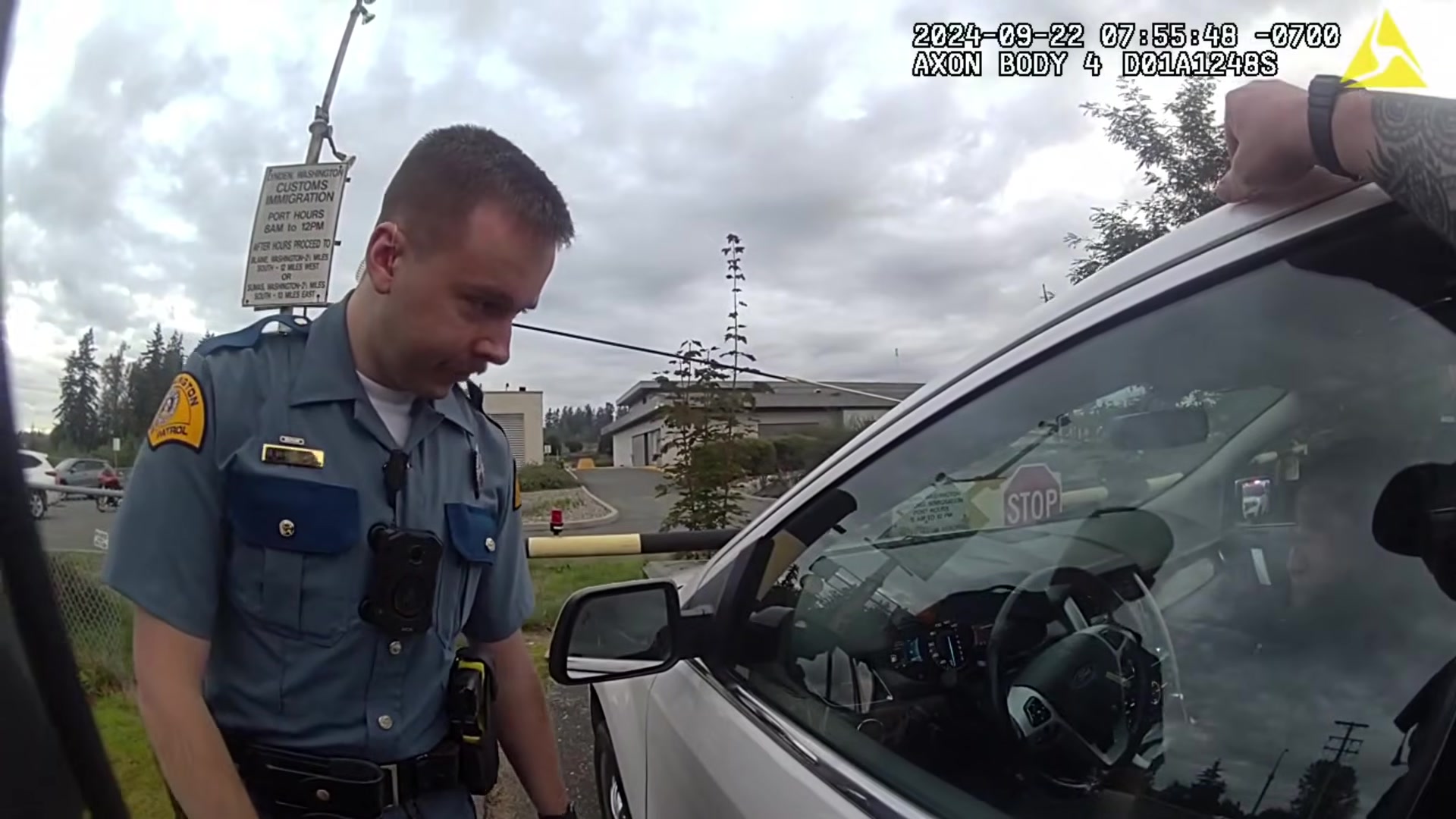
The bodycam footage establishes the location almost immediately.
A Washington State Patrol trooper stands beside a white SUV. Behind him, signs identify the facility as the Lynden, Washington Customs and Immigration port of entry.
The timestamp reads 2024-09-22.
Another introductory screen in the video explicitly states that Whatcom County Sheriff's deputies are assisting Washington State Patrol on a DUI stop at the U.S.–Canadian border crossing just north of Lynden.
That geographic description is consistent with official transportation information.
Washington State Department of Transportation identifies the Lynden crossing on State Route 539, one of several major crossings linking Whatcom County with British Columbia. WSDOT says the Lynden port normally operates from 8 a.m. until midnight.
That means the confrontation was developing at approximately the same time the port normally began its operating day.
Whatcom County itself contains five land ports connecting the region with Canada: Peace Arch/Douglas, Pacific Highway, Lynden/Aldergrove, Sumas/Abbotsford-Huntingdon and Point Roberts/Boundary Bay.
This is therefore not an ordinary roadside shoulder.
It is part of a heavily traveled international transportation network.
And on this particular morning, officers were dealing with a vehicle that had become the focus of an impaired-driving investigation.
The Woman Refuses to Leave the SUV
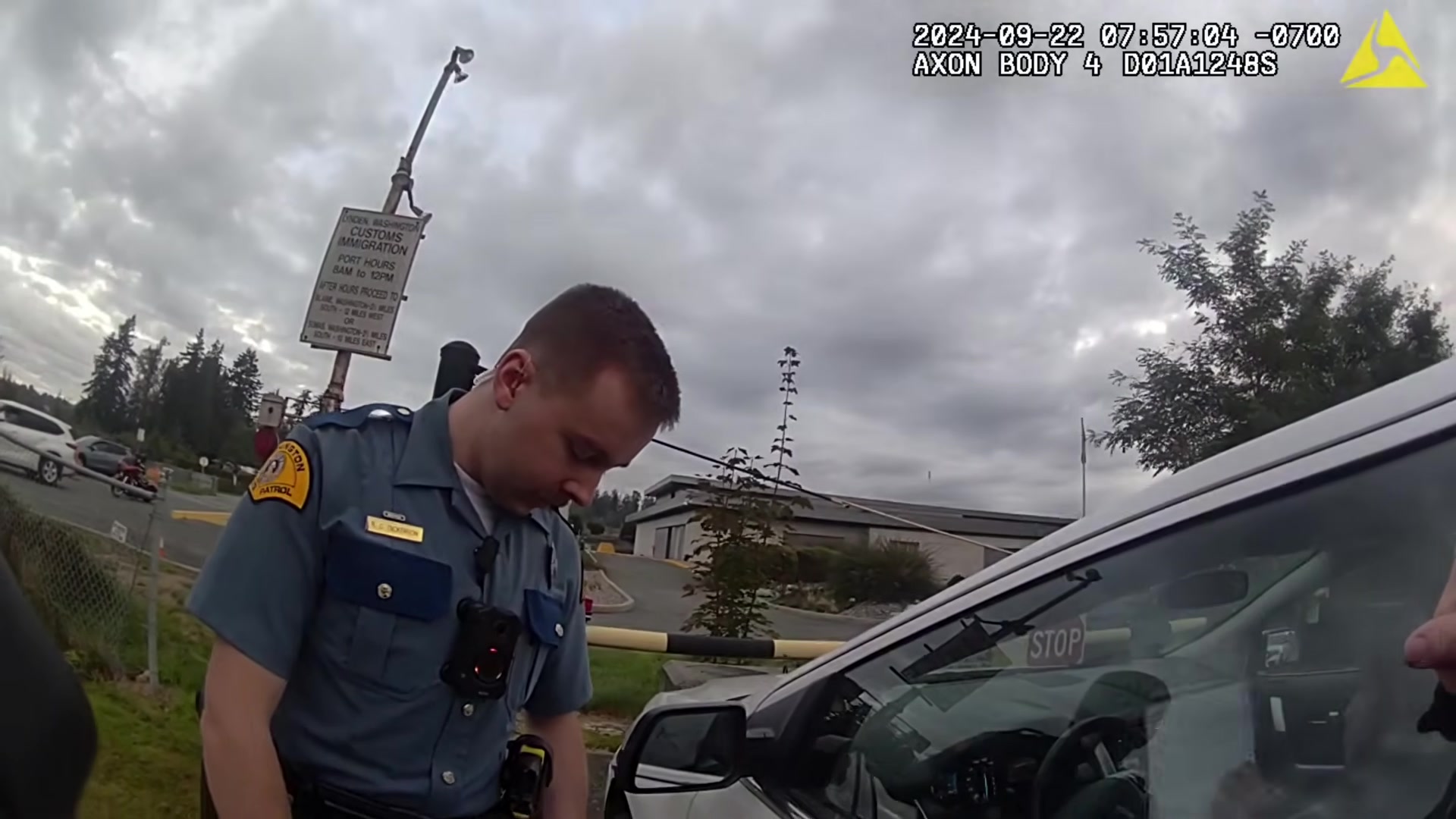
At first, the scene appears relatively controlled.
Several officers are present.
The SUV is stationary.
Nobody is running.
There is no high-speed pursuit unfolding through the border facility.
But the tension is obvious because the woman remains inside the vehicle.
A locked car creates a difficult tactical problem.
As long as the driver retains access to the steering wheel, ignition and controls, the vehicle itself remains potentially mobile.
That matters even more when officers suspect impairment.
An officer standing beside a vehicle has very little protection if the driver suddenly accelerates, reverses or turns toward personnel nearby.
The footage therefore becomes a contest between patience and control.
Officers want the woman to exit voluntarily.
She does not.
They continue communicating.
She remains inside.
From the driver's perspective, locking the doors might create a temporary barrier between herself and police.
From the officers' perspective, however, it does not end the investigation.
It simply creates another problem they have to solve.
The vehicle has effectively become a locked room that can still move.
Why a DUI Investigation at a Border Crossing Is Especially Serious
Impaired-driving investigations are already unpredictable.
At an international port of entry, the environment adds another layer of complexity.
Vehicles are concentrated into controlled lanes. Government employees and travelers may be nearby. Traffic movement depends on barriers, booths and instructions.
A driver who suddenly moves in an unexpected direction can create danger almost immediately.
The Cascade Gateway is also an exceptionally busy cross-border corridor.
Regional transportation data show that the five ports in the area handle substantial volumes of traffic, with Blaine's combined Peace Arch and Pacific Highway facilities ranking among the busiest U.S.–Canada crossings for personal vehicles.
The Lynden crossing is smaller, but it remains part of the same international transportation system.
This context helps explain why officers cannot simply walk away from a driver who refuses to cooperate during an active DUI investigation.
They have to resolve the situation.
The question is how.
The Standoff Around the SUV Escalates
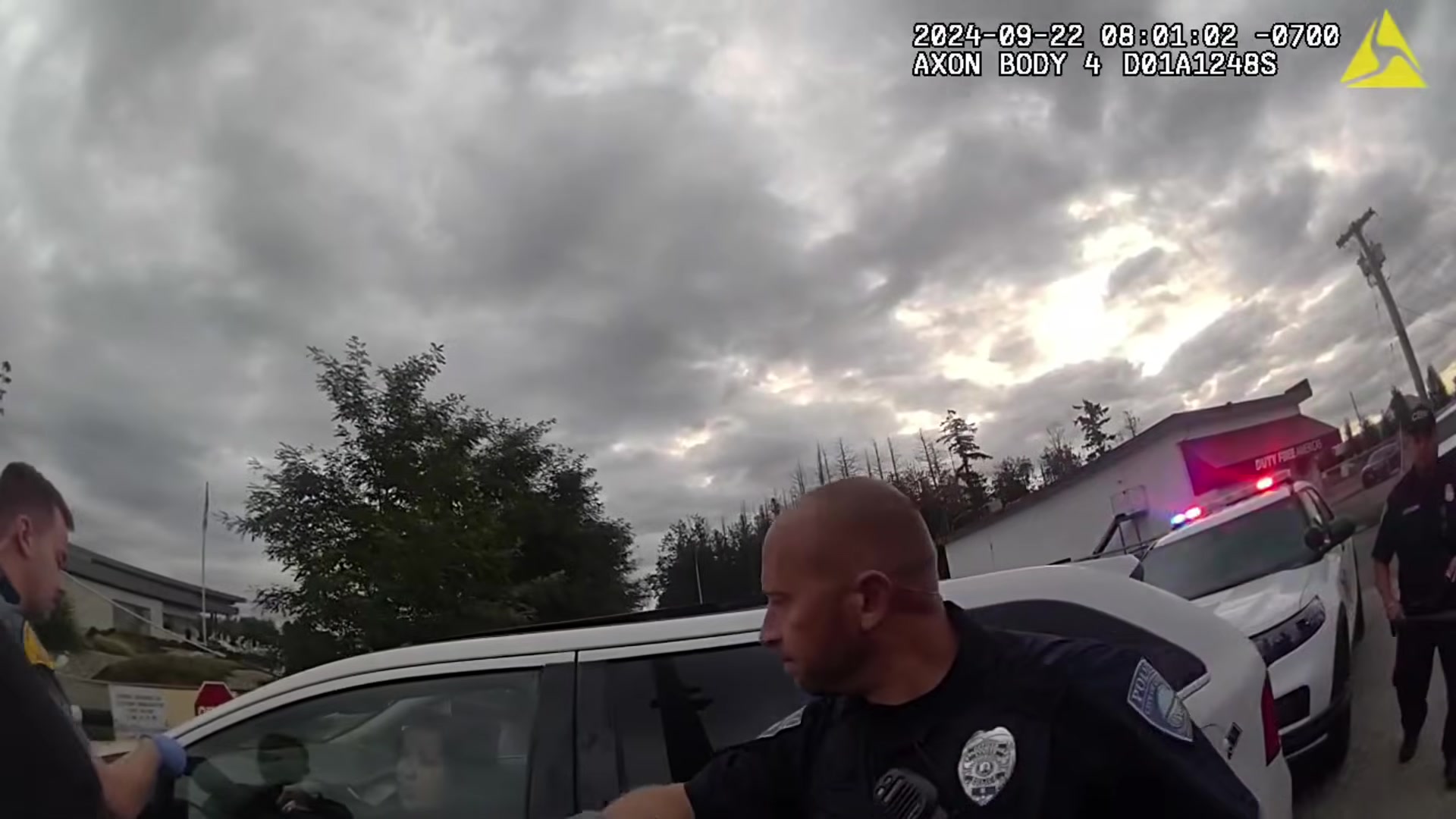
As additional deputies gather around the SUV, the atmosphere changes.
What had initially been an investigation involving Washington State Patrol now includes multiple Whatcom County Sheriff's deputies.
Emergency lights flash behind the vehicle.
Officers position themselves around it.
The woman remains inside.
The footage captures the uncomfortable middle ground between conversation and forced entry.
Officers generally prefer voluntary compliance when circumstances allow it. It is safer for everyone.
Breaking into a vehicle introduces new risks.
Glass can injure the occupant.
Officers have to reach into an enclosed space.
The driver may react unpredictably.
And the interior of a vehicle limits visibility.
But waiting indefinitely has risks as well.
A person sitting in the driver's seat retains access to thousands of pounds of movable machinery.
If the driver is believed to be impaired, that concern becomes even greater.
The officers therefore continue attempting to bring the encounter to a controlled conclusion.
But the door does not open.
Eventually, patience is no longer enough.
Officers Break the Window
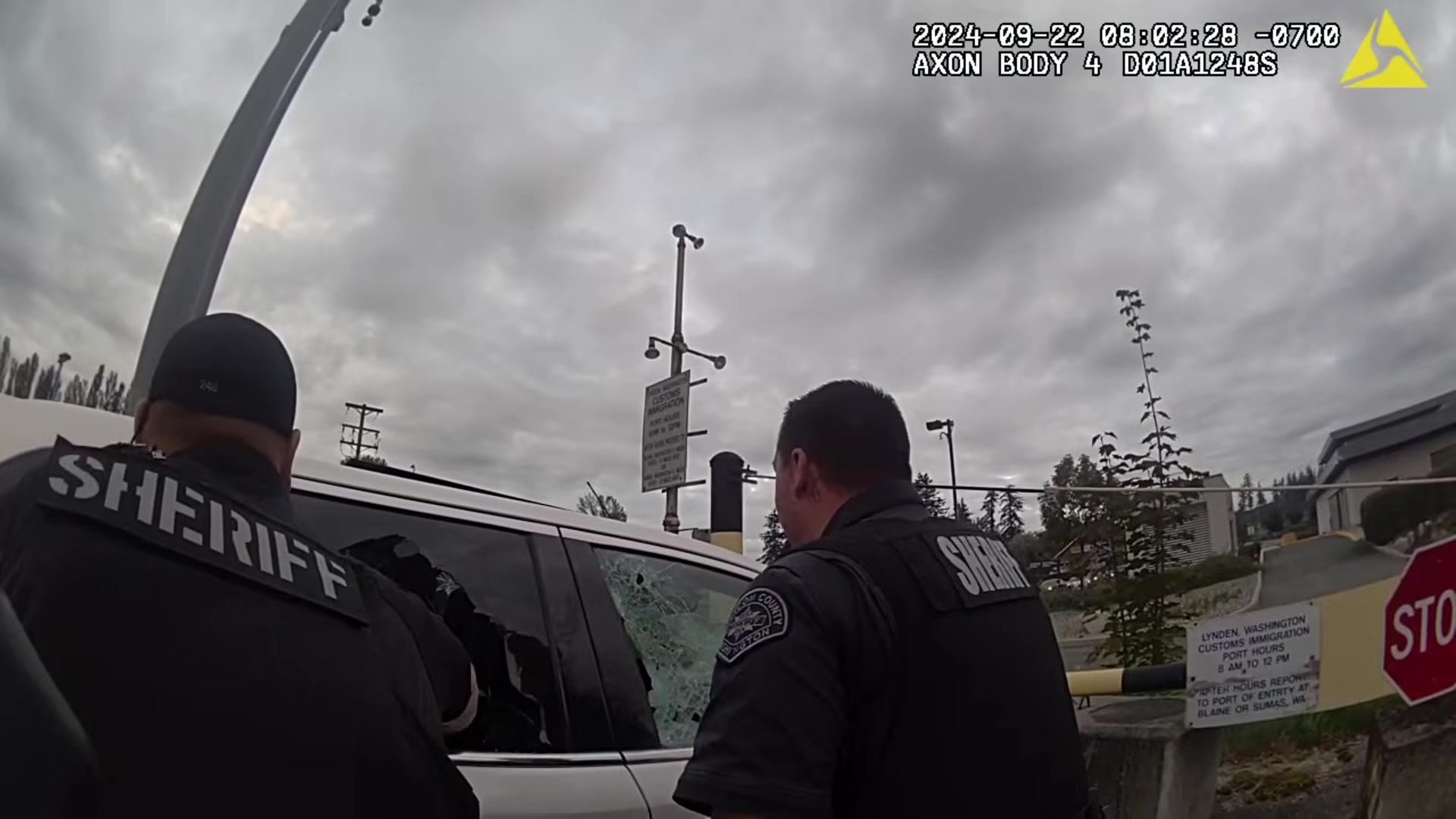
This is the visual turning point of the entire video.
The side window of the SUV is shattered.
Broken glass covers the opening as deputies surround the vehicle.
The physical barrier that had separated the woman from officers is gone.
This is the moment viewers have been waiting for because everything before it builds toward a single question:
Will she unlock the vehicle voluntarily, or will police have to enter it themselves?
Now that question has been answered.
They are going in.
The image is striking because it shows just how far the encounter has progressed.
Minutes earlier, officers were standing beside an intact SUV trying to communicate with its driver.
Now the window is destroyed and several officers are preparing to remove her.
Nothing about the physical escalation was inevitable at the beginning.
The vehicle could have been unlocked.
The driver could have stepped out.
The investigation could have continued outside the SUV.
Instead, each refusal narrowed the available options.
Multiple Officers Work to Gain Control
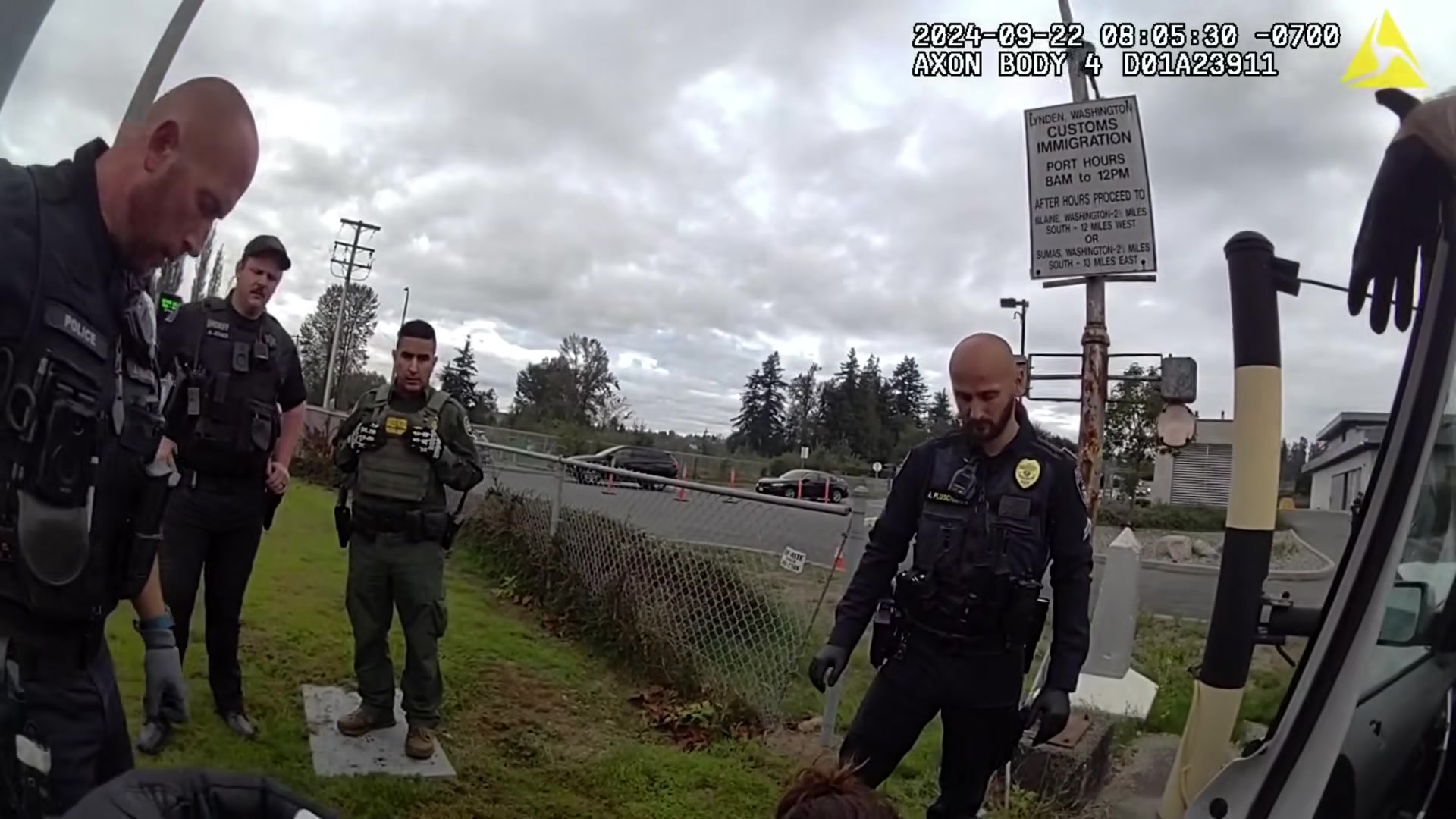
Once the window is broken, officers still face another challenge.
Creating access to the vehicle is not the same thing as gaining control of the person inside it.
The footage becomes much more physical.
Several officers work around the SUV while commands continue.
The confined interior makes everything more difficult.
Unlike an arrest occurring in an open parking lot, officers cannot simply approach from every direction.
Seats, doors, the center console and steering wheel all restrict movement.
The occupant also has numerous surfaces she can potentially hold onto.
That is one reason vehicle extractions can look chaotic even when several officers are present.
The deputies need to remove the driver while simultaneously preventing the vehicle from moving and minimizing injuries to everyone involved.
This portion of the footage provides the dramatic payoff to the slower opening.
The viewer has watched officers try the simplest option first.
Communication.
Then additional officers arrive.
Then they surround the vehicle.
Then the window is broken.
Now the encounter becomes physical.
That progression is important because it shows escalation as a sequence, rather than a single isolated moment.
The Investigation Moves From the Vehicle to the Person
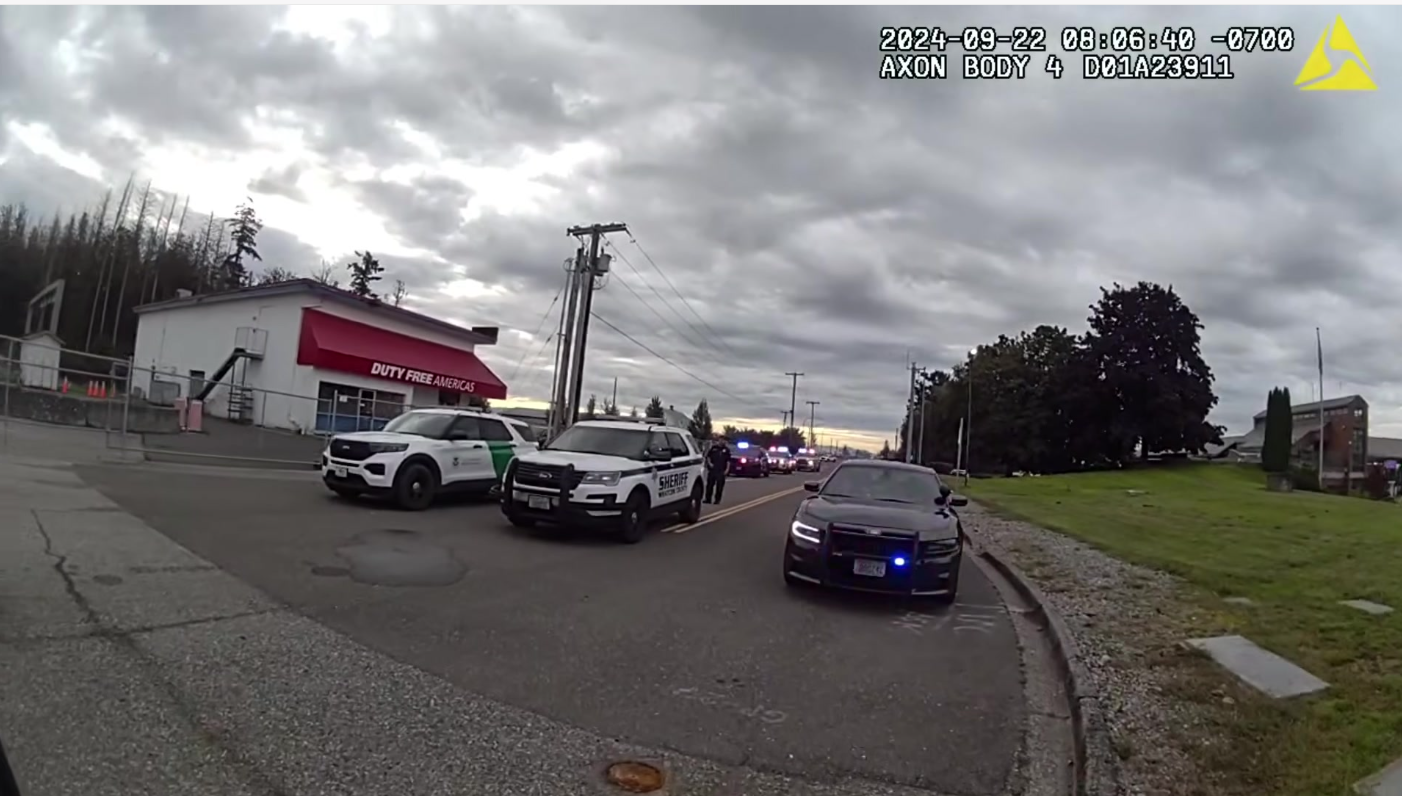
Once officers gain control of the woman, the focus of the encounter changes again.
The SUV is no longer the primary tactical problem.
Now officers have a person in custody who must be assessed, transported and processed according to whatever charges the investigation supports.
This is also where viewers should distinguish carefully between what the footage establishes and what requires additional documentation.
The video clearly identifies the initial incident as a DUI stop.
The footage clearly shows law enforcement surrounding the SUV.
It shows forced entry after the driver remains inside.
And it ultimately shows the woman in custody.
What the available public reporting does not allow me to establish with confidence is every final criminal charge or the eventual court disposition.
A public booking aggregation for Whatcom County lists a woman booked on September 22, 2024 on a DUI allegation.
However, matching a booking date and charge is not enough to responsibly claim that the record belongs to the woman shown here.
Without an official incident number, confirmed name or court document tying the two together, doing so would turn a possibility into an unsupported assertion.
That is precisely what responsible reporting should avoid.
Why the Broken Window Matters to the Story
There is a reason the window-breaking moment functions so effectively as the centerpiece of the video.
It represents the consequences of everything that happened before it.
Had the video opened directly with deputies breaking glass, viewers would naturally ask:
Why are they doing that?
What happened before this?
Was the vehicle moving?
Was the driver armed?
Was there an emergency?
The earlier footage supplies that missing context.
Police were already dealing with a DUI stop.
The woman remained inside the vehicle.
Officers were attempting to gain compliance.
Multiple agencies were present.
The doors remained an obstacle.
Only after that buildup does forced entry occur.
This illustrates one of the most important principles when presenting police footage in long-form articles:
CONTEXT SHOULD COME BEFORE THE MOST DRAMATIC CLIP.
A spectacular image can attract attention.
Context gives it meaning.
Without the preceding events, the broken window is merely a dramatic frame.
With the preceding events, it becomes the turning point of the story.
From the Driver's Seat to the Back of a Patrol Vehicle
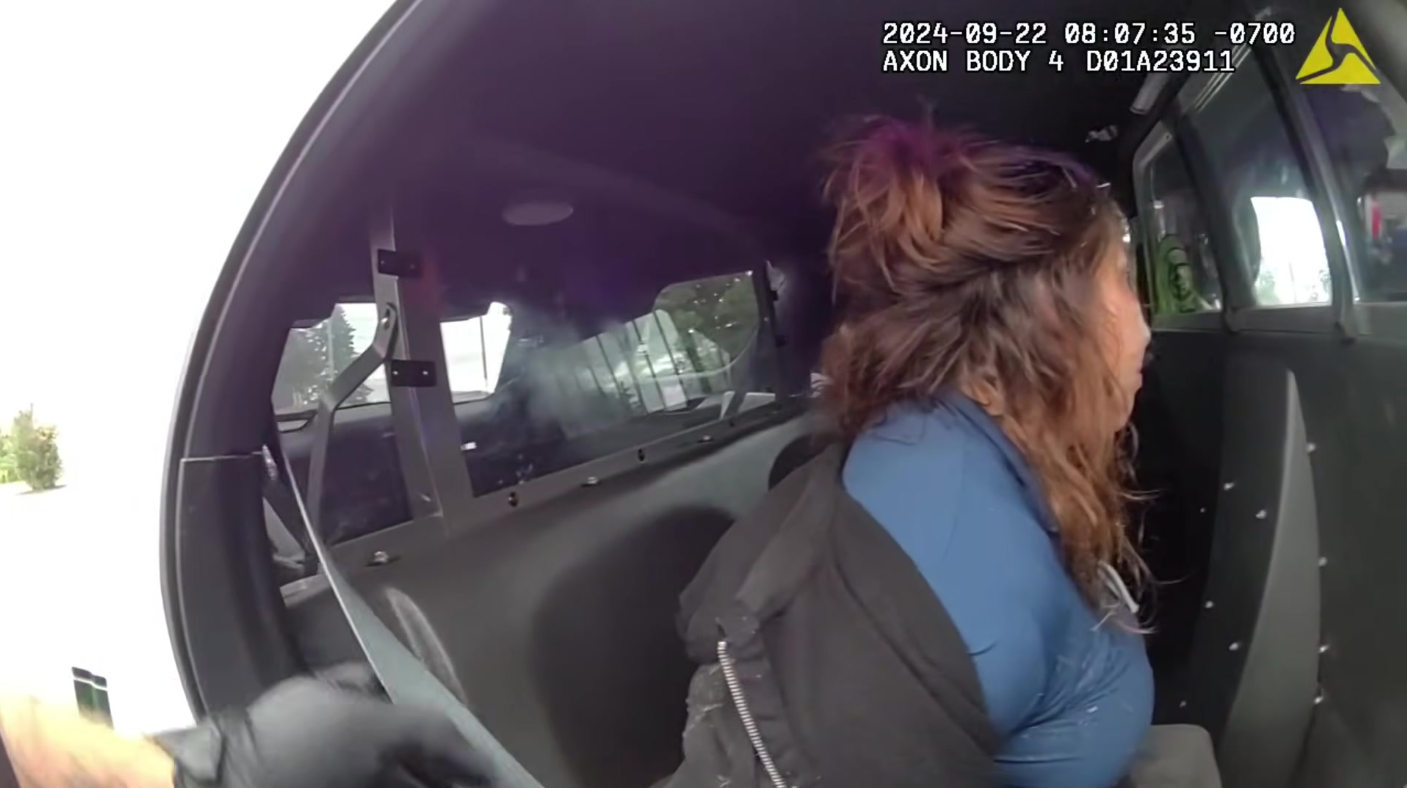
By approximately 8:07 a.m. on the bodycam timestamp, the scene looks completely different.
The woman is no longer sitting behind the wheel of her SUV.
She is seated in the rear compartment of a law-enforcement vehicle.
Her arms appear secured behind her.
The confrontation around the SUV is over.
That visual transition provides a natural conclusion to the incident captured in the supplied video.
At roughly 7:55 a.m., officers were standing beside her locked vehicle.
A little more than ten minutes later, she was sitting in custody.
That short period contains the entire arc of the encounter:
a suspected impaired driver,
a refusal to leave the vehicle,
multiple officers arriving,
continued resistance to the officers' attempts to gain access,
a shattered window,
a physical extraction,
and finally detention.
The setting makes the sequence even more unusual.
All of this happened at the edge of the United States, beside a port connecting Washington with British Columbia.
The Border Location Gives the Incident Another Layer
The Lynden–Aldergrove crossing is part of a network that plays an important role in travel between Washington and British Columbia.
WSDOT maintains cameras and border information for the Lynden crossing along Guide Meridian/SR 539, alongside the Peace Arch, Pacific Highway and Sumas crossings.
Federal planning documents similarly identify the Lynden land port as a U.S. Customs and Border Protection facility in Whatcom County.
The area is accustomed to large numbers of international travelers.
Regional reporting from the same period demonstrates how significant those crossings can become during busy weekends. Just one week after this incident, border wait times reached approximately 65 minutes at Lynden and even longer at some nearby crossings.
That does not directly relate to the woman's DUI investigation, but it provides useful context for the environment in which officers were operating.
Border facilities depend heavily on controlled vehicle movement.
Drivers cannot simply treat them like ordinary parking lots.
And when a suspected impaired driver becomes uncooperative inside that environment, multiple agencies may have to act quickly to prevent the situation from becoming more dangerous.
Why This Encounter Keeps Viewers Watching
From a storytelling perspective, this video contains an unusually clean escalation curve.
It begins with a mystery.
Why are so many officers surrounding one SUV at the Canadian border?
Then viewers receive the first answer:
It is a DUI investigation.
That immediately creates another question.
Why won't the driver come out?
Then the confrontation grows.
Additional officers surround the SUV.
The woman remains inside.
The tension becomes centered on the locked door.
At that point, viewers know something has to happen.
Either the driver will open it or police will.
Then comes the strongest visual moment:
the window breaks.
But even that does not end the story.
Officers still have to remove the occupant.
They still have to control her.
And viewers still want to know where the encounter ends.
The final image answers that question.
She is in the back of a patrol vehicle.
This is a strong structure for a bodycam article because the story continually moves forward rather than revealing the outcome immediately.
The headline establishes the problem.
The opening establishes the location.
The first section explains the DUI investigation.
The middle creates the standoff.
The broken window supplies the climax.
The custody scene supplies the resolution.
That structure naturally encourages the reader to continue.
A Locked Door Did Not End the Investigation
Perhaps the simplest lesson from the encounter is that locking a vehicle does not make a lawful police investigation disappear.
It can delay officers.
It can create additional tactical problems.
It can force them to change their approach.
But it does not automatically end the encounter.
In this case, what began as a suspected DUI investigation became a multi-agency confrontation around a locked SUV.
The woman remained inside.
Officers surrounded the vehicle.
Attempts at gaining cooperation did not resolve the situation.
Eventually, the glass barrier disappeared.
And shortly afterward, the driver was sitting in a patrol vehicle rather than behind the wheel of her own SUV.
The footage also demonstrates why bodycam context matters.
A screenshot of deputies standing beside a shattered window tells only part of the story.
The full sequence shows what happened before the glass broke and what happened afterward.
It shows escalation rather than merely its result.
And that makes the difference between a dramatic clip and an understandable account of an incident.
The publicly available material I found does not establish the woman's complete court outcome, so that portion of the story should remain open rather than being filled with speculation.
What the footage does establish is already compelling enough.
On the morning of September 22, 2024, Washington State Patrol and Whatcom County Sheriff's deputies dealt with a suspected impaired driver at the Lynden border crossing.
The driver stayed inside her SUV.
The confrontation escalated.
Officers forced their way into the vehicle.
And within minutes, the driver who had been locked behind the wheel was sitting in the back of a police vehicle.
What looked like a barrier between the driver and police ultimately became only another stage of the arrest.
WATCH THE FULL BORDER ENCOUNTER
The shattered window is the dramatic moment, but it makes far more sense after seeing everything that led to it.
The complete footage shows how officers initially approached the locked SUV, how the situation developed as additional deputies arrived, and what finally happened when voluntary cooperation was no longer resolving the standoff.
Watch from the beginning and see how a DUI investigation at an international border turned into a tense vehicle extraction in only a matter of minutes: https://www.youtube.com/watch?v=0XDJdpBJLjw
Comments (0)
Loading comments...
May You Like
Police Pull Over Paralyzed Driver With Blind Passenger

911 Call Leads Police to a Disturbing Family Situation

💨 High-Speed Police Pursuits Caught on Dashcam | Intense Moments Across the USA 🇺🇸