Instacart Delivery Stop Escalates When Driver Pulls a Knife on Police
Instacart Delivery Stop Escalates When Driver Pulls a Knife on Police
A traffic stop can change character in seconds. In this case, what begins with officers speaking to a man seated behind the wheel develops into a repeated attempt to flee, a dangerous confrontation at the driver’s window, and a final arrest after police surround the vehicle. The supplied body-camera footage gives a close view of those rapidly changing decisions, while later reporting from ABC7 Chicago provides enough identifying details to connect the encounter to a June 26, 2025 arrest in Skokie, Illinois.
ABC7 Chicago, citing Skokie police, identified the driver as Mohamed Aicha. Police said the June 26 encounter occurred after investigators were looking into a separate incident involving an Israeli flag that had been cut at a private home. Months later, police announced additional charges connected with that earlier flag incident. Those later allegations are separate from what viewers can directly see in the body-camera footage, so it is important to distinguish the visible police encounter from facts reported afterward by authorities.
A Routine Conversation Gives Way to a Much Bigger Problem
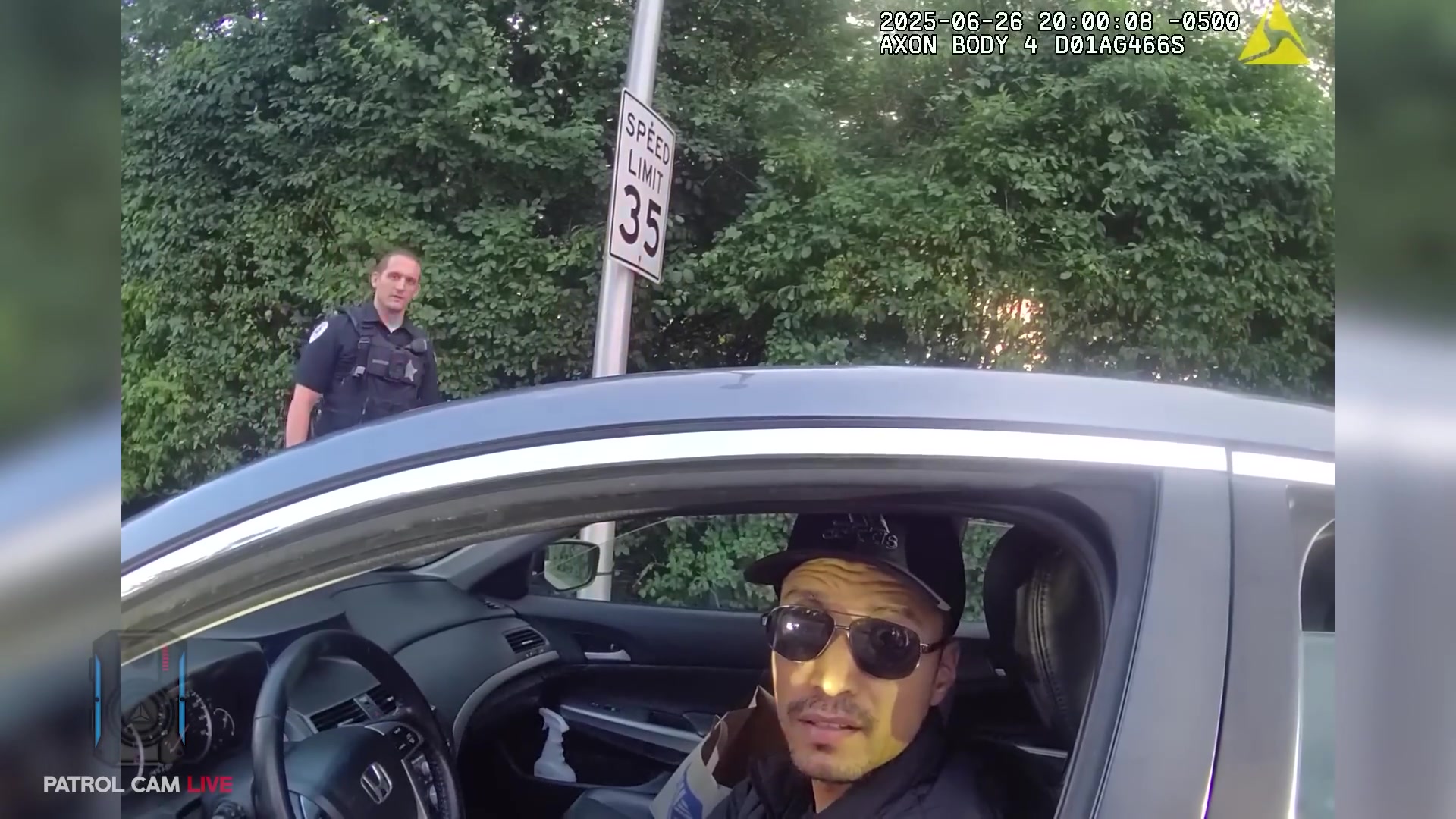
Early in the footage, the atmosphere is comparatively controlled. The driver is seated in a silver sedan while officers speak with him from outside. He is wearing sunglasses, and the exchange initially resembles the kind of roadside contact that can remain uneventful if everyone stays in place and follows instructions. Police vehicles are nearby, but the scene has not yet reached the level of force visible later in the recording.
The body-camera overlay places the encounter on June 26, 2025, matching the date later reported by ABC7 Chicago. The footage also shows markings consistent with Skokie police vehicles. Those details matter because they provide independent visual clues that align with the later reporting rather than relying only on a similar-looking arrest.
According to ABC7 Chicago, police said Aicha fled from a traffic stop in the 7900 block of Skokie Boulevard at about 8 p.m. The reporting further states that officers later took him into custody near Lamon Avenue and Jerome Street. The video’s progression, including the movement of multiple police vehicles and the eventual containment of the sedan, is consistent with an encounter that did not remain at its original stopping point.
For an officer, a driver suddenly leaving a lawful stop creates a new set of risks. A stationary encounter offers at least some predictability: officers know where the vehicle is, can position themselves around it, and can communicate with the driver. Once the vehicle moves, those advantages disappear. Police must immediately decide whether to pursue, how closely to follow, and how to prevent the fleeing vehicle from creating additional danger for pedestrians and other motorists.
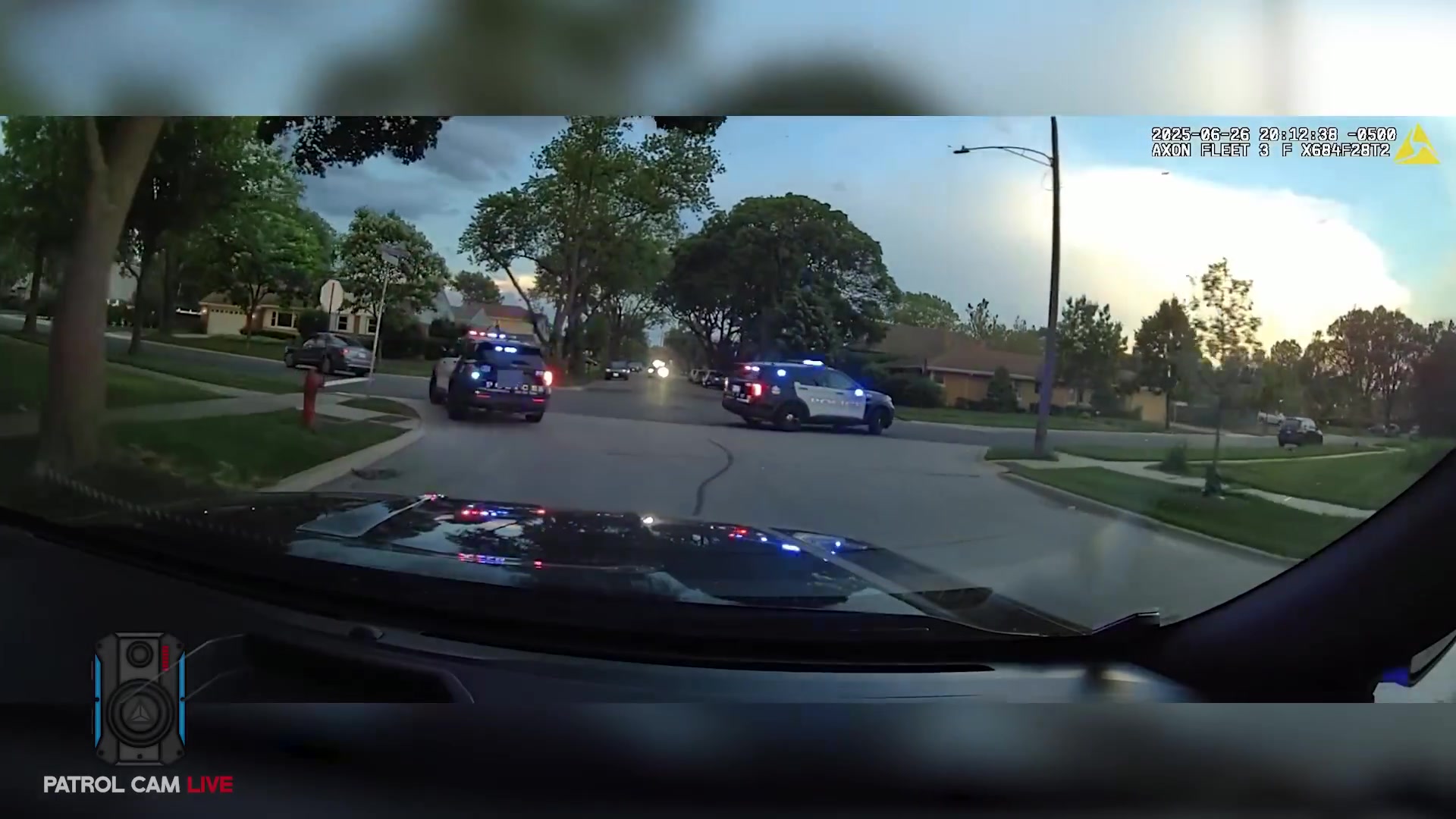
The footage captures that transition. Police vehicles begin moving through neighborhood streets, and the original face-to-face contact becomes a coordinated effort involving multiple officers. This is one reason traffic-stop footage can be deceptive when viewed only as a short viral clip. The most dramatic seconds may occur at the window, but the danger is shaped by everything that happened before and after those seconds.
Officers Converge as the Driver Is Stopped Again
As the encounter continues, officers appear to gain another opportunity to contain the sedan. More police units are visible, and the response becomes increasingly coordinated. The scene is no longer a single officer speaking with a cooperative motorist. Officers are dealing with a driver whom they believe has already attempted to get away.
That history changes how officers approach the vehicle. When police have reason to believe a driver may flee again, they commonly try to limit the car’s available escape path and reduce the amount of time officers spend exposed near the doors or windows. The footage shows several police vehicles in the area and officers moving into positions around the sedan. Their attention is focused not only on the person inside but also on the vehicle itself as a potential means of escape.
ABC7 Chicago reported that police said Aicha later grabbed an officer from his vehicle while armed with a knife. The body-camera footage shows a close, chaotic struggle at the driver’s side of the sedan. Because the camera is attached to an officer and bodies repeatedly block the view, not every hand movement is continuously visible. That limitation is important. Body-camera video can provide unusually direct evidence, but it does not automatically provide a perfect angle of every action.
What is clear is that officers are attempting to remove or control the driver at the vehicle, and the confrontation becomes physical. Commands are shouted. Officers crowd the window. The driver remains inside long enough for the struggle to become extremely close-range. At that distance, the difference between a verbal confrontation and a weapon threat can be only a fraction of a second.
The Knife Changes the Risk at the Driver’s Window
The title attached to the supplied video focuses on the knife, and that element is supported by later police reporting. ABC7 Chicago states that Skokie police said Aicha was armed with a knife during the confrontation and grabbed an officer from the vehicle. The visible struggle around the window is consistent with why officers suddenly treat the driver as an immediate threat rather than simply a person refusing to exit.
A knife at arm’s length presents a very different problem from a weapon seen from a distance. Officers working directly beside a car have limited room to move backward, especially when other officers, doors, curbs, and police vehicles restrict their movement. A driver also has partial protection from the vehicle itself, making it difficult for officers to control both hands without entering the passenger compartment or pulling the person through an opening.
The footage shows officers trying to manage that confined space. The situation is loud and compressed. Multiple commands overlap. The driver’s window area becomes the center of the confrontation. This is the point where a simple description such as “traffic stop” no longer captures what officers are facing.
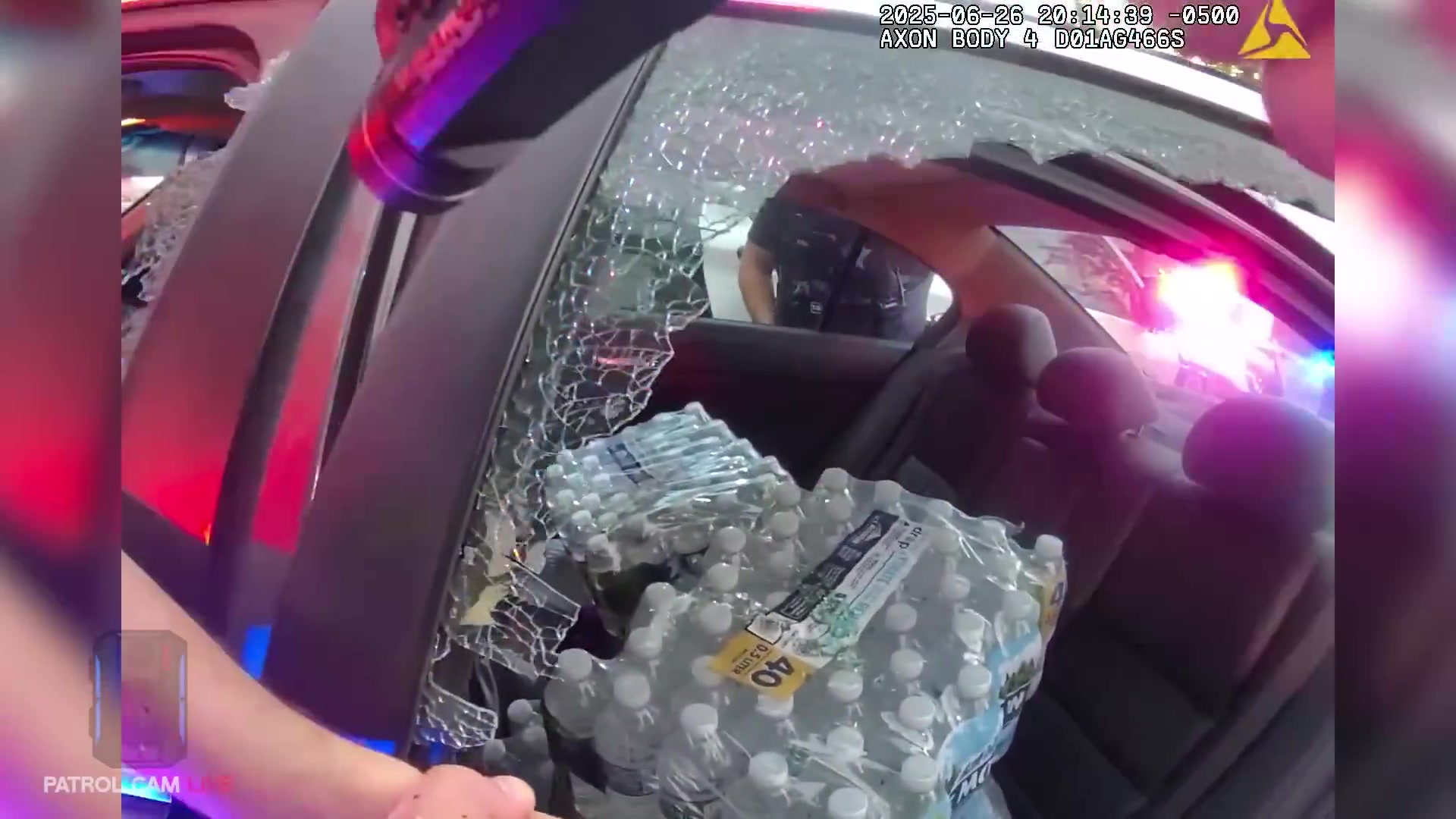
Later in the sequence, the driver-side window is visibly shattered. Broken glass covers part of the opening and interior area. That image conveys how forceful the encounter became, but the broken glass should not be treated as proof of every disputed movement that occurred seconds earlier. The safest reading is narrower: officers and the driver were engaged in a physical confrontation at the vehicle, police reported that the driver was armed with a knife, and the scene escalated substantially before the vehicle moved again.
Police use-of-force decisions are generally judged according to the circumstances confronting officers at the moment, not with the benefit of hindsight. A weapon, resistance, attempted flight, proximity to officers, and access to a vehicle can all affect the perceived level of danger. That does not mean every use of force is automatically justified. It means the sequence matters. A few seconds removed from the events that preceded them can produce a misleading picture.
The Sedan Moves Again and Police Resume the Chase
One of the most consequential developments is that the encounter does not end at the shattered window. The sedan moves away again, forcing officers to transition from close physical contact back into pursuit and containment. That repeated change in circumstances makes the incident especially difficult to manage. Officers must switch from hands-on control to vehicle tactics almost immediately.
ABC7 Chicago reported that Aicha was later charged with aggravated fleeing and eluding, along with aggravated battery to a police officer. Those are allegations, not a statement of guilt, and the later report also notes that he remained in custody after his arrest. The footage itself supports the more limited observation that the vehicle does not remain stationary throughout the encounter and that officers continue following it.
From a public-safety perspective, a second departure can increase urgency. Officers have already had close contact with the driver and, according to police, encountered a knife. Allowing the vehicle to continue unrestricted could expose additional people to risk. At the same time, any pursuit through populated streets creates its own hazards. Police therefore have to balance the danger posed by the fleeing person against the danger created by the pursuit itself.
The recording shows patrol vehicles moving through residential streets with emergency lights activated. Other units appear ahead and around the fleeing sedan. Rather than relying solely on one cruiser to follow indefinitely, officers work toward restricting the car’s movement. This kind of coordination becomes crucial when a driver has already demonstrated a willingness to leave more than once.
A Final Containment Brings the Chase to an End
Eventually, the sedan is boxed in and officers converge. By this stage, the response is visibly larger than at the beginning of the video. Several officers are present, and the driver has fewer avenues to move the car away. The focus shifts from pursuit to extraction and arrest.
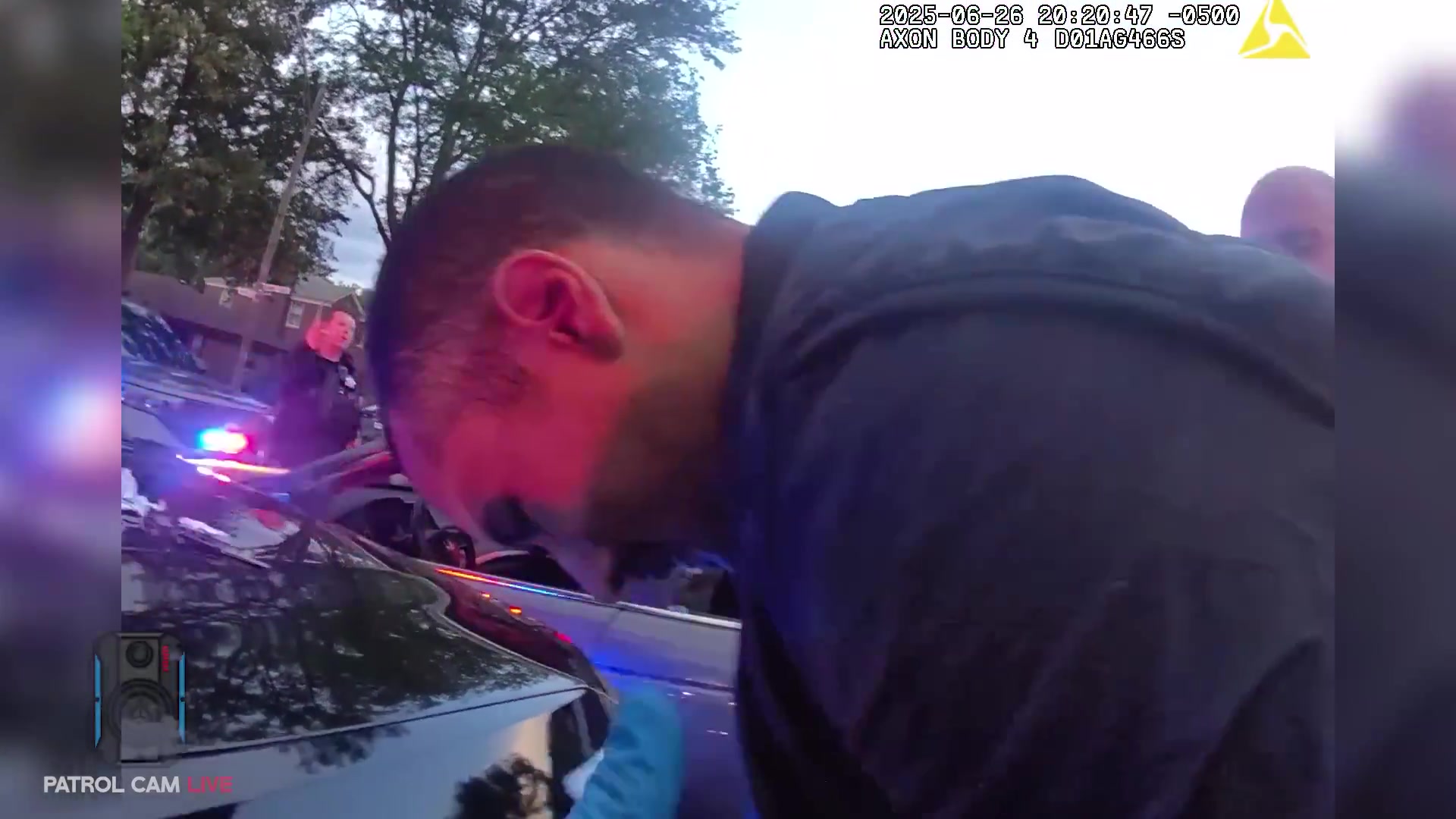
The body-camera perspective again becomes crowded as officers move close to the vehicle. This is normal in a hands-on arrest involving multiple officers: the camera may capture uniforms, arms, equipment, and fragments of the suspect rather than a clean wide shot. What matters is the overall progression. The driver is no longer able to continue the vehicle flight, officers physically take control, and the encounter moves toward restraint.
The video also appears to show officers using a conducted-energy weapon during the final effort to gain control. Such devices are often referred to generically as Tasers, although the exact model and effectiveness cannot be determined simply from a distant frame. A conducted-energy weapon is intended to provide officers with an intermediate force option in circumstances where physical control is difficult or dangerous. Its use does not guarantee immediate incapacitation, and officers may still need to move in and handcuff the person.
In this encounter, the final arrest involves several officers. The suspect is brought under control on the ground, and the intensity that defined the preceding minutes begins to subside. The contrast with the opening is striking: what began with one man sitting behind the wheel ends with a large police presence and a hands-on arrest after repeated attempts to stop the vehicle.
What Police Later Said About the Case
The later reporting adds context that the body-camera video alone cannot establish. ABC7 Chicago reported on November 14, 2025 that Skokie police said Aicha had also been investigated in connection with an Israeli flag that was cut at a home in the 3900 block of Cleveland Street on June 20. Police said additional evidence eventually led to hate-crime and criminal-damage-to-property charges related to that earlier incident.
Those later charges should not be collapsed into the roadside confrontation as though every allegation was established by the body-camera footage. The video does not independently prove why the flag was damaged or establish the mental state required for a hate-crime allegation. It documents the police encounter. The later news report documents what authorities said about the broader investigation.
ABC7 Chicago further reported that Aicha appeared in court on July 1 and remained in custody after the June arrest. Days after the arrest, according to the station, he was charged with aggravated battery to a police officer and aggravated fleeing and eluding. In November, authorities announced the additional hate-crime and property-damage charges.
This distinction between arrest footage and later legal developments is essential. Body-camera videos are often published with titles that compress an entire case into a few words. But criminal cases unfold over time. Officers make an arrest based on circumstances at the scene; prosecutors later evaluate evidence and file charges; courts determine what allegations can be proven. A video can illuminate one part of that process without resolving all of it.
Why the Body-Camera Perspective Matters
This footage is especially useful because it shows how quickly police priorities change. At first, the goal appears to be communication and investigation. Once the driver leaves, the priority becomes locating and stopping the vehicle. When officers reach the window and encounter a reported knife, the priority becomes immediate physical safety. When the sedan leaves again, officers return to pursuit. Finally, once the car is contained, the priority becomes gaining control and completing the arrest.
Each transition requires a different type of decision. An officer speaking calmly at a window uses different tactics from an officer pursuing a fleeing vehicle. An officer confronted with a knife at close range faces different considerations from an officer standing behind cover. The footage compresses all of those environments into less than ten minutes.
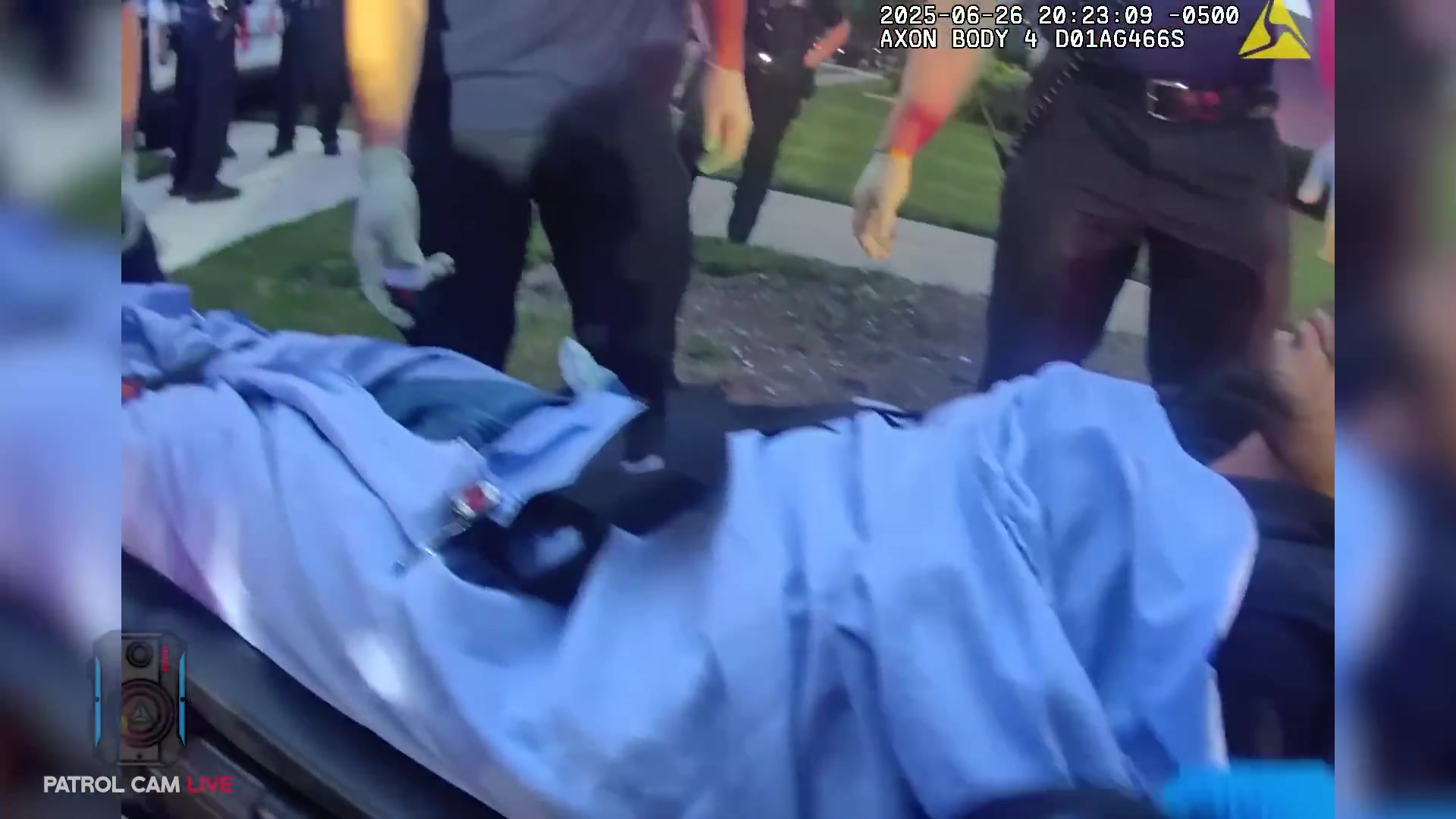
It also demonstrates why the clearest moment in a video is not necessarily the most important one. A freeze-frame may show broken glass, a raised arm, or an officer leaning into a car. Without the preceding minute, however, viewers may not know whether the vehicle had already fled, whether commands had been given, or why several officers were suddenly at the window. Sequence provides meaning.
At the same time, video should not be stretched beyond what it can show. The camera does not establish every legal element of every charge. It cannot reveal intent. It may miss a hand movement because another officer blocks the lens. Audio can be overwhelmed by sirens and shouting. Responsible analysis therefore combines the footage with verified reporting while clearly marking where one source ends and another begins.
A Stop That Refused to Stay Under Control
The defining feature of this incident is repeated escalation. Police appear to get the vehicle stopped, only to have the situation change again. Officers close distance, only to face a reported weapon threat. The sedan is confronted, then moves away. Each time the encounter seems close to resolution, another development forces officers to respond to a new problem.
By the end, the driver is in custody and the immediate danger has ended. The later legal case, however, extends beyond the dramatic roadside footage. Authorities linked Aicha to the earlier flag-damage investigation and announced additional charges months afterward. Those allegations remain part of the judicial process and should be described as allegations unless and until resolved by a court.
For viewers, the body-camera recording offers something a headline cannot: the pace of the decisions. There is little time between a command, a movement, a struggle, and the next attempt to control the scene. The officers are not responding to a static set of facts. They are responding to facts that keep changing in front of them.
That is ultimately what makes the footage compelling. The incident begins in a familiar setting, beside an ordinary passenger car on a suburban street. Within minutes, it becomes a multi-unit pursuit and a close-range confrontation involving a reported knife. The final arrest only makes sense when the entire sequence is viewed from beginning to end.
Comments (0)
Loading comments...
May You Like

Woman Refuses Repeated Orders to Exit Her Car Before Officers Move In
Entitled Driver Skips the Line and Gets Instant Karma3
High-Speed CHP Chase Ends When Spike Strips Stop Suspect