How Police Ruined This Shoplifter’s Terrible Escape Plan
POLICE SHUT DOWN A SHOPLIFTER’S ESCAPE ATTEMPT: HOW A MALL THEFT INVESTIGATION ESCALATED
A routine SHOPLIFTING INVESTIGATION can change dramatically when a suspect refuses to cooperate and attempts to leave in a vehicle.
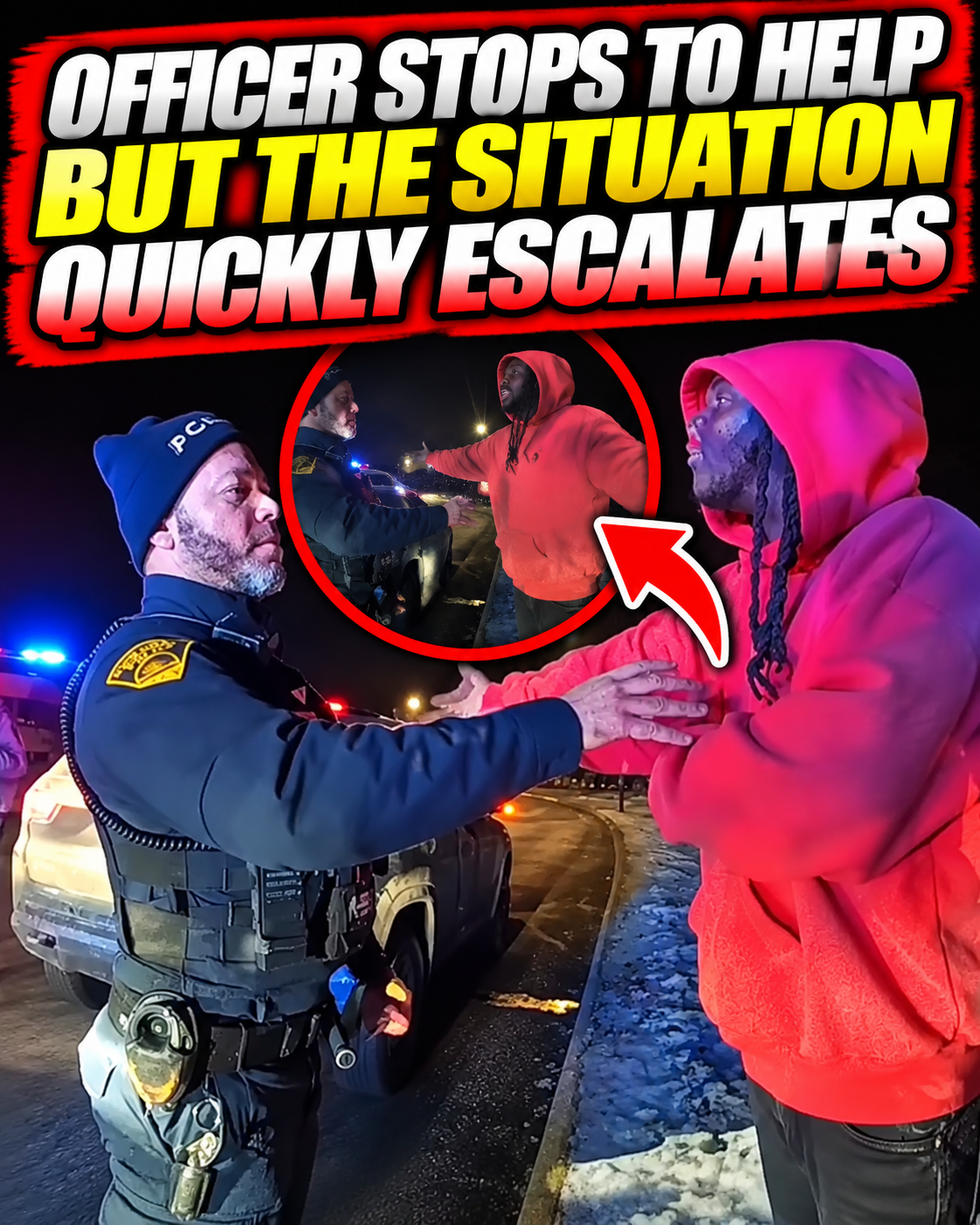
That is what appears to have happened in the incident represented by the uploaded thumbnail. The image shows a man near vehicles in a shopping-center parking lot, while an inset shows police officers restraining him. The headline describes a FAILED ESCAPE ATTEMPT involving a shoplifting suspect.
In this case, there is a stronger connection between the thumbnail and a specific publicly available video than with some similar viral crime thumbnails. A video published by the channel Uncovered on April 16, 2025, is titled “Why Did the Shoplifting Suspect’s Escape Fail?” Its available transcript and summary describe a woman confronted by Melbourne Police officers in a mall parking lot after multiple theft complaints. She remained inside an SUV, locked the doors, and eventually moved the vehicle while officers were positioned around it. The confrontation ended with officers removing her from the SUV and taking her into custody.
The available material does not provide enough reliable information to say that every person or visual element in the uploaded thumbnail is the actual person from that video. Therefore, the article below focuses on the DOCUMENTED INCIDENT rather than assuming the thumbnail itself is an exact police photograph.
HOW A SHOPLIFTING CALL TURNED INTO A POLICE ENCOUNTER
According to the available video transcript, police were dealing with more than a simple report from one store.
Officers had reportedly received MULTIPLE THEFT COMPLAINTS involving a woman at different stores in a mall. Police eventually located her in an SUV in the parking lot.
The officers identified themselves as members of the MELBOURNE POLICE DEPARTMENT and told her that their body cameras were recording. They asked for identification and instructed her to turn off the vehicle and step outside.
At that stage, the encounter was still relatively straightforward.
Police wanted to investigate suspected retail theft.
The suspect was inside a vehicle.
Officers wanted her to exit.
But instead of ending the encounter there, the situation escalated.
The woman reportedly remained inside the SUV, locked the doors, and refused repeated commands to get out.
That decision transformed the encounter from a relatively ordinary RETAIL-THEFT INVESTIGATION into a potentially dangerous vehicle-related confrontation.
THE SUV BECAME THE CENTER OF THE CONFRONTATION
A vehicle can create a completely different safety problem for police.
An officer standing next to a person on foot has one set of concerns. An officer standing beside a running SUV has another.
According to the available account, officers repeatedly told the woman to unlock the doors, turn off the vehicle, and exit.
Instead, she started the SUV.
Officers became concerned that she might attempt to leave.
The situation then became particularly tense because officers were positioned close to the vehicle.
The available transcript says the SUV moved while officers were nearby. Officers reportedly believed that the vehicle posed a danger as the woman attempted to maneuver away.
The encounter eventually included the SUV reversing into a patrol vehicle.
At that point, the officers had to deal with two problems simultaneously:
THE SUSPECT'S RESISTANCE
and
THE MOVING VEHICLE
Those circumstances help explain why the police response became much more physical.
WHY THE ESCAPE ATTEMPT FAILED
The title of the video asks why the shoplifting suspect's escape failed.
The answer is relatively straightforward.
The officers had already surrounded the SUV.
The suspect was not simply driving away from an isolated officer on an open road.
She was in a confined shopping-center parking area with police vehicles and officers around her.
According to the available account, she locked herself inside the SUV and ignored repeated commands. When the vehicle moved, officers continued attempting to prevent her from leaving. The SUV eventually reversed into a police vehicle, preventing the escape from developing into a successful departure from the parking lot.
This is an important distinction.
The incident was not primarily a conventional HIGH-SPEED POLICE CHASE.
Instead, it was a CONFINED VEHICLE ESCAPE ATTEMPT.
The officers were already in close proximity to the suspect, and the suspect's vehicle was surrounded.
That made the officers' immediate priority controlling the vehicle and preventing further movement.
OFFICERS EVENTUALLY OPENED THE SUV
One of the most visually dramatic parts of the encounter occurred when officers attempted to gain access to the vehicle.
The available transcript says officers initially tried to get the woman to cooperate voluntarily.
When that did not work, one officer reportedly attempted to use a window punch.
That effort did not work as expected.
However, one of the vehicle's windows was already cracked.
The officer was eventually able to pull the window open, allowing officers to reach inside.
The woman was then physically removed from the SUV and brought under control.
This part of the incident demonstrates why police encounters can look dramatically different within a matter of seconds.
At the beginning, officers were simply asking someone to step out of a vehicle.
Later, officers were physically removing the person from that vehicle.
The change did not occur because of a single isolated command. It developed through a series of decisions and escalating circumstances.
BODYCAM FOOTAGE PROVIDES IMPORTANT CONTEXT
The case also demonstrates why BODY-WORN CAMERA FOOTAGE has become so important in modern policing.
The available material says the Melbourne officers told the woman that their cameras were recording.
Bodycam footage can document:
- What officers said
- What the suspect said
- Whether commands were repeated
- How close officers were to a vehicle
- How the vehicle moved
- How officers attempted to gain compliance
- How the arrest was carried out
- What happened immediately afterward
However, bodycam footage still has limitations.
A camera may not show what happened inside the store before police arrived.
It may not capture the original theft complaints.
It may not show every piece of surveillance evidence.
It may not provide the complete court history of a case.
And an edited online video may contain only selected portions of a longer recording.
That is why viewers should distinguish between WHAT THE VIDEO SHOWS and WHAT THE COMPLETE INVESTIGATION ESTABLISHED.
WHAT HAPPENED AFTER THE WOMAN WAS REMOVED?
The confrontation did not end the moment officers pulled the woman from the SUV.
According to the available transcript, officers searched her belongings after she was detained.
During the search, officers reportedly discussed various pills and other substances they believed they had found.
The transcript mentions officers discussing prescription medication and suspected illicit drugs, including a conversation involving heroin. However, the available material does not provide a complete inventory, laboratory results, quantities, or a complete set of final criminal charges.
That limitation matters.
Police observations during a search are not necessarily the same thing as a final laboratory determination.
Likewise, an item that officers suspect to be a particular substance must still be evaluated through the applicable investigative and legal process.
Therefore, it is more accurate to say that officers REPORTED FINDING SUSPECTED DRUGS than to present every substance mentioned during the bodycam conversation as an established forensic fact.
OUTSTANDING WARRANTS ALSO ENTERED THE STORY
The available account says officers discovered that the woman had MULTIPLE OUTSTANDING WARRANTS.
The transcript does not establish the underlying cases in sufficient detail to explain precisely what those warrants involved.
That is another reason to avoid turning the bodycam footage into a complete criminal biography.
A warrant may arise from an earlier case, a failure to appear, or another legal matter depending on the jurisdiction and circumstances.
What matters for this encounter is that officers reportedly discovered active warrants while processing the woman after the confrontation.
This illustrates how one police encounter can uncover information unrelated to the original call.
Police may initially respond to:
SUSPECTED SHOPLIFTING
and subsequently encounter:
RESISTANCE
VEHICLE MOVEMENT
PROPERTY DAMAGE
or
OUTSTANDING WARRANTS
Each additional fact can affect how the incident develops.
THE MAN WHO WAS WITH HER
The available account also mentions another man who was present during the incident.
According to the transcript summary, officers did not describe him as participating in the attempted vehicle escape.
In fact, officers reportedly noted that he remained outside the SUV and told the woman to stop.
Nevertheless, police collected his identifying information because he was connected to the incident and because the vehicle collision required documentation.
This is an important reminder that being present during a police investigation does not automatically mean someone is accused of the same conduct as the primary suspect.
Police may identify witnesses, passengers, companions, employees, or other people who can provide information about what happened.
THE MEDICAL SIDE OF THE ENCOUNTER
After the woman was detained, the incident reportedly shifted again.
The available account says she complained of physical problems, including pain in her back and chest, throat discomfort, and asthma symptoms.
Officers requested an ambulance so medical personnel could evaluate her condition.
This is an important part of police work that is sometimes overlooked in viral videos.
An arrest does not eliminate the need to address a person's medical condition.
If someone says they are experiencing breathing difficulties or significant pain, officers may need to arrange medical evaluation depending on the circumstances.
The available transcript says an ambulance was called and officers encouraged the woman to move toward medical personnel.
That means the end of the incident was not simply:
POLICE ARRIVE → ARREST → JAIL
There was also a MEDICAL RESPONSE.
WHY A PARKING LOT CAN MAKE A POLICE ENCOUNTER MORE DANGEROUS
Shopping-center parking lots are complicated environments.
They contain:
- Moving vehicles
- Pedestrians
- Store entrances
- Shopping carts
- Delivery vehicles
- Pedestrian walkways
- Other parked cars
- Police vehicles
- Security personnel
When a suspect attempts to move a vehicle while officers are nearby, the risk extends beyond the suspect and the police.
Other shoppers could potentially be placed in danger.
That is one reason vehicle-related resistance is treated differently from simply refusing to answer questions.
A person sitting quietly inside a parked car creates one type of situation.
A person starting the engine and moving the vehicle while officers are positioned nearby creates another.
The available account specifically says officers were concerned about the vehicle's movement and that the SUV eventually struck a patrol car while the woman attempted to get away.
SHOPLIFTING DOES NOT AUTOMATICALLY MEAN A HIGH-LEVEL CRIME
The original investigation reportedly began with retail theft complaints.
But SHOPLIFTING can cover a wide range of circumstances depending on jurisdiction.
The value of the merchandise, the manner in which property was allegedly taken, prior convictions, use of force, and other circumstances can affect the seriousness of charges.
This distinction becomes particularly important in incidents where the original suspected offense is relatively straightforward but the police encounter escalates.
A retail theft investigation can potentially lead to additional allegations if a person:
- Resists officers
- Damages property
- Attempts to flee
- Uses a vehicle in a dangerous manner
- Assaults someone
- Possesses prohibited items
The original suspected theft and the subsequent police encounter therefore need to be treated as separate factual questions.
WHEN A SUSPECTED THEFT BECOMES A VEHICLE INCIDENT
This case is particularly interesting because the apparent escalation was not primarily about the value of the merchandise.
The major change occurred when the vehicle entered the confrontation.
The available footage summary describes officers repeatedly asking the woman to exit the SUV.
She remained inside.
The doors were locked.
The engine was started.
The vehicle moved.
A patrol vehicle was struck.
Officers then removed her from the SUV.
That sequence explains why the situation became significantly more serious from a law-enforcement perspective.
The central concern was no longer simply:
“DID SOMEONE TAKE PROPERTY WITHOUT PAYING?”
It became:
“CAN OFFICERS SAFELY CONTROL A MOVING VEHICLE AND THE PERSON OPERATING IT?”
THE IMPORTANCE OF FOLLOWING COMMANDS DURING A POLICE STOP
There is a practical lesson in the footage.
When officers are investigating a suspected crime, refusing every instruction can cause the encounter to become more complicated.
That does not mean every police command is automatically lawful or that a person has no rights.
It means that COMPLIANCE, COMMUNICATION, AND LEGAL RIGHTS are separate concepts.
A person can ask why they are being detained.
They can ask whether they are under arrest.
They can invoke applicable legal rights.
But physically escalating the encounter can create additional risks and potentially additional allegations.
In this case, the available account shows how a refusal to exit the SUV eventually became a physical confrontation.
THE DIFFERENCE BETWEEN RESISTANCE AND A DISAGREEMENT
There is also an important difference between verbally disagreeing with officers and physically interfering with an arrest.
A person might say:
“I don't agree with this.”
That is very different from physically preventing officers from carrying out lawful actions.
The precise legal definitions vary by jurisdiction.
But from a practical standpoint, officers must evaluate behavior rather than simply whether a person appears angry.
A person can be upset, frightened, confused, or frustrated without necessarily committing another offense.
The important issue is what the person actually does.
That is another reason the bodycam footage is useful.
It allows viewers to see the SEQUENCE OF ACTIONS rather than relying entirely on a headline.
WHY VIRAL TITLES CAN DISTORT THE ORIGINAL EVENT
The uploaded thumbnail uses dramatic wording:
POLICE SHUT DOWN
A SHOPLIFTER'S FAILED
ESCAPE ATTEMPT
That style of headline is common in online bodycam content because it immediately communicates conflict.
But headlines often compress complicated events into a few words.
The actual sequence here was more nuanced:
THEFT COMPLAINTS
↓
POLICE LOCATE SUSPECT
↓
SUSPECT REMAINS IN SUV
↓
OFFICERS ISSUE COMMANDS
↓
VEHICLE MOVES
↓
PATROL VEHICLE IS STRUCK
↓
OFFICERS GAIN ACCESS
↓
SUSPECT IS DETAINED
↓
SEARCH AND WARRANT CHECK
↓
MEDICAL ASSISTANCE REQUESTED
That is considerably more information than a simple “shoplifter tries to escape” headline communicates.
AN ARREST IS NOT THE SAME AS A CONVICTION
Another point that should always be included in crime reporting is PRESUMPTION OF INNOCENCE.
A person appearing in handcuffs is not the same thing as a person being convicted in court.
The available bodycam summary describes what officers did and what they reportedly found.
It does not, by itself, establish the final outcome of every potential charge.
That distinction is particularly important when online videos mention:
- Drugs
- Warrants
- Theft
- Resisting arrest
- Property damage
The correct question is not simply:
“WHAT DID THE POLICE SUSPECT?”
It is also:
“WHAT WAS ACTUALLY CHARGED, AND WHAT HAPPENED TO THOSE CHARGES?”
Without reliable court records, it is inappropriate to present allegations as final legal conclusions.
WHAT THE VIDEO CAN AND CANNOT TELL US
The available video information is useful because it documents a significant portion of the encounter.
It supports the following broad description:
- Police investigated reported retail theft complaints.
- Officers located a woman in an SUV at a mall.
- Officers identified themselves.
- They asked her to exit.
- She remained inside and locked the doors.
- The vehicle moved while officers were nearby.
- The SUV struck a police vehicle during the confrontation.
- Officers gained access through a window.
- The woman was removed and detained.
- Officers searched her belongings.
- Officers reportedly discovered suspected drugs.
- Officers discovered outstanding warrants.
- The woman complained of medical problems.
- Police requested an ambulance.
What it does NOT establish by itself is the complete court outcome or every underlying fact about the original theft complaints.
That distinction should remain clear.
WHY THE IMAGE SHOULD NOT BE TREATED AS A COURT RECORD
The uploaded thumbnail is a piece of online media.
It combines large text, an edited main image, an inset, an arrow, and police imagery.
That makes it effective as a VIDEO THUMBNAIL, but not as evidence by itself.
The person visible in the thumbnail should not automatically be identified as the person described in the video.
Likewise, a clothing logo or parking-lot background should not be treated as definitive proof of the location.
For factual reporting, the underlying video, police records, court documents, and credible news reports are more important than the graphic used to promote the story.
WHAT THIS INCIDENT SAYS ABOUT RETAIL-THEFT RESPONSES
Retailers increasingly use combinations of security personnel, surveillance cameras, electronic inventory systems, and police reports to investigate suspected theft.
Once police become involved, the focus can shift from store security to public safety.
The situation becomes particularly complicated when the suspect is no longer simply walking away from a store.
A vehicle can create an entirely different set of risks.
In this case, the available footage suggests that officers were trying to prevent the SUV from leaving while they were positioned around it. That ultimately resulted in the vehicle contacting a police car and officers physically removing the suspect.
This illustrates why parking-lot confrontations deserve careful analysis.
A FAILED ESCAPE DOES NOT END THE INVESTIGATION
Once the suspect was detained, officers still had investigative work to complete.
They reportedly:
SEARCHED THE VEHICLE AND BELONGINGS
CHECKED FOR WARRANTS
DOCUMENTED THE VEHICLE COLLISION
IDENTIFIED THE OTHER PERSON PRESENT
ADDRESSED THE SUSPECT'S MEDICAL COMPLAINTS
Those steps demonstrate that an arrest is often only one stage of a larger process.
Officers have to document what happened.
Property may need to be photographed.
Vehicles may need to be towed.
Evidence may need to be collected.
Witnesses may need to be identified.
Medical complaints may need to be addressed.
And prosecutors or courts may later evaluate the evidence.
THE BIGGER LESSON: ONE DECISION CAN CHANGE THE ENTIRE ENCOUNTER
The most significant lesson from this incident is how quickly a LOW-LEVEL INVESTIGATION can become much more complicated.
The initial allegation involved shoplifting.
The police contact could potentially have ended with a simple investigation.
Instead, the confrontation developed around a locked SUV.
The vehicle moved.
A police vehicle was struck.
Officers had to physically gain access.
The suspect was detained.
Additional information about suspected drugs and outstanding warrants emerged.
Then medical assistance was requested.
Every stage changed the nature of the encounter.
This is why the most important part of a bodycam story is often not the final arrest.
It is the SEQUENCE OF EVENTS that led there.
CONCLUSION
The uploaded thumbnail presents a dramatic image of a police encounter involving an alleged shoplifting suspect and a failed escape attempt.
Available online material identifies a closely matching 2025 UNCOVERED video titled “Why Did the Shoplifting Suspect’s Escape Fail?” The published transcript and summary describe Melbourne police confronting a woman in an SUV at a mall after multiple theft complaints. She reportedly refused repeated instructions to exit, locked the vehicle, started moving it while officers were nearby, and ultimately reversed into a police vehicle. Officers then opened a cracked window and removed her from the SUV.
Afterward, the available account says officers searched her belongings, reported finding suspected drugs, discovered outstanding warrants, and arranged medical attention after she complained of pain and asthma symptoms.
The incident demonstrates how a SHOPLIFTING INVESTIGATION can quickly become a much broader police encounter when a vehicle and attempted escape enter the picture.
It also demonstrates why BODYCAM FOOTAGE SHOULD BE VIEWED WITH CONTEXT.
The most important questions are not simply:
“DID THE SHOPLIFTER ESCAPE?”
or
“WHY DID POLICE ARREST HER?”
The more useful questions are:
WHAT DID POLICE INITIALLY INVESTIGATE?
WHAT HAPPENED WHEN THE SUSPECT REFUSED TO EXIT?
HOW DID THE VEHICLE BECOME INVOLVED?
WHAT EVIDENCE WAS COLLECTED AFTER THE ARREST?
and ultimately:
WHAT DID THE COMPLETE LEGAL RECORD SHOW?
Those questions provide a much clearer picture than a dramatic thumbnail alone.
Comments (0)
Loading comments...
May You Like

Woman Refuses Repeated Orders to Exit Her Car Before Officers Move In
🚨🚗 One Mistake Changes Everything During a DUI Arrest | Bodycam Footage US