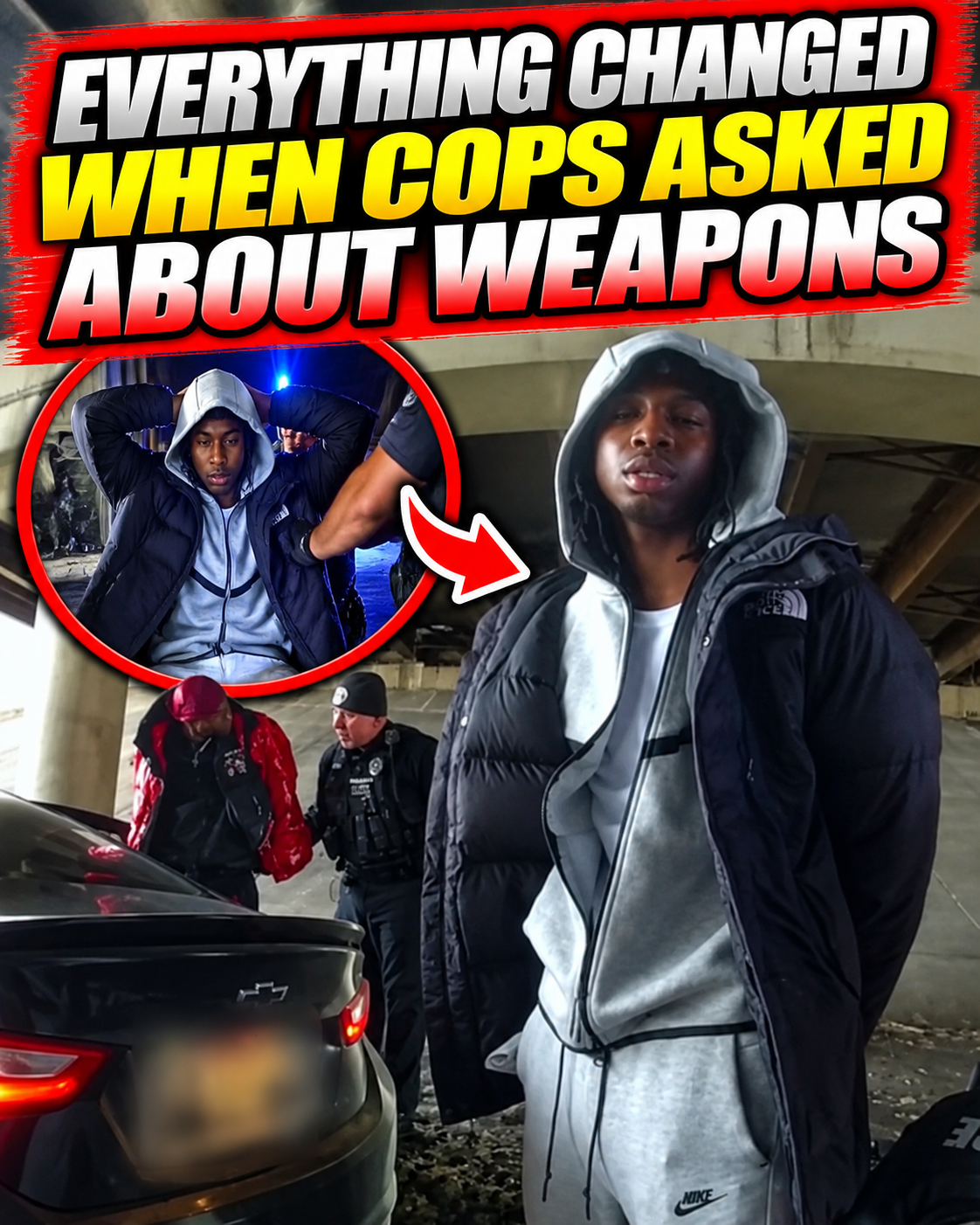
Her Fake ID Celebration Falls Apart When Cops Show Up
The Night I Realized the Fake ID Wasn’t Really the Story
The first thing I remember is the security guard pointing toward the entrance and telling us that the woman had been trying to get into the bar with a fake ID. It was April 5, 2025, and the downtown square was still full of people, music, and the usual weekend noise. From a distance, it looked like the kind of call that should have been over in a few minutes. A young woman trying to get into a bar before she was legally old enough, a fake identification card, a little attitude when police arrived. Annoying, maybe. Serious, certainly, but not the kind of situation anyone expected to become memorable. Then she started walking away after an officer told her to stop, and suddenly the tone changed. We told her she was making things worse for herself, that possessing and attempting to use a fraudulent ID could lead to serious charges, and that she needed to give us her real identification. She argued that she wasn't resisting. We explained that continuing to walk after being told to stop was itself becoming an issue. She kept talking over us, and for a few moments it felt like we were having two completely different conversations.
Then she said something that changed the entire way I heard her voice. She told us she didn't like cops because cops had killed her father. I remember pausing, because there is a difference between hearing someone say, "I don't like police," and hearing them tell you exactly why. Suddenly, the crying, the anger, the refusal to cooperate, even the way she kept asking whether this was really such a big deal, seemed to have another layer underneath it. I didn't know what had happened to her father. I didn't know the circumstances, and I wasn't going to invent an explanation just because she was standing in front of me crying. But I remember thinking that the fake ID was probably the smallest part of what was happening to her emotionally that night. She was looking at us through whatever memory she carried with her, and we were looking at her through the facts of what had happened in front of us.
She kept insisting that she was about to turn twenty-one, that she was tired, that she wasn't intoxicated, and that she didn't understand why everyone was treating the situation like it was so serious. We tried to explain that the circumstances had already gone beyond simply being refused entry to a bar. There was the fake identification, the attempt to use it, and the fact that she had ignored an officer's instruction to stop. We gave her an opportunity to provide her real ID so we could run her information and determine what happened next. Instead, she continued arguing. At one point, she started offering money, almost as if she believed there had to be some way to make the entire thing disappear. She begged. She asked if she could make a phone call. She said she would cooperate. Then, almost immediately, she would pull away again or refuse another instruction. Watching it unfold, I realized how quickly a person can become trapped inside a situation that began with one bad decision.
Eventually, we placed her in the back of the patrol vehicle. Even then, the incident wasn't finished. She kept trying to talk, kicking against the vehicle, moving her legs toward the opening, and asking us to listen to her explanation. We repeatedly told her that we had already given her chances to explain herself and that she needed to remain calm. She found her real ID, but by that point the circumstances had moved beyond simply checking who she was. One of the officers explained that if she continued kicking the vehicle, restraints would be used to prevent her from damaging herself or the car. She kept asking to speak with someone. We told her that she could talk once she reached the jail and that she could make a phone call after being processed. For her, eight minutes probably felt like an eternity. For us, it was the remaining distance between a chaotic scene and a place where the situation could finally be handled.
I remember hearing her say she couldn't do this, that she was begging us, and that she just wanted someone to talk to her. Those words stayed with me because they didn't sound like the same person who had been arguing with us a few minutes earlier. The anger was still there, but underneath it was fear. And fear doesn't always look like fear. Sometimes it looks like arguing. Sometimes it looks like refusing to listen. Sometimes it looks like challenging every instruction because, somewhere inside your head, you're no longer reacting only to what is happening right now. You're reacting to everything that happened before. I didn't know whether that was exactly what was happening with her. But after she mentioned her father, I couldn't completely ignore the possibility.
The supervisor eventually made it clear that there was one final opportunity to cooperate. If she stopped kicking and remained calm, she would be transported normally and could make the calls she wanted once she arrived. If she continued fighting against the vehicle, additional restraints could be used. She finally acknowledged that she understood. The atmosphere changed slowly. There was no dramatic transformation, no sudden apology that erased everything that had happened. Just a gradual realization that the argument was over and that she was going to jail. A few minutes later, she was being transported, still asking questions and still wanting to talk. The officers reassured her that she would be able to contact whoever she needed once she arrived.
Later, when I thought back on the incident, I kept returning to one sentence: "My guy was killed by cops." That was the detail I couldn't put away with the rest of the report. The fake ID was easy to understand. The resistance was easy to document. The kicking, the arguing, the refusal to provide identification—those were all visible. They were things a camera could capture and an incident report could describe. But the sentence about her father was different. A body camera could record the words, but it couldn't record what those words meant to her. It couldn't show us the history behind them. And I think that's something people forget when they watch footage like this later. They see a young woman crying and arguing with police over a fake ID, and it is easy to reduce the entire night to that one mistake.
But people rarely arrive at moments like that carrying only the thing that happened five minutes earlier.
She made a choice that night. Using a fake ID was her responsibility. Walking away after being told to stop was another decision she had to own. Once officers were involved, she also had a responsibility to follow lawful instructions and avoid making the situation more dangerous. Her personal history didn't erase those facts. But those facts didn't erase her history either. Both things could be true at the same time: she could be responsible for her actions, and she could also be carrying grief, anger, or fear that had nothing to do with the bar where we found her.
That's what I remember most. Not the handcuffs. Not the fake identification. Not even the argument. I remember a young woman who thought the worst thing happening to her that night was getting arrested, while somewhere underneath that anger she was still talking about the father she had lost. Maybe that loss explained why she reacted the way she did. Maybe it didn't. We couldn't know from a few minutes of body-camera footage. But it reminded me that police encounters are almost never the whole story of a person. We see the moment. We don't always see what came before it.
And sometimes the most important thing a person says isn't the reason they're standing in front of you. It's the reason they can't stop crying while they're there.
Comments (0)
Loading comments...
May You Like
🚨🚗 One Mistake Changes Everything During a DUI Arrest | Bodycam Footage US
Her Dad Is a Lawyer — Then He Shows Up After Her Arrest | Bodycam US