
He Crashed Into Her Squad Car… Then Made the ULTIMATE Mistake
Driver Rear-Ends a West Allis Police Squad, Then Tries to Walk Away
A West Allis police officer was sitting at a red light on an ordinary Sunday evening when her shift changed in an instant. At approximately 5:30 p.m. on November 2, 2025, a Ram 1500 pickup struck the back of her marked squad car at the intersection of South 68th Street and West Becher Street in West Allis, Wisconsin.
The collision alone would have required an investigation. What happened immediately afterward made the encounter far more unusual.
According to police and the criminal complaint later summarized by Milwaukee-area news outlets, the pickup driver, 38-year-old Victoriano Antonio Rivera, got out of his truck and approached the officer. She repeatedly ordered him to stop and get on the ground. Instead of complying, Rivera moved away and eventually headed back toward his vehicle. A bystander reportedly tried to stop him as well.
The officer then deployed her Taser.
Within seconds, the attempted departure was over and Rivera was on the ground being taken into custody.
Investigators said Rivera showed obvious signs of intoxication. Officers described a strong odor of alcohol, slurred speech, swaying and vomiting. According to the complaint, Rivera later told paramedics that he had consumed six or seven beers and estimated that he had been traveling between 20 and 30 mph when he struck the police vehicle.
The case ultimately produced charges of operating while intoxicated and misdemeanor obstructing an officer. Court records reported by FOX6 Milwaukee showed that Rivera had two previous OWI convictions, from 2014 and 2017, as well as an open 2021 OWI case. The November incident was initially described by West Allis police as an arrest for a third OWI offense, while later reporting explained that prosecutors were treating the new allegation in the context of that prior history.
The supplied body-camera video matches those reports closely. Its AXON overlays show November 2, 2025, beginning around 5:29 p.m. The street layout, illuminated businesses and intersection match the reported location at 68th and Becher. The video then moves from the crash itself to the officer's rapid effort to stop the driver from leaving.
It is a short incident, but it offers an unusually clear example of how quickly a routine traffic signal can become a crash scene, an attempted flight and an OWI investigation.
A Normal Red Light Becomes a Crash Scene
The incident begins without any pursuit, traffic stop or confrontation.
The officer is simply driving through West Allis. The squad camera shows nighttime traffic and storefronts along Becher Street. The marked police vehicle approaches the intersection and stops for the signal.
A white vehicle is ahead. Streetlights and decorative lights illuminate the commercial corridor.
Nothing visible suggests that an arrest is seconds away.
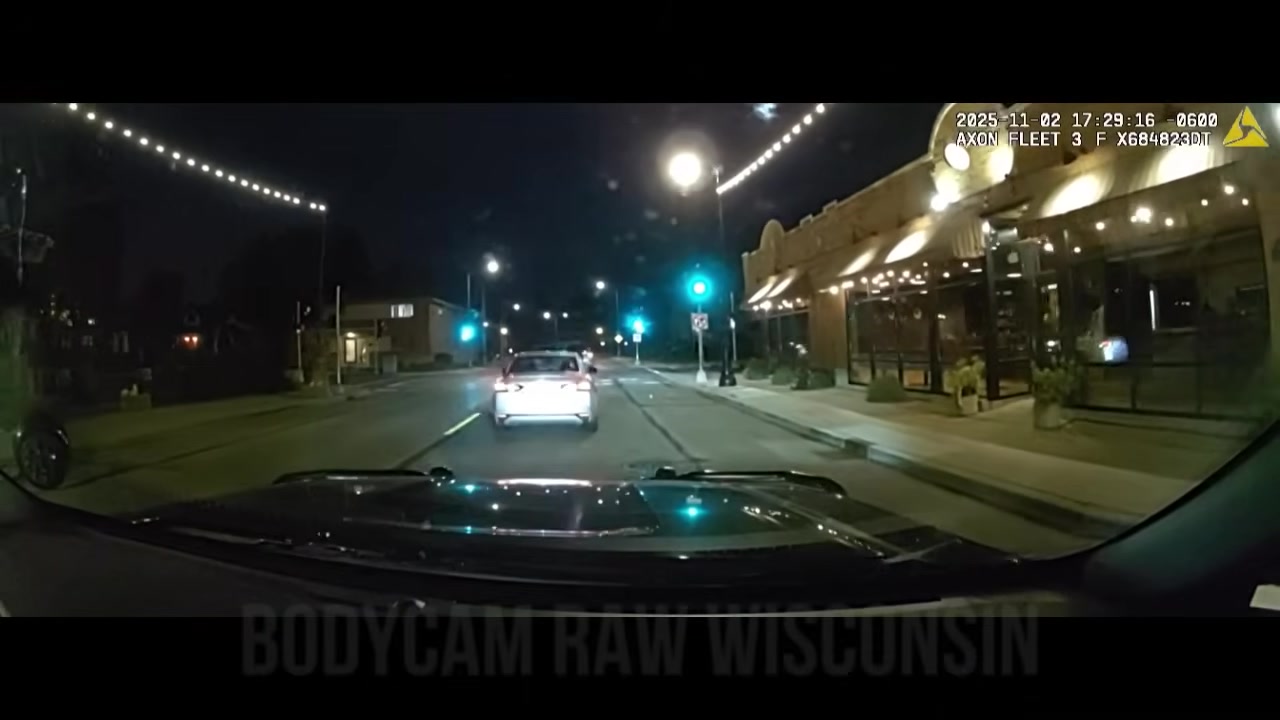
Then the officer's vehicle is struck from behind.
For any driver, being rear-ended while stationary can be disorienting. For an officer, the first task is not necessarily to assume criminal intent. The collision could have resulted from distraction, mechanical failure, a medical emergency or simple driver error.
The officer has to assess what happened while also checking the condition of the other driver and securing a busy intersection.
But the behavior that follows quickly gives the crash a different character.
The Pickup Driver Gets Out
Police identified the pickup driver as Victoriano Antonio Rivera, 38, of West Allis.
According to the criminal complaint described by WISN and FOX6, Rivera exited his Ram 1500 after striking the squad.
He then approached the officer.
The officer issued commands for him to stop and get on the ground.
The body-camera footage shows how quickly an officer has to establish control after a collision. The officer has just experienced an impact, stepped out of the squad and is now dealing with a driver who is moving instead of remaining beside his vehicle.
At this point, the officer does not yet have the benefit of a completed OWI investigation. She is reacting to behavior occurring directly in front of her.
Commands are repeated.
Rivera does not simply remain where he is.
A Bystander Tries to Help
One of the more unusual details in the criminal complaint is the role of a nearby bystander.
FOX6 reported that a person across the street attempted to get Rivera to stop as the situation unfolded.
That detail illustrates how public the encounter was. This was not an isolated roadside stop on an empty highway. It happened at a lit urban intersection surrounded by businesses and other people.
For officers, bystanders can complicate a rapidly developing arrest. A well-intentioned person may try to help without knowing whether the suspect is armed or how police plan to take control.
In this case, the civilian's effort did not end the situation.
Rivera continued moving and eventually headed back toward his truck.
The Officer Makes a Split-Second Decision
The officer now faced a practical problem.
The man whose truck had just hit her squad was ignoring commands and moving back toward the vehicle.
Allowing him to reenter the pickup could have restarted the danger immediately. A driver could leave the scene, create a pursuit or use the vehicle itself to threaten people nearby.
The officer chose a less-lethal option.
She deployed her Taser.
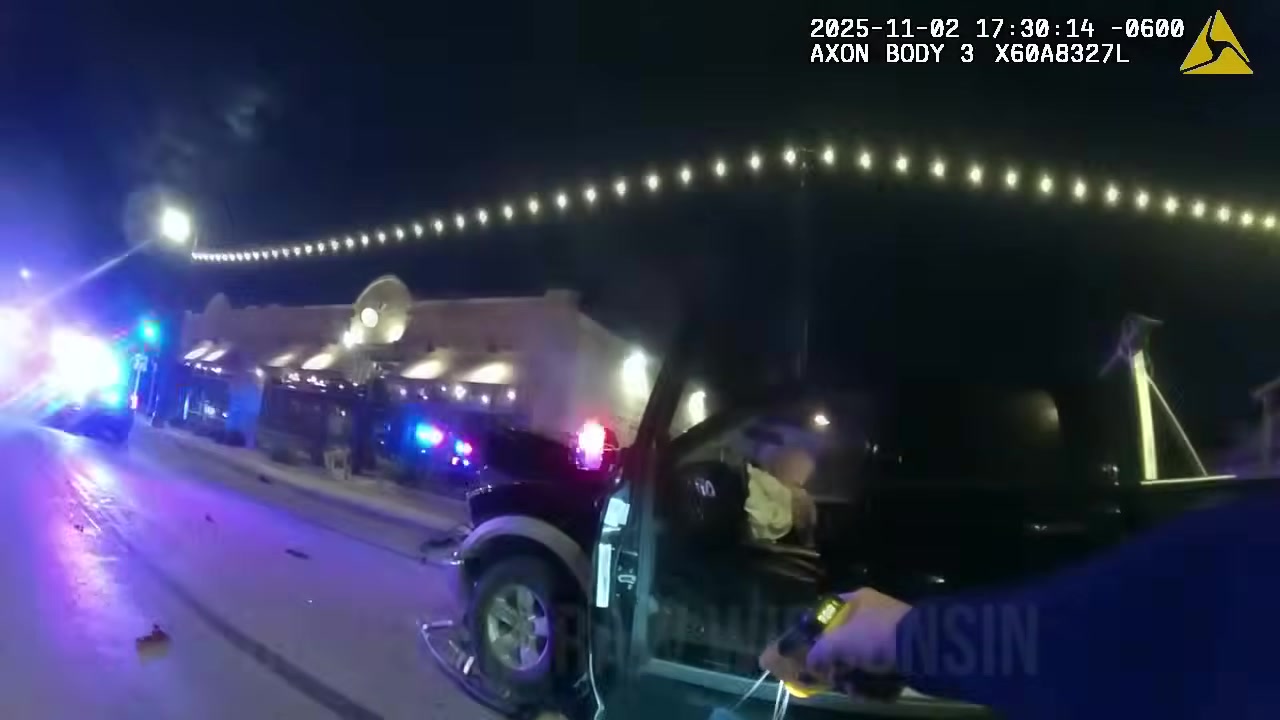
The video shows the confrontation ending quickly after the deployment. Rivera is brought to the ground and officers move in to take him into custody.
The title attached to the supplied video describes the officer as ending the situation “instantly.” That wording is dramatic, but the underlying point is visible: the attempted departure does not develop into a prolonged foot chase or vehicle pursuit.
The officer's intervention keeps the incident concentrated around the original crash scene.
Signs of Intoxication Become Apparent
Once Rivera was detained, the investigation shifted from immediate control to determining why the crash occurred.
Officers reported several signs they associated with alcohol impairment.
According to WISN's summary of the criminal complaint, officers said Rivera had a strong odor of alcohol and slurred speech. He was also described as swaying back and forth and vomiting.
FOX6 reported that police considered him too intoxicated to perform field sobriety tests.
Those observations matter because a rear-end collision by itself does not prove impairment. Investigators build an OWI case from the totality of evidence: driving behavior, physical observations, statements, field testing when possible, and chemical testing or medical evidence where applicable.
Here, police had the collision itself, Rivera's post-crash behavior and the physical signs officers documented.
Rivera Allegedly Says He Had Six or Seven Beers
The criminal complaint contained another significant detail.
During the trip to the hospital, an officer reportedly overheard Rivera speaking with paramedics.
Rivera allegedly said he had consumed six or seven beers.
He also estimated that he was traveling approximately 20 to 30 mph when the crash occurred.
Those statements were later included in media reporting about the charges.
They should be understood as allegations contained in the complaint rather than a final judicial finding. Rivera, like any criminal defendant, was entitled to the presumption of innocence unless and until guilt was established through the legal process.
Still, the statements provide context for why police moved from a crash investigation to an OWI arrest.
The Officer Was Stopped When the Impact Occurred
One detail is consistent across the major local reports: the squad car was stopped at a red light.
That matters when reconstructing responsibility for the initial collision.
The officer was not pursuing Rivera and did not suddenly brake during a traffic stop. The marked police vehicle was stationary at the intersection when the Ram struck it from behind.
The video reinforces that sequence.
The crash therefore begins as one of the most familiar forms of traffic collision, a rear-end impact at a signal, before the driver's behavior transforms the event into an arrest.
Why Walking Back Toward the Truck Raised the Stakes
From a distance, a person walking toward a vehicle can look less dramatic than someone sprinting away.
For an officer, however, direction matters more than speed.
If a noncompliant driver reaches the driver's seat, the officer may lose control of the encounter entirely.
A pickup truck can leave quickly. It can enter traffic, strike pedestrians or other cars, or initiate a pursuit through city streets.
The officer also cannot know what is inside the vehicle.
That is why commands to stop and remain away from the vehicle carry tactical importance even when the person is not visibly running.
The Taser deployment prevented Rivera from getting back into the truck, according to the sequence described in the complaint and visible in the footage.
The Case Moves From the Street to the Hospital
After Rivera was taken into custody, he was transported for medical evaluation.
FOX6 reported that he was treated for whiplash and muscle strains resulting from the collision.
Medical treatment after a crash and a Taser deployment is an important part of the process. Officers may have established probable cause for an arrest, but injuries still require evaluation.
The trip to the hospital also became relevant to the criminal case because of the statements Rivera allegedly made to paramedics about drinking and his speed before the crash.
West Allis Police Initially Announce a Third OWI Arrest
On the night of November 2, West Allis police publicly said the driver had been arrested for operating while under the influence, third offense.
FOX6 published the initial account that evening.
The early police summary was concise: a squad car stopped at a red light had been rear-ended by a pickup; the driver attempted to flee; an officer deployed a Taser; and the man was arrested for a third OWI offense.
That first report established the basic timeline but did not include the later details from the criminal complaint.
Those details emerged as prosecutors reviewed the case.
Prosecutors File Charges
By November 7 and 8, Milwaukee-area outlets were reporting that prosecutors had formally charged Rivera.
WISN identified him as Victoriano Antonio Rivera and reported that he faced an OWI charge following the squad-car collision.
FOX6 later reported charges of operating while intoxicated and misdemeanor obstructing an officer.
The charging documents added details about his alleged condition after the crash and his statements during transport.
The case also revealed a more complicated prior OWI history than the earliest headline suggested.
A History of OWI Cases
According to FOX6's review of court records, Rivera had two prior OWI convictions, one in 2014 and another in 2017.
He also had an open OWI case dating from 2021.
FOX6 therefore described the November 2025 case as the fourth time he had been charged with OWI in roughly eleven years, while the West Allis Police Department's initial statement characterized the new arrest as a third offense.
The distinction between an arrest, a charge, an open case and a conviction matters.
A previous conviction is a completed legal outcome. An open case remains unresolved. The current case was also an allegation at the time of the reporting.
Rather than collapsing all of those categories into a single number, the safest description is that Rivera had two reported prior OWI convictions, an unresolved 2021 OWI case, and the new November 2025 allegation.
A $10,000 Cash Bond
FOX6 reported that Rivera appeared in court on November 8.
A judge set a $10,000 cash bond.
Conditions included remaining sober and not driving.
Those conditions directly addressed the conduct alleged in the case.
Bond is not punishment and does not establish guilt. Its purpose is to manage release conditions while the case proceeds through court.
Still, the amount and restrictions indicate that the court was treating the allegations seriously.
The Body Camera Adds What the Complaint Cannot
A criminal complaint can describe commands, movements and the use of a Taser in precise legal language.
Body-camera footage adds timing.
The viewer sees how little time separates the impact from the officer's attempt to take control.
It also shows the environment: traffic lights, storefronts, passing vehicles, flashing emergency lights and people nearby.
Those details help explain why the officer could not simply allow the driver to wander away while deciding what to do next.
The scene was active and public.
The Dash Camera Shows the Ordinary Moment Before the Crash
The most effective part of the footage may be the quiet opening.
There is no warning soundtrack in real life.
The squad moves along Becher Street like any other vehicle. The light ahead is green in one portion of the footage. Traffic is light. Businesses are illuminated.
The timestamp advances normally.
Then the impact happens.
This contrast is what makes many body-camera incidents compelling without exaggeration. The viewer experiences the same lack of warning that the officer did.
A Rear-End Collision Can Be More Than a Minor Crash
Rear-end crashes are common, and many result only in property damage.
But the circumstances surrounding a collision determine its significance.
If the striking driver appears intoxicated, tries to leave, refuses commands and attempts to return to the vehicle, the situation moves far beyond exchanging insurance information.
Police have to address the immediate possibility that the driver will continue operating the vehicle while impaired.
That concern was especially important here because Rivera had just struck a stationary marked squad car.
The Taser Prevented a Longer Chase
One of the clearest turning points is the officer's decision to use the Taser.
If Rivera had reached the Ram and driven away, West Allis officers might have faced a vehicle pursuit through city streets.
If he had continued on foot, officers might have needed to chase him through the surrounding commercial and residential blocks.
Neither happened.
The Taser deployment brought the attempted escape to an end near the original collision.
That kept the investigation geographically contained and reduced the opportunity for additional traffic danger.
Why Less-Lethal Tools Matter in Encounters Like This
A Taser is still a use of force and carries risks. It is not harmless.
But it gives officers an option between hands-on physical control and higher levels of force when a person refuses commands and attempts to flee.
In this case, the officer was dealing with a man who was moving back toward a vehicle after a collision.
The tool allowed her to interrupt that movement from a short distance.
The subsequent arrest occurred without the encounter escalating into a more dangerous vehicle confrontation.
The Intersection Is a Familiar West Allis Landmark
The intersection of 68th and Becher is part of a well-developed neighborhood commercial corridor.
Local businesses sit close to the roadway, and the area regularly carries vehicle and pedestrian traffic.
That setting is visible throughout the footage.
The crash was not occurring on an empty rural road where officers could allow a situation to develop with little concern about surrounding traffic.
Every additional movement by an allegedly impaired driver created potential risk for other road users.
The Case Is a Useful Example of Evidence Building in Real Time
The OWI allegation was not based on a single fact.
Police began with the crash.
Then came Rivera's behavior after the collision.
Officers documented the smell of alcohol, slurred speech, instability and vomiting.
They concluded he was too impaired for field sobriety tests.
During transport, he allegedly described how much he had consumed.
Prosecutors then combined those facts with his prior driving record when deciding what charges to file.
That layered process is how many impaired-driving cases develop.
What the Video Does Not Prove by Itself
Video is powerful evidence, but it should not be treated as a substitute for the entire court record.
The footage can show the collision, the driver's movements and the officer's response.
It cannot independently establish a precise blood-alcohol concentration unless that information is documented elsewhere.
It cannot turn an allegation into a conviction.
And it cannot tell the viewer the complete history of previous cases.
That is why the video is most useful when paired with the criminal complaint and reliable local reporting.
The Story Has a Simple but Effective Narrative Arc
From a storytelling perspective, the incident holds attention because the escalation is immediate and easy to understand.
An officer stops at a red light.
Her squad is struck from behind.
The driver gets out.
He does not follow commands.
He moves back toward the truck.
The officer deploys a Taser.
Then the investigation reveals signs of suspected intoxication and a prior OWI history.
Each development answers one question while creating another.
Why did the truck hit the squad?
Why is the driver refusing to stop?
Why is he going back toward the vehicle?
What will officers find once he is detained?
That progression keeps a reader engaged without needing invented details or exaggerated claims.
The Officer's Fast Response Becomes the Defining Moment
The original video title focuses on how quickly the officer ends the attempted escape.
That is the visually memorable part of the footage.
But the larger significance is that her response prevents the scene from expanding.
One crash could have become a foot pursuit.
It could have become a second vehicle pursuit.
It could have put an allegedly impaired driver back into moving traffic.
Instead, the arrest occurs at the scene.
The Legal Process Continues After the Viral Moment
Online videos often end when the handcuffs go on.
The justice process does not.
After Rivera's arrest came medical evaluation, police reports, prosecutor review, formal charges and a bond hearing.
Prior cases also became relevant to how the new allegation was categorized.
Those later steps are less dramatic than the Taser deployment but are necessary for understanding what the arrest actually meant.
What Is Confirmed
The most reliable public reporting establishes the core sequence.
At about 5:30 p.m. on November 2, 2025, a marked West Allis police squad was stopped at a red light at 68th and Becher streets.
A Ram 1500 driven by Victoriano Antonio Rivera struck the squad from behind.
Rivera exited the truck and did not comply with commands to stop and get on the ground.
He moved back toward the vehicle.
An officer deployed a Taser and Rivera was taken into custody.
Police reported signs of alcohol impairment.
Rivera allegedly told paramedics he had consumed six or seven beers.
He was charged with OWI and misdemeanor obstructing an officer.
FOX6 reported two previous OWI convictions and an open 2021 OWI case.
A court later set a $10,000 cash bond with conditions that he remain sober and not drive.
A Traffic Light, a Crash and a Very Short Attempt to Leave
There is no lengthy pursuit in this case.
That is precisely what makes the footage distinctive.
The entire confrontation develops around a single intersection.
The officer is hit while stopped.
She gets out.
The driver refuses to remain where she directs him.
He tries to move back toward the truck.
Then the officer ends the attempt before it can turn into something larger.
The result is an incident measured in seconds on camera but followed by days of investigation and court proceedings.
Watch the Full Incident
The full body-camera and squad-camera footage provides the clearest view of how an ordinary red-light stop turned into a collision and an immediate arrest attempt at one of West Allis's busy neighborhood intersections.
Comments (0)
Loading comments...
May You Like

Chrysler 300 Gapped Cops at 150+ MPH | Police Dashcam

A Late-Night Escape Attempt Ends With Officers Making an Arrest

I CAN’T WALK! — BODYCAM PROVES OTHERWISE DURING ARREST












